Credit seminar on
Haldiram-A success story in Family
business
DEPARTMENT OF AGRICULTURAL ECONOMICSAND FARM MANAGEMENT
SEMINAR INCHARGE: PRESENTED BY:
Dr. A. Shrivastava Anu Sarah Daniel
College of Agriculture, M.B.A. (Ag.) Final year
Jabalpur 3rd Semester(2009)
Introduction
• Family businesses are prevalent all over the world.
• Impact on economy vary depending on the strategies.
• Between 65 and 80 per cent of the businesses in the world are estimated to be family
firms (Flören, 1998).
• Since liberalization in 1991, Family businesses started facing competition from Global
Giants.
• Thus, studying the strategies of Family business like Halidram (Since 1941) which have
survived , will provide a good premise for future studies
History
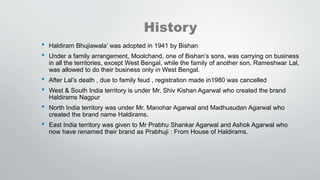
• Haldiram Bhujiawala’ was adopted in 1941 by Bishan
• Under a family arrangement, Moolchand, one of Bishan’s sons, was carrying on business
in all the territories, except West Bengal, while the family of another son, Rameshwar Lal,
was allowed to do their business only in West Bengal.
• After Lal’s death , due to family feud , registration made in1980 was cancelled
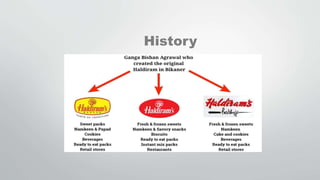
• West & South India territory is under Mr. Shiv Kishan Agarwal who created the brand
Haldirams Nagpur
• North India territory was under Mr. Manohar Agarwal and Madhusudan Agarwal who
created the brand name Haldirams.
• East India territory was given to Mr Prabhu Shankar Agarwal and Ashok Agarwal who
now have renamed their brand as Prabhuji : From House of Haldirams.
History
SWOT
Strengths
• Brand awareness and recall
• Product Line- namkeens, papads, chips, cookies, sweets, dry fruits, sherbets
• Trusted for quality and hygiene
• Attractive packaging
• Supply chain
• Appropriately priced for the customers
• Taste
• Global Presence
SWOT
Weakness
• Branding and Advertising
• Outlets are confined mainly to north India
SWOT
Opportunities
• Reaching more people
• Enlarging the hotel business
• Introducing people with healthy, fat-free, low calories snakes that are baked
SWOT
Threats
• Increasing Western Taste
• Bad Reputation
• Increased challenges from other brands
Marketing strategies
• Haldirams focuses more on the point of purchase advertising and uses special racks for
its products in the retail shops.
• The manufacturing was split between three manufacturing facilities at Delhi, Kolkata and
Nagpur.
• They keep prices slightly lower than other branded competitors like Bikaji, Lehar, Bikano
• Haldirams has come up with small one-time consumption packages priced at Rs 10
(40gms) to Rs 210 (1kg)
Conclusion
• Keep the lines of communication open
• Assign clear roles and responsibilities
• Keep good financial data
• Avoid overpaying family members
• Don’t hire relatives if they’re unqualified
• Keep up with market and innovate the product range
Appreciations
• Haldirams is the second largest Indian food brand after Parle
• India's Most Trusted Brand (2003)Increased challenges from other brands
• Recognized as a Star Export House by the Directorate General of Foreign Trade, a
department of Government of India.
• It is a member of various international food associations like Snack Food Association,
Virginia(USA), European Snack Association, London (UK) and International Association
Of Amusement Park Attractions in Alexandria (USA).
References
• Flören, R. H. (1998). The significance of family business in the Netherlands. Family
Business Review, 11(2), 121–134.
• https://www.drnishikantjha.com/papersCollection/Bhujia%20Barons_%20The%20Untold
%20Story%20.pdf
• https://www.haldirams.com/
• https://en.wikipedia.org/wiki/Haldiram%27s

Haldiram

  • 1.
    Credit seminar on Haldiram-Asuccess story in Family business DEPARTMENT OF AGRICULTURAL ECONOMICSAND FARM MANAGEMENT SEMINAR INCHARGE: PRESENTED BY: Dr. A. Shrivastava Anu Sarah Daniel College of Agriculture, M.B.A. (Ag.) Final year Jabalpur 3rd Semester(2009)
  • 2.
    Introduction • Family businessesare prevalent all over the world. • Impact on economy vary depending on the strategies. • Between 65 and 80 per cent of the businesses in the world are estimated to be family firms (Flören, 1998). • Since liberalization in 1991, Family businesses started facing competition from Global Giants. • Thus, studying the strategies of Family business like Halidram (Since 1941) which have survived , will provide a good premise for future studies
  • 3.
    History • Haldiram Bhujiawala’was adopted in 1941 by Bishan • Under a family arrangement, Moolchand, one of Bishan’s sons, was carrying on business in all the territories, except West Bengal, while the family of another son, Rameshwar Lal, was allowed to do their business only in West Bengal. • After Lal’s death , due to family feud , registration made in1980 was cancelled • West & South India territory is under Mr. Shiv Kishan Agarwal who created the brand Haldirams Nagpur • North India territory was under Mr. Manohar Agarwal and Madhusudan Agarwal who created the brand name Haldirams. • East India territory was given to Mr Prabhu Shankar Agarwal and Ashok Agarwal who now have renamed their brand as Prabhuji : From House of Haldirams.
  • 4.
  • 5.
    SWOT Strengths • Brand awarenessand recall • Product Line- namkeens, papads, chips, cookies, sweets, dry fruits, sherbets • Trusted for quality and hygiene • Attractive packaging • Supply chain • Appropriately priced for the customers • Taste • Global Presence
  • 6.
    SWOT Weakness • Branding andAdvertising • Outlets are confined mainly to north India
  • 7.
    SWOT Opportunities • Reaching morepeople • Enlarging the hotel business • Introducing people with healthy, fat-free, low calories snakes that are baked
  • 8.
    SWOT Threats • Increasing WesternTaste • Bad Reputation • Increased challenges from other brands
  • 9.
    Marketing strategies • Haldiramsfocuses more on the point of purchase advertising and uses special racks for its products in the retail shops. • The manufacturing was split between three manufacturing facilities at Delhi, Kolkata and Nagpur. • They keep prices slightly lower than other branded competitors like Bikaji, Lehar, Bikano • Haldirams has come up with small one-time consumption packages priced at Rs 10 (40gms) to Rs 210 (1kg)
  • 10.
    Conclusion • Keep thelines of communication open • Assign clear roles and responsibilities • Keep good financial data • Avoid overpaying family members • Don’t hire relatives if they’re unqualified • Keep up with market and innovate the product range
  • 11.
    Appreciations • Haldirams isthe second largest Indian food brand after Parle • India's Most Trusted Brand (2003)Increased challenges from other brands • Recognized as a Star Export House by the Directorate General of Foreign Trade, a department of Government of India. • It is a member of various international food associations like Snack Food Association, Virginia(USA), European Snack Association, London (UK) and International Association Of Amusement Park Attractions in Alexandria (USA).
  • 12.
    References • Flören, R.H. (1998). The significance of family business in the Netherlands. Family Business Review, 11(2), 121–134. • https://www.drnishikantjha.com/papersCollection/Bhujia%20Barons_%20The%20Untold %20Story%20.pdf • https://www.haldirams.com/ • https://en.wikipedia.org/wiki/Haldiram%27s