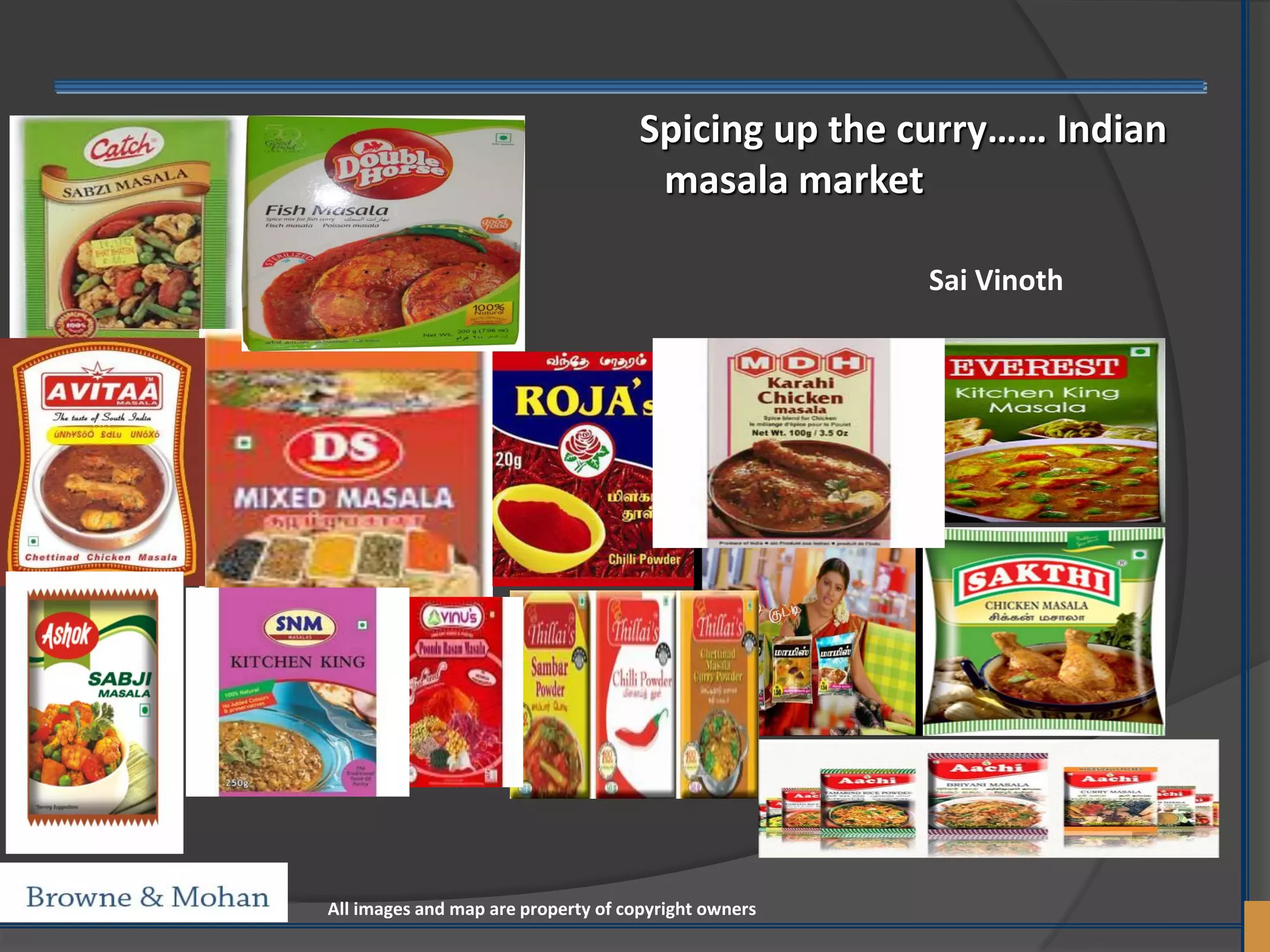
Spicing up the curry…… Indian
masala market
Sai Vinoth
All images and map are property of copyright owners
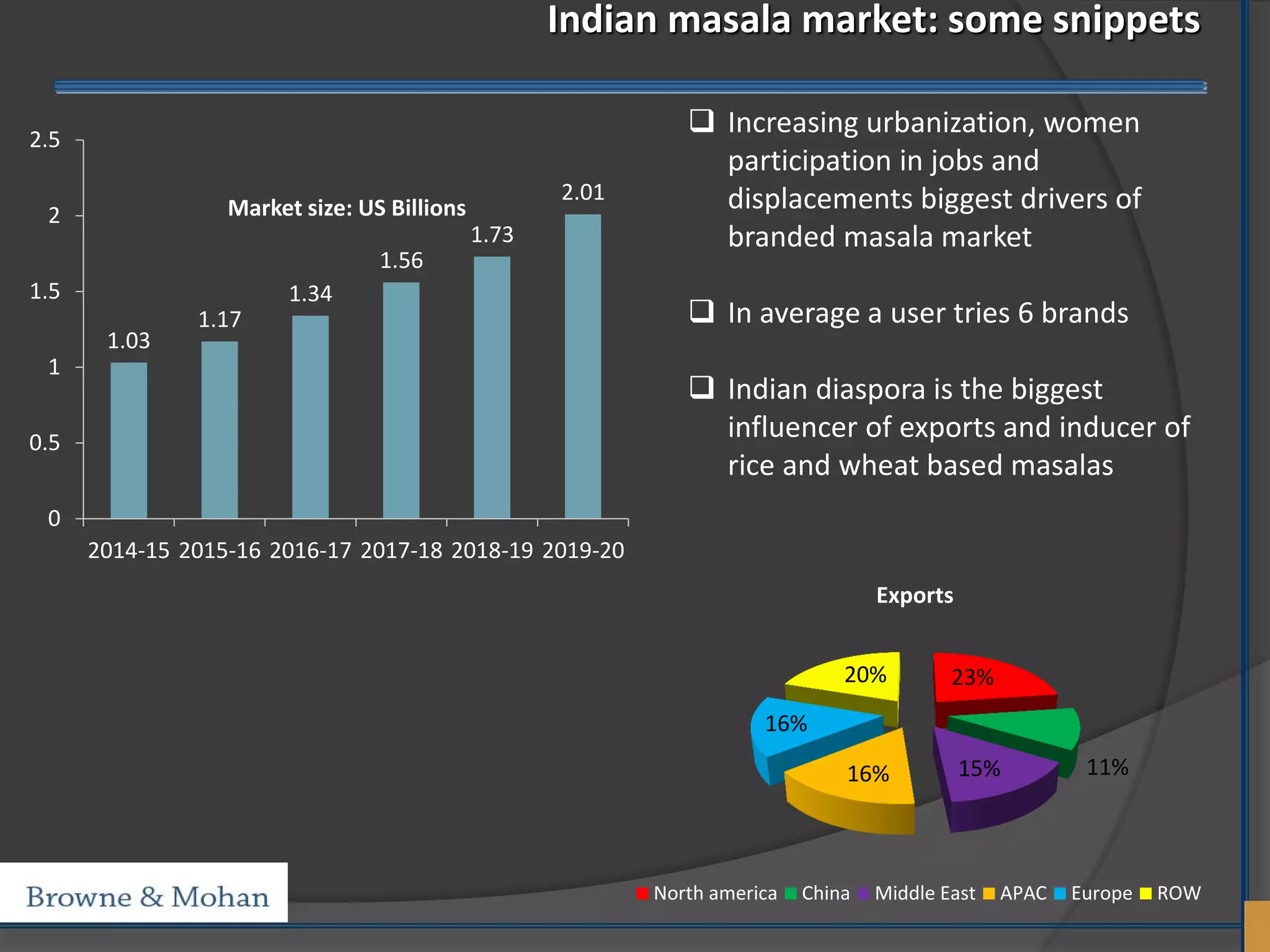
1.03
1.17
1.34
1.56
1.73
2.01
0
0.5
1
1.5
2
2.5
2014-15 2015-16 2016-17 2017-18 2018-19 2019-20
Market size: US Billions
23%
11%15%16%
16%
20%
Exports
North america China Middle East APAC Europe ROW
Indian masala market: some snippets
 Increasing urbanization, women
participation in jobs and
displacements biggest drivers of
branded masala market
 In average a user tries 6 brands
 Indian diaspora is the biggest
influencer of exports and inducer of
rice and wheat based masalas
Indian masala market: some snippets
 National brands, regional players, local players and in-store brands compete the
market
 1235 brands, 76% one district brands, 18% multi-district brands, majority are SME
 Most self funded, most commonly used growth strategy is start with Straight
masala and move to blended
 Contiguous markets expansion across states borders most effective
 Top 3 national players combined have 15% of the market
 Purity, Flavor, Aroma, and consistency are commonly used positioning props
 In-store brands highest in straight masalas like turmeric, Chilli and Coriander
 Qatar, UK, Bangladesh, Eastern Europe and Africa emerging exports growth zones
 Dry masala growth higher than pastes
Very High spice consuming state High spice consuming state
States with highest consumption of masala
0.2
0.2
0.1
0.3
0.2
Plant Material Manpower Marketing & administration Finance & distribution cost
Measures Industry averages of best performing companies
Operating profit 10-12%
Trade Receivables 10-11%
Inventory 13-16%
Cost structure and margins of a typical masala player
1. Sticking to roots and tradition: followed by companies like MTR and
Bramhins Group, focusing only on blended vegetarian
2. Passive diversification from vegetarian to Non-vegetarian: pursued by
companies like Everest surreptitiously driving non-vegetarian masala
3. Preserve order, Create legitimate arm for innovation: pursued by
companies lik MDH while retaining the current market positioning, create
another unit to try out ethnic or exotic options
4. Expand ethnic to go national: followed by companies like Mothers,
Double Horse and Eastern to try out regional requirements like
Puliyogare, Malabar fish masala or UP flavors.
5. Exotic to retain unique positioning: offer Thai, Mexican and Middle
Eastern flavors as pursued by Spring.
Typical expansion strategies
Effective Distribution channels strategies
While traditional channels are required for reach and efficiency, companies
like Aaachi, Maami Masala and others are finding value from engaging with
1. SHG for tier 3 cities and rural population growth. Effective in minimizing
trade receivables risk and high +ve WOM
2. Model franchise stores, one stop shop to provide total customer
experience and seek out new product offerings
3. Online distributors reach out to time pressed customers both in India and
abroad. Metros, Tier 2 India and International market entry
4. Community platforms for displaced son of soil brands, effectively used by
Konkan, Bengal and Maharastrian brands through community stores.
Marketing assets and branding strategies
Rank Most effective marketing asset
1 TV
2 Women magazines
3 Foodie Blogs
4 Newspaper
5 Community events
6 Banners and fliers in eateries
Rank Sources of Influences
1 Home maker or working women
2 Children
3 Students
Product diversification strategies that work
Rank Diversification that work Reason
1 Pickles High economies of scope
2 Ready to cook High EOS and scope
3 Papad &
accompanishments
Distribution economies, outsourcing
advantages
4 Ghee Branding, 3rd party advantages
5 Rice Wheat products Customer segment stickiness
Rank Diversification tough to work
1 Soups
2 Tea & Biscuits
3 Juices
Scaling up challenges
Whether a national player or a regional players the scaling up challenges
remain common. The major challenges are:
Rank Scaling up challenges
1 Managing Growth
2 Product Variety & optimizing margins
3 Cash flow and credit
4 Family succession and management
5 Imports and foreign brands, especially in Non-vegetarian
masalas and exotic masalas
11
Thank You
For any queries, please contact :
157/A, II floor, 10th A Main
Jayanagar, 1st Block
Bangalore. 560011
PH: 91-80-2656 5164, 40951170
marcom@browneandmohan.com

Spicing up your curry.....Indian market masala market insghts....

  • 1.
    Spicing up thecurry…… Indian masala market Sai Vinoth All images and map are property of copyright owners
  • 2.
    1.03 1.17 1.34 1.56 1.73 2.01 0 0.5 1 1.5 2 2.5 2014-15 2015-16 2016-172017-18 2018-19 2019-20 Market size: US Billions 23% 11%15%16% 16% 20% Exports North america China Middle East APAC Europe ROW Indian masala market: some snippets  Increasing urbanization, women participation in jobs and displacements biggest drivers of branded masala market  In average a user tries 6 brands  Indian diaspora is the biggest influencer of exports and inducer of rice and wheat based masalas
  • 3.
    Indian masala market:some snippets  National brands, regional players, local players and in-store brands compete the market  1235 brands, 76% one district brands, 18% multi-district brands, majority are SME  Most self funded, most commonly used growth strategy is start with Straight masala and move to blended  Contiguous markets expansion across states borders most effective  Top 3 national players combined have 15% of the market  Purity, Flavor, Aroma, and consistency are commonly used positioning props  In-store brands highest in straight masalas like turmeric, Chilli and Coriander  Qatar, UK, Bangladesh, Eastern Europe and Africa emerging exports growth zones  Dry masala growth higher than pastes
  • 4.
    Very High spiceconsuming state High spice consuming state States with highest consumption of masala
  • 5.
    0.2 0.2 0.1 0.3 0.2 Plant Material ManpowerMarketing & administration Finance & distribution cost Measures Industry averages of best performing companies Operating profit 10-12% Trade Receivables 10-11% Inventory 13-16% Cost structure and margins of a typical masala player
  • 6.
    1. Sticking toroots and tradition: followed by companies like MTR and Bramhins Group, focusing only on blended vegetarian 2. Passive diversification from vegetarian to Non-vegetarian: pursued by companies like Everest surreptitiously driving non-vegetarian masala 3. Preserve order, Create legitimate arm for innovation: pursued by companies lik MDH while retaining the current market positioning, create another unit to try out ethnic or exotic options 4. Expand ethnic to go national: followed by companies like Mothers, Double Horse and Eastern to try out regional requirements like Puliyogare, Malabar fish masala or UP flavors. 5. Exotic to retain unique positioning: offer Thai, Mexican and Middle Eastern flavors as pursued by Spring. Typical expansion strategies
  • 7.
    Effective Distribution channelsstrategies While traditional channels are required for reach and efficiency, companies like Aaachi, Maami Masala and others are finding value from engaging with 1. SHG for tier 3 cities and rural population growth. Effective in minimizing trade receivables risk and high +ve WOM 2. Model franchise stores, one stop shop to provide total customer experience and seek out new product offerings 3. Online distributors reach out to time pressed customers both in India and abroad. Metros, Tier 2 India and International market entry 4. Community platforms for displaced son of soil brands, effectively used by Konkan, Bengal and Maharastrian brands through community stores.
  • 8.
    Marketing assets andbranding strategies Rank Most effective marketing asset 1 TV 2 Women magazines 3 Foodie Blogs 4 Newspaper 5 Community events 6 Banners and fliers in eateries Rank Sources of Influences 1 Home maker or working women 2 Children 3 Students
  • 9.
    Product diversification strategiesthat work Rank Diversification that work Reason 1 Pickles High economies of scope 2 Ready to cook High EOS and scope 3 Papad & accompanishments Distribution economies, outsourcing advantages 4 Ghee Branding, 3rd party advantages 5 Rice Wheat products Customer segment stickiness Rank Diversification tough to work 1 Soups 2 Tea & Biscuits 3 Juices
  • 10.
    Scaling up challenges Whethera national player or a regional players the scaling up challenges remain common. The major challenges are: Rank Scaling up challenges 1 Managing Growth 2 Product Variety & optimizing margins 3 Cash flow and credit 4 Family succession and management 5 Imports and foreign brands, especially in Non-vegetarian masalas and exotic masalas
  • 11.
    11 Thank You For anyqueries, please contact : 157/A, II floor, 10th A Main Jayanagar, 1st Block Bangalore. 560011 PH: 91-80-2656 5164, 40951170 marcom@browneandmohan.com