Presented By-
NAME
A PRESENTATION ON
TRAINING AT
LUCKNOW
 History of HAL
 Divisions of HAL
 Product Information
 Collaboration with companies
 Brief about Accessories division
 Aircraft Materials
 Outsourcing
 Production Planning and Control
 Marketing
Contents
 The company had its origin as the Hindustan Aircraft Company.
 It is a Aerospace and Defense industry.
 It was incorporated on 23 Dec 1940 at Bangalore by Shri Walchand
Hirachand.
 In 1963 AIL was incorporated as wholly owned by government.
 In 1964 amalgamation order was issued by the government for the two
companies and the company was named as Hindustan Aeronautics Limited
(HAL).
History of HAL
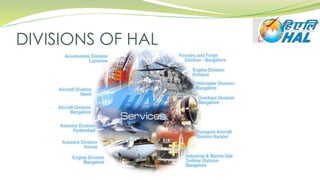
DIVISIONS OF HAL
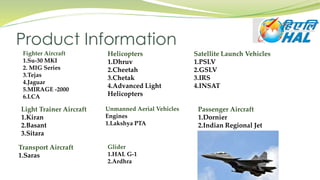
Product Information
Fighter Aircraft
1.Su-30 MKI
2. MIG Series
3.Tejas
4.Jaguar
5.MIRAGE -2000
6.LCA
Passenger Aircraft
1.Dornier
2.Indian Regional Jet
Helicopters
1.Dhruv
2.Cheetah
3.Chetak
4.Advanced Light
Helicopters
Unmanned Aerial Vehicles
Engines
1.Lakshya PTA
Transport Aircraft
1.Saras
Light Trainer Aircraft
1.Kiran
2.Basant
3.Sitara
Glider
1.HAL G-1
2.Ardhra
Satellite Launch Vehicles
1.PSLV
2.GSLV
3.IRS
4.INSAT
 Airbus
 Boeing
 Sukhoi Aviation Corporation
 Israel Aircraft Industries
 RSK MiG
 BAE Systems
 Rolls-Royce plc
 Dassault aviation
 Dornier Flugzeugwerke
 Indian Aeronautical Development Agency
 Indian Space Research Organisation
Collaboration with Companies
Accessories Division
 Accessories Division of HAL was established in 1970
 Primary objective was to have manufacturing systems and accessories for various
aircraft and engines and attain self sufficiency in this area
 At present it is turning out over 1100 different types of accessories
 Different types of accessories include hydraulics, engine fuel systems, air
conditioning and pressurization, Barometric instruments, electrical and electronics
system items, etc.
 The division has also made significant development in the field of microprocessor
based control systems for the LCA engine
Some specific types of cast iron used are:
 White cast iron
 Grey cast iron
 Chilled cast iron
 Malleable iron
 The demand for cast iron arise as a result of versatility especially in regard to wide range of
strength, resistance to wear and abrasion, resistance to corrosion, easy machining, ability to take
good casting impression, etc.
 Steel is another component which is widely used, it is divided into subcategories on the basis of
carbon percent
Aircraft Materials
Some other materials used are :
 Manganese
 Silicon
 Sulphur
 Phosphorus
 High Alloy Steel :- Stainless Steel, Heat Resistant Steel, Cold Resistant Steel,
Magnetic Steel
 Non Ferrous Alloys :- Cartridge Brass, Muntz Metal, Phosphorus Bronzes,
Gun Metal, Mondel Metal, Rabbit Medal, Duralumina
Outsourcing refers to a process in which a company contacts another company or
person to provide services that might otherwise be performed by in house employees.
Outsourcing things helps in core- competency i.e. it gives the organization competitive
advantage.
 Outsourcing in HAL started in 2003.
 No. of companies outsourced – 5000+
 No. of vendors registered with HAL –ADL – 90+
Outsourcing tools/components for various types of systems/units like:
 Hydraulic system components
 Landing gear systems
 Environmental Control System
 Engine Fuel Control System
Outsourcing
 ORDER BOOK :- Order Book is maintained in PPC which contains mfg order details pertaining to qty
to supply, delivery schedule, and customer and dispatch details.
This order book is required to monitor all the supply orders and to keep an eye on the supply as per
commitment/priority.
 BUDGET PREPARATION :-
 Revised Estimate
 Budgeted Estimate
 Forecasted Estimate
Production, Planning and Control
Marketing
 Marketing is the management process that identifies, anticipates and
satisfies customer requirements profitably.
 It is an organisation function and a set of processes for creating,
communicating and delivering value to customers.
 It is also responsible for managing customer relationships in ways that
benefit the organisation and its stakeholders.
THANK YOU

HAL LUCKNOW

  • 1.
    Presented By- NAME A PRESENTATIONON TRAINING AT LUCKNOW
  • 2.
     History ofHAL  Divisions of HAL  Product Information  Collaboration with companies  Brief about Accessories division  Aircraft Materials  Outsourcing  Production Planning and Control  Marketing Contents
  • 3.
     The companyhad its origin as the Hindustan Aircraft Company.  It is a Aerospace and Defense industry.  It was incorporated on 23 Dec 1940 at Bangalore by Shri Walchand Hirachand.  In 1963 AIL was incorporated as wholly owned by government.  In 1964 amalgamation order was issued by the government for the two companies and the company was named as Hindustan Aeronautics Limited (HAL). History of HAL
  • 4.
  • 5.
    Product Information Fighter Aircraft 1.Su-30MKI 2. MIG Series 3.Tejas 4.Jaguar 5.MIRAGE -2000 6.LCA Passenger Aircraft 1.Dornier 2.Indian Regional Jet Helicopters 1.Dhruv 2.Cheetah 3.Chetak 4.Advanced Light Helicopters Unmanned Aerial Vehicles Engines 1.Lakshya PTA Transport Aircraft 1.Saras Light Trainer Aircraft 1.Kiran 2.Basant 3.Sitara Glider 1.HAL G-1 2.Ardhra Satellite Launch Vehicles 1.PSLV 2.GSLV 3.IRS 4.INSAT
  • 6.
     Airbus  Boeing Sukhoi Aviation Corporation  Israel Aircraft Industries  RSK MiG  BAE Systems  Rolls-Royce plc  Dassault aviation  Dornier Flugzeugwerke  Indian Aeronautical Development Agency  Indian Space Research Organisation Collaboration with Companies
  • 7.
    Accessories Division  AccessoriesDivision of HAL was established in 1970  Primary objective was to have manufacturing systems and accessories for various aircraft and engines and attain self sufficiency in this area  At present it is turning out over 1100 different types of accessories  Different types of accessories include hydraulics, engine fuel systems, air conditioning and pressurization, Barometric instruments, electrical and electronics system items, etc.  The division has also made significant development in the field of microprocessor based control systems for the LCA engine
  • 8.
    Some specific typesof cast iron used are:  White cast iron  Grey cast iron  Chilled cast iron  Malleable iron  The demand for cast iron arise as a result of versatility especially in regard to wide range of strength, resistance to wear and abrasion, resistance to corrosion, easy machining, ability to take good casting impression, etc.  Steel is another component which is widely used, it is divided into subcategories on the basis of carbon percent Aircraft Materials
  • 9.
    Some other materialsused are :  Manganese  Silicon  Sulphur  Phosphorus  High Alloy Steel :- Stainless Steel, Heat Resistant Steel, Cold Resistant Steel, Magnetic Steel  Non Ferrous Alloys :- Cartridge Brass, Muntz Metal, Phosphorus Bronzes, Gun Metal, Mondel Metal, Rabbit Medal, Duralumina
  • 10.
    Outsourcing refers toa process in which a company contacts another company or person to provide services that might otherwise be performed by in house employees. Outsourcing things helps in core- competency i.e. it gives the organization competitive advantage.  Outsourcing in HAL started in 2003.  No. of companies outsourced – 5000+  No. of vendors registered with HAL –ADL – 90+ Outsourcing tools/components for various types of systems/units like:  Hydraulic system components  Landing gear systems  Environmental Control System  Engine Fuel Control System Outsourcing
  • 11.
     ORDER BOOK:- Order Book is maintained in PPC which contains mfg order details pertaining to qty to supply, delivery schedule, and customer and dispatch details. This order book is required to monitor all the supply orders and to keep an eye on the supply as per commitment/priority.  BUDGET PREPARATION :-  Revised Estimate  Budgeted Estimate  Forecasted Estimate Production, Planning and Control
  • 12.
    Marketing  Marketing isthe management process that identifies, anticipates and satisfies customer requirements profitably.  It is an organisation function and a set of processes for creating, communicating and delivering value to customers.  It is also responsible for managing customer relationships in ways that benefit the organisation and its stakeholders.
  • 13.