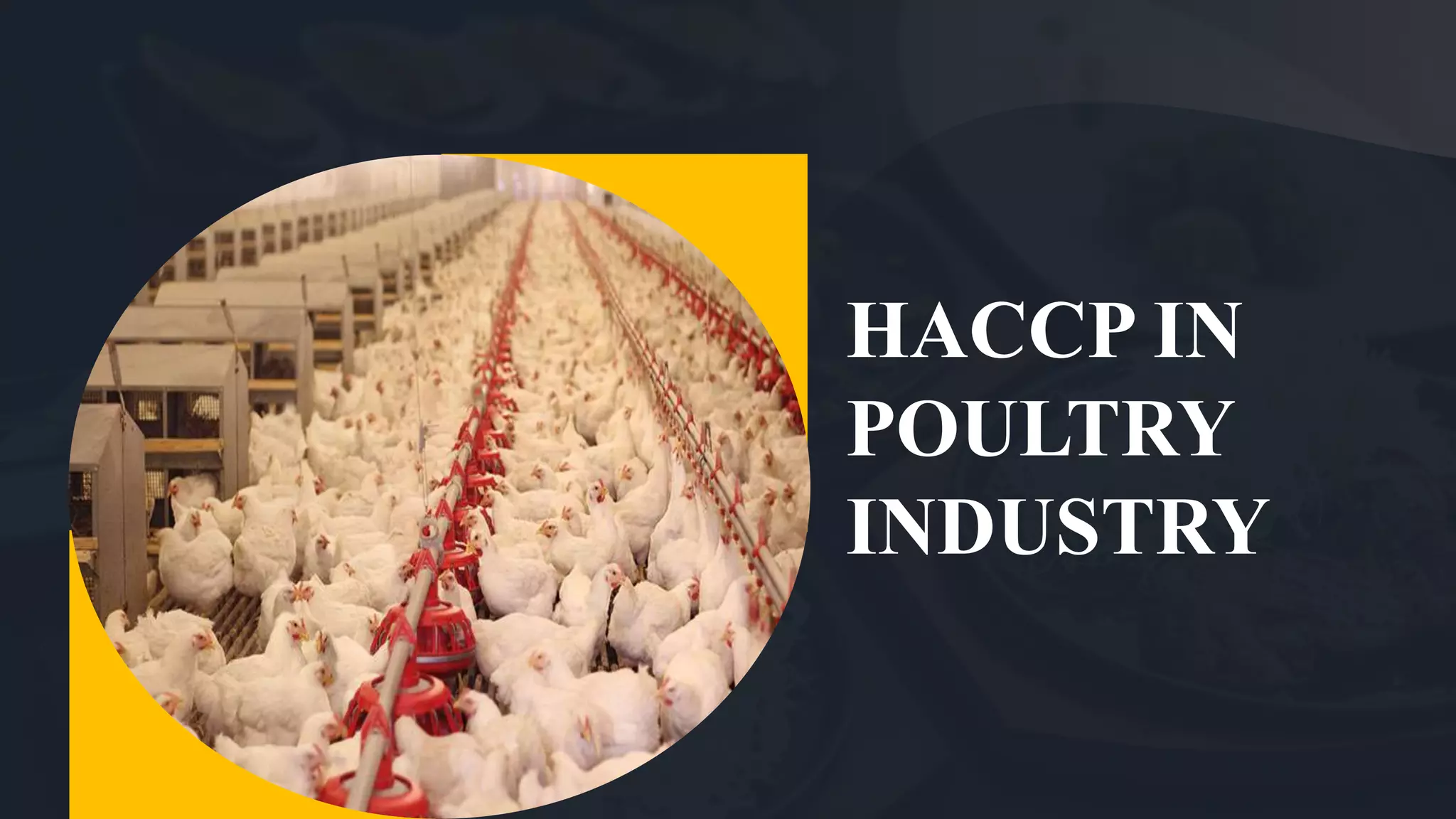





HACCP IN
POULTRY
INDUSTRY
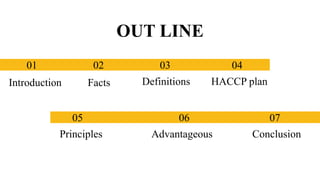
OUT LINE
Introduction Facts HACCP plan
Principles Advantageous Conclusion
01 02 03 04
05 06 07
Definitions
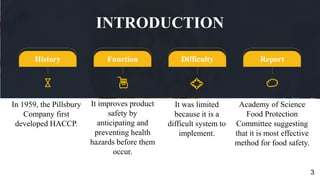
In 1959, the Pillsbury
Company first
developed HACCP.
It improves product
safety by
anticipating and
preventing health
hazards before them
occur.
It was limited
because it is a
difficult system to
implement.
Academy of Science
Food Protection
Committee suggesting
that it is most effective
method for food safety.
History Function Difficulty Report
INTRODUCTION
3
HACCP
Meat and poultry products are sensitive to microorganism
contamination by
 Bacteria
 Viruses
 Parasites
Poultry provide an excellent environment for growth of microbes
Bacterial contamination cause foodborne illness.
To improve product safety, industries are adopting HACCP system.
4
7
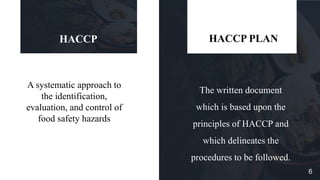
A systematic approach to
the identification,
evaluation, and control of
food safety hazards
HACCP
The written document
which is based upon the
principles of HACCP and
which delineates the
procedures to be followed.
HACCP PLAN
6
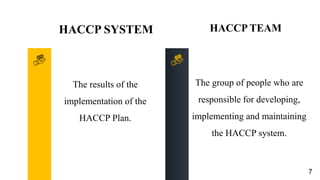
The results of the
implementation of the
HACCP Plan.
The group of people who are
responsible for developing,
implementing and maintaining
the HACCP system.
HACCP SYSTEM HACCP TEAM
7
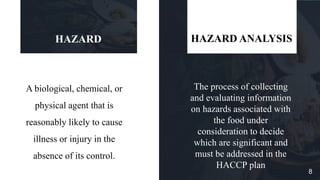
A biological, chemical, or
physical agent that is
reasonably likely to cause
illness or injury in the
absence of its control.
HAZARD
The process of collecting
and evaluating information
on hazards associated with
the food under
consideration to decide
which are significant and
must be addressed in the
HACCP plan
HAZARD ANALYSIS
8
DEVELOPING
OF
HACCP PLAN
9
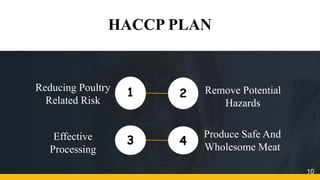
HACCP PLAN
Reducing Poultry
Related Risk
Produce Safe And
Wholesome Meat
Remove Potential
Hazards
Effective
Processing
1
4
2
3
10
11
Behavior and commitment of
all plant employees.
Management must provide
financial support
Awareness about the benefits
of program
Provide visible support to
employees.
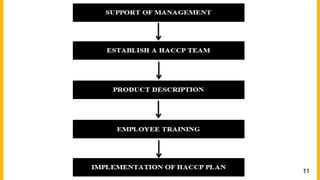
SUPPORT OF
MANAGEMENT
01
02
03
04
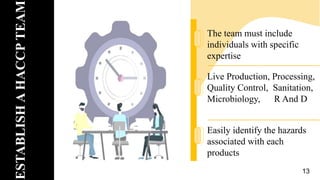
ESTABLISH
A
HACCP
TEAM
The team must include
individuals with specific
expertise
Live Production, Processing,
Quality Control, Sanitation,
Microbiology, R And D
Easily identify the hazards
associated with each
products
13
PRODUCT
DESCRIPTION
 Product’s name
 Shelf-life
 Product usage
 Packaging material
 Nutritional facts
 Product’s labeling instructions
 Any special instructions 14
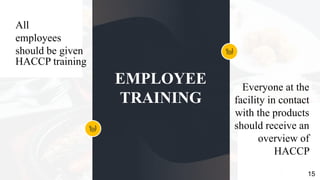
All
employees
should be given
HACCP training
Everyone at the
facility in contact
with the products
should receive an
overview of
HACCP
EMPLOYEE
TRAINING
15
PRINCIPLES
OF
HACCP
16
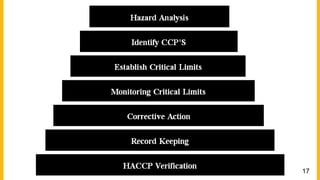
17
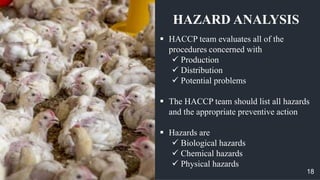
 HACCP team evaluates all of the
procedures concerned with
 Production
 Distribution
 Potential problems
 The HACCP team should list all hazards
and the appropriate preventive action
 Hazards are
 Biological hazards
 Chemical hazards
 Physical hazards
HAZARD ANALYSIS
18
Simple Presentation
ALLPPT Layout
Clean Text Slide
for your
Presentation
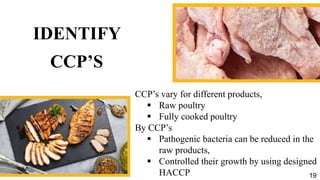
IDENTIFY
CCP’S
CCP’s vary for different products,
 Raw poultry
 Fully cooked poultry
By CCP’s
 Pathogenic bacteria can be reduced in the
raw products,
 Controlled their growth by using designed
HACCP 19
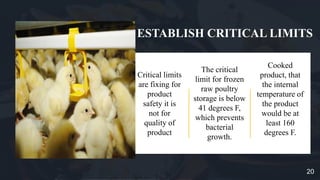
ESTABLISH CRITICAL LIMITS
Critical limits
are fixing for
product
safety it is
not for
quality of
product
The critical
limit for frozen
raw poultry
storage is below
41 degrees F,
which prevents
bacterial
growth.
Cooked
product, that
the internal
temperature of
the product
would be at
least 160
degrees F.
20
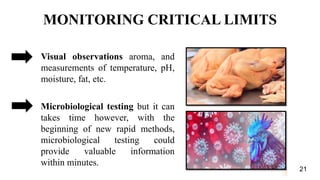
Visual observations aroma, and
measurements of temperature, pH,
moisture, fat, etc.
Microbiological testing but it can
takes time however, with the
beginning of new rapid methods,
microbiological testing could
provide valuable information
within minutes.
MONITORING CRITICAL LIMITS
21
Who is responsible for regaining
control of the process
How to regain control
How to recall product
CORRECTIVE ACTION
22
RECORD KEEPING
Preventive measures and List of all critical limits.
C
Monitoring and verification plans.
Procedures for product handling according to critical limit occurs.
HACCP flow diagrams with all CCP’s.
23
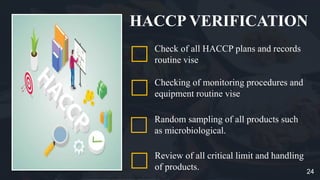
HACCP VERIFICATION
Checking of monitoring procedures and
equipment routine vise
Random sampling of all products such
as microbiological.
Review of all critical limit and handling
of products.
Check of all HACCP plans and records
routine vise
24
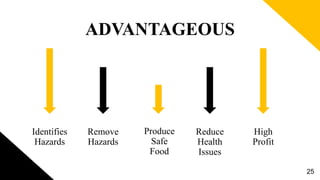
ADVANTAGEOUS
Identifies
Hazards
Remove
Hazards
Produce
Safe
Food
Reduce
Health
Issues
High
Profit
25
To sum up….
THANK
YOU

HACCP in Poultry Industry

  • 1.
  • 2.
    OUT LINE Introduction FactsHACCP plan Principles Advantageous Conclusion 01 02 03 04 05 06 07 Definitions
  • 3.
    In 1959, thePillsbury Company first developed HACCP. It improves product safety by anticipating and preventing health hazards before them occur. It was limited because it is a difficult system to implement. Academy of Science Food Protection Committee suggesting that it is most effective method for food safety. History Function Difficulty Report INTRODUCTION 3
  • 4.
    HACCP Meat and poultryproducts are sensitive to microorganism contamination by  Bacteria  Viruses  Parasites Poultry provide an excellent environment for growth of microbes Bacterial contamination cause foodborne illness. To improve product safety, industries are adopting HACCP system. 4
  • 5.
  • 6.
    A systematic approachto the identification, evaluation, and control of food safety hazards HACCP The written document which is based upon the principles of HACCP and which delineates the procedures to be followed. HACCP PLAN 6
  • 7.
    The results ofthe implementation of the HACCP Plan. The group of people who are responsible for developing, implementing and maintaining the HACCP system. HACCP SYSTEM HACCP TEAM 7
  • 8.
    A biological, chemical,or physical agent that is reasonably likely to cause illness or injury in the absence of its control. HAZARD The process of collecting and evaluating information on hazards associated with the food under consideration to decide which are significant and must be addressed in the HACCP plan HAZARD ANALYSIS 8
  • 9.
  • 10.
    HACCP PLAN Reducing Poultry RelatedRisk Produce Safe And Wholesome Meat Remove Potential Hazards Effective Processing 1 4 2 3 10
  • 11.
  • 12.
    Behavior and commitmentof all plant employees. Management must provide financial support Awareness about the benefits of program Provide visible support to employees. SUPPORT OF MANAGEMENT 01 02 03 04
  • 13.
    ESTABLISH A HACCP TEAM The team mustinclude individuals with specific expertise Live Production, Processing, Quality Control, Sanitation, Microbiology, R And D Easily identify the hazards associated with each products 13
  • 14.
    PRODUCT DESCRIPTION  Product’s name Shelf-life  Product usage  Packaging material  Nutritional facts  Product’s labeling instructions  Any special instructions 14
  • 15.
    All employees should be given HACCPtraining Everyone at the facility in contact with the products should receive an overview of HACCP EMPLOYEE TRAINING 15
  • 16.
  • 17.
  • 18.
     HACCP teamevaluates all of the procedures concerned with  Production  Distribution  Potential problems  The HACCP team should list all hazards and the appropriate preventive action  Hazards are  Biological hazards  Chemical hazards  Physical hazards HAZARD ANALYSIS 18
  • 19.
    Simple Presentation ALLPPT Layout CleanText Slide for your Presentation IDENTIFY CCP’S CCP’s vary for different products,  Raw poultry  Fully cooked poultry By CCP’s  Pathogenic bacteria can be reduced in the raw products,  Controlled their growth by using designed HACCP 19
  • 20.
    ESTABLISH CRITICAL LIMITS Criticallimits are fixing for product safety it is not for quality of product The critical limit for frozen raw poultry storage is below 41 degrees F, which prevents bacterial growth. Cooked product, that the internal temperature of the product would be at least 160 degrees F. 20
  • 21.
    Visual observations aroma,and measurements of temperature, pH, moisture, fat, etc. Microbiological testing but it can takes time however, with the beginning of new rapid methods, microbiological testing could provide valuable information within minutes. MONITORING CRITICAL LIMITS 21
  • 22.
    Who is responsiblefor regaining control of the process How to regain control How to recall product CORRECTIVE ACTION 22
  • 23.
    RECORD KEEPING Preventive measuresand List of all critical limits. C Monitoring and verification plans. Procedures for product handling according to critical limit occurs. HACCP flow diagrams with all CCP’s. 23
  • 24.
    HACCP VERIFICATION Checking ofmonitoring procedures and equipment routine vise Random sampling of all products such as microbiological. Review of all critical limit and handling of products. Check of all HACCP plans and records routine vise 24
  • 25.
  • 26.
  • 27.

Editor's Notes

  • #2 <a href="https://www.freepik.com/free-photos-vectors/food">Food photo created by valeria_aksakova - www.freepik.com</a>
  • #4 Photo by Foto T on Unsplash
  • #13 Photo by Stefan Johnson on Unsplash Photo by Mgg Vitchakorn on Unsplash
  • #14 Photo by Mgg Vitchakorn on Unsplash
  • #16 Photo by Zach Ward on Unsplash Photo by Food Photographer | Jennifer Pallian on Unsplash
  • #21 Photo by Victoria Shes on Unsplash
  • #28 Photo by Christiann Koepke on Unsplash