


HACCP Implementation on Process
Line of Cheddar Cheese
Submitted BY:
Muhammad Saad Haleem
(NIFSAT)
UNIVERSITY OF
AGRICULTURE,FAISALABAD
Cheddar Cheese
• Natural cheese: sliced, diced or
grated
• Processed cheese products
• Dried cheese products
• Enzyme-modified cheese
products
• Slightly crumbly texture
(Fox. et al., 2017)
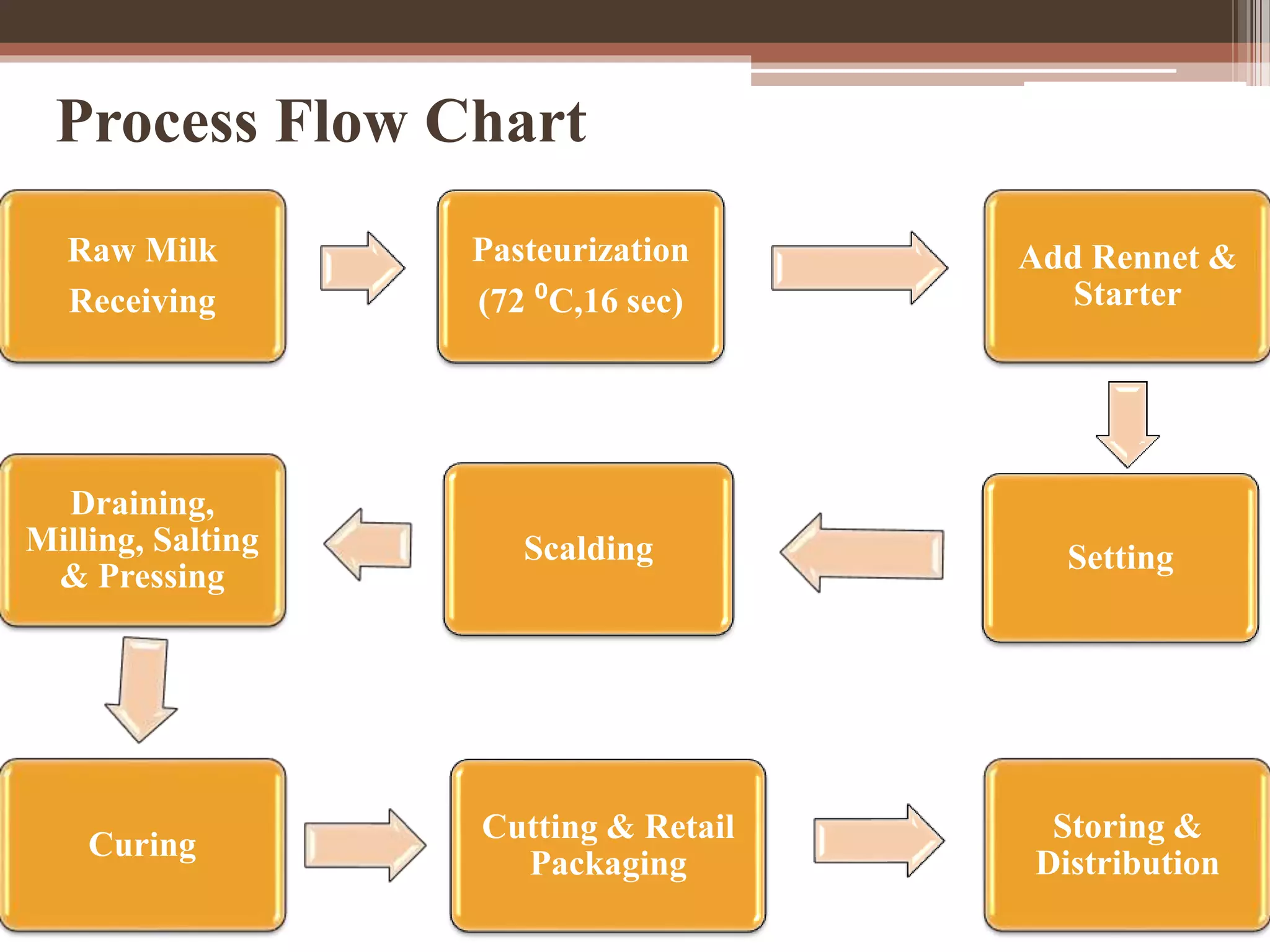
Process Flow Chart
Raw Milk
Receiving
Pasteurization
(72 ⁰C,16 sec)
Add Rennet &
Starter
SettingScalding
Draining,
Milling, Salting
& Pressing
Curing
Cutting & Retail
Packaging
Storing &
Distribution
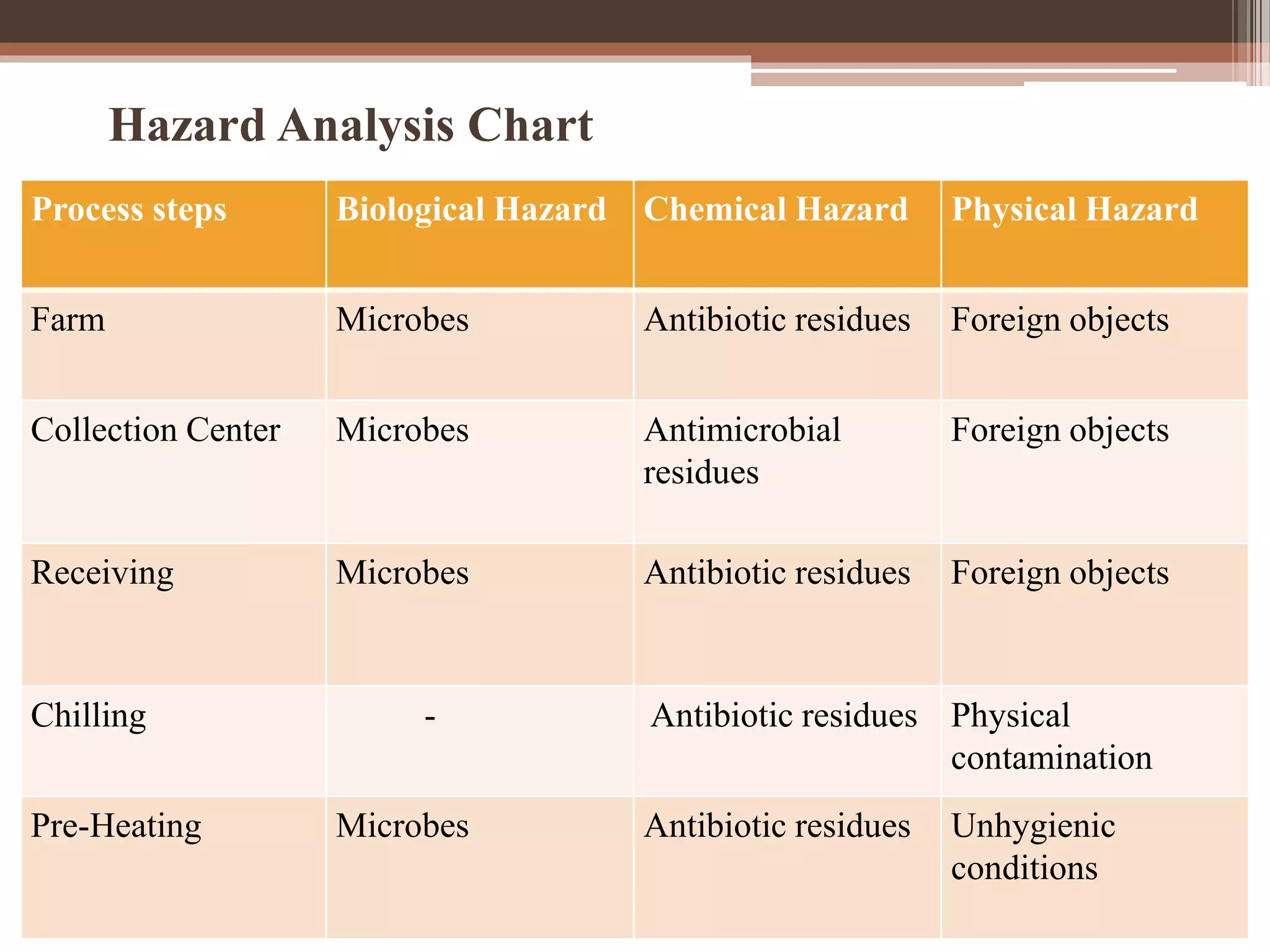
Hazard Analysis Chart
Process steps Biological Hazard Chemical Hazard Physical Hazard
Farm Microbes Antibiotic residues Foreign objects
Collection Center Microbes Antimicrobial
residues
Foreign objects
Receiving Microbes Antibiotic residues Foreign objects
Chilling - Antibiotic residues Physical
contamination
Pre-Heating Microbes Antibiotic residues Unhygienic
conditions
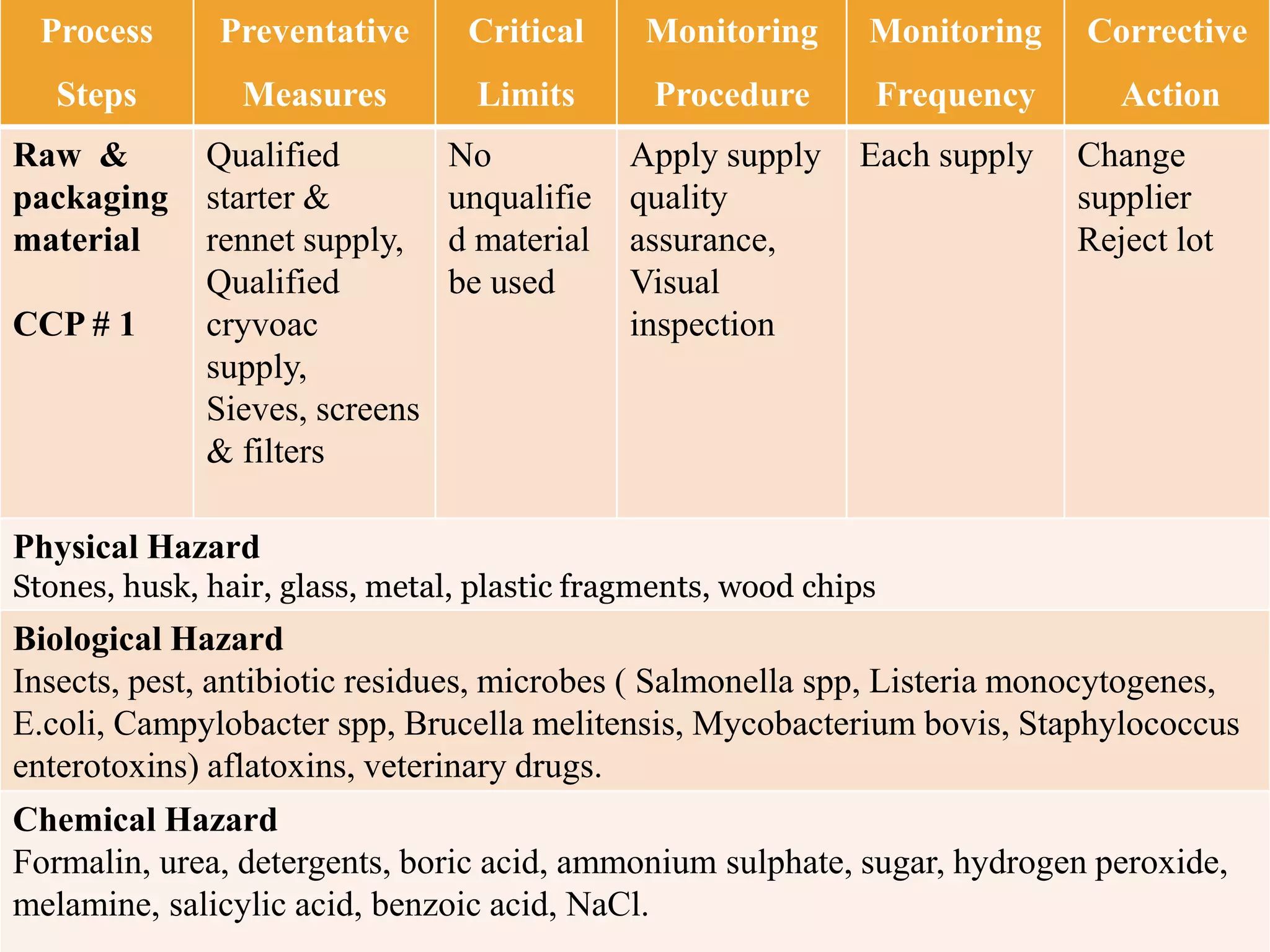
Process
Steps
Preventative
Measures
Critical
Limits
Monitoring
Procedure
Monitoring
Frequency
Corrective
Action
Raw &
packaging
material
CCP # 1
Qualified
starter &
rennet supply,
Qualified
cryvoac
supply,
Sieves, screens
& filters
No
unqualifie
d material
be used
Apply supply
quality
assurance,
Visual
inspection
Each supply Change
supplier
Reject lot
Physical Hazard
Stones, husk, hair, glass, metal, plastic fragments, wood chips
Biological Hazard
Insects, pest, antibiotic residues, microbes ( Salmonella spp, Listeria monocytogenes,
E.coli, Campylobacter spp, Brucella melitensis, Mycobacterium bovis, Staphylococcus
enterotoxins) aflatoxins, veterinary drugs.
Chemical Hazard
Formalin, urea, detergents, boric acid, ammonium sulphate, sugar, hydrogen peroxide,
melamine, salicylic acid, benzoic acid, NaCl.
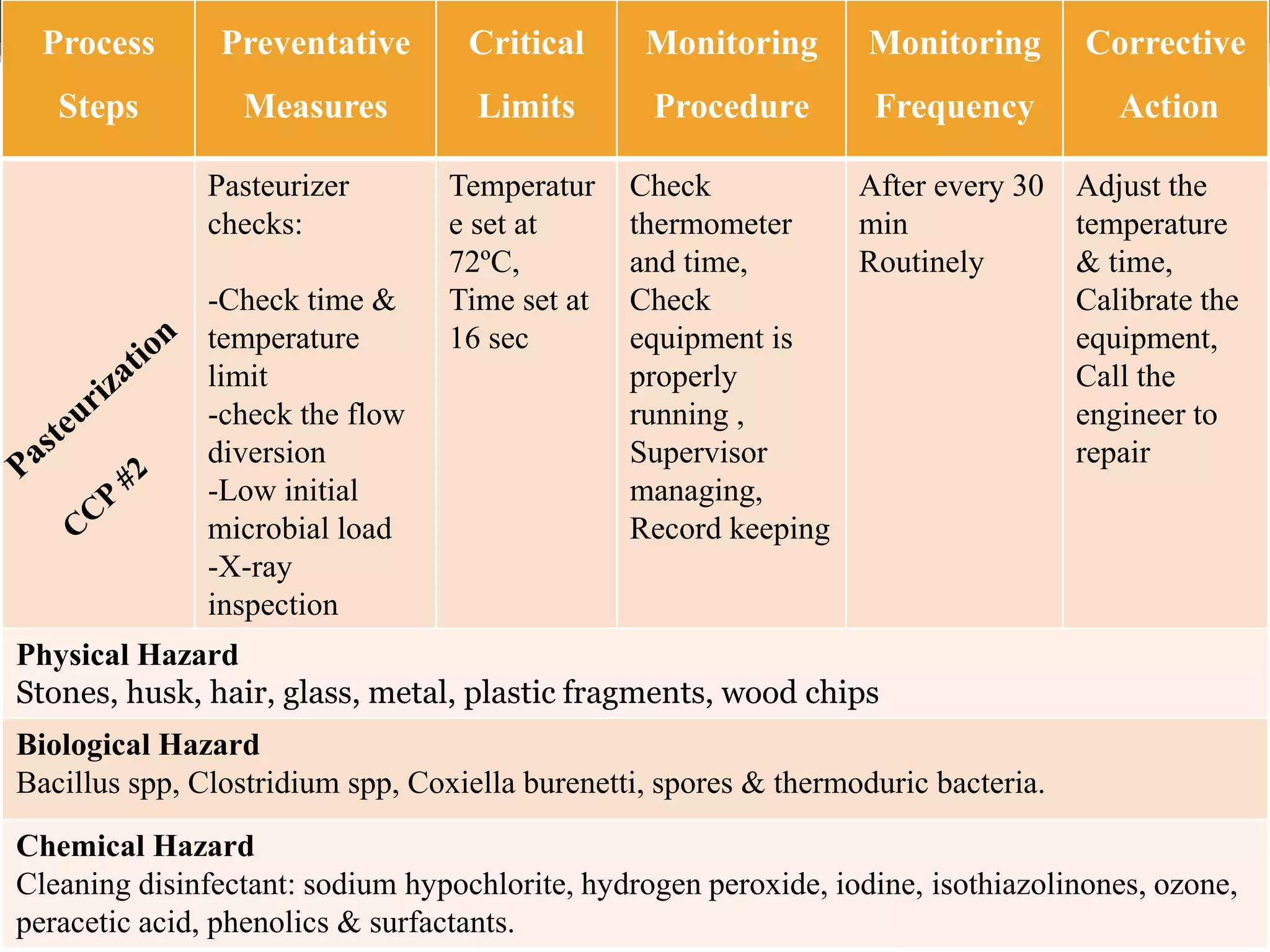
Process
Steps
Preventative
Measures
Critical
Limits
Monitoring
Procedure
Monitoring
Frequency
Corrective
Action
Pasteurizer
checks:
-Check time &
temperature
limit
-check the flow
diversion
-Low initial
microbial load
-X-ray
inspection
Temperatur
e set at
72ºC,
Time set at
16 sec
Check
thermometer
and time,
Check
equipment is
properly
running ,
Supervisor
managing,
Record keeping
After every 30
min
Routinely
Adjust the
temperature
& time,
Calibrate the
equipment,
Call the
engineer to
repair
Physical Hazard
Stones, husk, hair, glass, metal, plastic fragments, wood chips
Biological Hazard
Bacillus spp, Clostridium spp, Coxiella burenetti, spores & thermoduric bacteria.
Chemical Hazard
Cleaning disinfectant: sodium hypochlorite, hydrogen peroxide, iodine, isothiazolinones, ozone,
peracetic acid, phenolics & surfactants.
Process
Step
Preventive
Measure
Critical
Limits
Monitoring
Procedure
Monitoring
Frequency
Corrective
Action
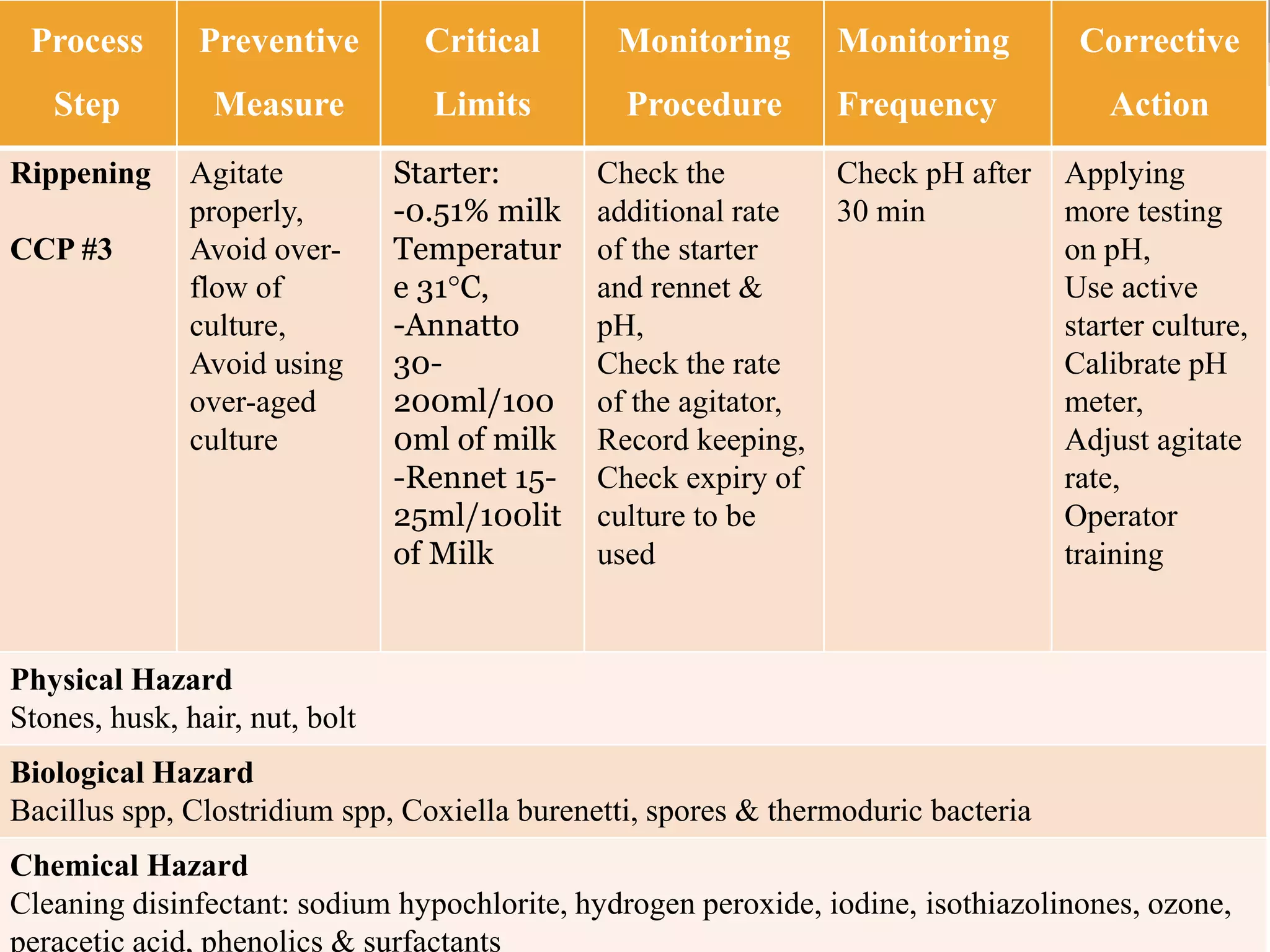
Rippening
CCP #3
Agitate
properly,
Avoid over-
flow of
culture,
Avoid using
over-aged
culture
Starter:
-0.51% milk
Temperatur
e 31C,
-Annatto
30-
200ml/100
0ml of milk
-Rennet 15-
25ml/100lit
of Milk
Check the
additional rate
of the starter
and rennet &
pH,
Check the rate
of the agitator,
Record keeping,
Check expiry of
culture to be
used
Check pH after
30 min
Applying
more testing
on pH,
Use active
starter culture,
Calibrate pH
meter,
Adjust agitate
rate,
Operator
training
Physical Hazard
Stones, husk, hair, nut, bolt
Biological Hazard
Bacillus spp, Clostridium spp, Coxiella burenetti, spores & thermoduric bacteria
Chemical Hazard
Cleaning disinfectant: sodium hypochlorite, hydrogen peroxide, iodine, isothiazolinones, ozone,
peracetic acid, phenolics & surfactants
Process
Step
Preventive
Measure
Critical
Limits
Monitoring
Procedure
Monitoring
Frequency
Corrective
Action
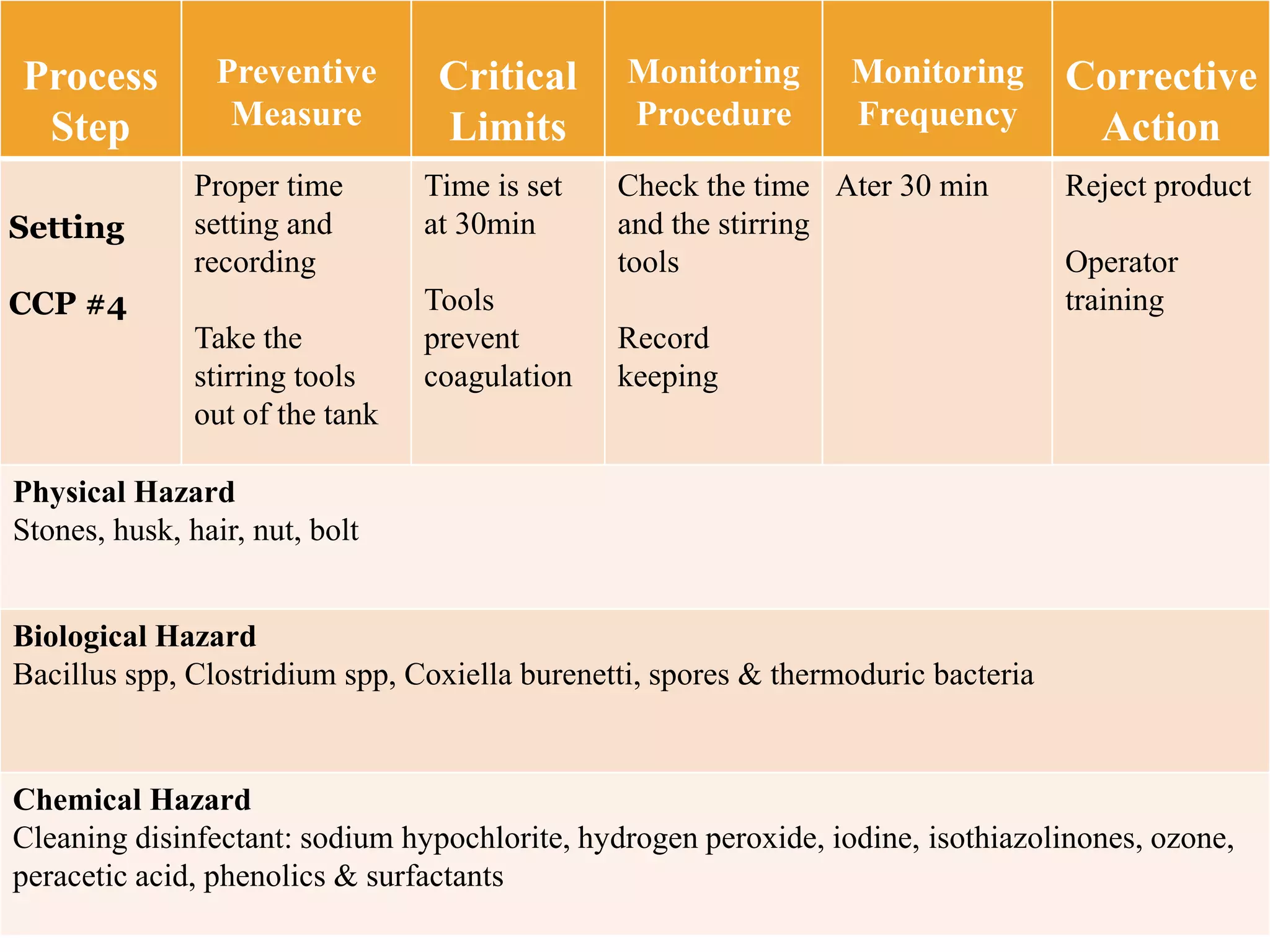
Proper time
setting and
recording
Take the
stirring tools
out of the tank
Time is set
at 30min
Tools
prevent
coagulation
Check the time
and the stirring
tools
Record
keeping
Ater 30 min Reject product
Operator
training
Physical Hazard
Stones, husk, hair, nut, bolt
Biological Hazard
Bacillus spp, Clostridium spp, Coxiella burenetti, spores & thermoduric bacteria
Chemical Hazard
Cleaning disinfectant: sodium hypochlorite, hydrogen peroxide, iodine, isothiazolinones, ozone,
peracetic acid, phenolics & surfactants
Setting
CCP #4
Process
Step
Preventive
Measure
Critical
Limits
Monitoring
Procedure
Monitoring
Frequency
Corrective
Action
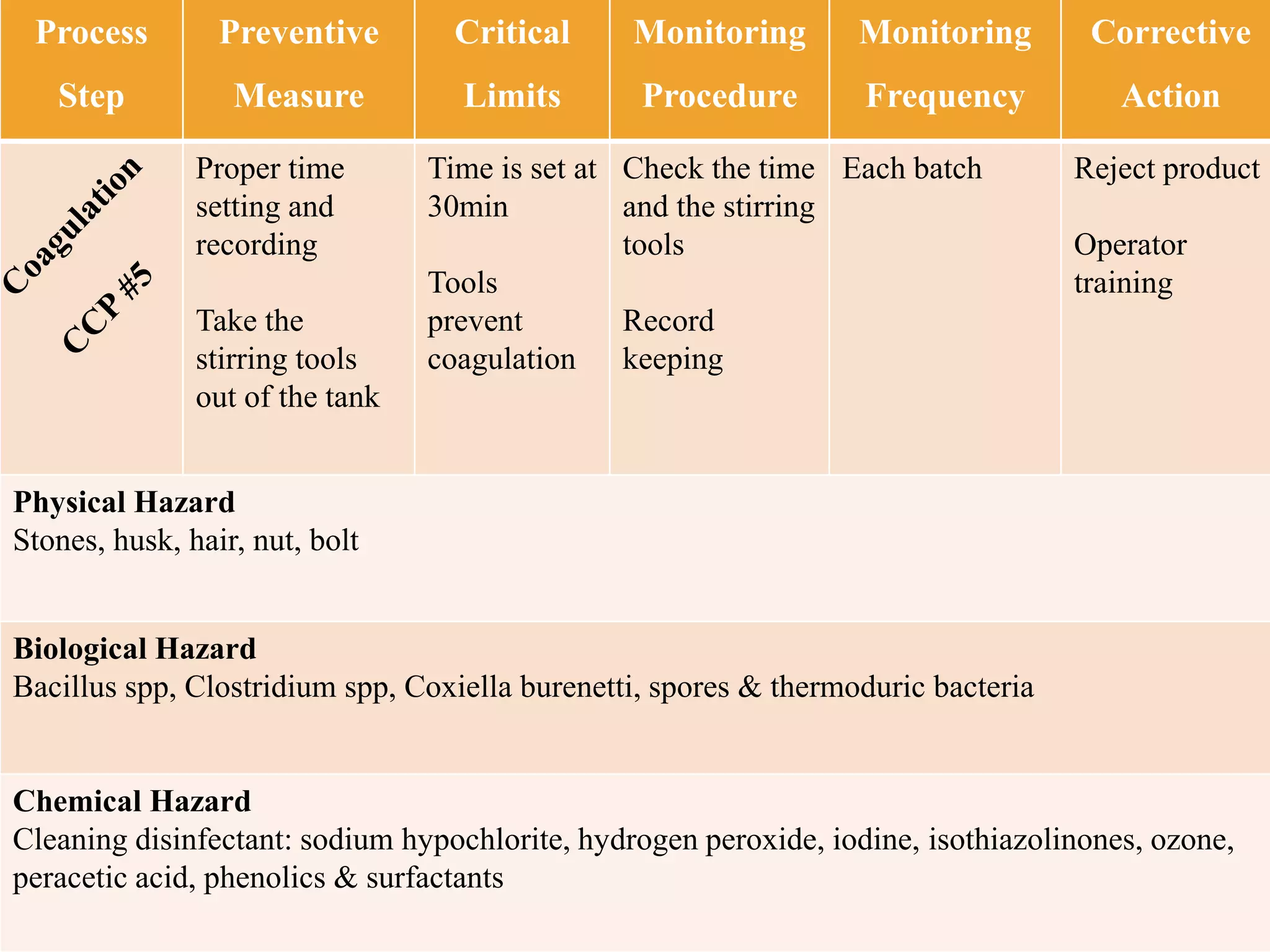
Proper time
setting and
recording
Take the
stirring tools
out of the tank
Time is set at
30min
Tools
prevent
coagulation
Check the time
and the stirring
tools
Record
keeping
Each batch Reject product
Operator
training
Physical Hazard
Stones, husk, hair, nut, bolt
Biological Hazard
Bacillus spp, Clostridium spp, Coxiella burenetti, spores & thermoduric bacteria
Chemical Hazard
Cleaning disinfectant: sodium hypochlorite, hydrogen peroxide, iodine, isothiazolinones, ozone,
peracetic acid, phenolics & surfactants
Process
Step
Preventive
Measure
Critical
Limits
Monitoring
Procedure
Monitoring
Frequency
Corrective
Action
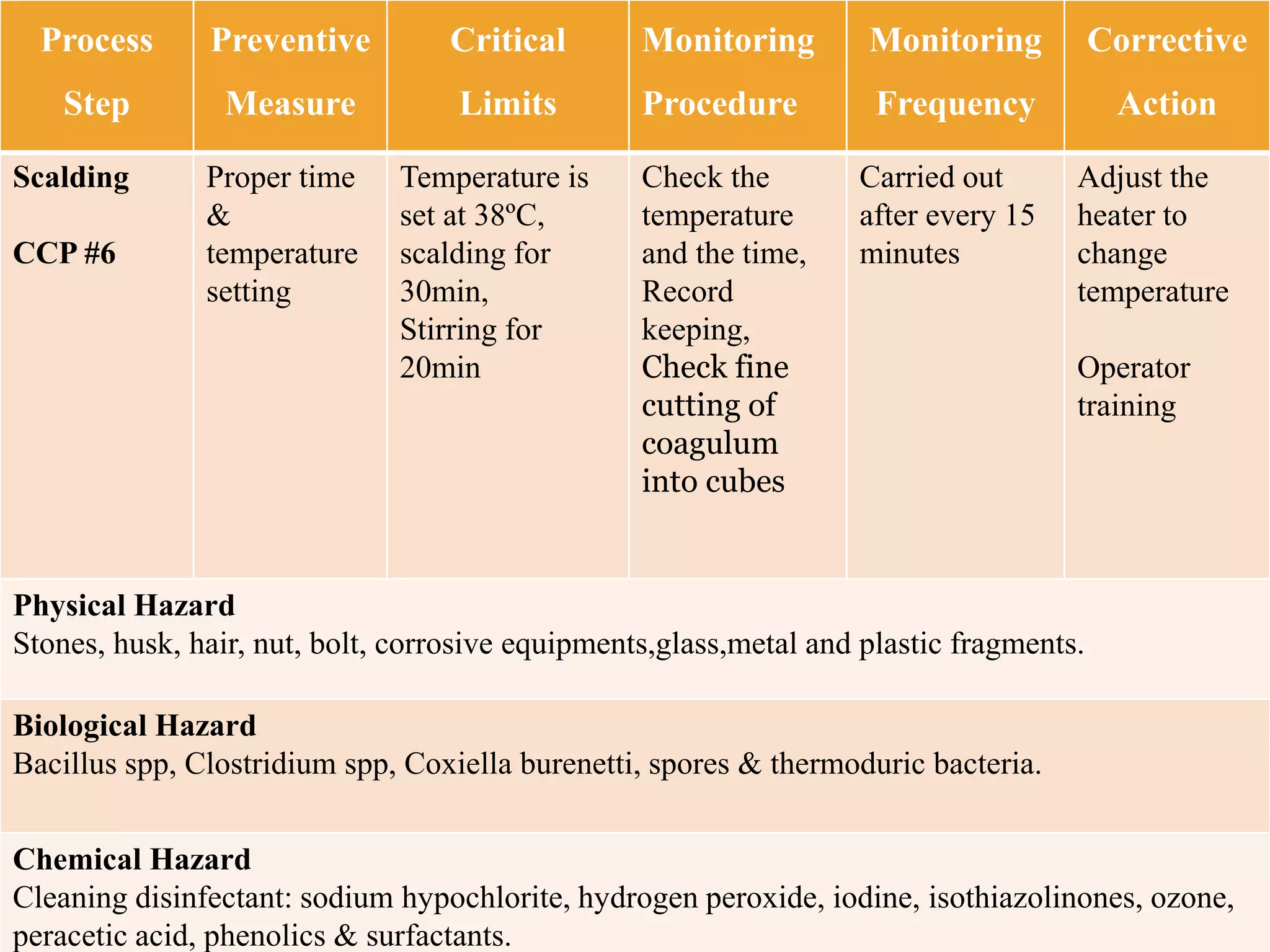
Scalding
CCP #6
Proper time
&
temperature
setting
Temperature is
set at 38ºC,
scalding for
30min,
Stirring for
20min
Check the
temperature
and the time,
Record
keeping,
Check fine
cutting of
coagulum
into cubes
Carried out
after every 15
minutes
Adjust the
heater to
change
temperature
Operator
training
Physical Hazard
Stones, husk, hair, nut, bolt, corrosive equipments,glass,metal and plastic fragments.
Biological Hazard
Bacillus spp, Clostridium spp, Coxiella burenetti, spores & thermoduric bacteria.
Chemical Hazard
Cleaning disinfectant: sodium hypochlorite, hydrogen peroxide, iodine, isothiazolinones, ozone,
peracetic acid, phenolics & surfactants.
Process
Step
Preventive
Measure
Critical
Limits
Monitoring
Procedure
Monitoring
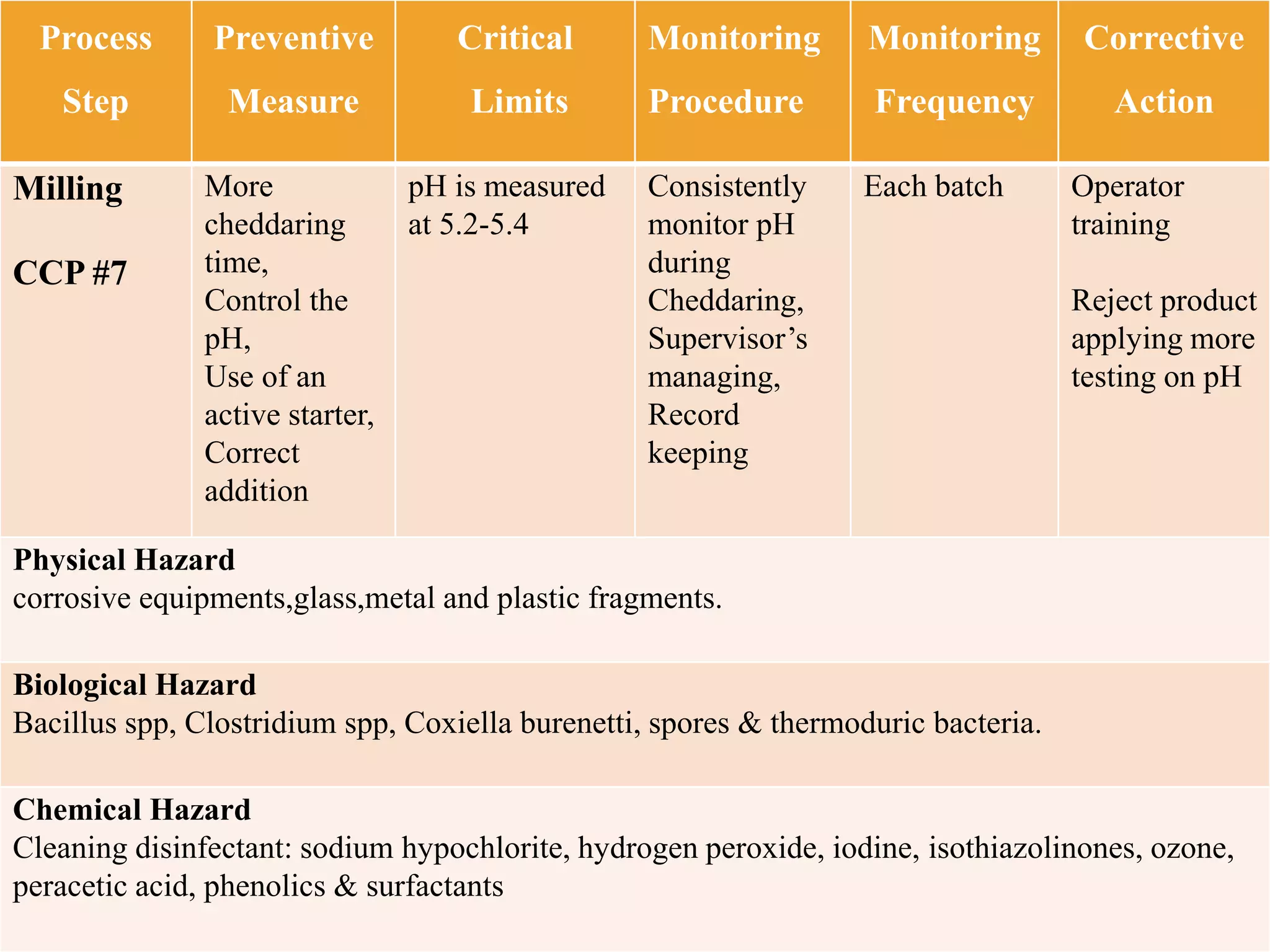
Frequency
Corrective
Action
Milling
CCP #7
More
cheddaring
time,
Control the
pH,
Use of an
active starter,
Correct
addition
pH is measured
at 5.2-5.4
Consistently
monitor pH
during
Cheddaring,
Supervisor’s
managing,
Record
keeping
Each batch Operator
training
Reject product
applying more
testing on pH
Physical Hazard
corrosive equipments,glass,metal and plastic fragments.
Biological Hazard
Bacillus spp, Clostridium spp, Coxiella burenetti, spores & thermoduric bacteria.
Chemical Hazard
Cleaning disinfectant: sodium hypochlorite, hydrogen peroxide, iodine, isothiazolinones, ozone,
peracetic acid, phenolics & surfactants
Process
Step
Preventive
measures
Critical
Limits
Monitoring
Procedure
Monitoring
frequency
Corrective
action
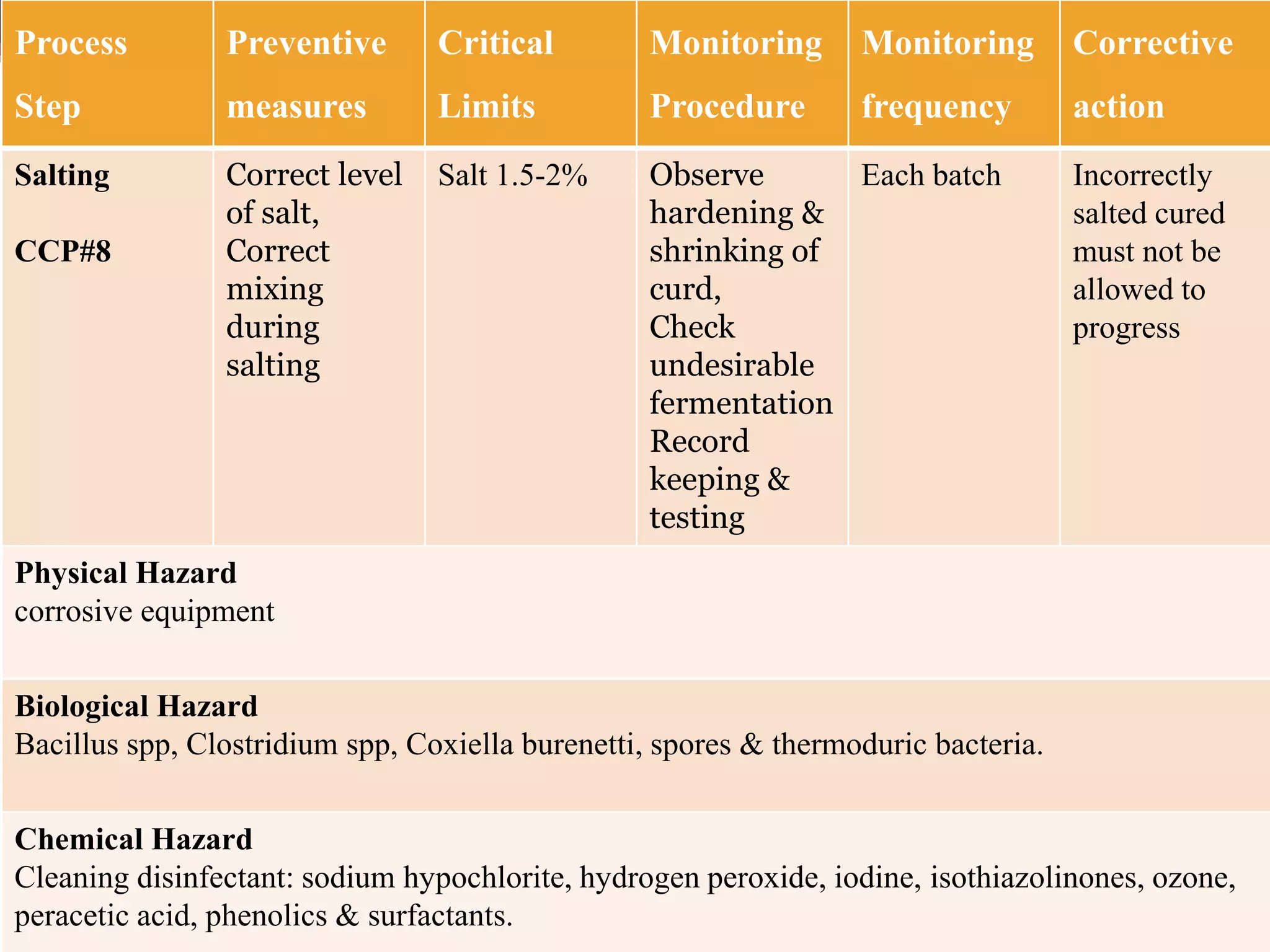
Salting
CCP#8
Correct level
of salt,
Correct
mixing
during
salting
Salt 1.5-2% Observe
hardening &
shrinking of
curd,
Check
undesirable
fermentation
Record
keeping &
testing
Each batch Incorrectly
salted cured
must not be
allowed to
progress
Physical Hazard
corrosive equipment
Biological Hazard
Bacillus spp, Clostridium spp, Coxiella burenetti, spores & thermoduric bacteria.
Chemical Hazard
Cleaning disinfectant: sodium hypochlorite, hydrogen peroxide, iodine, isothiazolinones, ozone,
peracetic acid, phenolics & surfactants.
Process
Step
Preventive
measures
Critical
Limits
Monitoring
Procedure
Monitoring
frequency
Corrective
action
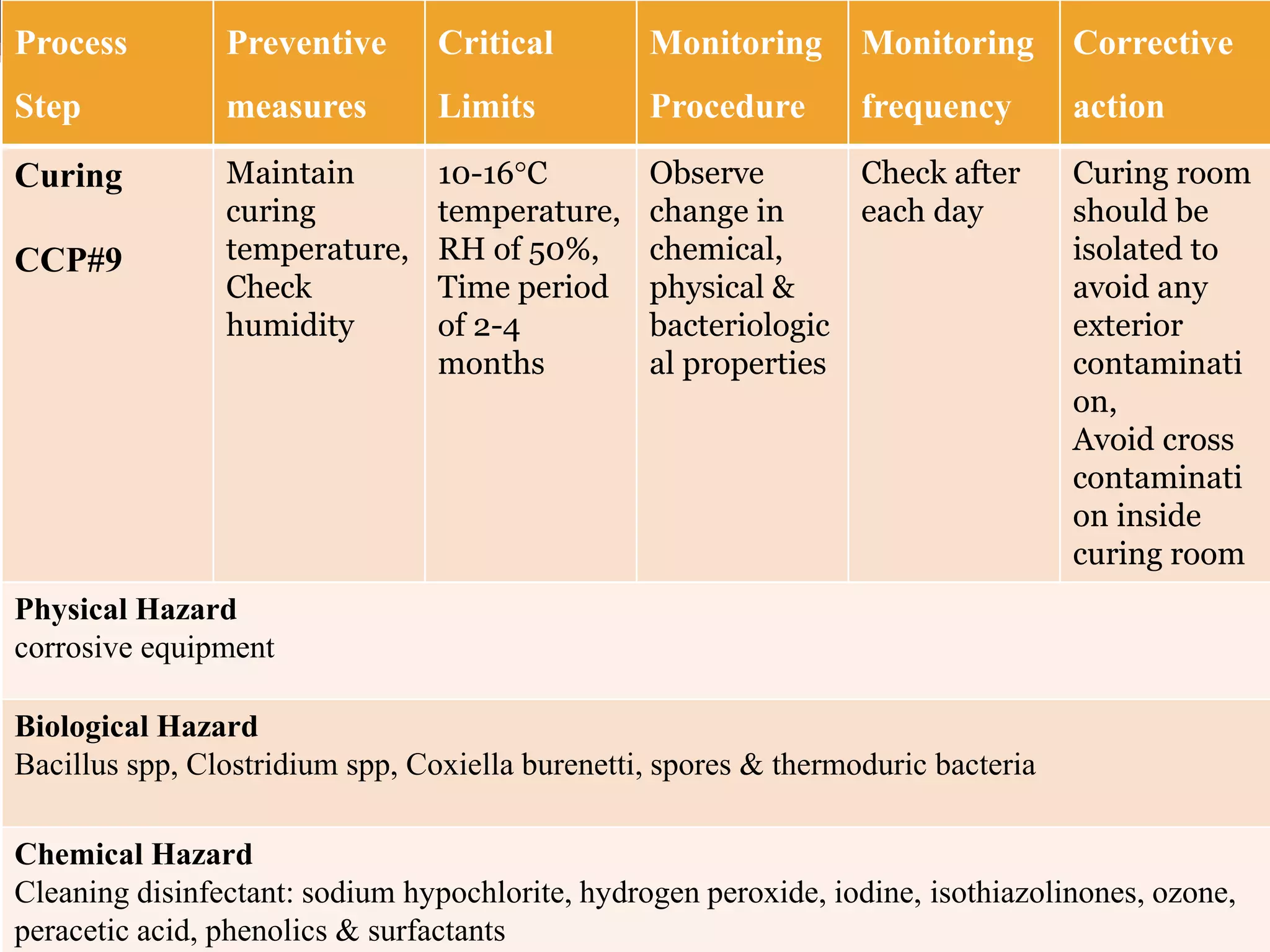
Curing
CCP#9
Maintain
curing
temperature,
Check
humidity
10-16C
temperature,
RH of 50%,
Time period
of 2-4
months
Observe
change in
chemical,
physical &
bacteriologic
al properties
Check after
each day
Curing room
should be
isolated to
avoid any
exterior
contaminati
on,
Avoid cross
contaminati
on inside
curing room
Physical Hazard
corrosive equipment
Biological Hazard
Bacillus spp, Clostridium spp, Coxiella burenetti, spores & thermoduric bacteria
Chemical Hazard
Cleaning disinfectant: sodium hypochlorite, hydrogen peroxide, iodine, isothiazolinones, ozone,
peracetic acid, phenolics & surfactants
Process
Step
Preventive
measures
Critical
Limits
Monitoring
Procedure
Monitoring
frequency
Corrective action
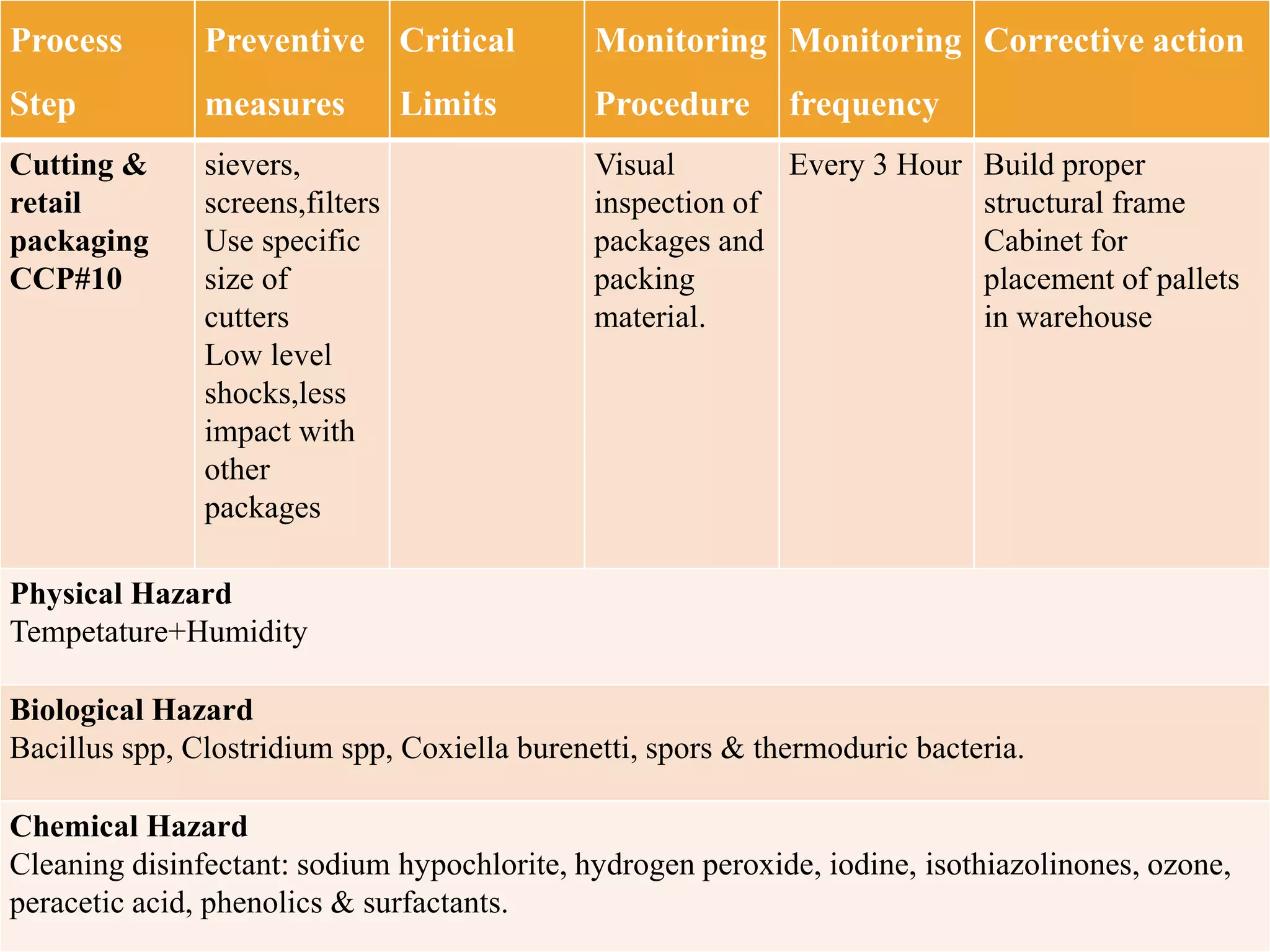
Cutting &
retail
packaging
CCP#10
sievers,
screens,filters
Use specific
size of
cutters
Low level
shocks,less
impact with
other
packages
Visual
inspection of
packages and
packing
material.
Every 3 Hour Build proper
structural frame
Cabinet for
placement of pallets
in warehouse
Physical Hazard
Tempetature+Humidity
Biological Hazard
Bacillus spp, Clostridium spp, Coxiella burenetti, spors & thermoduric bacteria.
Chemical Hazard
Cleaning disinfectant: sodium hypochlorite, hydrogen peroxide, iodine, isothiazolinones, ozone,
peracetic acid, phenolics & surfactants.
Process
Step
Preventive
measures
Critical
Limits
Monitoring
Procedure
Monitoring
frequency
Corrective
action
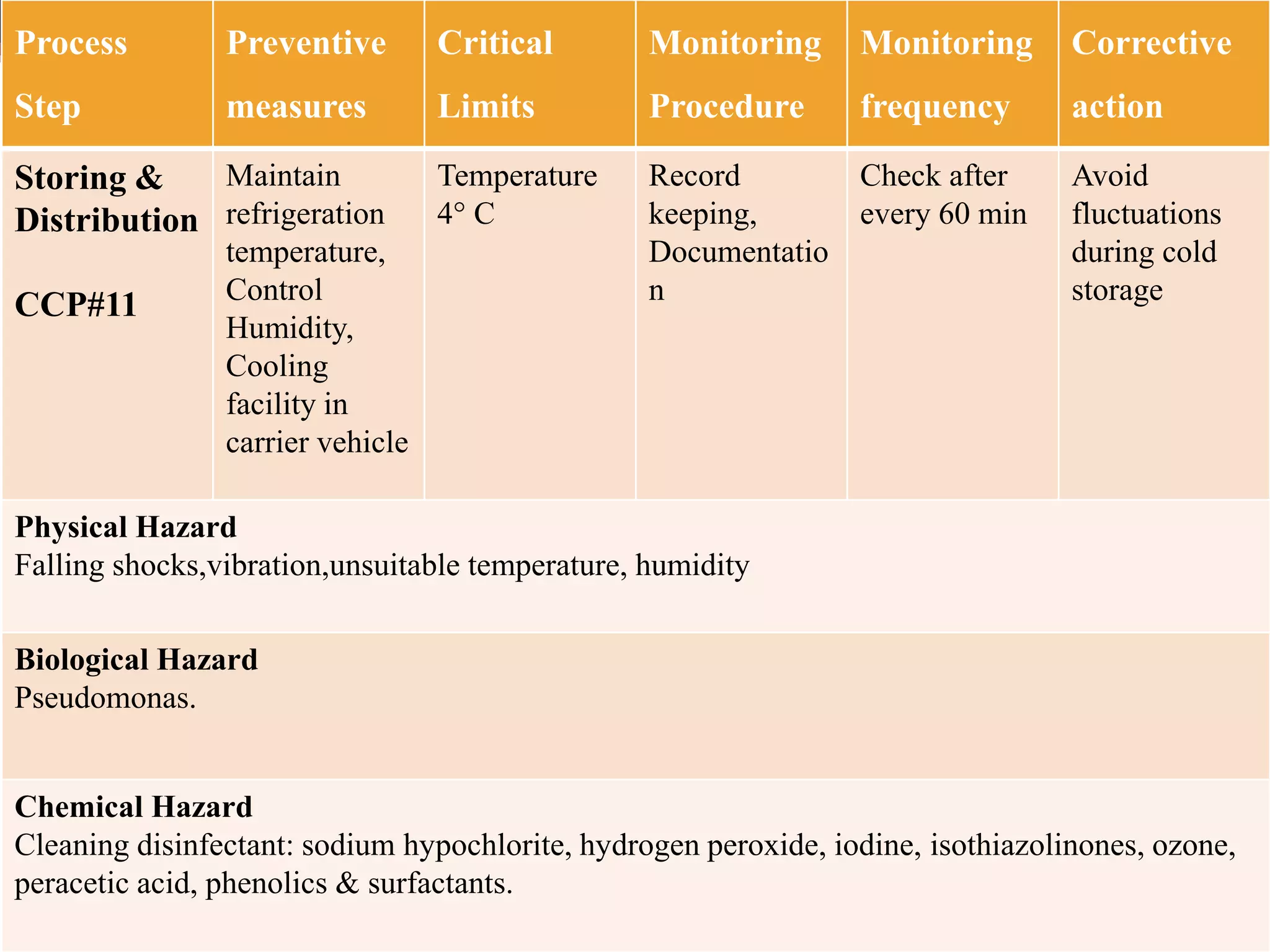
Storing &
Distribution
CCP#11
Maintain
refrigeration
temperature,
Control
Humidity,
Cooling
facility in
carrier vehicle
Temperature
4 C
Record
keeping,
Documentatio
n
Check after
every 60 min
Avoid
fluctuations
during cold
storage
Physical Hazard
Falling shocks,vibration,unsuitable temperature, humidity
Biological Hazard
Pseudomonas.
Chemical Hazard
Cleaning disinfectant: sodium hypochlorite, hydrogen peroxide, iodine, isothiazolinones, ozone,
peracetic acid, phenolics & surfactants.
Reference
• Fox P.F., T.M. Cogan and T.P. Guinee. 2017. Factors That Affect the Quality of
Cheese. 9th Ed. Food Research Centre, Moorepark, Fermoy, Co. Cork, Ireland.
617-625.
• Baraka A. 2019. Implementation of HACCP and ISO 22000- 2005 system for
white cheese line. Al-Azhar University-Gaza. 29-46.
• Asselt E.V., Marvin H.J.P., Van der Fels-Klerx H.J. 2016. Overview of food
safety hazards in the European dairy supply chain. 16th Ed. University of
Agriculture, Faislabad. 59-75.
• Johnson M.E. 2017. A 100-Year Review: Cheese production and quality,
Journal of Dairy Science. 100th Ed. American Dairy Science Association
(ADSA). 9952-9965
• Carrascosa C., Sanjuan E. 2016. Identification of the risk factors asspociated
with cheese production to implement the hazard analysis and critical control
points (HACCP) system on cheese farms. 99th Ed. American Dairy Science
Association (ADSA). 2606-2616.
HACCP implementation on cheddar cheese

HACCP implementation on cheddar cheese