College Of Engineering and
Technology
Food Process Engineering
Program
Meat, poultry & fish processing technology
For 3rdyear students By Mr. KedruDelil
Meat Hygiene Introduction
Meat Hygiene refers to ensuring of safety and suitability of
the meat at different stage
Implemented by the competent authority based on
specific standards and regulatory actions
Practiced at different stages of production, processing and
transportation
Meat hygiene must include hygiene of personnel, slaughter &
meat processing equipment's and environment
Cleaning and sanitization practices such as
disinfection of meat, plant premises, equipment's and
storage area are also important to ensure meat
hygiene and protects public health
Meat Hygiene Introduction
Cleaning and sanitization practices provide the necessary
environment for proper meat handling and processing
There are direct links between inadequate sanitation and the
contamination of meat and poultry products with pathogenic bacteria
Cross-contamination of these possible pathogens from the
environment, from the employees, or from the equipment to the
exposed product can be prevented with the application of proper
sanitation and cleaning
Objective of Maintaining meat Hygiene
Prevent quality losses and deterioration of the final
processed meat products
Ensure the health of people through production, distribution
and consumption of save meat
Promote national and international trade of meat
Failure in maintaining meat hygiene may pose
Serious public health hazards due to meat borne pathogens
which can cause diseases of public health
Scope of Meat Hygiene
Feeding System
lairage
slaughtering hygiene
Dissection
Meat cutting
Meat handling
Storage mechanisms /transportation
Meat Consumption
Principles of meat hygiene
There are three principles of meat hygiene, which are
crucial for meat processing operations.
1. Prevention of microbial contamination during meat
product manufacture by adopting proper cleaning
and sanitation practices.
2. Minimization of microbial growth in meat products
by storing them at a low temperature.
3. Reduction or elimination of the risk of microbial
contamination by applying suitable heat treatment
and packaging systems at the final processing
stage
Meat quality assurance
Meat Quality assurance systems are
Regulatory and non-regulatory institutions
Responsible for ensuring the safety of meat
focuses on prevention, elimination, control or reduction of
hazards to acceptable levels throughout the meat
production chain
 Hazard is:
A biological, chemical or physical agent in food with a
potential to cause an adverse health effect
Types of food hazards
Biological hazards: which are microorganisms (bacteria,
viruses, yeast and molds) and their toxins that may be
found in food
Chemical hazards e.g. cleaning chemicals, pesticides,
drug residues, heavy metals, allergens etc.
Physical hazards e.g. foreign bodies such as stone,
mud, glass, plastics and metals.
Control measures (Quality Assurance System Approach )
Two useful schemes are usually adapted at various
levels of meat production:
 Good Hygienic Practices (GHP) and
 Hazard Analysis and Critical Control Point (HACCP)
Scheme.
Good hygienic practices in meat processing
The microbial load/bacterial contamination can be kept
as low as possible by applying GHP throughout the
entire meat production and handling chain.
These includes:-
 Personnel hygiene
Hygiene during meat processing
Hygiene of Premises and Equipment
Good hygienic practices in meat processing
Personnel Hygiene
Wear appropriate protective clothing
Wash hands regularly and sterilize knives and
equipment's regularly using hot water
No finger rings, watches, bracelets
Periodic medical examinations of workers (every 6
months)
Good hygienic practices in meat processing
Hygiene During Meat Processing
Meat cutting should be in climatized rooms (approx. + 10 C)
with low air humidity
Remove rather than washing incase of coming-across a
minor contaminated part during meat manufacturing
And discard the whole meat in case of heavily
contamination
Avoid placing a fully processed meat on the floor but on the
hygienic stands or pallets
Good hygienic practices in meat processing
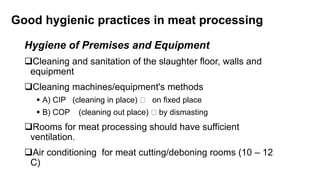
Hygiene of Premises and Equipment
Cleaning and sanitation of the slaughter floor, walls and
equipment
Cleaning machines/equipment's methods
 A) CIP (cleaning in place) on fixed place
 B) COP (cleaning out place) by dismasting
Rooms for meat processing should have sufficient
ventilation.
Air conditioning for meat cutting/deboning rooms (10 – 12
C)
Good hygienic practices in meat processing
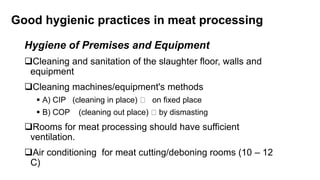
Hygiene of Premises and Equipment
Cleaning and sanitation of the slaughter floor, walls and
equipment
Cleaning machines/equipment's methods
 A) CIP (cleaning in place) on fixed place
 B) COP (cleaning out place) by dismasting
Rooms for meat processing should have sufficient
ventilation.
Air conditioning for meat cutting/deboning rooms (10 – 12
C)
HACCP in meat processing
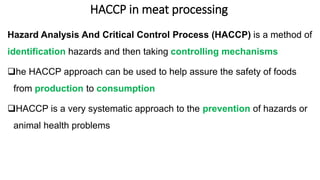
Hazard Analysis And Critical Control Process (HACCP) is a method of
identification hazards and then taking controlling mechanisms
he HACCP approach can be used to help assure the safety of foods
from production to consumption
HACCP is a very systematic approach to the prevention of hazards or
animal health problems
Basic elements of HACCP in meat processing plants
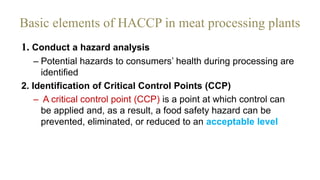
1. Conduct a hazard analysis
– Potential hazards to consumers’ health during processing are
identified
2. Identification of Critical Control Points (CCP)
– A critical control point (CCP) is a point at which control can
be applied and, as a result, a food safety hazard can be
prevented, eliminated, or reduced to an acceptable level
Basic elements of HACCP in meat processing plants
3. Establishment of Critical Limits for each CCP
– Establish CCP (the maximum or minimum value to which a physical,
biological, or chemical hazard must be controlled, values acceptable
from the point of view of product safety)
4. Establishment of a monitoring system for each CCP
– Monitoring activities are necessary to ensure that the
process is under control at each critical control point
– It is the regular/periodic measurement or observation at a
CCP
– Temperature, Time limits, pH, Moisture
Basic elements of HACCP in meat processing plants
5. Establish corrective actions
 Corrective actions is taken if a critical limit is not met and to ensure that no
product is injurious to health
– Reject incoming meat with too high internal temperatures
– Adjust temperature for refrigerated storage and transport of meat
– Remove with clean knives minimal visual contamination of meat
– surface, reject heavily contaminated meat
– Adjust cooking and sterilization parameters (temperature/time)
– In case of dry fermented products: If aw of processed products is too
– high, stop packaging in water vapour impermeable packages
Basic elements of HACCP in meat processing plants
6. Establish verification procedures for ensuring the HACCP system is
working as intended
– Verification ensures the HACCP plan is adequate, that is, working as intended
– Verification procedures may include such activities as review of HACCP plans, CCP
records, critical limits and microbial sampling and analysis.
7. Establish record keeping procedures (Documentation)
– Recordkeeping of the HACCP system and its implementation
– The output of the HACCP study (i.e. its CCPs, limits, targets, control
and monitoring procedures and corrective actions plus the personnel
involved, their authorities and responsibilities) should be documented
Sanitation and hygiene in meat processing.pptx

Sanitation and hygiene in meat processing.pptx

  • 1.
    College Of Engineeringand Technology Food Process Engineering Program Meat, poultry & fish processing technology For 3rdyear students By Mr. KedruDelil
  • 2.
    Meat Hygiene Introduction MeatHygiene refers to ensuring of safety and suitability of the meat at different stage Implemented by the competent authority based on specific standards and regulatory actions Practiced at different stages of production, processing and transportation Meat hygiene must include hygiene of personnel, slaughter & meat processing equipment's and environment Cleaning and sanitization practices such as disinfection of meat, plant premises, equipment's and storage area are also important to ensure meat hygiene and protects public health
  • 3.
    Meat Hygiene Introduction Cleaningand sanitization practices provide the necessary environment for proper meat handling and processing There are direct links between inadequate sanitation and the contamination of meat and poultry products with pathogenic bacteria Cross-contamination of these possible pathogens from the environment, from the employees, or from the equipment to the exposed product can be prevented with the application of proper sanitation and cleaning
  • 4.
    Objective of Maintainingmeat Hygiene Prevent quality losses and deterioration of the final processed meat products Ensure the health of people through production, distribution and consumption of save meat Promote national and international trade of meat Failure in maintaining meat hygiene may pose Serious public health hazards due to meat borne pathogens which can cause diseases of public health
  • 5.
    Scope of MeatHygiene Feeding System lairage slaughtering hygiene Dissection Meat cutting Meat handling Storage mechanisms /transportation Meat Consumption
  • 6.
    Principles of meathygiene There are three principles of meat hygiene, which are crucial for meat processing operations. 1. Prevention of microbial contamination during meat product manufacture by adopting proper cleaning and sanitation practices. 2. Minimization of microbial growth in meat products by storing them at a low temperature. 3. Reduction or elimination of the risk of microbial contamination by applying suitable heat treatment and packaging systems at the final processing stage
  • 7.
    Meat quality assurance MeatQuality assurance systems are Regulatory and non-regulatory institutions Responsible for ensuring the safety of meat focuses on prevention, elimination, control or reduction of hazards to acceptable levels throughout the meat production chain  Hazard is: A biological, chemical or physical agent in food with a potential to cause an adverse health effect
  • 8.
    Types of foodhazards Biological hazards: which are microorganisms (bacteria, viruses, yeast and molds) and their toxins that may be found in food Chemical hazards e.g. cleaning chemicals, pesticides, drug residues, heavy metals, allergens etc. Physical hazards e.g. foreign bodies such as stone, mud, glass, plastics and metals.
  • 9.
    Control measures (QualityAssurance System Approach ) Two useful schemes are usually adapted at various levels of meat production:  Good Hygienic Practices (GHP) and  Hazard Analysis and Critical Control Point (HACCP) Scheme.
  • 10.
    Good hygienic practicesin meat processing The microbial load/bacterial contamination can be kept as low as possible by applying GHP throughout the entire meat production and handling chain. These includes:-  Personnel hygiene Hygiene during meat processing Hygiene of Premises and Equipment
  • 11.
    Good hygienic practicesin meat processing Personnel Hygiene Wear appropriate protective clothing Wash hands regularly and sterilize knives and equipment's regularly using hot water No finger rings, watches, bracelets Periodic medical examinations of workers (every 6 months)
  • 12.
    Good hygienic practicesin meat processing Hygiene During Meat Processing Meat cutting should be in climatized rooms (approx. + 10 C) with low air humidity Remove rather than washing incase of coming-across a minor contaminated part during meat manufacturing And discard the whole meat in case of heavily contamination Avoid placing a fully processed meat on the floor but on the hygienic stands or pallets
  • 13.
    Good hygienic practicesin meat processing Hygiene of Premises and Equipment Cleaning and sanitation of the slaughter floor, walls and equipment Cleaning machines/equipment's methods  A) CIP (cleaning in place) on fixed place  B) COP (cleaning out place) by dismasting Rooms for meat processing should have sufficient ventilation. Air conditioning for meat cutting/deboning rooms (10 – 12 C)
  • 14.
    Good hygienic practicesin meat processing Hygiene of Premises and Equipment Cleaning and sanitation of the slaughter floor, walls and equipment Cleaning machines/equipment's methods  A) CIP (cleaning in place) on fixed place  B) COP (cleaning out place) by dismasting Rooms for meat processing should have sufficient ventilation. Air conditioning for meat cutting/deboning rooms (10 – 12 C)
  • 15.
    HACCP in meatprocessing Hazard Analysis And Critical Control Process (HACCP) is a method of identification hazards and then taking controlling mechanisms he HACCP approach can be used to help assure the safety of foods from production to consumption HACCP is a very systematic approach to the prevention of hazards or animal health problems
  • 16.
    Basic elements ofHACCP in meat processing plants 1. Conduct a hazard analysis – Potential hazards to consumers’ health during processing are identified 2. Identification of Critical Control Points (CCP) – A critical control point (CCP) is a point at which control can be applied and, as a result, a food safety hazard can be prevented, eliminated, or reduced to an acceptable level
  • 17.
    Basic elements ofHACCP in meat processing plants 3. Establishment of Critical Limits for each CCP – Establish CCP (the maximum or minimum value to which a physical, biological, or chemical hazard must be controlled, values acceptable from the point of view of product safety) 4. Establishment of a monitoring system for each CCP – Monitoring activities are necessary to ensure that the process is under control at each critical control point – It is the regular/periodic measurement or observation at a CCP – Temperature, Time limits, pH, Moisture
  • 18.
    Basic elements ofHACCP in meat processing plants 5. Establish corrective actions  Corrective actions is taken if a critical limit is not met and to ensure that no product is injurious to health – Reject incoming meat with too high internal temperatures – Adjust temperature for refrigerated storage and transport of meat – Remove with clean knives minimal visual contamination of meat – surface, reject heavily contaminated meat – Adjust cooking and sterilization parameters (temperature/time) – In case of dry fermented products: If aw of processed products is too – high, stop packaging in water vapour impermeable packages
  • 19.
    Basic elements ofHACCP in meat processing plants 6. Establish verification procedures for ensuring the HACCP system is working as intended – Verification ensures the HACCP plan is adequate, that is, working as intended – Verification procedures may include such activities as review of HACCP plans, CCP records, critical limits and microbial sampling and analysis. 7. Establish record keeping procedures (Documentation) – Recordkeeping of the HACCP system and its implementation – The output of the HACCP study (i.e. its CCPs, limits, targets, control and monitoring procedures and corrective actions plus the personnel involved, their authorities and responsibilities) should be documented