IOSR Journal of Mechanical and Civil Engineering (IOSR-JMCE)
e-ISSN: 2278-1684,p-ISSN: 2320-334X, Volume 13, Issue 4 Ver. II (Jul. - Aug. 2016), PP 57-62
www.iosrjournals.org
DOI: 10.9790/1684-1304025762 www.iosrjournals.org 57 | Page
Design And Fabrication Of Solar Powered Lithium Bromide
Vapour Absorption Refrigeration System
S.Arunkumar1
.B.E.,M.E.,R.Ragavendran2
.B.E., M.E
1, 2
(Assistant Professor: Dept of mechanical Engg Prathyusha Institute of Technology and Management
Thiruvallur, India)
Abstract: To perform or to make the surrounding or liquid substance lower than the atmospheric temperature
due to usage of LiBr-Water as working fluid in vapour absorption refrigeration system, which can be
successfully runs by the source of solar energy. The solar energy is stored in D.C battery via inverter then it is
utilized by the heating coil and pump. Through the solar energy and working fluid can able to achieve COP of
refrigeration up to 0.7 to 0.8 and also not only in industrial but also in commercial purpose is also able to
perform, it can be environmental pollution free from the while using solar powered lithium bromide and water
vapour absorption refrigeration system. absorption refrigeration cycle with fluids Libr-Water. The variation of
the Heat and Flow poor solution with generator temperature is obtained. The (COPs) solar co-efficient of
performance of the cycle and concentration load to heat Libr-Water solution going to the generator. The
performances of these three cycles against various generator, evaporator, and condenser temperatures are
compared. The results for Lithium bromide-water show that the cycles give better performance than the
ammonia-water cycle.
Keywords: Libr-Water solution, Lithium bromide-water
I. Introduction
Solar cooling is an attractive idea because cooling loads and availability of solar radiation are
approximately in phase. As the refrigeration system operates – pump work neglected without the need for
mechanical or electrical power, it is independent of electrical grids and thus may prevent in remote rural regions
the spoiling of agricultural products in storage due to the lack of refrigeration. That is why there is a high
demand for application of solar cooling for decentralised cold storage of food in the countries of the sun belt of
the earth.
Solar cooling uses solar thermal energy to power a refrigerator, which in order to preserve food has to
maintain temperatures lower than 5°C in the storage room. Heat operated cooling systems are well known.
Ammonia-water absorption refrigeration systems are normally preferred for low temperature applications. The
heat input for this system is required at temperatures higher than 90°C. Therefore high performance solar
collectors are needed to supply a sufficient solar energy input. Two main types of refrigeration systems are
Mechanical vapour compression and absorption refrigeration system. The mechanical vapour compression
system is outstanding due to its higher coefficient of performance, flexibility and compactness in manufacturing
and operation. However, the fact that it is generally powered by electricity results in the emission of a large
amount of CO2, which, in turn, causes the greenhouse effect. In addition, CFCs used as the working medium
seriously affect the ozone layer around the globe. The absorption system, powered by either electric or wasted
heat, is mainly used in large air conditioning and refrigeration systems. Owing to the environmental problem
caused by CFCs and the huge energy consumption of conventional cooling system, this novel solar powered
absorption refrigeration system has been developed. Novel solar powered absorption refrigeration system has
many advantages in refrigeration or heat pumping application such as: Materials are environmentally friendly,
chemically stable and the system can be powered by either solar energy or wasted heat.
II. Refrigeration
Refrigeration may be defined as the process of achieving and maintaining a temperature below that of
the surroundings, the aim being to cool some product or space to the required temperature. Refrigeration is a
process in which work is done to move heat from one location to another. The work of heat transport is
traditionally driven by mechanical work, but can also be driven by heat, magnetism, electricity, laser, or other
means. Refrigeration has many applications, including, but not limited to: household refrigerators, industrial
freezers, cryogenics, and air conditioning. Heat pumps may use the heat output of the refrigeration process, and
also may be designed to be reversible, but are otherwise similar to refrigeration units. One of the most important
applications of refrigeration has been the preservation of perishable food products by storing them at low
temperatures.
Design And Fabrication Of Solar Powered Lithium Bromide Vapour Absorption Refrigeration System
DOI: 10.9790/1684-1304025762 www.iosrjournals.org 58 | Page
2.1 Types of Refrigeration Systems
1 Air refrigeration system
2 Vapour compression refrigeration system (VCRS)
3 Vapour absorption refrigeration system (VARS)
4 Thermo-electric refrigeration system
5 Steam jet refrigeration system
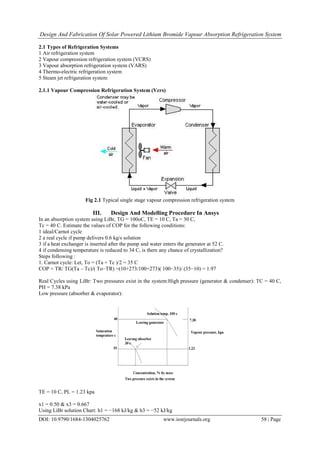
2.1.1 Vapour Compression Refrigeration System (Vcrs)
Fig 2.1 Typical single stage vapour compression refrigeration system
III. Design And Modelling Procedure In Ansys
In an absorption system using LiBr, TG = 100oC, TE = 10 C, Ta = 30 C,
Tc = 40 C. Estimate the values of COP for the following conditions:
1 ideal/Carnot cycle
2 a real cycle if pump delivers 0.6 kg/s solution
3 if a heat exchanger is inserted after the pump and water enters the generator at 52 C.
4 if condensing temperature is reduced to 34 C, is there any chance of crystallization?
Steps following :
1. Carnot cycle: Let, To = (Ta + Tc )/2 = 35 C
COP = TR/ TG(Ta – Tc)/( To−TR) =(10+273/100+273)( 100−35)/ (35−10) = 1.97
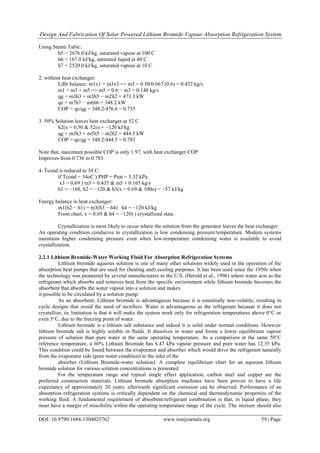
Real Cycles using LiBr: Two pressures exist in the system:High pressure (generator & condenser): TC = 40 C,
PH = 7.38 kPa
Low pressure (absorber & evaporator):
TE = 10 C, PL = 1.23 kpa
x1 = 0.50 & x3 = 0.667
Using LiBr solution Chart: h1 = −168 kJ/kg & h3 = −52 kJ/kg
Design And Fabrication Of Solar Powered Lithium Bromide Vapour Absorption Refrigeration System
DOI: 10.9790/1684-1304025762 www.iosrjournals.org 59 | Page
Using Steam Table:
h5 = 2676.0 kJ/kg, saturated vapour at 100 C
h6 = 167.0 kJ/kg, saturated liquid at 40 C
h7 = 2520.0 kJ/kg, saturated vapour at 10 C
2. without heat exchanger:
LiBr balance: m1x1 = m3x3 => m3 = 0.50/0.667 (0.6) = 0.452 kg/s
m1 = m3 + m5 => m5 = 0.6 − m3 = 0.148 kg/s
qg = m3h3 + m5h5 − m2h2 = 473.3 kW
qe = m7h7 − m6h6 = 348.2 kW
COP = qe/qg = 348.2/476.6 = 0.735
3. 50% Solution leaves heat exchanger at 52 C
h2(x = 0.50 & 52o) = −120 kJ/kg
qg = m3h3 + m5h5 − m2h2 = 444.5 kW
COP = qe/qg = 348.2/444.5 = 0.783
Note that, maximum possible COP is only 1.97, with heat exchanger COP
Improves from 0.736 to 0.783.
4. Tcond is reduced to 34 C:
if Tcond = 34oC ) PHP = Psat = 5.32 kPa.
x3 = 0.69 ) m3 = 0.435 & m5 = 0.165 kg/s
h1 = −168, h2 = −120 & h3(x = 0.69 & 100o) = −57 kJ/kg
Energy balance in heat exchanger:
m1(h2 − h1) = m3(h3 − h4) h4 = −120 kJ/kg
From chart, x = 0.69 & h4 = −120) ) crystallized state.
Crystallization is most likely to occur where the solution from the generator leaves the heat exchanger.
An operating condition conducive to crystallization is low condensing pressure/temperature. Modern systems
maintains higher condensing pressure even when low-temperature condensing water is available to avoid
crystallization.
2.2.1 Lithium Bromide-Water Working Fluid For Absorption Refrigeration Systems
Lithium bromide aqueous solution is one of many other solutions widely used in the operation of the
absorption heat pumps that are used for (heating and) cooling purposes. It has been used since the 1950s when
the technology was pioneered by several manufacturers in the U.S. (Herold et al., 1996) where water acts as the
refrigerant which absorbs and removes heat from the specific environment while lithium bromide becomes the
absorbent that absorbs the water vapour into a solution and makes
it possible to be circulated by a solution pump.
As an absorbent, Lithium bromide is advantageous because it is essentially non-volatile, resulting in
cycle designs that avoid the need of rectifiers. Water is advantageous as the refrigerant because it does not
crystallize; its limitation is that it will make the system work only for refrigeration temperatures above 0°C or
even 5°C, due to the freezing point of water.
Lithium bromide is a lithium salt substance and indeed it is solid under normal conditions. However
lithium bromide salt is highly soluble in fluids. It dissolves in water and forms a lower equilibrium vapour
pressure of solution than pure water at the same operating temperature. As a comparison at the same 50°C
reference temperature, a 60% Lithium Bromide has 6.47 kPa vapour pressure and pure water has 12.35 kPa.
This condition could be found between the evaporator and absorber which would drive the refrigerant naturally
from the evaporator side (pure water condition) to the inlet of the
absorber (Lithium Bromide-water solution). A complete equilibrium chart for an aqueous lithium
bromide solution for various solution concentrations is presented.
For the temperature range and typical single effect application, carbon steel and copper are the
preferred construction materials. Lithium bromide absorption machines have been proven to have a life
expectancy of approximately 20 years; afterwards significant corrosion can be observed. Performance of an
absorption refrigeration systems is critically dependent on the chemical and thermodynamic properties of the
working fluid. A fundamental requirement of absorbent/refrigerant combination is that, in liquid phase, they
must have a margin of miscibility within the operating temperature range of the cycle. The mixture should also
Design And Fabrication Of Solar Powered Lithium Bromide Vapour Absorption Refrigeration System
DOI: 10.9790/1684-1304025762 www.iosrjournals.org 60 | Page
be chemically stable, non-toxic, and non-explosive. In addition to these requirements, the following are
desirable. The elevation of boiling (the difference in boiling point between the pure refrigerant and the mixture
at the same pressure) should be as large as possible. Refrigerant should have high heat of vaporization and high
concentration within the absorbent in order to maintain low circulation rate between the generator and the
absorber per unit of cooling capacity.
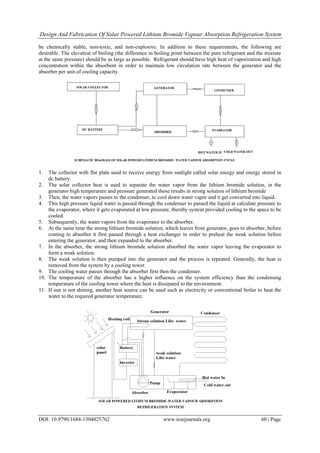
1. The collector with flat plate used to receive energy from sunlight called solar energy and energy stored in
dc battery.
2. The solar collector heat is used to separate the water vapor from the lithium bromide solution, in the
generator high temperature and pressure generated those results in strong solution of lithium bromide
3. Then, the water vapors passes to the condenser, to cool down water vapor and it get converted into liquid.
4. This high pressure liquid water is passed through the condenser to passed the liquid at calculate pressure to
the evaporator, where it gets evaporated at low pressure, thereby system provided cooling to the space to be
cooled.
5. Subsequently, the water vapors from the evaporator to the absorber.
6. At the same time the strong lithium bromide solution, which leaves from generator, goes to absorber, before
coming to absorber it first passed through a heat exchanger in order to preheat the weak solution before
entering the generator, and then expanded to the absorber.
7. In the absorber, the strong lithium bromide solution absorbed the water vapor leaving the evaporator to
form a weak solution.
8. The weak solution is then pumped into the generator and the process is repeated. Generally, the heat is
removed from the system by a cooling tower.
9. The cooling water passes through the absorber first then the condenser.
10. The temperature of the absorber has a higher influence on the system efficiency than the condensing
temperature of the cooling tower where the heat is dissipated to the environment.
11. If sun is not shining, another heat source can be used such as electricity or conventional boiler to heat the
water to the required generator temperature.
Design And Fabrication Of Solar Powered Lithium Bromide Vapour Absorption Refrigeration System
DOI: 10.9790/1684-1304025762 www.iosrjournals.org 61 | Page
IV. Discussion
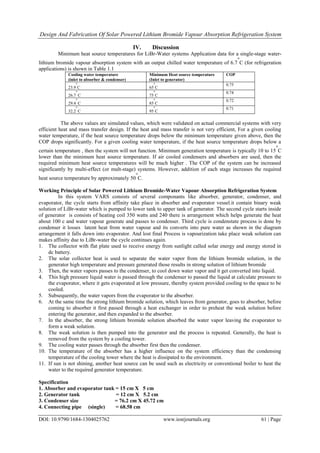
Minimum heat source temperatures for LiBr-Water systems Application data for a single-stage water-
lithium bromide vapour absorption system with an output chilled water temperature of 6.7
o
C (for refrigeration
applications) is shown in Table 1.1
Cooling water temperature
(inlet to absorber & condenser)
Minimum Heat source temperature
(Inlet to generator)
COP
23.9
o
C 65
o
C
0.75
26.7
o
C 75
o
C
0.74
29.4
o
C 85
o
C
0.72
32.2
o
C 95
o
C
0.71
The above values are simulated values, which were validated on actual commercial systems with very
efficient heat and mass transfer design. If the heat and mass transfer is not very efficient, For a given cooling
water temperature, if the heat source temperature drops below the minimum temperature given above, then the
COP drops significantly. For a given cooling water temperature, if the heat source temperature drops below a
certain temperature , then the system will not function. Minimum generation temperature is typically 10 to 15
o
C
lower than the minimum heat source temperature. If air cooled condensers and absorbers are used, then the
required minimum heat source temperatures will be much higher . The COP of the system can be increased
significantly by multi-effect (or mult-stage) systems. However, addition of each stage increases the required
heat source temperature by approximately 50
o
C.
Working Principle of Solar Powered Lithium Bromide-Water Vapour Absorption Refrigeration System
In this system VARS consists of several componants like absorber, generator, condenser, and
evaporator, the cycle starts from affinity take place in absorber and evaporator vessel.it contain binary weak
solution of LiBr-water which is pumped to lower tank to upper tank of generator. The second cycle starts inside
of generator is consists of heating coil 350 watts and 240 there is arrangement which helps generate the heat
about 100 c and water vapour generate and passes to condenser. Third cycle is condenstate process is done by
condenser it losses latent heat from water vapour and its converts into pure water as shown in the diagram
arrangement it falls down into evaporator. And lost final Process is vapourization take place weak solution can
makes affinity due to LiBr-water the cycle continues again.
1. The collector with flat plate used to receive energy from sunlight called solar energy and energy stored in
dc battery.
2. The solar collector heat is used to separate the water vapor from the lithium bromide solution, in the
generator high temperature and pressure generated those results in strong solution of lithium bromide
3. Then, the water vapors passes to the condenser, to cool down water vapor and it get converted into liquid.
4. This high pressure liquid water is passed through the condenser to passed the liquid at calculate pressure to
the evaporator, where it gets evaporated at low pressure, thereby system provided cooling to the space to be
cooled.
5. Subsequently, the water vapors from the evaporator to the absorber.
6. At the same time the strong lithium bromide solution, which leaves from generator, goes to absorber, before
coming to absorber it first passed through a heat exchanger in order to preheat the weak solution before
entering the generator, and then expanded to the absorber.
7. In the absorber, the strong lithium bromide solution absorbed the water vapor leaving the evaporator to
form a weak solution.
8. The weak solution is then pumped into the generator and the process is repeated. Generally, the heat is
removed from the system by a cooling tower.
9. The cooling water passes through the absorber first then the condenser.
10. The temperature of the absorber has a higher influence on the system efficiency than the condensing
temperature of the cooling tower where the heat is dissipated to the environment.
11. If sun is not shining, another heat source can be used such as electricity or conventional boiler to heat the
water to the required generator temperature.
Specification
1. Absorber and evaporator tank = 15 cm X 5 cm
2. Generator tank = 12 cm X 5.2 cm
3. Condenser size = 76.2 cm X 45.72 cm
4. Connecting pipe (single) = 68.58 cm
Design And Fabrication Of Solar Powered Lithium Bromide Vapour Absorption Refrigeration System
DOI: 10.9790/1684-1304025762 www.iosrjournals.org 62 | Page
5. Pump = 120 v and 10 watts
6. D.C battery = 12 v and 9 amp
7. Inverter = 850 watts and 230 v
8. Heating coil = 350 watts and 120 v
9. LiBR salt = 500 kg
VI. Conclusion
The following conclusions:
1. The maximum generator temperature was found to be 97 °C.
2. The range of C.O.P for the aqueous LiBr-water system was (0.735 – 0.8).
3. The range of minimum evaporator temperature was (5°C - 10°C).
4. Cooling ratio and cooling obtainable increases with increasing maximum generator temperature and pressure.
5. The Final concentration decreases with increasing maximum generator temperature and pressure.
References
[1]. BajpaiV.K ,Design of Solar Powered Vapour Absorption System, Proceedings of the World Congress on Engineering ,Vol III,2012.
[2]. Jasim M. Abdulateef, Kamaruzzaman Sopian, M. A. Alghoul, MohdYusof Sulaiman,AzamiZaharim and Ibrahim Ahmad, Solar
Absorption Refrigeration System Using New Working Fluid Pairs, international journal of energy, Issue 3, Vol. 1, 2007
[3]. Syed A.M. Said, Maged A.I. El-Shaarawi, Muhammad U. Siddiqui, Alternative designs for a 24-h operating solar-powered
absorption refrigeration technology, International journal of refrigeration 35 (2012).
[4]. S.LakshmiSowjanya 2013, Thermal Analysis of a Car Air Conditioning System Based on An Absorption Refrigeration Cycle Using
Energy From Exhaust Gas Of An I.C Engine, Advanced Engineering And Applied An International Journal ISSN 2320–
3927S.C.Pang,N,H.H.Masjuk,M.A.Kalam,M.A.Hazrat 2013, A Review on Renewable and sustainable energy reviews Liquid
Absorption And Solid Absorption System For Household, Industrial And Automobile Applications: 28,836– 847
[5]. SohailBux, A.C. Tiwari 2014, Natural Refrigerants Based Automobile Air Conditioning System, International Journal of Emerging
Science and Engineering (IJESE) ISSN: 2319–6378, Volume-2.
[6]. Poberžnik S.; Goricanec D.; Krope J.,Traditional vs. alternative energy house heating source, Proceedings of the 2ndIASME /
WSEAS International Conferenceon Energy & Environment (EE'07), Portoroz,n Slovenia, May 15- 17, 2007
[7]. Feng X.; Goswami D. Y., ThermodynamicProperties of ammonia-water mixtures forPower-cycle application, Energy, 24, 1999, pp.
525-536.
[8]. Mohideen S. T.; Renganarayanan S., Heat and mass transfer studies on 134 A-DMAC based falling film absorbers for absorption
refrigeration system, Proceedings of the 4thWSEAS Int. Conf. on HEAT TRANSFER,THERMA ENGINEERING
andENVIRONMENT, Elounda, Greece, August 21- 23, 2006, pp. 342-350.
[9]. Romero R. J.;Guillen L.; Pilatowsky I.,Monomethylamine-water vapour absorption refrigeration system.

H1304025762

  • 1.
    IOSR Journal ofMechanical and Civil Engineering (IOSR-JMCE) e-ISSN: 2278-1684,p-ISSN: 2320-334X, Volume 13, Issue 4 Ver. II (Jul. - Aug. 2016), PP 57-62 www.iosrjournals.org DOI: 10.9790/1684-1304025762 www.iosrjournals.org 57 | Page Design And Fabrication Of Solar Powered Lithium Bromide Vapour Absorption Refrigeration System S.Arunkumar1 .B.E.,M.E.,R.Ragavendran2 .B.E., M.E 1, 2 (Assistant Professor: Dept of mechanical Engg Prathyusha Institute of Technology and Management Thiruvallur, India) Abstract: To perform or to make the surrounding or liquid substance lower than the atmospheric temperature due to usage of LiBr-Water as working fluid in vapour absorption refrigeration system, which can be successfully runs by the source of solar energy. The solar energy is stored in D.C battery via inverter then it is utilized by the heating coil and pump. Through the solar energy and working fluid can able to achieve COP of refrigeration up to 0.7 to 0.8 and also not only in industrial but also in commercial purpose is also able to perform, it can be environmental pollution free from the while using solar powered lithium bromide and water vapour absorption refrigeration system. absorption refrigeration cycle with fluids Libr-Water. The variation of the Heat and Flow poor solution with generator temperature is obtained. The (COPs) solar co-efficient of performance of the cycle and concentration load to heat Libr-Water solution going to the generator. The performances of these three cycles against various generator, evaporator, and condenser temperatures are compared. The results for Lithium bromide-water show that the cycles give better performance than the ammonia-water cycle. Keywords: Libr-Water solution, Lithium bromide-water I. Introduction Solar cooling is an attractive idea because cooling loads and availability of solar radiation are approximately in phase. As the refrigeration system operates – pump work neglected without the need for mechanical or electrical power, it is independent of electrical grids and thus may prevent in remote rural regions the spoiling of agricultural products in storage due to the lack of refrigeration. That is why there is a high demand for application of solar cooling for decentralised cold storage of food in the countries of the sun belt of the earth. Solar cooling uses solar thermal energy to power a refrigerator, which in order to preserve food has to maintain temperatures lower than 5°C in the storage room. Heat operated cooling systems are well known. Ammonia-water absorption refrigeration systems are normally preferred for low temperature applications. The heat input for this system is required at temperatures higher than 90°C. Therefore high performance solar collectors are needed to supply a sufficient solar energy input. Two main types of refrigeration systems are Mechanical vapour compression and absorption refrigeration system. The mechanical vapour compression system is outstanding due to its higher coefficient of performance, flexibility and compactness in manufacturing and operation. However, the fact that it is generally powered by electricity results in the emission of a large amount of CO2, which, in turn, causes the greenhouse effect. In addition, CFCs used as the working medium seriously affect the ozone layer around the globe. The absorption system, powered by either electric or wasted heat, is mainly used in large air conditioning and refrigeration systems. Owing to the environmental problem caused by CFCs and the huge energy consumption of conventional cooling system, this novel solar powered absorption refrigeration system has been developed. Novel solar powered absorption refrigeration system has many advantages in refrigeration or heat pumping application such as: Materials are environmentally friendly, chemically stable and the system can be powered by either solar energy or wasted heat. II. Refrigeration Refrigeration may be defined as the process of achieving and maintaining a temperature below that of the surroundings, the aim being to cool some product or space to the required temperature. Refrigeration is a process in which work is done to move heat from one location to another. The work of heat transport is traditionally driven by mechanical work, but can also be driven by heat, magnetism, electricity, laser, or other means. Refrigeration has many applications, including, but not limited to: household refrigerators, industrial freezers, cryogenics, and air conditioning. Heat pumps may use the heat output of the refrigeration process, and also may be designed to be reversible, but are otherwise similar to refrigeration units. One of the most important applications of refrigeration has been the preservation of perishable food products by storing them at low temperatures.
  • 2.
    Design And FabricationOf Solar Powered Lithium Bromide Vapour Absorption Refrigeration System DOI: 10.9790/1684-1304025762 www.iosrjournals.org 58 | Page 2.1 Types of Refrigeration Systems 1 Air refrigeration system 2 Vapour compression refrigeration system (VCRS) 3 Vapour absorption refrigeration system (VARS) 4 Thermo-electric refrigeration system 5 Steam jet refrigeration system 2.1.1 Vapour Compression Refrigeration System (Vcrs) Fig 2.1 Typical single stage vapour compression refrigeration system III. Design And Modelling Procedure In Ansys In an absorption system using LiBr, TG = 100oC, TE = 10 C, Ta = 30 C, Tc = 40 C. Estimate the values of COP for the following conditions: 1 ideal/Carnot cycle 2 a real cycle if pump delivers 0.6 kg/s solution 3 if a heat exchanger is inserted after the pump and water enters the generator at 52 C. 4 if condensing temperature is reduced to 34 C, is there any chance of crystallization? Steps following : 1. Carnot cycle: Let, To = (Ta + Tc )/2 = 35 C COP = TR/ TG(Ta – Tc)/( To−TR) =(10+273/100+273)( 100−35)/ (35−10) = 1.97 Real Cycles using LiBr: Two pressures exist in the system:High pressure (generator & condenser): TC = 40 C, PH = 7.38 kPa Low pressure (absorber & evaporator): TE = 10 C, PL = 1.23 kpa x1 = 0.50 & x3 = 0.667 Using LiBr solution Chart: h1 = −168 kJ/kg & h3 = −52 kJ/kg
  • 3.
    Design And FabricationOf Solar Powered Lithium Bromide Vapour Absorption Refrigeration System DOI: 10.9790/1684-1304025762 www.iosrjournals.org 59 | Page Using Steam Table: h5 = 2676.0 kJ/kg, saturated vapour at 100 C h6 = 167.0 kJ/kg, saturated liquid at 40 C h7 = 2520.0 kJ/kg, saturated vapour at 10 C 2. without heat exchanger: LiBr balance: m1x1 = m3x3 => m3 = 0.50/0.667 (0.6) = 0.452 kg/s m1 = m3 + m5 => m5 = 0.6 − m3 = 0.148 kg/s qg = m3h3 + m5h5 − m2h2 = 473.3 kW qe = m7h7 − m6h6 = 348.2 kW COP = qe/qg = 348.2/476.6 = 0.735 3. 50% Solution leaves heat exchanger at 52 C h2(x = 0.50 & 52o) = −120 kJ/kg qg = m3h3 + m5h5 − m2h2 = 444.5 kW COP = qe/qg = 348.2/444.5 = 0.783 Note that, maximum possible COP is only 1.97, with heat exchanger COP Improves from 0.736 to 0.783. 4. Tcond is reduced to 34 C: if Tcond = 34oC ) PHP = Psat = 5.32 kPa. x3 = 0.69 ) m3 = 0.435 & m5 = 0.165 kg/s h1 = −168, h2 = −120 & h3(x = 0.69 & 100o) = −57 kJ/kg Energy balance in heat exchanger: m1(h2 − h1) = m3(h3 − h4) h4 = −120 kJ/kg From chart, x = 0.69 & h4 = −120) ) crystallized state. Crystallization is most likely to occur where the solution from the generator leaves the heat exchanger. An operating condition conducive to crystallization is low condensing pressure/temperature. Modern systems maintains higher condensing pressure even when low-temperature condensing water is available to avoid crystallization. 2.2.1 Lithium Bromide-Water Working Fluid For Absorption Refrigeration Systems Lithium bromide aqueous solution is one of many other solutions widely used in the operation of the absorption heat pumps that are used for (heating and) cooling purposes. It has been used since the 1950s when the technology was pioneered by several manufacturers in the U.S. (Herold et al., 1996) where water acts as the refrigerant which absorbs and removes heat from the specific environment while lithium bromide becomes the absorbent that absorbs the water vapour into a solution and makes it possible to be circulated by a solution pump. As an absorbent, Lithium bromide is advantageous because it is essentially non-volatile, resulting in cycle designs that avoid the need of rectifiers. Water is advantageous as the refrigerant because it does not crystallize; its limitation is that it will make the system work only for refrigeration temperatures above 0°C or even 5°C, due to the freezing point of water. Lithium bromide is a lithium salt substance and indeed it is solid under normal conditions. However lithium bromide salt is highly soluble in fluids. It dissolves in water and forms a lower equilibrium vapour pressure of solution than pure water at the same operating temperature. As a comparison at the same 50°C reference temperature, a 60% Lithium Bromide has 6.47 kPa vapour pressure and pure water has 12.35 kPa. This condition could be found between the evaporator and absorber which would drive the refrigerant naturally from the evaporator side (pure water condition) to the inlet of the absorber (Lithium Bromide-water solution). A complete equilibrium chart for an aqueous lithium bromide solution for various solution concentrations is presented. For the temperature range and typical single effect application, carbon steel and copper are the preferred construction materials. Lithium bromide absorption machines have been proven to have a life expectancy of approximately 20 years; afterwards significant corrosion can be observed. Performance of an absorption refrigeration systems is critically dependent on the chemical and thermodynamic properties of the working fluid. A fundamental requirement of absorbent/refrigerant combination is that, in liquid phase, they must have a margin of miscibility within the operating temperature range of the cycle. The mixture should also
  • 4.
    Design And FabricationOf Solar Powered Lithium Bromide Vapour Absorption Refrigeration System DOI: 10.9790/1684-1304025762 www.iosrjournals.org 60 | Page be chemically stable, non-toxic, and non-explosive. In addition to these requirements, the following are desirable. The elevation of boiling (the difference in boiling point between the pure refrigerant and the mixture at the same pressure) should be as large as possible. Refrigerant should have high heat of vaporization and high concentration within the absorbent in order to maintain low circulation rate between the generator and the absorber per unit of cooling capacity. 1. The collector with flat plate used to receive energy from sunlight called solar energy and energy stored in dc battery. 2. The solar collector heat is used to separate the water vapor from the lithium bromide solution, in the generator high temperature and pressure generated those results in strong solution of lithium bromide 3. Then, the water vapors passes to the condenser, to cool down water vapor and it get converted into liquid. 4. This high pressure liquid water is passed through the condenser to passed the liquid at calculate pressure to the evaporator, where it gets evaporated at low pressure, thereby system provided cooling to the space to be cooled. 5. Subsequently, the water vapors from the evaporator to the absorber. 6. At the same time the strong lithium bromide solution, which leaves from generator, goes to absorber, before coming to absorber it first passed through a heat exchanger in order to preheat the weak solution before entering the generator, and then expanded to the absorber. 7. In the absorber, the strong lithium bromide solution absorbed the water vapor leaving the evaporator to form a weak solution. 8. The weak solution is then pumped into the generator and the process is repeated. Generally, the heat is removed from the system by a cooling tower. 9. The cooling water passes through the absorber first then the condenser. 10. The temperature of the absorber has a higher influence on the system efficiency than the condensing temperature of the cooling tower where the heat is dissipated to the environment. 11. If sun is not shining, another heat source can be used such as electricity or conventional boiler to heat the water to the required generator temperature.
  • 5.
    Design And FabricationOf Solar Powered Lithium Bromide Vapour Absorption Refrigeration System DOI: 10.9790/1684-1304025762 www.iosrjournals.org 61 | Page IV. Discussion Minimum heat source temperatures for LiBr-Water systems Application data for a single-stage water- lithium bromide vapour absorption system with an output chilled water temperature of 6.7 o C (for refrigeration applications) is shown in Table 1.1 Cooling water temperature (inlet to absorber & condenser) Minimum Heat source temperature (Inlet to generator) COP 23.9 o C 65 o C 0.75 26.7 o C 75 o C 0.74 29.4 o C 85 o C 0.72 32.2 o C 95 o C 0.71 The above values are simulated values, which were validated on actual commercial systems with very efficient heat and mass transfer design. If the heat and mass transfer is not very efficient, For a given cooling water temperature, if the heat source temperature drops below the minimum temperature given above, then the COP drops significantly. For a given cooling water temperature, if the heat source temperature drops below a certain temperature , then the system will not function. Minimum generation temperature is typically 10 to 15 o C lower than the minimum heat source temperature. If air cooled condensers and absorbers are used, then the required minimum heat source temperatures will be much higher . The COP of the system can be increased significantly by multi-effect (or mult-stage) systems. However, addition of each stage increases the required heat source temperature by approximately 50 o C. Working Principle of Solar Powered Lithium Bromide-Water Vapour Absorption Refrigeration System In this system VARS consists of several componants like absorber, generator, condenser, and evaporator, the cycle starts from affinity take place in absorber and evaporator vessel.it contain binary weak solution of LiBr-water which is pumped to lower tank to upper tank of generator. The second cycle starts inside of generator is consists of heating coil 350 watts and 240 there is arrangement which helps generate the heat about 100 c and water vapour generate and passes to condenser. Third cycle is condenstate process is done by condenser it losses latent heat from water vapour and its converts into pure water as shown in the diagram arrangement it falls down into evaporator. And lost final Process is vapourization take place weak solution can makes affinity due to LiBr-water the cycle continues again. 1. The collector with flat plate used to receive energy from sunlight called solar energy and energy stored in dc battery. 2. The solar collector heat is used to separate the water vapor from the lithium bromide solution, in the generator high temperature and pressure generated those results in strong solution of lithium bromide 3. Then, the water vapors passes to the condenser, to cool down water vapor and it get converted into liquid. 4. This high pressure liquid water is passed through the condenser to passed the liquid at calculate pressure to the evaporator, where it gets evaporated at low pressure, thereby system provided cooling to the space to be cooled. 5. Subsequently, the water vapors from the evaporator to the absorber. 6. At the same time the strong lithium bromide solution, which leaves from generator, goes to absorber, before coming to absorber it first passed through a heat exchanger in order to preheat the weak solution before entering the generator, and then expanded to the absorber. 7. In the absorber, the strong lithium bromide solution absorbed the water vapor leaving the evaporator to form a weak solution. 8. The weak solution is then pumped into the generator and the process is repeated. Generally, the heat is removed from the system by a cooling tower. 9. The cooling water passes through the absorber first then the condenser. 10. The temperature of the absorber has a higher influence on the system efficiency than the condensing temperature of the cooling tower where the heat is dissipated to the environment. 11. If sun is not shining, another heat source can be used such as electricity or conventional boiler to heat the water to the required generator temperature. Specification 1. Absorber and evaporator tank = 15 cm X 5 cm 2. Generator tank = 12 cm X 5.2 cm 3. Condenser size = 76.2 cm X 45.72 cm 4. Connecting pipe (single) = 68.58 cm
  • 6.
    Design And FabricationOf Solar Powered Lithium Bromide Vapour Absorption Refrigeration System DOI: 10.9790/1684-1304025762 www.iosrjournals.org 62 | Page 5. Pump = 120 v and 10 watts 6. D.C battery = 12 v and 9 amp 7. Inverter = 850 watts and 230 v 8. Heating coil = 350 watts and 120 v 9. LiBR salt = 500 kg VI. Conclusion The following conclusions: 1. The maximum generator temperature was found to be 97 °C. 2. The range of C.O.P for the aqueous LiBr-water system was (0.735 – 0.8). 3. The range of minimum evaporator temperature was (5°C - 10°C). 4. Cooling ratio and cooling obtainable increases with increasing maximum generator temperature and pressure. 5. The Final concentration decreases with increasing maximum generator temperature and pressure. References [1]. BajpaiV.K ,Design of Solar Powered Vapour Absorption System, Proceedings of the World Congress on Engineering ,Vol III,2012. [2]. Jasim M. Abdulateef, Kamaruzzaman Sopian, M. A. Alghoul, MohdYusof Sulaiman,AzamiZaharim and Ibrahim Ahmad, Solar Absorption Refrigeration System Using New Working Fluid Pairs, international journal of energy, Issue 3, Vol. 1, 2007 [3]. Syed A.M. Said, Maged A.I. El-Shaarawi, Muhammad U. Siddiqui, Alternative designs for a 24-h operating solar-powered absorption refrigeration technology, International journal of refrigeration 35 (2012). [4]. S.LakshmiSowjanya 2013, Thermal Analysis of a Car Air Conditioning System Based on An Absorption Refrigeration Cycle Using Energy From Exhaust Gas Of An I.C Engine, Advanced Engineering And Applied An International Journal ISSN 2320– 3927S.C.Pang,N,H.H.Masjuk,M.A.Kalam,M.A.Hazrat 2013, A Review on Renewable and sustainable energy reviews Liquid Absorption And Solid Absorption System For Household, Industrial And Automobile Applications: 28,836– 847 [5]. SohailBux, A.C. Tiwari 2014, Natural Refrigerants Based Automobile Air Conditioning System, International Journal of Emerging Science and Engineering (IJESE) ISSN: 2319–6378, Volume-2. [6]. Poberžnik S.; Goricanec D.; Krope J.,Traditional vs. alternative energy house heating source, Proceedings of the 2ndIASME / WSEAS International Conferenceon Energy & Environment (EE'07), Portoroz,n Slovenia, May 15- 17, 2007 [7]. Feng X.; Goswami D. Y., ThermodynamicProperties of ammonia-water mixtures forPower-cycle application, Energy, 24, 1999, pp. 525-536. [8]. Mohideen S. T.; Renganarayanan S., Heat and mass transfer studies on 134 A-DMAC based falling film absorbers for absorption refrigeration system, Proceedings of the 4thWSEAS Int. Conf. on HEAT TRANSFER,THERMA ENGINEERING andENVIRONMENT, Elounda, Greece, August 21- 23, 2006, pp. 342-350. [9]. Romero R. J.;Guillen L.; Pilatowsky I.,Monomethylamine-water vapour absorption refrigeration system.