GYPSUM
INTRODUCTION
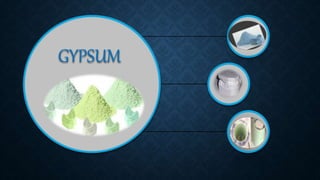
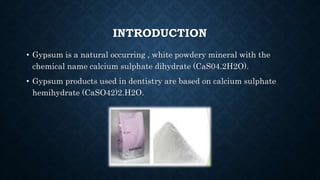
• Gypsum is a natural occurring , white powdery mineral with the
chemical name calcium sulphate dihydrate (CaS04.2H2O).
• Gypsum products used in dentistry are based on calcium sulphate
hemihydrate (CaSO42)2.H2O.
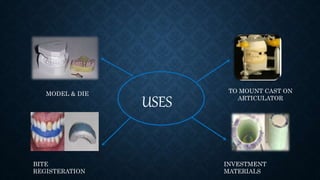
USES
MODEL & DIE
BITE
REGISTERATION
TO MOUNT CAST ON
ARTICULATOR
INVESTMENT
MATERIALS
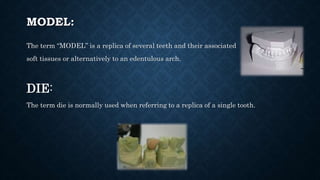
MODEL:
The term “MODEL” is a replica of several teeth and their associated
soft tissues or alternatively to an edentulous arch.
DIE:
The term die is normally used when referring to a replica of a single tooth.
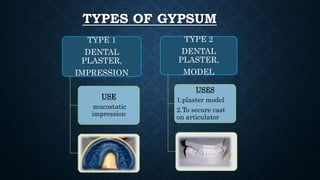
TYPE 1
DENTAL
PLASTER,
IMPRESSION
USE
mucostatic
impression
TYPE 2
DENTAL
PLASTER,
MODEL
USES
1.plaster model
2.To secure cast
on articulator
TYPES OF GYPSUM
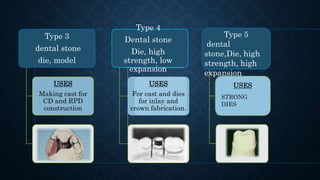
Type 3
dental stone
die, model
USES
Making cast for
CD and RPD
construction
Type 4
Dental stone
Die, high
strength, low
expansion
USES
For cast and dies
for inlay and
crown fabrication.
Type 5
dental
stone,Die, high
strength, high
expansion
USES
STRONG
DIES
1. dimensional accuracy
2. adequate mechanical properties
3. The material should be fluid at the time it is poured into the impression so that fine detail
can be recorded.
4. The set material should be strong to resist accidental fracture and hard enough to resist
abrasion during the carving of a wax pattern.
COMPOSITION
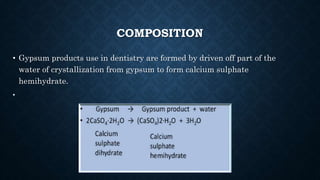
• Gypsum products use in dentistry are formed by driven off part of the
water of crystallization from gypsum to form calcium sulphate
hemihydrate.
•
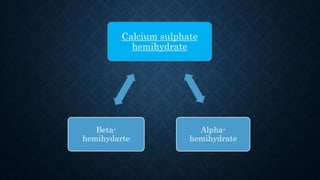
Calcium sulphate
hemihydrate
Alpha-
hemihydrate
Beta-
hemihydarte
DENTAL PLASTER
• It is also called plaster of paris.
• It is produce by process called calcination.
• Beta hemihydrate- Type I , II are fibrous aggregate of fine crystals with capillary pores. Fluffy
porous and least dense
CaSO4.2H2O 110-120oC CaSO4.1/2 H2O CaSO4 130-200oC CaSO4
gypsum B - hemihydrate
anhydrite
Beta hemihydrate
DENTAL PLASTER
DENTAL STONE
• Dental stone. a calcined gypsum derivative similar to but stronger than Plaster of
Paris, used for making dental casts and dies. Also called artificial stone.
• . Alpha hemihydrate- Type III, IV, V cleavage fragments and crystals in form of rods
or prisms Higher density and more crystalline
DENTAL STONE
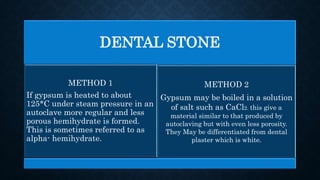
METHOD 1
If gypsum is heated to about
125*C under steam pressure in an
autoclave more regular and less
porous hemihydrate is formed.
This is sometimes referred to as
alpha- hemihydrate.
METHOD 2
Gypsum may be boiled in a solution
of salt such as CaCl2. this give a
material similar to that produced by
autoclaving but with even less porosity.
They May be differentiated from dental
plaster which is white.
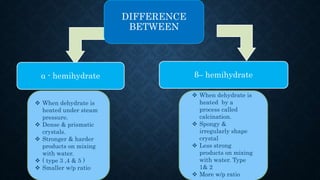
DIFFERENCE
BETWEEN
β– hemihydrateα - hemihydrate
 When dehydrate is
heated under steam
pressure.
 Dense & prismatic
crystals.
 Stronger & harder
products on mixing
with water.
 ( type 3 ,4 & 5 )
 Smaller w/p ratio
 When dehydrate is
heated by a
process called
calcination.
 Spongy &
irregularly shape
crystal
 Less strong
products on mixing
with water. Type
1& 2
 More w/p ratio
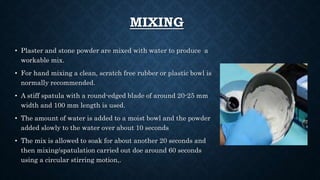
MIXING
• Plaster and stone powder are mixed with water to produce a
workable mix.
• For hand mixing a clean, scratch free rubber or plastic bowl is
normally recommended.
• A stiff spatula with a round-edged blade of around 20-25 mm
width and 100 mm length is used.
• The amount of water is added to a moist bowl and the powder
added slowly to the water over about 10 seconds
• The mix is allowed to soak for about another 20 seconds and
then mixing/spatulation carried out doe around 60 seconds
using a circular stirring motion,.
SETTING PROCESS
• The setting process begins rapidly after mixing the powder and water.
• The first stage : the water becomes saturated with hemihydrate, which has a solubility
of around 0.8% at room temperature. The dissolved hemihydrate is then rapidly
converted to dihydrate which has a much lower solubility of around 0.2%.
• The material should be used as soon as possible after mixing since its viscosity
increases to the stage where the material is unworkable within a few minutes.
• Potassium sulphate is a commonly used accelerator which is thought to act by
increasing the solubility of the hemihydrate .
• Borax is the most widely used retarder .
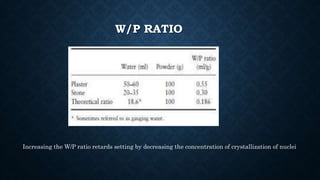
W/P RATIO
Increasing the W/P ratio retards setting by decreasing the concentration of crystallization of nuclei
PROPERTIES OF SET MATERIALS
• Gypsum is a very brittle material.
• The strength of gypsum depends on the porosity of set material.
• Stone is always mixed at lower W/P ratio, it is less porous much stronger and
harder.
• Solubility increases with the temperature of the water.
• Stone is less fragile but must be treated with care if fracture is to be avoided.
• Dimensional stability of gypsum is good.
SETTING TIME
• Setting time of gypsum is controlled by 2 factors :
• MANUFACTURERS :
• It may add chemical accelerators (potassium sulphate) or retarders
(borax)
• Gypsum products required the use of VICAT needle for judging setting
time.
• OPERATOR :
• Temperature , W/P ratio , and mixing time
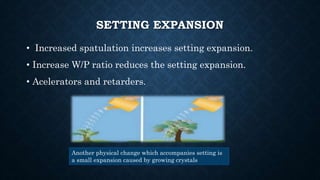
SETTING EXPANSION
• Increased spatulation increases setting expansion.
• Increase W/P ratio reduces the setting expansion.
• Acelerators and retarders.
Another physical change which accompanies setting is
a small expansion caused by growing crystals
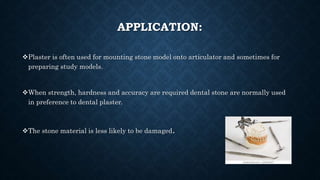
APPLICATION:
Plaster is often used for mounting stone model onto articulator and sometimes for
preparing study models.
When strength, hardness and accuracy are required dental stone are normally used
in preference to dental plaster.
The stone material is less likely to be damaged.
ADVANTAGES
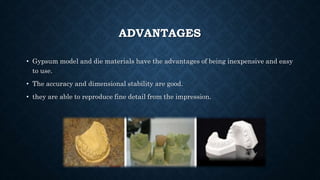
• Gypsum model and die materials have the advantages of being inexpensive and easy
to use.
• The accuracy and dimensional stability are good.
• they are able to reproduce fine detail from the impression.
DISADVANTAGES
• The mechanical properties are not ideal and the brittle nature of gypsum occasionally
leads to fracture- particularly through the teeth, which form the weakest part of any
model.
• Problems occasionally arise when gypsum model and die materials are used in
conjunction with alginate impression.
THANK YOU

gypsum

  • 1.
  • 2.
    INTRODUCTION • Gypsum isa natural occurring , white powdery mineral with the chemical name calcium sulphate dihydrate (CaS04.2H2O). • Gypsum products used in dentistry are based on calcium sulphate hemihydrate (CaSO42)2.H2O.
  • 3.
    USES MODEL & DIE BITE REGISTERATION TOMOUNT CAST ON ARTICULATOR INVESTMENT MATERIALS
  • 4.
    MODEL: The term “MODEL”is a replica of several teeth and their associated soft tissues or alternatively to an edentulous arch. DIE: The term die is normally used when referring to a replica of a single tooth.
  • 5.
  • 6.
    Type 3 dental stone die,model USES Making cast for CD and RPD construction Type 4 Dental stone Die, high strength, low expansion USES For cast and dies for inlay and crown fabrication. Type 5 dental stone,Die, high strength, high expansion USES STRONG DIES
  • 7.
    1. dimensional accuracy 2.adequate mechanical properties 3. The material should be fluid at the time it is poured into the impression so that fine detail can be recorded. 4. The set material should be strong to resist accidental fracture and hard enough to resist abrasion during the carving of a wax pattern.
  • 8.
    COMPOSITION • Gypsum productsuse in dentistry are formed by driven off part of the water of crystallization from gypsum to form calcium sulphate hemihydrate. •
  • 9.
  • 10.
    DENTAL PLASTER • Itis also called plaster of paris. • It is produce by process called calcination. • Beta hemihydrate- Type I , II are fibrous aggregate of fine crystals with capillary pores. Fluffy porous and least dense
  • 11.
    CaSO4.2H2O 110-120oC CaSO4.1/2H2O CaSO4 130-200oC CaSO4 gypsum B - hemihydrate anhydrite Beta hemihydrate DENTAL PLASTER
  • 12.
    DENTAL STONE • Dentalstone. a calcined gypsum derivative similar to but stronger than Plaster of Paris, used for making dental casts and dies. Also called artificial stone. • . Alpha hemihydrate- Type III, IV, V cleavage fragments and crystals in form of rods or prisms Higher density and more crystalline
  • 13.
    DENTAL STONE METHOD 1 Ifgypsum is heated to about 125*C under steam pressure in an autoclave more regular and less porous hemihydrate is formed. This is sometimes referred to as alpha- hemihydrate. METHOD 2 Gypsum may be boiled in a solution of salt such as CaCl2. this give a material similar to that produced by autoclaving but with even less porosity. They May be differentiated from dental plaster which is white.
  • 14.
    DIFFERENCE BETWEEN β– hemihydrateα -hemihydrate  When dehydrate is heated under steam pressure.  Dense & prismatic crystals.  Stronger & harder products on mixing with water.  ( type 3 ,4 & 5 )  Smaller w/p ratio  When dehydrate is heated by a process called calcination.  Spongy & irregularly shape crystal  Less strong products on mixing with water. Type 1& 2  More w/p ratio
  • 16.
    MIXING • Plaster andstone powder are mixed with water to produce a workable mix. • For hand mixing a clean, scratch free rubber or plastic bowl is normally recommended. • A stiff spatula with a round-edged blade of around 20-25 mm width and 100 mm length is used. • The amount of water is added to a moist bowl and the powder added slowly to the water over about 10 seconds • The mix is allowed to soak for about another 20 seconds and then mixing/spatulation carried out doe around 60 seconds using a circular stirring motion,.
  • 17.
    SETTING PROCESS • Thesetting process begins rapidly after mixing the powder and water. • The first stage : the water becomes saturated with hemihydrate, which has a solubility of around 0.8% at room temperature. The dissolved hemihydrate is then rapidly converted to dihydrate which has a much lower solubility of around 0.2%. • The material should be used as soon as possible after mixing since its viscosity increases to the stage where the material is unworkable within a few minutes. • Potassium sulphate is a commonly used accelerator which is thought to act by increasing the solubility of the hemihydrate . • Borax is the most widely used retarder .
  • 18.
    W/P RATIO Increasing theW/P ratio retards setting by decreasing the concentration of crystallization of nuclei
  • 19.
    PROPERTIES OF SETMATERIALS • Gypsum is a very brittle material. • The strength of gypsum depends on the porosity of set material. • Stone is always mixed at lower W/P ratio, it is less porous much stronger and harder. • Solubility increases with the temperature of the water. • Stone is less fragile but must be treated with care if fracture is to be avoided. • Dimensional stability of gypsum is good.
  • 20.
    SETTING TIME • Settingtime of gypsum is controlled by 2 factors : • MANUFACTURERS : • It may add chemical accelerators (potassium sulphate) or retarders (borax) • Gypsum products required the use of VICAT needle for judging setting time. • OPERATOR : • Temperature , W/P ratio , and mixing time
  • 21.
    SETTING EXPANSION • Increasedspatulation increases setting expansion. • Increase W/P ratio reduces the setting expansion. • Acelerators and retarders. Another physical change which accompanies setting is a small expansion caused by growing crystals
  • 22.
    APPLICATION: Plaster is oftenused for mounting stone model onto articulator and sometimes for preparing study models. When strength, hardness and accuracy are required dental stone are normally used in preference to dental plaster. The stone material is less likely to be damaged.
  • 23.
    ADVANTAGES • Gypsum modeland die materials have the advantages of being inexpensive and easy to use. • The accuracy and dimensional stability are good. • they are able to reproduce fine detail from the impression.
  • 24.
    DISADVANTAGES • The mechanicalproperties are not ideal and the brittle nature of gypsum occasionally leads to fracture- particularly through the teeth, which form the weakest part of any model. • Problems occasionally arise when gypsum model and die materials are used in conjunction with alginate impression.
  • 25.