LED Fundamentals

External Thermal
Resistance –
Substrates
01-03-2012
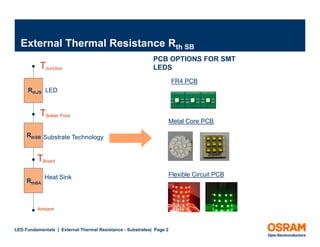
External Thermal Resistance Rth SB
                                                            PCB OPTIONS FOR SMT
           TJunction                                        LEDS
                                                                      FR4 PCB
     RthJS LED


           TSolder Point
                                                                  Metal Core PCB

     RthSB Substrate Technology


         TBoard
             Heat Sink                                            Flexible Circuit PCB
     RthBA


         Ambient


LED Fundamentals | External Thermal Resistance - Substrates| Page 2
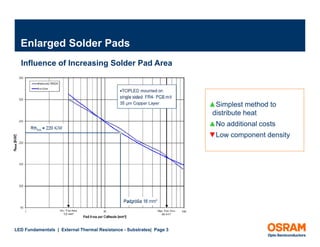
Enlarged Solder Pads
  Influence of Increasing Solder Pad Area


                                                                      ▲Simplest method to
                                                                       distribute heat
                                                                      ▲No additional costs
                                                                      ▼Low component density


LED Fundamentals | External Thermal Resistance - Substrates| Page 3
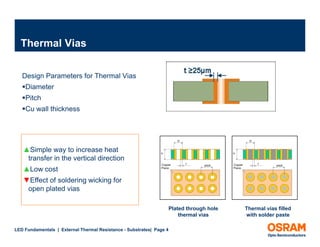
Thermal Vias

   Design Parameters for Thermal Vias
   Diameter
   Pitch
   Cu wall thickness


   ▲Simple way to increase heat
                y
    transfer in the vertical direction
   ▲Low cost
   ▼Effect of soldering wicking for
                      g       g
    open plated vias

                                                                      Plated through hole   Thermal vias filled
                                                                          thermal vias
                                                                          th     l i        with solder paste
                                                                                              ith ld         t

LED Fundamentals | External Thermal Resistance - Substrates| Page 4
Thermal Vias
                                                                effective vertical thermal conductivity
                                                             (0,8mm FR4 board, 25µm Cu plating in vias)
                                 120.0


                                 100.0
                                                                                                                   via diameter
                                                                                                                       100.0E-6
                         W/mK]


                                  80.0                                                                                 200.0E-6
   thermal conductivity [W


                                                                                                                       300.0E 6
                                                                                                                       300 0E-6
                                                                                                                       400.0E-6
                                                                                                                       500.0E-6
                                  60.0                                                                                 700.0E-6
                                                                                                                       1.0E-3

                                  40.0


                                  20.0
                                  20 0


                                   -
                                       000 0 0
                                       000.0E+0   200.0E-6
                                                   00 0 6         400.0E-6
                                                                   00 0 6          600 0 6
                                                                                   600.0E-6   800 0 6
                                                                                              800.0E-6    1.0E-3
                                                                                                            0 3
                                                                             via pitch [m]

LED Fundamentals | External Thermal Resistance - Substrates| Page 5
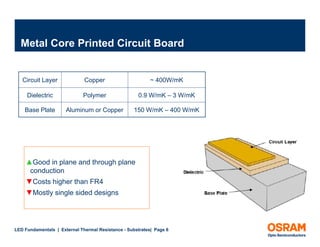
Metal Core Printed Circuit Board


   Circuit Layer              Copper                       ~ 400W/mK

     Dielectric
     Di l t i                Polymer
                             P l                     0.9 W/mK
                                                     0 9 W/ K – 3 W/ K
                                                                  W/mK

    Base Plate        Aluminum or Copper           150 W/mK – 400 W/mK


    ▲Good in plane and through plane
     conduction
    ▼Costs higher than FR4
    ▼Mostly single sided designs


LED Fundamentals | External Thermal Resistance - Substrates| Page 6
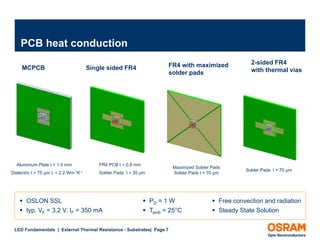
PCB heat conduction
                                                                        FR4 with maximized
                                                                              ith   i i d              2 sided
                                                                                                       2-sided FR4
     MCPCB                             Single sided FR4                                                with thermal vias
                                                                        solder pads


  Aluminium Plate t = 1.5 mm               FR4 PCB t = 0.8 mm
                                                                         Maximized Solder Pads
                                                                                                     Solder Pads t = 70 µm
Dielectric t = 75 µm  = 2.2 Wm-1K-1       Solder Pads t = 35 µm         Solder Pads t = 70 µm


     OSLON SSL                                                  PD = 1 W                 Free convection and radiation
     typ. VF = 3.2 V, IF = 350 mA
       yp                                                        Tamb = 25°C              Steady State Solution
                                                                                                  y


 LED Fundamentals | External Thermal Resistance - Substrates| Page 7
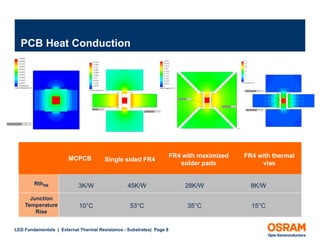
PCB Heat Conduction


                       MCPCB                                          FR4 with maximized
                                                                           ith    i i d    FR4 with th
                                                                                                ith thermal
                                                                                                          l
                                       Single sided FR4
                                                                         solder pads            vias


        RthSB              3K/W                  45K/W                    28K/W              8K/W

      Junction
    Temperature             10°C                  53°C                     35°C              15°C
        Rise


LED Fundamentals | External Thermal Resistance - Substrates| Page 8
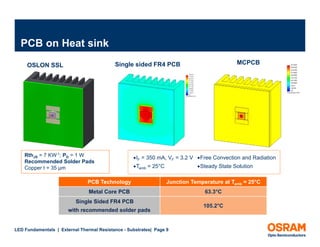
PCB on Heat sink
     OSLON SSL                             Single sided FR4 PCB                             MCPCB


    RthJS = 7 KW-1; PD = 1 W
                  1
                                                   IF = 350 mA, VF = 3.2 V Free Convection and Radiation
    Recommended Solder Pads
    Copper t = 35 µm                               Tamb = 25°C              Steady State Solution

                               PCB Technology                     Junction Temperature at Tamb = 25°C
                                                                                                 25 C
                                Metal Core PCB                                  63.3°C
                          Single Sided FR4 PCB
                                                                               105.2°C
                       with recommended solder pads


LED Fundamentals | External Thermal Resistance - Substrates| Page 9
Thank you for your attention.


LED Fundamentals | External Thermal Resistance - Substrates| Page 10
Disclaimer

 All information contained in this document has been checked with the greatest care.
 OSRAM Opto Semiconductors GmbH can however, not be made liable for any damage
 that occurs in connection with the use of these contents.


 OSRAM Opto Semiconductor GmbH makes no representations and warranties as to a
 possible interference with third parties' intellectual property rights in view of products
 originating f
   i i ti from one of OSRAM Opto Semiconductor GmbH's partners, or in view of
                        f          O t S i         d t G bH'            t        i i      f
 products being a combination of an OSRAM Opto Semiconductor GmbH's product and a
 product of one of OSRAM Opto Semiconductor GmbH's partners. Furthermore, OSRAM
 Opto Semiconductors GmbH cannot be made liable for any damage that occurs in
   p                                                            y       g
 connection with the use of a product of one of OSRAM Opto Semiconductor GmbH's
 partners, or with the use of a combination of an OSRAM Opto Semiconductor GmbH's
 product and a product of one of OSRAM Opto Semiconductor GmbH's partners.


LED Fundamentals | External Thermal Resistance - Substrates| Page 11

External Thermal Resistance - Substrates: LED Fundamentals

  • 1.
  • 2.
    External Thermal ResistanceRth SB PCB OPTIONS FOR SMT TJunction LEDS FR4 PCB RthJS LED TSolder Point Metal Core PCB RthSB Substrate Technology TBoard Heat Sink Flexible Circuit PCB RthBA Ambient LED Fundamentals | External Thermal Resistance - Substrates| Page 2
  • 3.
    Enlarged Solder Pads Influence of Increasing Solder Pad Area ▲Simplest method to distribute heat ▲No additional costs ▼Low component density LED Fundamentals | External Thermal Resistance - Substrates| Page 3
  • 4.
    Thermal Vias Design Parameters for Thermal Vias Diameter Pitch Cu wall thickness ▲Simple way to increase heat y transfer in the vertical direction ▲Low cost ▼Effect of soldering wicking for g g open plated vias Plated through hole Thermal vias filled thermal vias th l i with solder paste ith ld t LED Fundamentals | External Thermal Resistance - Substrates| Page 4
  • 5.
    Thermal Vias effective vertical thermal conductivity (0,8mm FR4 board, 25µm Cu plating in vias) 120.0 100.0 via diameter 100.0E-6 W/mK] 80.0 200.0E-6 thermal conductivity [W 300.0E 6 300 0E-6 400.0E-6 500.0E-6 60.0 700.0E-6 1.0E-3 40.0 20.0 20 0 - 000 0 0 000.0E+0 200.0E-6 00 0 6 400.0E-6 00 0 6 600 0 6 600.0E-6 800 0 6 800.0E-6 1.0E-3 0 3 via pitch [m] LED Fundamentals | External Thermal Resistance - Substrates| Page 5
  • 6.
    Metal Core PrintedCircuit Board Circuit Layer Copper ~ 400W/mK Dielectric Di l t i Polymer P l 0.9 W/mK 0 9 W/ K – 3 W/ K W/mK Base Plate Aluminum or Copper 150 W/mK – 400 W/mK ▲Good in plane and through plane conduction ▼Costs higher than FR4 ▼Mostly single sided designs LED Fundamentals | External Thermal Resistance - Substrates| Page 6
  • 7.
    PCB heat conduction FR4 with maximized ith i i d 2 sided 2-sided FR4 MCPCB Single sided FR4 with thermal vias solder pads Aluminium Plate t = 1.5 mm FR4 PCB t = 0.8 mm Maximized Solder Pads Solder Pads t = 70 µm Dielectric t = 75 µm  = 2.2 Wm-1K-1 Solder Pads t = 35 µm Solder Pads t = 70 µm  OSLON SSL  PD = 1 W  Free convection and radiation  typ. VF = 3.2 V, IF = 350 mA yp  Tamb = 25°C  Steady State Solution y LED Fundamentals | External Thermal Resistance - Substrates| Page 7
  • 8.
    PCB Heat Conduction MCPCB FR4 with maximized ith i i d FR4 with th ith thermal l Single sided FR4 solder pads vias RthSB 3K/W 45K/W 28K/W 8K/W Junction Temperature 10°C 53°C 35°C 15°C Rise LED Fundamentals | External Thermal Resistance - Substrates| Page 8
  • 9.
    PCB on Heatsink OSLON SSL Single sided FR4 PCB MCPCB RthJS = 7 KW-1; PD = 1 W 1 IF = 350 mA, VF = 3.2 V Free Convection and Radiation Recommended Solder Pads Copper t = 35 µm Tamb = 25°C Steady State Solution PCB Technology Junction Temperature at Tamb = 25°C 25 C Metal Core PCB 63.3°C Single Sided FR4 PCB 105.2°C with recommended solder pads LED Fundamentals | External Thermal Resistance - Substrates| Page 9
  • 10.
    Thank you foryour attention. LED Fundamentals | External Thermal Resistance - Substrates| Page 10
  • 11.
    Disclaimer All informationcontained in this document has been checked with the greatest care. OSRAM Opto Semiconductors GmbH can however, not be made liable for any damage that occurs in connection with the use of these contents. OSRAM Opto Semiconductor GmbH makes no representations and warranties as to a possible interference with third parties' intellectual property rights in view of products originating f i i ti from one of OSRAM Opto Semiconductor GmbH's partners, or in view of f O t S i d t G bH' t i i f products being a combination of an OSRAM Opto Semiconductor GmbH's product and a product of one of OSRAM Opto Semiconductor GmbH's partners. Furthermore, OSRAM Opto Semiconductors GmbH cannot be made liable for any damage that occurs in p y g connection with the use of a product of one of OSRAM Opto Semiconductor GmbH's partners, or with the use of a combination of an OSRAM Opto Semiconductor GmbH's product and a product of one of OSRAM Opto Semiconductor GmbH's partners. LED Fundamentals | External Thermal Resistance - Substrates| Page 11