A Change of Tongue
Antjie Krog
A mix of reportage, memoir, fiction and poetry, A Change
of Tongue offers a portrait of South Africa in the decade
following the abolishment of apartheid and the country’s
first democratic elections.
Why Be Happy When You Could Be Normal?
Jeanette Winterson
When Jeanette left home at sixteen because she was in
love with a woman, her Pentecostal mother asked her:
Why be happy when you could be normal? This is
Jeanette's true story of a life's work to find happiness: a
search for belonging, love, identity, a home.
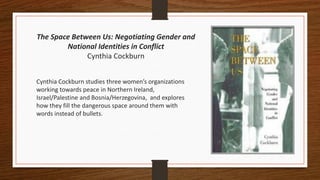
The Space Between Us: Negotiating Gender and
National Identities in Conflict
Cynthia Cockburn
Cynthia Cockburn studies three women’s organizations
working towards peace in Northern Ireland,
Israel/Palestine and Bosnia/Herzegovina, and explores
how they fill the dangerous space around them with
words instead of bullets.
Delusions of Gender: How Our Minds, Society,
and Neurosexism Create Difference
Cordelia Fine
Continuing inequality is increasingly justified in the media
by calling on immutable biological differences between
the male and the female brain. Drawing on the latest
research in developmental psychology, neuroscience, and
education, Delusions of Gender rebuts these claims,
showing how old myths, dressed up in new scientific
finery, help perpetuate the status quo.
Feminist Theory: From Margin to Center
Bell Hooks
Feminist Theory argues that contemporary feminists must
acknowledge the full complexity and diversity of women's
experience to create a mass movement to end women's
oppression. Hooks maintains that mainstream feminism's
reliance on white, middle-class, and professional
spokeswomen obscures the involvement, leadership, and
centrality of women of colour and poor women in the
movement for women's liberation.
Rethinking Homonationalism
Jasbir Puar
Jasbir Puar discusses homonationalism as a facet of modernity and a historical shift
marked by the entrance of (some) homosexual bodies as worthy of protection by nation-
states, due to a constitutive and fundamental reorientation of the relationship between
the state, capitalism, and sexuality. Read the full article here.
Citizen Action in the Time of the Network
Nishant Shah
Through a case study of the ‘Shanzhai Spring Festival Gala’ in China, Nishant Shah
illustrates the need for a new conceptual framework and vocabulary to account for the
new conditions of citizen action in the age of digital activism and the potentials for political
change and intervention therein. Read the full article here.
Measuring Unpaid Care Work with Public Policies In Mind
Valeria Esquivel
Time Use Surveys have been carried out in more than 60 countries to measure Unpaid Care
Work, but they are rarely used in evidence-based, gender-sensitive policymaking. Valeria
Esquivel discusses some of the reasons for the gap between the availability of time-use
data and their lack of influence in informing gender-sensitive policymaking, and makes
some suggestions for ways to bridge it. Read the full article here.
Have the Millennium Development Goals promoted gender
equality and women’s rights?
AWID
AWID looks at some of the achievements of the MDGS vis-à-vis gender equality and
women’s rights, while also examining the limitations of the goals. They argue that the
MDGs did not integrate a full vision of gender equality and women’s rights as enshrined in
key human rights instruments and significant inter-governmental agreements. Still, the
MDGs brought some opportunities to advance women’s rights and gender equality. Read
the full article here.
Violence Against Women and Girls
Cecilia Umul, International Indigenous Women’s Forum
In this article, Cecilia Umul dwells on the issue of violence against indigenous women and
girls, who are in a context of colonization and militarization, racism and social exclusion,
economic policies and "development" that increases poverty. Moving forward, Umul
outlines some key objectives in eradicating structural violence against indigenous women,
youth, adolescents and girls. Read the full article here.

G@W Recommends: 10 Books and Articles

  • 1.
    A Change ofTongue Antjie Krog A mix of reportage, memoir, fiction and poetry, A Change of Tongue offers a portrait of South Africa in the decade following the abolishment of apartheid and the country’s first democratic elections.
  • 2.
    Why Be HappyWhen You Could Be Normal? Jeanette Winterson When Jeanette left home at sixteen because she was in love with a woman, her Pentecostal mother asked her: Why be happy when you could be normal? This is Jeanette's true story of a life's work to find happiness: a search for belonging, love, identity, a home.
  • 3.
    The Space BetweenUs: Negotiating Gender and National Identities in Conflict Cynthia Cockburn Cynthia Cockburn studies three women’s organizations working towards peace in Northern Ireland, Israel/Palestine and Bosnia/Herzegovina, and explores how they fill the dangerous space around them with words instead of bullets.
  • 4.
    Delusions of Gender:How Our Minds, Society, and Neurosexism Create Difference Cordelia Fine Continuing inequality is increasingly justified in the media by calling on immutable biological differences between the male and the female brain. Drawing on the latest research in developmental psychology, neuroscience, and education, Delusions of Gender rebuts these claims, showing how old myths, dressed up in new scientific finery, help perpetuate the status quo.
  • 5.
    Feminist Theory: FromMargin to Center Bell Hooks Feminist Theory argues that contemporary feminists must acknowledge the full complexity and diversity of women's experience to create a mass movement to end women's oppression. Hooks maintains that mainstream feminism's reliance on white, middle-class, and professional spokeswomen obscures the involvement, leadership, and centrality of women of colour and poor women in the movement for women's liberation.
  • 6.
    Rethinking Homonationalism Jasbir Puar JasbirPuar discusses homonationalism as a facet of modernity and a historical shift marked by the entrance of (some) homosexual bodies as worthy of protection by nation- states, due to a constitutive and fundamental reorientation of the relationship between the state, capitalism, and sexuality. Read the full article here.
  • 7.
    Citizen Action inthe Time of the Network Nishant Shah Through a case study of the ‘Shanzhai Spring Festival Gala’ in China, Nishant Shah illustrates the need for a new conceptual framework and vocabulary to account for the new conditions of citizen action in the age of digital activism and the potentials for political change and intervention therein. Read the full article here.
  • 8.
    Measuring Unpaid CareWork with Public Policies In Mind Valeria Esquivel Time Use Surveys have been carried out in more than 60 countries to measure Unpaid Care Work, but they are rarely used in evidence-based, gender-sensitive policymaking. Valeria Esquivel discusses some of the reasons for the gap between the availability of time-use data and their lack of influence in informing gender-sensitive policymaking, and makes some suggestions for ways to bridge it. Read the full article here.
  • 9.
    Have the MillenniumDevelopment Goals promoted gender equality and women’s rights? AWID AWID looks at some of the achievements of the MDGS vis-à-vis gender equality and women’s rights, while also examining the limitations of the goals. They argue that the MDGs did not integrate a full vision of gender equality and women’s rights as enshrined in key human rights instruments and significant inter-governmental agreements. Still, the MDGs brought some opportunities to advance women’s rights and gender equality. Read the full article here.
  • 10.
    Violence Against Womenand Girls Cecilia Umul, International Indigenous Women’s Forum In this article, Cecilia Umul dwells on the issue of violence against indigenous women and girls, who are in a context of colonization and militarization, racism and social exclusion, economic policies and "development" that increases poverty. Moving forward, Umul outlines some key objectives in eradicating structural violence against indigenous women, youth, adolescents and girls. Read the full article here.