Gender and Caring
Notes on Lynch and Lyons, ‘ The Gendered Order of Caring’ in Ursula
Barry (ed) Whe re A W N w? N w Fe minist Pe rspe ctive s o n W me n in
                    re e o       e                            o
Co nte mpo rary I land (Dublin: Tasc, 2008)
                 re


Feminist Economics Study Group – Wk 4 – 13 Feb 2013
There are deep gender inequalities in the doing of care and love work that operate to the
advantage of men.

It is women’ s unwaged labour and related domestic labour that frees men up yo exercise
control in the public sphere of politics, the economy and culture.

… there is a moral imperative on women to do care work that does not apply equally to
men ; a highly gendered moral code impels women to do the greatr part of primary
caring, with most believing they have no choice in the matter.(1)


1. Baker, Lynch, Cantillon, Walsh (2004) Eq uality: Fro m The o ry to A n
                                                                       ctio
The reason love and care matter is because we are relational beings, emotional as well
as intellectual, social as well as invidivual. P. 1 6 5
Feminist-inspired scholars have drawn attention to the salience of care and love as
public goods, and have identified the importance of caring as a human capability
meeting a basic human need. (1)

They have also exposed the limitations of conceptualisations of citizenship devoid of a
concept of care, and highlighted the importance of caring as work, work that neds to be
distributed equally between women and men in particular.


1. Nassbaum, Glover (eds) women, Culture and Development: A Study of Humsn Capabilities (Oxford: Oxford University Press, 1995)
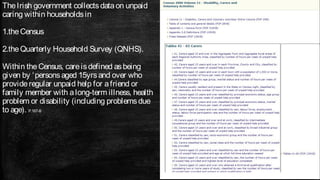
The Irish government collects data on unpaid
caring within households in

1.the Census

2.the Quarterly Household Survey (QNHS).

Within the Census, care is defined as being
given by ‘ persons aged 15yrs and over who
provide regular unpaid help for a friend or
family member with a long-term illness, health
problem or disability (including problems due
to age). P.167-8
The way care is defined in the Census excludes what constitutes a major category of
care work, that of the ordinary, everyday care of children (unless the child has a
recognised disability). Data on the care of children is compiled in the QNHS, however,
and is also available through the European Community Household Panel (ECPH)
survey. The focus in all three is on the hours of work involved in caring so we do not
know the nature and scope of the caring involved. P.168
According to the [2006] Census there
are less than 150,000 people, 5 per
cent of the adult population in unpaid
care work (mostly with adults) of
whom 61 per cent are women and 39
per cent are men.

However, when we measure all types
of caring activity, as has been donw
in the European Community
household Panel (ECPH) we see that
there are 1 million people who do
caring who are not maned in the
census.
Even though it is no doubt
unintentional, the failure to collect
data on hours spent on child care
work in the Census, means that child
car, which is the major form of care
work in Irish society, is no counted in
terms of work hours.

… women ar almost five times as
likely to work long care hours than is
the case for men.

Women spend much more time at
care work than men, even when they
are employed.

Fem econ-wk3-feb2013

  • 1.
    Gender and Caring Noteson Lynch and Lyons, ‘ The Gendered Order of Caring’ in Ursula Barry (ed) Whe re A W N w? N w Fe minist Pe rspe ctive s o n W me n in re e o e o Co nte mpo rary I land (Dublin: Tasc, 2008) re Feminist Economics Study Group – Wk 4 – 13 Feb 2013
  • 2.
    There are deepgender inequalities in the doing of care and love work that operate to the advantage of men. It is women’ s unwaged labour and related domestic labour that frees men up yo exercise control in the public sphere of politics, the economy and culture. … there is a moral imperative on women to do care work that does not apply equally to men ; a highly gendered moral code impels women to do the greatr part of primary caring, with most believing they have no choice in the matter.(1) 1. Baker, Lynch, Cantillon, Walsh (2004) Eq uality: Fro m The o ry to A n ctio
  • 3.
    The reason loveand care matter is because we are relational beings, emotional as well as intellectual, social as well as invidivual. P. 1 6 5 Feminist-inspired scholars have drawn attention to the salience of care and love as public goods, and have identified the importance of caring as a human capability meeting a basic human need. (1) They have also exposed the limitations of conceptualisations of citizenship devoid of a concept of care, and highlighted the importance of caring as work, work that neds to be distributed equally between women and men in particular. 1. Nassbaum, Glover (eds) women, Culture and Development: A Study of Humsn Capabilities (Oxford: Oxford University Press, 1995)
  • 4.
    The Irish governmentcollects data on unpaid caring within households in 1.the Census 2.the Quarterly Household Survey (QNHS). Within the Census, care is defined as being given by ‘ persons aged 15yrs and over who provide regular unpaid help for a friend or family member with a long-term illness, health problem or disability (including problems due to age). P.167-8
  • 5.
    The way careis defined in the Census excludes what constitutes a major category of care work, that of the ordinary, everyday care of children (unless the child has a recognised disability). Data on the care of children is compiled in the QNHS, however, and is also available through the European Community Household Panel (ECPH) survey. The focus in all three is on the hours of work involved in caring so we do not know the nature and scope of the caring involved. P.168
  • 6.
    According to the[2006] Census there are less than 150,000 people, 5 per cent of the adult population in unpaid care work (mostly with adults) of whom 61 per cent are women and 39 per cent are men. However, when we measure all types of caring activity, as has been donw in the European Community household Panel (ECPH) we see that there are 1 million people who do caring who are not maned in the census.
  • 7.
    Even though itis no doubt unintentional, the failure to collect data on hours spent on child care work in the Census, means that child car, which is the major form of care work in Irish society, is no counted in terms of work hours. … women ar almost five times as likely to work long care hours than is the case for men. Women spend much more time at care work than men, even when they are employed.