Duration: 3 Weeks


INTRODUCTION TO GENDER
Course Objectives
  To help students identify why and in what ways African
                    societies are gendered
To examine the impacts of gender relations and inequalities
                       on development
  To critically examine state and civil society responses to
                     gender inequalities.
Learning Objectives
• By the end of the session you should:
  – Distinguish the difference between gender and
    sex
  – Be familiar with key gender concepts
  – Be able to identify gender issues in everyday life
  – Provide a gender analysis of major social problems
    in Africa
  – Become familiar with state and civil society efforts
    to address gender inequalities.
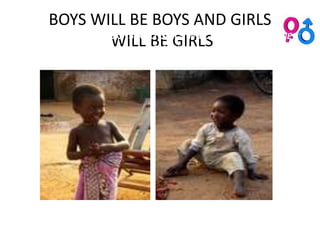
BOYS WILL BE BOYS AND GIRLS
“BOYS WILL BE BOYS AND GIRLS WILL BE GIRLS.”SUZANNE
              WILL ROMAINE
                     BE GIRLS
???
• GENDER         Gender    Gender
             Women         Gender
    Sex              Men    Femininity
• GENDER SexGender
                   Women
  GENDER Gender Gender     Gender
               Masculinity
  GENDER     Men    GENDER
   Gender             Women
What is gender?
• Sex versus gender
         Female versus woman
         Male versus man


• Gender relations or social relations of gender
   –   Women and men
   –   Women and women
   –   Men and men
   –   Women/men and institutions, social phenomenon,
       systems, etc.
Definition: Gender Vs. Sex
Unlike sex, which is a biological
concept, gender is a social construct
specifying the socially and culturally
prescribed ideas about the behaviour,
actions, and roles a particular sex
performs and follows.
Why is gender important?
Because…….life is gendered.
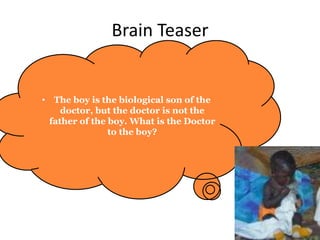
Brain Teaser


• The boy is the biological son of the
    doctor, but the doctor is not the
 father of the boy. What is the Doctor
               to the boy?
Brain Storming Exercise
• What are some of the important events or
  influences in your childhood that you feel
  influenced your sense of being male or
  female?
• Consider messages you received from
  parents, teachers, peers, role models, pastors
• Consider messages about, region identity,
  ethnicity, class, sexual orientation, age
Gender is a social construct…
…but there are commonalities.
Common features of gender relations
• Gendered divisions of labour

• Differential power  patriarchy

• Gender ideologies and myths
Common features of gender relations

• Gendered division of labour
  –Productive and reproductive roles
  –Male roles and responsibilities valued
   more than women’s
  –Women roles and responsibilities
   undervalued
  –‘private’ and ‘public’ dichotomy
Power
–Power as control of resources (land,
 power, labour, education, training, etc.)
–Power as patriarchy -a social system in
 which the role of the male as the
 primary authority figure is central to
 social organisation and where fathers
 hold authority over women, children
 and property.
Common features of gender relations
• Gender ideologies (natural, unchanging, etc.)


• Gender myths and stereotypes (“women
  are……,” “men are……..”).
What is gender (in)equality?
• Gender equality involves ensuring that the
  perceptions, interests, needs and priorities of
  women and men (which can be very different
  because of their differing roles and
  responsibilities) will be given equal weight in
  all aspects of life, including planning and
  decision-making.
Why is gender equality important?
• Equal rights, opportunities and
  responsibilities is a matter of human rights
  and social justice.
• Societies and cultures are richer and more
  diverse with gender equality.
• Greater equality between women and men
  isaprecondition for sustainable people-
  centred development.
Equal rights and citizenship
• Definition of Citizenship
  – Sense of belonging
  – Rights and responsibilities
  – It is a status
  – It is a process
  – It is formal
  – It is informal
Constitutional Guarantees
              of Citizenship
• All persons shall be equal before the law (17.1)
• A person shall not be discriminated against on
  grounds of gender, race, colour, ethnic origin,
  religion, creed or social or economic status
  (17.2).
• For the purposes of this article, “discriminate”
  means to give different treatment to different
  persons attributable only or mainly to
  their respective descriptions by race, place of
  origin, political opinions, colour, gender,
  occupation, religion or creed…(17.3)
International Agreements
• The Convention on the Elimination of All Forms of
  Discrimination Against Women (CEDAW)
   – Addresses women human rights issues

• The Vienna Declaration Programme of Action (1993)
   – Women’s rights are human rights
   – The human rights of women and the girl-child are an inalienable
     integral and indivisible part of universal human rights

• International Covenant on Economic, Social and Cultural
  Rights (ICESCR)
   – Seeks to provide economic, social and cultural rights of individuals,
     including labour rights and rights to health, education, and an
     adequate standard of living
International Agreements, Ctd.
• The African Union Solemn Declaration on
  Gender Equality and Women’s Empowerment
• The African Charter on Human and People’s
  Rights
  – Effective measures should be undertaken to
    ensure that women have an active role in the
    development process
International Agreements Ctd.
• Beijing Platform for Action
  – To advance the goals of equality, development and
    peace for all women everywhere in the interest of
    all humanity
Richer, more diverse cultures
• What is Culture?
  –“The complex whole which includes
   knowledge, belief, art, morals, law,
   custom, and any other capabilities and
   habits acquired by [a person] as a
   member of society" (Tylor 1958 [1871]
Development Imperatives
• What is development?
  – Movement from one level to another
  – To enlarge opportunities and freedoms for people
  – To expand, strengthen, evolve societies and
    economies
  – To exploit potentialities of resources to the benefit
    of society/people
Development Imperatives
• Development is not neutral – there
  are winners and losers -----

 Development paths and outcomes
 are gendered.
Week 2: State and Civil Society
   Responses to Gender Inequalities
• Recap of Week 1
• At the end of today’s class, you should be able
  to:
  – Be familiar with the history of the feminist
    movement
  – Be familiar with arguments for affirmative action
    and the forms affirmative action takes
  – Identify the efforts that have been made globally,
    regionally and locally to deal with gender
    inequalities
History of efforts to address
          gender inequalities
• Many efforts to deal with gender inequalities
  over many centuries
• First Wave Feminism
  – Women get the vote after long struggle by
    suffragettes in U.S .and U.K.
• Second Wave Feminism
  – Struggle for reproductive rights
  – Right to work
  – Equal pay for equal work
UN Processes
• Influence of second wave feminism on UN
  – -Four world conferences – Mexico, Copenhagen,
    Nairobi, Beijing
  – Outcomes of world conferences
  – CEDAW
  – Millennium Development Goals (MDGs):
  – Halving Poverty (MDG 1)
  – Promote gender equality and empower women
    (MDG 3)
  – Improve Maternal Health (MDG 5)
International Development
              Approaches
• Different approaches to addressing the impact
  of development initiatives on women
  • Women in Development (WID)
  • Women and Development, (WAD)
  • Gender and Development (GAD )
  • Gender mainstreaming
National Level Processes
•   Historical context to interventions in Ghana
•   State policies and actions
•   Civil society actions
•   Group agency
•   Individual agency
Historical Context to National
                Interventions
• In colonial period no attempt made to address position and status
  of women in traditional society.
• Colonialism gendered society further e.g. through discriminatory
  education, jobs and preferential treatment introduced to traditional
  occupations, e.g. cocoa farming.
• Post colonial history Nkrumah regime had social justice policies
  which advantaged women, e.g. in job diversification for women,
  women in public sector and politics, etc.
• Policies under other regimes, especially military, discriminatory
  against women, e.g. early years of Armed Forces Revolution Council
  (AFRC) and Provisional National Defence Council era (PNDC) when
  young women and traders seen as cause of economic problems.
• PNDC period however also championed rights of women, especially
  through 31st December Women’s Movement.
• Economic Recovery/Structural Adjustment of
  1980s and ‘90s had negative effects on women,
  e.g. taxes to informal sector, which is dominated
  by women, promotion of cash crop farming and
  neglect of food crop farming (where you find
  most women)
• Economic recovery also introduced gender
  differentials in access to services such as health
  and education because of subsidy removals
• Mechanisms to redress through laws, policy and
  other actions.
State Actions:
              Legal Reform

• Intestate Succession Law, 1985 (PNDC
  111): Protects the inheritance rights of
  spouses and children
• Criminal code amendment act of 1994
  section 69 (FGM)
• Criminal code amendment act of 1998
  section 314.a (Trokosi)
State Actions:
               Legal Reform

• The Human Trafficking Act, 2005 (Act
  694)Domestic Violence Act, 2007 (Act
  732): Seeks to protect the populace
  against violence and abuse in homes
  and institutions
• Property Rights of Spouses Bill (Before
  Parliament)
State Action: Policy Reform
•   Reproductive Health Policy and Strategy
•   Gender Policy in Agriculture
•   Girl-Child Education Policy
•   Ghana Poverty Reduction Strategy
•   Maternity Leave policies
•   Establishing of Women and Juvenile Unit
    (WAJU) of Police service, now called Domestic
    Violence Victim Support Unit (DOVVSU)
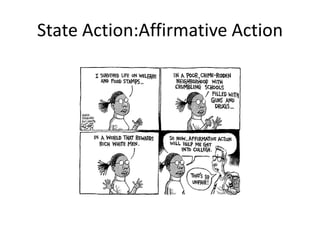
State Action:Affirmative Action
What is Affirmative Action?
A set of temporary measures adopted by
governments, public and private institutions
such as political parties, educational
establishments, corporations and companies
to address a history of systemic discrimination
and exclusion of particular social groups.
Background to Affirmative Action
• Origins in the USA used to address racial
  discrimination
• South Africa used to address racial and gender
  disparities after Apartheid
• Different kinds of affirmative action.
  – Direct (qualitative or quantitative, i.e. quotas).
  – Indirect (e.g. science clinics for girls and school
    lunches for poor children )
Examples of affirmative action….?
Examples of Affirmative
                 Action
• Scholarship schemes (Northern Ghana
  scholarships; cocoa marketing board
  scholarships)
• Fee free education; Free textbooks and uniforms
• Targeted investments in infrastructure, education
  and health in some Regions
• Reservations of seats for women (10 women in
  parliament)
• Measures to promote participation of women in
  certain professions
Examples, Ctd.
• School meals in certain districts
• Reserved places in state universities for students
  from deprived districts
• Girl Child Education Policies
• Lower cut-off point for girls in tertiary education
• Science clinics for girls
• 50% of appointed district assembly members are
  women
Affirmative Action Quotas
Quotas are only effective when backed by law
and when policies such as electoral reform,
political education, the mobilisation of citizens
and the removal of obstacles to women’s
ability to utilise the quotas are removed
Value of affirmative Action?
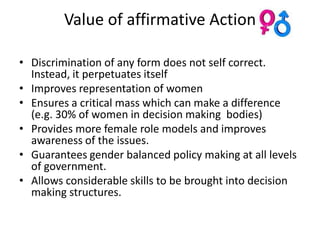
Value of affirmative Action

• Discrimination of any form does not self correct.
  Instead, it perpetuates itself
• Improves representation of women
• Ensures a critical mass which can make a difference
  (e.g. 30% of women in decision making bodies)
• Provides more female role models and improves
  awareness of the issues.
• Guarantees gender balanced policy making at all levels
  of government.
• Allows considerable skills to be brought into decision
  making structures.
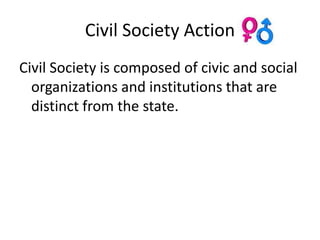
Civil Society Action
Civil Society is composed of civic and social
  organizations and institutions that are
  distinct from the state.
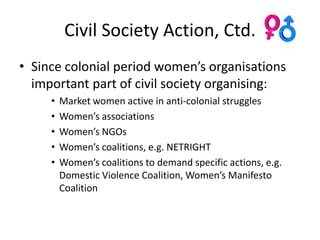
Civil Society Action, Ctd.
• Since colonial period women’s organisations
  important part of civil society organising:
     •   Market women active in anti-colonial struggles
     •   Women’s associations
     •   Women’s NGOs
     •   Women’s coalitions, e.g. NETRIGHT
     •   Women’s coalitions to demand specific actions, e.g.
         Domestic Violence Coalition, Women’s Manifesto
         Coalition
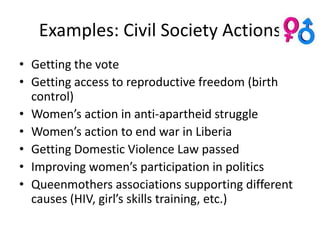
Examples: Civil Society Actions
• Getting the vote
• Getting access to reproductive freedom (birth
  control)
• Women’s action in anti-apartheid struggle
• Women’s action to end war in Liberia
• Getting Domestic Violence Law passed
• Improving women’s participation in politics
• Queenmothers associations supporting different
  causes (HIV, girl’s skills training, etc.)
Group Agency
• Agency refers to:
  – The means or mode of acting; instrumentality.
  – Conveys the idea that people are not passive and can
    change their situations through self conscious action
• The role of women’s self-help groups
  – Micro-finance groups , e.g. susu
  – Women’s cooperative, e.g. shea butter, beading,
    pottery, bread making, etc.
  – Widows support group
  – HIV social network groups
Individual Agency
• Instances where people have triggered change by
  their actions:
  – Taking legal action (e.g. Women who petitioned
    CHRAJ on workplace sexual harassment: FanAir,
    NADMO)
  – Taking a stand against gender discriminatory practices
    (e.g. Swaziland where mother of Reed Dance Bride
    protested)
  – Leaving abusive relationships,
  – Learning new skills to improve lives
  – Helping others
Progress toward gender equality ?
Progress
• More consciousness of the importance of
  gender equality

• Some issues being addressed, e.g. narrowing
  gap between boys and girls in education

• In some countries strong representation of
  women in politics, e.g. Rwanda, South Africa
• Important legislation, e.g. Domestic violence
  law has been passed.
• Increased number of women in professional
  careers and in decision-making
• Improved maternal health coverage
• More access to credit for women
Remaining Problems ?
Remaining Problems
• Women still disproportionately poor

• Political representation of women low. In Ghana
  only about 8 percent women in Parliament

• Incidents of violence against women high despite
  the law

• Gender stereotyping and attitudes towards
  women reflect male privilege
Why is progress slow?
Why Progress is slow
• Enormity of the challenge
• Cultures evolve slowly
• Attitudinal and behavioural change difficult to
  achieve
• Weak political will
• Poor implementation of policies
• Not enough resources devoted to resolving
  issues
Consciousness-Raising Activity

– Identify a positive action toward women and/or
  men that you may not have done before this
  course
– Describe a liberating act that is positive and
  consciousness raising that could help change the
  quality of people’s lives
– Your action must be non-violent and legal
Week 3: Film
• The CEGENSA Resource Centre has a number
  of films that can be shown to illustrate some
  of the issues discussed in the introductory
  class.
• We recommend for example:
  – The Witches of Gambaga
  – Pray the Devil Back to Hell
  – Fat Kine
  – Molade
Questions Following Film
• What gender issues did the film illustrate for
  you?

Intro to gender revised by dr. anyidoho

  • 1.
  • 2.
    Course Objectives To help students identify why and in what ways African societies are gendered To examine the impacts of gender relations and inequalities on development To critically examine state and civil society responses to gender inequalities.
  • 3.
    Learning Objectives • Bythe end of the session you should: – Distinguish the difference between gender and sex – Be familiar with key gender concepts – Be able to identify gender issues in everyday life – Provide a gender analysis of major social problems in Africa – Become familiar with state and civil society efforts to address gender inequalities.
  • 4.
    BOYS WILL BEBOYS AND GIRLS “BOYS WILL BE BOYS AND GIRLS WILL BE GIRLS.”SUZANNE WILL ROMAINE BE GIRLS
  • 5.
    ??? • GENDER Gender Gender Women Gender Sex Men Femininity • GENDER SexGender Women GENDER Gender Gender Gender Masculinity GENDER Men GENDER Gender Women
  • 6.
    What is gender? •Sex versus gender Female versus woman Male versus man • Gender relations or social relations of gender – Women and men – Women and women – Men and men – Women/men and institutions, social phenomenon, systems, etc.
  • 7.
    Definition: Gender Vs.Sex Unlike sex, which is a biological concept, gender is a social construct specifying the socially and culturally prescribed ideas about the behaviour, actions, and roles a particular sex performs and follows.
  • 8.
    Why is genderimportant?
  • 9.
  • 10.
    Brain Teaser • Theboy is the biological son of the doctor, but the doctor is not the father of the boy. What is the Doctor to the boy?
  • 11.
    Brain Storming Exercise •What are some of the important events or influences in your childhood that you feel influenced your sense of being male or female? • Consider messages you received from parents, teachers, peers, role models, pastors • Consider messages about, region identity, ethnicity, class, sexual orientation, age
  • 12.
    Gender is asocial construct…
  • 13.
    …but there arecommonalities.
  • 14.
    Common features ofgender relations • Gendered divisions of labour • Differential power  patriarchy • Gender ideologies and myths
  • 15.
    Common features ofgender relations • Gendered division of labour –Productive and reproductive roles –Male roles and responsibilities valued more than women’s –Women roles and responsibilities undervalued –‘private’ and ‘public’ dichotomy
  • 16.
    Power –Power as controlof resources (land, power, labour, education, training, etc.) –Power as patriarchy -a social system in which the role of the male as the primary authority figure is central to social organisation and where fathers hold authority over women, children and property.
  • 17.
    Common features ofgender relations • Gender ideologies (natural, unchanging, etc.) • Gender myths and stereotypes (“women are……,” “men are……..”).
  • 18.
    What is gender(in)equality? • Gender equality involves ensuring that the perceptions, interests, needs and priorities of women and men (which can be very different because of their differing roles and responsibilities) will be given equal weight in all aspects of life, including planning and decision-making.
  • 19.
    Why is genderequality important? • Equal rights, opportunities and responsibilities is a matter of human rights and social justice. • Societies and cultures are richer and more diverse with gender equality. • Greater equality between women and men isaprecondition for sustainable people- centred development.
  • 20.
    Equal rights andcitizenship • Definition of Citizenship – Sense of belonging – Rights and responsibilities – It is a status – It is a process – It is formal – It is informal
  • 21.
    Constitutional Guarantees of Citizenship • All persons shall be equal before the law (17.1) • A person shall not be discriminated against on grounds of gender, race, colour, ethnic origin, religion, creed or social or economic status (17.2). • For the purposes of this article, “discriminate” means to give different treatment to different persons attributable only or mainly to their respective descriptions by race, place of origin, political opinions, colour, gender, occupation, religion or creed…(17.3)
  • 22.
    International Agreements • TheConvention on the Elimination of All Forms of Discrimination Against Women (CEDAW) – Addresses women human rights issues • The Vienna Declaration Programme of Action (1993) – Women’s rights are human rights – The human rights of women and the girl-child are an inalienable integral and indivisible part of universal human rights • International Covenant on Economic, Social and Cultural Rights (ICESCR) – Seeks to provide economic, social and cultural rights of individuals, including labour rights and rights to health, education, and an adequate standard of living
  • 23.
    International Agreements, Ctd. •The African Union Solemn Declaration on Gender Equality and Women’s Empowerment • The African Charter on Human and People’s Rights – Effective measures should be undertaken to ensure that women have an active role in the development process
  • 24.
    International Agreements Ctd. •Beijing Platform for Action – To advance the goals of equality, development and peace for all women everywhere in the interest of all humanity
  • 25.
    Richer, more diversecultures • What is Culture? –“The complex whole which includes knowledge, belief, art, morals, law, custom, and any other capabilities and habits acquired by [a person] as a member of society" (Tylor 1958 [1871]
  • 26.
    Development Imperatives • Whatis development? – Movement from one level to another – To enlarge opportunities and freedoms for people – To expand, strengthen, evolve societies and economies – To exploit potentialities of resources to the benefit of society/people
  • 27.
    Development Imperatives • Developmentis not neutral – there are winners and losers ----- Development paths and outcomes are gendered.
  • 28.
    Week 2: Stateand Civil Society Responses to Gender Inequalities • Recap of Week 1 • At the end of today’s class, you should be able to: – Be familiar with the history of the feminist movement – Be familiar with arguments for affirmative action and the forms affirmative action takes – Identify the efforts that have been made globally, regionally and locally to deal with gender inequalities
  • 29.
    History of effortsto address gender inequalities • Many efforts to deal with gender inequalities over many centuries • First Wave Feminism – Women get the vote after long struggle by suffragettes in U.S .and U.K. • Second Wave Feminism – Struggle for reproductive rights – Right to work – Equal pay for equal work
  • 30.
    UN Processes • Influenceof second wave feminism on UN – -Four world conferences – Mexico, Copenhagen, Nairobi, Beijing – Outcomes of world conferences – CEDAW – Millennium Development Goals (MDGs): – Halving Poverty (MDG 1) – Promote gender equality and empower women (MDG 3) – Improve Maternal Health (MDG 5)
  • 31.
    International Development Approaches • Different approaches to addressing the impact of development initiatives on women • Women in Development (WID) • Women and Development, (WAD) • Gender and Development (GAD ) • Gender mainstreaming
  • 32.
    National Level Processes • Historical context to interventions in Ghana • State policies and actions • Civil society actions • Group agency • Individual agency
  • 33.
    Historical Context toNational Interventions • In colonial period no attempt made to address position and status of women in traditional society. • Colonialism gendered society further e.g. through discriminatory education, jobs and preferential treatment introduced to traditional occupations, e.g. cocoa farming. • Post colonial history Nkrumah regime had social justice policies which advantaged women, e.g. in job diversification for women, women in public sector and politics, etc. • Policies under other regimes, especially military, discriminatory against women, e.g. early years of Armed Forces Revolution Council (AFRC) and Provisional National Defence Council era (PNDC) when young women and traders seen as cause of economic problems. • PNDC period however also championed rights of women, especially through 31st December Women’s Movement.
  • 34.
    • Economic Recovery/StructuralAdjustment of 1980s and ‘90s had negative effects on women, e.g. taxes to informal sector, which is dominated by women, promotion of cash crop farming and neglect of food crop farming (where you find most women) • Economic recovery also introduced gender differentials in access to services such as health and education because of subsidy removals • Mechanisms to redress through laws, policy and other actions.
  • 35.
    State Actions: Legal Reform • Intestate Succession Law, 1985 (PNDC 111): Protects the inheritance rights of spouses and children • Criminal code amendment act of 1994 section 69 (FGM) • Criminal code amendment act of 1998 section 314.a (Trokosi)
  • 36.
    State Actions: Legal Reform • The Human Trafficking Act, 2005 (Act 694)Domestic Violence Act, 2007 (Act 732): Seeks to protect the populace against violence and abuse in homes and institutions • Property Rights of Spouses Bill (Before Parliament)
  • 37.
    State Action: PolicyReform • Reproductive Health Policy and Strategy • Gender Policy in Agriculture • Girl-Child Education Policy • Ghana Poverty Reduction Strategy • Maternity Leave policies • Establishing of Women and Juvenile Unit (WAJU) of Police service, now called Domestic Violence Victim Support Unit (DOVVSU)
  • 38.
  • 39.
    What is AffirmativeAction? A set of temporary measures adopted by governments, public and private institutions such as political parties, educational establishments, corporations and companies to address a history of systemic discrimination and exclusion of particular social groups.
  • 40.
    Background to AffirmativeAction • Origins in the USA used to address racial discrimination • South Africa used to address racial and gender disparities after Apartheid • Different kinds of affirmative action. – Direct (qualitative or quantitative, i.e. quotas). – Indirect (e.g. science clinics for girls and school lunches for poor children )
  • 41.
  • 42.
    Examples of Affirmative Action • Scholarship schemes (Northern Ghana scholarships; cocoa marketing board scholarships) • Fee free education; Free textbooks and uniforms • Targeted investments in infrastructure, education and health in some Regions • Reservations of seats for women (10 women in parliament) • Measures to promote participation of women in certain professions
  • 43.
    Examples, Ctd. • Schoolmeals in certain districts • Reserved places in state universities for students from deprived districts • Girl Child Education Policies • Lower cut-off point for girls in tertiary education • Science clinics for girls • 50% of appointed district assembly members are women
  • 44.
    Affirmative Action Quotas Quotasare only effective when backed by law and when policies such as electoral reform, political education, the mobilisation of citizens and the removal of obstacles to women’s ability to utilise the quotas are removed
  • 45.
  • 46.
    Value of affirmativeAction • Discrimination of any form does not self correct. Instead, it perpetuates itself • Improves representation of women • Ensures a critical mass which can make a difference (e.g. 30% of women in decision making bodies) • Provides more female role models and improves awareness of the issues. • Guarantees gender balanced policy making at all levels of government. • Allows considerable skills to be brought into decision making structures.
  • 47.
    Civil Society Action CivilSociety is composed of civic and social organizations and institutions that are distinct from the state.
  • 48.
    Civil Society Action,Ctd. • Since colonial period women’s organisations important part of civil society organising: • Market women active in anti-colonial struggles • Women’s associations • Women’s NGOs • Women’s coalitions, e.g. NETRIGHT • Women’s coalitions to demand specific actions, e.g. Domestic Violence Coalition, Women’s Manifesto Coalition
  • 49.
    Examples: Civil SocietyActions • Getting the vote • Getting access to reproductive freedom (birth control) • Women’s action in anti-apartheid struggle • Women’s action to end war in Liberia • Getting Domestic Violence Law passed • Improving women’s participation in politics • Queenmothers associations supporting different causes (HIV, girl’s skills training, etc.)
  • 50.
    Group Agency • Agencyrefers to: – The means or mode of acting; instrumentality. – Conveys the idea that people are not passive and can change their situations through self conscious action • The role of women’s self-help groups – Micro-finance groups , e.g. susu – Women’s cooperative, e.g. shea butter, beading, pottery, bread making, etc. – Widows support group – HIV social network groups
  • 51.
    Individual Agency • Instanceswhere people have triggered change by their actions: – Taking legal action (e.g. Women who petitioned CHRAJ on workplace sexual harassment: FanAir, NADMO) – Taking a stand against gender discriminatory practices (e.g. Swaziland where mother of Reed Dance Bride protested) – Leaving abusive relationships, – Learning new skills to improve lives – Helping others
  • 52.
  • 53.
    Progress • More consciousnessof the importance of gender equality • Some issues being addressed, e.g. narrowing gap between boys and girls in education • In some countries strong representation of women in politics, e.g. Rwanda, South Africa
  • 54.
    • Important legislation,e.g. Domestic violence law has been passed. • Increased number of women in professional careers and in decision-making • Improved maternal health coverage • More access to credit for women
  • 55.
  • 56.
    Remaining Problems • Womenstill disproportionately poor • Political representation of women low. In Ghana only about 8 percent women in Parliament • Incidents of violence against women high despite the law • Gender stereotyping and attitudes towards women reflect male privilege
  • 57.
  • 58.
    Why Progress isslow • Enormity of the challenge • Cultures evolve slowly • Attitudinal and behavioural change difficult to achieve • Weak political will • Poor implementation of policies • Not enough resources devoted to resolving issues
  • 59.
    Consciousness-Raising Activity – Identifya positive action toward women and/or men that you may not have done before this course – Describe a liberating act that is positive and consciousness raising that could help change the quality of people’s lives – Your action must be non-violent and legal
  • 60.
    Week 3: Film •The CEGENSA Resource Centre has a number of films that can be shown to illustrate some of the issues discussed in the introductory class. • We recommend for example: – The Witches of Gambaga – Pray the Devil Back to Hell – Fat Kine – Molade
  • 61.
    Questions Following Film •What gender issues did the film illustrate for you?

Editor's Notes

  • #6 Question Any kind of gender training – workshops, seminars, etc. When you think about gender, what comes to mind? Negative associations (burden, not clear, not important, etc.) Positive associations (important, can and should be attended to).  ‘Buzzword’ - means its everywhere AND it gets unclear. So aim of the plenary is to make it clearer. Second, plenary should make it positive – something that can actually help.
  • #9  FIRST --- conceptions of masculinity and femininity, gender roles and relationships. Canges over time and place. QUE: ways in which masculinity and femininity, and relationships between men and women, have changed – looking at parents, looking at kids, going in different places.  SECOND -- works with social and economic relationships in which are also embedded class, race, global relationships of power – ‘A woman is not ‘just a woman’, she is also, at the same time, peasant, Wolof, caste, living in neo-colonial Senegal etc. Hence gender relations need to be analysed in terms of hteirinterreleations with other systems of stratification’ (p. 20).So a poor older woman is not perceived the same, does not have the same constraints and opportunities as an educated, younger woman.
  • #13  FIRST --- conceptions of masculinity and femininity, gender roles and relationships. Canges over time and place. QUE: ways in which masculinity and femininity, and relationships between men and women, have changed – looking at parents, looking at kids, going in different places.  SECOND -- works with social and economic relationships in which are also embedded class, race, global relationships of power – ‘A woman is not ‘just a woman’, she is also, at the same time, peasant, Wolof, caste, living in neo-colonial Senegal etc. Hence gender relations need to be analysed in terms of hteirinterreleations with other systems of stratification’ (p. 20).So a poor older woman is not perceived the same, does not have the same constraints and opportunities as an educated, younger woman.
  • #14  It is also universal, and common themes in gender relationships  
  • #15 It is also universal, and common themes in gender relationships - characterissed by partriachygendered divisions of labour: reproductive and productive work*reproductive is about maintenance of family, community, humanity.  QUE: examples of reproductive work?  carework, community work; maintaining communal resources; increases when resources become more scarce but unpaid and usually unacknowledged. *******It is not just the way things are or the natural order of things…As we said, has changed and can be changed again. This is what we need to seek to do.HOW DOES IT CHANGE? Social changes, sometimes policies and interventions: e.g. cocoa production in Ghanaurban development in many parts of the worldagric for women in Gambia