FUNDAMENTALS OF
GENDER STUDIES
OUTCOMES
1. Define Gender
2. Explain the evolution of gender
3. Compare sex and gender
4. Discuss links between gender and sexuality
5. Differentiate equality and equity
6. Discuss a link between gender equality and
women’s right
7. Explain transgender and transsexual
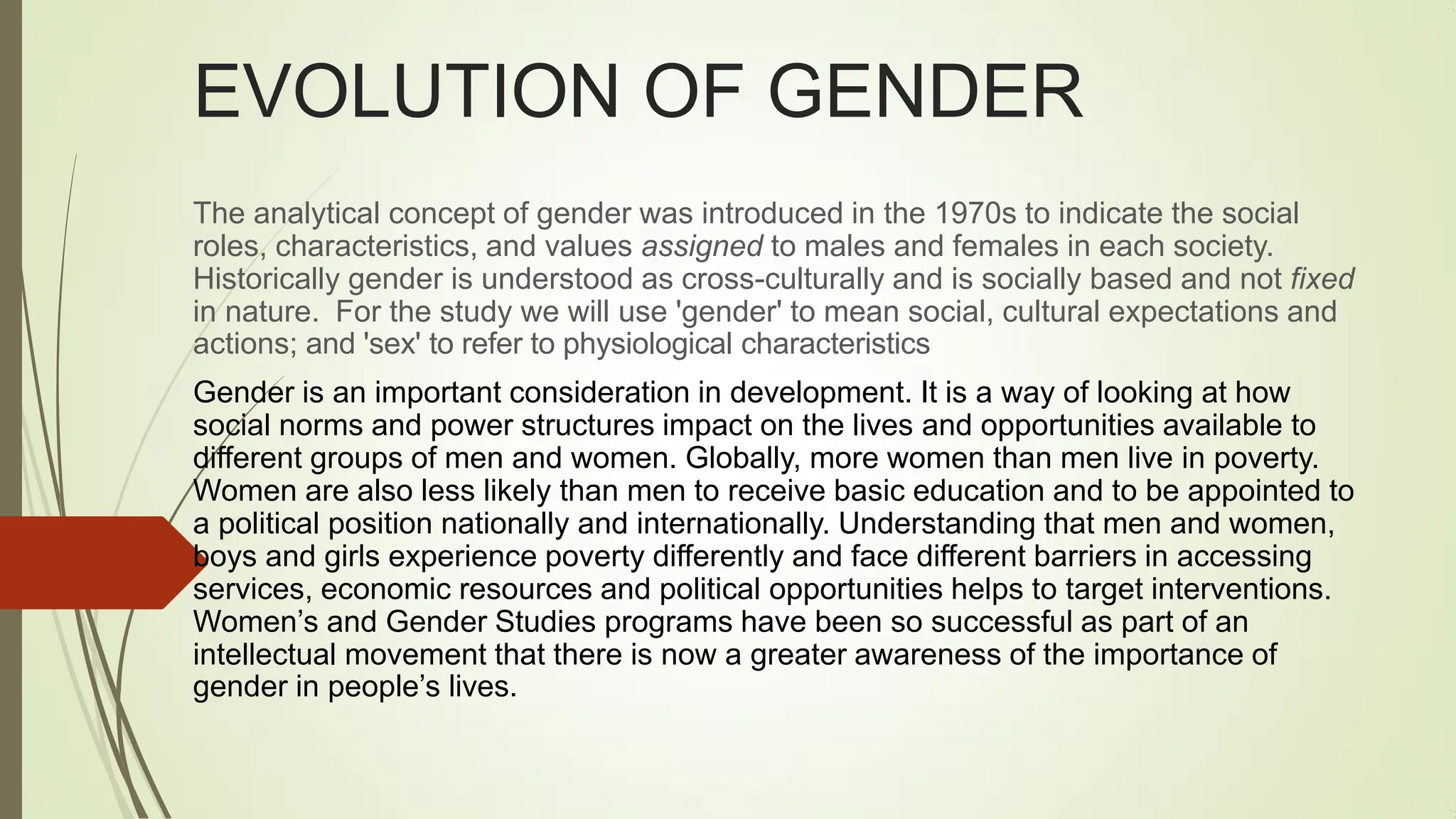
EVOLUTION OF GENDER
The analytical concept of gender was introduced in the 1970s to indicate the social
roles, characteristics, and values assigned to males and females in each society.
Historically gender is understood as cross-culturally and is socially based and not fixed
in nature. For the study we will use 'gender' to mean social, cultural expectations and
actions; and 'sex' to refer to physiological characteristics
Gender is an important consideration in development. It is a way of looking at how
social norms and power structures impact on the lives and opportunities available to
different groups of men and women. Globally, more women than men live in poverty.
Women are also less likely than men to receive basic education and to be appointed to
a political position nationally and internationally. Understanding that men and women,
boys and girls experience poverty differently and face different barriers in accessing
services, economic resources and political opportunities helps to target interventions.
Women‟s and Gender Studies programs have been so successful as part of an
intellectual movement that there is now a greater awareness of the importance of
gender in people‟s lives.
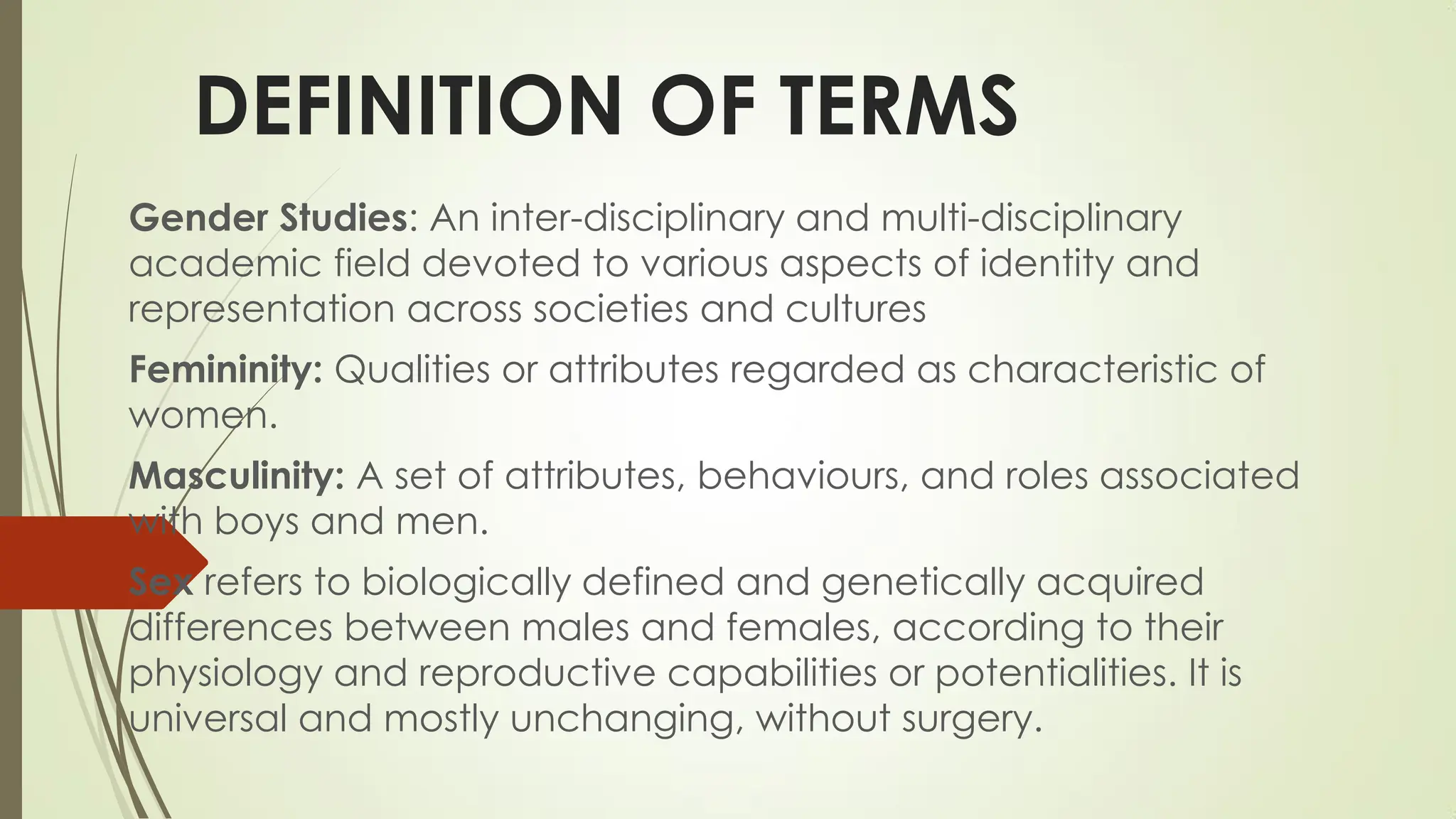
DEFINITION OF TERMS
Gender Studies: An inter-disciplinary and multi-disciplinary
academic field devoted to various aspects of identity and
representation across societies and cultures
Femininity: Qualities or attributes regarded as characteristic of
women.
Masculinity: A set of attributes, behaviours, and roles associated
with boys and men.
Sex refers to biologically defined and genetically acquired
differences between males and females, according to their
physiology and reproductive capabilities or potentialities. It is
universal and mostly unchanging, without surgery.
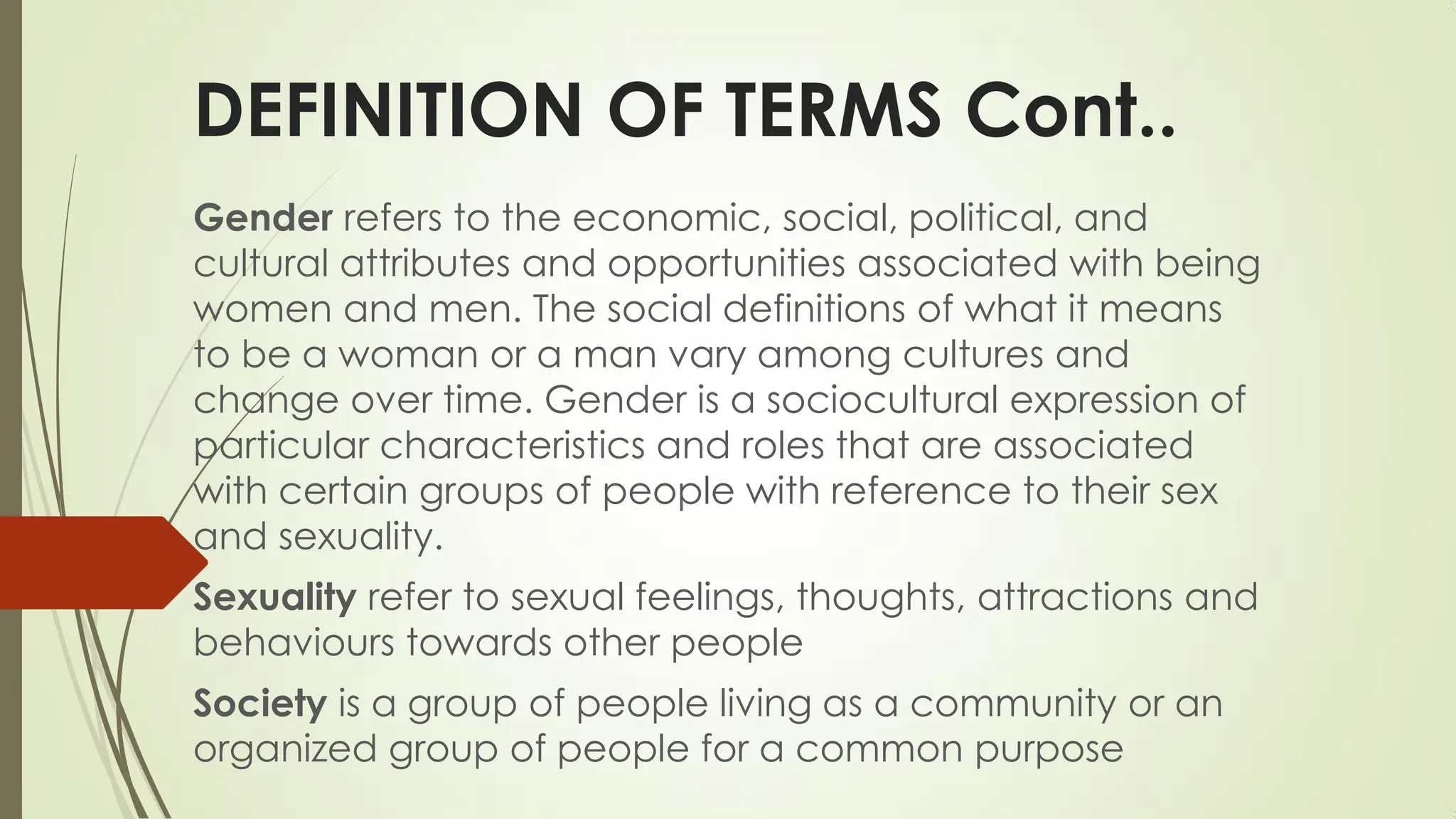
DEFINITION OF TERMS Cont..
Gender refers to the economic, social, political, and
cultural attributes and opportunities associated with being
women and men. The social definitions of what it means
to be a woman or a man vary among cultures and
change over time. Gender is a sociocultural expression of
particular characteristics and roles that are associated
with certain groups of people with reference to their sex
and sexuality.
Sexuality refer to sexual feelings, thoughts, attractions and
behaviours towards other people
Society is a group of people living as a community or an
organized group of people for a common purpose
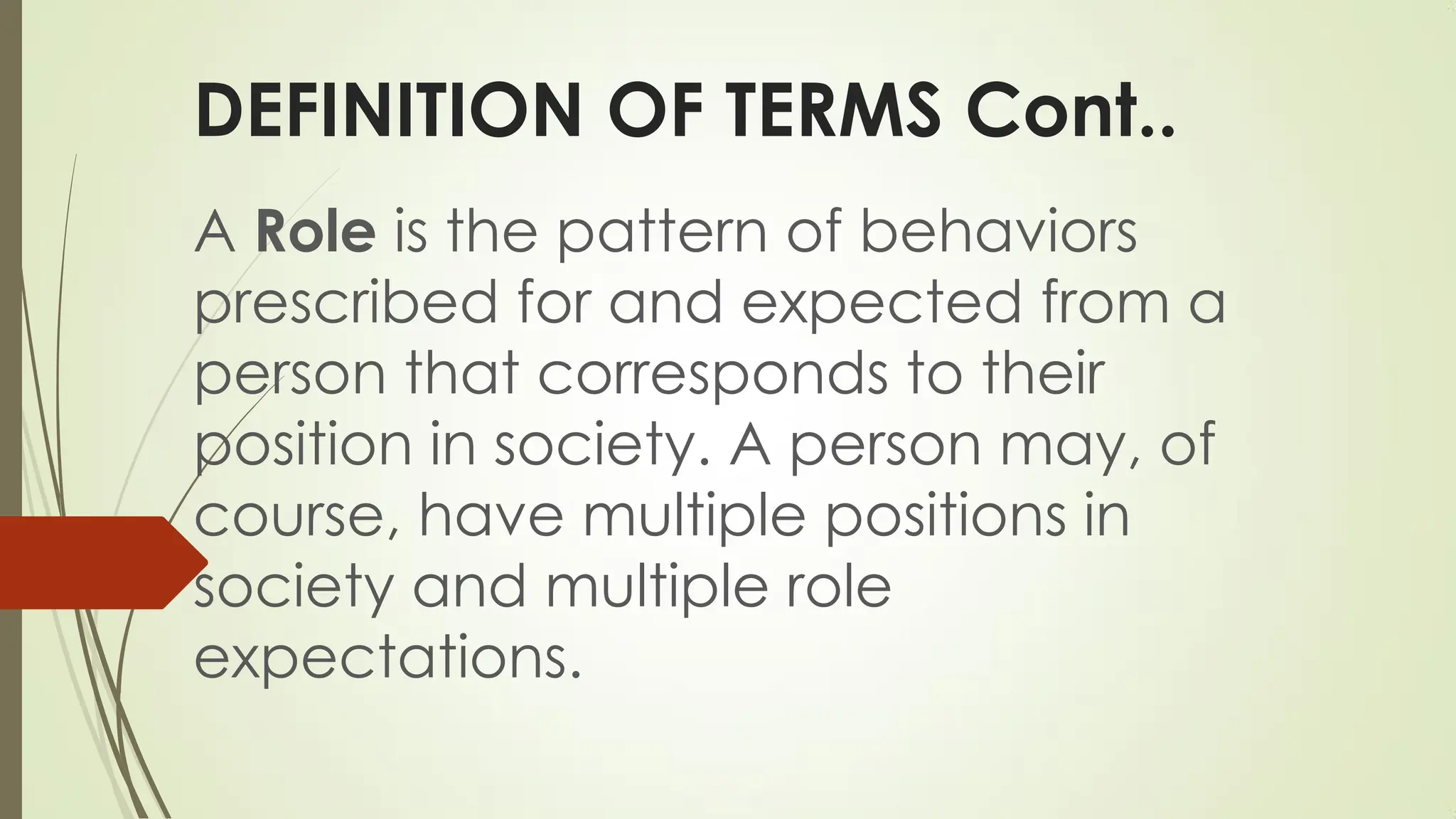
DEFINITION OF TERMS Cont..
A Role is the pattern of behaviors
prescribed for and expected from a
person that corresponds to their
position in society. A person may, of
course, have multiple positions in
society and multiple role
expectations.
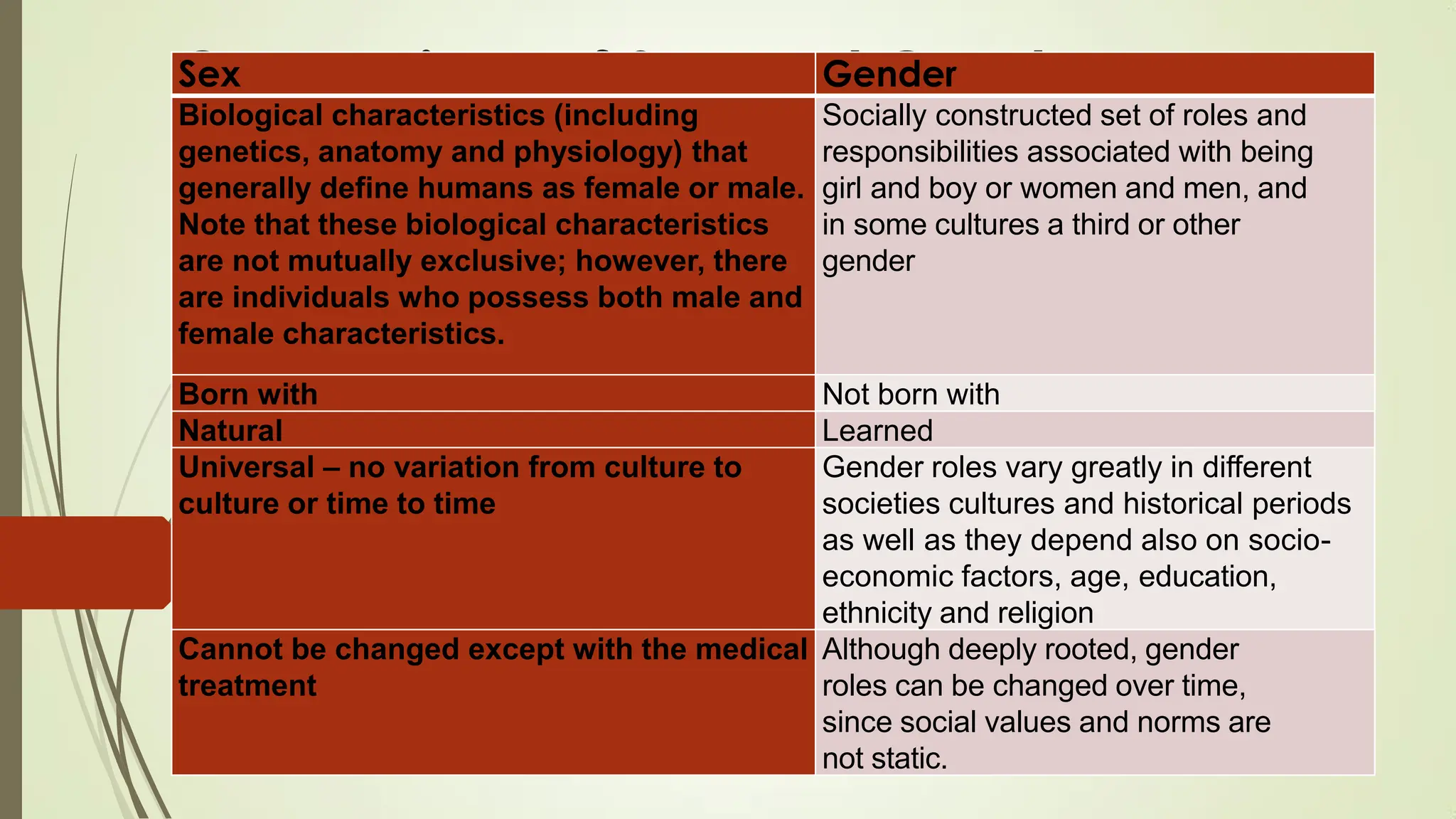
Comparison of Sex and Gender
Sex Gender
Biological characteristics (including
genetics, anatomy and physiology) that
generally define humans as female or male.
Note that these biological characteristics
are not mutually exclusive; however, there
are individuals who possess both male and
female characteristics.
Socially constructed set of roles and
responsibilities associated with being
girl and boy or women and men, and
in some cultures a third or other
gender
Born with Not born with
Natural Learned
Universal – no variation from culture to
culture or time to time
Gender roles vary greatly in different
societies cultures and historical periods
as well as they depend also on socio-
economic factors, age, education,
ethnicity and religion
Cannot be changed except with the medical
treatment
Although deeply rooted, gender
roles can be changed over time,
since social values and norms are
not static.
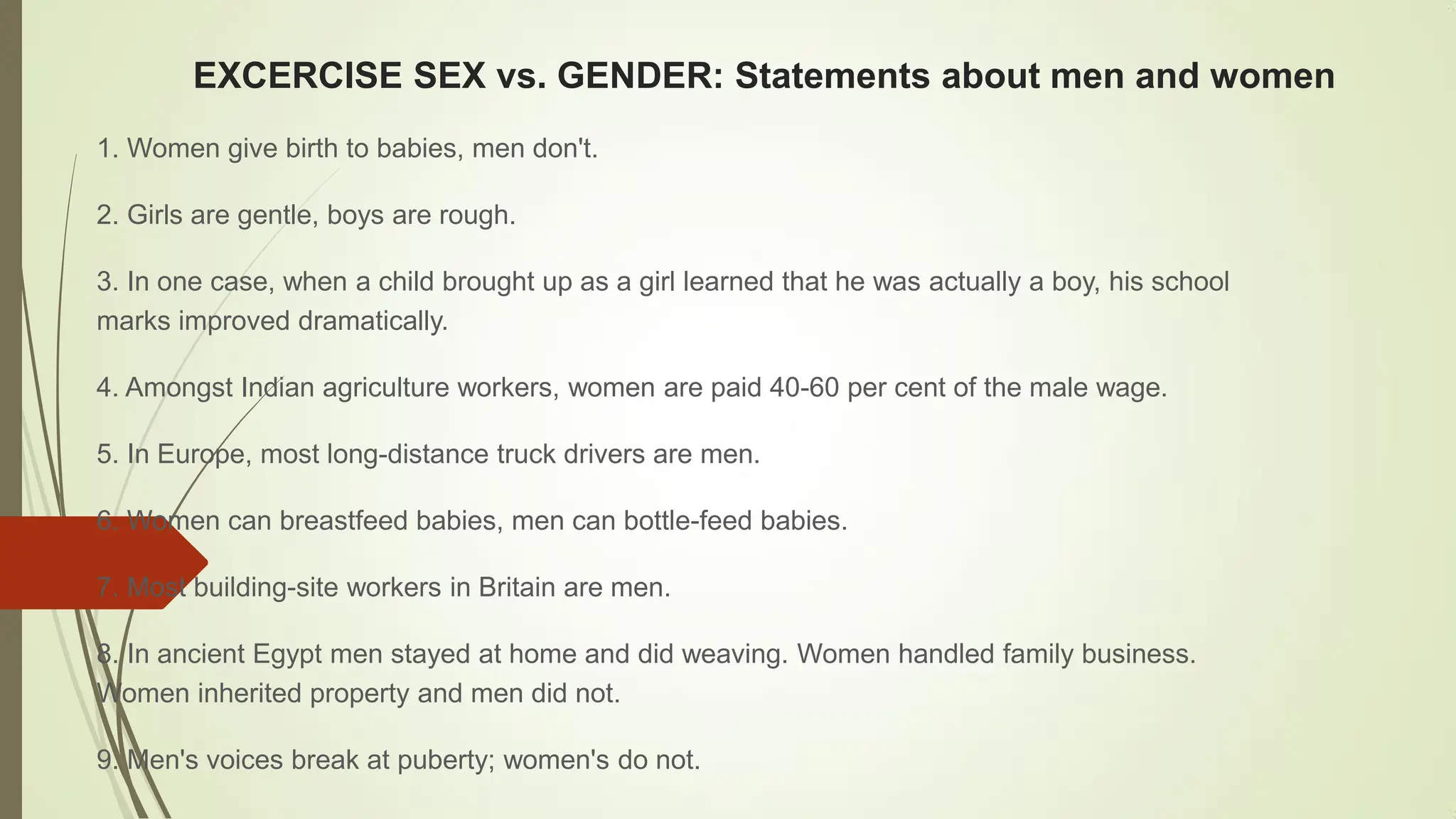
EXCERCISE SEX vs. GENDER: Statements about men and women
1. Women give birth to babies, men don't.
2. Girls are gentle, boys are rough.
3. In one case, when a child brought up as a girl learned that he was actually a boy, his school
marks improved dramatically.
4. Amongst Indian agriculture workers, women are paid 40-60 per cent of the male wage.
5. In Europe, most long-distance truck drivers are men.
6. Women can breastfeed babies, men can bottle-feed babies.
7. Most building-site workers in Britain are men.
8. In ancient Egypt men stayed at home and did weaving. Women handled family business.
Women inherited property and men did not.
9. Men's voices break at puberty; women's do not.
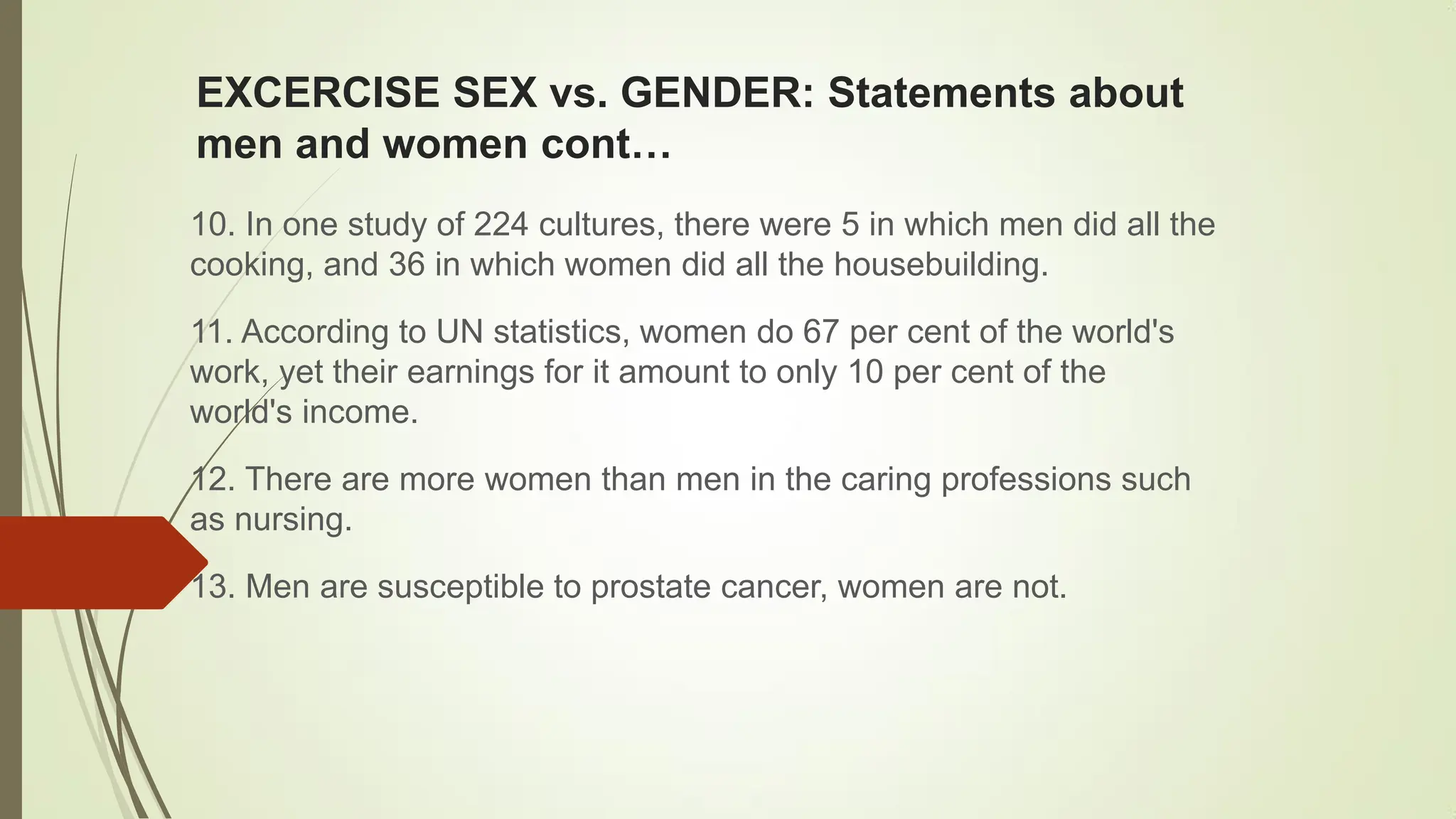
EXCERCISE SEX vs. GENDER: Statements about
men and women cont…
10. In one study of 224 cultures, there were 5 in which men did all the
cooking, and 36 in which women did all the housebuilding.
11. According to UN statistics, women do 67 per cent of the world's
work, yet their earnings for it amount to only 10 per cent of the
world's income.
12. There are more women than men in the caring professions such
as nursing.
13. Men are susceptible to prostate cancer, women are not.
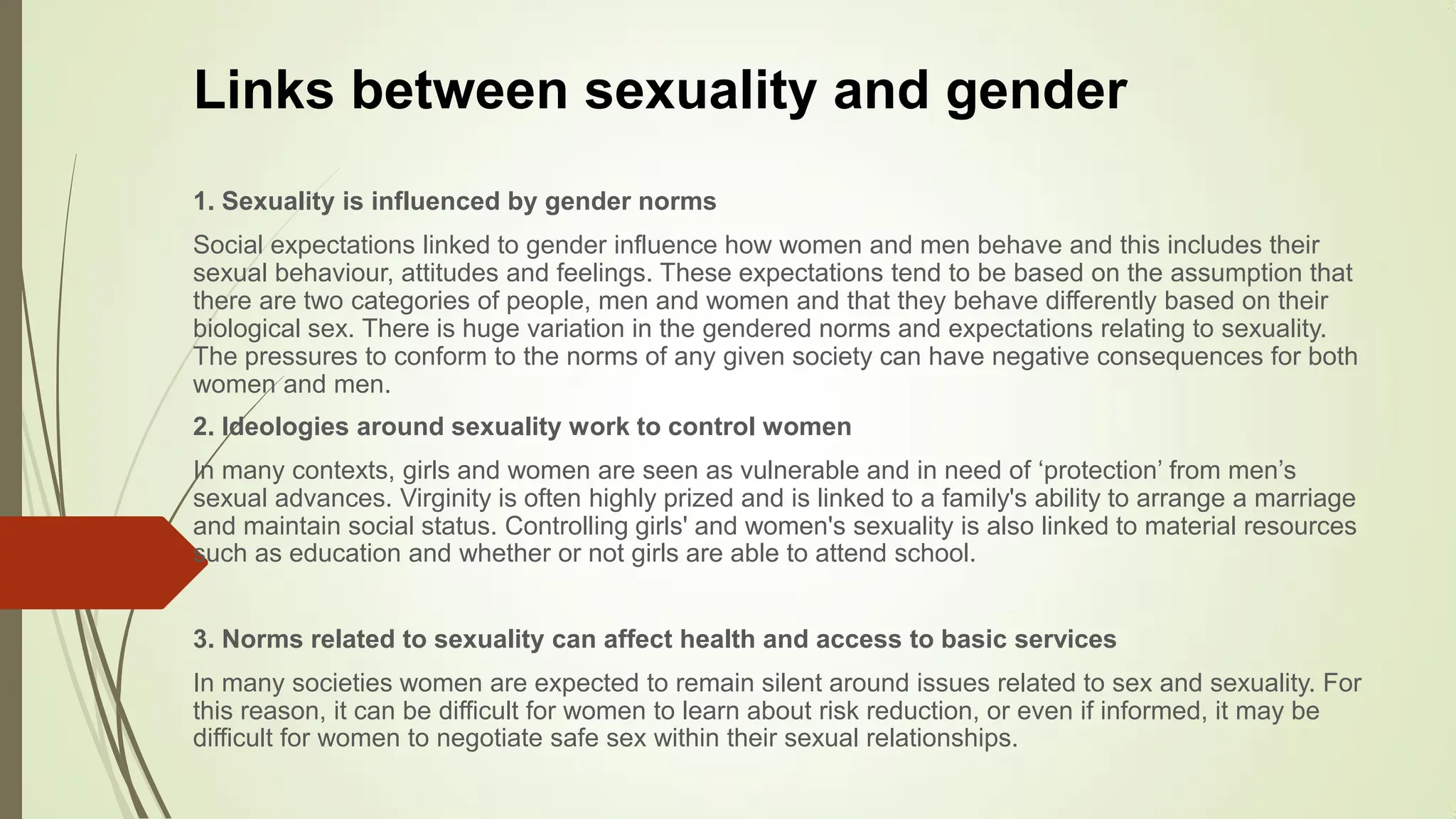
Links between sexuality and gender
1. Sexuality is influenced by gender norms
Social expectations linked to gender influence how women and men behave and this includes their
sexual behaviour, attitudes and feelings. These expectations tend to be based on the assumption that
there are two categories of people, men and women and that they behave differently based on their
biological sex. There is huge variation in the gendered norms and expectations relating to sexuality.
The pressures to conform to the norms of any given society can have negative consequences for both
women and men.
2. Ideologies around sexuality work to control women
In many contexts, girls and women are seen as vulnerable and in need of „protection‟ from men‟s
sexual advances. Virginity is often highly prized and is linked to a family's ability to arrange a marriage
and maintain social status. Controlling girls' and women's sexuality is also linked to material resources
such as education and whether or not girls are able to attend school.
3. Norms related to sexuality can affect health and access to basic services
In many societies women are expected to remain silent around issues related to sex and sexuality. For
this reason, it can be difficult for women to learn about risk reduction, or even if informed, it may be
difficult for women to negotiate safe sex within their sexual relationships.
Gender Equality vs Gender Equity
Gender Equality is the state or condition that affords people
equal enjoyment of human rights, socially valued goods,
opportunities, and resources. This means equal outcomes for
women, men, and gender-diverse people.
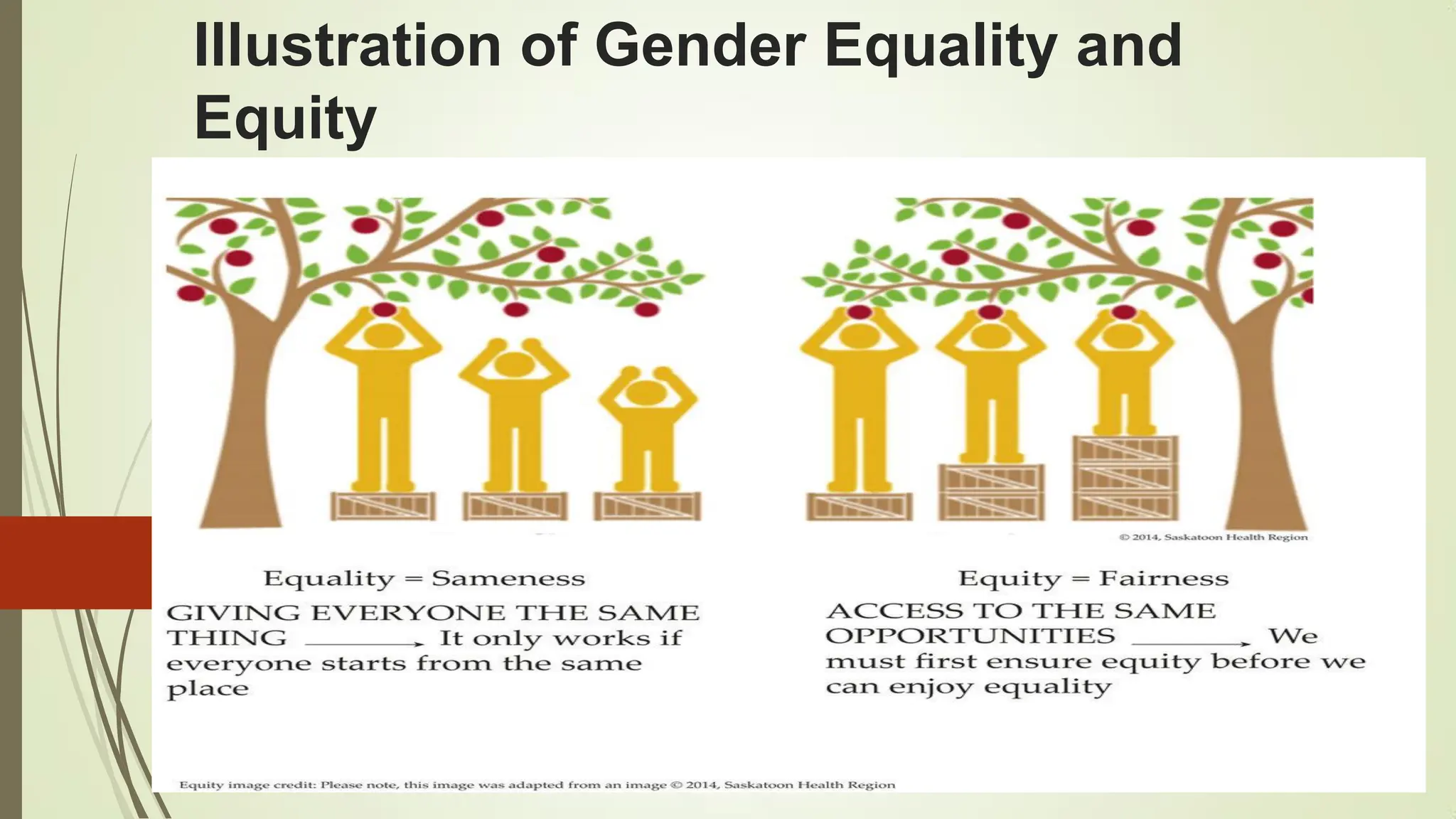
Gender equity recognises that women and gender-diverse people
are not in the same „starting position‟ as men. This is because of
historical and social disadvantages. Treating women, gender-
diverse people and men equally might not actually be fair. In fact,
it can create further disadvantage. Gender equity measures are
needed to level the playing field.
Illustration of Gender Equality and
Equity
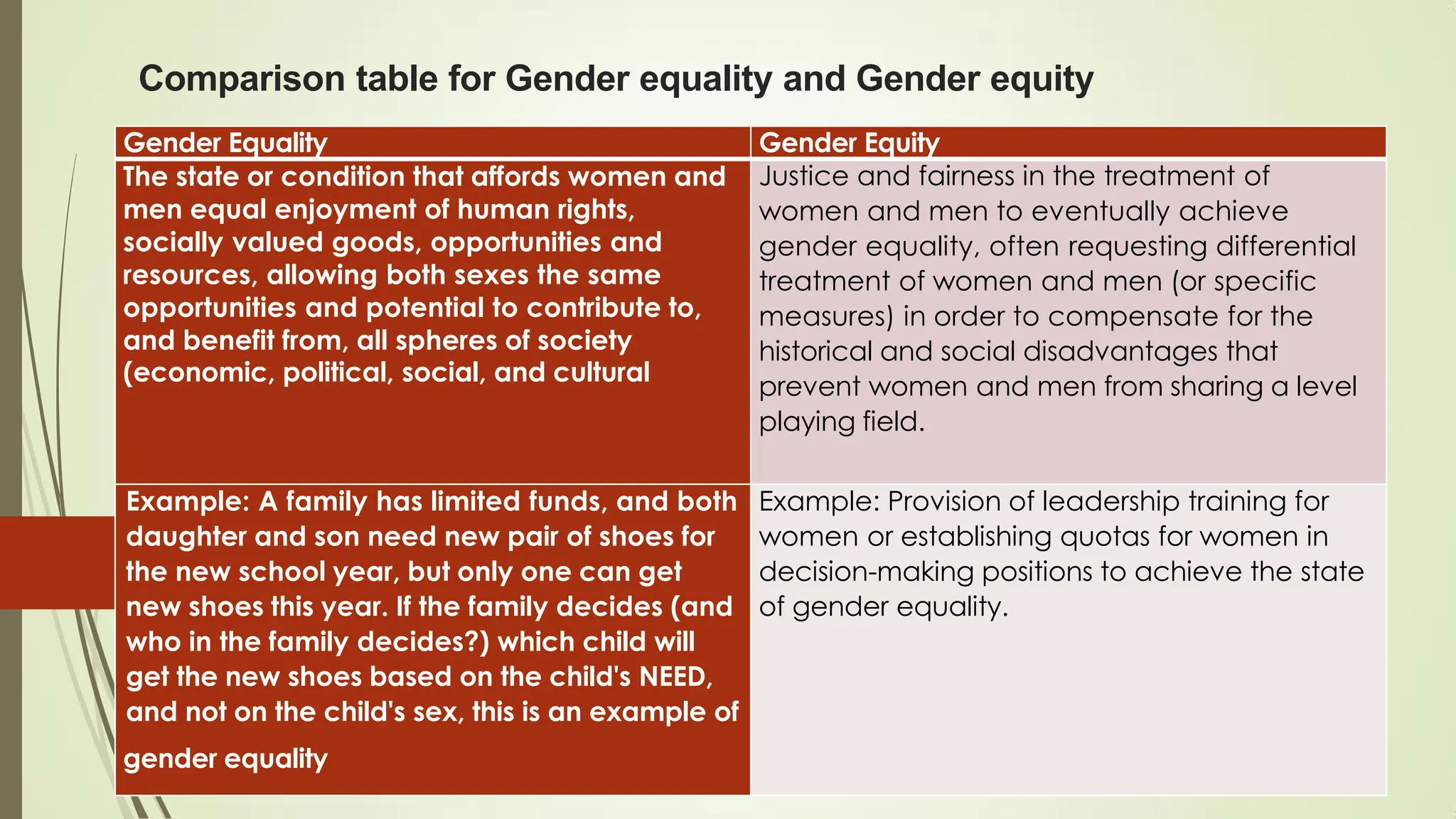
Comparison table for Gender equality and Gender equity
Gender Equality Gender Equity
The state or condition that affords women and
men equal enjoyment of human rights,
socially valued goods, opportunities and
resources, allowing both sexes the same
opportunities and potential to contribute to,
and benefit from, all spheres of society
(economic, political, social, and cultural
Justice and fairness in the treatment of
women and men to eventually achieve
gender equality, often requesting differential
treatment of women and men (or specific
measures) in order to compensate for the
historical and social disadvantages that
prevent women and men from sharing a level
playing field.
Example: A family has limited funds, and both
daughter and son need new pair of shoes for
the new school year, but only one can get
new shoes this year. If the family decides (and
who in the family decides?) which child will
get the new shoes based on the child's NEED,
and not on the child's sex, this is an example of
gender equality
Example: Provision of leadership training for
women or establishing quotas for women in
decision-making positions to achieve the state
of gender equality.
GENDER EQUALITY vs.
WOMEN'S RIGHTS
Women's rights:
• entitlements that women have on the basis that they are human.
• normatively based in several international human rights
documents (e.g. The Convention on the Elimination of
Discrimination Against Women (CEDAW)).
• Arranged around the concept of duty bearer & rights holder
TRANSGENDER vs.
TRANSSEXUAL
Transgender: refers to those trans people who live permanently in
their preferred gender, without necessarily needing to undergo any
medical intervention/s.
Transsexual: refers to people who identifies entirely with the
gender role opposite to the sex assigned to at birth and seeks to
live permanently in the preferred gender role. Transsexual people
might intend to undergo, are undergoing or have undergone
gender reassignment treatment (which may or may not involve
hormone therapy or surgery
Discussion questions
1. Jane and John are brother and sister. Jane is invited by a neighbour
to a birthday party. John says he would like to go too, but when Jane
and John‟s parents telephone the neighbours, they are informed that
it is an “all girl” birthday party, and John is not invited. As Jane and
John‟s parents, what would you tell them?
2. Should men still do such things as open doors for women, stand until
a woman is seated, and walk on the outside of the sidewalk?
3. Should women and girls (of any age) be encouraged to participate
in beauty pageants?
4. Should women retain their birth names upon marriage?
L1 Evolution of Gender studies namibia.pdf

  • 1.
  • 2.
    OUTCOMES 1. Define Gender 2.Explain the evolution of gender 3. Compare sex and gender 4. Discuss links between gender and sexuality 5. Differentiate equality and equity 6. Discuss a link between gender equality and women’s right 7. Explain transgender and transsexual
  • 3.
    EVOLUTION OF GENDER Theanalytical concept of gender was introduced in the 1970s to indicate the social roles, characteristics, and values assigned to males and females in each society. Historically gender is understood as cross-culturally and is socially based and not fixed in nature. For the study we will use 'gender' to mean social, cultural expectations and actions; and 'sex' to refer to physiological characteristics Gender is an important consideration in development. It is a way of looking at how social norms and power structures impact on the lives and opportunities available to different groups of men and women. Globally, more women than men live in poverty. Women are also less likely than men to receive basic education and to be appointed to a political position nationally and internationally. Understanding that men and women, boys and girls experience poverty differently and face different barriers in accessing services, economic resources and political opportunities helps to target interventions. Women‟s and Gender Studies programs have been so successful as part of an intellectual movement that there is now a greater awareness of the importance of gender in people‟s lives.
  • 4.
    DEFINITION OF TERMS GenderStudies: An inter-disciplinary and multi-disciplinary academic field devoted to various aspects of identity and representation across societies and cultures Femininity: Qualities or attributes regarded as characteristic of women. Masculinity: A set of attributes, behaviours, and roles associated with boys and men. Sex refers to biologically defined and genetically acquired differences between males and females, according to their physiology and reproductive capabilities or potentialities. It is universal and mostly unchanging, without surgery.
  • 5.
    DEFINITION OF TERMSCont.. Gender refers to the economic, social, political, and cultural attributes and opportunities associated with being women and men. The social definitions of what it means to be a woman or a man vary among cultures and change over time. Gender is a sociocultural expression of particular characteristics and roles that are associated with certain groups of people with reference to their sex and sexuality. Sexuality refer to sexual feelings, thoughts, attractions and behaviours towards other people Society is a group of people living as a community or an organized group of people for a common purpose
  • 6.
    DEFINITION OF TERMSCont.. A Role is the pattern of behaviors prescribed for and expected from a person that corresponds to their position in society. A person may, of course, have multiple positions in society and multiple role expectations.
  • 7.
    Comparison of Sexand Gender Sex Gender Biological characteristics (including genetics, anatomy and physiology) that generally define humans as female or male. Note that these biological characteristics are not mutually exclusive; however, there are individuals who possess both male and female characteristics. Socially constructed set of roles and responsibilities associated with being girl and boy or women and men, and in some cultures a third or other gender Born with Not born with Natural Learned Universal – no variation from culture to culture or time to time Gender roles vary greatly in different societies cultures and historical periods as well as they depend also on socio- economic factors, age, education, ethnicity and religion Cannot be changed except with the medical treatment Although deeply rooted, gender roles can be changed over time, since social values and norms are not static.
  • 8.
    EXCERCISE SEX vs.GENDER: Statements about men and women 1. Women give birth to babies, men don't. 2. Girls are gentle, boys are rough. 3. In one case, when a child brought up as a girl learned that he was actually a boy, his school marks improved dramatically. 4. Amongst Indian agriculture workers, women are paid 40-60 per cent of the male wage. 5. In Europe, most long-distance truck drivers are men. 6. Women can breastfeed babies, men can bottle-feed babies. 7. Most building-site workers in Britain are men. 8. In ancient Egypt men stayed at home and did weaving. Women handled family business. Women inherited property and men did not. 9. Men's voices break at puberty; women's do not.
  • 9.
    EXCERCISE SEX vs.GENDER: Statements about men and women cont… 10. In one study of 224 cultures, there were 5 in which men did all the cooking, and 36 in which women did all the housebuilding. 11. According to UN statistics, women do 67 per cent of the world's work, yet their earnings for it amount to only 10 per cent of the world's income. 12. There are more women than men in the caring professions such as nursing. 13. Men are susceptible to prostate cancer, women are not.
  • 10.
    Links between sexualityand gender 1. Sexuality is influenced by gender norms Social expectations linked to gender influence how women and men behave and this includes their sexual behaviour, attitudes and feelings. These expectations tend to be based on the assumption that there are two categories of people, men and women and that they behave differently based on their biological sex. There is huge variation in the gendered norms and expectations relating to sexuality. The pressures to conform to the norms of any given society can have negative consequences for both women and men. 2. Ideologies around sexuality work to control women In many contexts, girls and women are seen as vulnerable and in need of „protection‟ from men‟s sexual advances. Virginity is often highly prized and is linked to a family's ability to arrange a marriage and maintain social status. Controlling girls' and women's sexuality is also linked to material resources such as education and whether or not girls are able to attend school. 3. Norms related to sexuality can affect health and access to basic services In many societies women are expected to remain silent around issues related to sex and sexuality. For this reason, it can be difficult for women to learn about risk reduction, or even if informed, it may be difficult for women to negotiate safe sex within their sexual relationships.
  • 11.
    Gender Equality vsGender Equity Gender Equality is the state or condition that affords people equal enjoyment of human rights, socially valued goods, opportunities, and resources. This means equal outcomes for women, men, and gender-diverse people. Gender equity recognises that women and gender-diverse people are not in the same „starting position‟ as men. This is because of historical and social disadvantages. Treating women, gender- diverse people and men equally might not actually be fair. In fact, it can create further disadvantage. Gender equity measures are needed to level the playing field.
  • 12.
    Illustration of GenderEquality and Equity
  • 13.
    Comparison table forGender equality and Gender equity Gender Equality Gender Equity The state or condition that affords women and men equal enjoyment of human rights, socially valued goods, opportunities and resources, allowing both sexes the same opportunities and potential to contribute to, and benefit from, all spheres of society (economic, political, social, and cultural Justice and fairness in the treatment of women and men to eventually achieve gender equality, often requesting differential treatment of women and men (or specific measures) in order to compensate for the historical and social disadvantages that prevent women and men from sharing a level playing field. Example: A family has limited funds, and both daughter and son need new pair of shoes for the new school year, but only one can get new shoes this year. If the family decides (and who in the family decides?) which child will get the new shoes based on the child's NEED, and not on the child's sex, this is an example of gender equality Example: Provision of leadership training for women or establishing quotas for women in decision-making positions to achieve the state of gender equality.
  • 14.
    GENDER EQUALITY vs. WOMEN'SRIGHTS Women's rights: • entitlements that women have on the basis that they are human. • normatively based in several international human rights documents (e.g. The Convention on the Elimination of Discrimination Against Women (CEDAW)). • Arranged around the concept of duty bearer & rights holder
  • 15.
    TRANSGENDER vs. TRANSSEXUAL Transgender: refersto those trans people who live permanently in their preferred gender, without necessarily needing to undergo any medical intervention/s. Transsexual: refers to people who identifies entirely with the gender role opposite to the sex assigned to at birth and seeks to live permanently in the preferred gender role. Transsexual people might intend to undergo, are undergoing or have undergone gender reassignment treatment (which may or may not involve hormone therapy or surgery
  • 16.
    Discussion questions 1. Janeand John are brother and sister. Jane is invited by a neighbour to a birthday party. John says he would like to go too, but when Jane and John‟s parents telephone the neighbours, they are informed that it is an “all girl” birthday party, and John is not invited. As Jane and John‟s parents, what would you tell them? 2. Should men still do such things as open doors for women, stand until a woman is seated, and walk on the outside of the sidewalk? 3. Should women and girls (of any age) be encouraged to participate in beauty pageants? 4. Should women retain their birth names upon marriage?