Discussing gender and 
international cultural 
relations 
A collection of interviews with women 
working in international cultural 
relations, exploring perceptions of 
gender and diversity
Contents 
2 | P a g e 
Page 
Foreword 3 
Gender and international cultural relations, Rosemary Bechler 
Introduction: gender equality 4 
‘Hegemonic masculinity’ 6 
Gender difference 9 
Global differences 14 
Beyond dichotomies 16 
Talking gender 
• Lesley Abdela 
Using the whole gamut of colours to get the picture right 20 
• Zeinab Badawi 
Holding elites to account 34 
• Srilatha Batliwala 
Empowerment can work in unpredictable ways 44 
• Charlotte Bunch 
‘Our life experience has been left out of this picture!’ No more! 54 
• Baroness Helena Kennedy QC 
All of our human interconnections 66 
• Oona King 
Things should be fairer 76 
• Zohra Moosa 
Going into a different room 87 
• Linda Tarr-Whelan 
Equality doesn’t mean ‘the same’ 98
Foreword 
International Women’s Day marked its centenary in 2011. One hundred years of any 
celebration gives cause to reflect on the path towards gender equality which 
International Women’s Day highlights. For us at the British Council, issues of equality 
and diversity are an important part of our work in international cultural relations, and 
we have adopted a strategy of embedding them in everything we do. We give 
attention to gender equality within our own management of an international 
workforce, and externally in our programmes and services. 
But over time our awareness of gender as it affects cultural relations has developed 
and we are keen to explore its implications further. This led us to engage Rosemary 
Bechler, a writer immersed in thinking about the relationship between human and 
political rights. Here she tackles the interplay of gender in this relationship, outlining 
challenging, illuminating and relatively under-explored ideas. 
She talked to eight women who have made notable contributions in their fields, 
including diversity, human rights, journalism and international relations. These 
interviews, held between December 2009 and December 2010, offer widely differing 
perspectives and experiences. Women are far from a homogenous group, and the 
rich variety that exists when thinking about gender across diverse cultures and its 
different impact on women depends on all those characteristics that make each one 
of us unique. 
We hope that reading this collection of interviews will help you reflect on the role of 
gender in international cultural relations. We hope at times you will pause because 
your views have been challenged or because you are learning something new and 
need to let it sink in – this was certainly our experience. 
Most of us would be quick to point out that there is still huge inequality – wherever 
we live. The reasons may be complex and diverse, but acknowledging the impact of 
gender, and reflecting on the implications, must be a good place to start. Our 
challenge is to work out what this means in practice. As Rosemary Bechler points 
out, gender equality seeks equal rights and entitlements for both women and men, 
with an equal voice in civil and political life. 
This does not mean that women and men should be the same: the opposite of 
gender equality is inequality, not difference. We believe there is a need for us all to 
understand our differences and the opportunities they bring to meet our goals. 
3 | P a g e 
Fiona Bartels-Ellis and Jane Franklin, Diversity Unit
Gender and international cultural relations 
Introduction: gender equality 
Gender equality calls for women and men to have equal rights and entitlements to 
human, social, economic and cultural development, and an equal voice in civil and 
political life. This does not mean that women and men will become the same, but 
that women’s and men’s rights, responsibilities and opportunities do not depend on 
whether they are born male or female. The pursuit of gender equality has a long 
history. Especially in the West, it can be seen as an extension of the ongoing claims 
for liberty and equality unleashed by the French Revolution, when equality before the 
law became newly established as the basis of the social order. Well into the 20th 
century, the extended struggle for the franchise has stood as the symbol of a much 
wider struggle by women playing a central role in extending, defending or giving 
substance to social citizenship rights. 
The call for equal rights for women resurfaced in the 1960s and 1970s alongside 
movements for civil and human rights, peace, the environment, and gay liberation. 
One of the major triumphs of this stage was the UN adoption of the Convention on 
the Elimination of All Forms of Discrimination Against Women (CEDAW) in 1979, the 
first international human-rights instrument to explicitly define all forms of 
discrimination against women as fundamental human-rights violations. CEDAW 
emphasised women's individual rights in opposition to those traditionalists who 
defend major inequalities in the status quo as the ‘complementary’ roles for men and 
women that nature intended. It called for the equality of men and women in public 
and political life, before the law and with respect to nationality rights, in education, 
employment, the provision of healthcare (including access to family planning 
services), and in marriage and family matters. Another high point was the 
constitution of the new South Africa (1996 – built on the Women’s Charter for 
Effective Equality and the ANC’s 1993 Bill of Rights), which emphasises the equal 
citizenship of women and men and people of all races, by making provision for equal 
protection under the law, equal rights in the family, and in all areas of public life. 
In the last three to four decades, this pursuit of gender equality has brought 
successive challenges to many major areas of social, economic and political life, 
beginning with a quest for equal representation in the corridors of power, but 
developing into a broader critique of masculine bias and ‘power politics’, and the 
search for forms of mutual empowerment. Democratic advances have always 
occurred, either as new groups have claimed access to rights already declared, or 
new rights have been demanded in social relations hitherto considered ‘naturally’ 
hierarchical, such as those concerned with race and gender. In recent years, a new 
element has entered the quest for gender equality – the appreciation of the different 
4 | P a g e
perspectives that are brought into this process by non-western experiences and 
voices. So, this is now a truly global challenge. 
Meanwhile, women’s engagement with politics and the law has had an impact on 
public policy across the world. Thanks to the efforts of women’s organisations in the 
United Nations Decade for Women (1975–85), the UN began to disaggregate data 
by sex, first introducing its gender development index (GDI) in its Human 
Development Report for 1995 based on gender differences in life expectancy, 
earned income, illiteracy and enrolment in education. It also introduced the gender 
empowerment measure (GEM), based on the proportion of women in parliament and 
in economic leadership positions. By the end of the 20th century, the majority of the 
world’s nations had pledged to eradicate gender discrimination through instruments 
such as CEDAW, the Beijing Platform for Action and the UN’s Security Council 
Resolution 1325. As a result, gender discrimination in employment has been 
outlawed in many countries; gender quotas for election candidates and ministerial 
appointments are widespread in Europe; rape has been classified for the first time as 
a war crime; the phrase ‘gender violence’ has entered global vocabulary; and 
development organisations have ensured that issues of world poverty are now 
formulated in gender terms, with a clear realisation that it is women who bear a 
disproportionate share of the costs. 
Most of the legal, economic and social reforms in western liberal democracies that 
have benefited women can be attributed to the struggle for equal rights and equal 
treatment, and the challenge to modern states to become sufficiently neutral arbiters 
to ensure women’s equality. However, campaigners who had hoped that 
incorporating a critical mass of women into leading positions in existing institutional 
structures on an equal basis with men might transform the nature of power and the 
practice of politics were to be disappointed. Critics of the liberal perspective began to 
point out that deep structures of gender inequality have kept women unequal in both 
public and private life, long after they have received the vote and other formal rights. 
All too often, to gain political power and acceptance in political, business, scientific or 
academic elites, women are still trapped in a double bind between adopting the 
dominant values or reinforcing a gender stereotype. Either way, it seemed, the issue 
of masculine bias was far from being fully addressed. How could one, for example, 
set about enabling women to participate as the equals of men in the public sphere, 
without continuing to undervalue the contribution that women make in the private 
sphere? 
This dilemma, sometimes summed up as the ‘equality vs difference’ dilemma, and 
elsewhere described as the competing claims of an ‘ethic of care’ in caring 
relationships and an ‘ethic of justice’ which defends our rights as equal individual 
citizens, has been one of the main drivers of the national debate ever since. But it 
has also informed a broader exploration that took place in the academic discipline of 
International Relations (IR) – one that has a potentially transformative effect on how 
we might approach international cultural relations. 
5 | P a g e
‘Hegemonic masculinity’ 
In the 1980s, gender analysts in a range of academic disciplines were investigating 
how gender – notions of what ‘women’ and ‘men’ are and the unequal relationship 
between them – is subtly enmeshed in the economic, cultural and social structures of 
society. Feminists studying male ‘sex roles’ in war, diplomacy and high-level state 
negotiations in the field of International Relations (IR) shared the early hopes that 
change would come about if sufficient numbers of women were absorbed into 
international politics as soldiers, diplomats or academics. Now they too were 
discovering that if women were willing to adopt ‘masculinist’ values, significant 
numbers could enter these professions to minimal effect. In 1988, J. Ann Tickner, 
finding that IR was one of the last social sciences to be touched by a gender analysis 
because the field was ‘so thoroughly masculinized that the workings of these 
hierarchical gender relations [were] hidden’, turned her attention to ‘hegemonic 
masculinity’. 
This term describes a particular ideal of the male warrior espoused by western 
political theorists from the Greeks to Machiavelli, which remains central to IR thinking 
on the behaviour of states. For example, in his Politics Among Nations (1948), Hans 
Morgenthau based his theory of international relations on a Hobbesian view of the 
‘nature of man’: all social institutions must channel the natural aggression of man. 
Self-preservation of strong and weak alike encourages the setting up of a sovereign 
nation-state to secure the unity and strong leadership necessary for civilised life: but 
the international realm essentially remains a war of all against all. Nationhood 
enables its members to share the meanings of their collective identity through a 
process of ‘Othering’ – or the drawing of boundaries between a civilised ‘Us’ and a 
barbaric ‘Them’. The realist concept of a single, unifying ‘national interest’ assumed 
that citizens’ identification with the nation took precedence over all other kinds of 
social or political identification and human attachment. 
Not surprisingly, a vocabulary that propounded the defence at all costs of state 
sovereignty from foreign threat flourished in the Cold War period. Neo-realists, 
striving to build a truly detached, instrumental ‘science ‘of International Relations, 
borrowed methodologies from the natural sciences, statistics, and, particularly in 
national security studies, game theory. This search for a science of IR was an 
extension of ‘hegemonic masculinity’, privileging scientific objectivity, emotional 
distance and instrumentality over other weaker ways of behaving – for example, co-operation 
6 | P a g e 
between states – which were designated less ‘realistic’. 
But as the Cold War ended, giving way to ethnic conflicts and the ‘war on terror’, the 
relevance of the state as a rational actor with a unitary national interest has come 
under increasing scrutiny. The rising importance of global interdependence and 
communication, the role of non-state actors, and cultural controversies over religious
and ethnic identities have all foregrounded a much more complex set of international 
relations. Realist and neo-realist assumptions began to be challenged by social 
constructivists, world order and critical theorists and postmodernists, claiming that 
issues of culture and identity must be taken into account in the national security core 
of mainstream IR thinking. 
Alongside them, gender analysts suggested that solutions to the latest threats – the 
recognition of the need for an understanding of the ‘Other’, persuasion and influence, 
dialogue and co-operation – were also at odds with these power politics 
prescriptions. Fears, perceptions and projected enemy images had played their part. 
What had been presented as a rational pursuit of interests in an objective reality, in 
fact rested on a historically and socially constructed, gender-specific notion of 
autonomous agency and ‘power over’. This, they thought, was in danger of 
legitimising and sustaining anarchy in the international order as a self-fulfilling 
prophecy. It was in this post-Cold War context that Tickner began to track 
‘hegemonic masculinity’ through history to show how partial the realist account was, 
and to highlight the extent to which mainstream IR thinking relied on gender 
stereotypes and practices, while at the same time completely denying its relevance. 
Returning to early modern European state formation, she could point to the role of 
‘hegemonic masculinity’ in another process of ‘Othering’ essential to state identity – 
the gendered division of labour. This socio-sexual process of polarisation between 
work and home took place simultaneously with the consolidation of states in the 17th 
century. In the assertion of authority within a given territory through the rule of law, 
this second process placed internal boundaries between the ‘public’ and ‘private’ 
realms of society, thereby excluding women from citizenship rights. Civil and political 
rights applied only to the public sphere. What went on inside families was deemed to 
be a private matter beyond the reach of law. 
As a result, while men were socialised to identify with constructions of masculinity 
that emphasised autonomy, male superiority, fraternity, strength, public protector 
roles and ultimately the bearing of arms, women, on the other hand, were taught to 
defer, as wives and daughters, to the protection and stronger will of men, while 
providing the private emotional, economic and social support systems for men’s war 
activities. The historical connection between citizenship rights and the duty to take 
up arms in the defence of the state legitimised a dominance of men over women that 
still plays a role in limiting women’s rights in the world today. Tickner pointed out how 
modern life was conceptually divided into a number of highly gendered spheres – 
private/public/ international – and that IR as a discipline had taken up its position as 
a wholly masculine sphere of war and diplomacy at the furthest extreme from the 
domestic sphere of families, women, and reproduction, personal life, domestic and 
family life and that of civil society. 
7 | P a g e
Not only were women’s lives invisible to this 
discourse, but in both processes of ‘Othering’, the 
‘powerlessness’ – passivity, weakness, 
dependency, defeat – associated with femininity, 
became another threat alongside that posed by 
the enemy. Throughout western history, the 
characteristics and values of hegemonic 
masculinity have been socially privileged over their 
binary opposites, associated with a devalued 
femininity. Of course this is not the only attitude to 
women! But it has had a systemic effect. This 
‘gender dichotomisation’ plays an important role in 
sustaining authority and legitimising a political and 
social order. Hegemonic masculinity has not only depended for its reproduction on 
the support of the female: it has been equally reliant on the stigma of ‘being feminine’ 
to keep alternative masculinities in order. In this process, gender inequality is 
frequently compounded by other dimensions such as class, race, or sexuality. At 
various points in history, political discourses can be found, for example in racist 
thinking around empire-building or in genocide scenarios, when foreigners, ethnic 
minorities, and also devalued masculinities, have been designated a threat to the 
natural order simply by dint of being ‘effeminate’ – irrational, emotional, unstable or 
‘queer’. In far less extreme circumstances, the devaluing and subsequent fear of 
femininity plays a part in ensuring conformity to the status quo. 
Gender activists and analysts in IR and many other disciplines – sociology, 
psychology, history, philosophy and the humanities – began to consider to what 
extent they themselves were perpetuating this gendered, unequal view of the world, 
by concentrating their efforts on placing women in the most visibly powerful 
positions. They pointed out that even the highest forms of ‘power over’, far from 
being autonomous and self-reliant, were in fact entirely dependent for their 
maintenance on three sets of ‘others’: ‘subordinated femininity’ as the state’s social 
support system created by the public/private split; various levels and forms of 
‘subordinated masculinity’, required to identify with ‘hegemonic masculinity’ to 
guarantee order, externally and internally; and, of course, the enemy – the allegedly 
‘objective’ threat to the state located in the amoral world ‘out there’. What would the 
field of IR look like were this not the case? 
In 1988, taking her cue from this exploration of binary oppositions, J. Ann Tickner’s 
pioneering critique of the role of ‘hegemonic masculinity’ in Hans Morgenthau’s six 
principles of power politics helped launch a substantial new body of research. A rich 
literature followed on issues of war and peace, international law and development, 
culture and security, democracy, rights, identities and agents for change. 
8 | P a g e 
Carol Cohn, studying the ‘rational’ discourse of 
defence intellectuals and attitudes to weapons 
of mass destruction in the late 1980s, came 
across this example of the threat of 
feminisation as a powerful tool in the 
construction and maintenance of masculine 
hierarchy, in her interview with a physicist who 
had been working with defence colleagues on 
the modelling of nuclear ‘counterforce attacks’: 
‘All of a sudden,’ he said, ‘I heard what we 
were saying and I blurted out, “Wait, I’ve just 
heard how we’re talking – Only thirty million! 
Only thirty million human beings killed 
instantly?” Silence fell upon the room. Nobody 
said a word. They didn’t even look at me. It 
was awful. I felt like a woman.’
Gender difference 
What all these studies have in common is that they approach international relations 
primarily in terms of gendered cultural relations. Once the exclusive preoccupation 
with a ‘realist’ notion of state power and a unitary ‘national interest’ is set aside, 
power emerges, not as a fixed and constant battle of the national ‘Us’ against 
external or internal threats, but as an ever-changing, multilevel phenomenon of 
creative social forces which shape us and our choices, from our personal and sexual 
identities as men and women, to our social as well as international relations as 
citizens. 
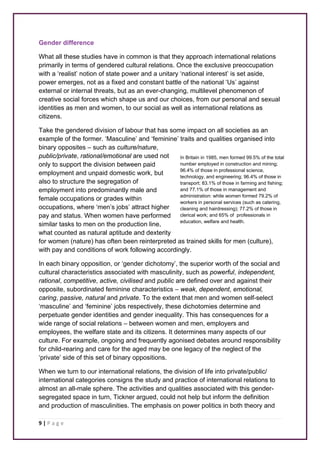
Take the gendered division of labour that has some impact on all societies as an 
example of the former. ‘Masculine’ and ‘feminine’ traits and qualities organised into 
binary opposites – such as culture/nature, 
public/private, rational/emotional are used not 
only to support the division between paid 
employment and unpaid domestic work, but 
also to structure the segregation of 
employment into predominantly male and 
female occupations or grades within 
occupations, where ‘men’s jobs’ attract higher 
pay and status. When women have performed 
similar tasks to men on the production line, 
what counted as natural aptitude and dexterity 
for women (nature) has often been reinterpreted as trained skills for men (culture), 
with pay and conditions of work following accordingly. 
In each binary opposition, or ‘gender dichotomy’, the superior worth of the social and 
cultural characteristics associated with masculinity, such as powerful, independent, 
rational, competitive, active, civilised and public are defined over and against their 
opposite, subordinated feminine characteristics – weak, dependent, emotional, 
caring, passive, natural and private. To the extent that men and women self-select 
‘masculine’ and ‘feminine’ jobs respectively, these dichotomies determine and 
perpetuate gender identities and gender inequality. This has consequences for a 
wide range of social relations – between women and men, employers and 
employees, the welfare state and its citizens. It determines many aspects of our 
culture. For example, ongoing and frequently agonised debates around responsibility 
for child-rearing and care for the aged may be one legacy of the neglect of the 
‘private’ side of this set of binary oppositions. 
When we turn to our international relations, the division of life into private/public/ 
international categories consigns the study and practice of international relations to 
almost an all-male sphere. The activities and qualities associated with this gender-segregated 
9 | P a g e 
In Britain in 1985, men formed 99.5% of the total 
number employed in construction and mining; 
96.4% of those in professional science, 
technology, and engineering; 96.4% of those in 
transport; 83.1% of those in farming and fishing; 
and 77.1% of those in management and 
administration: while women formed 79.2% of 
workers in personal services (such as catering, 
cleaning and hairdressing); 77.2% of those in 
clerical work; and 65% of professionals in 
education, welfare and health. 
space in turn, Tickner argued, could not help but inform the definition 
and production of masculinities. The emphasis on power politics in both theory and
practice reinforces the associations between masculinity and power itself, restricting 
the development of alternatives. 
This complex system of mutually reinforcing stereotypes is supported by a whole 
range of social institutions and practices that in turn have profound effects on 
people’s bodies and minds. Gender analysts have been concerned to show how 
central the fixing of gender identities is to the embedding of gender hierarchies and 
social relations of inequality in many different societies in a plethora of ways. Gender 
activists have explored how, when and where such inequalities can be contested to 
generate positive change. 
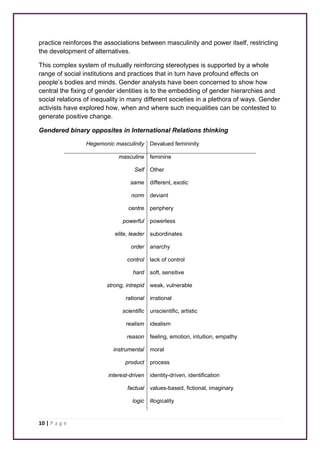
Gendered binary opposites in International Relations thinking 
10 | P a g e 
Hegemonic masculinity Devalued femininity 
masculine 
Self 
same 
norm 
centre 
powerful 
elite, leader 
order 
control 
hard 
strong, intrepid 
rational 
scientific 
realism 
reason 
instrumental 
product 
interest-driven 
factual 
logic 
feminine 
Other 
different, exotic 
deviant 
periphery 
powerless 
subordinates 
anarchy 
lack of control 
soft, sensitive 
weak, vulnerable 
irrational 
unscientific, artistic 
idealism 
feeling, emotion, intuition, empathy 
moral 
process 
identity-driven, identification 
values-based, fictional, imaginary 
illogicality
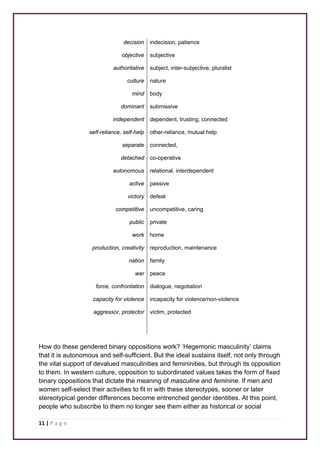
11 | P a g e 
decision 
objective 
authoritative 
culture 
mind 
dominant 
independent 
self-reliance, self-help 
separate 
detached 
autonomous 
active 
victory 
competitive 
public 
work 
production, creativity 
nation 
war 
force, confrontation 
capacity for violence 
aggressor, protector 
indecision, patience 
subjective 
subject, inter-subjective, pluralist 
nature 
body 
submissive 
dependent, trusting, connected 
other-reliance, mutual help 
connected, 
co-operative 
relational, interdependent 
passive 
defeat 
uncompetitive, caring 
private 
home 
reproduction, maintenance 
family 
peace 
dialogue, negotiation 
incapacity for violence/non-violence 
victim, protected 
How do these gendered binary oppositions work? ‘Hegemonic masculinity’ claims 
that it is autonomous and self-sufficient. But the ideal sustains itself, not only through 
the vital support of devalued masculinities and femininities, but through its opposition 
to them. In western culture, opposition to subordinated values takes the form of fixed 
binary oppositions that dictate the meaning of masculine and feminine. If men and 
women self-select their activities to fit in with these stereotypes, sooner or later 
stereotypical gender differences become entrenched gender identities. At this point, 
people who subscribe to them no longer see them either as historical or social
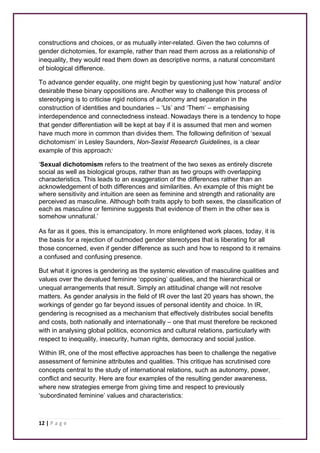
constructions and choices, or as mutually inter-related. Given the two columns of 
gender dichotomies, for example, rather than read them across as a relationship of 
inequality, they would read them down as descriptive norms, a natural concomitant 
of biological difference. 
To advance gender equality, one might begin by questioning just how ‘natural’ and/or 
desirable these binary oppositions are. Another way to challenge this process of 
stereotyping is to criticise rigid notions of autonomy and separation in the 
construction of identities and boundaries – ‘Us’ and ‘Them’ – emphasising 
interdependence and connectedness instead. Nowadays there is a tendency to hope 
that gender differentiation will be kept at bay if it is assumed that men and women 
have much more in common than divides them. The following definition of ‘sexual 
dichotomism’ in Lesley Saunders, Non-Sexist Research Guidelines, is a clear 
example of this approach: 
‘Sexual dichotomism refers to the treatment of the two sexes as entirely discrete 
social as well as biological groups, rather than as two groups with overlapping 
characteristics. This leads to an exaggeration of the differences rather than an 
acknowledgement of both differences and similarities. An example of this might be 
where sensitivity and intuition are seen as feminine and strength and rationality are 
perceived as masculine. Although both traits apply to both sexes, the classification of 
each as masculine or feminine suggests that evidence of them in the other sex is 
somehow unnatural.’ 
As far as it goes, this is emancipatory. In more enlightened work places, today, it is 
the basis for a rejection of outmoded gender stereotypes that is liberating for all 
those concerned, even if gender difference as such and how to respond to it remains 
a confused and confusing presence. 
But what it ignores is gendering as the systemic elevation of masculine qualities and 
values over the devalued feminine ‘opposing’ qualities, and the hierarchical or 
unequal arrangements that result. Simply an attitudinal change will not resolve 
matters. As gender analysis in the field of IR over the last 20 years has shown, the 
workings of gender go far beyond issues of personal identity and choice. In IR, 
gendering is recognised as a mechanism that effectively distributes social benefits 
and costs, both nationally and internationally – one that must therefore be reckoned 
with in analysing global politics, economics and cultural relations, particularly with 
respect to inequality, insecurity, human rights, democracy and social justice. 
Within IR, one of the most effective approaches has been to challenge the negative 
assessment of feminine attributes and qualities. This critique has scrutinised core 
concepts central to the study of international relations, such as autonomy, power, 
conflict and security. Here are four examples of the resulting gender awareness, 
where new strategies emerge from giving time and respect to previously 
‘subordinated feminine’ values and characteristics: 
12 | P a g e
1. War/peace – redefining security. In the 1990s gender analysts in IR began to 
challenge ‘realist’ perspectives on security, which take a top-down, often 
coercive, state-centred approach. Women conceived of power as mutual 
empowerment rather than domination. By contrast, they incorporated the need to 
address profound inequalities, both between countries and specific social groups. 
The movement away from ‘state-centric’ analysis has led to the recognition that 
international violence is no longer confined to violence between sovereign, 
territorially bounded nation-states. 
Gender analysis is also used to challenge the familiar premise that wars are 
fought to protect women and children. To the extent that wars generate refugee 
crises, mass rape, rampant prostitution and trafficking, together with a legacy of 
domestic violence, they also have disproportionately savage effects on women. 
This redefinition of security has brought a huge range of issues to the fore that 
were previously invisible. UN Resolution 1325, for example, has given 
unprecedented recognition to the role played by women in conflict prevention, 
conflict resolution and post-conflict rehabilitation and nation-building. 
2. Democracy. The evolution of democratic practices and institutions and their 
attendant notion of individual rights have certainly had benefits for women. But 
the top-down definition of democracy ignores activities outside the conventional 
political arena in which women are more likely to be involved. Given the barriers 
to formal political office that exist for women in most states, women activists 
frequently bypass the state by working either at the grass-roots level, or by 
joining forces transnationally to work for women’s rights at the global level. 
Women’s NGOs and social movements have played a crucial role in developing 
gender awareness at the international level. At the international women’s 
conference in Beijing in 1995, 30,000 women attended the NGO forum. The 
openness of the forum and a sense of its participatory democracy contrasted 
strongly with the hierarchical structures of the tradition fostered by 
intergovernmental/governmental conferencing. 
3. Gender and development. An extensive literature documents the ways in which 
development strategies reflect ignorance about the role of women in many 
societies. Following on from the World Bank’s 2001 flagship study, Engendering 
Development, there has been wide recognition that the attempt to implement 
‘ungendered poverty reduction national strategies’ can only ‘reinforce unequal 
gender patterns that hinder development’. Women, for example, are significantly 
more active in African agriculture than are men. But men have much greater 
access to farm inputs and earn much more farm income than do women. 
Recognising and responding to gender-differentiated roles has altered research 
priorities, the selection and development of agricultural technologies, and the 
assumption that women at best are passive recipients of development assistance 
13 | P a g e
rather than farmers, workers, investors, trade unionists and managers of the 
environment. 
4. Care-giving. In many societies, a ‘male breadwinner bias’ links citizens’ 
entitlements to a model of lifelong employment not constrained by the 
reproductive responsibilities of childbearing, childrearing, domestic work and 
caring for the sick and elderly. One response to this hierarchical ordering of 
activities has been to defend the rights of women to employment as active, 
independent individuals. A second has been to expose the exploitation and 
inequality that results on a global scale from the public/private binary opposition. 
But thirdly, gender analysts and activists have also drawn attention to the set of 
practical ethical values that arise from the interconnected lives of mutually 
dependent people – moral concepts such as responsibility and care, trust, 
attentiveness, responsiveness, and patience. They ask why these qualities have 
remained absent from the conceptual lens of social and political and even IR 
thinking. What would happen if care-giving went ‘public’? 
Global differences 
In opening the door to gender difference, gender analysts in IR have used it as a 
socially constructed and variable category of analysis to investigate power dynamics 
and gender hierarchies at many different levels of society and in many different 
societies. Having often been the first to point to inequalities – of race, class or 
sexuality – that shared some important features of the discrimination that they were 
making visible, they did not however fully anticipate the results. 
In the 1980s, other voices began to make themselves heard, arguing that a unified 
representation of women across such diverse cultural lines was impossible. White, 
western, middle-class and liberally inclined women could not assume that they were 
the spokespeople for a universal sisterhood, let alone a wider circle of 
marginalisation and oppression. Critics of such an approach called for a multiplicity 
of voices to be heard, paying closer attention to the cultural specificity of gender 
relations within different countries and societies across the globe. In particular, they 
pointed to the limits of an Enlightenment concept of progress and human freedom 
which, while it had inspired the movement for women’s equal rights, had at the same 
time failed to grasp the diverse cultural and historical forms that power and 
empowerment could take in non-western countries. 
Those they were criticising replied that there was a danger in fragmenting the 
resistance to a masculinist order that remained globally hegemonic. The 
Enlightenment goal of universalising experiences, for example in the defence of 
human rights, allows people to build effective reforming coalitions across borders 
14 | P a g e
and barriers. This raised searching questions about the nature of power in a 
globalising world, and what it takes to be an agent of change. 
One of the most revealing terrains for this new strand of research has been the study 
of societies as shaped by colonialism. Gender analysts have looked at the 
assumptions that western women shared with their male counterparts about the 
‘backward’ nature of cultural beliefs and practices that were alien to them, rooted in 
tradition or founded on religion. Colonialism and imperialism were justified by 
discourses claiming that western societies were ‘modern’ and ‘progressive’ and that 
colonised people required the political leadership and moral guidance of the west to 
be ‘enlightened’. Western feminists often assumed an inherently superior attitude to 
women in non-western societies, despite the fact that they too were denied basic 
rights in the same period. 
Gender activists from non-western countries have pointed out, as a result, that a true 
break with ‘hegemonic masculinity’ involves recognising the way in which women 
from different societies may have very different priorities, and that often women in 
the global elite cannot speak for their ‘sisters’: they do not speak ‘as one’. An 
emergent African-feminist approach to public and private life, shaped by African 
women’s resistance to the colonial legacy in African culture, may have little time for 
what it sees as a western emphasis on individual autonomy rooted in the rise of 
western industrialised societies. Its proponents have been more concerned with what 
it is to be part of the communal group as a sustainable collective. This realisation 
has, in turn, led to a search for ways of building alliances that bridge the differences 
between women: for example, a practice of solidarity in difference that has been 
called 'transversal politics', and a new theoretical flexibility addressed as 
'intersectional analysis'. 
This process of global differentiation, and the local/global dynamic, has had a 
significant impact on transnational women’s movements and their relationship to 
such international processes as those of the United Nations. Transnational alliances 
can be forged across boundaries of race, ethnicity, class or sexuality, between 
people who recognise the links between different forms of domination. To be 
successful, they must be alert and sensitive to power asymmetries among both 
women and men, and among different groups of women. 
The success of the Convention on the Elimination of All Forms of Discrimination 
Against Women (CEDAW), for example, depended on the evolution of a ‘cultural 
pluralist’ position on women’s rights that championed the universal nature of human 
rights while allowing for diversity and discretion in how these are interpreted and 
implemented in different contexts. CEDAW campaigners, seeing how crucial it was 
for international human rights standards to be properly contextualised in each 
specific culture, rejected the notion of ‘strong’ inter-governmental enforcement 
mechanisms bringing ‘deviant states’ into compliance. Instead, they set up a 
‘transnational implementation network’, open to the kinds of negotiation inspired by 
15 | P a g e
local knowledge. This recognised that the successful promotion of human rights 
requires a concept of human dignity and of self-determination on the part of the 
individual and the community. Since then, cross-cultural dialogue has played an 
essential role in the formation of a new type of agent for change, able to 
accommodate diverse perspectives while still maintaining a critical edge, allowing 
local people to speak for themselves while international networks convey this 
knowledge across the world. 
Beyond dichotomies 
In many if not most gender dichotomies, the binary opposite of the male skill is an 
absence or lack of skill that most people would choose to avoid. One core function of 
‘power over’ is to project itself as all forms of ‘power’, and complete ‘powerlessness’ 
as its sole alternative. But quite a few key binary oppositions have an associated 
third term that on first view is less obviously demeaning. These too can find 
themselves included in the process of stigmatisation. For example, the opposite of 
‘scientific’ – ‘unscientific’ – has little to recommend it, but in the process of 
dichotomisation, ‘artistic’ or ‘the humanities’ may also acquire some of the 
connotations of trivial or dispensable femininity. Some key binary oppositions work in 
this way, as follows: 
16 | P a g e 
powerful powerless/power between or mutually 
empowering 
independence dependence/connection 
competitive uncompetitive/non-competitive or caring 
self-reliant other-reliant/mutual help 
strong weak/sensitive or vulnerable 
capacity for violence incapacity for violence/non-violence or peace 
In 1981, sensing the power of a refusal to let these ‘third terms’ be despised, 
silenced or privatised, many of the Greenham Common women left homes and 
families to join the peace camp, protesting against the installation of cruise missiles 
in Britain. Defining peace as people claiming control over their lives, women learnt 
how to protest effectively and assertively by confronting the police and the military, 
but their action was explicitly non-violent. Deciding that militarism could not be 
sustained without the co-operation of women, they also tried to work in mutually 
supportive ways, sharing tasks, skills and knowledge. Arguing that a diverse range of 
views among the women in the camp was a source of strength, they saw this 
avoidance of top-down organisation as ‘women’s culture and practice’ – essential in 
defeating a ‘warring patriarchy’. Perhaps most ambitiously of all, they rejected the 
inevitability of escalating war against the Other, and the binary choice between 
‘power over’ and ‘powerlessness’.
Over the last two decades, the resistance to false either/or alternatives and the 
energetic search for third terms has provided many of the opportunities for progress 
in the pursuit of gender equality. It has become better understood that gender 
equality and gender difference, for example, are simultaneously incommensurate 
and complementary, rather than antagonistic. The opposite of equality is inequality, 
not difference. It is the relations of subordination and consequent disadvantage, not 
gender differences, which distort the political choices open to both men and women. 
In the important area of social citizenship rights, for example, Ruth Lister, in her book 
on Citizenship, draws up a set of gender dichotomies: 
public, male, citizen private, female, non-citizen 
rational, able to apply 
dispassionate reason 
and standards of justice 
17 | P a g e 
emotional, irrational, subject to desire and 
passion, unable to apply standards of justice 
impartial, concerned 
with public interest 
partial, preoccupied with private, domestic 
concerns 
independent, active, 
heroic and strong 
dependent, passive, weak, vulnerable 
upholding the realm of 
freedom, the human 
maintaining the realm of necessity, of the 
natural, seasonal and repetitious 
Lister points out that in equating dependency with weakness and incapacity for 
citizenship, the reality of the human life course, during which we all experience 
different degrees of dependence and independence, is denied. The construction of a 
public/private divide contributes to the false opposition of justice and care. From this, 
Lister argues for the opening up of a diversity of political choices, a delicate 
balancing of more immediate and practical concerns with longer term strategic 
gender interests. At its most strategic, either/or is replaced by a ‘both/and’ rethinking 
to bring about a rebalancing of relations, not just between men and women, but also 
between individual families and the state, to create conditions in which both men and 
women, ‘the earner/carer and the carer/earner’ can flourish. 
A completely different example of how fruitful it can be to identify and then move 
beyond the dualistic model of gender dichotomies concerns the false opposition 
between product and process. There is always a tension between ‘product’ – goal, 
end-result, status, deliverables, deadlines, what can be counted, exhibited or sold – 
and ‘process’ – who participates and how they are enabled to make their 
contribution, take ownership, receive satisfaction, create trusting and caring 
relationships, and secure ongoing influence. This is an important consideration when 
it comes to British Council projects relying on successful partnerships worldwide. In 
the highest form of such partnerships, each partner realises the benefit they can gain 
from accepting the other’s ideas and creativity. This is not just the immediate 
tangible benefits of the offer, but the degree to which this openness reinvests in the 
relationship in future. Too little emphasis on the quality output of any partnership can 
miss opportunities in a highly competitive world, but exclusive concern for a package
or end-product can ignore the requirements of the relationship throughout the 
process of co-operation, which can be more important. Hence one area where the 
British Council has been most innovative is in the intercultural cultivation of ‘mutuality 
and trust’. It is no accident that these considerations raise some of the basic criteria 
of gender awareness, as this passage from the pamphlet, Mutuality, trust and 
cultural relations, by Martin Rose and Nick Wadham-Smith (British Council 2004) 
attests: 
‘All the central assumptions about how we work will be subject to cultural variation, 
and mutuality itself is no exception. 
To take a few examples, some cultures (and we aren’t talking here simply about 
countries) will put personal relationships before rules, or vice versa; others will 
differentiate between ‘work’ and ‘home’ relationships, seeing their own home lives as 
completely separate from the demands of the office. In some cultures a professional 
approach needs to be very individually focused and personal; in others, 
professionalism gives centre stage to the business in hand, and second place to the 
personal. A detached, impassive style of communication in a meeting can be very 
unsettling in a culture where it is usual to display emotion with gestures and raised 
voice – just as the opposite is also true. In some cultures people are judged by who 
they are in terms of external markers like age, family or social position; while in 
others the judgment is based exclusively on their own individual achievements. All 
these divergences can lead to misunderstanding between – but also within cultures.’ 
But what of ‘hegemonic masculinity’? Can we see any shift in the tectonic plates 
when it comes to this dominant model? As a final glimpse of what it might mean to 
move beyond gender dichotomies, it is interesting to note some recent research in 
British sixth forms and universities that suggests that homophobia is in steady 
decline, and that when acceptable forms of masculinity no longer consider overt 
homophobia to be socially acceptable, this leads to significant changes in behaviour. 
The esteemed attributes of boys and men cease to rely on the marginalisation and 
domination of others. Different kinds of emotional attachment between young men, 
however ironised, become permissible: there are fewer physical fights. 
This survey of international cultural relations viewed from a gender perspective has 
explored a wide range of approaches, all of which come under the heading of 
gender-sensitivity and awareness. A brief history of this process has touched on 
many different postures of gender awareness in IR thinking, from the liberal, through 
critical and constructivist or standpoint analysis, to postmodern and postcolonial 
thinking. All these approaches have been plunged into rich contestation between 
themselves as well as challenging mainstream thinking. 
What is noticeable today is the greater understanding that this history provides a 
range of tools, all of which can be useful in analysing the impact of gender and 
finding ways forward to creating a more equitable and enabling world. In the 
18 | P a g e
interviews that follow, we have invited a range of women leaders from the worlds of 
politics, journalism, law, human rights activism and academe to ponder which 
aspects of the gender perspective they have most valued in their lives, not only in 
dealing with the challenges of leadership and power, but in their attempts to advance 
inclusive cultural relations in many different spheres. For most, though not all, and in 
very diverse ways, a gender perspective has played a major role in their success. 
19 | P a g e 
Rosemary Bechler
Talking gender 
Lesley Abdela 
20 | P a g e 
is a Senior Partner in the consultancy Shevolution. She is 
a consultant on gender, women in governance and politics, 
civil society, media and democracy. Lesley Abdela has 
worked in over 40 countries, with ‘boots on the ground’ experience in post-conflict 
recovery in Kosovo, Sierra Leone, Aceh/Indonesia, Iraq, Afghanistan, and in Nepal, 
where she was made Senior Gender Advisor to UN Agencies in 2007/8. She is Vice- 
President of the Electoral Reform Society, a Fellow of the Royal Society for Arts and 
the Royal Geographical Society. 
As a professional journalist and broadcaster, she was Woman Political Journalist of 
the Year 2009 (Dods & Scottish Widows Women In Public Life Awards), chosen by 
votes of the Members of the House of Commons and the House of Lords and 
Members of the Parliamentary Press Lobby. 
She was also a governor of Nottingham Trent University 1997–2000, which in 1996 
had awarded her an Honorary Doctorate in recognition of a lifetime of work on 
women’s advancement. 
Lesley Abdela served on the Board of the British Council 1995–2000. In 1980 she 
founded the all-party 300 Group campaign to get more women into local, national 
and European politics. She was awarded the MBE by Queen Elizabeth II for her 
work on women in public life. 
Further information at http://en.wikipedia.org/wiki/Lesley_Abdela 
Using the whole gamut of colours to get the picture right 
Rosemary Bechler: How did you become a women’s rights and gender specialist? 
Lesley Abdela: I was working in the House of Commons for 18 months as a 
researcher mainly on energy and environment and just came into the whole thing 
backwards. I wasn’t involved in the women’s movement at that time. In my own 
career as a young advertising executive, I had come up against the statement in one 
job interview that ‘we have a policy of no women executives here’, but I wasn’t really
aware of ‘sex discrimination’, or what ‘sexual harassment’ was, although I had 
encountered the phenomenon thanks to one of my bosses. I was a naïve, young, 
middle-class woman having a great time living in London. All I knew of the women’s 
movement at that point, to my shame, was what I had seen and read in the British 
media. The British media at the time portrayed the Women’s Liberation Movement in 
the Seventies as anti-men, aggressive, left-wing, rather extremist. 
People forget that in the 1950s and 1960s Britain was a post-conflict country. Only 
around eight per cent of my generation went to university and very few of those were 
women. In the early Sixties, I had chosen art college instead. But I did notice how 
few women MPs there were – the numbers had dropped back to the low twenties at 
that time. And I remember thinking that it was absurd to run a country with so few 
women at the helm. I’d always been interested in international affairs, and I was 
convinced from the start that more women in government would mean better 
relations between countries. 
In the 1979 general election, I stood for the Liberal Party. That was when Margaret 
Thatcher was elected as the first woman Prime Minister. Nineteen women in all were 
elected out of 635 Members of Parliament in that year. That’s roughly 3.5 per cent. 
Since then I’ve been told that at that time the Afghanistan parliament contained 
around the same percentage of women – an interesting parallel! I had been 
whingeing on for some time about how appalling this statistic was when someone 
said, ‘Why don’t you do something about it?’ 
I used to have breakfast (after depositing my then four-year-old son at nursery 
school) with another of the mothers, and sometimes with Tim Symonds, who is now 
my partner, and we’d talk about what they knew of the women’s movement in the 
States. This led to the launch in 1980 of the all-party campaign to get more women 
elected to Parliament and on to local councils called the 300 Group. It started in my 
kitchen, as so many of the best revolutions do, and we had the first discussion 
meetings there before our first public meeting in the headquarters of the Gingerbread 
Group – the one-parent family campaign in the UK. 
Not knowing anything about campaigning, we got a list of over a hundred women’s 
organisations from the Equal Opportunities Commission and just sent letters to all 
the women’s groups we could get hold of, as well as the women’s wings of the main 
political parties. The purpose of the first meeting we held was to decide if there was 
a need for a new group dedicated solely to getting more women into parliament and 
local councils, or whether such an organisation already existed. We found there were 
a lot of good women’s groups who included the need for more women in politics and 
public life among other issues – the UK Business and Professional Women, Fawcett 
Society, Women in Management, Women’s Institutes, Townswomen’s Guilds and so 
forth – but that there was no group solely committed to increasing women’s 
participation in parliament and on local councils. 
21 | P a g e
So we thought, OK, let’s launch one. We decided to launch the 300 Group in the 
Grand Committee Room of the House of Commons because it’s at the heart of 
Parliament and you didn’t have to pay for the use of the room. Very naïvely we sent 
out invitations to anyone and everyone to come along. Having worked in Parliament, 
I fly-posted all the ladies’ loos there, to attract the attention of the shoals of female 
researchers, secretaries and other clerical staff. You are not in fact allowed to fly-post 
inside the British Parliament, but I thought I might get away with it in the ladies’ 
loos. When the day arrived, and I presented myself at the St Stephen’s Entrance as 
the proud organiser of the event in the Grand Committee Room, a woman police 
officer stepped forward and said, ‘Would you mind coming with me, for a minute?’ I’d 
forgotten that there were women police officers! She must have been reasonably 
sympathetic I think because she just told me not to do it again. But it gave me a bit of 
a fright at the time. About 400 people came to the launch, and many had to sit on the 
floor since the room only seated 250! It was very buzzy. I’d never been involved in 
anything like this in my life before. Men and women from all political parties were on 
the platform and in the audience. 
So, what do you do next? We decided to form a membership organisation which we 
called the 300 Group as a working title because the aim was to fill at least half of 
Parliament with women. It wasn’t, as some people thought at the time, that we were 
somewhere secretly training up 300 women as an elite squad to take over the 
country! People paid subs, about £12 a year, and much of my personal money went 
into setting up that group. We had no other resources. Compared with women’s 
organisations in poor and developing countries, in the UK it was (and still is) much 
more difficult to get funding for women’s organisations – as the UK is a developed 
country we couldn’t go to international donors and it was and is virtually impossible 
to get government funding for women’s advocacy campaigns. 
I was living in Burford, a small town in the Oxfordshire countryside, and determined 
that it wouldn’t be yet another London-centric resource – so the 300 Group 
organised all round the country. At one stage we had 4,000 paid-up members and 
within four years 44 groups across the UK. All of us were unpaid volunteers running 
public meetings and workshops from people’s kitchens, bedrooms, living rooms and 
dining rooms. We were realising that there were many women who liked the idea of 
a parliamentary career, but simply didn’t know how to go about it. 
So that was when we started doing training workshops. All of us, and certainly the 
British Council, now train people all over the world on election campaigning and 
governance. But if you think back to 1980, none of the political parties, to my 
knowledge, trained anyone for anything. So when women started to ask, ‘How do 
you do it? How do you give a speech?’ ‘How does the system work?’ ‘How do you 
influence the national budget or other policies?’ ‘How do we mobilise volunteers for 
our election campaign team? How do we write press releases? How do we give 
media interviews? How do we get chosen as parliamentary candidates by our party?’ 
– we turned to the Industrial Society, now called the Work Foundation, and the 
22 | P a g e
political parties and many other contacts we had made en route. In those early days 
of the 300 Group everyone acted in a voluntary unpaid capacity. Eleanor Macdonald, 
Founder of Women in Management, conducted the first few workshops. We brought 
in women politicians to talk about their experiences of going through selection, how 
you got chosen, how much time you had to give and so forth. We asked them not to 
be party political, but to convey more ‘how you do it’ – the nuts and bolts. We linked 
up with an advertising agency and used their studio to train women up in how to give 
an interview on TV and radio. Experienced political TV and radio journalists gave 
their time free on Saturdays as trainers. We got people from the Treasury to tell us 
how you could influence the budget – all sorts of practical stuff. We made a deal with 
a new Danish shipping company and had our annual conference on a ship going 
across the North Sea. We never did anything in an orthodox way. 
RB: Why not? 
LA: Ah! This may not sound very romantic, but remember that I had been an 
advertising executive. As I saw it, this was a marketing strategy. We wanted to 
create a market demand in the political parties, in the public and in the media for 
more women parliamentarians – because nobody cared. 
Before Thatcher came to power there were no column inches at all in the papers 
lamenting the grotesque imbalance of men and women in politics. It wasn’t an issue. 
We had to make it an issue. My partner, Tim, as the unpaid press officer, did a lot to 
neutralise editors predisposed to mock or attack anyone campaigning for women’s 
rights. He would say to them ‘If you give the 300 Group the kind of mauling you gave 
the women’s liberation movement, you will put a lot of women off. You could support 
this, and this is why I as a man think the country would be better run if there were 
more women in parliament...’ Many men and women in the media were actively 
supportive of the 300 Group Campaign. Well-known journalist Polly Toynbee gave 
us coverage in the Guardian, and that attracted members. Journalists in the Times, 
Telegraph and Sunday papers wrote about the campaign and it was covered on 
national TV and radio as well as local media around the UK. Erin Pizzey, who later 
founded the Women’s Refuge, wrote about us for Cosmopolitan magazine: that 
brought in a lot of new members. Women’s magazine editors were very supportive 
too. 
It was uphill work: but we involved women and men MPs and parliamentary 
candidates by trying to make sure that if they did something for us, they got the 
positive publicity they wanted in their local papers or local radio – the only way you 
could say thank you. 
Secondly, again in marketing terms, the other part of any marketing strategy is to 
make sure there are sufficient numbers of good quality products to fulfil the market 
demand you generate. In this case it meant we wanted to help develop highly 
23 | P a g e
motivated women from across the political spectrum and from all backgrounds, who 
were committed to democratic ideals and had skills, knowledge and confidence. 
The whole design of our political system, as in many countries, was for men, by men 
and comfortable for men. This is not an anti-men point: it’s just the facts of real life. 
We wanted to give women confidence and the skills that they might need so that 
nobody could turn round and say, ‘Who does she think she is, doing this?’ So we 
held debates in the House of Commons Committee Rooms on everything from 
defence to Europe and women’s issues. We prepared briefing papers on these 
topics. Probably a lot of the men were bluffing their way forward on these issues, but 
women were singled out and held in contempt if they didn’t appear to know their 
stuff. 
At that time I was very opposed to any form of quotas. I didn’t think we’d need them. 
It took me eight or nine years to realise that we would. I deliberately set out to move 
the image of our women’s organisation away from what I called the ‘typewriter and 
the pram’ image. Those community groups were doing a lot of good work, but if we 
wanted an image that persuaded people that women were ready to help run the 
country, we had to look as though we could. Background didn’t matter – all 
backgrounds, all ethnic groups were written into our mission statement (the word 
‘diversity’ didn’t really exist back then) – but what did matter was that we looked as if 
we knew what we were doing. 
We took some flak for this. Labour accused us of being a Tory set-up and the Tories 
said we were pro-Labour. The Liberals didn’t like us working with other parties, and 
so it went on. At one point it was said that the CIA must be funding us; at another, 
the KGB or the trade unions were funding us! Would that they had been! (That is 
meant as a joke, of course!) But that is what happens when you are a new group. 
And don’t forget that our emergence took place in parallel with the growth of CND 
(the Campaign for Nuclear Disarmament), and the launch of the SDP (the Social 
Democratic Party) – it was a Cold War climate. 
So to go back to your question about unorthodox methods – if you are campaigning 
on anything, you need time, money, people. And if you lack any one of those 
resources you probably have to make up for it with your inventive powers. In the end, 
we had people and time, but we never had any money. I was always looking for 
something different that captured the imagination, and was listening one day to a 
Saturday morning travel programme when – due to a cancellation – the Danish 
shipping line DFDS offered cheap tickets for a newly launched set of ferry cruises 
across the North Sea to Denmark. We were too late for that, but I went to talk to 
them, saying, ‘Look, you’ll get a lot of publicity if we bring over 100 wannabe 
politicians on the first week-end in September to have tea with Danish women 
politicians’. We did a deal: £35 per person all-in for free use of the disco space in the 
daytime for the training conference (much cheaper than any university), two nights, 
all meals – no interruption from husbands or families – and everyone loved it! We did 
24 | P a g e
it four years running and all the media came with us – The Sunday Times, the 
Guardian, Channel 4, everyone. We stopped it only after we hit a gale force 9, and 
everyone was seasick. 
RB: So when would you say that a gender perspective as such, beyond the quest for 
equality, became important to your outlook? 
LA: You couldn’t be working with women without realising that there were a lot of 
injustices and issues that needed looking at. I was divorced by this time, and 
bringing up a child on my own. I had to earn a living, so I had passed on the 300 
Group to others and I became a freelance journalist. 
A gender perspective really entered my life most insistently when my old interest in 
how women could improve international relations resurfaced. When the Berlin Wall 
came down, I was asked by the politician Shirley Williams, who was at the time 
Director of an entity called Project Liberty based at the Kennedy School of 
Government, Harvard University, if I would be interested in helping women in Central 
European countries in transition from communism to take part in democratic politics 
by adapting some of the training programmes from the 300 Group. Project Liberty 
was helping propagate advice on how to build a proper civil service, governance and 
politics in a democracy in the post-Cold War transition period in Eastern and Central 
Europe. Shirley asked me if I would like to be their part-time gender consultant for 
that project. The idea was to go to the six countries they thought would be the first to 
join the EU – Poland, Hungary, the Czech Republic, Slovakia, Romania and Bulgaria 
– and to work out what would help women to take a full part in these developments. 
It became a bit broader than that – we trained mayors and advised governments on 
how to run democratic elections and so forth. I said I would. 
First Project Liberty held a big conference in Vienna for women from those countries, 
and then I set off with an American intern, listening to women everywhere we went 
and finding partners – often emerging NGOs. But when it came to Slovakia, we didn’t 
really have a contact. As it happened, the British Council had just opened a new 
office in Bratislava and the Council Director was a woman – Rosemary Hilhorst. She 
said we could hold our first meetings in their office, but asked if she could be an 
observer, as she was interested. In fact she was so interested that she asked us if 
we could train some of her locally employed staff in ‘leadership’ and other skills; 
themes then gathered under the loose heading of ‘women in politics, leadership and 
management’. The word spread about this training, and I was soon being asked to 
do workshops all over the world for the British Council. 
Then, at the start of the Balkan Wars, in September 1994, Douglas Hurd, as 
Secretary of State for Defence, made a speech to the UN about something he 
referred to as ‘preventive diplomacy’, and in it he talked about how the world should 
be investing far more in preventing wars through diplomacy than in trying to cope 
with the fall-out from these conflagrations. I was so enthused by this that I wrote a 
25 | P a g e
paper welcoming the approach and saying that a key element of this must be the 
involvement of women. 
My argument hinged on various premises. First of all, how could you leave out half 
the talent in a country when you were attempting the most difficult task of all – 
preventing war and building peace? Secondly, I had already realised that the 
‘warlords’ involved as often as not in these negotiations – Mafia bosses/business 
people, politicians and diplomats or fanatical religious leaders – had a rather different 
perspective on conflict from the many women leaders who were working at the 
community level, some of whom I had encountered by this time. They were school 
headteachers, matrons in hospitals, and CBO (community-based organisation) and 
NGO activists. 
I sent my paper to Douglas Hurd, to Lynda Chalker, Minister for Overseas 
Development (ODA, now the Department for International Development - DFID) and 
to the Director-General of the British Council, Sir John Hanson, knowing by now that 
the Council was something to do with nice things like culture and diplomacy. As it 
happened I had picked a good time. The British Council was one of the few 
institutions already in place to play a significant role in the transition from socialism of 
the former Soviet Union, and they had not only taken an interest in ‘preventive 
diplomacy’, but also come to the conclusion that they wanted to involve more women 
in some of the things they were doing. 
So I was invited in to have lunch with the Director-General and at a later date tea 
with the then Chairman of the British Council, Sir Martin Jacomb. It emerged that at 
that time they had only two women on the British Council Board, out of 28 people. 
They were looking to appoint another woman, and would I be interested? I just fell in 
love with the organisation. I couldn’t believe that there was an organisation as 
committed as I was to putting the necessary resources into building friendships 
across the world, understanding each other’s cultures, getting to know each other, 
everything I felt strongly about. As an activist and as a journalist I have spent a lot of 
my time knocking and criticising institutions, but there are two which remain high up 
in my esteem, the BBC World Service radio, and the British Council. They are two of 
the best ambassadors we have ever had, and they are never fully valued by the 
government of the day. At that time, Margaret Thatcher had been slicing funds from 
the ministries across the board and the British Council, funded partly by the ODA 
and partly by the FCO, had taken a double hit. The next Prime Minister did more of 
the same; it wasn’t a party position, but universal. Think of the more major role the 
Council might have played that no one else was in such a trusted position to play, in 
Iraq, Afghanistan, Pakistan – but it didn’t happen. We should be investing so much 
more heavily in these sorts of activities. 
Once I was on the Board of the British Council, I got used to wearing a double hat. 
When I visited a country, I would be doing my professional workshops during the 
daytime. But in the evening, my ambassadorial role for the Council would kick in, and 
26 | P a g e
I would be given the opportunity to meet women ministers, or ambassadors, or 
women judges. It doesn’t sound extraordinary now, but in those days there wasn’t 
much contact with the newly emerging women leaders who were beginning to arrive 
on the world stage. British Council country directors would use me as an excuse to 
have a reception to meet upcoming women in politics and public life, the Minister of 
Education, women business leaders, or a new woman mayor! 
Until the 1995 Fourth UN Conference on Women – the Beijing Conference – I had 
never heard the word ‘gender’ used to distinguish the cultural differences that 
emerge in all societies between the sexes, as opposed to their biological differences. 
This was the beginning of the call for ‘gender mainstreaming’, which, in plain 
layman’s terms, means the requirement to ask yourself, whenever you are involved 
in any aspect of policy, projects, appointments – whatever – how might this affect 
women and girls, boys and men differently? I call it ‘putting on your gender 
spectacles’ and looking at the world through them, like sunglasses. 
Thanks to the British Council, I found myself on the UNDP express train from 
Warsaw to Beijing, together with women from 36 countries – primarily, but not solely, 
women from former communist countries. It was women who were government 
officials or NGO activists – and often it was the first time they had spoken to each 
other. They had to share cabins on the train. My role on the train was to be part of 
the multi-national team preparing them as advocates for the Beijing Conference, 
because most of them had never been to an event where you didn’t just sit there to 
be preached at. You had to lobby actively. The British Council and the Foreign Office 
had donated a ‘feminist library’ to the train. It was eight days and eight nights. As we 
thundered along, it occurred to me that at last the British Government had found a 
way to send me to Siberia! 
And it was an amazing experience. I don’t know if people realise how active the 
British Council was at that conference. Lynda Chalker was there from ODA, and the 
British Government worked with the British Embassy in China to ensure that the 
NGOs had debriefings every day. 
The last session on that train was one I was invited to facilitate for around 30 people. 
Its goal was to draw up a statement called the Beijing Express Declaration. A lot of 
the points raised for discussion concerned building peace and the need to involve 
women in this process. These are themes that have become so much more 
prominent in recent years. I had grown up in a country in peacetime. My generation 
was the first one in the UK not to have been directly involved in a war. But it was on 
the train with people from the Caucasus and Georgia that I realised that the reality 
and normality for most other people was to grow up in countries where there was a 
conflict or a war going on. I wasn’t the norm: they were! I can remember clearly a 
group of Turkish and Greek Cypriots inviting us to an evening called ‘Enemies sing, 
dance and read poetry together!’ but by the time we reached China, they were no 
27 | P a g e
longer talking to each other and I was sent in to rally them round. But that was the 
first time that this reality had been spelt out to me so unforgettably. 
There is quite an old girls’ network from the Beijing Express adventure – a number of 
them by now have become government ministers and leaders of international NGOs. 
RB: You once wrote this about the gender perspective on peacebuilding: 
‘Indeed, the art of peacebuilding is far more subtle than the practise of warfare, in 
which men in power have had centuries of experience. It requires almost opposite 
characteristics, among them: patience, creative dialogue, imagination, empathy, 
attention to the critical minutiae and avoidance of grandstanding.’ How important do 
you think these characteristics are to the British Council work that you were 
introduced to on the Beijing Express? 
LA: There isn’t a glib answer to your question. But, yes, a lot of what the British 
Council does comes under this very important heading of ‘creative dialogue’. The 
British Council gets its funding cut so easily it is a soft target in the eyes of Treasury 
civil servants, government ministers and the Civil Service, because what it does is 
not dramatic and flashy. Instead, it quietly builds friendships across nations and 
ethnic divides within nations, patiently building relations of trust where people have a 
chance to educate themselves or meet people from another country. You can go into 
the libraries and work on the internet in something like neutral territory. I saw a very 
recent example of young people who had been badly affected by the conflict in 
Sierra Leone learning to blog on human rights and peace issues in the Freetown 
office of the British Council. I’m not saying you can’t blow all this apart with an AK47 
or a well-placed suicide bomber. But the best ‘weapon’ that we can use against 
terrorism is exactly this sort of thing: not so much ‘winning hearts and minds’, but 
strengthening the resolve of the vast majority of people who want peaceful lives, and 
a safe space in which to flourish with their friends and their families. At the risk of 
sounding trite, I do think that this is a big part of the task of building more peaceful 
societies: establishing trust and mutual understanding. 
When it comes to gender, we perhaps need a less romantic approach. When it 
works, ‘gender mainstreaming’ is what should be happening. But a lot of the time it 
gets lost. By calling it ‘cross-cutting’, nobody takes responsibility for the gender 
mainstreaming and it often simply doesn’t get done. So alongside that you need 
women-specific, women-targeted activities. You also need, as well – not instead of – 
a human-rights-based, women’s rights approach – as in CEDAW, UN Resolution 
1325, and the more recent daughters and nieces of 1325 – UN Resolutions 1820, 
1888, 1889 and so forth. Some people say that gender mainstreaming is the be-all 
and end-all. Others say you can only rely on women-specific, women-targeted 
measures. A third group insists that a women’s rights-based approach is the only 
way. There is a time and a place for each of these strategies. You have got to use 
the whole gamut of colours to get the picture right. To use a mixed metaphor, you 
28 | P a g e
have to have the full orchestra playing – I believe you need to use all three most of 
the time. 
In Nepal, where I was running workshops mainly for men, I was asked by one senior 
UNMIN [United Nations Mission in Nepal] British male official for seven words that 
summed up ‘gender concerns’. I replied that if I had to boil it down to seven words, 
they would be: participation – not only the presence of women but their 
involvement at all levels of decision-making; early planning – for example, in a 
post-conflict situation, women should be there right from the beginning, when there is 
a gleam in someone’s eye about building peace; visibility/invisibility – often it is 
the invisible discrimination that keeps women down, or out, or otherwise impacts 
badly on them. For example, in post-conflict Sierra Leone, the men in the camps 
were offered a reintegration ‘package’ – medical, psycho-social counselling, 
financial, something to start them off retraining – once they handed over their 
weapons. But all around those camps there were women who had been related to 
soldiers, as bush-wives or child soldiers themselves. But they were totally invisible to 
the (mostly) men who were in charge of the disarmament, demobilisation and 
reintegration (DDR) programmes. It was thought that the NGOs would deal with 
them. Many became destitute: many turned to prostitution. 
Next – a human rights-based approach. When human rights find themselves up 
against so-called cultural traditions, it must be human rights that take precedence. 
So often, positions described as ‘religious’ have little to do with the religion, and 
much more to say about socio-cultural expectations. The reason why CEDAW and 
the UN resolutions are so useful is because they are signed up to by so many 
countries, and the task they set themselves is to translate the universal standards 
into measures that are relevant to different types of society. This is a balancing act, 
but one where the universal standards should never be sacrificed to special pleading 
if it involves creating or perpetuating cruelties, injustices or discrimination. 
I always think of myself as providing ‘technical expertise’ when requested. For 
example, I was asked to accompany a human rights lawyer to Swaziland by the EU, 
to give advice on the implementation of CEDAW. The invitation for assistance was 
from the government of Swaziland. We were there as ‘technical experts’. What we 
are doing is all working together to see how we can learn from each other – what has 
worked, what hasn’t, how can this be best implemented? When we describe some 
barrier in terms of ‘cultural specificity’ or ‘country specific’ I think we pussy-foot 
around the issues too much. We undermine and sell out the women in those 
countries who are themselves trying to use CEDAW and the UN resolutions to get 
their rights. Beating up somebody, whether it is a man or a woman, a boy or a girl, is 
simply wrong. Too often, when the internationals led by men come into a country, 
what do they sell out first? Women’s rights. You never hear a male politician or a 
leading mullah rejecting the offer of computers or mobile phones on the grounds that 
this might upset centuries of tradition. They welcome them with open arms. But the 
same men react to suggestions for any progress towards women’s human rights with 
29 | P a g e
protests that it will overturn tradition, destroy local custom and bring disorder and 
mayhem. 
Then there is the question of avoiding stereotypes: saying, ‘That’s a men’s thing!’, 
or ‘That’s a women’s thing!’ We indulge in these all the time, to our detriment, even 
in Britain. When have we had a female Chancellor of the Exchequer? Never, in my 
lifetime. For a very brief period – blink and you’d miss it – we had a female Foreign 
Secretary. We have never had a woman Minister of Defence. I often have to remind 
people that there are ‘brains behind the burkhas’, for example. We say, ‘We all know 
what the Arab world is like: women stay at home…’ Actually, the first woman minister 
in the Iraq Government was appointed in 1958, if I remember rightly. And as I said, 
we achieved 3.5 per cent of women MPs at the same time as Afghanistan! If you 
want to know what’s going on on the ground in any country, you might hear, ‘Talk to 
the head of household – he’ll know’. But unless you also talk to the women, and the 
men, separately – you will never get the full picture. So, we must make a real effort 
to avoid stereotyping people in everything we do. 
RB: There is a tightrope walk, isn’t there, between not making reductive assumptions 
about complex human beings on the one hand, but on the other hand, learning to 
value properly some of the differences that women can bring, for example, to 
decision-making – when those differences have been undervalued in the past, 
thanks to gender inequality? 
LA: There will be some men who have a more feminine style of leadership and 
women who have a more masculine approach. Sometimes, if you are only one 
woman playing in a very male culture, you will get sucked in. (It would have been 
very interesting to be able to run the film backwards and see what kind of a leader 
Margaret Thatcher would have become had she had a Cabinet that was half women, 
and a Parliament that was half women. Because it would have been a different 
culture. There would have been more options.) What we need to concentrate on is 
giving people more opportunities, more options on the roles they can play, not less. 
I might have mentioned, when I was Deputy Director for Democratisation in Kosovo 
in 1999, there were no women appointed by the internationals to the two top-level 
governing councils. They had ethnic Serbs, ethnic Albanians, Bosniaks, in proportion 
to their percentage of the population – but no representation of women. The 
perception was, as one senior figure (male) pointed out to me, ‘Oh Lesley, you’ve 
seen the women in the fields here… anyway women here aren’t interested in 
politics’. It turned out to be absolute rubbish. 
By contrast, Rajiv Bendre, the first British Council Director in Sierra Leone after the 
conflict ended, did his best when he decided, together with the then Deputy Director 
in Sierra Leone, Abator Thomas, that he would make women in governance a top 
priority for the British Council. I was invited over within a few weeks of the rebels 
leaving Freetown to do an assessment that would advance their work on women’s 
30 | P a g e
political empowerment. Sierra Leone women had led the march to tell the rebel 
leader that it was time to stop what they were doing, and Rajiv reached out to these 
women. They set up a ‘50/50 Group Sierra Leone’, which has become amazingly 
dynamic. The current British Council Director, Louisa Waddingham, is continuing 
support. Abator Thomas went on to become Minister of Health, and Zainab Bangura, 
leader of the partner NGO Campaign for Good Governance, became Foreign 
Secretary in Sierra Leone. While they were doing that, the former British High 
Commissioner, who was from a more traditional background, decided to go back and 
help stabilise the communities by strengthening the power of the local chiefs who 
were the kingmakers in their areas, some of whom immediately set about reversing 
any gains that had been made in putting up women candidates. Sierra Leone women 
who I met back in London were quick to turn to me: ‘What on earth is Britain doing? 
We couldn’t be more grateful for the fact that you have helped stop the slaughter at 
home, but while you are reforming your own House of Lords over here, why are you 
pushing us women out from governance over there?’ It was, to say the least, a 
contradictory message. 
So the last of my seven keywords or phrases is a question to ask yourself – who 
benefits? – from your policy, your project, your approach – men or women? 
Whether what is at stake is training opportunities, money, property rights, especially 
after conflicts where so many women are left as widows – every policy that you are 
engaged in. Don’t just look at the theory, but look at the outputs: is it an equal 
number of men and women who benefit from an opportunity to study overseas, for 
example? If not, what should we be doing, what can we do, to make sure that it is? 
And in some instances, one group is very under-represented – for example, after the 
[2004] tsunami, in some areas, where three times as many women were killed in that 
disaster, an awful lot of men were suddenly looking after children for the first time. In 
that case, you may need for example to provide cookery lessons for men. In other 
cases, women need the extra support. 
For example – on paper women and men may have equal access to overseas study 
visits but in reality you may need to add things to achieve gender balance. To give 
an example of success: I know of one woman from Nigeria, Nkoyo Toyo, who 
founded Gender and Development Action (GADA) in 1994, who was able to bring 
her daughter with her when she won a Chevening scholarship, thanks to the 
intervention of the British Council. She was the leader of an NGO that was trying to 
build democracy under General Abacha’s nose. When some American pro-democracy 
31 | P a g e 
organisation tried to do similar work on democracy-building in partnership 
with Nigerian men, the men got badly beaten up for their pains. But Toyo’s women 
slipped through under the radar. Nkoyo Toyo was recently made Permanent 
Representative of Nigeria to Ethiopia, as well as ambassador to the African Union. 
What I found in the many countries I visited was that because I had the title – 
member of the Board of the British Council – people listened to me and doors were 
opened. In Ethiopia, when they first opened their internet café in the British Council
offices, they found that it was only used by boy students. I suggested to the Director, 
Michael Sargent, that they began by offering a Monday afternoon session in 
computer training for girls over a certain number of weeks. This was to be a ‘girls 
only’ space. Had I not been on the Board, people might have said, ‘Nice idea’, but I 
don’t think it would have happened immediately. So this is why I think there is one 
crucial conclusion to draw from my experience. The most important thing that the 
British Council can do today is to involve women equally at all levels of decision-making, 
including the Board. By the time I left, after doing a double act with Emma 
Rothschild on equal opportunities, gender and women’s rights in the British Council 
for a few years, there were eight women on the Board, including the Vice Chair and 
the Chair. This was a deliberate statement of value. We were trying to get gender 
mainstreaming under way. I am not sure of the latest status of progress on these 
issues within the British Council. 
Things are going in two ways at once at the moment, globally. There are many more 
women government ministers around the world – not enough parliamentarians, but 
many more than before: 24 parliaments now have over a third of women 
representatives. Every time I do the stats, there is clear progress in many ways, not 
just electoral representation. At the same time, you have this wave going across the 
world that none of us anticipated: not just of Muslim fundamentalism, but of Christian 
fundamentalism in the United States, Jewish fundamentalism among Israeli 
extremists. It is terribly bad luck for women, I think, that three of the major religions in 
the world started in the Middle East 2,000 years ago, because a lot of what we are 
experiencing is a throwback in time. 
I don’t see it as a backlash effect, but one very ready way to try and control any 
society is to concentrate on controlling the women, and we are seeing a great deal of 
this tactic being resorted to today. As often as not, this has nothing to do with 
religion, but is about men playing political games. I spent four months on the ground 
in the middle of Iraq, and found that the contrast was stark. On the one hand, women 
had organised themselves to get a quota for political representation; they were 
campaigning hard against the introduction of Sharia law, and they were more visible 
than ever before. But on the other hand, they were losing ground rapidly, because in 
a conflict situation, it is very easy to intimidate women. 
What I have observed is that, oddly enough, in six of the countries in the world where 
women have over a third of the government representatives, this has happened after 
terrible upheavals: South Africa after the fall of apartheid; Rwanda has the highest 
percentage in the world; Burundi; Nepal; Iraq; Afghanistan has 27 per cent women – 
opportunities open as well as close for women. It sounds awful to say it but the ‘war 
on terror’ has provided a very paradoxical context – it has been an opportunity for 
many women who have emerged as leaders. Take, for example, the recruitment of 
the least empowered women into the Maoist forces in Nepal. A lot of traditions have 
been thrown off under these circumstances. Of course, they may revert. But in the 
meantime, women in Nepal from all sides have emerged as local organisation 
32 | P a g e
leaders and members of the equivalent of parliament. The question is, where do you 
go next? It is a hard world to read at the moment on these issues. Very interesting to 
me was watching who the spokespeople are on climate change in the run-up to 
Copenhagen. There was a woman representing the interests of small islands, but 
most of those interviewed on television were men from the countries where the big 
budgets are. HIV AIDS, again, it’s still the same situation. Yet women bear the brunt 
of both these huge crises in the world… 
Whether it is football crowd safety, policing, the judiciary, whatever it is – to have, 
let’s say, at least 40 per cent women on all stages from pre-planning onwards right 
through to implementation is the way to ensure that gender mainstreaming will 
happen. If anything I am more convinced about this now than I was at the beginning. 
I don’t mean that women are sweeter, more decent, nicer. I just think that their 
presence changes the dynamic. 
Men can be very good at implementing gender policies too – but men and women 
need to be trained how to do this. So that is my second recommendation. Don’t 
leave training to learning a bit of cultural history just before deployment. At the very 
least, make sure every member of British Council staff has had a three-day gender 
training course to learn what’s really involved. The British Council could make a huge 
contribution if it concentrated on the practical question of ‘how’. 
33 | P a g e
Zeinab Badawi 
34 | P a g e 
has been in broadcasting for more than two decades, and 
has worked extensively abroad as a reporter in Africa, the 
Middle East and Europe. She is one of the most senior news anchors on the BBC 
World News channel and on BBC Four, currently presenting her own evening daily 
programme at 1900 on BBC Four – World News Today, which is simultaneously 
broadcast on the BBC World News channel and attracts tens of millions of viewers 
across the world. She is a regular presenter of the BBC’s hard-hitting, in-depth 
interview programme HARDtalk, which is broadcast on both BBC World News and 
the News channel. Many viewers in Britain remember her as presenter of Channel 4 
News, which she co-presented with Jon Snow for nearly a decade (1989–98). 
An Oxford graduate in politics and economics, with a postgraduate degree on the 
Middle East from London University (awarded with a distinction), Zeinab was named 
International TV Personality of the Year at the prestigious Association for 
International Broadcasting annual global media excellence awards in November 
2009. She is a trustee of the National Portrait Gallery, the Centre for Contemporary 
British History and of the British Council, and helped found the medical charity 
AfriMed. She has four children between 9 and 15 years old. 
Holding elites to account 
Rosemary Bechler: Can we begin with your great-grandfather, who was a pioneer 
in women’s education – do you see him as starting a thread that goes through your 
life? 
Zeinab Badawi: My great grandfather – because my parents are related to each 
other he’s also my great-great uncle – was a very visionary man. Education, you 
could say, is the family business. I come from a very secular, educated family – 
probably the most liberal in Sudan: and, at the turn of the last century, when there 
were no schools for girls, he thought it was wrong to educate your boys and not your 
girls. He was fairly affluent, so he just set up a school in his own house, north of 
Khartoum, halfway between Khartoum and Egypt which is where the family are 
originally from. 
A lot of people opposed it, and the British who were in charge at the time said, ‘Don’t 
waste your time doing this. It’s not worth it.’ But he persevered and he set up schools 
for girls as well as boys. He was given an OBE by King George V in 1949, when 
Churchill was Prime Minister. There is a family joke that he said to the Governor 
General of Sudan, ‘Well, tell Mr Churchill that I fought against him in the Battle of 
Omdurman, but I won’t hold that against him,’ when he took the OBE. So they did 
recognise his efforts in the end. Then a women’s university was established in the 
Sixties and Seventies, which is still run by my uncle. It is a proper university, where
you can study medicine, pharmacy, whatever you want, and it raises its funds from 
non-governmental organisations. It is the only university in the Sudan that has 
persisted with English as a curriculum language. In 1989 when this government 
came in, they changed everything to Arabic in an effort to Arabise the curriculum. So 
yes, that university is still turning out graduates, not just from all regions of Sudan but 
from across Africa, and you pay according to your ability to do so. 
I wouldn’t say this has had much impact on my life personally, because it was never 
down-your-throat, this endeavour. And after all, I have lived in England since I was 
two years old. I visited Sudan when I was 12 or 13 and again when I was 19. Of 
course there were loads of relatives coming backwards and forwards, and dropping 
by in London to say hello, and among them many aunts doing PhDs in British 
universities. One nearly 80-year-old aunt has a PhD in Statistics from Liverpool 
University, and another a doctorate from Aberystwyth. My mother has six brothers, 
four of them doctors, and one used to visit us when he was studying at York 
University. In Africa of course, you hear about the high rates of illiteracy, especially 
amongst women. But I grew up with women who, if they were alive today, like my 
grandmother, would have been well over 100, yet were certainly able to read and 
write fluently. 
In fact, women in Sudan have always played a very active role in society. Traditional 
Sudanese Islam is not at all like the Taliban! Even at the height of the Islamist 
movement there, women were never denied a role in public life. The university would 
campaign against female genital mutilation, and the girls that attended college there 
were educated on such issues. But it was a much more gentle sort of approach than 
say, the suffragettes, because they didn’t see any really serious obstacles to their 
going to college in Sudan and having an education. 
I don’t want to give the impression that it’s great for women all over Sudan. But I only 
interacted with a small, elite group of people in Sudan. I would go to Khartoum and 
see relatives who all spoke to me in English. For me, there was never any question 
of not going to university. When people ask me if it was a struggle coming from an 
African-Arab-Muslim background, I have to make it clear that whilst I am sympathetic 
to, say, the struggle that girls from some South Asian families encounter in Britain, 
that was not my own personal experience. My family would never ever say, ‘Go and 
have an arranged marriage at 18’, or ‘You don’t need to go to university’. And so I 
don’t understand it. What I am saying is that these positions are not Islamic. They 
are essentially cultural. 
RB: You then went to St Hilda’s College, Oxford, at a time when that college was 
also in the middle of a conversation about the end of single-sex education in 
Oxford… 
35 | P a g e
ZB: St Hilda’s didn’t actually go co-ed until 2008 – a year after a handful of the last 
colleges went mixed… 
RB: One of your fellow alumnae from St Hilda’s, the crime writer Val McDermid, 
once said of her single-sex college education, ‘It meant that when we emerged into 
the world of work, we had a bedrock of self-confidence that made it far easier for us 
to compete on the unequal terms we found there.’ Does that speak to you at all? 
ZB: I understand that perspective and it was said often at the time. When I went 
back for a visit a while ago, there was this discussion raging about whether St Hilda’s 
would remain single sex or not, and my old tutor said, ‘Of course, in the colleges that 
have gone co-ed, all the jobs have been opened out to the chaps and you find that 
many of the top jobs go to males.’ The male colleges were better endowed: that 
much was obvious. At least St Hilda’s did provide women with strong female roles. It 
did become a sort of ‘right-on’, feminist place. I, however, went to an all-girls school 
in North London that was a grammar school and then became a comprehensive, and 
for me, it was a natural transition to an all-women’s college. 
By the time I went to university, I didn’t really need very strong female role models: 
these had already been provided during my formative years. Had I needed them, 
Hester Curtis, the headmistress at Hornsey High was, I remember, a very strong 
personality! It may be important for other women to have role models, who don’t 
have that strong sense of self. And had I gone up to Oxford ten years earlier, it might 
have made a difference. But, by the time I and my contemporaries went up in 1978, 
just a year before Margaret Thatcher became Prime Minister, the feminist challenge 
wasn’t significant. It was not something that I and my contemporaries ever 
discussed; I am sure my colleagues would say the same. I consider myself a post-feminist. 
RB: How about in the early years of your career in another very male world – 
journalism and television news reporting? Was gender ever an issue for you? 
ZB: I have to say, not really. At that stage, to be frank, there was a strong Oxbridge 
bias. There were four graduate trainees taken on in my first job: three of us were 
Oxbridge and one from Edinburgh. I was the only female, but the two people who 
interviewed us and took us on were both Oxbridge themselves. It’s different now, but 
30 years ago that advantage was much stronger. I knew that there were people who 
worked at Yorkshire TV who had worked their way up from local radio or the local 
newspapers and got into the local news television programmes that way. There were 
essentially two routes into TV: Yorkshire Post, radio, then TV – which was seen as 
very glamorous. Or you took the short cut and went straight in as a graduate trainee. 
Coming from the south, having a south-east accent and graduating from Oxbridge 
counted for much more than my gender. But of course, that’s all quite a long time 
ago. 
36 | P a g e
I would be lying if I said gender was an issue for me from school onwards. If anything 
it was the opposite: I didn’t even think about it because I went to all-girls and all-women 
establishments. I had studied Russian and spoke Arabic intuitively – so, 
when you are looking at journalism, especially international journalism, I had some 
very clear advantages there. 
My two daughters are only 12 and 13, but I do say to them, ‘Go to university.’ What 
can I say? They both go to private girls’ schools here in London, and have had things 
presented to them on a plate much more than we ever did, which I don’t think is 
particularly good for them. Their lifestyle is much more affluent and easygoing than 
my upbringing was – very small classes and every kind of advantage. 
RB: In 2009, after around two decades in broadcasting, you came top as the ‘clear 
winner’ of the AIB award for excellence in international news broadcasting, so 
perhaps this is another stereotypical fate that you have avoided… But do you 
recognise Joan Bakewell’s description of the BBC (and perhaps the TV world in 
general) as biased against the older woman broadcaster? 
ZB: TV is seen generally as a young person’s game. But Joan Bakewell has raised a 
valid point. There is no female equivalent of David Dimbleby on TV. Radio has got its 
iconic older women like Jenni Murray and Libby Purves: it’s not so bad. But in TV, it’s 
true, regardless of age – the top jobs, general election coverage or whatever, 
generally go to the men. The men have a much more senior role in all age brackets, 
whether you are talking about your 30s, 40s, 50s, or 60s. It is a gender thing. So 
hers is a valid point. On the other hand, people asking, ‘Where are all the women 
over 50 on TV?’ might just lead to a few tokenistic appointments, without doing 
anything about the bosses at the very top – the BBC controllers – who would still be 
male. 
It’s a question of priorities. I have had a lot of children in a short space of time and 
been a single mother, basically, during that period. Not everybody wants four 
children, but with my African background, and having been one of six children myself 
– we like lots of children. This was a question of cultural background rather than a 
Nicola Horlick/Superwoman kind of choice. It hasn’t prevented me having the career 
I wanted. Maybe this is more of a problem on the domestic channels. On my 
channels, in BBC Four News and in BBC World News, I am as senior as they get – 
and I’m quite happy with my role. 
As for gender equality, I haven’t spent my time on these issues. What I have spent a 
lot of time, energy, and money on is setting up a medical charity called AfriMed, the 
African Medical Partnership Fund, trying to move equipment from the NHS here in 
the UK principally to Sudan. We just sent three container-loads of stuff. Look at my 
background, as a trustee of the BBC World Service Trust, a long-term council 
member of the Overseas Development Institute – poverty-driven projects are really 
much more where I am at. 
37 | P a g e
So if you say to me, would I spend half a morning mentoring a woman graduate from 
University College London, who is trying to get into television, or half a morning 
trying to see if we can secure a permit through Port Sudan to get medical supplies 
into Khartoum, I am more likely to be doing the latter. My poverty focus is on men, 
women, children. Yes, of course we know all the arguments about how you have to 
empower the women and make sure they are healthy if you want a healthy family. 
But my motivation is to get the equipment into hospitals in Sudan to treat anybody 
who is ill. Of course, as part of this, procuring maternity units and incubators for 
infants is important – but I cannot say that I have had a gender focus. No – for me 
the issue is much more one of poverty alleviation. 
Democracy and good governance also concern me, of course. If I had to sum up 
what motivates me, it is holding elites to account and making sure that they do 
deliver. My father was Vice-President of the Sudanese Socialist Party in pre-independence 
38 | P a g e 
politics. He was imprisoned by the British for four years. The principle 
of equality for all citizens, regardless of gender, is what matters as far as I am 
concerned. 
RB: As the presenter of BBC World News Today, part of a cutting–edge new venture 
to provide what you have called, ‘a global news programme for the global citizen’, 
you have remarked that, ‘No longer can you say that “foreign” is something that 
deals with the other – that doesn’t affect me’, and that since there is ‘an appetite for 
international news… public opinion needs some sort of guidance to throw light on 
these issues…’ The BBC newsgathering operation is the largest in the world. What 
do you see as its strengths and weaknesses in this task? What is your approach? 
ZB: It’s much easier now after the financial crisis. People realise that you don’t just 
live on your little bit of territory and that what happens in distant places does have an 
impact on you. Globalisation has already had an impact. Climate change was a big 
factor, as people became more environmentally aware that what happened abroad 
affected you and that what you do here also contributes to greenhouse gas 
omissions and so on. The fact that the world is interconnected is much better 
grasped than it once was. Not long ago you would go on holiday to Spain, knowing 
that the whole family of man existed at some level, but it didn’t amount to much more 
than remembering that different people had different customs and that you should 
respect them. 
In Britain, I have to say, I don’t know how much of an appetite there is for 
international news. Obviously, more people will watch the national news 
programmes, like the Six O’Clock News on BBC1, than my programme at 7 p.m. 
Maybe people will always be more interested in the local, the national and then the 
international, in that order. But now, people do realise that international events and 
processes can have an impact on both local and national life. That’s the difference, I 
think. In the old days, international was ‘foreign’, parked far away from you in a 
distant land you didn’t necessarily need to engage with. Now that has changed.
Public opinion does need guidance on various topics, such as climate change, 
Middle East issues, development. The general principle one might apply to this is 
‘more light than heat’. I am not evangelical when it comes to climate change, for 
example, and I think public opinion needed to be aware of the fact that climate 
change policies couldn’t just be pursued at all costs. You have to show people that 
there may be some costs involved in pursuing various options. 
Another example: if you look at the way in which British audiences usually engage 
with development issues, the role of humanitarian aid is greatly exaggerated. Thanks 
to Bob Geldof, Bono and others, over the years this has become the easiest way to 
relate to these issues. But it can lead to a misguided view that the best way to solve 
problems in Africa is to throw more aid at them, whereas in fact humanitarian aid is 
just one very small tool in the kit when it comes to really fixing these problems. 
On an issue like this, public opinion can be important in its impact on government. 
Live Aid did have a positive impact on British government development and foreign 
policy. But Live Aid was 25 years ago, after all, and our understanding is more 
nuanced now. There’s much more to be talked about beyond aid – trade and 
investment for example. NEPAD, the strategic socio-economic development 
framework for Africa set up by the Organisation of African Unity in 2001, has made a 
difference. We have had a UN Secretary General who is African. Just in the last two 
or three years, I would say, people have come to realise that the role of the 
indigenous government is the single most important aspect of poverty alleviation in 
developing countries. 
In terms of global news coverage, I always do try very hard to make sure that we use 
indigenous speakers and look at home-grown initiatives as much as possible. They 
always get fed up with me when I say, ‘OK, what’s our story today?’, and I will 
always be urging them, if we are doing an India story, say, to try and find someone to 
comment who is British Indian or Indian Indian rather than westerners talking about 
the ‘other world’. Sometimes you do have them and they are very well informed. We 
are restricted in where we have studios: you can’t go everywhere. But I just think it’s 
important, cosmetically, to have people from the region talking about their region. 
The programme goes out in Britain on BBC Four, but it also goes out internationally, 
and we reach 70 million households on BBC World. Compared to British domestic 
programmes, it is phenomenal. So, we are much more aware that you can’t just give 
a UK-centric or Eurocentric view by pulling spokespeople out of the LSE. But we are 
lucky, because London is a very cosmopolitan city, so if you are doing the Greek 
crisis, you will find that there are two or three Greek commentators you can 
immediately locate in London. It’s important to make sure that we don’t just have 
westerners summing up what’s going on. 
39 | P a g e
It’s also important to me that we give a cultural context to stories rather than just 
confine ourselves to analysis, however well informed. Take the story about the 
gunman who went on the rampage in Punjab and killed his female cousin’s British 
Pakistani family from the north of England as they visited the family grave. The Six 
O’Clock News had the relatives on from the north of England saying how awful this 
tragedy was, and how powerless they felt. When I dealt with that story, I thought, it 
isn’t sufficient to say that this man had killed his cousin and his aunt and uncle over 
some kind of marriage dispute. We needed a British Pakistani commentator who 
could put that into a cultural context so that you could begin to understand the 
circumstances in which such a thing might conceivably happen. First of all, she was 
able to say that this was rare, so that any prejudices about ‘crazy Pakistanis’ would 
not be reinforced. But nevertheless, you cannot ignore such a story on the grounds 
that it presents British Pakistanis and their families in a bad light. This woman could 
explain why it happened, the strong family values in Pakistan and the question of 
honour provoked by a divorce, where the British part of the family had more liberal 
views than their Pakistani relatives. Instead of a one-minute-20-seconds report on a 
‘terrible tragedy’, like the other news bulletins offer, I will do a three-and-a-half-minute 
considered interview with somebody who can put it into context. The Qur’an 
quite clearly tells you who you can’t marry: but it doesn’t tell you who you should 
marry. The commentator was able to point out, ‘Yes, divorce in the Arab world, for 
instance, which is also Muslim, is not so frowned upon. This is more of a South 
Asian phenomenon.’ 
It’s not a question of sitting there, saying to the audience, ‘This is what you should 
think’ or ‘This is wrong: this is bad’. I’m not trying to explain away or in any sense 
excuse what that chap did in that cemetery – of course not. But I am simply saying, 
the fact that this has happened before could begin to explain something about it. It is 
the same with female genital mutilation. Here, you would have to explain that it is 
carried out by the women and that until they are re-educated to be able to define 
their own sexuality in a different way, all the laws in Egypt or Sudan – the two 
countries where this is practised the most – are not going to change it. It has been 
outlawed in the Sudan since 1968 and that hasn’t put an end to it. So my aim is to 
shed some light on such issues. 
As a journalist you are always dealing with hugely difficult subjects and you have to 
be able to put them across in a simple, palatable way without distorting what’s at 
stake. I’m happy to have my programme described as ‘highbrow’. I don’t mind that it 
isn’t watched by a wider number of people. But I do find that internationally, a wider 
range of people watch it than you see in Britain, where programming has become 
more market-driven – hasn’t it? – and where reality TV attracts a lot of attention. 
Would I be interested in news bulletins that were full of crime stories, and foxes 
attacking children and that kind of stuff? I wouldn’t mind if I could really deal with the 
issues. I like to use events, but I’m much more interested in issues than just 
40 | P a g e
‘happenings’. Important issues have to be explained, so yes – my programme is 
more highbrow. 
RB: Is there anything different that you feel a British-African-Arab-Muslim woman 
brings to a programme entitled HARDtalk? 
ZB: I wouldn’t get too hung up on the title. It’s a 23-minute extended interview, and 
the idea is that you really can probe, and that I suppose is why it gets the name, 
HARDtalk. Do I bring anything different to it? Well, you bring yourself. TV is a big 
‘stripper-out’ of falsehoods. You can’t very easily be something you are not on TV. 
And what would I say? Well, I have always had a foot in each camp, British as well 
as Arab-African – I come from an Arabic-speaking family in an African country and 
speak Arabic fluently, although I don’t read or write it at all, to save my life. This just 
means that I have more of an insight into the way that other people and cultures 
operate. I can see both sides of an argument and that is all that I try to do – to 
present, where it is relevant, the two sides of an argument. 
Everyone’s identity, as we know, is a bit multiple and mixed. But it’s not only how you 
see yourself: it’s also a question of how the person you are interviewing sees you. 
Maybe people, if you are dealing with an African-Arab story, might open up a bit 
more to me. But I don’t want to labour this difference. No, I don’t. 
RB: You have said in the past that Islam has been wrongly treated as an extremist 
monolith and that there was ‘far too much talk of this potential clash of religions…’ 
but that, of course, ‘When you read that the Taliban says, “You can’t educate girls” – 
that’s compete rubbish again…’ Where do you think we are at in terms of a British 
audience really understanding not just Islam, but the many Islams that exist in the 
world? 
ZB: A recent online poll by the Exploring Islam Foundation said that something like 
58 per cent of people in Britain think that Islam is ‘more prone to terrorism’. I do think 
the media plays a part in this, and that you do have to de-couple that oft-invoked 
term, ‘Islamic terrorism’. It’s just terrorist terrorism – that’s it. There is no basis in 
Islam to go and blow people up. Unfortunately, after 9/11, this has captured the 
popular imagination and people go around saying, ‘It’s not Jews and Hindus and 
Buddhists and Christians who are blowing people up. It is Muslims. So obviously, 
there is a problem with Muslims!’ And there is a problem with a tiny number of 
Muslims. That is true. Osama bin Laden is that ‘hostile Other’ personified. After the 
collapse of the Soviet Union, everyone was looking for a ‘hostile Other’ to replace it, 
and his warped sense of Islam supplied it. Everyone needs a ‘hostile Other’ to define 
themselves with and unfortunately this is the bogeyman of our time. But you can’t 
demonise a whole religion and a whole people on the basis of a small number of 
people who have hijacked Islam for their own purposes. It is incumbent on western 
diaspora Muslim communities, Muslims in Britain, Bosnia and wherever to denounce 
41 | P a g e
such extremism on behalf of mainstream Muslims everywhere. It is happening, and 
they are getting better at doing that – and the more it happens the better. 
RB: Would you say the ‘war on terror’ has ultimately set back women’s struggle for 
equality, globally? I’m thinking about Afghanistan, where ‘talking to the Taliban’ is 
now being seen by some activists in terms of women’s rights being sacrificed by the 
international community in the name of ‘peace and security’. Horrific violence against 
women in Iraq as a direct by-product of the ‘war on terror’ there is another example. 
But also in post-conflict Southern Sudan, where the UN has been trying to re-introduce 
42 | P a g e 
customary laws. Here again, women’s rights activists have complained that 
in the attempt, as they see it, to shore up an outmoded tradition in order to fend off 
the Muslim-dominated, Sharia-based law of Khartoum, it is their rights that are 
sacrificed…. 
ZB: The government in the North of Sudan isn’t really Islamist, first of all. Current 
perceptions of Islamism in Sudan are exaggerated: you have to go there. Certainly, 
when it comes to the official identity in Southern Sudan, they are trying to carve out a 
Christian version because the elite tribal leaders are predominantly Christian. 
It is a very patriarchal society. Female illiteracy is very, very high compared to male 
illiteracy. But patriarchy is not being restored there. It has never gone away. 
Southern Sudan is the least developed part of Africa. It has the highest level of 
communicable diseases anywhere in the world. You have people living in Stone Age 
conditions in Southern Sudan. There is little to show for the $6 billion of oil money 
that has gone into the country in the last five years, and there are concerns about the 
misappropriation of funds. Will the South become independent in January? They 
have 80 per cent of Sudan’s oil reserves for a 15 million population. Where will that 
money go? These are the issues really exercising people who are concerned about 
the future of Southern Sudan. 
As for Afghanistan, a very different situation, that’s not a serious objective. You 
cannot go and launch a war ‘to liberate the women’. It’s just a stupid thing to have 
said. I wouldn’t take that seriously. Do you honestly think, Rosemary, you can go in 
and bring about women’s rights at the barrel of a gun? It’s absurd. I think it was just a 
little bit of post-hoc justification. They went in and they bombed Afghanistan in 
December 2001, to try and kill Osama bin Laden, and that had nothing to do with 
wanting to liberate women. It was not about what the Taliban did to their own people. 
That was the reason given much, much later. Tony Blair was just trying to shoehorn 
it into his belief in humanitarian interventions like those he supported in Bosnia and 
Kosova and Sierra Leone – claiming that it was all part of the same scheme. But it 
wasn’t. It was very much a limited operation, or so they thought at the time, to try and 
defeat the Taliban, because the Taliban after the 9/11 bombings were seen as a 
threat to the West. That was the sole motivation.
Needless to say, cluster bombs and drone attacks don’t exercise any gender 
discrimination either. All civilians are suffering more in these wars. You’re male, 
you’re old, you’re young, you’re female, you’re a child – it just gets you regardless. 
Where women do suffer is in places such as the DRC where sexual violence against 
women is used as a weapon in war. The men get killed: the women get raped and 
then killed. 
RB: You once said, ‘Trying to emphasise the shared history of the three 
monotheistic religions – that is the way I would favour’. How important is this as an 
alternative to the ‘bogeyman approach’ to Islam? 
ZB: Going back to what I said earlier on about the demonisation of Islam portrayed 
as this strange, hostile ‘Other’ – a lot of people don’t realise that Islam builds on the 
beliefs of Judaism and Christianity. There is more common ground than difference, 
even in theological terms. For example, Jesus is a frontline prophet for the Muslims. 
A lot of people don’t even realise that. Jesus is a name that is still used in its Arabic 
form – Isa – to this day in the Arab world. The Virgin Mary is the most revered 
woman in Islam. She has an entire chapter devoted to her in the Qur’an – Maryam in 
the Arab world – and there is a huge cult of personality surrounding the Virgin Mary 
in Egypt, for example, that some people argue followed on from their worship of Isis. 
But for whatever reasons, this clash of civilisations has no basis in theology. Yes, of 
course, the Muslims add Mohammed as a prophet – but they add him. They don’t 
take away any of the others. All they say is that ‘Jesus is not the son of God, 
because we don’t believe that God can reproduce himself’. But in all other regards, 
the crucifixion, the ascension, the virgin birth – it is all there in the Qur’an. So if 
people see Islam as very foreign, I’m saying, ‘Don’t’ – because it isn’t. 
When you promote a better understanding between people who seem quite different, 
whoever they are, you actually find that they’re not so different after all. That better 
understanding is precisely where, for example, the British Council can and does 
make a difference. 
43 | P a g e
Srilatha Batliwala 
44 | P a g e 
is a feminist activist and researcher who is currently 
Scholar Associate with the Association for Women’s 
Rights in Development (AWID). Since the 1970s, 
Srilatha has worked for gender equality and women’s 
empowerment through grass-roots activism, advocacy, teaching, research, training, 
grant-making and organisational development. Up to the mid 1990s she focused on 
building movements of poor urban and rural women in India. She then moved on to 
work in several premier international institutions – including as a Program Officer in 
the Ford Foundation, New York (1997–2000), and as Civil Society Research Fellow 
at the Hauser Center for Nonprofit Organizations, Harvard University (2001–09), 
and, since 2007, with AWID. 
Srilatha has published extensively on a range of women’s issues. Her current work 
focuses on the concepts and practices of feminist movement-building worldwide, and 
supporting young women activists in the South. She lives and works from her home 
base in Bangalore, India. 
Empowerment can work in unpredictable ways 
Rosemary Bechler: You were involved in grass-roots work in India in the early 
1990s, and were already very interested in rescuing the meaning of ‘empowerment’ 
from its misappropriation as you saw it, either by the state or international agencies. 
Could you tell us a bit about this thread in your life? 
Srilatha Batliwala: At the beginning of my career, for many years, I was a grass-roots 
organiser working with pavement-dwellers in Bombay and rural women in the 
southern state of Karnataka, which is where I live now, building women’s movements 
on the ground in India. But my focus was on mediating between the dominant 
understanding of development and women’s empowerment and what I thought I was 
really learning from women in the field. I was engaged in using feminist popular 
education methods – consciousness-raising, awareness-building and helping women 
to organise themselves to assert their rights and their vision of change. We urged 
them to engage, because of course you know we were all raised in the Indian 
welfare state reality – so working to influence state actors was very much the focus 
of our interventions in those days. 
A big part of this effort came down to trying also to rearticulate and redefine what 
was considered ‘women’s empowerment’. Often it was a rather instrumentalist 
approach that was envisaged: for example, reducing fertility through empowerment 
or some other process of using it as a means to an end, rather than seeing it as a 
matter of natural justice and human rights. 
At that stage I worked in a team of people who were playing the role of an 
interlocutor or a mediator. But even then, it was always with the intention that over 
time we would step back from this role, and allow women to speak on their own
behalf. It has become obvious over the years that ‘mediators’ can only too easily 
become part of the problem rather than the solution to disempowerment if they 
themselves can’t hand over the reins at a key point to the constituency that has most 
at stake in the change that has to be made. That is a problem I have always been 
conscious of and tried to avoid in my work. 
RB: You have spoken of the Women’s Conference in Beijing in 1995 as a platform 
for state actors and governments to appropriate the vocabulary of ‘empowerment’. 
Would you see NGOs as playing a part in this appropriation? 
SB: I didn’t make the link in my own mind until very much later. How we thought 
about it then was that part of the empowerment practice involved stepping back from 
the mediation role so that those most directly affected – ‘the primary stakeholders’ 
was what I used to call them – eventually have the right to voice their own priorities 
and not be spoken for on a continuous basis by others. Nowadays people might talk 
about the ‘NGO-isation’ of issues – but actually it’s just an elegant (or ugly) way of 
saying the same thing. 
This theme of bringing people about whom decisions get made into the decision-making 
process has remained the focus of my commitment to social justice. In fact, if 
anything I feel more strongly about it than ever before. I think it was my years as a 
Programme Officer at the Ford Foundation in charge of global civil society that really 
sharpened my thinking on this. At that time I was receiving large numbers of 
proposals from a wide arena of international NGOs based all over the world. I had 
jumped in at the deep end without much time to think. But one thing I saw very 
clearly from the start was that these organisations were always seeking to represent 
the interests of poor communities, but I couldn’t see where or how the positions that 
were being taken on various issues were actually generated by or linked to those 
poor communities. I couldn’t see where they were getting their mandates from. 
I was rather alone in thinking this initially, but it struck me right away, thanks to my 
background and early career. But I have to say, to my colleagues’ credit, including 
my supervisors, that the minute that I raised this, they got it immediately. I had their 
100 per cent support, and soon they were rubbing their hands with glee and 
congratulating themselves for having appointed me. I did not dismiss organisations 
that didn’t seem to me to be doing what they should be doing, but I had 
conversations with them in which I encouraged them to think through these issues. 
This of course predates by a few years the whole moment when I realised I was a 
gender activist. At the Ford Foundation, even though my portfolio had nothing to do 
with women’s rights – it was a global civil society portfolio – I always saw myself as 
advancing the women’s cause in grass-roots people’s movements. That is simply 
what I did. I funded a whole set of global grass-roots networks for the first time – 
quite a struggle, because the perception was, interestingly, that grass-roots 
campaigners must remain at the grass roots: ‘If you go and give them all this money, 
45 | P a g e
then they will stop grass-roots work, and start globetrotting.’ The implication, 
according to my rather uncharitable interpretation, was that other people should do 
the globetrotting, but not them. So I did have to make the case, which was that as 
long as you have a situation in which other people constantly represent the grass 
roots, you are never going to empower them to represent themselves. It’s not good 
politics. I did win that one, and I’m glad to say that my successor in that programme 
continued that line of funding. 
There was a whole range of organisations I was able to support who have done 
some really magnificent work in organising themselves as international platforms. 
Global advocacy work, in other words, now became one part of grass-roots work. I 
founded an international network called Shack/Slum Dwellers International and gave 
them the wherewithal to do the advocacy work in a serious and consistent way. 
WIEGO – Women in Informal Employment: Globalizing and Organizing – was 
another of them, which encompassed several international networks of home-based 
workers and informal sector workers such as street vendors. Then there was 
GROOTS International – Grassroots Organizations Operating Together in 
Sisterhood. There were many other examples. But what was so interesting about 
these large-scale organisations that I funded is that they were all largely founded and 
led by women. This was an important factor in democratising that whole global civil 
society by making it accessible to women’s networks and suggestions. 
RB: Can we fast-forward to the moment when you realised that you were a gender 
activist…? 
SB: My own serious thinking on gender and empowerment began in 2002, when I 
was at the Hauser Center, and the Ford Foundation commissioned me to conduct an 
inquiry into whether or not women’s leadership makes any difference. I did a 
collection of interviews with a colleague from Gender at Work, which had also been 
studying the gender attributes of different organisations and their organisational 
cultures. This study led us to interview around 20 recognised women leaders from 
almost the same number of countries around the world. We began to look at the 
ways in which organisations and cultures tend to embody and reproduce the power 
relations that we have grown up with and been conditioned by in our family 
structures, schools and social groupings, as well as the formal political system. This 
has provided a whole other area of cutting-edge ideas. 
One of the concrete findings of that study was that these women leaders we 
interviewed were much more likely than men to shape their interventions and 
organisational practices in more culturally sensitive ways. One example was the way 
a black woman from the southern part of the United States was able to build on black 
women’s experiences of being part of church groups and of sitting around the 
kitchen table, to deal with their problems, whether interpersonal or organisational, 
that way. A Vietnamese woman had addressed the deeply internalised sense of age 
hierarchy in their social context, to help people to shake that up a bit, but in a very 
46 | P a g e
sensitive way – so that they could be comfortable and didn’t feel that they were 
violating the fundamental organising principles of the culture. She had the skill to be 
able to work just a little bit outside that framework and set of expectations. 
On the other hand, we also found that, equally often, it is difficult for women to act 
differently in leadership from the cultural norms. I have had this experience myself. 
For example, when I was leading a very large, government-funded, women’s 
empowerment project here in India, launched in 1989, one of the things that I tried 
very hard to do throughout four years was to create a culture of taking ownership of 
your decisions, empowering the activists themselves to think things through and take 
initiative on their own. I had a tremendous problem from day one because, far from 
leaping at this opportunity that I was offering them, they tried to push me very hard 
into taking all the important decisions. Whenever there was some infringement of 
their responsibilities – say one of them wouldn’t show up in the field for several days 
– on being taken to task over this they would say, ‘Oh, you know, we made a 
mistake. You are our mother. You must teach us the way!’ This is very typical of a 
certain kind of culture – this set of assumptions that the mother figure must forgive 
her children and show them the better path. It is a way of pushing the responsibility 
back on to the leader’s shoulders. 
It took me a while to see that they just weren’t used to taking responsibility, making 
decisions and standing by them – anything but. They have spent most of their lives 
being denied the power. So I had to work through this gently but firmly, saying, ‘No, I 
am not your mother and this is not a family and we are not here to cover up each 
other’s mistakes. This project is for the empowerment of Dalit women who are far 
worse off than you are and it’s a serious process of change. Every time you do 
something like this, the most important thing that you have to understand is that you 
are not hurting me, but the people who have all their life been given short shrift – you 
are just reproducing that politics.’ It was a very slow and very painful process – lots 
of tears – and then I did something which really set the cat among the pigeons. Each 
activist was responsible for working with the women’s collective in about ten villages, 
and I instituted a system whereby if you wanted to take leave you had to get it 
approved by the women’s collective and not by me. This was much more scary, and 
then we began to see people in their true colours. Some got angry and said, ‘Well, 
why should we ask them? We are here to help them, and you are asking us to seek 
their permission for taking leave…?’ It all started coming out very, very clearly and I 
used that to make them examine their reactions and see them for what they really 
were. 
I wasn’t there long enough to make that cultural change. It worked with some 
individuals who took those lessons to heart and understood what I was getting at. It 
changed their thinking. Others did not. Resocialising people – breaking through their 
socialisation and trying to create a new set of norms – is a very difficult and long-term 
process. Unfortunately my successor didn’t continue it. She was much more 
anxious about her own status and influence, so shifted things back to her say-so in 
47 | P a g e
decision-making. That was one of my attempts to lead differently and to enable 
others to think about their power relations a little differently. 
Empowerment can work in unpredictable ways. Take another example of my 
relationship with the older women in the women’s collectives at that time. Some of 
these had been operating very successfully on a number of fronts, taking up different 
struggles and I began to talk about handing over certain responsibilities to them, and 
moving out of certain roles. They got quite upset. I was, of course, faithfully following 
my own prescription, spelt out above, about letting the constituency lead itself, not 
speaking on their behalf, and what-not. 
This is what they said to me. They said: ‘Look here, why are you doing this? In the 
beginning, you need to walk in front. After a while, we will tell you, and then you 
move to the side and you walk beside us, and finally, when we are really ready, we 
will tell you and then you can walk behind us. But right now we are not ready for you 
to walk behind us. Instead of you deciding, it is we who have to decide this. Listen 
and ask us – we’ll tell you when.’ That was an important and valuable lesson I learnt, 
as a result of the pressure that came from women who were actually empowered 
enough to recognise that as leaders we were there for them, not the other way 
around. 
So that’s the question – how do you work within cultural norms but at the same time 
gently shake them up and help people create new norms that are more egalitarian? 
We are back to this challenge of what we might call ‘deep democratisation’, which I 
think women as a rule worry about a little more. My point is not that all women 
become egalitarian leaders, but that at least, if women come from a feminist and 
democratic sensibility, they care about it a bit more. They may not succeed, but they 
will try. 
Women also more often try to create processes for listening to each other’s stories, 
compared with men’s organisations or male leaders who simply assume that they 
are doing it the right way and that if they create the formal mechanisms for ‘delivery’ 
then that’s fine – ‘What more do we have to worry about?’ A good example might be 
the gathering of the Nobel Women’s Initiative in Guatemala, which I attended as a 
guest speaker. The choice of partners showed sensitivity towards the host culture. 
They had done a great deal of research into the women who were most active in 
Guatemala, and also found those involved in cutting-edge work in very different 
societies around the world who should be brought together because they would 
exchange views, support common initiatives, and learn from and support each other. 
They got them to come: that speaks very highly for them. 
RB: When you say that women’s networks can help democratise the whole of global 
civil society, which do you regard as more important – working for women’s visible 
democratic representation, or involving women in the ‘politics outside politics’ which 
you have written about 
48 | P a g e
SB: I see democratisation as a spectrum – something that spans from the customary 
and traditional forms of organisations over to the ‘modern’, more formal institutions 
that we usually associate with democracy. Democratisation has to permeate all the 
structures and institutions of society. So in that sense, democratising our parliament 
is a very important agenda, but so is democratising our families, and our schools and 
so on. 
The problem is that the same method which might be successful in one set of 
institutions is not necessarily successful in the other set. For example, if we want to 
democratise our courts, our legal systems and our parliaments, we know that if we 
do a certain kind of campaigning, we will get there. It may take time, but we know 
how to do it. If we tried those same methods to democratise our families, we would 
find ourselves up against many more barriers, because of the way in which those 
traditional and customary institutions operate. (I don’t like to call them informal, 
because they aren’t: they are fairly formal, rigid and resistant to change.) If you look 
at inheritance norms, or decision-making norms, or something like that, you can 
legislate all you want, but you basically cannot change those institutions through 
legislation. 
India gives us a prime example of that. Our laws are for the most part extremely 
progressive, with one of the most progressive constitutions in the world, which gave 
everyone the vote regardless of literacy in 1947. Women got the vote well before 
they did in Switzerland – in 1971! So, that has been a positive process of change in 
this country. We women didn’t really have to fight to be included in the adult 
franchise as they did in many parts of the world. But, having said that, every attempt 
to democratise inheritance laws has met with a lot of formal resistance, and been 
debated very hotly in parliament. More importantly, Hindu law was very 
discriminatory towards women because women basically had no inheritance rights 
under Hindu law. And every attempt was made to reform that. We had debates, and 
it took 40 to 50 years, but gradually every state parliament passed it, one state after 
the other. Attempts to do this in the 1950s met with such strong resistance that 
governments stepped back from that agenda. But finally they have managed to get 
the legislation through in the 1990s and the 2000s. Now every single family affected 
by these laws uses every conceivable legal measure they can find to sidestep this 
legislation. For instance, they will make a will, saying, ‘all my property, goods, 
chattels and wealth go to my son’, or giving the girl’s husband a big dowry at the time 
of marriage and getting the girls to sign agreements saying they will make no further 
claims on the father’s property, etc. 
So we know that this kind of reform doesn’t work in this sort of domain. It needs 
something very different as a process, and one which takes a lot longer. It is not 
about fragmenting democratisation into different pieces, but about understanding 
that the mode of effective democratisation has to vary depending on which set of 
institutions one is targeting. What one is touching on here is the process of cultural 
change. I feel very strongly about this aspect of the enquiry you are engaged in. 
49 | P a g e
RB: Do you think there have been major advances for feminists in exploring how 
cultural change works? 
SB: The answer to that would vary a great deal depending on where one sits. I 
would have to say straight away that hopefully I am realistic, but I tend to be a bit of 
an optimist. Maybe I am being a bit of a Pollyanna, but I feel that the gains we have 
made in the last decade are very different from those we made in the first period of 
our activism. They are a little uncomfortable perhaps. 
From my perspective, we have had so many reversals, that we have actually been 
pushed to take a very hard look at ourselves over the last decade. I think that has 
been very rewarding. We have been pushed to re-examine a lot of our frameworks – 
even the whole notion of ‘patriarchy’ as the single and most important trauma of 
oppression. That has been a very good thing which has advanced our thinking 
enormously, not just to think in black and white terms of patriarchy as the root of all 
evil. The concept of discrimination has taken a bit of a beating as a result, and this in 
turn has encouraged us to move towards ‘intersectional analysis,’ as it is referred to. 
The intersectional approach basically recognises that different forms of oppression 
are not experienced individually. They don’t operate discretely and then add up like a 
numbers game. It is not a question of adding together – ‘Well, I’m black; I’m Third 
World; I’m female; I’m lower caste; and I live in an area dominated by a strong 
fundamentalist movement, etc. – so I get so many points’. That’s not the way the 
world works. What happens in fact is that all those things operate together at any 
given time. So we can’t afford to separate patriarchy from its surroundings, any more 
than the old leftist movements were successful in persuading people to espouse 
workers’ liberation before they moved on to other aspects of their oppression, 
promising that everything else would fall into place after the revolution. We know that 
this is not true and not true of patriarchy either. Patriarchy is an important ideology of 
oppression, but there are multiple other forms of oppression that are equally or more 
oppressive in some people’s lives than patriarchy. 
I learnt this because so much of my work is with Dalit women, and many Dalit 
women will take patriarchy any day over caste oppression, strange as that may 
seem. For them, caste oppression has determined everything in their lives and cut 
off all their opportunities. So, in that sense we have learned that different forms of 
oppression interact with each other. 
Finally, the other hugely important thing we have learnt in this decade is about the 
importance of recognising our own internalisation of oppressive practices and 
consciously sustaining our movements through multi-generational ways of working. 
There have been very strong challenges from young feminist activists saying, ‘You 
have been very exclusionary, domineering and dismissive of us, because you think 
we don’t know anything’, and so on. There’s a lot to think about there. These have 
not necessarily been a very happy set of lessons, but they have been an important 
set of lessons. 
50 | P a g e
RB: Are there dangers for feminists in assuming that they can somehow stand in for 
all marginalised others? In aspiring to think more inclusively than patriarchy, perhaps 
we have been too arrogant about what we can do and who we can speak for… 
SB: Yes, you see that more clearly than anywhere else in the whole question of 
Islam and feminism – or more broadly, religious fundamentalism and feminism. I 
think it is better now, but for a long period of time we were extremely ill-equipped to 
understand religious fundamentalism and its capacity to mobilise women in very 
large numbers. To go back to the left and the working class: while the left were busy 
invoking their inviolable right to speak for the working class, the working class was 
busy becoming more and more conservative and voting for people like Enoch 
Powell, for example. So this has been a huge challenge, particularly for the 
traditional, let me call them the liberal, feminists. They have had a hard time 
understanding the militancy and the real sense of agency that many women in the 
Islamic world feel in making their assertions of their religious identity. 
We spent a long time ignoring many other facets of identity – and this is where my 
point about intersectionality comes in. We were so concentrated on gender as the 
primary identity that we forget that for a lot of people in a lot of parts of the world that 
is not the dominant experience. Yes, all women experience oppression. We weren’t 
wrong about that: that is true. But for many women, their identities as members of 
some ethnic group were much more important as determinations in their lives. Black 
feminists were actually raising this from the late 1970s and early 1980s, but we didn’t 
listen to them for about 20 years. This was because of their marginalisation. And it’s 
also why, apart from Bell Hooks, who kept plugging away at it – they left the 
movement. So we don’t have such a strong record on representing the ‘marginalised 
Other’. But in the circles in which I have chosen to move and to be present, these 
are real learnings. It isn’t lip service that we are paying to this new sense of 
complexity. The Association for Women’s Rights in Development (AWID), with whom 
I have been working for the last three years, has a brilliant initiative on religious 
fundamentalism because we realise that we really do have to understand the 
perspective of women who are inside this experience – not as outsiders looking in on 
them and saying, ‘Oh dear, how misguided of them’. 
Finally, one very important change which took place, which was also a very positive 
change, was the face of the women’s movement, its body and soul, finally shifted 
from the northern hemisphere in that last decade. When we talk about feminism, 
very important theoretical and on-the-ground work has been done in the South, 
finally, thanks to the UN conference decade, thanks to the previous decade, finally 
attention has shifted to the South. So, Latin American feminists, South Asian 
feminists, African feminists, Middle East feminists are much more dominant today, 
and their thinking and their work is influential. This is something that I first became 
aware of about seven or eight years ago, when the Institute of Development Studies 
(IDS) group assembled by Andrea Cornwall began to address the challenge of 
Feminism Revisited. A book came out of a series of papers they commissioned for a 
51 | P a g e
conference held in 2004 called Gender Myths and Feminist Fables. I would like to 
pinpoint that event as an important turning-point for me. The work that was done for 
it by a whole range of feminists from the South addressed for the first time in depth 
the cultural domain of change. 
It began to look at the cultures of formal political systems, but also of power 
structures on the ground. It really examined the new frontiers opening up in 
organising and policy work. It was a northern institution that facilitated this. They 
made a point of exhibiting their sensitivity to the ways in which new frontiers of 
thinking in both theory and practice have shifted to the South. There are very 
important projects going on now such as the Pathways of Women’s Empowerment 
projects – again co-ordinated by IDS – where the bulk of the work is going on in 
West Africa, the Middle East and South Asia. There is another project called 
Women’s Empowerment in Muslim Contexts. This has really advanced theory in 
empowerment and is particularly engaged in exploring how culture and gender 
operate. These are all basically research, participatory and action research projects. 
RB: In this wave of feminism, have we learnt more about how important it is to make 
alliances with other campaigns for liberty and equality? 
SB: It’s a bit complicated, Rosemary. As a global movement we have come to 
recognise that these alliances are very important and that we need to be actively 
building them. We also realise that we need to be in those important spaces that the 
big boys have been occupying for a long time. But I don’t know if they are quite as 
eager to move over and let us enter those spaces. Some of this resistance is born of 
the sense of our having already got access to a lot of space. Moreover, we are still 
perceived as a constituency that is only capable of raising its own issues. They think 
that we are very single-issue oriented, and not capable of seeing the bigger picture 
or being part of an alliance that is broader – say – on the environment. But I think 
that this is only partly true. It is much more a problem of perception. When we write 
our own analysis for example and critique the dominant way of thinking, we have 
naturally tended to concentrate on how a particular issue affects women – but this 
idea that we are small-minded is not very fair when you are talking about half the 
human race! Nevertheless, we have to deal with the real politics here of being 
perceived as insular, and I think we have a long way to go on this. 
RB: Does it help if we say we are working on gender and social equality rather than 
on women’s rights or women’s empowerment? 
SB: A lot of this vocabulary doesn’t actually make much sense. Many of these 
distinctions and blurring of distinctions are not much more than the re-entry of male 
interest under the guise of gender. Look at what has happened with gender 
mainstreaming in all the UN institutions! It is a complete travesty. It hasn’t at all 
achieved what we had hoped. Again, it has ended up as a numbers game in which 
women are once again marginalised, but in a new set of ways. 
52 | P a g e
The solution to our perceived isolation is not to change what we say, but to change 
what we do. This is a case where we just have to demonstrate through action that 
we are capable of being allies, but that we are not going to be allies who are going to 
sacrifice our issue in order to be ‘good soldiers’. We want to work with other people 
in a way that is also responsive to our concerns and our constituency. 
I think our work has to move towards articulating our vision of social equality much 
more clearly so that men are not excluded by this. For instance, AWID is planning its 
next national forum on ‘Revisioning the Global Economy’ and we were debating what 
to call the conference. There is a very active and lively debate going on between 
those who want to call it ‘Women Revisioning the Economy’ and those who want it to 
be called ‘Revisioning the Global Economy’ – because hey, we are talking about 
revisioning it for everybody. We care about everybody. And that illustrates the 
challenge – to place ourselves as really articulating our broad concerns about the 
world and not just the world that women occupy. There is something needing to be 
done there I think. 
But I would like to finish by returning to the promise of a huge amount of new 
thinking and action from southern women that will be making its mark in the next few 
years. I would just like to say, ‘Watch this space!’ 
53 | P a g e
Charlotte Bunch 
54 | P a g e 
Founding Director and Senior Scholar of the Center for 
Women's Global Leadership at Rutgers University, has 
been an activist, author and organiser in the feminist 
and human rights movements for four decades. A Distinguished Professor in 
Women’s and Gender Studies, Bunch was previously a Fellow at the Institute for 
Policy Studies, and a founder of Washington D.C. Women’s Liberation and of Quest: 
A Feminist Quarterly. 
She is the author of numerous essays, has edited nine anthologies, and is the author 
of Passionate Politics: Feminist Theory in Action and Demanding Accountability: The 
Global Campaign and Vienna Tribunal for Women’s Human Rights. 
Bunch’s contributions to conceptualising and organising for women’s human rights 
have been recognised by many, including the National Women’s Hall of Fame, the 
White House Eleanor Roosevelt Award for Human Rights, being one of the ‘1,000 
Women Peacemakers’ nominated for the Nobel Peace Prize. She has an Honorary 
Doctor of Laws degree from the University of Connecticut. 
‘Our life experience has been left out of this picture!’ No more! 
Rosemary Bechler: I believe you helped organise the first national women’s 
liberation movement conference in Chicago in 1968? How did you become a 
pioneering strategist and organiser in women’s and human rights movements? 
Charlotte Bunch: I became a feminist in those early years in the Sixties as a direct 
result of my engagement with the civil rights and anti-war movements of the era. As 
a student in the civil rights movement period in North Carolina, I was introduced very 
early on to what came to be called its ‘New Left movements’. After graduating from 
college, I studied and then became a Fellow at a place in Washington called the 
Institute for Policy Studies. By then I had played a leadership role in the student 
Christian movement, and been involved in extensive international travel, connecting 
with people. So, by the time I entered the ‘adult left’ as a young thing, I was already 
expecting to be taken seriously. 
I found myself facing the barriers that many women described, where we would 
speak and nobody would really listen. And then one of the men would say the same 
thing, and everyone would say, ‘Oh, what a great idea!’ As an activist and organiser, 
already I began to feel that we probably needed to do something about this. A good 
college friend of mine was involved in one of the first radical women’s discussion 
groups in Chicago, and she told me about what they were doing. So, several of us 
women at the Institute for Policy Studies said, ‘Let’s start a women’s discussion 
group’. It started out as what we called at the time a ‘radical women’s discussion 
group’ – but soon became what people later labelled ‘consciousness-raising’, in the
sense that we talked about our lives, and our experiences on the left, and why we 
felt we were not being taken seriously and what we could do about it. We began to 
meet up with other women who had been involved in the movements in the 1960s 
and it all began to snowball from there. As I was doing this, for myself personally, I 
just began to feel that this was very exciting and the next possible direction for my 
organising work. 
RB: Do you think you had any idea at the time of what you had initiated? 
CB: No, I had no idea. Having been a participant in the civil rights movement in the 
US in the 1960s, we modelled ourselves initially as much as we could on that 
experience. But no, we just felt that women should be treated better, and in the spirit 
of the times, we just took off, talking and working on it – without any real notion of 
where that would go. 
RB: You have been given numerous awards for your advocacy drawing international 
attention to women’s issues, including the Eleanor Roosevelt Award for Human 
Rights, and have argued strenuously for a human rights approach to women’s rights. 
Could you explain what this involves? 
CB: Two things are important to mention here. Firstly, although I grew up in a small 
town in New Mexico, in the US, I had parents who were very interested in the globe 
and who had considered becoming missionaries. So I always had an interest in the 
international. It came very naturally to me that we should not be thinking just in 
domestic, national terms. Secondly, as I mentioned, when I got involved in the civil 
rights movement in the Sixties – that led me into the anti-Vietnam war protests. I 
travelled to Vietnam, and I also visited Finland, Lebanon, Japan, and Ethiopia as an 
Executive Committee member of the World Student Christian Federation (WSCF). 
All these experiences helped me to become accustomed to thinking about 
international and global issues. 
I spent probably the decade of the Seventies primarily in the US national feminist 
movement because that was the hottest, most exciting time for us. But I was always 
searching for people who were thinking about these same issues but around the 
world. I did a special edition of the magazine I edited, named Quest, on international 
feminism in 1976–77. I went to any conferences I could find about international 
feminism, and was particularly involved in the conference on women that took place 
in Copenhagen in 1980. That led to my organising an international workshop on 
trafficking in women and sex tourism, in the Netherlands in 1983. I mention that 
particular episode because at the time I was exploring and asking myself, what are 
the ways to work internationally? But it was looking at that particular question that 
turned me towards thinking about women’s rights as human rights. 
I asked myself, why are the victims of trafficking not having more access to human 
rights remedies? Why are they not being given asylum and refugee status when they 
want to leave the situations they are in? Why do we treat them as criminals rather 
55 | P a g e
than as human rights victims? That was the issue that sparked my thinking about 
why women’s rights were not understood as human rights issues. It started from a 
very practical impulse to make more remedies available to these women. But the 
more I thought about it, the more I began to realise that the human rights tools that 
had been developed were routinely not applied to the women-specific violations of 
women’s rights. Of course, where women were suffering from a human rights abuse 
identical to one that men were suffering from – women were included. And of course, 
there were many women who were part of the human rights movement. But what I 
began to realise was that the exclusion of an understanding of the gender-specific 
aspects of human rights had led to the more general exclusion of women from the 
human rights culture, its traditions, its treaties and the attention that it generated. 
So it was as an activist organiser, looking at what could be done to bring these 
issues that women suffer from more effectively to international attention, that I began 
to look closely at the model of international human rights. I became convinced that 
this terrain was a crucial one for a potential breakthrough for women – if we could 
get women understood as an integral part of the human rights question when it came 
to gender abuse, then we would be getting somewhere. 
When I say, ‘abuse’ – this was not confined to violence against women. We were 
talking much more broadly about a range of issues. But we realised early on that the 
‘violence against women’ issue was one where people could immediately see the 
parallel to other major forms of human rights abuse. People could understand the 
gender-specific abuses women experience more clearly through the issue of 
violence against women. 
RB: Can that impact also be a danger? 
CB: I think it can be now – now that violence against women is the only issue that 
some people want to deal with. If I look at the organising that women are doing, 
there is still plenty of work going on around economic equality and all of those 
fundamental issues. And many of those people are now also using a human rights 
framework for that campaigning. But the media has never shown an interest. It 
doesn’t have the same sensationalist emotional appeal, and they have been much 
more willing to respond to the issue of violence against women. It has created an 
over-emphasis in the media. 
RB: You have worked also for the inclusion of sexual orientation as well as gender 
on the global human rights agenda, and in particular, wanted to see a lesbian 
feminist perspective developed as a contribution to this whole discussion. Can you 
tell us about this? 
CB: In the Seventies, back in the US, I was involved in the development of thinking 
about the specific aspects of discrimination around sexual orientation. I also began 
to feel that women’s sexuality and the control of women’s sexuality was a central 
piece of the jigsaw of the feminist agenda – because the need to control women’s 
56 | P a g e
sexuality is given over and over again as either the cause of violence, or the reason 
given for various forms of discrimination against women. So often, we are told that 
families and cultures have the right to control women’s bodies. 
It seemed to me that in order to advance a critique of what patriarchy does to 
women, you had to take on issues of sexuality. This included responding to the rights 
of lesbians and gay men as well, since in my mind, many of the attitudes they 
confront are rooted in sets of attitudes about what women should and should not be 
able to do. In fact, in some of my later work around women’s human rights 
defenders, we have tried to show how the control of women’s sexuality, and sexual 
baiting – lesbian-baiting in particular – is used to try and prevent women from 
becoming more activist. And that the only real response to that is to answer it with an 
understanding of what is being done. You do not succeed when you try to avoid it 
and say it doesn’t matter. You don’t have to make it your issue, but you do have to 
be able to point out why it is happening. It is happening for a reason, because it is 
part of the ideology and cultural control of women’s sexuality. 
RB: I very much like the title of your book, Passionate Politics: Feminist Theory in 
Action (1987). This is not often the way that people nowadays – perhaps a younger 
generation – seem to see feminist theory in action. Do we need to persuade them all 
over again that this was about a passionate politics that changed and enhanced 
people’s lives? 
CB: I think we need to reinvigorate that idea, yes. There are young women and men 
who feel passionately about the issues, but there is not the same political space for 
them to express themselves in. So yes, we need to find more space for the next 
generation of those who are interested in raising these issues, to be able to do so 
more effectively. 
RB: Returning now to international activism and your involvement in founding the 
Center for Women’s Global Leadership at Douglass College in Rutgers University. 
What were you hoping to achieve? 
CB: In the 1980s, I was looking for opportunities to do more cross-cultural feminist 
work and had started a number of projects as a consultant for the International 
Women’s Tribune Centre, and other organisations around the UN World 
Conferences on Women. By ‘cross-cultural’, I’m referring to something most people 
would now call, ‘transnational’. What we meant to do in the beginning was to bring 
women together around women’s rights issues, where we took seriously the cultural 
contexts in which they have to work, but without allowing ourselves to be limited by 
those cultural or national boundaries. Of course you can’t just say that all women are 
the same – or face the same problems. You have to be quite serious about the 
divergent ways in which cultures have shaped the problems women face. And at the 
same time, there is an enormous amount of common ground within the work for 
women’s rights – in the dynamics, the power and control, the use of sexuality, and 
57 | P a g e
the different forms of discrimination. So my approach in the work we were doing – 
and this accords with your broad theme in these interviews – is to recognise 
difference and diversity from the beginning, but to expect that as you look at these 
diverse forms you will come to see some of the common threads and goals. People 
can unite around what they have in common if they feel that what is different is also 
accepted and not being denied. 
I was trying to work out how I could create more cross-cultural, feminist dialogue and 
build a greater platform for this kind of work. At this time I was not at Rutgers 
University – I was acting as an independent consultant – but I was approached by 
them and asked to do a two-year professorship to help them internationalise their 
curriculum in women’s and gender studies. That really gave me the opportunity to 
spend two years at a university where I led a seminar on global feminism and human 
rights, working with others on the best way to spread this thinking that we have been 
discussing. Also, I could think about women’s leadership, which has always been on 
my mind as a key part of the problem: the fact that women haven’t had the kind of 
access to power and changing things that goes with leadership – or if they have, 
there was the problem that they haven’t sufficiently seen themselves as leaders, 
even when they were doing that work. And I don’t just mean elected political leaders, 
but leaders of public opinion and leaders in many ways. 
So, during this period, I had a chance to do seminars at Rutgers University on these 
themes that had been in my work for a long time. This was an extraordinary moment 
for me – my first chance to glimpse the possibilities of being effective in this kind of 
work through a university. Rutgers has an outstanding women’s and gender studies 
programme and they decided that they wanted me to continue the project. With the 
Dean of the women’s college there, I came up with the idea of the Center for 
Women’s Global Leadership as an institution. Rutgers has several centres for 
women, together with a long history of looking at these issues through these kinds of 
institutes. It has a Center for American Women and Politics that looks at women’s 
leadership and women in politics in the US, and a Center for Women and Work, for 
example. They wanted something that was focused on women’s leadership, 
internationally, and I said I would be happy to co-operate if I could make it about 
women’s leadership on human rights, and use it as a framework for talking about 
how to bring women’s voices into the international human rights arena, and more 
broadly, into the UN. We began to see our Center as a platform for this and we held 
Leadership Institutes every year for ten years as a way to bring women to New York, 
based at Rutgers, to learn about how they could connect their own local organising 
both to the concepts of human rights, but also, specifically, to the mechanisms of the 
UN – in its human rights, development and also Security Council work. 
RB: Can you give me an example of the interesting cross-cultural work that you did? 
58 | P a g e
CB: The global campaign for women’s human rights that we did for the Vienna World 
Conference in Human Rights in 1993 was based on these principles. We embarked 
on it two years beforehand and had long discussions in the run-up to the event about 
just what we have been talking about – how to put forward ‘violence against women’ 
as a key issue that affected women everywhere, and yet be able to illustrate both 
what women have in common around the world and also the different cultural forms 
that this takes. In Vienna, we started our tribunal with a case of domestic violence 
from every region in the world, as a way of saying that in every region and every 
country in the world there is domestic violence and this we have in common. But 
each of the cases showed the intersection of domestic violence with the 
particularities of their region. So the US case was an African-American woman who 
was showing how the domestic violence she experienced interfaced with racism in 
the US. And the case from Brazil involved a woman showing how the use of the 
‘crimes of passion’ defence – really the same as the defence made elsewhere of 
honour killings – that these crimes having to do with the woman’s reputation actually 
happen everywhere in one form or another. Women, and not just immigrant women, 
are killed in the United States too because somebody in their family or their partner 
thinks that they have crossed a line and disgraced their own people. We were trying 
to show that although the cultural forms vary, there are common threads here. The 
testimony we chose from each of the regions was chosen by women from 
organisations in those regions who discussed what specific kind of domestic violence 
they wanted to showcase. 
RB: Did they also get something out of exchanging their examples with each other, 
do you think? 
CB: Absolutely. The women who participated in these tribunals – and we tried to use 
the same principle in our Leadership Institutes – almost all testified to how it really 
transformed their understanding. First of all, they experienced the insight that they 
weren’t alone and that it wasn’t a phenomenon just of their country or of their 
particular ethnic or religious group. Secondly they realised that there were women 
everywhere trying to do something about it, and that change was both possible and 
that indeed there were remedies. When we showcased these cases we also made 
sure that something was said about what women had done about it, so that it wasn’t 
just the victimisation that we dwelt on, but also the local initiatives women had 
attempted to respond to a particular instance. Where the justice system or the 
international system or any other system had failed them, whether it was the criminal 
justice system or the health department, wherever they had gone to try to get help 
and that had failed – we showed what remedies should be made available. The main 
goal was, and continues to be, not just what’s wrong, but how it could be different. 
Those processes of exchange worked well at the tribunal and also in the Leadership 
Institutes, which were attended by women from all over the world. We didn’t ask 
those women to start out by identifying themselves as regional in the first instance. 
They were invited to start by discussing the issues that they worked on in a forum 
59 | P a g e
with women who were working on similar issues but from very different parts of the 
world. This enabled the cross-cultural effect to kick in, so that, for example, if they 
were working on issues of women’s economic inequality in one part of the world, 
they saw that women were interested in that in other places too. 
Although we started with violence against women, we didn’t stop there. We were 
also looking at reproductive and sexual rights, at economic justice, political 
discrimination, racial discrimination and how all these interfaced with what happened 
to women in their homes. So we always worked with this premise that what you must 
do is to bring commonness and diversity together, that these are not opposites. It is 
through seeing how the common threads are shaped in different contexts that you 
understand better what you can do to change it. 
RB: Does that lead to a different concept of leadership, including global leadership, 
do you think? 
CB: I think it does lead to a more inclusive leadership, because it puts at the 
forefront the question of diversity, not just as a moral command, but as the only way 
of reaching the real solution, of making sure that you are dealing with the underlying 
or structural causes of discrimination or violence. I feel like I’m always arguing both. 
There is a democracy or justice issue: everyone should have a voice, no matter what 
it is that they wish to say. Absolutely. But it is also the case that this is the only way 
to get really effective solutions – the only way is to hear from people in diverse 
situations. Women – those at least who have been in women’s movements – should 
understand that, because they started out by saying: ‘Our life experience has been 
left out of this picture!’ That is what women’s movements have been about: saying, 
for example, ‘You would get a better solution to the problem of safety if you took 
account of where women feel unsafe. You would get a better solution to conflicts and 
war if you took account of what women see as the reasons why these wars are 
happening and how they impact on us.’ That is not to argue that only women should 
be included, but that they bring necessary pieces to the puzzle, and that you can 
only get a full picture if you have at least some access to how that situation is viewed 
from different places. 
I argue the same amongst women. You can’t ask any woman to represent every 
woman, but you can certainly build on the notion that we need to be inclusive of the 
diversity of our experiences. 
RB: Tell me about the Charlotte Bunch Women’s Human Rights Strategic 
Opportunities Fund – I’m particularly interested in the emphasis on ‘strategic’… 
CB: The fund was set up when I left my position as Executive Director of the Center, 
now almost a year ago. We wanted to be sure that there were ways to fund initiatives 
that happen without your knowing in advance that the moment for them is going to 
come. It is hard to always be fundraising ahead for an opportunity. What I had 
always done at the Center was to keep within our budget some money that allowed 
60 | P a g e
us to respond to a strategic opportunity not anticipated in advance. For example, 
many years ago the issue of rape in war, first in Bosnia and then Rwanda, emerged 
in the middle of our development of the ‘violence against women’ theme. We saw the 
need to have people working on that and responding to it. When they said that they 
wanted to have a fund in my name, I replied that in terms of my legacy, what I cared 
about most was that ability to respond to the moment, to understand that there is an 
opportunity to advance women’s human rights here that you couldn’t necessarily 
have predicted. So that is what the fund is designed to support. 
RB: This particular emphasis on acting in the moment contrasts rather with the 
Gender Equality Architecture Reform (GEAR) coalition in which you have been a 
major voice… How long has it taken to plan this – four years? 
CB: Yes, well, it is rather at the opposite end of the spectrum of campaigning… But 
although it has taken much longer than any of us anticipated, what I have just 
described about strategic opportunities is a good explanation of how I became 
involved with GEAR. ‘We’ were women’s groups who monitor work at the UN, in 
particular the Center for Women’s Global Leadership and Women’s International 
League for Peace and Freedom (WILPF) and Development Alternatives with Women 
for a New Era (DAWN) – we were all involved in 2005 in the Beijing +15 review of 
the UN. Then we saw how difficult it would be to ensure that women’s issues were 
raised in the World Summit scheduled for that September, which was especially 
frustrating since it was clear that the World Summit was part of a process of UN 
reform that was intending to change many of the ways in which the UN was working. 
Once more, no one was talking about the work on women. 
Right after that in 2006, Kofi Annan announced the Coherence Panel. This was a 
panel looking at UN structures, and that was exactly what was needed – a high-level 
panel looking at how development, humanitarian assistance and environmental 
issues were approached at the national level by member-states in the UN. It was a 
strategic opportunity to get them to talk about how work on women and gender 
needs to be enhanced in the UN and looked at structurally. The expectation was that 
the panel was going to recommend some far-reaching changes: we could highlight 
something that many women had been saying since the Beijing Conference – that 
the UN structures for women were simply not adequate. There had been a number 
of efforts to get women’s representation more squarely on the agenda. There had 
been efforts to get the position of Head of UNIFEM upgraded to a higher level, 
because the incumbent was not ‘at the table’ either within the UN in New York or at 
the country level. But wherever you looked at the UN, if women’s issues got raised it 
was more the product of someone who personally cared about them – a woman or a 
man – making sure it happened. But it wasn’t structured into its processes, in the 
sense of having someone institutionally whose job it was to make sure that it 
happened, with sufficient resources to be at the table and make it part of the agenda. 
We had plenty of good normative statements and platforms, but no adequate 
structures for this. 
61 | P a g e
In 2006, the economy was still booming and we were hoping to move the UN quickly 
towards a stronger, more effective women’s agency. Well, it has now taken five 
years and been a lesson for all of us about how hard it is to move structures! But 
hopefully, now the United Nations Entity for Gender Equality and the Empowerment 
of Women (UN Women) has been created in July 2010, and if and as the economy 
improves, although it may build more slowly than we envisioned, hopefully it will build 
to be that more powerful voice for women. 
The strength of the women’s movement for many years has been at the local level. It 
is a grass-roots movement, first and foremost, and is strong in many places locally in 
the sense that it often started because of and tends to be focused on very concrete 
and specific local problems that women face. What was missing with this generation 
of women, including myself, who became active in my lifetime, was that we were not 
looking to build big, new organisations. I often felt the lack of that global dimension of 
change, which was where women could use international and global policy-making 
to reinforce what they were trying to do locally, and also where they could go to 
appeal when they have a government or a situation where they cannot advance 
locally. To break the deadlock, they had to be able to go to the international level to 
name and shame, and put pressure on their governments. That is why the human 
rights system was so appealing to us, because it afforded this opportunity. Take the 
women who work in the population control/reproductive rights field, for example – I 
know they began to feel that they needed to be in the global arena to have more 
impact on where the money went. Part of this is simply about where the money gets 
spent, who determines development priorities and who makes the decisions at the 
international level that have an impact on the national level. 
To my mind there is a constant interface between the way that international 
decisions impact on women locally, and also the way that those women could bring 
new ideas to the international arena. UN Resolution 1325 on Women, Peace and 
Security is a good example of using the same principles (though not my primary 
work), but there has been an effort made to bring women’s experience in that field 
into the international arena, and to try to use that, say, at the international level to 
give more power to women locally and have more impact on their work. Having 
spent the beginning of my life working at the local and national level – I felt the time 
had come when I should spend some time figuring out how to enhance the global 
dimension of that work. But these levels have to reinforce each other, or you are not 
really achieving anything. It is not as if you can do it only at the international level. 
RB: So it was very important that in the 1990s you saw the emergence of strong 
women’s caucuses, linking gender equality and women’s empowerment as central to 
the subjects of that decade of remarkable UN World Conferences – whether it was 
the Earth Summit, the Vienna Conference on Human Rights, Population and 
Development in Cairo, Social Development in Copenhagen, or the World Conference 
on Women in Beijing? 
62 | P a g e
CB: Exactly, and the difference between that approach that some of us have and 
that I tend to equate with the women’s movement – and what I would call a more 
traditional, hierarchical approach (which certainly lots of women also subscribe to) – 
was that our intention and commitment was to bring women into those arenas 
through the caucuses, through the Institutes, through the CEDAW shadow reports, 
so that they could have an impact with their local or grass-roots knowledge. Through 
their impact, we would try to change the policy. 
Of course, there is also a role for international experts, who you would call in to help 
those changes go through. But ours was a political strategy. It wasn’t enough just to 
get the international experts to say, ‘It should be like this’. It was about building the 
political movement and the pressure, and the voices of women who are experiencing 
it, together with some of the international lawyers’ expertise. In the 1990s we did a 
lot of bringing some of the women who were international women lawyers together 
with activists so that they could reinforce what the activists were saying. 
RB: So, really this goes back to the theme of enhanced decision-making which has 
been so much your quest and your motivation – whether you are talking about 
protecting the human rights of those in poverty to ensure that they have some control 
over their lives, or civil society and particular women’s organisations being involved 
in monitoring and designing the Millennium Programme, or the UN Women entity? 
CB: It does always come back to decision-making and how people are involved in 
being part of that process. Of course, you can have decisions that you don’t agree 
with – but it is really about having that inclusive engagement, and believing that it will 
over time, if it is more inclusive, produce better solutions. 
My greatest hope for UN Women is that it will bring a stronger voice of women to the 
table inside the UN itself: by having an Under-Secretary General; by having higher 
level representation at the national level, now that the resident co-ordinators and the 
country teams are mandated to include UN Women in those decisions, in a way that 
goes rather further than what was possible for UNIFEM and the other bodies in the 
past. The second hope is that by deploying the movement approach that I have just 
described, what we are seeing in some places and encouraging in others is that 
women’s movements will get reinvigorated about what their engagement with the UN 
can be, through this new vehicle. We are encouraging women at the national and 
local level, also with other civil society groups, to go and start talking with people at 
the UN about what they want UN Women to do at the national level. This is again a 
strategic opportunity, a moment when you can bring up new ideas. They may not all 
happen, but there is a chance to say, ‘OK – we have a new agency. What could it 
strengthen that the UN is already doing? What else would we like to see it do that 
the UN is not doing?’ In that sense, UN Women could provide a wide-reaching, 
reinvigorated moment through its structure. 
63 | P a g e
But just a change in the bureaucracy won’t mean much. It has to have a strong 
leader, of course, together with civil society engagement pushing and providing 
ideas, and then ultimately, it has to have money. We hope that women’s rights 
organisations will have a strong voice in that process. Of course there will be many 
other voices as well, so the end result may not always be what we wanted. But our 
hope is that UN Women will convince the UN and the governments at the national 
level to engage more seriously with women’s groups. Now, in some countries that is 
not going to happen, because the governments of some countries are intentionally 
not engaging with them. But at least there will be more pressure around this from the 
UN. 
We also believe that it is a challenge for civil society to come up with more concrete 
ideas about what they think the role of the UN could be. Some work a lot with UN 
policy; many don’t. It is a challenge to all of us to make sure that the UN does more 
of what we want from it. Meanwhile, the governments still have to put that money up 
and the new head of it will have to raise that money. It is true that the UN launch 
report says that it should have a considerable budget, but it is not a UN budget. It is 
a voluntary budget. So we shall have to see. 
I am heartened by the interest in some places – in Latin America, where they have 
just held a regional commission on women and gender, and involved a lot of 
women’s organisations in discussion on this. There are some other places with 
strong women’s organisations working on this. Nepal had a big meeting with the UN 
agencies and many women activists. It will take more time for some other places to 
get that level of engagement, where the women’s movement is not as strong. Right 
now, there are very many supporters of the UN Women campaign who have not had 
to do a lot so far. So we are saying, ‘OK, this is the moment that you have to step up 
nationally and be involved in at least trying to make the mechanism be what you 
want it to be! Be involved. Use the power you do have.’ As that happens, hopefully 
we will once again be able to share at the global level what’s been done in different 
places and give ideas to those who maybe haven’t been able to come up with ideas 
of their own. 
The committees and the NGOs that have been monitoring CEDAW in what has been 
described as its ‘transnational implementation network’, have definitely, over the 
years, done some very interesting work that would be a model for UN Women if it 
were working effectively. I’m thinking of the ways in which they share shadow 
reporting – where NGOs compile their own assessment of progress on gender 
equality alongside the official report handed in by the government of the member-nation 
– and where they bring together women whose countries are reporting at any 
given time, again to share with each other what they have learned, how to use these 
reports, and how to use CEDAW. Cases are brought to CEDAW, as a result, from 
one country or region to another. It is a good model. 
64 | P a g e
But the difference is this. Both the advantage and the limitation of CEDAW is that it is 
a specific treaty which is mostly about changing and implementing laws. Now, with 
UN Women, you have the opportunity and the challenge to go beyond the treaty and 
the laws, to how you want this implemented in the country programmes, the 
development work, the peace and security work of the UN. So it is much more 
complex. But I would definitely use the CEDAW model. Yes. I think it has been very 
important – both the work of the CEDAW committee and of the NGOs that have 
shaped it. Women have meetings cross-culturally or interculturally, all the time now, 
under the auspices of CEDAW. In fact we have specifically recommended that in 
some places where there has been recent shadow reporting, women’s groups might 
want to use those reports as an excellent starting-point for talking about what they 
want UN Women to do on the ground. If you have a report which is all about what 
your country isn’t doing for gender equality or women’s rights, then look at that and 
see how the UN might play its part in how you want things to change. Take the 
shadow reports, or the reports people did for Beijing +15, 20 or 10 or whatever year, 
and use that as a starting point. We are not starting at zero. 
RB: What impact could a successful UN Women have on the UN and its reputation 
in the world? 
CB: It is possible that if UN Women is successful in mobilising a greater impact on 
issues of gender and women’s rights, including how women are seen and are a part 
of peace and security, or rape and conflict issues which are big issues in the media, 
there is a chance to begin to show the ways in which the UN can have an impact, 
despite its limitations. 
The reputation of the UN, I think, is poor right now in terms of its impact on these 
issues. People look at rape in the Congo and ask, ‘Why can’t the UN do more?’ So if 
enough resources and concentrated talent are applied, it could be a step forward. 
Whether governments will let that happen and whether there are enough 
governments willing to see the UN being successful at this time, is never certain. Let 
us be clear that governments ultimately decide whether the UN is going to be 
effective or not. This is something that we are always waiting for and hoping to see. 
The four UN World Conferences and the work the UN did around them have had a 
big impact on giving space and legitimacy to women’s rights. But the purpose of the 
UN reform was to try and reinvigorate the UN, and the intention behind UN Women 
is to try and reinvigorate the work on women’s rights. Can UN Women take us to the 
next stage and really focus on some of the hard places of implementation – 
economic problems which are very tough in this world economy; issues of maternal 
mortality, where the UN seems to have had some success in calling attention to it; 
issues of war and rape? If it is successful in some of these areas, it could point the 
way in showing what the UN can do. The UN needs some areas of success right 
now. Whether this opportunity is taken depends a lot on how much both the UN 
Secretariat and its member-governments support this entity in trying to do just that. 
65 | P a g e
Baroness Helena Kennedy QC 
66 | P a g e 
is a leading barrister and Queen’s 
Counsel. She is an expert in 
human rights law, civil liberties 
and constitutional issues. She is a member of the House of Lords and Chair of 
Justice, the British arm of the International Commission of Jurists. She is a bencher 
of Gray’s Inn and President of the School of Oriental and African Studies at London 
University. She was Chair of Charter 88, the constitutional reform group from 1992 to 
1997, the Human Genetics Commission from 1998 to 2007 and the British Council 
from 1998 to 2004. She also chaired the Power Inquiry into British Democracy in 
2006 which last year launched their new campaign, POWER2010. 
She has received honours for her work on human rights from the governments of 
France and Italy and has been awarded more than 30 honorary doctorates. She is 
an Honorary Fellow of three Royal Colleges – Psychiatry, Paediatrics and Pathology. 
She was elected a member of the French Academie Internationale de Culture. She 
has acted in many of the most prominent British criminal cases of the last 30 years, 
including the Brighton bombing attack on the British Cabinet, the Guildford Four 
Appeal and the Michael Bettany espionage case. She is currently acting in cases 
connected to the recent wave of terrorism including the conspiracy to blow up 
transatlantic aircraft. She was a member of the International Bar Association Task 
Force on International Terrorism in 2002. 
She is a frequent broadcaster and journalist on the law and women’s rights. Her 
publications include the widely acclaimed Eve Was Framed: Women and British 
Justice (1992, revised 2005) and Just Law: the Changing Face of Justice and Why It 
Matters To Us All (2004). Last year she became President of The Women of The 
Year Lunch and the Investigating Officer of the Human Trafficking Commission in 
Scotland. She has recently been presented with the Chambers and Partners Bar 
Award for Lifetime Achievement. 
All of our human interconnections 
Rosemary Bechler: As it happens, it’s Human Rights Day today, and I was 
wondering when exactly women’s rights became an important aspect of your life? 
Helena Kennedy: I came down to London to study law in 1968. Almost immediately, 
I became interested in what was happening to women. Prior to that it hadn’t figured 
very largely in my life. I went to a big co-educational school in Glasgow, where I 
became head girl, and I hadn’t directly experienced anything I had associated with 
sexism. Looking back on it, there was quite a lot of sexism around. But I didn’t have 
that language to describe it. 
I think I was already quite a political person. I was clearly someone on the left, very 
aware of class politics. But, in the last years of the Sixties I began to listen to what 
women were saying about our identity issues: ‘If we are talking about civil rights, or
about racism, we must also look at the ways in which women are experiencing 
discrimination…’ All of a sudden, one became much more alert. I was involved in the 
women’s movement from that time, and it was a big learning curve, learning so much 
about other women’s lives. The whole idea of patriarchy was revelatory. 
As I started practising the law, of course, I began to see how the law works through a 
number of filters. First, for me, there was the class filter. I was a young woman from 
a working-class background going into a profession that at that time was very upper 
middle class. There were very few women, perhaps six to seven per cent, and many 
of those women had no intention of practising even if they qualified. Even if they did 
a pupillage, once they married they often then decided that they wouldn’t practise. 
People would say very clearly in those days, ‘We don’t take women in our chambers’ 
or ‘We’ve got one!’ – as if that had fulfilled any conceivable expectation. 
It wasn’t as if most of my work was for women by any means, but their experience 
was always close to my heart and I began to understand how it was working. So I 
was experiencing discrimination against women in the raw, and I also had a new 
understanding of it, which came from my involvement in the women’s movement. I 
started writing on women’s issues and in the 1970s contributed to a book called The 
Bar on Trial, which was an analysis of how the Bar was functioning, how antiquated 
it was, how it needed to modernise. I wrote the chapter on the experience of 
discrimination that women were encountering. Of course, the book was dismissed as 
being by a bunch of ‘young turks’ who were revolutionaries. People were either 
bemused or dismissive. As is usually the case, the people engaged in these 
practices enjoy the comfort of those familiar ways of doing things, and very rarely 
understand how it might be experienced by others. Women provided me with a very 
interesting paradigm for the law’s failures because you could really point them up. Of 
course it was the same thing for other experiences, those of black people, or of 
homosexuals. As a further complication, often discrimination against them was 
enforced by working-class people. 
But I think that women’s experience of discrimination still discomforts people. 
Women themselves do not want to be described in ways that are seen as 
antagonistic to men. There is still a way in which women who are too vocal on these 
subjects lay themselves open to ridicule, not just by men, but from other women. It is 
still a very problematic area today in a way that is not the same for issues of race. 
Issues of race are easier to deal with now because the people involved really do not 
want to be called ‘a racist’ – whereas the backward-looking in terms of gender are 
perfectly happy to be seen as ‘old-fashioned’. It is interesting to see just how 
differently women are dealt with still – not just women politicians, but all sorts of 
successful women such as Susan Greenfield, the scientist – these women are often 
tested by other standards. 
RB: What difference did you want to make as the first woman to be appointed Chair 
of the British Council? 
67 | P a g e
HK: Before I became the Chair of the British Council, I had had a number of 
experiences of its work over the years. One was at an early stage as a young lawyer, 
when they supported my attending a conference in Australia, to speak on issues to 
do with women and the law and politics in Britain. At a later stage, once I was a 
Queen’s Counsel and had written Eve Was Framed – my book about women and the 
law dealing both with women using the criminal law as victims and defendants or as 
practitioners – I was invited by the British Council to be on their Law Advisory 
Committee. At that time the Council was very much committee-bound, and whatever 
subject it chose to engage the rest of the world in, whether it was the arts, the visual 
arts, education, or law, there would be an advisory committee. 
I do remember attending one of the first meetings in a room in Spring Gardens in 
1993 or 1994, and there were around the table 20 men in suits. It was so striking. Of 
course there was the lawyer from the Foreign Office, and lawyers from different 
government departments, from the Bar Council, and the Law Society and a number 
of judges. It was just a wall-to-wall pinstriped gathering. This spoke volumes – not 
just about the law, but also, I felt, the way in which we were not connecting outwards 
to the world and reflecting the ways in which British society was changing. So when I 
came in to chair the British Council in 1998 – I was appointed in the spring of that 
year – one of the things I felt was absolutely imperative for a cultural organisation 
was that it reflected Britain to the world as Britain is now, and not as it was in the 
1950s, and not in some imagined nostalgia trip. 
That, I felt, was one of the big challenges for me. Reflecting Britain as it was in those 
days meant making sure that the people who went out on British Council delegations 
were from all classes and all parts of the firmament, including women. We didn’t 
have targets as such, but I wanted the committees to think about that reflective 
function…. 
The other great challenge of course was always about funding. I won’t pretend I 
wasn’t very proactive on that front. I made up my mind very early on that we had to 
have our money ring-fenced. What happened in those days was that the Foreign 
Office, which was our sponsoring ministry and was supposed to champion our 
budget with the Treasury, was expected to give a part of the money it received to us. 
But it was never set in stone, and so, if bad things happened in foreign affairs or 
around the world and they needed to have a new embassy built in some far-flung 
place, then my budget often paid for it! Well, I wasn’t having that. So I spent quite a 
lot of time going up the back stairs at the Treasury and seeing the Chancellor and 
others to make sure that we had our money protected. I consider that one of my 
victories. And it was a victory because it did so much for the morale of people inside 
the British Council who had always felt like the lesser relation in this foreign affairs 
relationship. It transformed that. People felt much better about what the British 
Council was and about having the respect of the government. It did a lot to boost 
their self-image, because the Council had gone through a bad time. 
68 | P a g e
The British Council is not known in Britain. It is lauded around the world. But it is 
internally much less well known for what it does. I am really worried that now when 
you have the kind of monumental debt that this Government has because of the 
worldwide banking crisis, this will have to be fought for all over again. We know that 
every department will be hit, but that health and education will be protected. It seems 
likely that the British Council will be vulnerable. Moreover, if you have a big change 
of government, even more the case at the moment because of the big clear-out after 
this ‘expenses scandal’ – you have a new parliament with a fresh intake of new, 
young MPs, a lot of whom will know nothing whatsoever about the British Council. 
Even at the more senior level, the new intake may not fully understand the work of 
the British Council, which is really about making connections with people all around 
the world that survive all manner of ghastly things. For example, while we ended up 
going to war with the United States in Iraq, which most of the world were appalled 
by, this in many ways did not affect the British Council’s work on the ground, 
because we had the kind of relationships that made it very clear that inside the 
British Council many people had also strongly disapproved of the Iraq War. As I 
travelled around, when people asked me, as they did, I was able to make it very 
clear that I had opposed the Iraq War, had demonstrated against this war and made 
my position very clear in Parliament on this issue. People liked the fact that we were 
at arm’s length from government, and still maintained the relationships regardless of 
prevailing government policy. 
I remember people in India and other parts of the world telling me that, during the 
Suez crisis for example in the Fifties, exactly that same story could have been told – 
that even in places of such great tension, relationships continued on the ground. 
That is what had impressed them. So I am worried that there won’t be enough 
knowledge in any new parliament about why this incredible institution is so valuable. 
The work that we do in the British Council, which women are often so brilliant at, is 
making cultural relationships and building connections. In terms of gender, one of the 
things that is a problem with any organisation that concerns itself with international 
relations, whether this is formally within the Diplomatic Corps or as in our case, is 
that it is pretty tricky combining that kind of work with family life. A lot of women 
would not choose to be an ambassador, to be sent travelling all round the world. (I 
contributed to a book on that subject too – Balancing Acts.) Women in the British 
Council were not visible as country directors when I went in. I think that we have 
seen a big change in that, partly because I called for the introduction of proper 
appointment procedures. 
What used to happen was that there was a debate in the lift at Spring Gardens. 
Someone would say, ‘Hello Charlie, you know that Burma is coming up…’ and 
through word of mouth people would apply to become Director, and put a word in for 
each other. Women were always disadvantaged by that stuff. It’s the same getting 
69 | P a g e
appointments at the Bar or deciding who becomes a QC. As soon as it’s informal it 
doesn’t work for those who are outside the magic circle. 
There are downsides, of course, to formal procedures. They can become 
mechanistic and ghastly, there’s no doubt about it. People lose their discretionary 
sense some times. I eventually experienced this downside when, having insisted on 
the introduction of proper criteria and interviewing for jobs and so forth at the Council 
so that women and people from minorities got a fair crack of the whip – my own 
private secretary, who was a very clever young woman who had gone to Oxford and 
had worked in Eastern Europe before working for me, applied for a job in Europe. 
One of the tick boxes she had to fill in asked her, ‘Have you ever managed people?’ 
Well, of course, she had managed me, let me tell you, and I’m not easy. Another box 
asked her for her experience in managing finances, which she didn’t have to do for 
me. She was a very smart young woman who could have learned anything in a 
minute – but she couldn’t quite tick the boxes. So she didn’t get the job. Yet 
undoubtedly she could have done that job well. Instead, she ended up leaving the 
British Council and went to the Bar, having seen the joy and pleasure that I have 
from my law practice, and is now a barrister with a brief which changes every day, 
and which she can pick up as fast as you like! These tick boxes were not exactly 
what I had in mind when I insisted on fair proceedings, but that is the law of 
unintended consequences. 
RB: The reform of the appointments procedure was based on the principle of 
equality of opportunity. But there is also this question of the difference that women 
can bring to any culture, and how one can capture that – presumably not readily… 
HK: Absolutely not – this is not readily picked up by tick boxes of any kind… 
especially if they are devised by the fellas! But, in truth, the British Council was quite 
responsive to this. It is a cultural relations organisation with ‘soft diplomacy’ at its 
heart, so the best people who work in it by and large really did have very good 
antennae for being sensitive to difference, and the better ways of communicating 
which value difference. 
That is where these things go wrong so often. The Bar is a good example, but it 
happens in politics too. For very good reasons, we as feminists argued at a certain 
period that ‘we are the same as men and there is no difference!’ We did this because 
‘difference’ had always been used as a stick to beat women with: ‘You are different: 
you are not logical, you are emotional, and you don’t have that hard-nosed way of 
dealing with things… and therefore you are not suitable material for becoming a 
judge, or a Cabinet Minister or whatever’ and so forth. So women had to say, ‘Don’t 
be ridiculous! We can be as tough, hard-nosed and logical as anybody…’ 
But the truth is that women often do bring different skills, which isn’t to say that many 
men don’t have them too. But women often do think more laterally, take more time to 
see the people who work with them or for them more in the round, realising that they 
70 | P a g e
have a family life and demands on their time that also need respecting. So women 
often bring other values to the jobs that they do. At the Bar, in arguing for an 
increase of women on the bench, I always used to call for a change in the criteria 
that were set down for this recruitment process. This was because very often what 
women could bring simply wasn’t valued sufficiently. Actually, senior women at the 
Bar who had had families were often the most efficient time managers you could find 
– because they had to be. It meant they could run a court like clockwork. Give them 
a certain amount of time and they would get through that business in that time, 
because that was how they had learnt to run their lives. Women’s expectations and 
experience allow them to bring other things to the party which too often are not 
valued as they should be. I found that the British Council was actually very open to 
this perception. I think this is because if you have spent time abroad, and had to 
learn from other people and value other people’s cultures, then you are more open to 
those ideas. That, at any rate, is what I found there. There was much more 
openness to difference in the British Council than there ever was, for example, in the 
legal profession. 
RB: Are there any major lessons you would like to share about working for change in 
our human rights and civil liberties? 
HK: What I have learnt, if I have learnt anything over my life – is that anything 
valuable has to be re-fought for all the time. I had somehow thought that you’d make 
the argument and that once you’d won that, it was all over. You’d fight it, you’d win it 
– and you could put it in your back pocket and move on. But not a bit of it. That’s not 
true. The same encroachments on standards raise their heads time after time. I have 
felt this strongly over the battles that I have had over the last 12 years with 
government when it comes to the erosion of civil liberties and legal principle. 
You really have to hold on to legal principles in the bad times – when confronted with 
terrorism, for example – because once you start lowering the standards to deal with 
one problem, you really can pollute the system. You can’t vacuum seal it. It seeps 
into the rest of the system, and it is never just used for terrorism. So, for example 
you may introduce a new law of stop-and-search ‘for terrorism’, but before you know 
it, these are being applied in totally different circumstances. What happened in 
Northern Ireland had this kind of pollutive effect. That was my experience when I did 
all those big Irish cases, including the Guildford Four. When you looked at the laws 
that had been introduced to deal with the Irish, you ended up seeing the ways in 
which there weren’t just miscarriages of justice at that time affecting the Irish, they 
have also affected all manner of other people. The West Midlands police, for 
example, found themselves caught up in all manner of corrupt processes, such as 
forced confessions and other bad habits that contaminate the policing, and not only 
the policing, also the judiciary and lawyering. What I realised over all those civil 
liberties battles is that anything that is of value – you have to keep fighting for it. 
71 | P a g e
I saw it again the other day when it came to domestic violence. I have been involved 
now in arguing over the same issues of domestic violence for 35 years. There have 
been breakthroughs, of course. But, you know, here we are – at the moment I am 
working with Refuge, the battered women’s organisation, who are looking at suing 
the police in certain areas for their failure to respond to real, repeated violence, 
where the women end up dead. We have almost two women a week dying or 
committing suicide as a result of domestic violence. There is much greater 
awareness, but not enough has changed, 
RB: In 2005, when you were rewriting Eve was Framed, you wrote: ‘We are 
disconcerted because this reaches into dark places where primordial power play 
simmers.’ In answering the question, why was the criminal justice system still 
skewed against women, you commented that the elephant in the room was male 
violence – that people didn’t really ask themselves what is the function of this in our 
society and how do we educate against it? Now there is a new government-initiated 
campaign against violence against women that is to be focused on schools; is this an 
advance? 
HK: Absolutely, and it has no doubt been helped by having women in government 
who have really taken the issue seriously and who have run with it. But there is still a 
problem, for example, in policing, where male violence against women is not seen as 
the same as knife or gun crime. It is still regarded as something ‘other’ and getting 
the police to live up to the rhetoric on the ground is quite hard. 
I don’t think we do talk enough about it. What I asked in Eve Was Framed Mark 2 
was: why is it that it is men who are serial killers? On the whole it is men who go out 
and murder strangers. Why is it that, when we have the killing of a partner and the 
children of a family, it is men who do that? They will kill the children to punish the 
wife. What is that all about? What it is about is the dynamics, the power relations that 
still operate between men and women. We are still so unnerved and discomfited by 
it, we don’t address it. 
RB: But when you say that these issues have to be re-fought again and again, what 
is the mechanism for any kind of longer-term advance? Is it the case that each 
generation has to learn from scratch all over again? 
HK: I think, Rosemary, that we don’t tell the stories well enough. We don’t any more 
do what my parents did with me, and perhaps yours did with you. I learned from my 
parents, whose own parents had been Irish immigrants, about Ireland and the British 
presence in Ireland, the famine and the things that have happened in recent history 
to Irish people – real iniquities of discrimination which meant that Catholics didn’t get 
the same job opportunities as others, not only in Ireland but also in the Glasgow in 
which I was brought up. (If you had a Catholic surname your chances of being 
employed by Glasgow Corporation or certain companies were much slighter.) So you 
knew those stories of discrimination and you knew why a good society had to 
72 | P a g e
confront those things. I’m not sure if we have passed on this story-telling about why 
you need to take these stands. Do we pass on enough about why you do need to 
contain the power of the state, and why you have to make sure that police officers, 
for example, aren’t just allowed to come into people’s houses and search things and 
why they can’t just push you up against a wall and demand to know who you are in 
the street? 
I hear these stories all the time, of course, in the courts. I also hear the grief when 
you sit and talk with families about the effect that it has on the children when a father 
is pulled out of his house and arrested. They see this happening to their Daddy, and 
it affects their own relationship to the police. I see it and wonder at it, but how many 
people understand how this works? Those stories have to be told. I think we are 
becoming much less good at telling our own story. Maybe people don’t have the 
same opportunities to share them. But maybe it’s true that people only really learn 
these principles and values when these lessons are close to home. 
To return to the issue of domestic violence, that is one example where I feel as if we 
have to keep making those arguments over and over and over again. I spent a day 
last week at Refuge, speaking to the mothers and sisters of women who had been 
killed by people who just wouldn’t accept that they wanted to end a relationship, or 
just oppressive partners who wouldn’t take no for an answer. The cruelty of it and the 
pain that goes on for those who remain is extraordinary to witness. We have to keep 
these testimonies alive and we aren’t good at it any more. 
RB: There are other areas where history can seemingly go backwards. Take 
universal human rights. Isn’t this another area where the struggle to create binding 
international norms has been undermined by the abuse of human rights by some of 
the big players in our world, including some democratic nation-states? 
HK: One of the things that I feel I always have to repeat is that the state is there at 
our behest – we are not here at the behest of the state. Once you interfere with that 
relationship, so that the state can require you on the street to produce a pass to 
show who you are and where you live, or to provide your genetic material or your 
fingerprints – once you have moved so far in that direction, you are no longer an 
empowered citizen. You have actually turned into a passive citizen. As in the case of 
unequal gender relations, this is a recipe for abuse. But it is easy to be lulled into it. 
Just think about how New Labour pushed the notion that we now live in this benign 
state. Of course for any genuine government of the centre left, it is the case that the 
state can deliver lots of good things. And it is true that we need the state to provide a 
good education, healthcare, and care for those who are disadvantaged. So the state 
has a role to play, of course. I am not someone who believes in the minuscule state. 
But equally, the state can be an abuser under any government. In fact it can be 
much more criminal than your individual criminal. So containing the power of the 
state is also important. I think that Labour failed to live up to a tradition that used to 
73 | P a g e
exist of recognising that the state, while capable of doing good things, is also 
capable of doing very bad things. I think they forgot that part of a great tradition. So 
we saw the growth of a serious level of authoritarianism under New Labour. It’s a 
great worry. What it was about was wanting to show that Labour as a party were as 
capable of dealing with the law and order issues as the Conservatives. They actually 
moved to the right of the Conservatives on many law and order issues, where they 
then ended up eroding civil liberties. 
RB: How important has your international experience been to shaping your insights 
and your values? 
HK: It’s been absolutely crucial. I felt when I chaired the British Council that I was 
travelling along parallel lines. I had come into the House of Lords as a direct result of 
my chairing Charter 88. We in Charter 88 had worked very closely on providing a 
platform around which New Labour could talk about changing the architecture of the 
British Constitution. It was going to be exciting, I thought, to be involved in those 
constitutional changes, and for me particularly as a lawyer doing the kind of work I 
did, to be involved in the introduction of the Human Rights Act. And at the same time 
I was chairing the British Council which was renewing its work on law. I always felt 
that the Universal Declaration on Human Rights, human rights law, gives you a 
language – a grammar – a way of conducting a conversation with the rest of the 
world – which allows you to talk about law across different legal systems. No matter 
how different these systems were, here was a template against which all legal 
systems had to be measured. 
It seemed to me to be a very interesting area of law in which we could have a good 
exchange with the other countries we were working with. It was hugely invigorating 
for the Council to bring human rights lawyers together to see that human rights are 
not just about the grand stuff – not just about torture (although recently we have had 
to learn all over again in Britain that torture is still very much on the front burner as 
an issue) – but also on the more mundane level, it is about discrimination. It is about 
treating the person next door as though they are lesser beings. It is about the way 
that men treat women, and parents treat their children. International human rights 
law is about all of our human interconnections. 
And none of us have clean hands. That’s the important thing. You can have this 
conversation without being paternalistic, condescending and grand and making out 
that other countries have to come up to our standards. We too have been shameful 
on a lot of this stuff. When the Universal Declaration was created, there wasn’t a 
person sitting at the table with Eleanor Roosevelt who didn’t have unclean hands. 
Many had a bad story to tell. The United States still had Jim Crow laws on race. We 
didn’t know it at the time, in 1947/8, but the Soviet Union was banishing people to 
Siberia. Britain was just emerging from our colonial past with lots of bad stories to tell 
about that. But it was a universal undertaking and we are learning from each other. I 
think that allows you to have a much better kind of exchange. 
74 | P a g e
Yes, there should be more two-way traffic, with people coming from other places to 
take part in events here in Britain. It does happen: it should be flagged up more. But 
it is very difficult to get that on to the radar, very hard to laud the British Council at 
home when the whole sea of its activity is going to be abroad. As soon as someone 
new came on to the Board of the British Council, they would sooner or later say, to 
be greeted with wry smiles, ‘Can I just mention something? It seems to me that 
people in Britain don’t know what the British Council is about…’ 
75 | P a g e
Oona King 
76 | P a g e 
is Head of Diversity at Channel 4 (March 2009 – present). 
Before taking this position Oona was Senior Policy Advisor to 
the Prime Minister on Equalities, Diversity and Faith at 10 
Downing Street. Oona is also a broadcaster, writer, and political campaigner. She is 
Chair of the Institute for Community Cohesion (iCoCo), Founding Chair of the All- 
Party Parliamentary Group on Genocide Prevention in the House of Commons; and 
Chair of Rich Mix Cultural Foundation, a £30 million project which seeks to bring 
different communities together through art. 
Oona is a presenter for television and radio documentaries. In television this includes 
work for Channel 4 (The Last Word), BBC (The Struggles I’ve Seen), and Sky News 
(news reporter and commentator 2005–07). Oona’s book about her time in the 
House of Commons, House Music – The Oona King Diaries was published in 
September 2007 by Bloomsbury, and nominated for Channel 4 Political Awards 
‘Political Book of the Year’ 2008. 
Oona was MP for Bethnal Green and Bow in London from 1997 to 2005, became 
PPS to the Cabinet Minister for Trade and Industry, and was previously PPS to the 
Minister for e-Commerce. She was appointed to two Select Committees 
(International Development and Urban Affairs). Other roles included Vice-Chair of 
the British Council (1998–2002), Chair of the All-Party Group on Business Services 
(1998–2001), Vice-Chair of London Labour MPs (1997–2005), and Treasurer of 
Friends of Islam (2001–05). The work of her All Party Group on peace-keeping was 
commended by the UN Security Council’s Expert Panel. In November 2010, it was 
announced that she would become a member of the House of Lords and sit on the 
Labour benches. 
Things should be fairer 
Rosemary Bechler: What decided you to embark on a career in politics? Do you 
think of yourself as a woman leader? 
Oona King: Channel 4 recently paid for some ‘Executive coaching’, which is not 
something I have ever experienced before and these people came in and asked me 
what motivated me, what sort of leader I thought I was, and so on. After three hours, 
this lady said, ‘Well basically, in summary, I would say that you are motivated by 
guilt.’ I was outraged – I thought, ‘I’m not a Catholic: that’s my husband! No I’m not; 
what do you mean?’ But when I unpack things, maybe it is the sense that I had a 
very good education, that I had a loving family – we didn’t have much money but it is 
all about the love, the engagement and the attention that kids get – and the 
unfairness that other people starting out on life have to do without this. Nobody ever 
said that it was a fair world: but my overriding feeling was that ‘things should be 
fairer’.
The person who had the single biggest influence on me, I guess, was my mother. 
She was and is always incredibly passionate about social justice. She is the only 
person I have ever met in my life who doesn’t even tell white lies. If that was a gene, 
I obviously didn’t inherit it. It is not just politicians, is it, who find it hard to always tell 
the truth? My Mum does that. It was on one of the many occasions when she had 
got very distressed over some injustice and told me, ‘Oh, you wouldn’t understand: 
but the politicians are just not doing their job properly…’ when I made her explain to 
me what a politician was. I decided that this was what I would try and be. My Dad 
also had a very good influence on me. My brother and I might not have listened to 
him at the time, but he instilled in us the notion that there is always a payback time, 
and that there is no such thing as a ‘free education’. 
I joined the Labour Party when I was 14, although, as with most things, this was only 
because they knocked on the door and asked. I only found out later that I was under 
age. As a teenager, the question of what I could do to make things more equitable 
was channelled into issues of world poverty and international development. I wanted 
to see poverty eradicated at an international level, and Amnesty International was 
the one organisation I joined even before the Labour Party. 
But, of course, unfairness is also closer to home. My Mum told me recently that even 
now she feels that she can’t walk into a posh hotel, because she knows she doesn’t 
‘belong there’. It’s a very interesting question, this one about who has the right to 
belong where, especially when it comes to forums of power. And it was the question 
that posed itself to me one day when I was working as an assistant to an MEP in the 
offices of the European Parliament. This particular random representative of the 
older male MEP contingency had just asked me to ‘help him ring England’. It was 
early in the morning and I was just rushing along doing something, so I said: ‘Yes, I 
will. Just hang on.’ He said, ‘No, I need it now.’ I really wanted to say, ‘Do it yourself’ 
and I think I did say, ‘Can’t you do it?’ and he said, ‘No I can’t, love. Oh come on, 
please help me.’ I just thought: ‘Well, I can use a telephone. Maybe I should be the 
MEP!’ He’d been there for ten years and hadn’t worked out how to ring Britain. So 
the question arises – who has the right to be where? 
RB: Apart from the issue of unfairness – did other aspects of race or gender shape 
your aspirations in the formative years? 
OK: Of course, if people on the bus ever say to you, ‘You don’t belong here: go back 
to your country’, it’s bound to have some kind of psychological impact. But race 
didn’t have a visceral impact on me until I was 18 to 20 years old. The first time it 
really got through to me what it would be like to be under racist attack all the time 
was in New Orleans when I was 18. The hotelier overheard me telling another 
backpacker my background including my black father and white mother. He said, 
‘You’re one of them: we don’t have people like that here’, and threw my rucksack out 
of a first-floor window so that my belongings scattered all over the street. My outrage 
at that treatment, experienced not because of who I was but what my genetic 
77 | P a g e
background was, was a ‘first’. I clearly remember that surge of rage; my 
instantaneous conviction that if I had had a Molotov cocktail to hand, I would not 
have hesitated for a minute, and the subsequent thought that racism like that on an 
everyday basis would turn anybody into a psycho. 
But before that I suffered very little from racism, because I am light-skinned, and 
certainly in North London where I was growing up, ‘shadism rules’. I was lower than 
the Afro-Caribbean kids but higher than the Asian kids in the race matrix of North 
London! Gender was no more of a factor in what drove me. When I told my careers 
officer at school that I wanted to be Prime Minister, the Head of State and the Prime 
Minister were both women, and I thought that it was absolutely normal that I might 
aspire to that position. I have always been a feminist, because anyone who believes 
in equality between men and women is a feminist. But I would say that, again, I only 
became what I might call more militantly feminist later on in life, after I had been in 
the House of Commons for a year or two. 
RB: In your maiden speech in the House of Commons you spoke about representing 
a ‘truly multicultural constituency’. Did you feel that you had advantages in terms of 
representing people in a House of Commons that was overwhelmingly white and 
male? You were only the second black female, following Diane Abbott, to become an 
MP. 
OK: I was brought up in a white environment, by a white mother, so the fact that on 
the whole there were only white people there didn’t seem unusual. I knew they 
viewed me slightly differently, in an ‘exotic animal’ type way, but not necessarily in a 
bad way. I knew I had more to fear from Diana Abbott, as she made clear to me in 
my first week, than from most of them. I couldn’t blame her, because I had run 
against her for Hackney when she was the standing MP. My Dad said, ‘You just 
don’t run against the only black woman in Parliament’ – I’m afraid it hadn’t really 
occurred to me. The people from her constituency had asked me to run: and if 
anyone asked me from anywhere, I would have said, ‘Yes’. So, I put it all down to 
experience and moved on. But I did know that she hated me. So I was very 
perplexed when I got a letter from her congratulating me on my selection and 
offering any help whatsoever that she could give me – until I noticed that the date 
said April 1st. I like anyone who makes me laugh. That made me laugh so much, I 
had to hand it to her… 
Obviously there are group differences between men and women. But I feel slightly 
fraudulent if you go down the path of, ‘Oh, women are all about consensual ways of 
taking decisions, multi-tasking, listening, inclusion and so forth, and men are all 
alpha males out to beat you over the head, and less effective because they can’t do 
consensus’. Obviously those stereotypes exist in reality. Indeed, the House of 
Commons is stuffed full of the ‘alpha male’ category. But do you change things if you 
just put women in there? Or do they start behaving just like the men? Yes, they do, 
78 | P a g e
because it is the general environment that produces this set of behaviours, and not 
simply a matter of gender determination. 
On the other hand, there are some experiences that it is hard to understand from the 
outside. I chose a rather neat example of this conundrum for my maiden speech in 
the House of Commons, taken from attitudes to the police in my family when I was 
growing up. My white grandmother would always tell me, ‘Now, if you get lost, you 
can always find a nice policeman who will take care of you’. And my black 
grandmother would tell me if I saw a policeman, to run for my life. They were both 
right though. My white family were never mistreated by a policeman: my black family 
were never treated well by the police. There is something about being brought up in 
those two worlds that makes you more attuned to the inevitable dissonances, and 
the fact that just because you haven’t experienced something, it doesn’t mean that it 
has no basis in fact. What it also ensures is that among ethnic minorities today in 
Britain there is some sense of connection, of experience shared. You could offer that 
as an MP, but where does that lead us? 
Identity politics by its nature is exclusionary, whether you are talking about gender or 
ethnicity. And I’m not just talking about some recent phase. Once you go beyond 
your own identity group, people are going to be less fair to people, less 
accommodating and less tolerant – so I think it is inevitable that too much reliance on 
identities leads to injustice. 
RB: So if identity politics of whatever kind can far too easily be taken to misleading 
extremes, what you want to see instead is people being sensitive to difference, while 
in the meantime getting on with the job – which is, a fairer society. 
Can I ask you about the recent history of multiculturalism which provided the 
backdrop for your career as an MP: did Trevor Phillips and New Labour take a step 
in the right direction when they criticised the prevailing concept of a ‘multicultural 
society’? 
OK: At one level, for example, multiculturalism is just a statement of fact. But the 
issue is whether these many cultures live side by side or whether they integrate 
properly. At a certain point multicultural policies began to polarise our society. Those 
riots in Oldham and Bradford in 2001 led to new thinking around community 
cohesion. You would have had to have been in denial, or at least rather foolish, not 
to realise that there was an issue with segregation. In Tower Hamlets, I couldn’t 
ignore the problem. There were two schools next to each other that shared a 
playground, with a fence down the middle. There were white kids with a smattering 
of Afro-Caribbeans playing on one side, and playing on the other, brown, Muslim 
kids. The problem with segregated communities still exists. But what we did do was 
to recognise that we should not fund people to exacerbate their differences, but to 
bring them together. This is one reason why the critique of British multiculturalism 
was justified: it helped government policy to move on from funding different 
79 | P a g e
communities just to circle their wagons. It involved a philosophical shift to 
recognising that rather than keep people in identity boxes, it was part of the job of 
government to bring people together. 
There were other more practical reasons for making this change. When you had 300 
languages in one area, there was no way you could fund a community centre for 
each of them. So we had to recognise the limitations of the earlier model of 
multiculturalism. Of course, people got upset when Trevor Phillips described us as a 
nation sleep-walking towards segregation. But putting the cat among the pigeons is 
the only way that Britain ever sits up and has a conversation about such issues. He 
did achieve that. 
Britain may not yet be comfortable with its own diversity, but I am acutely aware of 
how much better off we are in this regard than many other European countries. As a 
member of an ethnic minority who has lived in several of them, I would take Britain 
over France, Italy, Spain, Belgium, Austria or Germany any day of the week. Of 
course we can do much better than we are doing. Of course there remain some very 
important issues that have to be addressed. Recent research done by the University 
of Cambridge shows that if you send a CV off with a non-Muslim rather than a 
Muslim name, you are five times more likely to be called to interview, despite having 
the same qualifications. Obviously there is a lot of racism around, though less in this 
country than in other countries. But we have made some progress. 
I completely despair of Britain’s national press on these issues. But notions of 
community cohesion are quite ingrained now, at the local level, in many local 
authorities. I have been on training days for local and regional press, which provide 
local reporters with alternatives to filing tall tales about asylum-seekers stealing the 
Queen’s swans and so forth! The Institute of Community Cohesion (ICOCO), which I 
used to chair, provides really practical tool-kits for the bureaucrats who have to 
manage diversity on a daily basis. After all, it is one thing for people like us to have 
opinions on these matters, but quite another to sit in the benefits office where two 
mothers are shouting at each other over what their sons are receiving from the state. 
That’s the real deal, and I know we are considered to have attained best practice in 
many of the very practical ways in which you can manage difference in terms of local 
government. Google ‘good results’ on the ICOCO website and you will see some of 
the practical examples I am talking about. 
It often comes down to what people know. Take Eastern European immigration: we 
went to visit a factory that makes bread. Their night-staff are all Polish, and their day-staff 
English. Talking to the managers from their HR department, we learnt that the 
night-shift doesn’t speak English, and that the day-shift wouldn’t communicate with 
them even if there weren’t an insuperable language problem. But they have done 
some amazing things there to resolve this, and it doesn’t entail putting a man on the 
moon. It is just about providing a forum for genuine dialogue and a meaningful 
interaction so that they have a chance to work towards a common goal which is 
80 | P a g e
mutually beneficial. Those basic ingredients, applied to any community or 
communities in Britain – a workforce, a school, faith groups, anywhere – will improve 
community relations. And Britain has good examples to show of this. They may only 
cover eight per cent of the country to date – 92 per cent so far may be untouched by 
these efforts. But it will filter through. 
RB: In 2006, on BBC’s This Week you said: ‘Multiculturalism hasn’t failed: it’s a 
statement of fact. We live together side by side in this country better than most.’ But 
you went on to warn that ‘Politicians must wake up to the concerns of the white 
working class. Fast.’ Is that where you think we are now? 
OK: There are huge problems with the white working class. There are huge 
problems with something I refer to as ‘democracy rage’: people wanting to know, 
‘Who the hell is in charge here?’ And we’re not talking about Heathrow, where 
people were left for six hours without instruction. Many of the people I represented 
had been left for 16 years without anyone knocking on their door or trying to sort out 
their problems. 
RB: So what was it like representing Bethnal Green and Bow? 
OK: One of the most important things for any MP is to have some authentic 
understanding of the constituencies that they are trying to represent. There is a 
Jewish community in the East End that has shrunk to almost nothing, but I felt I had 
that one ‘covered’ by my own Jewish upbringing. The white East End community felt 
familiar to me from my white grandmother on my mother’s side. I could easily interact 
with them and identify with them because I understood her thought processes and 
had a role model for that outlook close to hand. The community that I knew least 
about was also the largest single community in Bethnal Green and Bow – ‘the 
Bangladeshi community’ as I knew it when I was elected in 1997, but which became 
‘the Muslim community’ after 9/11 as part of the increase in Islamophobia which was 
the understandable reaction to that event. Though to be fair, even without 9/11, as 
was the case with Black consciousness in the United States, a point is reached when 
people who are in deprived circumstances will reassert their identity as part of their 
route out of deprivation. That had also begun to occur in my constituency. But the 
effects were massively accelerated by these external cataclysmic events. 
After 9/11 it was noticeable that more people were coming for help, because they felt 
so embattled. There was a general increase in community tensions. By then I had a 
reputation for being a constituency MP who would always go the extra mile, and who 
would really listen to what people were saying to me. This was as much due to my 
excellent members of staff as it was to me. I didn’t start with a very diverse 
workforce. But gradually we introduced people from the Bangladeshi community, of 
both sexes, and I went to Bangladesh every year, and learnt to speak some Sylheti, 
a Bangla dialect, over two years. Thanks to this team, I had good relations and a 
high reputation with the Bangladeshi community – until 9/11. Then everything went 
81 | P a g e
insane, like some curious anthropological experiment. If race had identified me most 
strongly up until that moment – because it was the most visible indicator – now 
religion took over. Suddenly, the fact that I was Jewish, hitherto unimportant, 
became more important than anything else. In what was essentially a reductive 
process, everything I did was now ‘down to’ the fact that I was part of some kind of 
worldwide Jewish conspiracy. 
Whatever stereotype it is – whether it is to do with race, gender, age, sexuality – the 
whole point is to be able to put someone into one box and shut the lid on them. And 
at this point, so far as I was concerned, the prison of religion took over from the 
prison of ethnicity and made it hard to carry on representing that community. 
Obviously, this worked the other way as well. I used to have countless women 
coming to see me on the grounds that I was a woman. But for me the main thing 
about being an MP and genuinely representing people is that, at the end of the day, 
there is no short cut that comes from sharing the same label. You have to be able to 
listen to people, find out about their background and their problems, regardless of 
who they or you are. If you have a system where 120,000 people are represented by 
one person, obviously physical resemblance isn’t going to be the decisive factor. The 
most important part of the job of being an MP so far as I am concerned is translating 
the privations that your constituents are suffering from into intelligible policy and 
pushing it through Parliament. Some of the people best at doing this happen to be 
older white males, just because there are so many of them around. 
RB: So what was it then about the House of Commons that made you a ‘militant 
feminist’ after two years? 
OK: Well the whole thing was a bit of a shock. The fact is, we won’t get gender parity 
in the House of Commons until we act far, far more boldly than we are doing now. 
There is only one thing that works and it is direct action: women-only shortlists. To 
get any significant change, that is what you have to do. That is why we have such a 
huge problem with the representation of ethnicity: because we have chosen not to 
advance in that way on that front. The politician in me says, ‘Yes, that’s probably 
right, because you will never be able to sell the line to the Daily Mail that you can 
select good MPs while not allowing white people to stand’. But to increase diversity, 
there are other things that can and must be done. 
With respect to gender, there are two aspects to this. The first point is that becoming 
an MP is all-consuming. You have to be there all hours of the day and night – which 
simply doesn’t allow people who have a family to sustain those relationships. I didn’t 
have kids then, but nevertheless, I did still want to have a life. Not a huge life, but 
let’s say – 95 per cent work, five per cent life! But you can’t do that. Some of this has 
to do with the traditions of the place. You can’t decide when the votes are going to 
be (although sometimes you can, it turns out). Not having electronic voting physically 
ties you to the place, so that parents can’t see their kids. Traditionally, voting starts 
82 | P a g e
late in the day, once city gents had finished at their law practice or their business. 
Those habits cast a long shadow over this calling, if you have a family. 
Then there’s the culture. It is entirely adversarial, and the Chamber is a blood sport – 
without a shadow of a doubt. There are good things and bad things emanating from 
that – mainly bad! So the Chamber does always show you ‘the measure of the man’, 
but it is always measuring in male terms! It is extraordinary though to see how a 
human being reacts under that pressure when they are surrounded by 600 people 
scenting blood. There is nothing quite like it! For women who have strength in that 
area it is not a handicap at all. But I tend to take the view that most women would not 
be able to operate well in that environment. As a new MP you see the pink ribbons 
hanging up in the Members’ cloakroom, and are impressed that AIDS awareness or 
is it breast cancer has got this far, only to discover that they are there for the MPs to 
hang their swords on. When I was there, there were 13 bars, no crèche and a 
shooting gallery. The overriding thing, however, was the innate sexism of the set-up. 
After all, as recently as 1987, Harriet Harman had to put up with a 97 per cent male 
establishment. I can’t help feeling for her. 
For me personally, I don’t think I am any longer the terrible loudmouth I must have 
been as a teenager when I was going around telling people that I wanted to be Prime 
Minister. Nevertheless, I recognise that that argumentative loudmouth was exactly 
the type that thrives in the House of Commons. It was like a home from home for me. 
That doesn’t mean that you weren’t terrified by it: you cannot help but be, when you 
stand up at Prime Minister’s Question Time or in debates and you think, ‘Oh my 
goodness, I am about to be taken out on this point, or that point, or the other point’. 
But it wasn’t an issue for me. I can get up in front of tens of hundreds or thousands 
of people and it doesn’t scare me. Public speaking is one of my strengths. But the 
fact remains that it is absolutely insane to have a system where that skill is prized 
above all others, when nine times out of ten it is the other set of skills that is needed 
to solve a country’s problems. That’s the issue. It is not the case that all women will 
be undermined by an adversarial culture. But what is a huge problem is its impact on 
diversity: the way that this sole set of skills is so dominant in determining access, on 
who has networks, or whose career is advanced within the House of Commons. 
The British Parliament isn’t quite so hilariously and stupidly tribal as it seems from 
the outside. You do a lot of cross-party work, and I always had friends, cross-party. 
But it’s interesting to look at how career structures work in these institutions. Looking 
back at my own career, I can see that I made the wrong choices at nearly every 
single stage if I wanted to be a minister. To be a minister, you have to have 
patronage. Without that, forget it. Any MP of course will tell you that it is just as 
important being a very successful select committee chair as being a minister – 
someone whose business is to scrutinise the Executive. I agree with that. This is 
something I have campaigned for in the past, a rebalancing of powers which brings 
far more people into decision-making, far more effective pre-legislation scrutiny – 
and so on and so forth. However, if I am going to give up my life to be in the House 
83 | P a g e
of Commons, then I want influence there. People have kept encouraging me to go 
back to the House as an MP, but if I’m going to do that, it must be worth the effort: 
and that means being a minister with influence in the government, not the chair of a 
select committee. That is where power resides. Those are the career options on offer 
today. And inevitably that narrows the criteria for success, and the set of values that 
really count. 
RB: So if women are forced to behave like men in the House of Commons and vie 
for power in the same old way, is it possible to advance gender equality? Was there 
any safety in increased numbers in 1997? Were you able to have some impact, 
either on the adversarial culture or on the work/life balance? 
OK: In 1997, I was part of that ‘Blair’s Babes’ breakthrough. Was this a good thing? 
Well, from my point of view, we lined up to take a photo! It has been shown that 
having women MPs increases the turn-out at elections, and so it was assumed to be 
a good thing. But looking back, the real impact of Labour’s women-only shortlists 
was on neither of the gender features of an MP’s life that I’ve mentioned, but on the 
huge tracts of policy that today impact on every child in Britain. The childcare policy 
pushed through by Harriet Harman and Gordon Brown changed gender politics in 
the House beyond recognition. You had never previously seen the business of 
Parliament devoted to debating the importance of childcare to the economy before. It 
didn’t happen before 1997 and it did happen afterwards. That’s important. 
The Labour Party had always been about equality and redistributing wealth (although 
we didn’t like using the ‘r’ word). But it was the women’s perspective, especially 
those women who had kids, such as Harman, Jowell, Hewitt and people like Glenys 
Kinnock joining in from the sidelines, who drove the recognition home in the most 
senior parts of government: that if you wanted to tackle inequality, you would have to 
tackle the early years, and that meant first and foremost addressing the problems 
that mothers have with their kids. That was profoundly different from anything that 
we had seen before in the House. 
You have to start somewhere, and today I read a dismissive headline announcing 
that ‘Labour has only clawed 600,000 children out of poverty with its Sure Start 
programme!’ I am not going to apologise for that. I take the view that you improve 
matters one child at a time and that you do what you can. Yes, I have a frustration 
that we weren’t as involved with these decisions as we would like to have been: you 
never are. But I do think that the larger presence of women MPs had a 
transformative impact. 
RB: When you stood against Ken Livingstone as Labour nomination for London 
Mayor in 2010, you said that you wanted to provide an inspirational new kind of 
leadership able to ‘reach across traditional political boundaries’ to win over some of 
the Tory-leaning London voters as well as Labour supporters. Would you associate 
that approach with a gendered approach to politics? You insisted that people who 
84 | P a g e
voted for you should believe that you are equally qualified for the job, but you did 
urge Labour voters to consider how best to reflect the diversity of Britain in the 
choice that they then made… 
OK: Yes, I do think there are gender characteristics to be found in politics, and I was 
conscious of trying to bring diversity to this race for the Labour nomination. As with 
any characteristics, if they are treated mechanically as stereotypes, they can 
become prisons that are as irritating as they are helpful. But I do think that any man 
or woman will get the best out of his or her team if they are able to exhibit those 
kinds of characteristics that are traditionally associated with women. This includes 
being a better listener, having empathetic skills, being more imaginative when it 
comes to solutions, and also having more control over your own ego so that this 
doesn’t distort your outcomes. 
But I have to say that the single biggest obstacle to my standing as the Labour 
Mayor was that I don’t have pots of money somewhere to throw at such a contest, 
and I was not being bankrolled by a trade union or a business, obviously run by men. 
Given that fact of life, and with two young children, it doesn’t make sense to stand up 
as I did, and say ‘OK, I’ll run in this race!’ It was actually irrational of me to stand in 
that selection process. For the particular individual concerned – me – it made no 
sense to be bringing diversity to the race. And had I known at the time the full scope 
of what was involved, I don’t think I would have done it. 
This is because you have responsibilities to your family, to yourself, and to the 
people you bring into such a contest. I clearly remember a month into the campaign. 
I had ten people working for me full time and I couldn’t pay them any salary because 
we hadn’t raised any money. They couldn’t pay their rents: I was devastated. Men in 
that situation are quite often older. They are better networked. OK, in the next three 
months I raised £150,000. But the final bill came to £200,000: £20,000 of which is 
my personal overdraft and £30,000 of which is still outstanding, which ruins my life! 
RB: So despite having a very carefully balanced appeal on the equalities issue, what 
you are saying is that there is no balance in the kind of resources that you had at 
your disposal. 
OK: Exactly. That squeezes women out of the political system. Had I been rational 
about things, as a woman usually has to be, I would never have done it. The effect is 
that you have fewer women candidates, because women are less likely to be able to 
access that funding, and they are less likely to have the kind of confidence which 
takes that on. You have to be moronically thick-skinned to raise funds for your own 
self-promotion in that way. 
Those are the hard calculations you have to make. Then there are the soft 
calculations. My kids, perhaps because they were adopted, found it very hard to lose 
their Mum for four months. I didn’t see them from 6.30 in the morning till midnight. I 
would have four hours sleep a night and my two-year-old was waking me ten times 
85 | P a g e
during those four hours. I am lucky that I have a saint for a husband and we do share 
it, and he took on 70 per cent of it for those four months. But I was quite sure that 
Ken [Livingstone] wasn’t having to do the childcare as well as run his campaign for 
the duration. 
My husband was appalled. I bought him an iPad and said, ‘Here, have an iPad 
instead of a wife! Will that work?’ He wouldn’t speak to me. He was appalled 
because he saw what it was doing to our kids. Had I won, I would have lost my 
family. When we walked through to get the results, I knew I couldn’t have won – not 
least because 50 per cent of the electoral college was trade unions and Ken had 
nine out of the eleven trade unions in support of him. But I was so scared 
nevertheless, that I might somehow have defeated the odds, that I felt sick with 
worry. Honestly, I would have been devastated. And what does that tell you about 
women and politics? I have wanted to be a politician since I was four years old! 
RB: So what now? Are you still interested in being a woman leader? 
OK: Obviously going into the House of Lords is not exactly turning my back on 
politics. I am still interested in being a woman leader. But what I am going to do is to 
make it possible for other women to actually run in these races. We have got to sort 
it out one bit at a time, and what I am going to do is to set up an organisation which 
will essentially help to fund progressive women. They have got to be progressive – 
not necessarily Labour Party women (although of course I think it would be better if 
they were!), but women who are willing to put their heads above the parapet for 
good, progressive causes. If you see a woman with potential to be a leader – given 
that we have so few in this country – there should be an organisation that steps in 
and says, ‘OK, you have never done any fundraising before in your life? Oh, you 
don’t know any investment bankers? You don’t have any rich friends and the trade 
unions haven’t rolled over for you? OK – this is what you do.’ 
Somebody else has to take on the other side of squaring this circle, but I am going to 
do my very best to sort out the finance side of it, so that if, in five years’ time or less, 
hopefully, there is a progressive woman, someone like me, who says, ‘OK, I’ll run as 
London Mayor’ – there will be some help out there. (Now I’m not actually very good 
at excluding people, so I’m not saying that I wouldn’t help young men – but – well, 
they’ve got to be rather like progressive women… [laughs]). In my teens I thought 
the women’s libbers had won. But having worked in trade unions a lot, and inside 
and outside politics, it is interesting to see just how virulent sexism is in every walk of 
life. I have represented women in so many workplaces, and seen them consistently 
cut out of the picture over and over again. We’ve won all the arguments, but nothing 
has changed. So something has to be done about it, and this is one thing that I am 
going to do. 
86 | P a g e
Zohra Moosa 
87 | P a g e 
is Women’s Rights Advisor at ActionAid, an international 
anti-poverty organisation based in South Africa that works 
with the world's poorest people in Asia, Africa and Latin America. She leads on 
research and policy development in the UK office, where she wrote Destined to fail? 
How violence against women is undoing development. Prior to this role, Zohra was 
Senior Policy and Campaigns Officer at the Fawcett Society where she ran Seeing 
Double, a national programme on the needs and priorities of ethnic minority women 
in the UK. 
Her publications include Lifts and Ladders: resolving ethnic minority women's 
exclusion from power and Poverty Pathways: ethnic minority women’s livelihoods. 
Zohra joined Fawcett from her role as Senior Policy Advisor to the Director of 
Strategy and Communications at the Commission for Racial Equality. 
Going into a different room 
Rosemary Bechler: You grew up in Toronto I believe. Have you always thought of 
yourself as a feminist ? 
Zohra Moosa: Yes. There is this idea in feminist thinking that talks about the ‘click 
moment’ – that point when the penny drops for a person and they realise that sexism 
exists. Or they find themselves feeling that ‘something is not quite right’ in their world 
as a woman. I didn’t have that moment. It must have been quite early on when I 
realised that sexism affected me, because I remember choosing to do projects on it 
at school. One of my first school essays, in the early 1990s – I’m 32 years old now – 
was ‘The history of feminism in Canada’. I was passionately interested in suffragists 
and the - to me - strange idea that women were equal to men, but couldn’t have the 
same rights. That was a logical puzzle for me: how could there have been a time 
when people thought that women didn’t have the mental capacity to do something 
that men could do? That felt as if I was at some kind of historical zoo, looking at the 
animals and thinking – how strange history was! I remember that feeling. 
I was also aware of racism, but didn’t have a vocabulary to begin to talk about it in 
the same way. I certainly didn’t write about it. But I can remember a vague feeling of 
alienation in writing about white women feminists and suffragists in history class, at 
the same time as my English class was discussing transatlantic slavery. I realised 
that these two pieces of Canadian history related to myself in some way, but I 
couldn’t work out how they joined up. I knew only that I was somewhere in the 
middle of them. 
RB: Who was your first feminist influence?
ZM: My mother and I have always had a very close relationship and I would have 
said that she was. But she didn’t overtly self-identify as a feminist until many years 
later, certainly not while I was at high school. (I remember asking her about it as a 
schoolgirl and her saying: ‘I’m not a feminist but…’) 
I used to ask her a lot about her relationship with her mother, and my grandmother’s 
history. My grandmother was born in India, then lived in Bangladesh and Pakistan 
before moving to Canada. The stories I remember most dearly were about the 
changes my grandmother had to undergo as a woman as a result of her migrations – 
ever-more restrictive for her in terms of her ability to move around, climb trees, or 
ride a bicycle, or go to the market by herself, for example. So feminism was a part of 
my conversations with my mother, but it was not couched in the same vocabulary 
that I was using at school to study these themes. 
I was born in England. We emigrated to Canada because of racism in the late 
Seventies and early Eighties. It was a very difficult time in England generally and my 
parents didn’t want me and my brother to grow up in that sort of society. They were 
willing to go to either Canada or the States, and Canada gave them the visa first. It 
isn’t my story exactly. I knew, however, that this was the reason why I was brought 
up in Canada for my first 20 or so years. That was one element: but on the other 
hand I was very conscious that my Dad missed England very much, and I regarded 
myself as really coming from Britain. So, my first school project on ‘Where do you 
come from?’ was on England, and I remember collecting all the Union Jacks I could 
get my hands on to decorate my display. In my mind at that time Britain was my 
home. I came back here in 2002 to study for a degree and then stayed on to work. 
The sense of going back felt very natural, especially since I had identified a 
university course that I wanted to pursue. I was also drawn to returning so that I 
could figure out what it had been like for my parents for the decade that they spent 
here before moving to Canada. We had had a house, they had jobs – it felt like a 
piece missing in the jigsaw. I wanted to know, well, what’s England all about then? 
RB: So what was England all about? 
ZM: Strange. I lived in Brighton, which I experienced as quite racist, being accosted 
in the street two or three times – that sort of thing – so that confirmed one part of the 
picture I’d imbibed. I remember walking up a footpath with three fellow students, two 
South Asian friends and one who was white, to a friend’s party in what was known as 
a ‘pretty rough neighbourhood’ just outside the city centre. We were stopped by a 
mildly inebriated white guy who wanted to know what we were doing there and who 
told us to clear off. We said that we didn’t want any trouble, but he was physically 
blocking our progress and said, ‘If you don’t turn around, I’m going to get my knife 
and make you go home…’ None of us was English: all of our accents were all over 
the place. But he seemed less threatening to me than to the three guys, so I stayed 
closer to him, but I was scared out of my mind. We made what we hoped were 
calming noises, but the message was that we didn’t belong in this country and that 
88 | P a g e
we were to go back to where we came from. Eventually, he just lost steam and we 
were able to proceed very quickly to our friend’s house. Coming from Toronto, which 
is 50 per cent foreign-born, well, it’s a completely different experience. (There are 
very few places in the world like Toronto – the rest of Canada is not like Toronto.) So 
I was completely floored by it. I still find it hard to believe that someone would say 
things like that: it seems like a caricature of racism. It presented me with a 
psychological problem: how could he think that at this stage in history? It’s 
completely irrational and also really ‘old-fashioned’ to my mind. On one level, I 
thought it must be some kind of joke it was so absurd an idea to me! 
Of course, racism also exists in Toronto. In fact, I learnt a lot of my activism and 
community organising skills in its anti-racist movement. But I wasn’t personally 
targeted at that time in such a way. Racism in Toronto, I would argue, is less overt. I 
have been called ‘Paki’ here, and I don’t remember ever being called that in Toronto. 
My work as an anti-racist activist in Toronto was primarily about bringing feminist 
perspectives into the movements. For the group of students and activists I ended up 
hanging about with in Toronto, conversations about patriarchy were always part of 
our anti-racism campaigning and in particular, discussions about how we were 
organising. 
RB: Did it take a lot of working out, the relationship between feminism and anti-racism? 
ZM: It felt very natural for me to integrate the two. But harder to understand why 
some people couldn’t see that they were connected. For example, in the women’s 
studies classes that I took in university we were asked to write about ‘transnational 
feminism’. Because of my history of migration, I touched on the idea of what it is like 
to straddle different communities and be in multiple worlds at the same time, melting 
into different backgrounds differently – perhaps being a different person in each. 
Your feminist thinking may emerge in some situations, but at other times, your anti-racism 
will be more important to you, personally, than seeing sexism and patriarchy 
as the number one challenge. White feminists who didn’t understand this conjuncture 
would sometimes present me with more of a challenge than anything else I was 
trying to contend with. Occasionally I felt that I had to exit from the feminist 
movement because it too was being racist. The anti-racist movement could seem 
more welcoming to the feminist that I was, than those women were to my anti-racist 
self. 
The feedback that I got from that essay was: ‘Oh! How interesting!’ This surprised 
me. I realised then how much my social location had informed my life and politics, 
and that it wasn’t just abstract knowledge on my part. I didn’t feel that I had to read 
about this connection between anti-racism and feminism in a book for it to make 
sense, even if I didn’t exactly have the words to express it. If other people did not 
understand it, it must be because they were socially located elsewhere – because 
they were male or had white privilege, say. I would have to explain myself to them. I 
89 | P a g e
then expected them to ‘get’ it, because I had explained it. But of course it doesn’t 
happen quite like that. 
My experience, however, was easily shared. As a student, I organised a lot with 
women of colour from all over the world, and it was like a code, or another language. 
It was a common background, understood. This is not to say that we were all coming 
from the same place or that there wasn’t any learning involved. But we had access to 
some of the same reference points and so there was a degree of shorthand 
available. First and foremost those reference points that we shared were 
experiences; and then, it would have been books and people like Bell Hooks and the 
epiphany that reading her works gives virtually every one who has ever read her. 
There was that moment of, ‘Oh, so that’s what’s going on….’ 
RB: This is where ‘intersectional analysis’ entered your life, in those women’s studies 
courses? Tell me about that… 
ZM: The academic training gave me a name for what I was already thinking and 
experiencing on my own and in my activism. Two modules in particular were really 
key for me, one on transnational feminism and one on women and development. 
They were only a very small part of my whole degree, but they seem to have had a 
disproportionate impact! 
After university, I ran a youth NGO called the Youth Action Network – a national 
youth-for-youth NGO in which everyone was under 25 years old and working on 
young people’s place in the social justice and environmental justice movements. 
‘Intersectional analysis’ was the skill that I brought to that NGO. As the co-ordinator I 
did a lot of work about young women of colour there, which was at the same time 
challenging ‘age oppression’. Our concern was what we could do at the intersections 
of age and race and gender. One of the projects I was involved in was also around 
class, about young women of colour and their different experience of poverty and 
violence. Many people may have experienced both, but they won’t experience it the 
same way. The matter isn’t addressed by adding up different oppressions. It is more 
a question of acknowledging that your actual qualitative experience will be different if 
you are sitting in the middle of a nexus of determinants. 
RB: Were you aware that this kind of approach was a new development? 
ZM: For me, it simply made sense that I was working on a specific nexus of issues 
until that project was over, and then I was working on something else. Each time, 
you had to understand the specifics of what you were trying to achieve. I guess I feel 
that you have to see the challenges of the day for the women that are struggling; I 
can understand why white, middle-class suffragists would be working on women’s 
representation. They might not have thought about other women’s priorities in their 
campaign, but I wouldn’t criticise their achievements. In Canada, First Nations 
women and Inuit women’s needs were not typically part of the suffrage movement. 
But that’s no reason for animosity. I know, of course, that there has been a fair 
90 | P a g e
amount of animosity between the different ‘waves’ of feminism and also between the 
different ‘types’ – socialist, radical, liberal feminists and so on. But I am not very 
fussed about such categories. 
They are still helpful as concepts in grasping different approaches to an issue. But 
when you are talking about people, that is different. The lines between these 
different categories are a bit like national borders. We act as if they are rigid and 
impermeable. But people cross them. That is how I would describe my own 
positionality. Someone else might look at my politics and say, ‘You are this type of 
feminist’. But I would challenge the idea that I never cross a border and that I’m 
never another kind of feminist. As a conceptual framework, it can be useful to 
understand that radical feminists understand the problem in this way, tend to agitate 
for this type of change, and therefore pursue these types of solutions… but the world 
of sexism is fluid and the cultural ideology of sexism is always adapting to changing 
circumstances. Why freeze-frame people with these labels? I am very wary of people 
who get too stuck in their boxes, or who criticise others for being boxed in a 
particular way. It’s fair enough to criticise the effectivity of a particular action or 
analysis. Certainly you might criticise ‘first wavers’ for not having adequately 
considered factors such as sexuality and race, and pursuing agendas that were 
harmful to lesbian women and women of colour as a result. That’s a fair critique to 
make. But judging them as people on that basis, and throwing out everything they 
did – that makes no sense to me at all. 
RB: What are the main insights that, growing up as a woman of colour today, you 
bring to the feminist movement, whichever wave? 
ZM: Well, first of all, there isn’t just one feminist movement. There are multiple 
feminist movements, within London, let alone across the world, and they also cross 
boundaries. So with all these forces at work, I think I would say that I bring to my 
work a voice that is conscious of race, conscious of gender, and also conscious of 
religion. I actively identify, that is I write and comment, as a Muslim woman of colour, 
on issues to do with Islam and feminism, for example. And I do this because, 
certainly when it comes to the British commentariat, I don’t see a very sophisticated 
understanding of Islam, let alone of Muslim feminisms. So I consciously take on that 
role. I want to play a part in changing the kind of questions that I get asked… 
RB: What sort of questions? 
ZM: The classic question, of course, is: ‘How do you reconcile being Muslim and 
feminist?’ To which I always think, ‘Why would anyone assume they are 
irreconcilable?’ I can’t imagine, because I have only ever been both. There are 
people who call themselves ‘secularists’, but who seem to me to be more exactly 
described as ‘anti-religion’. They often claim that theirs is the only viable form of 
feminism: completely rejecting the possibility of religiosity combining with being a 
feminist. So I am left with no alternative other than to write, challenging those 
91 | P a g e
assumptions. I have to say to these people, it is not that I haven’t read enough, am 
not sufficiently educated, or simply haven’t thought things through – it is that I have a 
different opinion. 
There is a genuine misunderstanding about Islam in the West despite the fact that 
Islam has been in the West for aeons. I am of the West. But otherwise incredibly 
intelligent, articulate people still have unenlightened prejudices about Islam. They 
completely misunderstand the place that faith could have in someone’s life, the place 
that community might have in someone’s life. It is like those feminists who didn’t 
understand how race could be primary, or who saw foregrounding race as a betrayal 
of feminism. There are those who think, ‘If you are going to be Muslim first, or willing 
to buy into certain Muslim institutions, then you’re not really trying to challenge 
sexism’. 
Certainly the rise of religious dogmatisms, so-called fundamentalisms is a problem. 
But it is not just a Muslim problem: it is a problem for other faiths as well. And it is a 
problem I share with people active in gay rights, women’s rights and civil rights – a 
serious challenge that we should be organising against. I come from a political 
theory background and I feel that the term ‘secularist’, which I also subscribe to 
when it is applied correctly (to my mind) to states, has been hijacked by people who 
don’t know what it means and think it means anti-religious. But nowadays this 
misunderstanding amounts to a massive cultural barrier between Muslim feminists 
and other feminists. Personally I don’t know how to bridge that. I’m not a huge fan of 
Ayaan Hirsi Ali’s thinking on this topic. I respect what she has had to go through. But 
the need to dismiss everything about Islam because of the patriarchal elements she 
experienced in her lifetime, that’s unhelpful as a way forward. I assume she is not 
naïve about the orientalist leanings of those who support her, and feel that she plays 
to them rather too effectively. A lot of her commentary is not only unhelpful, but 
inaccurate as well. 
I believe in democracy and the rights of individuals to choose governments, create 
institutions that they want to be bound by, and to participate in the rule-making and 
the decision-making. The ban on the burkha in France is ridiculous. Legislating on 
clothing is not the best way to emancipate women. I don’t wear the burkha and do 
have opinions on that mode of dress. But the question I start from is: what is 
empowering for the women who are affected? What are they asking for? I don’t see 
a bunch of French women, Muslim or otherwise, marching on the French state and 
saying, ‘We need the state to ban burkhas.’ So, on whose mandate are they doing 
that? 
I believe that there shouldn’t be parallel systems for Muslim women in the West, 
because they are entitled to their rights on a par with other citizens of the West. The 
system should be adapting to their new claims on the state. The state has to widen 
its concepts of justice and rights. All these rules were negotiated originally with the 
populace of those times, and when there are new populaces, there are new rules 
92 | P a g e
that have to be renegotiated. The whole concept of justice and the whole concept of 
human rights has to shift – not just for those people, but for everyone. That is how 
you build accountable democracy. 
RB: When did you go to work for the Fawcett Society? 
ZM: I had been working at the Commission for Racial Equality. I joined Fawcett to 
run a new programme that they were building to look at racism and sexism and the 
intersections between them. Fawcett’s history comes out of the suffragist movement. 
Fawcett had already been around for 140 odd years, dominated, as they 
acknowledged, by older, middle-class white women. Before recruiting me they had 
done a little bit of work testing the ground on race and feminism and found a 
considerable appetite for that amongst their members and networks, as well as in 
wider political circles. Essentially no one else in those circles was doing this work. 
What I found when I joined was a classic scenario: I was not only required to do the 
agenda-changing work in terms of bringing in the experience of women of colour in 
Britain – but I was also meant to work on Fawcett’s internal practice to ensure that 
the organisation integrated a race analysis into its work, to be better at responding to 
women of colour’s needs and involving them. This meant transforming its 
membership, communications, leadership, outreach and decision-making processes. 
The language I would use to sum up this task, which is probably not the language 
Fawcett would have deployed, is that my job was to undo some of its ‘institutional 
racism’. When I use such terms, it is in a rather low-key way: this is not meant to be 
any kind of revelation, let alone a denunciation. Of course institutional racism exists 
in all institutions unless a conscious attempt is made to tackle it. It is not about 
people being bad people, but simply perpetuating what they have been trained to do. 
For example, whose fault is it if attendance at a Fawcett AGM – where people show 
up to participate and say what they want to see Fawcett doing to position itself as the 
organisation of choice for British women – is 99 per cent white? It was my job to help 
Fawcett change the situation: as simple as that. 
It was a huge job, and of course, far beyond any one person’s ability to effect. 
Transforming the institutional culture of an organisation with Fawcett’s legacy takes a 
lot of work and huge commitment from everyone, from the staff to the trustees. 
Everybody had to agree that this was a priority for them, and to show their 
eagerness to support my efforts in any way they could. And they did. In many ways it 
was a lovely environment to be working in and a truly great opportunity. It gave me a 
unique chance to work on what had become the running theme in my life. It was also 
pretty daunting. I was there for just over three years running Seeing Double, the race 
and gender programme. I built it up, recruiting people to it who could do innovative 
research and outreach, writing reports that are still useful I think, and running its 
advocacy. I also worked with government, briefing ministers and handling media 
coverage for example. I must give all due credit to Katharine Rake, then Director of 
Fawcett – for her vision and immense support regarding this work. I was particularly 
93 | P a g e
pleased that we were able to raise funds from the Electoral Commission specifically 
to run an outreach project for black women, employing staff to go out around the 
country to meet them, to talk to them about politics, and to get them registered to 
vote. 
By the time I left, people had heard of Seeing Double or at least knew of the 
research and work so I hope I made a difference. Fawcett AGMs have certainly been 
different! Simply having a woman of colour go out and represent Fawcett as the 
official spokesperson, not just on race issues but on women’s rights more generally, 
was a step forward. It immediately sent a different signal, and attracted different 
people – I’m rolling in different circles after all. 
RB: So here we are firmly on the white liberal feminist agenda: women’s 
representation and the pursuit or use of progressive legislation? Was it enough for 
you? 
ZM: Millicent Fawcett, who the organisation is named after, was the wife of an MP. A 
lot of the organisational tactics of Fawcett are about working with parliament and 
other institutions, within the rules of the game. This is what you might call serious 
tinkering with the model rather than pulling it down and starting all over again. 
I can see value in that. The right to vote was a seminal achievement, as was the 
Equal Pay Act, and the anti-discrimination laws that followed. I do think that change 
happens through more channels than just through legislation or government policy 
though – I don’t think anyone would dispute that. 
Change also has to happen culturally. It’s tricky: sometimes people think that you 
need the will of the people first and the laws will follow on; but it often happens the 
other way around. The laws have come first, and culture has been changed: this was 
certainly true of the civil rights movement in America; of gay marriage, for example; 
and indeed women’s right to vote. You just get the law in and then watch people 
change their minds once that happens. Survey after survey tells us that most people 
think it is OK for men to hit a woman, for example, but this would never stop me from 
campaigning for legislation protecting women from domestic violence. I’m not going 
to wait around for people to change their minds before I advocate for a change in the 
law. This was all very much Fawcett’s agenda and it suited me very well, because I 
am what I like to think of as a principled pragmatist who will go as far as I can down 
one route and then change tack when I have to. Go for what you can go for, and 
keep fighting for the rest at the same time. 
But as a child of migrants, who is a migrant, whose mother has lived in five countries 
and as someone for whom migration is part of my sense of self, I do find the whole 
centrality of national politics alien, just as I find national borders a bit parochial. In a 
certain mood I might be tempted to ask: Aren’t we past that now? For the particular 
class of people I mix with – travellers who can afford to go places with ease, often 
with access to more than one passport – globalisation has ensured that we have a 
94 | P a g e
different experience of countries. I have access to two very good passports which 
generally secure an open door policy around the world, I’m highly educated, and I 
speak English. That’s extremely valuable: it means I can present myself articulately, 
confidently and influentially in multiple and different places. 
Of course, it was different for two generations of my forbears. My grandparents 
moved because of wars and other political tensions: they weren’t just in it for the 
adventure as I am! They were going out of necessity. And my parents, too, were 
economic, and also political, migrants. So partly, my attitude arises very much from 
my own personal history, and partly, it is the world we are in. There is a group of 
people who can just be wherever they want, with comparative ease. But there are 
also people who are still moving out of need. They may not be crossing oceans, but 
they are crossing borders. We have a huge population of refugees in the world. 
To be clear, my irreverence for borders is not a contempt for national cultures. It is 
more about my conviction that rights transcend the lines we put around them. I 
fundamentally disagree with the idea that someone in one place is automatically 
entitled to more than someone in another place, within countries, as well. There can 
be people in this country with more or fewer rights: and I fundamentally disagree with 
that. I don’t accept the idea that I get to have whatever it is I have because of the 
place I was born in, to the parents who had access to whatever they had. My parents 
weren’t very affluent: they managed. But one thing that was true about Canada was 
that within one generation, you could escape the class, in terms of income, that you 
were born into by your own efforts. That was possible in the period that I was 
growing up. 
So maybe that’s why I think borders are not very interesting. Maybe I would think 
differently, if it were true that governments as duty bearers protected the people 
within their territories at any one time, not just citizens, and respected their rights. 
That would be really great. But we don’t have that situation right now. And the idea 
that some people get locked out of healthcare, or access to water or food, because 
they have the wrong passport or were born in the wrong place, or don’t speak the 
right language – I just find that preposterous. Just as preposterous as the idea that 
women are lesser beings than men in some way – another completely illogical 
situation. 
RB: Do you feel that in this regard, you are in a small enclave of enlightened people 
under siege, or do you feel that history is inexorably going your way? 
ZM: I don’t know that many people who believe in ‘no borders’ and when I raise it in 
some circles, I am met with raised eyebrows. It is a bit too radical for some. The fact 
of diversity in the modern world hasn’t of itself got rid of racism among young people, 
for example. People living in London who watch certain TV programmes have got 
more used to diversity. But a lot of our TV programmes are still confined to a small 
segment of the world, and a great deal of the UK has little in common with the hyper- 
95 | P a g e
diverse experience that I am used to. This is also the case in Canada: Toronto is 
different, but whether it is different enough is another matter. 
In terms of the direction of travel: I do see the EU, and the turn towards regional 
forms of government as marking some alternative to the nation state as the sole 
decision-making entity and way of organising populations in the world. I would hope 
that this would continue, although there is a certain patriotism involved in 
membership of these entities – for example, the idea that we have to stay in the EU if 
we want to be an economic power that can be a force in the world, to rival, say, 
America, China, Brazil – that I find regrettable. On the other hand, there is also an 
EU social project which very much resonates with me: How can we make the best of 
ourselves, and offer this to the rest of the world, engaging in constructive dialogue 
for everyone’s betterment? 
Those are the bits that I like. Protectionism, I find not only narrow-minded but also 
short-sighted, like not caring about the environment. I just think: isn’t this all a bit 
1980s? 
RB: So how did your life reflect this part of your commitment, after Fawcett? 
ZM: Well, my educational qualifications were in gender and international 
development, looking at women’s rights in developing countries. My passion was still 
in anti-poverty work and the need to transform power relations between the Global 
North and the Global South, partly because my parents came from the Global South. 
But it was also a matter of intellectual curiosity and allegiances. It took me many 
years to find the kind of role that I am in now: I am the Women’s Rights Adviser for 
ActionAid – an international NGO that works on development and that is based in 
South Africa. Amongst INGOs, it has more of a rabble-rousing reputation than some, 
which suits me too. I have been in the post for a year, so I’m still in a honeymoon 
period. But already it has provided a very interesting contrast to both the private and 
public sector, and has convinced me of the power of civil movements and the value 
of organising with other people in civil society. 
In Fawcett, I had the kind of access that belongs to political elites. I could call up 
virtually any minister or politician or journalist who would be happy to talk to me 
about whatever I happened to want to talk about. Now it is very different, an 
interesting difference. Now I’m talking about poverty, the poverty of people in other 
places, as a spokesperson for a typical NGO, albeit as a big fish in the world of 
NGOs, whom many small NGOs will look to as a funder. There is a stark contrast 
between the struggle I have to place a story in the media about women in Kenya, 
compared to the ease with which I could publicise some aspect of British women’s 
lives for Fawcett. I would dearly love to be able to procure similar coverage for 
women’s human rights defenders who are based ‘elsewhere’. Some of the hostilities, 
penalties, sanctions and risks that these women are going through just to be able to 
spotlight human rights violations that are disproportionately affecting women 
96 | P a g e
because of gender inequality – their courage and their fight all over Asia, Africa and 
the Americas – people ought to know more about this. Some of the most innovative 
ideas in how to challenge sexism and secure women’s rights are emerging in the 
Global South. But the backlash that they are enduring – for example, in the rise of 
fundamentalisms or the way that trade justice and economic rights interface with 
women’s rights – these things affect us all. 
RB: You’re a good journalist, so it must be frustrating not to be able to get these 
issues into the media in the North. 
ZM: I do wonder why it is so difficult. People may not respond to those who find 
themselves trapped in foreign wars, but then they are very moved by natural 
emergencies: they give very generously. 
I suspect people realise that we would have to give up a lot for these injustices really 
to change. One reason why people are so protective of borders is because they 
know that, without them, there might be more people here and they might want some 
of our stuff. The fact that there is nothing natural or fair about our having more than 
other people just makes it much worse. Because we have to convince ourselves that 
we are entitled to these privileges and have earned them in some way. 
Certainly there are luxuries that I still like to hang on to and even hoard. I would 
struggle if I couldn’t fly to see my family and had to take a three-week boat-trip! But 
one of the things that I do know is that what ActionAid calls immersions really do 
work. You get people to go to another country and live with a family in a village, say 
in Rwanda. It might only be for three days. But after the three days, something huge 
has shifted. It is a physical and emotional change. I guess that’s the kind of process 
I’m most committed to now, to find ways of disrupting an orthodoxy. The mainstream 
feminist movements I’ve been part of have not always had those diverse 
perspectives. But it does make a difference to have someone different in the room. It 
makes a difference for you to be in a different room. You can’t live my life. You’ll 
never fully understand it. But you can get out of your location and have that different 
perspective. You can understand what it is to be disrupted, lifted and put somewhere 
else… Bit by bit, it all helps. 
The ultimate goal for any feminist is to run yourself out of a job. I am of the North. I 
might have roots in the South, but I’m not from there. My aim is to be a kind of 
interlocutor who bridges different perspectives, as I do between white feminist and 
black feminist perceptions, or acting as a bridge between Muslim and non-Muslim 
feminists. I want to make myself useful for the women I am meant to be advocating 
on behalf of and to stand in solidarity with them at the same time. I want to do that in 
a way that is principled and effective – that would be my ambition. 
97 | P a g e
Linda Tarr-Whelan 
98 | P a g e 
is a Distinguished Senior Fellow and Director of the 
Women’s Leadership Initiative at Demos, a US 
national progressive think-tank. She is the author of 
Women Lead the Way: Your Guide to Stepping up to Leadership and Changing the 
World (Berrett-Koehler, 2009). Linda served as Ambassador to the UN Commission 
on the Status of Women in the Clinton Administration and as Deputy Assistant for 
Women’s Concerns to President Jimmy Carter in the White House. 
Named as one of the 50 most powerful women in Washington by Ladies Home 
Journal, her career has included government, unions and NGOs, including being 
President/CEO of the Center for Policy Alternatives, and as Managing Partner of 
Tarr-Whelan & Associates, Inc, an international management consultancy. She 
appears frequently as a speaker, writer, commentator and blogger 
(www.lindatarrwhelan.com). 
Equality doesn’t mean ‘the same’ 
Rosemary Bechler: When we met in early 2010 you were in the middle of a 26-day 
tour of the United States and the United Kingdom to promote Women Lead the Way. 
In around 80 events, you talked to all sorts of different groups of women from the 
City Women’s Network, Harriet Harman and the Hansard Society and Opportunity 
Now, to college campuses and girl scouts, because, as you said, ‘If you want to shift 
cultural attitudes you have to get your message across to a lot of people’. How did 
this question of what is holding women back from leadership positions in government 
or business first strike you as a priority? 
Linda Tarr Whelan: I started my working life as a nurse. I was fired on day one 
because I didn’t stand up when the doctor came into the room. In those days doctors 
were all men and nurses were all women (things have changed a bit since 1960). 
But it made me very conscious that no matter how good you were as a professional 
woman in a ‘woman’s profession’, unless the system allowed you to do your job well, 
you didn’t stand a chance. I was a union organiser heavily involved in setting up the 
Coalition for Labour Union Women in the United States and other NGO-type 
organisations. So, I have been muddling around this question for a very long time. 
Over my career I have found myself coming back to that conclusion again and again. 
But I really got interested in what difference it makes if you have a critical mass of 
women at the decision-making table when I went to Beijing. I headed up the Center 
for Policy Alternatives at the time and because we were doing a great deal of work 
on women in the economy, I was named a public delegate from the United States to 
attend the Fourth World Conference on Women in 1995. When I went there it blew 
my mind, to tell you the truth.
First of all, the conversation was not about women’s rights. It wasn’t really about 
justice. I come out of a feminist campaigning background, still largely stuck with its 
preoccupation with what is right or just. But in Beijing, there was a general 
recognition that you get better outcomes in the economy and in political decision-making 
if you have 30 per cent or more women at the table. Research had existed 
with findings to that effect from the mid-1970s onwards in the United States, but I 
had never come across it because it was confined to the business schools. But 
Beijing made me think – this has got some great potential! I had believed for some 
time that many of the things that would improve our society are valued by women, at 
least in the United States, much more highly than by men. It frustrated me that 
progressive organisations had never tapped into that, so I kept my eye on this 
argument. And I have tried with my book to talk much more about these outcomes 
with balanced leadership, because trying to convince men with power that they 
should give some of it up doesn’t work very well. 
RB: So in the United States, what happened to ‘the 30 per cent solution’ after 
Beijing? 
LTW: Nothing happened. Hillary Clinton had played a very prominent role in Beijing 
as the first lady, but this was not a key policy position. She and Madeleine Albright 
did collaborate and begin to bring some gender analysis into foreign aid, because 
that’s where they both could make a difference. There was an Inter-Agency Council 
to implement the Beijing Platform but no one talked about the leadership issue. The 
bottom line was silence. 
Then of course George Bush became President, and we had much worse than 
silence. All of the structures that had been put together in government that dealt with 
women, whether it was women’s health, women’s employment, the White House 
Office on Women, were all closed down. Right after Beijing, I was named the United 
States Ambassador to the Commission on the Status of Women, so I had an 
excellent seat to see what was going on in other parts of the world, and what was not 
going on in the United States. 
On gender issues, the United States sees itself rather narrowly as helping others to 
progress, rather than anything else. For example, the US has used a quota system 
after the wars in Afghanistan and Iraq to insist that women should be in government. 
But this, you know, was all about seeing the women as victims, not because they 
would bring with them into governance a positive difference in values. It’s a start. But 
many of the best examples I think we can learn from, whether you talk about Kuwait, 
Ghana, or the Grameen Bank of Bangladesh, have not yet been brought into the 
United States. Much of what I’ve set out to do over the years has involved 
encouraging a much more equal, two-way, North–South relationship, and aiming to 
change the debate like the Beijing Conference did. Our debate is still stuck pretty 
much. 
99 | P a g e
So we had eight years in the desert as far as I am concerned. Nevertheless, I kept 
seeing and hearing more and more things coming from business research in the US 
as well as from international experience. So I wrote Women Lead the Way because 
no one else wrote it, and this is still a non-issue in the United States. It is my goal to 
make this question of balanced leadership into a public issue and begin to move it 
forward in the United States as many other countries have done. 
In the political world, the United States keeps falling more and more behind. There is 
a lot of complacency whereby Americans think that we must be doing well because 
we had Nancy Pelosi, the first woman Speaker of the House of Representatives. But 
she didn’t have many troops backing her up [and in 2010 the Republicans won the 
House and the proportion of women declined]. The United States when I went to 
Beijing was 42nd in the world in terms of the proportion of women in our Congress. 
There are now 83 countries ahead of the United States on that one statistic. 
RB: Is closing the gender gap the same challenge in the UK? You have cited recent 
Goldman Sachs research which indicates that the GDP would have increased much 
more rapidly – up 9 per cent in the US, and 13 per cent in the UK – if men and 
women were equally employed and at similar levels? 
LTW: But the fact that you are holding a discussion about the Equalities Bill already 
makes the contexts rather different in the US and the UK. We have no discussion 
like that going on at the moment. And there is movement here in the UK in terms of 
corporations. I met with several women today who were involved in the media and in 
research related to corporate life and balanced boards or balanced senior 
leadership. There is more research going on here. I don’t know any comparable 
organisations in the US that would hold a dialogue about this. I also see that there is 
some competition emerging in Europe, which I would hope to encourage between 
the United States and European countries. You have Norway changing its corporate 
structures, and President Sarkozy – who is hardly a feminist – introducing a bill in the 
parliament to ensure that we see more women on French boards of directors. 
RB: You use the fact that the United States comes overall 31st in the Global Gender 
Gap Index report both to reassure American women that they are not imagining 
things when they find it difficult to move on, and to try and generate some self-respect 
amongst them. You say: ‘We have to shift longstanding cultural and political 
attitudes… All too many women see their lack of upward mobility as a strictly 
personal issue… Stop taking it personally!’ 
The first wave of feminism coined this marvellous phrase: ‘the personal is political’. 
Have we lost track of this insight in the intervening years, so that we think everything 
boils down to individual choices? 
LTW: I think that is true. Our management consultancy firm used to work with a 
women’s organisation called the Women’s Legal Defence and Education Fund and 
did focus groups with women about childcare and the need for childcare. These were 
100 | P a g e
employed women all working outside the home, and without exception they felt that 
they had made a choice to have children, so therefore it was their job to take care of 
them themselves, without any appeal to other people. 
It is a kind of internal backlash. We speak a lot about the backlash from men, but 
actually there is this internal backlash that women experience. In the United States it 
is very much connected with the reversals in the argument about reproductive 
choice. The right wing in the United States has been relentless in the last two 
decades: any issue that comes up with respect to education, employment or 
whatever, they make into an argument about abortion. So that has turned a lot of 
women off who think that it is the ‘women’s movement’ that is politicising and 
polarising these issues. In fact it is not the women’s movement. 
I am speaking to a lot of women on this book tour, but I find that across the 
spectrum, the idea that ‘the personal is political’ is really new news! We old feminists 
might take it for granted. But actually what is needed is that we regenerate a good 
idea that was there before, and build upon it. 
The other argument that is important in building confidence is to address a common 
assumption that it really makes no difference whether it is a man or woman who is at 
the decision-making table. We have been fed a lot of that, that what we are looking 
for is equality where equal means ‘the same’. Whereas in fact, what we are looking 
for is the equality of opportunity and access which means that you can do different 
things with that opportunity. 
RB: This seems particularly important when it comes to powerful leadership 
positions. You argue strongly that the old stereotype that women don’t want to lead 
must not be reinforced. But if we take a look at someone like Sarah Palin today, 
power looks more unattractive than ever. Do you see her as an important role model 
for women? 
LTW: I think she is inadequate as a leader for a state or a country, and the fact that 
she resigned before finishing her term of office in Alaska and has very little to show 
for what she did there is pretty emblematic. But setting aside my politics, I do think 
that she has been quite a leading light for women who are very unlike me – 
housewives who have realised they could do something they didn’t think they could 
do because she is supposedly ‘like them’. She isn’t actually very much like them. But 
it has opened up a dialogue with women who really thought their place was still in 
the home and answering to men who told them what to do. 
The press that she got was no less unfair than the press coverage that Hillary 
Clinton got. Hillary made a decision, ‘I’m not going to whine about it’ – to show that 
she could be a strong leader. She thought this would undercut her own basic 
argument about why she should be president of the United States. The Women’s 
Media Center did an analysis of the press coverage of both campaigns, and they 
concluded that they were equally distasteful and ridiculous in the sexist way they 
101 | P a g e
drew on various personality traits – really bad. So, yes, I don’t think power is easy. 
On the other hand, if we don’t try for it and change what’s there, it’s going to stay like 
that. 
But I also think that it is true that a lot of top women who do move into power 
positions don’t use their bargaining power to try and make the conditions better for 
themselves, and to try and bring more women in and up. If you are the only woman 
at the table, it is not a pretty place. I’ve been there and I still hear the stories. The 
temptation is to be just exactly like the men, not to show any kind of difference. 
Sarah Palin is highly competitive, and she doesn’t really want others sharing the 
limelight I believe. But she is drawing huge crowds, mostly of men. She has got a life 
story that was very attractive from the celebrity point of view. She is so different from 
Republican and Democratic women who have previously held office: the pregnant 
daughter, the new baby, the five children – that was a story in itself. People are 
intensely curious, ‘Who in the world is this woman, and how did she get where she is 
today?’ But our celebrities rise and fall like fireworks with some grim regularity. When 
the questions started to turn to – ‘and what would she do as Vice President?’ – she 
started to run herself into some real trouble. 
RB: You write about a rather different kind of leadership in your Chapter 5 on ‘The 
Transformational Leader’, where the emphasis is very much on empowering people 
who are interested in building a more caring society. 
LTW: Madeleine Albright, the first woman to become US Secretary of State is a 
much better example of the women I have worked with who are interested in women. 
Not every woman in power is interested in issues of gender in any way, or even 
identify themselves as a ‘woman’. I worked with Madeleine from the time that we 
were both in the Carter White House. This was the period, 30 years ago, when 
President Carter signed the CEDAW legislation, which is still waiting to be ratified in 
the United States. I worked for her directly at the United Nations when she was the 
US Permanent Representative to the UN, and then in the State Department. It is 
exactly the same programme advanced over these years that Hillary Clinton is trying 
to implement in the State Department. In personal terms as well as policy terms, the 
aim is to advance the ability of women to have economic opportunity, to have 
political power, to be engaged. 
When Albright went to the UN, seven or eight other countries had permanent 
representatives who were women. The first thing she did was to invite all of those 
women to her first official lunch. The normal thing on these occasions was to lunch 
with the Security Council country representatives. There was a great deal of talk 
about this, but it wasn’t a one-off aberration. She did this every month that she was 
in New York and Claudia Fritsche, Ambassador of Liechtenstein, continued the get-togethers. 
These women’s lunches still go on today, with I believe 11 women. That is 
the personal-plus-political approach to look out for that I think can make a difference. 
She also chaired the Beijing Platform for Action set up to implement the Beijing work 
102 | P a g e
for the US Government. Much of the time I have known her she was a single mother 
of twin daughters, and she talks about being a mother. I have never heard men at 
her level talk about family. It is like two different worlds. 
Interestingly, the women that Albright gathered around her at that lunch table had a 
common vision of wars which distanced them from the conventional metaphors. 
They focused on the victims of these wars and the fact that so many of them were 
women and children. This is also a good example of something else that is very 
important for empowering women in power – their ability to cultivate what I’ve called 
‘an Insider–Outsider relationship’. At the United Nations, the energy has been with 
the NGOs and INGOs ever since the whole Beijing process gave them more voice. 
This was at the time when these women activists were creating hugely important 
international networks of the North and the South that really began to give all of us 
who were there a different way to look at these issues. Albright understood that she 
needed to learn from these ‘Outsider’ women campaigners, on issues of peace and 
security, rape as an instrument of war, and all the other issues they raise at the UN. 
They, meanwhile, had been bashing on the door for ever and feeling that they 
weren’t really making much progress. With a few ‘Insider’ women working with them, 
the debate changed. 
So it was a huge breakthrough when UN Resolution 1325 was passed. By that time 
Madeleine Albright had moved into the State Department and there was another 
Permanent Representative, but it was the policy of the United States to actually 
make sure that this happened. And that is another transition that she made as a 
woman leader: not only did she open the door and understand that she and her 
colleagues could be champions to change the system, but she also brought it into 
policy in a way that made it the customary new way of doing business. Condoleezza 
Rice also had to nod in that direction every once in a while. That, to me, is a very, 
very important transition, because so often what is going on politically to determine 
policy is totally divorced from these other elements. And now the United States has 
our third woman Secretary of State, Hillary Clinton. 
If you are discouraged by the leadership you see, the big question is how do you 
achieve something different? You have to start by thinking through how women add 
difference to leadership and power. Most women haven’t thought about this, but it 
makes for a powerful argument. What they have seen is the male ‘power over’ that 
‘is the model of power’ and many women try to fit into that mode, leaving important 
parts of themselves behind. In the various jobs I have done, I have commissioned a 
lot of polls. Women’s voices across race and class and party and geography and all 
those things that are supposed to divide us in America are characterised by an 
incredible similarity across a whole series of issues and values. This is not just one 
issue at a time, but the values that underlie them and that indicate the way that 
women want to live their lives. You mentioned a more compassionate and caring 
country – well yes, I think it’s a really important dynamic to bring that difference into 
103 | P a g e
the corridors of power. Because I am really tired of the style in which we are running 
our country. 
RB: Tell me more about the value set that you believe women from all sorts of 
different backgrounds have in common. 
LTW: In preparation for a series of women’s economic summits I did with the think-tank, 
the Center for Policy Alternatives, I put together a group of leading women who 
were from both political parties, from the grass roots to the corporate boardroom, 
academia – all the strata of society. What we hoped to arrive at was shared values 
underlying all these differences. I had put three hours aside on the agenda for this 
search. But in half an hour we were done – not only on the values themselves, but 
on a different way to talk about values as well. 
Here’s the list: 
• A premium on prevention and investment for the future rather than crisis 
management for immediate problems 
• Long-range thinking that takes into account possible unintended 
consequences for society or the planet, rather than quick or ‘shoot from the 
hip’ answers 
• A life integrating work, community, and family and friends as a goal for 
everyone 
• Value for stakeholders, including stockholders, employees, customers, and 
society, trumping shareholder value alone as the mark of worth 
• Open access to resources needed for success, with emphasis on building 
relationships rather than closed networks 
• Horizontal organisational structures to encourage innovation, not just vertical 
ones 
• A commitment to diversity, inclusion, and equality, with inequality being 
unacceptable 
• Consensus building, not ‘gotcha’ politics 
• Sustainable self-sufficiency replacing charity 
• Collaboration and partnerships as the hallmarks of successful leadership. 
As an example, take ‘prevention versus crisis’: a battle fought in the United States 
every time there is healthcare legislation. With more women included who have that 
value-set, you do get a different conversation and a different set of possible 
solutions. On ‘horizontal and not just vertical innovation’ – here as in other values – it 
is the business research that is so compelling to me. Business asks: ‘What kinds of 
values, skills, styles do we need for the 21st century?’ And this is the answer. ‘We 
have a very different workforce. We’ve got globalisation, flexibility and diversity.’ Go 
down the list of what they think is necessary, and this research parallels in so many 
ways what it is that so many women want to see. Now, in the United States the 
business schools are busy teaching men those ‘soft skills’, relationships, horizontal 
work and teamwork, which in the past has always been downgraded compared to 
the ‘hard skills’. Suddenly, these are the values that are called for. So, the way I see 
104 | P a g e
it, we can either prepare the guys to make this switch or we can go for a ‘balance’ in 
which women understand and feel that they have this positive difference to offer. 
So I think the values are really important. And having written the book and done a lot 
of talking about the book, one of the things I most want to do is a lot more writing and 
thinking about how to make that underlying set of values visible to more people. 
RB: One of the main problems you encounter is a lack of confidence in women? 
LTW: There is a flattening of organisations, and the mores are changing, but the 
question of women’s confidence remains a real barrier. Women we have met who 
are at the top of their profession say they go home every day and wait for their knees 
to stop quaking. I have been very aware that both women and men have to change, 
and that men have the power right now in almost every place I look. So for me the 
arguments that were more likely to be heard by men – whether they are acted upon 
is a different matter again – are those that deal with hard questions: How do we 
increase profit? How do we deal with productivity? How do we do this and that? 
Women have not made those arguments very often, although we qualify for that level 
of decision-making. What must come next is to empower women to actually use that 
data to make the changes happen. 
RB: So where will this kind of sea-change come from? 
LTW: Social networking. I recently started blogging regularly for an organisation 
called MomsRising, founded by Joan Blades and several other women, which is a 
spin-off from MoveOn and has a million members. We are talking together about 
how to expand their agenda, their Motherhood Manifesto for example, to include 
women’s leadership. 
A couple of weeks ago, we turned up to a meeting in Grass Valley, California, where 
I had been invited to speak. We didn’t know where it was or what it was, but it turned 
out to be the first regional conference on ‘Passion Into Action’ of a group of women 
who had been brought together through social networking. We came into this little 
town, having driven 250 miles, and the sign says, ‘8,800 population’ and I thought, 
‘Oh, I’ve really done it this time’. We walked into this room and there were 300 
women waiting. There would have been more, except the fire marshal wouldn’t allow 
any more women into the room. They were full of enthusiasm. There were a number 
of speakers on ‘personal leadership’, your ability to be a leader, and what difference 
it would make if there were more women leaders. 
So, I’m not sure, but this policy I am developing for ‘policy and practice change’ has 
a huge social networking component, because none of the existing feminist 
organisations that I know of are going to lead this discussion. They have already got 
more than enough on their plates. Some buy this idea that we would get things done 
better on the policy side if we had more women leaders and changed the leadership 
105 | P a g e
structure. But though I deal with my sisters a lot, I think the right way to put it is to 
say, ‘This idea is still being digested’. 
As one strategy, I am co-chairing the Leadership Circle for CEDAW Ratification. We 
are still working on this. Talk about pushing the rock up the hill! In the US system you 
need 67 votes in the US Senate out of 100, and we have 59 Democrats: but it is not 
enough [post the 2010 election there are only 52]. I find myself once again engaged 
with the UN and moderating various panels on these issues. Actually there are so 
many good ideas: this work also ties in with the World Bank and some of the other 
international organisations that have clearly seen women as an economic benefit to 
society. So it gives me a way to transition the argument. The President and Hillary 
Clinton support CEDAW ratification very strongly, but it isn’t moving very fast. Only 
Somalia, Sudan, Fiji and Iran have joined the US in not ratifying CEDAW – it’s a 
pretty choice list. 
106 | P a g e
ISBN 978-086355-660-9 
© British Council 2011 
The British Council is the United Kingdom's international organisation for educational 
opportunities and cultural relations. We are a registered charity: 209131 (England 
and Wales) SC037733 (Scotland). 
107 | P a g e

Gender and icr

  • 1.
    Discussing gender and international cultural relations A collection of interviews with women working in international cultural relations, exploring perceptions of gender and diversity
  • 2.
    Contents 2 |P a g e Page Foreword 3 Gender and international cultural relations, Rosemary Bechler Introduction: gender equality 4 ‘Hegemonic masculinity’ 6 Gender difference 9 Global differences 14 Beyond dichotomies 16 Talking gender • Lesley Abdela Using the whole gamut of colours to get the picture right 20 • Zeinab Badawi Holding elites to account 34 • Srilatha Batliwala Empowerment can work in unpredictable ways 44 • Charlotte Bunch ‘Our life experience has been left out of this picture!’ No more! 54 • Baroness Helena Kennedy QC All of our human interconnections 66 • Oona King Things should be fairer 76 • Zohra Moosa Going into a different room 87 • Linda Tarr-Whelan Equality doesn’t mean ‘the same’ 98
  • 3.
    Foreword International Women’sDay marked its centenary in 2011. One hundred years of any celebration gives cause to reflect on the path towards gender equality which International Women’s Day highlights. For us at the British Council, issues of equality and diversity are an important part of our work in international cultural relations, and we have adopted a strategy of embedding them in everything we do. We give attention to gender equality within our own management of an international workforce, and externally in our programmes and services. But over time our awareness of gender as it affects cultural relations has developed and we are keen to explore its implications further. This led us to engage Rosemary Bechler, a writer immersed in thinking about the relationship between human and political rights. Here she tackles the interplay of gender in this relationship, outlining challenging, illuminating and relatively under-explored ideas. She talked to eight women who have made notable contributions in their fields, including diversity, human rights, journalism and international relations. These interviews, held between December 2009 and December 2010, offer widely differing perspectives and experiences. Women are far from a homogenous group, and the rich variety that exists when thinking about gender across diverse cultures and its different impact on women depends on all those characteristics that make each one of us unique. We hope that reading this collection of interviews will help you reflect on the role of gender in international cultural relations. We hope at times you will pause because your views have been challenged or because you are learning something new and need to let it sink in – this was certainly our experience. Most of us would be quick to point out that there is still huge inequality – wherever we live. The reasons may be complex and diverse, but acknowledging the impact of gender, and reflecting on the implications, must be a good place to start. Our challenge is to work out what this means in practice. As Rosemary Bechler points out, gender equality seeks equal rights and entitlements for both women and men, with an equal voice in civil and political life. This does not mean that women and men should be the same: the opposite of gender equality is inequality, not difference. We believe there is a need for us all to understand our differences and the opportunities they bring to meet our goals. 3 | P a g e Fiona Bartels-Ellis and Jane Franklin, Diversity Unit
  • 4.
    Gender and internationalcultural relations Introduction: gender equality Gender equality calls for women and men to have equal rights and entitlements to human, social, economic and cultural development, and an equal voice in civil and political life. This does not mean that women and men will become the same, but that women’s and men’s rights, responsibilities and opportunities do not depend on whether they are born male or female. The pursuit of gender equality has a long history. Especially in the West, it can be seen as an extension of the ongoing claims for liberty and equality unleashed by the French Revolution, when equality before the law became newly established as the basis of the social order. Well into the 20th century, the extended struggle for the franchise has stood as the symbol of a much wider struggle by women playing a central role in extending, defending or giving substance to social citizenship rights. The call for equal rights for women resurfaced in the 1960s and 1970s alongside movements for civil and human rights, peace, the environment, and gay liberation. One of the major triumphs of this stage was the UN adoption of the Convention on the Elimination of All Forms of Discrimination Against Women (CEDAW) in 1979, the first international human-rights instrument to explicitly define all forms of discrimination against women as fundamental human-rights violations. CEDAW emphasised women's individual rights in opposition to those traditionalists who defend major inequalities in the status quo as the ‘complementary’ roles for men and women that nature intended. It called for the equality of men and women in public and political life, before the law and with respect to nationality rights, in education, employment, the provision of healthcare (including access to family planning services), and in marriage and family matters. Another high point was the constitution of the new South Africa (1996 – built on the Women’s Charter for Effective Equality and the ANC’s 1993 Bill of Rights), which emphasises the equal citizenship of women and men and people of all races, by making provision for equal protection under the law, equal rights in the family, and in all areas of public life. In the last three to four decades, this pursuit of gender equality has brought successive challenges to many major areas of social, economic and political life, beginning with a quest for equal representation in the corridors of power, but developing into a broader critique of masculine bias and ‘power politics’, and the search for forms of mutual empowerment. Democratic advances have always occurred, either as new groups have claimed access to rights already declared, or new rights have been demanded in social relations hitherto considered ‘naturally’ hierarchical, such as those concerned with race and gender. In recent years, a new element has entered the quest for gender equality – the appreciation of the different 4 | P a g e
  • 5.
    perspectives that arebrought into this process by non-western experiences and voices. So, this is now a truly global challenge. Meanwhile, women’s engagement with politics and the law has had an impact on public policy across the world. Thanks to the efforts of women’s organisations in the United Nations Decade for Women (1975–85), the UN began to disaggregate data by sex, first introducing its gender development index (GDI) in its Human Development Report for 1995 based on gender differences in life expectancy, earned income, illiteracy and enrolment in education. It also introduced the gender empowerment measure (GEM), based on the proportion of women in parliament and in economic leadership positions. By the end of the 20th century, the majority of the world’s nations had pledged to eradicate gender discrimination through instruments such as CEDAW, the Beijing Platform for Action and the UN’s Security Council Resolution 1325. As a result, gender discrimination in employment has been outlawed in many countries; gender quotas for election candidates and ministerial appointments are widespread in Europe; rape has been classified for the first time as a war crime; the phrase ‘gender violence’ has entered global vocabulary; and development organisations have ensured that issues of world poverty are now formulated in gender terms, with a clear realisation that it is women who bear a disproportionate share of the costs. Most of the legal, economic and social reforms in western liberal democracies that have benefited women can be attributed to the struggle for equal rights and equal treatment, and the challenge to modern states to become sufficiently neutral arbiters to ensure women’s equality. However, campaigners who had hoped that incorporating a critical mass of women into leading positions in existing institutional structures on an equal basis with men might transform the nature of power and the practice of politics were to be disappointed. Critics of the liberal perspective began to point out that deep structures of gender inequality have kept women unequal in both public and private life, long after they have received the vote and other formal rights. All too often, to gain political power and acceptance in political, business, scientific or academic elites, women are still trapped in a double bind between adopting the dominant values or reinforcing a gender stereotype. Either way, it seemed, the issue of masculine bias was far from being fully addressed. How could one, for example, set about enabling women to participate as the equals of men in the public sphere, without continuing to undervalue the contribution that women make in the private sphere? This dilemma, sometimes summed up as the ‘equality vs difference’ dilemma, and elsewhere described as the competing claims of an ‘ethic of care’ in caring relationships and an ‘ethic of justice’ which defends our rights as equal individual citizens, has been one of the main drivers of the national debate ever since. But it has also informed a broader exploration that took place in the academic discipline of International Relations (IR) – one that has a potentially transformative effect on how we might approach international cultural relations. 5 | P a g e
  • 6.
    ‘Hegemonic masculinity’ Inthe 1980s, gender analysts in a range of academic disciplines were investigating how gender – notions of what ‘women’ and ‘men’ are and the unequal relationship between them – is subtly enmeshed in the economic, cultural and social structures of society. Feminists studying male ‘sex roles’ in war, diplomacy and high-level state negotiations in the field of International Relations (IR) shared the early hopes that change would come about if sufficient numbers of women were absorbed into international politics as soldiers, diplomats or academics. Now they too were discovering that if women were willing to adopt ‘masculinist’ values, significant numbers could enter these professions to minimal effect. In 1988, J. Ann Tickner, finding that IR was one of the last social sciences to be touched by a gender analysis because the field was ‘so thoroughly masculinized that the workings of these hierarchical gender relations [were] hidden’, turned her attention to ‘hegemonic masculinity’. This term describes a particular ideal of the male warrior espoused by western political theorists from the Greeks to Machiavelli, which remains central to IR thinking on the behaviour of states. For example, in his Politics Among Nations (1948), Hans Morgenthau based his theory of international relations on a Hobbesian view of the ‘nature of man’: all social institutions must channel the natural aggression of man. Self-preservation of strong and weak alike encourages the setting up of a sovereign nation-state to secure the unity and strong leadership necessary for civilised life: but the international realm essentially remains a war of all against all. Nationhood enables its members to share the meanings of their collective identity through a process of ‘Othering’ – or the drawing of boundaries between a civilised ‘Us’ and a barbaric ‘Them’. The realist concept of a single, unifying ‘national interest’ assumed that citizens’ identification with the nation took precedence over all other kinds of social or political identification and human attachment. Not surprisingly, a vocabulary that propounded the defence at all costs of state sovereignty from foreign threat flourished in the Cold War period. Neo-realists, striving to build a truly detached, instrumental ‘science ‘of International Relations, borrowed methodologies from the natural sciences, statistics, and, particularly in national security studies, game theory. This search for a science of IR was an extension of ‘hegemonic masculinity’, privileging scientific objectivity, emotional distance and instrumentality over other weaker ways of behaving – for example, co-operation 6 | P a g e between states – which were designated less ‘realistic’. But as the Cold War ended, giving way to ethnic conflicts and the ‘war on terror’, the relevance of the state as a rational actor with a unitary national interest has come under increasing scrutiny. The rising importance of global interdependence and communication, the role of non-state actors, and cultural controversies over religious
  • 7.
    and ethnic identitieshave all foregrounded a much more complex set of international relations. Realist and neo-realist assumptions began to be challenged by social constructivists, world order and critical theorists and postmodernists, claiming that issues of culture and identity must be taken into account in the national security core of mainstream IR thinking. Alongside them, gender analysts suggested that solutions to the latest threats – the recognition of the need for an understanding of the ‘Other’, persuasion and influence, dialogue and co-operation – were also at odds with these power politics prescriptions. Fears, perceptions and projected enemy images had played their part. What had been presented as a rational pursuit of interests in an objective reality, in fact rested on a historically and socially constructed, gender-specific notion of autonomous agency and ‘power over’. This, they thought, was in danger of legitimising and sustaining anarchy in the international order as a self-fulfilling prophecy. It was in this post-Cold War context that Tickner began to track ‘hegemonic masculinity’ through history to show how partial the realist account was, and to highlight the extent to which mainstream IR thinking relied on gender stereotypes and practices, while at the same time completely denying its relevance. Returning to early modern European state formation, she could point to the role of ‘hegemonic masculinity’ in another process of ‘Othering’ essential to state identity – the gendered division of labour. This socio-sexual process of polarisation between work and home took place simultaneously with the consolidation of states in the 17th century. In the assertion of authority within a given territory through the rule of law, this second process placed internal boundaries between the ‘public’ and ‘private’ realms of society, thereby excluding women from citizenship rights. Civil and political rights applied only to the public sphere. What went on inside families was deemed to be a private matter beyond the reach of law. As a result, while men were socialised to identify with constructions of masculinity that emphasised autonomy, male superiority, fraternity, strength, public protector roles and ultimately the bearing of arms, women, on the other hand, were taught to defer, as wives and daughters, to the protection and stronger will of men, while providing the private emotional, economic and social support systems for men’s war activities. The historical connection between citizenship rights and the duty to take up arms in the defence of the state legitimised a dominance of men over women that still plays a role in limiting women’s rights in the world today. Tickner pointed out how modern life was conceptually divided into a number of highly gendered spheres – private/public/ international – and that IR as a discipline had taken up its position as a wholly masculine sphere of war and diplomacy at the furthest extreme from the domestic sphere of families, women, and reproduction, personal life, domestic and family life and that of civil society. 7 | P a g e
  • 8.
    Not only werewomen’s lives invisible to this discourse, but in both processes of ‘Othering’, the ‘powerlessness’ – passivity, weakness, dependency, defeat – associated with femininity, became another threat alongside that posed by the enemy. Throughout western history, the characteristics and values of hegemonic masculinity have been socially privileged over their binary opposites, associated with a devalued femininity. Of course this is not the only attitude to women! But it has had a systemic effect. This ‘gender dichotomisation’ plays an important role in sustaining authority and legitimising a political and social order. Hegemonic masculinity has not only depended for its reproduction on the support of the female: it has been equally reliant on the stigma of ‘being feminine’ to keep alternative masculinities in order. In this process, gender inequality is frequently compounded by other dimensions such as class, race, or sexuality. At various points in history, political discourses can be found, for example in racist thinking around empire-building or in genocide scenarios, when foreigners, ethnic minorities, and also devalued masculinities, have been designated a threat to the natural order simply by dint of being ‘effeminate’ – irrational, emotional, unstable or ‘queer’. In far less extreme circumstances, the devaluing and subsequent fear of femininity plays a part in ensuring conformity to the status quo. Gender activists and analysts in IR and many other disciplines – sociology, psychology, history, philosophy and the humanities – began to consider to what extent they themselves were perpetuating this gendered, unequal view of the world, by concentrating their efforts on placing women in the most visibly powerful positions. They pointed out that even the highest forms of ‘power over’, far from being autonomous and self-reliant, were in fact entirely dependent for their maintenance on three sets of ‘others’: ‘subordinated femininity’ as the state’s social support system created by the public/private split; various levels and forms of ‘subordinated masculinity’, required to identify with ‘hegemonic masculinity’ to guarantee order, externally and internally; and, of course, the enemy – the allegedly ‘objective’ threat to the state located in the amoral world ‘out there’. What would the field of IR look like were this not the case? In 1988, taking her cue from this exploration of binary oppositions, J. Ann Tickner’s pioneering critique of the role of ‘hegemonic masculinity’ in Hans Morgenthau’s six principles of power politics helped launch a substantial new body of research. A rich literature followed on issues of war and peace, international law and development, culture and security, democracy, rights, identities and agents for change. 8 | P a g e Carol Cohn, studying the ‘rational’ discourse of defence intellectuals and attitudes to weapons of mass destruction in the late 1980s, came across this example of the threat of feminisation as a powerful tool in the construction and maintenance of masculine hierarchy, in her interview with a physicist who had been working with defence colleagues on the modelling of nuclear ‘counterforce attacks’: ‘All of a sudden,’ he said, ‘I heard what we were saying and I blurted out, “Wait, I’ve just heard how we’re talking – Only thirty million! Only thirty million human beings killed instantly?” Silence fell upon the room. Nobody said a word. They didn’t even look at me. It was awful. I felt like a woman.’
  • 9.
    Gender difference Whatall these studies have in common is that they approach international relations primarily in terms of gendered cultural relations. Once the exclusive preoccupation with a ‘realist’ notion of state power and a unitary ‘national interest’ is set aside, power emerges, not as a fixed and constant battle of the national ‘Us’ against external or internal threats, but as an ever-changing, multilevel phenomenon of creative social forces which shape us and our choices, from our personal and sexual identities as men and women, to our social as well as international relations as citizens. Take the gendered division of labour that has some impact on all societies as an example of the former. ‘Masculine’ and ‘feminine’ traits and qualities organised into binary opposites – such as culture/nature, public/private, rational/emotional are used not only to support the division between paid employment and unpaid domestic work, but also to structure the segregation of employment into predominantly male and female occupations or grades within occupations, where ‘men’s jobs’ attract higher pay and status. When women have performed similar tasks to men on the production line, what counted as natural aptitude and dexterity for women (nature) has often been reinterpreted as trained skills for men (culture), with pay and conditions of work following accordingly. In each binary opposition, or ‘gender dichotomy’, the superior worth of the social and cultural characteristics associated with masculinity, such as powerful, independent, rational, competitive, active, civilised and public are defined over and against their opposite, subordinated feminine characteristics – weak, dependent, emotional, caring, passive, natural and private. To the extent that men and women self-select ‘masculine’ and ‘feminine’ jobs respectively, these dichotomies determine and perpetuate gender identities and gender inequality. This has consequences for a wide range of social relations – between women and men, employers and employees, the welfare state and its citizens. It determines many aspects of our culture. For example, ongoing and frequently agonised debates around responsibility for child-rearing and care for the aged may be one legacy of the neglect of the ‘private’ side of this set of binary oppositions. When we turn to our international relations, the division of life into private/public/ international categories consigns the study and practice of international relations to almost an all-male sphere. The activities and qualities associated with this gender-segregated 9 | P a g e In Britain in 1985, men formed 99.5% of the total number employed in construction and mining; 96.4% of those in professional science, technology, and engineering; 96.4% of those in transport; 83.1% of those in farming and fishing; and 77.1% of those in management and administration: while women formed 79.2% of workers in personal services (such as catering, cleaning and hairdressing); 77.2% of those in clerical work; and 65% of professionals in education, welfare and health. space in turn, Tickner argued, could not help but inform the definition and production of masculinities. The emphasis on power politics in both theory and
  • 10.
    practice reinforces theassociations between masculinity and power itself, restricting the development of alternatives. This complex system of mutually reinforcing stereotypes is supported by a whole range of social institutions and practices that in turn have profound effects on people’s bodies and minds. Gender analysts have been concerned to show how central the fixing of gender identities is to the embedding of gender hierarchies and social relations of inequality in many different societies in a plethora of ways. Gender activists have explored how, when and where such inequalities can be contested to generate positive change. Gendered binary opposites in International Relations thinking 10 | P a g e Hegemonic masculinity Devalued femininity masculine Self same norm centre powerful elite, leader order control hard strong, intrepid rational scientific realism reason instrumental product interest-driven factual logic feminine Other different, exotic deviant periphery powerless subordinates anarchy lack of control soft, sensitive weak, vulnerable irrational unscientific, artistic idealism feeling, emotion, intuition, empathy moral process identity-driven, identification values-based, fictional, imaginary illogicality
  • 11.
    11 | Pa g e decision objective authoritative culture mind dominant independent self-reliance, self-help separate detached autonomous active victory competitive public work production, creativity nation war force, confrontation capacity for violence aggressor, protector indecision, patience subjective subject, inter-subjective, pluralist nature body submissive dependent, trusting, connected other-reliance, mutual help connected, co-operative relational, interdependent passive defeat uncompetitive, caring private home reproduction, maintenance family peace dialogue, negotiation incapacity for violence/non-violence victim, protected How do these gendered binary oppositions work? ‘Hegemonic masculinity’ claims that it is autonomous and self-sufficient. But the ideal sustains itself, not only through the vital support of devalued masculinities and femininities, but through its opposition to them. In western culture, opposition to subordinated values takes the form of fixed binary oppositions that dictate the meaning of masculine and feminine. If men and women self-select their activities to fit in with these stereotypes, sooner or later stereotypical gender differences become entrenched gender identities. At this point, people who subscribe to them no longer see them either as historical or social
  • 12.
    constructions and choices,or as mutually inter-related. Given the two columns of gender dichotomies, for example, rather than read them across as a relationship of inequality, they would read them down as descriptive norms, a natural concomitant of biological difference. To advance gender equality, one might begin by questioning just how ‘natural’ and/or desirable these binary oppositions are. Another way to challenge this process of stereotyping is to criticise rigid notions of autonomy and separation in the construction of identities and boundaries – ‘Us’ and ‘Them’ – emphasising interdependence and connectedness instead. Nowadays there is a tendency to hope that gender differentiation will be kept at bay if it is assumed that men and women have much more in common than divides them. The following definition of ‘sexual dichotomism’ in Lesley Saunders, Non-Sexist Research Guidelines, is a clear example of this approach: ‘Sexual dichotomism refers to the treatment of the two sexes as entirely discrete social as well as biological groups, rather than as two groups with overlapping characteristics. This leads to an exaggeration of the differences rather than an acknowledgement of both differences and similarities. An example of this might be where sensitivity and intuition are seen as feminine and strength and rationality are perceived as masculine. Although both traits apply to both sexes, the classification of each as masculine or feminine suggests that evidence of them in the other sex is somehow unnatural.’ As far as it goes, this is emancipatory. In more enlightened work places, today, it is the basis for a rejection of outmoded gender stereotypes that is liberating for all those concerned, even if gender difference as such and how to respond to it remains a confused and confusing presence. But what it ignores is gendering as the systemic elevation of masculine qualities and values over the devalued feminine ‘opposing’ qualities, and the hierarchical or unequal arrangements that result. Simply an attitudinal change will not resolve matters. As gender analysis in the field of IR over the last 20 years has shown, the workings of gender go far beyond issues of personal identity and choice. In IR, gendering is recognised as a mechanism that effectively distributes social benefits and costs, both nationally and internationally – one that must therefore be reckoned with in analysing global politics, economics and cultural relations, particularly with respect to inequality, insecurity, human rights, democracy and social justice. Within IR, one of the most effective approaches has been to challenge the negative assessment of feminine attributes and qualities. This critique has scrutinised core concepts central to the study of international relations, such as autonomy, power, conflict and security. Here are four examples of the resulting gender awareness, where new strategies emerge from giving time and respect to previously ‘subordinated feminine’ values and characteristics: 12 | P a g e
  • 13.
    1. War/peace –redefining security. In the 1990s gender analysts in IR began to challenge ‘realist’ perspectives on security, which take a top-down, often coercive, state-centred approach. Women conceived of power as mutual empowerment rather than domination. By contrast, they incorporated the need to address profound inequalities, both between countries and specific social groups. The movement away from ‘state-centric’ analysis has led to the recognition that international violence is no longer confined to violence between sovereign, territorially bounded nation-states. Gender analysis is also used to challenge the familiar premise that wars are fought to protect women and children. To the extent that wars generate refugee crises, mass rape, rampant prostitution and trafficking, together with a legacy of domestic violence, they also have disproportionately savage effects on women. This redefinition of security has brought a huge range of issues to the fore that were previously invisible. UN Resolution 1325, for example, has given unprecedented recognition to the role played by women in conflict prevention, conflict resolution and post-conflict rehabilitation and nation-building. 2. Democracy. The evolution of democratic practices and institutions and their attendant notion of individual rights have certainly had benefits for women. But the top-down definition of democracy ignores activities outside the conventional political arena in which women are more likely to be involved. Given the barriers to formal political office that exist for women in most states, women activists frequently bypass the state by working either at the grass-roots level, or by joining forces transnationally to work for women’s rights at the global level. Women’s NGOs and social movements have played a crucial role in developing gender awareness at the international level. At the international women’s conference in Beijing in 1995, 30,000 women attended the NGO forum. The openness of the forum and a sense of its participatory democracy contrasted strongly with the hierarchical structures of the tradition fostered by intergovernmental/governmental conferencing. 3. Gender and development. An extensive literature documents the ways in which development strategies reflect ignorance about the role of women in many societies. Following on from the World Bank’s 2001 flagship study, Engendering Development, there has been wide recognition that the attempt to implement ‘ungendered poverty reduction national strategies’ can only ‘reinforce unequal gender patterns that hinder development’. Women, for example, are significantly more active in African agriculture than are men. But men have much greater access to farm inputs and earn much more farm income than do women. Recognising and responding to gender-differentiated roles has altered research priorities, the selection and development of agricultural technologies, and the assumption that women at best are passive recipients of development assistance 13 | P a g e
  • 14.
    rather than farmers,workers, investors, trade unionists and managers of the environment. 4. Care-giving. In many societies, a ‘male breadwinner bias’ links citizens’ entitlements to a model of lifelong employment not constrained by the reproductive responsibilities of childbearing, childrearing, domestic work and caring for the sick and elderly. One response to this hierarchical ordering of activities has been to defend the rights of women to employment as active, independent individuals. A second has been to expose the exploitation and inequality that results on a global scale from the public/private binary opposition. But thirdly, gender analysts and activists have also drawn attention to the set of practical ethical values that arise from the interconnected lives of mutually dependent people – moral concepts such as responsibility and care, trust, attentiveness, responsiveness, and patience. They ask why these qualities have remained absent from the conceptual lens of social and political and even IR thinking. What would happen if care-giving went ‘public’? Global differences In opening the door to gender difference, gender analysts in IR have used it as a socially constructed and variable category of analysis to investigate power dynamics and gender hierarchies at many different levels of society and in many different societies. Having often been the first to point to inequalities – of race, class or sexuality – that shared some important features of the discrimination that they were making visible, they did not however fully anticipate the results. In the 1980s, other voices began to make themselves heard, arguing that a unified representation of women across such diverse cultural lines was impossible. White, western, middle-class and liberally inclined women could not assume that they were the spokespeople for a universal sisterhood, let alone a wider circle of marginalisation and oppression. Critics of such an approach called for a multiplicity of voices to be heard, paying closer attention to the cultural specificity of gender relations within different countries and societies across the globe. In particular, they pointed to the limits of an Enlightenment concept of progress and human freedom which, while it had inspired the movement for women’s equal rights, had at the same time failed to grasp the diverse cultural and historical forms that power and empowerment could take in non-western countries. Those they were criticising replied that there was a danger in fragmenting the resistance to a masculinist order that remained globally hegemonic. The Enlightenment goal of universalising experiences, for example in the defence of human rights, allows people to build effective reforming coalitions across borders 14 | P a g e
  • 15.
    and barriers. Thisraised searching questions about the nature of power in a globalising world, and what it takes to be an agent of change. One of the most revealing terrains for this new strand of research has been the study of societies as shaped by colonialism. Gender analysts have looked at the assumptions that western women shared with their male counterparts about the ‘backward’ nature of cultural beliefs and practices that were alien to them, rooted in tradition or founded on religion. Colonialism and imperialism were justified by discourses claiming that western societies were ‘modern’ and ‘progressive’ and that colonised people required the political leadership and moral guidance of the west to be ‘enlightened’. Western feminists often assumed an inherently superior attitude to women in non-western societies, despite the fact that they too were denied basic rights in the same period. Gender activists from non-western countries have pointed out, as a result, that a true break with ‘hegemonic masculinity’ involves recognising the way in which women from different societies may have very different priorities, and that often women in the global elite cannot speak for their ‘sisters’: they do not speak ‘as one’. An emergent African-feminist approach to public and private life, shaped by African women’s resistance to the colonial legacy in African culture, may have little time for what it sees as a western emphasis on individual autonomy rooted in the rise of western industrialised societies. Its proponents have been more concerned with what it is to be part of the communal group as a sustainable collective. This realisation has, in turn, led to a search for ways of building alliances that bridge the differences between women: for example, a practice of solidarity in difference that has been called 'transversal politics', and a new theoretical flexibility addressed as 'intersectional analysis'. This process of global differentiation, and the local/global dynamic, has had a significant impact on transnational women’s movements and their relationship to such international processes as those of the United Nations. Transnational alliances can be forged across boundaries of race, ethnicity, class or sexuality, between people who recognise the links between different forms of domination. To be successful, they must be alert and sensitive to power asymmetries among both women and men, and among different groups of women. The success of the Convention on the Elimination of All Forms of Discrimination Against Women (CEDAW), for example, depended on the evolution of a ‘cultural pluralist’ position on women’s rights that championed the universal nature of human rights while allowing for diversity and discretion in how these are interpreted and implemented in different contexts. CEDAW campaigners, seeing how crucial it was for international human rights standards to be properly contextualised in each specific culture, rejected the notion of ‘strong’ inter-governmental enforcement mechanisms bringing ‘deviant states’ into compliance. Instead, they set up a ‘transnational implementation network’, open to the kinds of negotiation inspired by 15 | P a g e
  • 16.
    local knowledge. Thisrecognised that the successful promotion of human rights requires a concept of human dignity and of self-determination on the part of the individual and the community. Since then, cross-cultural dialogue has played an essential role in the formation of a new type of agent for change, able to accommodate diverse perspectives while still maintaining a critical edge, allowing local people to speak for themselves while international networks convey this knowledge across the world. Beyond dichotomies In many if not most gender dichotomies, the binary opposite of the male skill is an absence or lack of skill that most people would choose to avoid. One core function of ‘power over’ is to project itself as all forms of ‘power’, and complete ‘powerlessness’ as its sole alternative. But quite a few key binary oppositions have an associated third term that on first view is less obviously demeaning. These too can find themselves included in the process of stigmatisation. For example, the opposite of ‘scientific’ – ‘unscientific’ – has little to recommend it, but in the process of dichotomisation, ‘artistic’ or ‘the humanities’ may also acquire some of the connotations of trivial or dispensable femininity. Some key binary oppositions work in this way, as follows: 16 | P a g e powerful powerless/power between or mutually empowering independence dependence/connection competitive uncompetitive/non-competitive or caring self-reliant other-reliant/mutual help strong weak/sensitive or vulnerable capacity for violence incapacity for violence/non-violence or peace In 1981, sensing the power of a refusal to let these ‘third terms’ be despised, silenced or privatised, many of the Greenham Common women left homes and families to join the peace camp, protesting against the installation of cruise missiles in Britain. Defining peace as people claiming control over their lives, women learnt how to protest effectively and assertively by confronting the police and the military, but their action was explicitly non-violent. Deciding that militarism could not be sustained without the co-operation of women, they also tried to work in mutually supportive ways, sharing tasks, skills and knowledge. Arguing that a diverse range of views among the women in the camp was a source of strength, they saw this avoidance of top-down organisation as ‘women’s culture and practice’ – essential in defeating a ‘warring patriarchy’. Perhaps most ambitiously of all, they rejected the inevitability of escalating war against the Other, and the binary choice between ‘power over’ and ‘powerlessness’.
  • 17.
    Over the lasttwo decades, the resistance to false either/or alternatives and the energetic search for third terms has provided many of the opportunities for progress in the pursuit of gender equality. It has become better understood that gender equality and gender difference, for example, are simultaneously incommensurate and complementary, rather than antagonistic. The opposite of equality is inequality, not difference. It is the relations of subordination and consequent disadvantage, not gender differences, which distort the political choices open to both men and women. In the important area of social citizenship rights, for example, Ruth Lister, in her book on Citizenship, draws up a set of gender dichotomies: public, male, citizen private, female, non-citizen rational, able to apply dispassionate reason and standards of justice 17 | P a g e emotional, irrational, subject to desire and passion, unable to apply standards of justice impartial, concerned with public interest partial, preoccupied with private, domestic concerns independent, active, heroic and strong dependent, passive, weak, vulnerable upholding the realm of freedom, the human maintaining the realm of necessity, of the natural, seasonal and repetitious Lister points out that in equating dependency with weakness and incapacity for citizenship, the reality of the human life course, during which we all experience different degrees of dependence and independence, is denied. The construction of a public/private divide contributes to the false opposition of justice and care. From this, Lister argues for the opening up of a diversity of political choices, a delicate balancing of more immediate and practical concerns with longer term strategic gender interests. At its most strategic, either/or is replaced by a ‘both/and’ rethinking to bring about a rebalancing of relations, not just between men and women, but also between individual families and the state, to create conditions in which both men and women, ‘the earner/carer and the carer/earner’ can flourish. A completely different example of how fruitful it can be to identify and then move beyond the dualistic model of gender dichotomies concerns the false opposition between product and process. There is always a tension between ‘product’ – goal, end-result, status, deliverables, deadlines, what can be counted, exhibited or sold – and ‘process’ – who participates and how they are enabled to make their contribution, take ownership, receive satisfaction, create trusting and caring relationships, and secure ongoing influence. This is an important consideration when it comes to British Council projects relying on successful partnerships worldwide. In the highest form of such partnerships, each partner realises the benefit they can gain from accepting the other’s ideas and creativity. This is not just the immediate tangible benefits of the offer, but the degree to which this openness reinvests in the relationship in future. Too little emphasis on the quality output of any partnership can miss opportunities in a highly competitive world, but exclusive concern for a package
  • 18.
    or end-product canignore the requirements of the relationship throughout the process of co-operation, which can be more important. Hence one area where the British Council has been most innovative is in the intercultural cultivation of ‘mutuality and trust’. It is no accident that these considerations raise some of the basic criteria of gender awareness, as this passage from the pamphlet, Mutuality, trust and cultural relations, by Martin Rose and Nick Wadham-Smith (British Council 2004) attests: ‘All the central assumptions about how we work will be subject to cultural variation, and mutuality itself is no exception. To take a few examples, some cultures (and we aren’t talking here simply about countries) will put personal relationships before rules, or vice versa; others will differentiate between ‘work’ and ‘home’ relationships, seeing their own home lives as completely separate from the demands of the office. In some cultures a professional approach needs to be very individually focused and personal; in others, professionalism gives centre stage to the business in hand, and second place to the personal. A detached, impassive style of communication in a meeting can be very unsettling in a culture where it is usual to display emotion with gestures and raised voice – just as the opposite is also true. In some cultures people are judged by who they are in terms of external markers like age, family or social position; while in others the judgment is based exclusively on their own individual achievements. All these divergences can lead to misunderstanding between – but also within cultures.’ But what of ‘hegemonic masculinity’? Can we see any shift in the tectonic plates when it comes to this dominant model? As a final glimpse of what it might mean to move beyond gender dichotomies, it is interesting to note some recent research in British sixth forms and universities that suggests that homophobia is in steady decline, and that when acceptable forms of masculinity no longer consider overt homophobia to be socially acceptable, this leads to significant changes in behaviour. The esteemed attributes of boys and men cease to rely on the marginalisation and domination of others. Different kinds of emotional attachment between young men, however ironised, become permissible: there are fewer physical fights. This survey of international cultural relations viewed from a gender perspective has explored a wide range of approaches, all of which come under the heading of gender-sensitivity and awareness. A brief history of this process has touched on many different postures of gender awareness in IR thinking, from the liberal, through critical and constructivist or standpoint analysis, to postmodern and postcolonial thinking. All these approaches have been plunged into rich contestation between themselves as well as challenging mainstream thinking. What is noticeable today is the greater understanding that this history provides a range of tools, all of which can be useful in analysing the impact of gender and finding ways forward to creating a more equitable and enabling world. In the 18 | P a g e
  • 19.
    interviews that follow,we have invited a range of women leaders from the worlds of politics, journalism, law, human rights activism and academe to ponder which aspects of the gender perspective they have most valued in their lives, not only in dealing with the challenges of leadership and power, but in their attempts to advance inclusive cultural relations in many different spheres. For most, though not all, and in very diverse ways, a gender perspective has played a major role in their success. 19 | P a g e Rosemary Bechler
  • 20.
    Talking gender LesleyAbdela 20 | P a g e is a Senior Partner in the consultancy Shevolution. She is a consultant on gender, women in governance and politics, civil society, media and democracy. Lesley Abdela has worked in over 40 countries, with ‘boots on the ground’ experience in post-conflict recovery in Kosovo, Sierra Leone, Aceh/Indonesia, Iraq, Afghanistan, and in Nepal, where she was made Senior Gender Advisor to UN Agencies in 2007/8. She is Vice- President of the Electoral Reform Society, a Fellow of the Royal Society for Arts and the Royal Geographical Society. As a professional journalist and broadcaster, she was Woman Political Journalist of the Year 2009 (Dods & Scottish Widows Women In Public Life Awards), chosen by votes of the Members of the House of Commons and the House of Lords and Members of the Parliamentary Press Lobby. She was also a governor of Nottingham Trent University 1997–2000, which in 1996 had awarded her an Honorary Doctorate in recognition of a lifetime of work on women’s advancement. Lesley Abdela served on the Board of the British Council 1995–2000. In 1980 she founded the all-party 300 Group campaign to get more women into local, national and European politics. She was awarded the MBE by Queen Elizabeth II for her work on women in public life. Further information at http://en.wikipedia.org/wiki/Lesley_Abdela Using the whole gamut of colours to get the picture right Rosemary Bechler: How did you become a women’s rights and gender specialist? Lesley Abdela: I was working in the House of Commons for 18 months as a researcher mainly on energy and environment and just came into the whole thing backwards. I wasn’t involved in the women’s movement at that time. In my own career as a young advertising executive, I had come up against the statement in one job interview that ‘we have a policy of no women executives here’, but I wasn’t really
  • 21.
    aware of ‘sexdiscrimination’, or what ‘sexual harassment’ was, although I had encountered the phenomenon thanks to one of my bosses. I was a naïve, young, middle-class woman having a great time living in London. All I knew of the women’s movement at that point, to my shame, was what I had seen and read in the British media. The British media at the time portrayed the Women’s Liberation Movement in the Seventies as anti-men, aggressive, left-wing, rather extremist. People forget that in the 1950s and 1960s Britain was a post-conflict country. Only around eight per cent of my generation went to university and very few of those were women. In the early Sixties, I had chosen art college instead. But I did notice how few women MPs there were – the numbers had dropped back to the low twenties at that time. And I remember thinking that it was absurd to run a country with so few women at the helm. I’d always been interested in international affairs, and I was convinced from the start that more women in government would mean better relations between countries. In the 1979 general election, I stood for the Liberal Party. That was when Margaret Thatcher was elected as the first woman Prime Minister. Nineteen women in all were elected out of 635 Members of Parliament in that year. That’s roughly 3.5 per cent. Since then I’ve been told that at that time the Afghanistan parliament contained around the same percentage of women – an interesting parallel! I had been whingeing on for some time about how appalling this statistic was when someone said, ‘Why don’t you do something about it?’ I used to have breakfast (after depositing my then four-year-old son at nursery school) with another of the mothers, and sometimes with Tim Symonds, who is now my partner, and we’d talk about what they knew of the women’s movement in the States. This led to the launch in 1980 of the all-party campaign to get more women elected to Parliament and on to local councils called the 300 Group. It started in my kitchen, as so many of the best revolutions do, and we had the first discussion meetings there before our first public meeting in the headquarters of the Gingerbread Group – the one-parent family campaign in the UK. Not knowing anything about campaigning, we got a list of over a hundred women’s organisations from the Equal Opportunities Commission and just sent letters to all the women’s groups we could get hold of, as well as the women’s wings of the main political parties. The purpose of the first meeting we held was to decide if there was a need for a new group dedicated solely to getting more women into parliament and local councils, or whether such an organisation already existed. We found there were a lot of good women’s groups who included the need for more women in politics and public life among other issues – the UK Business and Professional Women, Fawcett Society, Women in Management, Women’s Institutes, Townswomen’s Guilds and so forth – but that there was no group solely committed to increasing women’s participation in parliament and on local councils. 21 | P a g e
  • 22.
    So we thought,OK, let’s launch one. We decided to launch the 300 Group in the Grand Committee Room of the House of Commons because it’s at the heart of Parliament and you didn’t have to pay for the use of the room. Very naïvely we sent out invitations to anyone and everyone to come along. Having worked in Parliament, I fly-posted all the ladies’ loos there, to attract the attention of the shoals of female researchers, secretaries and other clerical staff. You are not in fact allowed to fly-post inside the British Parliament, but I thought I might get away with it in the ladies’ loos. When the day arrived, and I presented myself at the St Stephen’s Entrance as the proud organiser of the event in the Grand Committee Room, a woman police officer stepped forward and said, ‘Would you mind coming with me, for a minute?’ I’d forgotten that there were women police officers! She must have been reasonably sympathetic I think because she just told me not to do it again. But it gave me a bit of a fright at the time. About 400 people came to the launch, and many had to sit on the floor since the room only seated 250! It was very buzzy. I’d never been involved in anything like this in my life before. Men and women from all political parties were on the platform and in the audience. So, what do you do next? We decided to form a membership organisation which we called the 300 Group as a working title because the aim was to fill at least half of Parliament with women. It wasn’t, as some people thought at the time, that we were somewhere secretly training up 300 women as an elite squad to take over the country! People paid subs, about £12 a year, and much of my personal money went into setting up that group. We had no other resources. Compared with women’s organisations in poor and developing countries, in the UK it was (and still is) much more difficult to get funding for women’s organisations – as the UK is a developed country we couldn’t go to international donors and it was and is virtually impossible to get government funding for women’s advocacy campaigns. I was living in Burford, a small town in the Oxfordshire countryside, and determined that it wouldn’t be yet another London-centric resource – so the 300 Group organised all round the country. At one stage we had 4,000 paid-up members and within four years 44 groups across the UK. All of us were unpaid volunteers running public meetings and workshops from people’s kitchens, bedrooms, living rooms and dining rooms. We were realising that there were many women who liked the idea of a parliamentary career, but simply didn’t know how to go about it. So that was when we started doing training workshops. All of us, and certainly the British Council, now train people all over the world on election campaigning and governance. But if you think back to 1980, none of the political parties, to my knowledge, trained anyone for anything. So when women started to ask, ‘How do you do it? How do you give a speech?’ ‘How does the system work?’ ‘How do you influence the national budget or other policies?’ ‘How do we mobilise volunteers for our election campaign team? How do we write press releases? How do we give media interviews? How do we get chosen as parliamentary candidates by our party?’ – we turned to the Industrial Society, now called the Work Foundation, and the 22 | P a g e
  • 23.
    political parties andmany other contacts we had made en route. In those early days of the 300 Group everyone acted in a voluntary unpaid capacity. Eleanor Macdonald, Founder of Women in Management, conducted the first few workshops. We brought in women politicians to talk about their experiences of going through selection, how you got chosen, how much time you had to give and so forth. We asked them not to be party political, but to convey more ‘how you do it’ – the nuts and bolts. We linked up with an advertising agency and used their studio to train women up in how to give an interview on TV and radio. Experienced political TV and radio journalists gave their time free on Saturdays as trainers. We got people from the Treasury to tell us how you could influence the budget – all sorts of practical stuff. We made a deal with a new Danish shipping company and had our annual conference on a ship going across the North Sea. We never did anything in an orthodox way. RB: Why not? LA: Ah! This may not sound very romantic, but remember that I had been an advertising executive. As I saw it, this was a marketing strategy. We wanted to create a market demand in the political parties, in the public and in the media for more women parliamentarians – because nobody cared. Before Thatcher came to power there were no column inches at all in the papers lamenting the grotesque imbalance of men and women in politics. It wasn’t an issue. We had to make it an issue. My partner, Tim, as the unpaid press officer, did a lot to neutralise editors predisposed to mock or attack anyone campaigning for women’s rights. He would say to them ‘If you give the 300 Group the kind of mauling you gave the women’s liberation movement, you will put a lot of women off. You could support this, and this is why I as a man think the country would be better run if there were more women in parliament...’ Many men and women in the media were actively supportive of the 300 Group Campaign. Well-known journalist Polly Toynbee gave us coverage in the Guardian, and that attracted members. Journalists in the Times, Telegraph and Sunday papers wrote about the campaign and it was covered on national TV and radio as well as local media around the UK. Erin Pizzey, who later founded the Women’s Refuge, wrote about us for Cosmopolitan magazine: that brought in a lot of new members. Women’s magazine editors were very supportive too. It was uphill work: but we involved women and men MPs and parliamentary candidates by trying to make sure that if they did something for us, they got the positive publicity they wanted in their local papers or local radio – the only way you could say thank you. Secondly, again in marketing terms, the other part of any marketing strategy is to make sure there are sufficient numbers of good quality products to fulfil the market demand you generate. In this case it meant we wanted to help develop highly 23 | P a g e
  • 24.
    motivated women fromacross the political spectrum and from all backgrounds, who were committed to democratic ideals and had skills, knowledge and confidence. The whole design of our political system, as in many countries, was for men, by men and comfortable for men. This is not an anti-men point: it’s just the facts of real life. We wanted to give women confidence and the skills that they might need so that nobody could turn round and say, ‘Who does she think she is, doing this?’ So we held debates in the House of Commons Committee Rooms on everything from defence to Europe and women’s issues. We prepared briefing papers on these topics. Probably a lot of the men were bluffing their way forward on these issues, but women were singled out and held in contempt if they didn’t appear to know their stuff. At that time I was very opposed to any form of quotas. I didn’t think we’d need them. It took me eight or nine years to realise that we would. I deliberately set out to move the image of our women’s organisation away from what I called the ‘typewriter and the pram’ image. Those community groups were doing a lot of good work, but if we wanted an image that persuaded people that women were ready to help run the country, we had to look as though we could. Background didn’t matter – all backgrounds, all ethnic groups were written into our mission statement (the word ‘diversity’ didn’t really exist back then) – but what did matter was that we looked as if we knew what we were doing. We took some flak for this. Labour accused us of being a Tory set-up and the Tories said we were pro-Labour. The Liberals didn’t like us working with other parties, and so it went on. At one point it was said that the CIA must be funding us; at another, the KGB or the trade unions were funding us! Would that they had been! (That is meant as a joke, of course!) But that is what happens when you are a new group. And don’t forget that our emergence took place in parallel with the growth of CND (the Campaign for Nuclear Disarmament), and the launch of the SDP (the Social Democratic Party) – it was a Cold War climate. So to go back to your question about unorthodox methods – if you are campaigning on anything, you need time, money, people. And if you lack any one of those resources you probably have to make up for it with your inventive powers. In the end, we had people and time, but we never had any money. I was always looking for something different that captured the imagination, and was listening one day to a Saturday morning travel programme when – due to a cancellation – the Danish shipping line DFDS offered cheap tickets for a newly launched set of ferry cruises across the North Sea to Denmark. We were too late for that, but I went to talk to them, saying, ‘Look, you’ll get a lot of publicity if we bring over 100 wannabe politicians on the first week-end in September to have tea with Danish women politicians’. We did a deal: £35 per person all-in for free use of the disco space in the daytime for the training conference (much cheaper than any university), two nights, all meals – no interruption from husbands or families – and everyone loved it! We did 24 | P a g e
  • 25.
    it four yearsrunning and all the media came with us – The Sunday Times, the Guardian, Channel 4, everyone. We stopped it only after we hit a gale force 9, and everyone was seasick. RB: So when would you say that a gender perspective as such, beyond the quest for equality, became important to your outlook? LA: You couldn’t be working with women without realising that there were a lot of injustices and issues that needed looking at. I was divorced by this time, and bringing up a child on my own. I had to earn a living, so I had passed on the 300 Group to others and I became a freelance journalist. A gender perspective really entered my life most insistently when my old interest in how women could improve international relations resurfaced. When the Berlin Wall came down, I was asked by the politician Shirley Williams, who was at the time Director of an entity called Project Liberty based at the Kennedy School of Government, Harvard University, if I would be interested in helping women in Central European countries in transition from communism to take part in democratic politics by adapting some of the training programmes from the 300 Group. Project Liberty was helping propagate advice on how to build a proper civil service, governance and politics in a democracy in the post-Cold War transition period in Eastern and Central Europe. Shirley asked me if I would like to be their part-time gender consultant for that project. The idea was to go to the six countries they thought would be the first to join the EU – Poland, Hungary, the Czech Republic, Slovakia, Romania and Bulgaria – and to work out what would help women to take a full part in these developments. It became a bit broader than that – we trained mayors and advised governments on how to run democratic elections and so forth. I said I would. First Project Liberty held a big conference in Vienna for women from those countries, and then I set off with an American intern, listening to women everywhere we went and finding partners – often emerging NGOs. But when it came to Slovakia, we didn’t really have a contact. As it happened, the British Council had just opened a new office in Bratislava and the Council Director was a woman – Rosemary Hilhorst. She said we could hold our first meetings in their office, but asked if she could be an observer, as she was interested. In fact she was so interested that she asked us if we could train some of her locally employed staff in ‘leadership’ and other skills; themes then gathered under the loose heading of ‘women in politics, leadership and management’. The word spread about this training, and I was soon being asked to do workshops all over the world for the British Council. Then, at the start of the Balkan Wars, in September 1994, Douglas Hurd, as Secretary of State for Defence, made a speech to the UN about something he referred to as ‘preventive diplomacy’, and in it he talked about how the world should be investing far more in preventing wars through diplomacy than in trying to cope with the fall-out from these conflagrations. I was so enthused by this that I wrote a 25 | P a g e
  • 26.
    paper welcoming theapproach and saying that a key element of this must be the involvement of women. My argument hinged on various premises. First of all, how could you leave out half the talent in a country when you were attempting the most difficult task of all – preventing war and building peace? Secondly, I had already realised that the ‘warlords’ involved as often as not in these negotiations – Mafia bosses/business people, politicians and diplomats or fanatical religious leaders – had a rather different perspective on conflict from the many women leaders who were working at the community level, some of whom I had encountered by this time. They were school headteachers, matrons in hospitals, and CBO (community-based organisation) and NGO activists. I sent my paper to Douglas Hurd, to Lynda Chalker, Minister for Overseas Development (ODA, now the Department for International Development - DFID) and to the Director-General of the British Council, Sir John Hanson, knowing by now that the Council was something to do with nice things like culture and diplomacy. As it happened I had picked a good time. The British Council was one of the few institutions already in place to play a significant role in the transition from socialism of the former Soviet Union, and they had not only taken an interest in ‘preventive diplomacy’, but also come to the conclusion that they wanted to involve more women in some of the things they were doing. So I was invited in to have lunch with the Director-General and at a later date tea with the then Chairman of the British Council, Sir Martin Jacomb. It emerged that at that time they had only two women on the British Council Board, out of 28 people. They were looking to appoint another woman, and would I be interested? I just fell in love with the organisation. I couldn’t believe that there was an organisation as committed as I was to putting the necessary resources into building friendships across the world, understanding each other’s cultures, getting to know each other, everything I felt strongly about. As an activist and as a journalist I have spent a lot of my time knocking and criticising institutions, but there are two which remain high up in my esteem, the BBC World Service radio, and the British Council. They are two of the best ambassadors we have ever had, and they are never fully valued by the government of the day. At that time, Margaret Thatcher had been slicing funds from the ministries across the board and the British Council, funded partly by the ODA and partly by the FCO, had taken a double hit. The next Prime Minister did more of the same; it wasn’t a party position, but universal. Think of the more major role the Council might have played that no one else was in such a trusted position to play, in Iraq, Afghanistan, Pakistan – but it didn’t happen. We should be investing so much more heavily in these sorts of activities. Once I was on the Board of the British Council, I got used to wearing a double hat. When I visited a country, I would be doing my professional workshops during the daytime. But in the evening, my ambassadorial role for the Council would kick in, and 26 | P a g e
  • 27.
    I would begiven the opportunity to meet women ministers, or ambassadors, or women judges. It doesn’t sound extraordinary now, but in those days there wasn’t much contact with the newly emerging women leaders who were beginning to arrive on the world stage. British Council country directors would use me as an excuse to have a reception to meet upcoming women in politics and public life, the Minister of Education, women business leaders, or a new woman mayor! Until the 1995 Fourth UN Conference on Women – the Beijing Conference – I had never heard the word ‘gender’ used to distinguish the cultural differences that emerge in all societies between the sexes, as opposed to their biological differences. This was the beginning of the call for ‘gender mainstreaming’, which, in plain layman’s terms, means the requirement to ask yourself, whenever you are involved in any aspect of policy, projects, appointments – whatever – how might this affect women and girls, boys and men differently? I call it ‘putting on your gender spectacles’ and looking at the world through them, like sunglasses. Thanks to the British Council, I found myself on the UNDP express train from Warsaw to Beijing, together with women from 36 countries – primarily, but not solely, women from former communist countries. It was women who were government officials or NGO activists – and often it was the first time they had spoken to each other. They had to share cabins on the train. My role on the train was to be part of the multi-national team preparing them as advocates for the Beijing Conference, because most of them had never been to an event where you didn’t just sit there to be preached at. You had to lobby actively. The British Council and the Foreign Office had donated a ‘feminist library’ to the train. It was eight days and eight nights. As we thundered along, it occurred to me that at last the British Government had found a way to send me to Siberia! And it was an amazing experience. I don’t know if people realise how active the British Council was at that conference. Lynda Chalker was there from ODA, and the British Government worked with the British Embassy in China to ensure that the NGOs had debriefings every day. The last session on that train was one I was invited to facilitate for around 30 people. Its goal was to draw up a statement called the Beijing Express Declaration. A lot of the points raised for discussion concerned building peace and the need to involve women in this process. These are themes that have become so much more prominent in recent years. I had grown up in a country in peacetime. My generation was the first one in the UK not to have been directly involved in a war. But it was on the train with people from the Caucasus and Georgia that I realised that the reality and normality for most other people was to grow up in countries where there was a conflict or a war going on. I wasn’t the norm: they were! I can remember clearly a group of Turkish and Greek Cypriots inviting us to an evening called ‘Enemies sing, dance and read poetry together!’ but by the time we reached China, they were no 27 | P a g e
  • 28.
    longer talking toeach other and I was sent in to rally them round. But that was the first time that this reality had been spelt out to me so unforgettably. There is quite an old girls’ network from the Beijing Express adventure – a number of them by now have become government ministers and leaders of international NGOs. RB: You once wrote this about the gender perspective on peacebuilding: ‘Indeed, the art of peacebuilding is far more subtle than the practise of warfare, in which men in power have had centuries of experience. It requires almost opposite characteristics, among them: patience, creative dialogue, imagination, empathy, attention to the critical minutiae and avoidance of grandstanding.’ How important do you think these characteristics are to the British Council work that you were introduced to on the Beijing Express? LA: There isn’t a glib answer to your question. But, yes, a lot of what the British Council does comes under this very important heading of ‘creative dialogue’. The British Council gets its funding cut so easily it is a soft target in the eyes of Treasury civil servants, government ministers and the Civil Service, because what it does is not dramatic and flashy. Instead, it quietly builds friendships across nations and ethnic divides within nations, patiently building relations of trust where people have a chance to educate themselves or meet people from another country. You can go into the libraries and work on the internet in something like neutral territory. I saw a very recent example of young people who had been badly affected by the conflict in Sierra Leone learning to blog on human rights and peace issues in the Freetown office of the British Council. I’m not saying you can’t blow all this apart with an AK47 or a well-placed suicide bomber. But the best ‘weapon’ that we can use against terrorism is exactly this sort of thing: not so much ‘winning hearts and minds’, but strengthening the resolve of the vast majority of people who want peaceful lives, and a safe space in which to flourish with their friends and their families. At the risk of sounding trite, I do think that this is a big part of the task of building more peaceful societies: establishing trust and mutual understanding. When it comes to gender, we perhaps need a less romantic approach. When it works, ‘gender mainstreaming’ is what should be happening. But a lot of the time it gets lost. By calling it ‘cross-cutting’, nobody takes responsibility for the gender mainstreaming and it often simply doesn’t get done. So alongside that you need women-specific, women-targeted activities. You also need, as well – not instead of – a human-rights-based, women’s rights approach – as in CEDAW, UN Resolution 1325, and the more recent daughters and nieces of 1325 – UN Resolutions 1820, 1888, 1889 and so forth. Some people say that gender mainstreaming is the be-all and end-all. Others say you can only rely on women-specific, women-targeted measures. A third group insists that a women’s rights-based approach is the only way. There is a time and a place for each of these strategies. You have got to use the whole gamut of colours to get the picture right. To use a mixed metaphor, you 28 | P a g e
  • 29.
    have to havethe full orchestra playing – I believe you need to use all three most of the time. In Nepal, where I was running workshops mainly for men, I was asked by one senior UNMIN [United Nations Mission in Nepal] British male official for seven words that summed up ‘gender concerns’. I replied that if I had to boil it down to seven words, they would be: participation – not only the presence of women but their involvement at all levels of decision-making; early planning – for example, in a post-conflict situation, women should be there right from the beginning, when there is a gleam in someone’s eye about building peace; visibility/invisibility – often it is the invisible discrimination that keeps women down, or out, or otherwise impacts badly on them. For example, in post-conflict Sierra Leone, the men in the camps were offered a reintegration ‘package’ – medical, psycho-social counselling, financial, something to start them off retraining – once they handed over their weapons. But all around those camps there were women who had been related to soldiers, as bush-wives or child soldiers themselves. But they were totally invisible to the (mostly) men who were in charge of the disarmament, demobilisation and reintegration (DDR) programmes. It was thought that the NGOs would deal with them. Many became destitute: many turned to prostitution. Next – a human rights-based approach. When human rights find themselves up against so-called cultural traditions, it must be human rights that take precedence. So often, positions described as ‘religious’ have little to do with the religion, and much more to say about socio-cultural expectations. The reason why CEDAW and the UN resolutions are so useful is because they are signed up to by so many countries, and the task they set themselves is to translate the universal standards into measures that are relevant to different types of society. This is a balancing act, but one where the universal standards should never be sacrificed to special pleading if it involves creating or perpetuating cruelties, injustices or discrimination. I always think of myself as providing ‘technical expertise’ when requested. For example, I was asked to accompany a human rights lawyer to Swaziland by the EU, to give advice on the implementation of CEDAW. The invitation for assistance was from the government of Swaziland. We were there as ‘technical experts’. What we are doing is all working together to see how we can learn from each other – what has worked, what hasn’t, how can this be best implemented? When we describe some barrier in terms of ‘cultural specificity’ or ‘country specific’ I think we pussy-foot around the issues too much. We undermine and sell out the women in those countries who are themselves trying to use CEDAW and the UN resolutions to get their rights. Beating up somebody, whether it is a man or a woman, a boy or a girl, is simply wrong. Too often, when the internationals led by men come into a country, what do they sell out first? Women’s rights. You never hear a male politician or a leading mullah rejecting the offer of computers or mobile phones on the grounds that this might upset centuries of tradition. They welcome them with open arms. But the same men react to suggestions for any progress towards women’s human rights with 29 | P a g e
  • 30.
    protests that itwill overturn tradition, destroy local custom and bring disorder and mayhem. Then there is the question of avoiding stereotypes: saying, ‘That’s a men’s thing!’, or ‘That’s a women’s thing!’ We indulge in these all the time, to our detriment, even in Britain. When have we had a female Chancellor of the Exchequer? Never, in my lifetime. For a very brief period – blink and you’d miss it – we had a female Foreign Secretary. We have never had a woman Minister of Defence. I often have to remind people that there are ‘brains behind the burkhas’, for example. We say, ‘We all know what the Arab world is like: women stay at home…’ Actually, the first woman minister in the Iraq Government was appointed in 1958, if I remember rightly. And as I said, we achieved 3.5 per cent of women MPs at the same time as Afghanistan! If you want to know what’s going on on the ground in any country, you might hear, ‘Talk to the head of household – he’ll know’. But unless you also talk to the women, and the men, separately – you will never get the full picture. So, we must make a real effort to avoid stereotyping people in everything we do. RB: There is a tightrope walk, isn’t there, between not making reductive assumptions about complex human beings on the one hand, but on the other hand, learning to value properly some of the differences that women can bring, for example, to decision-making – when those differences have been undervalued in the past, thanks to gender inequality? LA: There will be some men who have a more feminine style of leadership and women who have a more masculine approach. Sometimes, if you are only one woman playing in a very male culture, you will get sucked in. (It would have been very interesting to be able to run the film backwards and see what kind of a leader Margaret Thatcher would have become had she had a Cabinet that was half women, and a Parliament that was half women. Because it would have been a different culture. There would have been more options.) What we need to concentrate on is giving people more opportunities, more options on the roles they can play, not less. I might have mentioned, when I was Deputy Director for Democratisation in Kosovo in 1999, there were no women appointed by the internationals to the two top-level governing councils. They had ethnic Serbs, ethnic Albanians, Bosniaks, in proportion to their percentage of the population – but no representation of women. The perception was, as one senior figure (male) pointed out to me, ‘Oh Lesley, you’ve seen the women in the fields here… anyway women here aren’t interested in politics’. It turned out to be absolute rubbish. By contrast, Rajiv Bendre, the first British Council Director in Sierra Leone after the conflict ended, did his best when he decided, together with the then Deputy Director in Sierra Leone, Abator Thomas, that he would make women in governance a top priority for the British Council. I was invited over within a few weeks of the rebels leaving Freetown to do an assessment that would advance their work on women’s 30 | P a g e
  • 31.
    political empowerment. SierraLeone women had led the march to tell the rebel leader that it was time to stop what they were doing, and Rajiv reached out to these women. They set up a ‘50/50 Group Sierra Leone’, which has become amazingly dynamic. The current British Council Director, Louisa Waddingham, is continuing support. Abator Thomas went on to become Minister of Health, and Zainab Bangura, leader of the partner NGO Campaign for Good Governance, became Foreign Secretary in Sierra Leone. While they were doing that, the former British High Commissioner, who was from a more traditional background, decided to go back and help stabilise the communities by strengthening the power of the local chiefs who were the kingmakers in their areas, some of whom immediately set about reversing any gains that had been made in putting up women candidates. Sierra Leone women who I met back in London were quick to turn to me: ‘What on earth is Britain doing? We couldn’t be more grateful for the fact that you have helped stop the slaughter at home, but while you are reforming your own House of Lords over here, why are you pushing us women out from governance over there?’ It was, to say the least, a contradictory message. So the last of my seven keywords or phrases is a question to ask yourself – who benefits? – from your policy, your project, your approach – men or women? Whether what is at stake is training opportunities, money, property rights, especially after conflicts where so many women are left as widows – every policy that you are engaged in. Don’t just look at the theory, but look at the outputs: is it an equal number of men and women who benefit from an opportunity to study overseas, for example? If not, what should we be doing, what can we do, to make sure that it is? And in some instances, one group is very under-represented – for example, after the [2004] tsunami, in some areas, where three times as many women were killed in that disaster, an awful lot of men were suddenly looking after children for the first time. In that case, you may need for example to provide cookery lessons for men. In other cases, women need the extra support. For example – on paper women and men may have equal access to overseas study visits but in reality you may need to add things to achieve gender balance. To give an example of success: I know of one woman from Nigeria, Nkoyo Toyo, who founded Gender and Development Action (GADA) in 1994, who was able to bring her daughter with her when she won a Chevening scholarship, thanks to the intervention of the British Council. She was the leader of an NGO that was trying to build democracy under General Abacha’s nose. When some American pro-democracy 31 | P a g e organisation tried to do similar work on democracy-building in partnership with Nigerian men, the men got badly beaten up for their pains. But Toyo’s women slipped through under the radar. Nkoyo Toyo was recently made Permanent Representative of Nigeria to Ethiopia, as well as ambassador to the African Union. What I found in the many countries I visited was that because I had the title – member of the Board of the British Council – people listened to me and doors were opened. In Ethiopia, when they first opened their internet café in the British Council
  • 32.
    offices, they foundthat it was only used by boy students. I suggested to the Director, Michael Sargent, that they began by offering a Monday afternoon session in computer training for girls over a certain number of weeks. This was to be a ‘girls only’ space. Had I not been on the Board, people might have said, ‘Nice idea’, but I don’t think it would have happened immediately. So this is why I think there is one crucial conclusion to draw from my experience. The most important thing that the British Council can do today is to involve women equally at all levels of decision-making, including the Board. By the time I left, after doing a double act with Emma Rothschild on equal opportunities, gender and women’s rights in the British Council for a few years, there were eight women on the Board, including the Vice Chair and the Chair. This was a deliberate statement of value. We were trying to get gender mainstreaming under way. I am not sure of the latest status of progress on these issues within the British Council. Things are going in two ways at once at the moment, globally. There are many more women government ministers around the world – not enough parliamentarians, but many more than before: 24 parliaments now have over a third of women representatives. Every time I do the stats, there is clear progress in many ways, not just electoral representation. At the same time, you have this wave going across the world that none of us anticipated: not just of Muslim fundamentalism, but of Christian fundamentalism in the United States, Jewish fundamentalism among Israeli extremists. It is terribly bad luck for women, I think, that three of the major religions in the world started in the Middle East 2,000 years ago, because a lot of what we are experiencing is a throwback in time. I don’t see it as a backlash effect, but one very ready way to try and control any society is to concentrate on controlling the women, and we are seeing a great deal of this tactic being resorted to today. As often as not, this has nothing to do with religion, but is about men playing political games. I spent four months on the ground in the middle of Iraq, and found that the contrast was stark. On the one hand, women had organised themselves to get a quota for political representation; they were campaigning hard against the introduction of Sharia law, and they were more visible than ever before. But on the other hand, they were losing ground rapidly, because in a conflict situation, it is very easy to intimidate women. What I have observed is that, oddly enough, in six of the countries in the world where women have over a third of the government representatives, this has happened after terrible upheavals: South Africa after the fall of apartheid; Rwanda has the highest percentage in the world; Burundi; Nepal; Iraq; Afghanistan has 27 per cent women – opportunities open as well as close for women. It sounds awful to say it but the ‘war on terror’ has provided a very paradoxical context – it has been an opportunity for many women who have emerged as leaders. Take, for example, the recruitment of the least empowered women into the Maoist forces in Nepal. A lot of traditions have been thrown off under these circumstances. Of course, they may revert. But in the meantime, women in Nepal from all sides have emerged as local organisation 32 | P a g e
  • 33.
    leaders and membersof the equivalent of parliament. The question is, where do you go next? It is a hard world to read at the moment on these issues. Very interesting to me was watching who the spokespeople are on climate change in the run-up to Copenhagen. There was a woman representing the interests of small islands, but most of those interviewed on television were men from the countries where the big budgets are. HIV AIDS, again, it’s still the same situation. Yet women bear the brunt of both these huge crises in the world… Whether it is football crowd safety, policing, the judiciary, whatever it is – to have, let’s say, at least 40 per cent women on all stages from pre-planning onwards right through to implementation is the way to ensure that gender mainstreaming will happen. If anything I am more convinced about this now than I was at the beginning. I don’t mean that women are sweeter, more decent, nicer. I just think that their presence changes the dynamic. Men can be very good at implementing gender policies too – but men and women need to be trained how to do this. So that is my second recommendation. Don’t leave training to learning a bit of cultural history just before deployment. At the very least, make sure every member of British Council staff has had a three-day gender training course to learn what’s really involved. The British Council could make a huge contribution if it concentrated on the practical question of ‘how’. 33 | P a g e
  • 34.
    Zeinab Badawi 34| P a g e has been in broadcasting for more than two decades, and has worked extensively abroad as a reporter in Africa, the Middle East and Europe. She is one of the most senior news anchors on the BBC World News channel and on BBC Four, currently presenting her own evening daily programme at 1900 on BBC Four – World News Today, which is simultaneously broadcast on the BBC World News channel and attracts tens of millions of viewers across the world. She is a regular presenter of the BBC’s hard-hitting, in-depth interview programme HARDtalk, which is broadcast on both BBC World News and the News channel. Many viewers in Britain remember her as presenter of Channel 4 News, which she co-presented with Jon Snow for nearly a decade (1989–98). An Oxford graduate in politics and economics, with a postgraduate degree on the Middle East from London University (awarded with a distinction), Zeinab was named International TV Personality of the Year at the prestigious Association for International Broadcasting annual global media excellence awards in November 2009. She is a trustee of the National Portrait Gallery, the Centre for Contemporary British History and of the British Council, and helped found the medical charity AfriMed. She has four children between 9 and 15 years old. Holding elites to account Rosemary Bechler: Can we begin with your great-grandfather, who was a pioneer in women’s education – do you see him as starting a thread that goes through your life? Zeinab Badawi: My great grandfather – because my parents are related to each other he’s also my great-great uncle – was a very visionary man. Education, you could say, is the family business. I come from a very secular, educated family – probably the most liberal in Sudan: and, at the turn of the last century, when there were no schools for girls, he thought it was wrong to educate your boys and not your girls. He was fairly affluent, so he just set up a school in his own house, north of Khartoum, halfway between Khartoum and Egypt which is where the family are originally from. A lot of people opposed it, and the British who were in charge at the time said, ‘Don’t waste your time doing this. It’s not worth it.’ But he persevered and he set up schools for girls as well as boys. He was given an OBE by King George V in 1949, when Churchill was Prime Minister. There is a family joke that he said to the Governor General of Sudan, ‘Well, tell Mr Churchill that I fought against him in the Battle of Omdurman, but I won’t hold that against him,’ when he took the OBE. So they did recognise his efforts in the end. Then a women’s university was established in the Sixties and Seventies, which is still run by my uncle. It is a proper university, where
  • 35.
    you can studymedicine, pharmacy, whatever you want, and it raises its funds from non-governmental organisations. It is the only university in the Sudan that has persisted with English as a curriculum language. In 1989 when this government came in, they changed everything to Arabic in an effort to Arabise the curriculum. So yes, that university is still turning out graduates, not just from all regions of Sudan but from across Africa, and you pay according to your ability to do so. I wouldn’t say this has had much impact on my life personally, because it was never down-your-throat, this endeavour. And after all, I have lived in England since I was two years old. I visited Sudan when I was 12 or 13 and again when I was 19. Of course there were loads of relatives coming backwards and forwards, and dropping by in London to say hello, and among them many aunts doing PhDs in British universities. One nearly 80-year-old aunt has a PhD in Statistics from Liverpool University, and another a doctorate from Aberystwyth. My mother has six brothers, four of them doctors, and one used to visit us when he was studying at York University. In Africa of course, you hear about the high rates of illiteracy, especially amongst women. But I grew up with women who, if they were alive today, like my grandmother, would have been well over 100, yet were certainly able to read and write fluently. In fact, women in Sudan have always played a very active role in society. Traditional Sudanese Islam is not at all like the Taliban! Even at the height of the Islamist movement there, women were never denied a role in public life. The university would campaign against female genital mutilation, and the girls that attended college there were educated on such issues. But it was a much more gentle sort of approach than say, the suffragettes, because they didn’t see any really serious obstacles to their going to college in Sudan and having an education. I don’t want to give the impression that it’s great for women all over Sudan. But I only interacted with a small, elite group of people in Sudan. I would go to Khartoum and see relatives who all spoke to me in English. For me, there was never any question of not going to university. When people ask me if it was a struggle coming from an African-Arab-Muslim background, I have to make it clear that whilst I am sympathetic to, say, the struggle that girls from some South Asian families encounter in Britain, that was not my own personal experience. My family would never ever say, ‘Go and have an arranged marriage at 18’, or ‘You don’t need to go to university’. And so I don’t understand it. What I am saying is that these positions are not Islamic. They are essentially cultural. RB: You then went to St Hilda’s College, Oxford, at a time when that college was also in the middle of a conversation about the end of single-sex education in Oxford… 35 | P a g e
  • 36.
    ZB: St Hilda’sdidn’t actually go co-ed until 2008 – a year after a handful of the last colleges went mixed… RB: One of your fellow alumnae from St Hilda’s, the crime writer Val McDermid, once said of her single-sex college education, ‘It meant that when we emerged into the world of work, we had a bedrock of self-confidence that made it far easier for us to compete on the unequal terms we found there.’ Does that speak to you at all? ZB: I understand that perspective and it was said often at the time. When I went back for a visit a while ago, there was this discussion raging about whether St Hilda’s would remain single sex or not, and my old tutor said, ‘Of course, in the colleges that have gone co-ed, all the jobs have been opened out to the chaps and you find that many of the top jobs go to males.’ The male colleges were better endowed: that much was obvious. At least St Hilda’s did provide women with strong female roles. It did become a sort of ‘right-on’, feminist place. I, however, went to an all-girls school in North London that was a grammar school and then became a comprehensive, and for me, it was a natural transition to an all-women’s college. By the time I went to university, I didn’t really need very strong female role models: these had already been provided during my formative years. Had I needed them, Hester Curtis, the headmistress at Hornsey High was, I remember, a very strong personality! It may be important for other women to have role models, who don’t have that strong sense of self. And had I gone up to Oxford ten years earlier, it might have made a difference. But, by the time I and my contemporaries went up in 1978, just a year before Margaret Thatcher became Prime Minister, the feminist challenge wasn’t significant. It was not something that I and my contemporaries ever discussed; I am sure my colleagues would say the same. I consider myself a post-feminist. RB: How about in the early years of your career in another very male world – journalism and television news reporting? Was gender ever an issue for you? ZB: I have to say, not really. At that stage, to be frank, there was a strong Oxbridge bias. There were four graduate trainees taken on in my first job: three of us were Oxbridge and one from Edinburgh. I was the only female, but the two people who interviewed us and took us on were both Oxbridge themselves. It’s different now, but 30 years ago that advantage was much stronger. I knew that there were people who worked at Yorkshire TV who had worked their way up from local radio or the local newspapers and got into the local news television programmes that way. There were essentially two routes into TV: Yorkshire Post, radio, then TV – which was seen as very glamorous. Or you took the short cut and went straight in as a graduate trainee. Coming from the south, having a south-east accent and graduating from Oxbridge counted for much more than my gender. But of course, that’s all quite a long time ago. 36 | P a g e
  • 37.
    I would belying if I said gender was an issue for me from school onwards. If anything it was the opposite: I didn’t even think about it because I went to all-girls and all-women establishments. I had studied Russian and spoke Arabic intuitively – so, when you are looking at journalism, especially international journalism, I had some very clear advantages there. My two daughters are only 12 and 13, but I do say to them, ‘Go to university.’ What can I say? They both go to private girls’ schools here in London, and have had things presented to them on a plate much more than we ever did, which I don’t think is particularly good for them. Their lifestyle is much more affluent and easygoing than my upbringing was – very small classes and every kind of advantage. RB: In 2009, after around two decades in broadcasting, you came top as the ‘clear winner’ of the AIB award for excellence in international news broadcasting, so perhaps this is another stereotypical fate that you have avoided… But do you recognise Joan Bakewell’s description of the BBC (and perhaps the TV world in general) as biased against the older woman broadcaster? ZB: TV is seen generally as a young person’s game. But Joan Bakewell has raised a valid point. There is no female equivalent of David Dimbleby on TV. Radio has got its iconic older women like Jenni Murray and Libby Purves: it’s not so bad. But in TV, it’s true, regardless of age – the top jobs, general election coverage or whatever, generally go to the men. The men have a much more senior role in all age brackets, whether you are talking about your 30s, 40s, 50s, or 60s. It is a gender thing. So hers is a valid point. On the other hand, people asking, ‘Where are all the women over 50 on TV?’ might just lead to a few tokenistic appointments, without doing anything about the bosses at the very top – the BBC controllers – who would still be male. It’s a question of priorities. I have had a lot of children in a short space of time and been a single mother, basically, during that period. Not everybody wants four children, but with my African background, and having been one of six children myself – we like lots of children. This was a question of cultural background rather than a Nicola Horlick/Superwoman kind of choice. It hasn’t prevented me having the career I wanted. Maybe this is more of a problem on the domestic channels. On my channels, in BBC Four News and in BBC World News, I am as senior as they get – and I’m quite happy with my role. As for gender equality, I haven’t spent my time on these issues. What I have spent a lot of time, energy, and money on is setting up a medical charity called AfriMed, the African Medical Partnership Fund, trying to move equipment from the NHS here in the UK principally to Sudan. We just sent three container-loads of stuff. Look at my background, as a trustee of the BBC World Service Trust, a long-term council member of the Overseas Development Institute – poverty-driven projects are really much more where I am at. 37 | P a g e
  • 38.
    So if yousay to me, would I spend half a morning mentoring a woman graduate from University College London, who is trying to get into television, or half a morning trying to see if we can secure a permit through Port Sudan to get medical supplies into Khartoum, I am more likely to be doing the latter. My poverty focus is on men, women, children. Yes, of course we know all the arguments about how you have to empower the women and make sure they are healthy if you want a healthy family. But my motivation is to get the equipment into hospitals in Sudan to treat anybody who is ill. Of course, as part of this, procuring maternity units and incubators for infants is important – but I cannot say that I have had a gender focus. No – for me the issue is much more one of poverty alleviation. Democracy and good governance also concern me, of course. If I had to sum up what motivates me, it is holding elites to account and making sure that they do deliver. My father was Vice-President of the Sudanese Socialist Party in pre-independence 38 | P a g e politics. He was imprisoned by the British for four years. The principle of equality for all citizens, regardless of gender, is what matters as far as I am concerned. RB: As the presenter of BBC World News Today, part of a cutting–edge new venture to provide what you have called, ‘a global news programme for the global citizen’, you have remarked that, ‘No longer can you say that “foreign” is something that deals with the other – that doesn’t affect me’, and that since there is ‘an appetite for international news… public opinion needs some sort of guidance to throw light on these issues…’ The BBC newsgathering operation is the largest in the world. What do you see as its strengths and weaknesses in this task? What is your approach? ZB: It’s much easier now after the financial crisis. People realise that you don’t just live on your little bit of territory and that what happens in distant places does have an impact on you. Globalisation has already had an impact. Climate change was a big factor, as people became more environmentally aware that what happened abroad affected you and that what you do here also contributes to greenhouse gas omissions and so on. The fact that the world is interconnected is much better grasped than it once was. Not long ago you would go on holiday to Spain, knowing that the whole family of man existed at some level, but it didn’t amount to much more than remembering that different people had different customs and that you should respect them. In Britain, I have to say, I don’t know how much of an appetite there is for international news. Obviously, more people will watch the national news programmes, like the Six O’Clock News on BBC1, than my programme at 7 p.m. Maybe people will always be more interested in the local, the national and then the international, in that order. But now, people do realise that international events and processes can have an impact on both local and national life. That’s the difference, I think. In the old days, international was ‘foreign’, parked far away from you in a distant land you didn’t necessarily need to engage with. Now that has changed.
  • 39.
    Public opinion doesneed guidance on various topics, such as climate change, Middle East issues, development. The general principle one might apply to this is ‘more light than heat’. I am not evangelical when it comes to climate change, for example, and I think public opinion needed to be aware of the fact that climate change policies couldn’t just be pursued at all costs. You have to show people that there may be some costs involved in pursuing various options. Another example: if you look at the way in which British audiences usually engage with development issues, the role of humanitarian aid is greatly exaggerated. Thanks to Bob Geldof, Bono and others, over the years this has become the easiest way to relate to these issues. But it can lead to a misguided view that the best way to solve problems in Africa is to throw more aid at them, whereas in fact humanitarian aid is just one very small tool in the kit when it comes to really fixing these problems. On an issue like this, public opinion can be important in its impact on government. Live Aid did have a positive impact on British government development and foreign policy. But Live Aid was 25 years ago, after all, and our understanding is more nuanced now. There’s much more to be talked about beyond aid – trade and investment for example. NEPAD, the strategic socio-economic development framework for Africa set up by the Organisation of African Unity in 2001, has made a difference. We have had a UN Secretary General who is African. Just in the last two or three years, I would say, people have come to realise that the role of the indigenous government is the single most important aspect of poverty alleviation in developing countries. In terms of global news coverage, I always do try very hard to make sure that we use indigenous speakers and look at home-grown initiatives as much as possible. They always get fed up with me when I say, ‘OK, what’s our story today?’, and I will always be urging them, if we are doing an India story, say, to try and find someone to comment who is British Indian or Indian Indian rather than westerners talking about the ‘other world’. Sometimes you do have them and they are very well informed. We are restricted in where we have studios: you can’t go everywhere. But I just think it’s important, cosmetically, to have people from the region talking about their region. The programme goes out in Britain on BBC Four, but it also goes out internationally, and we reach 70 million households on BBC World. Compared to British domestic programmes, it is phenomenal. So, we are much more aware that you can’t just give a UK-centric or Eurocentric view by pulling spokespeople out of the LSE. But we are lucky, because London is a very cosmopolitan city, so if you are doing the Greek crisis, you will find that there are two or three Greek commentators you can immediately locate in London. It’s important to make sure that we don’t just have westerners summing up what’s going on. 39 | P a g e
  • 40.
    It’s also importantto me that we give a cultural context to stories rather than just confine ourselves to analysis, however well informed. Take the story about the gunman who went on the rampage in Punjab and killed his female cousin’s British Pakistani family from the north of England as they visited the family grave. The Six O’Clock News had the relatives on from the north of England saying how awful this tragedy was, and how powerless they felt. When I dealt with that story, I thought, it isn’t sufficient to say that this man had killed his cousin and his aunt and uncle over some kind of marriage dispute. We needed a British Pakistani commentator who could put that into a cultural context so that you could begin to understand the circumstances in which such a thing might conceivably happen. First of all, she was able to say that this was rare, so that any prejudices about ‘crazy Pakistanis’ would not be reinforced. But nevertheless, you cannot ignore such a story on the grounds that it presents British Pakistanis and their families in a bad light. This woman could explain why it happened, the strong family values in Pakistan and the question of honour provoked by a divorce, where the British part of the family had more liberal views than their Pakistani relatives. Instead of a one-minute-20-seconds report on a ‘terrible tragedy’, like the other news bulletins offer, I will do a three-and-a-half-minute considered interview with somebody who can put it into context. The Qur’an quite clearly tells you who you can’t marry: but it doesn’t tell you who you should marry. The commentator was able to point out, ‘Yes, divorce in the Arab world, for instance, which is also Muslim, is not so frowned upon. This is more of a South Asian phenomenon.’ It’s not a question of sitting there, saying to the audience, ‘This is what you should think’ or ‘This is wrong: this is bad’. I’m not trying to explain away or in any sense excuse what that chap did in that cemetery – of course not. But I am simply saying, the fact that this has happened before could begin to explain something about it. It is the same with female genital mutilation. Here, you would have to explain that it is carried out by the women and that until they are re-educated to be able to define their own sexuality in a different way, all the laws in Egypt or Sudan – the two countries where this is practised the most – are not going to change it. It has been outlawed in the Sudan since 1968 and that hasn’t put an end to it. So my aim is to shed some light on such issues. As a journalist you are always dealing with hugely difficult subjects and you have to be able to put them across in a simple, palatable way without distorting what’s at stake. I’m happy to have my programme described as ‘highbrow’. I don’t mind that it isn’t watched by a wider number of people. But I do find that internationally, a wider range of people watch it than you see in Britain, where programming has become more market-driven – hasn’t it? – and where reality TV attracts a lot of attention. Would I be interested in news bulletins that were full of crime stories, and foxes attacking children and that kind of stuff? I wouldn’t mind if I could really deal with the issues. I like to use events, but I’m much more interested in issues than just 40 | P a g e
  • 41.
    ‘happenings’. Important issueshave to be explained, so yes – my programme is more highbrow. RB: Is there anything different that you feel a British-African-Arab-Muslim woman brings to a programme entitled HARDtalk? ZB: I wouldn’t get too hung up on the title. It’s a 23-minute extended interview, and the idea is that you really can probe, and that I suppose is why it gets the name, HARDtalk. Do I bring anything different to it? Well, you bring yourself. TV is a big ‘stripper-out’ of falsehoods. You can’t very easily be something you are not on TV. And what would I say? Well, I have always had a foot in each camp, British as well as Arab-African – I come from an Arabic-speaking family in an African country and speak Arabic fluently, although I don’t read or write it at all, to save my life. This just means that I have more of an insight into the way that other people and cultures operate. I can see both sides of an argument and that is all that I try to do – to present, where it is relevant, the two sides of an argument. Everyone’s identity, as we know, is a bit multiple and mixed. But it’s not only how you see yourself: it’s also a question of how the person you are interviewing sees you. Maybe people, if you are dealing with an African-Arab story, might open up a bit more to me. But I don’t want to labour this difference. No, I don’t. RB: You have said in the past that Islam has been wrongly treated as an extremist monolith and that there was ‘far too much talk of this potential clash of religions…’ but that, of course, ‘When you read that the Taliban says, “You can’t educate girls” – that’s compete rubbish again…’ Where do you think we are at in terms of a British audience really understanding not just Islam, but the many Islams that exist in the world? ZB: A recent online poll by the Exploring Islam Foundation said that something like 58 per cent of people in Britain think that Islam is ‘more prone to terrorism’. I do think the media plays a part in this, and that you do have to de-couple that oft-invoked term, ‘Islamic terrorism’. It’s just terrorist terrorism – that’s it. There is no basis in Islam to go and blow people up. Unfortunately, after 9/11, this has captured the popular imagination and people go around saying, ‘It’s not Jews and Hindus and Buddhists and Christians who are blowing people up. It is Muslims. So obviously, there is a problem with Muslims!’ And there is a problem with a tiny number of Muslims. That is true. Osama bin Laden is that ‘hostile Other’ personified. After the collapse of the Soviet Union, everyone was looking for a ‘hostile Other’ to replace it, and his warped sense of Islam supplied it. Everyone needs a ‘hostile Other’ to define themselves with and unfortunately this is the bogeyman of our time. But you can’t demonise a whole religion and a whole people on the basis of a small number of people who have hijacked Islam for their own purposes. It is incumbent on western diaspora Muslim communities, Muslims in Britain, Bosnia and wherever to denounce 41 | P a g e
  • 42.
    such extremism onbehalf of mainstream Muslims everywhere. It is happening, and they are getting better at doing that – and the more it happens the better. RB: Would you say the ‘war on terror’ has ultimately set back women’s struggle for equality, globally? I’m thinking about Afghanistan, where ‘talking to the Taliban’ is now being seen by some activists in terms of women’s rights being sacrificed by the international community in the name of ‘peace and security’. Horrific violence against women in Iraq as a direct by-product of the ‘war on terror’ there is another example. But also in post-conflict Southern Sudan, where the UN has been trying to re-introduce 42 | P a g e customary laws. Here again, women’s rights activists have complained that in the attempt, as they see it, to shore up an outmoded tradition in order to fend off the Muslim-dominated, Sharia-based law of Khartoum, it is their rights that are sacrificed…. ZB: The government in the North of Sudan isn’t really Islamist, first of all. Current perceptions of Islamism in Sudan are exaggerated: you have to go there. Certainly, when it comes to the official identity in Southern Sudan, they are trying to carve out a Christian version because the elite tribal leaders are predominantly Christian. It is a very patriarchal society. Female illiteracy is very, very high compared to male illiteracy. But patriarchy is not being restored there. It has never gone away. Southern Sudan is the least developed part of Africa. It has the highest level of communicable diseases anywhere in the world. You have people living in Stone Age conditions in Southern Sudan. There is little to show for the $6 billion of oil money that has gone into the country in the last five years, and there are concerns about the misappropriation of funds. Will the South become independent in January? They have 80 per cent of Sudan’s oil reserves for a 15 million population. Where will that money go? These are the issues really exercising people who are concerned about the future of Southern Sudan. As for Afghanistan, a very different situation, that’s not a serious objective. You cannot go and launch a war ‘to liberate the women’. It’s just a stupid thing to have said. I wouldn’t take that seriously. Do you honestly think, Rosemary, you can go in and bring about women’s rights at the barrel of a gun? It’s absurd. I think it was just a little bit of post-hoc justification. They went in and they bombed Afghanistan in December 2001, to try and kill Osama bin Laden, and that had nothing to do with wanting to liberate women. It was not about what the Taliban did to their own people. That was the reason given much, much later. Tony Blair was just trying to shoehorn it into his belief in humanitarian interventions like those he supported in Bosnia and Kosova and Sierra Leone – claiming that it was all part of the same scheme. But it wasn’t. It was very much a limited operation, or so they thought at the time, to try and defeat the Taliban, because the Taliban after the 9/11 bombings were seen as a threat to the West. That was the sole motivation.
  • 43.
    Needless to say,cluster bombs and drone attacks don’t exercise any gender discrimination either. All civilians are suffering more in these wars. You’re male, you’re old, you’re young, you’re female, you’re a child – it just gets you regardless. Where women do suffer is in places such as the DRC where sexual violence against women is used as a weapon in war. The men get killed: the women get raped and then killed. RB: You once said, ‘Trying to emphasise the shared history of the three monotheistic religions – that is the way I would favour’. How important is this as an alternative to the ‘bogeyman approach’ to Islam? ZB: Going back to what I said earlier on about the demonisation of Islam portrayed as this strange, hostile ‘Other’ – a lot of people don’t realise that Islam builds on the beliefs of Judaism and Christianity. There is more common ground than difference, even in theological terms. For example, Jesus is a frontline prophet for the Muslims. A lot of people don’t even realise that. Jesus is a name that is still used in its Arabic form – Isa – to this day in the Arab world. The Virgin Mary is the most revered woman in Islam. She has an entire chapter devoted to her in the Qur’an – Maryam in the Arab world – and there is a huge cult of personality surrounding the Virgin Mary in Egypt, for example, that some people argue followed on from their worship of Isis. But for whatever reasons, this clash of civilisations has no basis in theology. Yes, of course, the Muslims add Mohammed as a prophet – but they add him. They don’t take away any of the others. All they say is that ‘Jesus is not the son of God, because we don’t believe that God can reproduce himself’. But in all other regards, the crucifixion, the ascension, the virgin birth – it is all there in the Qur’an. So if people see Islam as very foreign, I’m saying, ‘Don’t’ – because it isn’t. When you promote a better understanding between people who seem quite different, whoever they are, you actually find that they’re not so different after all. That better understanding is precisely where, for example, the British Council can and does make a difference. 43 | P a g e
  • 44.
    Srilatha Batliwala 44| P a g e is a feminist activist and researcher who is currently Scholar Associate with the Association for Women’s Rights in Development (AWID). Since the 1970s, Srilatha has worked for gender equality and women’s empowerment through grass-roots activism, advocacy, teaching, research, training, grant-making and organisational development. Up to the mid 1990s she focused on building movements of poor urban and rural women in India. She then moved on to work in several premier international institutions – including as a Program Officer in the Ford Foundation, New York (1997–2000), and as Civil Society Research Fellow at the Hauser Center for Nonprofit Organizations, Harvard University (2001–09), and, since 2007, with AWID. Srilatha has published extensively on a range of women’s issues. Her current work focuses on the concepts and practices of feminist movement-building worldwide, and supporting young women activists in the South. She lives and works from her home base in Bangalore, India. Empowerment can work in unpredictable ways Rosemary Bechler: You were involved in grass-roots work in India in the early 1990s, and were already very interested in rescuing the meaning of ‘empowerment’ from its misappropriation as you saw it, either by the state or international agencies. Could you tell us a bit about this thread in your life? Srilatha Batliwala: At the beginning of my career, for many years, I was a grass-roots organiser working with pavement-dwellers in Bombay and rural women in the southern state of Karnataka, which is where I live now, building women’s movements on the ground in India. But my focus was on mediating between the dominant understanding of development and women’s empowerment and what I thought I was really learning from women in the field. I was engaged in using feminist popular education methods – consciousness-raising, awareness-building and helping women to organise themselves to assert their rights and their vision of change. We urged them to engage, because of course you know we were all raised in the Indian welfare state reality – so working to influence state actors was very much the focus of our interventions in those days. A big part of this effort came down to trying also to rearticulate and redefine what was considered ‘women’s empowerment’. Often it was a rather instrumentalist approach that was envisaged: for example, reducing fertility through empowerment or some other process of using it as a means to an end, rather than seeing it as a matter of natural justice and human rights. At that stage I worked in a team of people who were playing the role of an interlocutor or a mediator. But even then, it was always with the intention that over time we would step back from this role, and allow women to speak on their own
  • 45.
    behalf. It hasbecome obvious over the years that ‘mediators’ can only too easily become part of the problem rather than the solution to disempowerment if they themselves can’t hand over the reins at a key point to the constituency that has most at stake in the change that has to be made. That is a problem I have always been conscious of and tried to avoid in my work. RB: You have spoken of the Women’s Conference in Beijing in 1995 as a platform for state actors and governments to appropriate the vocabulary of ‘empowerment’. Would you see NGOs as playing a part in this appropriation? SB: I didn’t make the link in my own mind until very much later. How we thought about it then was that part of the empowerment practice involved stepping back from the mediation role so that those most directly affected – ‘the primary stakeholders’ was what I used to call them – eventually have the right to voice their own priorities and not be spoken for on a continuous basis by others. Nowadays people might talk about the ‘NGO-isation’ of issues – but actually it’s just an elegant (or ugly) way of saying the same thing. This theme of bringing people about whom decisions get made into the decision-making process has remained the focus of my commitment to social justice. In fact, if anything I feel more strongly about it than ever before. I think it was my years as a Programme Officer at the Ford Foundation in charge of global civil society that really sharpened my thinking on this. At that time I was receiving large numbers of proposals from a wide arena of international NGOs based all over the world. I had jumped in at the deep end without much time to think. But one thing I saw very clearly from the start was that these organisations were always seeking to represent the interests of poor communities, but I couldn’t see where or how the positions that were being taken on various issues were actually generated by or linked to those poor communities. I couldn’t see where they were getting their mandates from. I was rather alone in thinking this initially, but it struck me right away, thanks to my background and early career. But I have to say, to my colleagues’ credit, including my supervisors, that the minute that I raised this, they got it immediately. I had their 100 per cent support, and soon they were rubbing their hands with glee and congratulating themselves for having appointed me. I did not dismiss organisations that didn’t seem to me to be doing what they should be doing, but I had conversations with them in which I encouraged them to think through these issues. This of course predates by a few years the whole moment when I realised I was a gender activist. At the Ford Foundation, even though my portfolio had nothing to do with women’s rights – it was a global civil society portfolio – I always saw myself as advancing the women’s cause in grass-roots people’s movements. That is simply what I did. I funded a whole set of global grass-roots networks for the first time – quite a struggle, because the perception was, interestingly, that grass-roots campaigners must remain at the grass roots: ‘If you go and give them all this money, 45 | P a g e
  • 46.
    then they willstop grass-roots work, and start globetrotting.’ The implication, according to my rather uncharitable interpretation, was that other people should do the globetrotting, but not them. So I did have to make the case, which was that as long as you have a situation in which other people constantly represent the grass roots, you are never going to empower them to represent themselves. It’s not good politics. I did win that one, and I’m glad to say that my successor in that programme continued that line of funding. There was a whole range of organisations I was able to support who have done some really magnificent work in organising themselves as international platforms. Global advocacy work, in other words, now became one part of grass-roots work. I founded an international network called Shack/Slum Dwellers International and gave them the wherewithal to do the advocacy work in a serious and consistent way. WIEGO – Women in Informal Employment: Globalizing and Organizing – was another of them, which encompassed several international networks of home-based workers and informal sector workers such as street vendors. Then there was GROOTS International – Grassroots Organizations Operating Together in Sisterhood. There were many other examples. But what was so interesting about these large-scale organisations that I funded is that they were all largely founded and led by women. This was an important factor in democratising that whole global civil society by making it accessible to women’s networks and suggestions. RB: Can we fast-forward to the moment when you realised that you were a gender activist…? SB: My own serious thinking on gender and empowerment began in 2002, when I was at the Hauser Center, and the Ford Foundation commissioned me to conduct an inquiry into whether or not women’s leadership makes any difference. I did a collection of interviews with a colleague from Gender at Work, which had also been studying the gender attributes of different organisations and their organisational cultures. This study led us to interview around 20 recognised women leaders from almost the same number of countries around the world. We began to look at the ways in which organisations and cultures tend to embody and reproduce the power relations that we have grown up with and been conditioned by in our family structures, schools and social groupings, as well as the formal political system. This has provided a whole other area of cutting-edge ideas. One of the concrete findings of that study was that these women leaders we interviewed were much more likely than men to shape their interventions and organisational practices in more culturally sensitive ways. One example was the way a black woman from the southern part of the United States was able to build on black women’s experiences of being part of church groups and of sitting around the kitchen table, to deal with their problems, whether interpersonal or organisational, that way. A Vietnamese woman had addressed the deeply internalised sense of age hierarchy in their social context, to help people to shake that up a bit, but in a very 46 | P a g e
  • 47.
    sensitive way –so that they could be comfortable and didn’t feel that they were violating the fundamental organising principles of the culture. She had the skill to be able to work just a little bit outside that framework and set of expectations. On the other hand, we also found that, equally often, it is difficult for women to act differently in leadership from the cultural norms. I have had this experience myself. For example, when I was leading a very large, government-funded, women’s empowerment project here in India, launched in 1989, one of the things that I tried very hard to do throughout four years was to create a culture of taking ownership of your decisions, empowering the activists themselves to think things through and take initiative on their own. I had a tremendous problem from day one because, far from leaping at this opportunity that I was offering them, they tried to push me very hard into taking all the important decisions. Whenever there was some infringement of their responsibilities – say one of them wouldn’t show up in the field for several days – on being taken to task over this they would say, ‘Oh, you know, we made a mistake. You are our mother. You must teach us the way!’ This is very typical of a certain kind of culture – this set of assumptions that the mother figure must forgive her children and show them the better path. It is a way of pushing the responsibility back on to the leader’s shoulders. It took me a while to see that they just weren’t used to taking responsibility, making decisions and standing by them – anything but. They have spent most of their lives being denied the power. So I had to work through this gently but firmly, saying, ‘No, I am not your mother and this is not a family and we are not here to cover up each other’s mistakes. This project is for the empowerment of Dalit women who are far worse off than you are and it’s a serious process of change. Every time you do something like this, the most important thing that you have to understand is that you are not hurting me, but the people who have all their life been given short shrift – you are just reproducing that politics.’ It was a very slow and very painful process – lots of tears – and then I did something which really set the cat among the pigeons. Each activist was responsible for working with the women’s collective in about ten villages, and I instituted a system whereby if you wanted to take leave you had to get it approved by the women’s collective and not by me. This was much more scary, and then we began to see people in their true colours. Some got angry and said, ‘Well, why should we ask them? We are here to help them, and you are asking us to seek their permission for taking leave…?’ It all started coming out very, very clearly and I used that to make them examine their reactions and see them for what they really were. I wasn’t there long enough to make that cultural change. It worked with some individuals who took those lessons to heart and understood what I was getting at. It changed their thinking. Others did not. Resocialising people – breaking through their socialisation and trying to create a new set of norms – is a very difficult and long-term process. Unfortunately my successor didn’t continue it. She was much more anxious about her own status and influence, so shifted things back to her say-so in 47 | P a g e
  • 48.
    decision-making. That wasone of my attempts to lead differently and to enable others to think about their power relations a little differently. Empowerment can work in unpredictable ways. Take another example of my relationship with the older women in the women’s collectives at that time. Some of these had been operating very successfully on a number of fronts, taking up different struggles and I began to talk about handing over certain responsibilities to them, and moving out of certain roles. They got quite upset. I was, of course, faithfully following my own prescription, spelt out above, about letting the constituency lead itself, not speaking on their behalf, and what-not. This is what they said to me. They said: ‘Look here, why are you doing this? In the beginning, you need to walk in front. After a while, we will tell you, and then you move to the side and you walk beside us, and finally, when we are really ready, we will tell you and then you can walk behind us. But right now we are not ready for you to walk behind us. Instead of you deciding, it is we who have to decide this. Listen and ask us – we’ll tell you when.’ That was an important and valuable lesson I learnt, as a result of the pressure that came from women who were actually empowered enough to recognise that as leaders we were there for them, not the other way around. So that’s the question – how do you work within cultural norms but at the same time gently shake them up and help people create new norms that are more egalitarian? We are back to this challenge of what we might call ‘deep democratisation’, which I think women as a rule worry about a little more. My point is not that all women become egalitarian leaders, but that at least, if women come from a feminist and democratic sensibility, they care about it a bit more. They may not succeed, but they will try. Women also more often try to create processes for listening to each other’s stories, compared with men’s organisations or male leaders who simply assume that they are doing it the right way and that if they create the formal mechanisms for ‘delivery’ then that’s fine – ‘What more do we have to worry about?’ A good example might be the gathering of the Nobel Women’s Initiative in Guatemala, which I attended as a guest speaker. The choice of partners showed sensitivity towards the host culture. They had done a great deal of research into the women who were most active in Guatemala, and also found those involved in cutting-edge work in very different societies around the world who should be brought together because they would exchange views, support common initiatives, and learn from and support each other. They got them to come: that speaks very highly for them. RB: When you say that women’s networks can help democratise the whole of global civil society, which do you regard as more important – working for women’s visible democratic representation, or involving women in the ‘politics outside politics’ which you have written about 48 | P a g e
  • 49.
    SB: I seedemocratisation as a spectrum – something that spans from the customary and traditional forms of organisations over to the ‘modern’, more formal institutions that we usually associate with democracy. Democratisation has to permeate all the structures and institutions of society. So in that sense, democratising our parliament is a very important agenda, but so is democratising our families, and our schools and so on. The problem is that the same method which might be successful in one set of institutions is not necessarily successful in the other set. For example, if we want to democratise our courts, our legal systems and our parliaments, we know that if we do a certain kind of campaigning, we will get there. It may take time, but we know how to do it. If we tried those same methods to democratise our families, we would find ourselves up against many more barriers, because of the way in which those traditional and customary institutions operate. (I don’t like to call them informal, because they aren’t: they are fairly formal, rigid and resistant to change.) If you look at inheritance norms, or decision-making norms, or something like that, you can legislate all you want, but you basically cannot change those institutions through legislation. India gives us a prime example of that. Our laws are for the most part extremely progressive, with one of the most progressive constitutions in the world, which gave everyone the vote regardless of literacy in 1947. Women got the vote well before they did in Switzerland – in 1971! So, that has been a positive process of change in this country. We women didn’t really have to fight to be included in the adult franchise as they did in many parts of the world. But, having said that, every attempt to democratise inheritance laws has met with a lot of formal resistance, and been debated very hotly in parliament. More importantly, Hindu law was very discriminatory towards women because women basically had no inheritance rights under Hindu law. And every attempt was made to reform that. We had debates, and it took 40 to 50 years, but gradually every state parliament passed it, one state after the other. Attempts to do this in the 1950s met with such strong resistance that governments stepped back from that agenda. But finally they have managed to get the legislation through in the 1990s and the 2000s. Now every single family affected by these laws uses every conceivable legal measure they can find to sidestep this legislation. For instance, they will make a will, saying, ‘all my property, goods, chattels and wealth go to my son’, or giving the girl’s husband a big dowry at the time of marriage and getting the girls to sign agreements saying they will make no further claims on the father’s property, etc. So we know that this kind of reform doesn’t work in this sort of domain. It needs something very different as a process, and one which takes a lot longer. It is not about fragmenting democratisation into different pieces, but about understanding that the mode of effective democratisation has to vary depending on which set of institutions one is targeting. What one is touching on here is the process of cultural change. I feel very strongly about this aspect of the enquiry you are engaged in. 49 | P a g e
  • 50.
    RB: Do youthink there have been major advances for feminists in exploring how cultural change works? SB: The answer to that would vary a great deal depending on where one sits. I would have to say straight away that hopefully I am realistic, but I tend to be a bit of an optimist. Maybe I am being a bit of a Pollyanna, but I feel that the gains we have made in the last decade are very different from those we made in the first period of our activism. They are a little uncomfortable perhaps. From my perspective, we have had so many reversals, that we have actually been pushed to take a very hard look at ourselves over the last decade. I think that has been very rewarding. We have been pushed to re-examine a lot of our frameworks – even the whole notion of ‘patriarchy’ as the single and most important trauma of oppression. That has been a very good thing which has advanced our thinking enormously, not just to think in black and white terms of patriarchy as the root of all evil. The concept of discrimination has taken a bit of a beating as a result, and this in turn has encouraged us to move towards ‘intersectional analysis,’ as it is referred to. The intersectional approach basically recognises that different forms of oppression are not experienced individually. They don’t operate discretely and then add up like a numbers game. It is not a question of adding together – ‘Well, I’m black; I’m Third World; I’m female; I’m lower caste; and I live in an area dominated by a strong fundamentalist movement, etc. – so I get so many points’. That’s not the way the world works. What happens in fact is that all those things operate together at any given time. So we can’t afford to separate patriarchy from its surroundings, any more than the old leftist movements were successful in persuading people to espouse workers’ liberation before they moved on to other aspects of their oppression, promising that everything else would fall into place after the revolution. We know that this is not true and not true of patriarchy either. Patriarchy is an important ideology of oppression, but there are multiple other forms of oppression that are equally or more oppressive in some people’s lives than patriarchy. I learnt this because so much of my work is with Dalit women, and many Dalit women will take patriarchy any day over caste oppression, strange as that may seem. For them, caste oppression has determined everything in their lives and cut off all their opportunities. So, in that sense we have learned that different forms of oppression interact with each other. Finally, the other hugely important thing we have learnt in this decade is about the importance of recognising our own internalisation of oppressive practices and consciously sustaining our movements through multi-generational ways of working. There have been very strong challenges from young feminist activists saying, ‘You have been very exclusionary, domineering and dismissive of us, because you think we don’t know anything’, and so on. There’s a lot to think about there. These have not necessarily been a very happy set of lessons, but they have been an important set of lessons. 50 | P a g e
  • 51.
    RB: Are theredangers for feminists in assuming that they can somehow stand in for all marginalised others? In aspiring to think more inclusively than patriarchy, perhaps we have been too arrogant about what we can do and who we can speak for… SB: Yes, you see that more clearly than anywhere else in the whole question of Islam and feminism – or more broadly, religious fundamentalism and feminism. I think it is better now, but for a long period of time we were extremely ill-equipped to understand religious fundamentalism and its capacity to mobilise women in very large numbers. To go back to the left and the working class: while the left were busy invoking their inviolable right to speak for the working class, the working class was busy becoming more and more conservative and voting for people like Enoch Powell, for example. So this has been a huge challenge, particularly for the traditional, let me call them the liberal, feminists. They have had a hard time understanding the militancy and the real sense of agency that many women in the Islamic world feel in making their assertions of their religious identity. We spent a long time ignoring many other facets of identity – and this is where my point about intersectionality comes in. We were so concentrated on gender as the primary identity that we forget that for a lot of people in a lot of parts of the world that is not the dominant experience. Yes, all women experience oppression. We weren’t wrong about that: that is true. But for many women, their identities as members of some ethnic group were much more important as determinations in their lives. Black feminists were actually raising this from the late 1970s and early 1980s, but we didn’t listen to them for about 20 years. This was because of their marginalisation. And it’s also why, apart from Bell Hooks, who kept plugging away at it – they left the movement. So we don’t have such a strong record on representing the ‘marginalised Other’. But in the circles in which I have chosen to move and to be present, these are real learnings. It isn’t lip service that we are paying to this new sense of complexity. The Association for Women’s Rights in Development (AWID), with whom I have been working for the last three years, has a brilliant initiative on religious fundamentalism because we realise that we really do have to understand the perspective of women who are inside this experience – not as outsiders looking in on them and saying, ‘Oh dear, how misguided of them’. Finally, one very important change which took place, which was also a very positive change, was the face of the women’s movement, its body and soul, finally shifted from the northern hemisphere in that last decade. When we talk about feminism, very important theoretical and on-the-ground work has been done in the South, finally, thanks to the UN conference decade, thanks to the previous decade, finally attention has shifted to the South. So, Latin American feminists, South Asian feminists, African feminists, Middle East feminists are much more dominant today, and their thinking and their work is influential. This is something that I first became aware of about seven or eight years ago, when the Institute of Development Studies (IDS) group assembled by Andrea Cornwall began to address the challenge of Feminism Revisited. A book came out of a series of papers they commissioned for a 51 | P a g e
  • 52.
    conference held in2004 called Gender Myths and Feminist Fables. I would like to pinpoint that event as an important turning-point for me. The work that was done for it by a whole range of feminists from the South addressed for the first time in depth the cultural domain of change. It began to look at the cultures of formal political systems, but also of power structures on the ground. It really examined the new frontiers opening up in organising and policy work. It was a northern institution that facilitated this. They made a point of exhibiting their sensitivity to the ways in which new frontiers of thinking in both theory and practice have shifted to the South. There are very important projects going on now such as the Pathways of Women’s Empowerment projects – again co-ordinated by IDS – where the bulk of the work is going on in West Africa, the Middle East and South Asia. There is another project called Women’s Empowerment in Muslim Contexts. This has really advanced theory in empowerment and is particularly engaged in exploring how culture and gender operate. These are all basically research, participatory and action research projects. RB: In this wave of feminism, have we learnt more about how important it is to make alliances with other campaigns for liberty and equality? SB: It’s a bit complicated, Rosemary. As a global movement we have come to recognise that these alliances are very important and that we need to be actively building them. We also realise that we need to be in those important spaces that the big boys have been occupying for a long time. But I don’t know if they are quite as eager to move over and let us enter those spaces. Some of this resistance is born of the sense of our having already got access to a lot of space. Moreover, we are still perceived as a constituency that is only capable of raising its own issues. They think that we are very single-issue oriented, and not capable of seeing the bigger picture or being part of an alliance that is broader – say – on the environment. But I think that this is only partly true. It is much more a problem of perception. When we write our own analysis for example and critique the dominant way of thinking, we have naturally tended to concentrate on how a particular issue affects women – but this idea that we are small-minded is not very fair when you are talking about half the human race! Nevertheless, we have to deal with the real politics here of being perceived as insular, and I think we have a long way to go on this. RB: Does it help if we say we are working on gender and social equality rather than on women’s rights or women’s empowerment? SB: A lot of this vocabulary doesn’t actually make much sense. Many of these distinctions and blurring of distinctions are not much more than the re-entry of male interest under the guise of gender. Look at what has happened with gender mainstreaming in all the UN institutions! It is a complete travesty. It hasn’t at all achieved what we had hoped. Again, it has ended up as a numbers game in which women are once again marginalised, but in a new set of ways. 52 | P a g e
  • 53.
    The solution toour perceived isolation is not to change what we say, but to change what we do. This is a case where we just have to demonstrate through action that we are capable of being allies, but that we are not going to be allies who are going to sacrifice our issue in order to be ‘good soldiers’. We want to work with other people in a way that is also responsive to our concerns and our constituency. I think our work has to move towards articulating our vision of social equality much more clearly so that men are not excluded by this. For instance, AWID is planning its next national forum on ‘Revisioning the Global Economy’ and we were debating what to call the conference. There is a very active and lively debate going on between those who want to call it ‘Women Revisioning the Economy’ and those who want it to be called ‘Revisioning the Global Economy’ – because hey, we are talking about revisioning it for everybody. We care about everybody. And that illustrates the challenge – to place ourselves as really articulating our broad concerns about the world and not just the world that women occupy. There is something needing to be done there I think. But I would like to finish by returning to the promise of a huge amount of new thinking and action from southern women that will be making its mark in the next few years. I would just like to say, ‘Watch this space!’ 53 | P a g e
  • 54.
    Charlotte Bunch 54| P a g e Founding Director and Senior Scholar of the Center for Women's Global Leadership at Rutgers University, has been an activist, author and organiser in the feminist and human rights movements for four decades. A Distinguished Professor in Women’s and Gender Studies, Bunch was previously a Fellow at the Institute for Policy Studies, and a founder of Washington D.C. Women’s Liberation and of Quest: A Feminist Quarterly. She is the author of numerous essays, has edited nine anthologies, and is the author of Passionate Politics: Feminist Theory in Action and Demanding Accountability: The Global Campaign and Vienna Tribunal for Women’s Human Rights. Bunch’s contributions to conceptualising and organising for women’s human rights have been recognised by many, including the National Women’s Hall of Fame, the White House Eleanor Roosevelt Award for Human Rights, being one of the ‘1,000 Women Peacemakers’ nominated for the Nobel Peace Prize. She has an Honorary Doctor of Laws degree from the University of Connecticut. ‘Our life experience has been left out of this picture!’ No more! Rosemary Bechler: I believe you helped organise the first national women’s liberation movement conference in Chicago in 1968? How did you become a pioneering strategist and organiser in women’s and human rights movements? Charlotte Bunch: I became a feminist in those early years in the Sixties as a direct result of my engagement with the civil rights and anti-war movements of the era. As a student in the civil rights movement period in North Carolina, I was introduced very early on to what came to be called its ‘New Left movements’. After graduating from college, I studied and then became a Fellow at a place in Washington called the Institute for Policy Studies. By then I had played a leadership role in the student Christian movement, and been involved in extensive international travel, connecting with people. So, by the time I entered the ‘adult left’ as a young thing, I was already expecting to be taken seriously. I found myself facing the barriers that many women described, where we would speak and nobody would really listen. And then one of the men would say the same thing, and everyone would say, ‘Oh, what a great idea!’ As an activist and organiser, already I began to feel that we probably needed to do something about this. A good college friend of mine was involved in one of the first radical women’s discussion groups in Chicago, and she told me about what they were doing. So, several of us women at the Institute for Policy Studies said, ‘Let’s start a women’s discussion group’. It started out as what we called at the time a ‘radical women’s discussion group’ – but soon became what people later labelled ‘consciousness-raising’, in the
  • 55.
    sense that wetalked about our lives, and our experiences on the left, and why we felt we were not being taken seriously and what we could do about it. We began to meet up with other women who had been involved in the movements in the 1960s and it all began to snowball from there. As I was doing this, for myself personally, I just began to feel that this was very exciting and the next possible direction for my organising work. RB: Do you think you had any idea at the time of what you had initiated? CB: No, I had no idea. Having been a participant in the civil rights movement in the US in the 1960s, we modelled ourselves initially as much as we could on that experience. But no, we just felt that women should be treated better, and in the spirit of the times, we just took off, talking and working on it – without any real notion of where that would go. RB: You have been given numerous awards for your advocacy drawing international attention to women’s issues, including the Eleanor Roosevelt Award for Human Rights, and have argued strenuously for a human rights approach to women’s rights. Could you explain what this involves? CB: Two things are important to mention here. Firstly, although I grew up in a small town in New Mexico, in the US, I had parents who were very interested in the globe and who had considered becoming missionaries. So I always had an interest in the international. It came very naturally to me that we should not be thinking just in domestic, national terms. Secondly, as I mentioned, when I got involved in the civil rights movement in the Sixties – that led me into the anti-Vietnam war protests. I travelled to Vietnam, and I also visited Finland, Lebanon, Japan, and Ethiopia as an Executive Committee member of the World Student Christian Federation (WSCF). All these experiences helped me to become accustomed to thinking about international and global issues. I spent probably the decade of the Seventies primarily in the US national feminist movement because that was the hottest, most exciting time for us. But I was always searching for people who were thinking about these same issues but around the world. I did a special edition of the magazine I edited, named Quest, on international feminism in 1976–77. I went to any conferences I could find about international feminism, and was particularly involved in the conference on women that took place in Copenhagen in 1980. That led to my organising an international workshop on trafficking in women and sex tourism, in the Netherlands in 1983. I mention that particular episode because at the time I was exploring and asking myself, what are the ways to work internationally? But it was looking at that particular question that turned me towards thinking about women’s rights as human rights. I asked myself, why are the victims of trafficking not having more access to human rights remedies? Why are they not being given asylum and refugee status when they want to leave the situations they are in? Why do we treat them as criminals rather 55 | P a g e
  • 56.
    than as humanrights victims? That was the issue that sparked my thinking about why women’s rights were not understood as human rights issues. It started from a very practical impulse to make more remedies available to these women. But the more I thought about it, the more I began to realise that the human rights tools that had been developed were routinely not applied to the women-specific violations of women’s rights. Of course, where women were suffering from a human rights abuse identical to one that men were suffering from – women were included. And of course, there were many women who were part of the human rights movement. But what I began to realise was that the exclusion of an understanding of the gender-specific aspects of human rights had led to the more general exclusion of women from the human rights culture, its traditions, its treaties and the attention that it generated. So it was as an activist organiser, looking at what could be done to bring these issues that women suffer from more effectively to international attention, that I began to look closely at the model of international human rights. I became convinced that this terrain was a crucial one for a potential breakthrough for women – if we could get women understood as an integral part of the human rights question when it came to gender abuse, then we would be getting somewhere. When I say, ‘abuse’ – this was not confined to violence against women. We were talking much more broadly about a range of issues. But we realised early on that the ‘violence against women’ issue was one where people could immediately see the parallel to other major forms of human rights abuse. People could understand the gender-specific abuses women experience more clearly through the issue of violence against women. RB: Can that impact also be a danger? CB: I think it can be now – now that violence against women is the only issue that some people want to deal with. If I look at the organising that women are doing, there is still plenty of work going on around economic equality and all of those fundamental issues. And many of those people are now also using a human rights framework for that campaigning. But the media has never shown an interest. It doesn’t have the same sensationalist emotional appeal, and they have been much more willing to respond to the issue of violence against women. It has created an over-emphasis in the media. RB: You have worked also for the inclusion of sexual orientation as well as gender on the global human rights agenda, and in particular, wanted to see a lesbian feminist perspective developed as a contribution to this whole discussion. Can you tell us about this? CB: In the Seventies, back in the US, I was involved in the development of thinking about the specific aspects of discrimination around sexual orientation. I also began to feel that women’s sexuality and the control of women’s sexuality was a central piece of the jigsaw of the feminist agenda – because the need to control women’s 56 | P a g e
  • 57.
    sexuality is givenover and over again as either the cause of violence, or the reason given for various forms of discrimination against women. So often, we are told that families and cultures have the right to control women’s bodies. It seemed to me that in order to advance a critique of what patriarchy does to women, you had to take on issues of sexuality. This included responding to the rights of lesbians and gay men as well, since in my mind, many of the attitudes they confront are rooted in sets of attitudes about what women should and should not be able to do. In fact, in some of my later work around women’s human rights defenders, we have tried to show how the control of women’s sexuality, and sexual baiting – lesbian-baiting in particular – is used to try and prevent women from becoming more activist. And that the only real response to that is to answer it with an understanding of what is being done. You do not succeed when you try to avoid it and say it doesn’t matter. You don’t have to make it your issue, but you do have to be able to point out why it is happening. It is happening for a reason, because it is part of the ideology and cultural control of women’s sexuality. RB: I very much like the title of your book, Passionate Politics: Feminist Theory in Action (1987). This is not often the way that people nowadays – perhaps a younger generation – seem to see feminist theory in action. Do we need to persuade them all over again that this was about a passionate politics that changed and enhanced people’s lives? CB: I think we need to reinvigorate that idea, yes. There are young women and men who feel passionately about the issues, but there is not the same political space for them to express themselves in. So yes, we need to find more space for the next generation of those who are interested in raising these issues, to be able to do so more effectively. RB: Returning now to international activism and your involvement in founding the Center for Women’s Global Leadership at Douglass College in Rutgers University. What were you hoping to achieve? CB: In the 1980s, I was looking for opportunities to do more cross-cultural feminist work and had started a number of projects as a consultant for the International Women’s Tribune Centre, and other organisations around the UN World Conferences on Women. By ‘cross-cultural’, I’m referring to something most people would now call, ‘transnational’. What we meant to do in the beginning was to bring women together around women’s rights issues, where we took seriously the cultural contexts in which they have to work, but without allowing ourselves to be limited by those cultural or national boundaries. Of course you can’t just say that all women are the same – or face the same problems. You have to be quite serious about the divergent ways in which cultures have shaped the problems women face. And at the same time, there is an enormous amount of common ground within the work for women’s rights – in the dynamics, the power and control, the use of sexuality, and 57 | P a g e
  • 58.
    the different formsof discrimination. So my approach in the work we were doing – and this accords with your broad theme in these interviews – is to recognise difference and diversity from the beginning, but to expect that as you look at these diverse forms you will come to see some of the common threads and goals. People can unite around what they have in common if they feel that what is different is also accepted and not being denied. I was trying to work out how I could create more cross-cultural, feminist dialogue and build a greater platform for this kind of work. At this time I was not at Rutgers University – I was acting as an independent consultant – but I was approached by them and asked to do a two-year professorship to help them internationalise their curriculum in women’s and gender studies. That really gave me the opportunity to spend two years at a university where I led a seminar on global feminism and human rights, working with others on the best way to spread this thinking that we have been discussing. Also, I could think about women’s leadership, which has always been on my mind as a key part of the problem: the fact that women haven’t had the kind of access to power and changing things that goes with leadership – or if they have, there was the problem that they haven’t sufficiently seen themselves as leaders, even when they were doing that work. And I don’t just mean elected political leaders, but leaders of public opinion and leaders in many ways. So, during this period, I had a chance to do seminars at Rutgers University on these themes that had been in my work for a long time. This was an extraordinary moment for me – my first chance to glimpse the possibilities of being effective in this kind of work through a university. Rutgers has an outstanding women’s and gender studies programme and they decided that they wanted me to continue the project. With the Dean of the women’s college there, I came up with the idea of the Center for Women’s Global Leadership as an institution. Rutgers has several centres for women, together with a long history of looking at these issues through these kinds of institutes. It has a Center for American Women and Politics that looks at women’s leadership and women in politics in the US, and a Center for Women and Work, for example. They wanted something that was focused on women’s leadership, internationally, and I said I would be happy to co-operate if I could make it about women’s leadership on human rights, and use it as a framework for talking about how to bring women’s voices into the international human rights arena, and more broadly, into the UN. We began to see our Center as a platform for this and we held Leadership Institutes every year for ten years as a way to bring women to New York, based at Rutgers, to learn about how they could connect their own local organising both to the concepts of human rights, but also, specifically, to the mechanisms of the UN – in its human rights, development and also Security Council work. RB: Can you give me an example of the interesting cross-cultural work that you did? 58 | P a g e
  • 59.
    CB: The globalcampaign for women’s human rights that we did for the Vienna World Conference in Human Rights in 1993 was based on these principles. We embarked on it two years beforehand and had long discussions in the run-up to the event about just what we have been talking about – how to put forward ‘violence against women’ as a key issue that affected women everywhere, and yet be able to illustrate both what women have in common around the world and also the different cultural forms that this takes. In Vienna, we started our tribunal with a case of domestic violence from every region in the world, as a way of saying that in every region and every country in the world there is domestic violence and this we have in common. But each of the cases showed the intersection of domestic violence with the particularities of their region. So the US case was an African-American woman who was showing how the domestic violence she experienced interfaced with racism in the US. And the case from Brazil involved a woman showing how the use of the ‘crimes of passion’ defence – really the same as the defence made elsewhere of honour killings – that these crimes having to do with the woman’s reputation actually happen everywhere in one form or another. Women, and not just immigrant women, are killed in the United States too because somebody in their family or their partner thinks that they have crossed a line and disgraced their own people. We were trying to show that although the cultural forms vary, there are common threads here. The testimony we chose from each of the regions was chosen by women from organisations in those regions who discussed what specific kind of domestic violence they wanted to showcase. RB: Did they also get something out of exchanging their examples with each other, do you think? CB: Absolutely. The women who participated in these tribunals – and we tried to use the same principle in our Leadership Institutes – almost all testified to how it really transformed their understanding. First of all, they experienced the insight that they weren’t alone and that it wasn’t a phenomenon just of their country or of their particular ethnic or religious group. Secondly they realised that there were women everywhere trying to do something about it, and that change was both possible and that indeed there were remedies. When we showcased these cases we also made sure that something was said about what women had done about it, so that it wasn’t just the victimisation that we dwelt on, but also the local initiatives women had attempted to respond to a particular instance. Where the justice system or the international system or any other system had failed them, whether it was the criminal justice system or the health department, wherever they had gone to try to get help and that had failed – we showed what remedies should be made available. The main goal was, and continues to be, not just what’s wrong, but how it could be different. Those processes of exchange worked well at the tribunal and also in the Leadership Institutes, which were attended by women from all over the world. We didn’t ask those women to start out by identifying themselves as regional in the first instance. They were invited to start by discussing the issues that they worked on in a forum 59 | P a g e
  • 60.
    with women whowere working on similar issues but from very different parts of the world. This enabled the cross-cultural effect to kick in, so that, for example, if they were working on issues of women’s economic inequality in one part of the world, they saw that women were interested in that in other places too. Although we started with violence against women, we didn’t stop there. We were also looking at reproductive and sexual rights, at economic justice, political discrimination, racial discrimination and how all these interfaced with what happened to women in their homes. So we always worked with this premise that what you must do is to bring commonness and diversity together, that these are not opposites. It is through seeing how the common threads are shaped in different contexts that you understand better what you can do to change it. RB: Does that lead to a different concept of leadership, including global leadership, do you think? CB: I think it does lead to a more inclusive leadership, because it puts at the forefront the question of diversity, not just as a moral command, but as the only way of reaching the real solution, of making sure that you are dealing with the underlying or structural causes of discrimination or violence. I feel like I’m always arguing both. There is a democracy or justice issue: everyone should have a voice, no matter what it is that they wish to say. Absolutely. But it is also the case that this is the only way to get really effective solutions – the only way is to hear from people in diverse situations. Women – those at least who have been in women’s movements – should understand that, because they started out by saying: ‘Our life experience has been left out of this picture!’ That is what women’s movements have been about: saying, for example, ‘You would get a better solution to the problem of safety if you took account of where women feel unsafe. You would get a better solution to conflicts and war if you took account of what women see as the reasons why these wars are happening and how they impact on us.’ That is not to argue that only women should be included, but that they bring necessary pieces to the puzzle, and that you can only get a full picture if you have at least some access to how that situation is viewed from different places. I argue the same amongst women. You can’t ask any woman to represent every woman, but you can certainly build on the notion that we need to be inclusive of the diversity of our experiences. RB: Tell me about the Charlotte Bunch Women’s Human Rights Strategic Opportunities Fund – I’m particularly interested in the emphasis on ‘strategic’… CB: The fund was set up when I left my position as Executive Director of the Center, now almost a year ago. We wanted to be sure that there were ways to fund initiatives that happen without your knowing in advance that the moment for them is going to come. It is hard to always be fundraising ahead for an opportunity. What I had always done at the Center was to keep within our budget some money that allowed 60 | P a g e
  • 61.
    us to respondto a strategic opportunity not anticipated in advance. For example, many years ago the issue of rape in war, first in Bosnia and then Rwanda, emerged in the middle of our development of the ‘violence against women’ theme. We saw the need to have people working on that and responding to it. When they said that they wanted to have a fund in my name, I replied that in terms of my legacy, what I cared about most was that ability to respond to the moment, to understand that there is an opportunity to advance women’s human rights here that you couldn’t necessarily have predicted. So that is what the fund is designed to support. RB: This particular emphasis on acting in the moment contrasts rather with the Gender Equality Architecture Reform (GEAR) coalition in which you have been a major voice… How long has it taken to plan this – four years? CB: Yes, well, it is rather at the opposite end of the spectrum of campaigning… But although it has taken much longer than any of us anticipated, what I have just described about strategic opportunities is a good explanation of how I became involved with GEAR. ‘We’ were women’s groups who monitor work at the UN, in particular the Center for Women’s Global Leadership and Women’s International League for Peace and Freedom (WILPF) and Development Alternatives with Women for a New Era (DAWN) – we were all involved in 2005 in the Beijing +15 review of the UN. Then we saw how difficult it would be to ensure that women’s issues were raised in the World Summit scheduled for that September, which was especially frustrating since it was clear that the World Summit was part of a process of UN reform that was intending to change many of the ways in which the UN was working. Once more, no one was talking about the work on women. Right after that in 2006, Kofi Annan announced the Coherence Panel. This was a panel looking at UN structures, and that was exactly what was needed – a high-level panel looking at how development, humanitarian assistance and environmental issues were approached at the national level by member-states in the UN. It was a strategic opportunity to get them to talk about how work on women and gender needs to be enhanced in the UN and looked at structurally. The expectation was that the panel was going to recommend some far-reaching changes: we could highlight something that many women had been saying since the Beijing Conference – that the UN structures for women were simply not adequate. There had been a number of efforts to get women’s representation more squarely on the agenda. There had been efforts to get the position of Head of UNIFEM upgraded to a higher level, because the incumbent was not ‘at the table’ either within the UN in New York or at the country level. But wherever you looked at the UN, if women’s issues got raised it was more the product of someone who personally cared about them – a woman or a man – making sure it happened. But it wasn’t structured into its processes, in the sense of having someone institutionally whose job it was to make sure that it happened, with sufficient resources to be at the table and make it part of the agenda. We had plenty of good normative statements and platforms, but no adequate structures for this. 61 | P a g e
  • 62.
    In 2006, theeconomy was still booming and we were hoping to move the UN quickly towards a stronger, more effective women’s agency. Well, it has now taken five years and been a lesson for all of us about how hard it is to move structures! But hopefully, now the United Nations Entity for Gender Equality and the Empowerment of Women (UN Women) has been created in July 2010, and if and as the economy improves, although it may build more slowly than we envisioned, hopefully it will build to be that more powerful voice for women. The strength of the women’s movement for many years has been at the local level. It is a grass-roots movement, first and foremost, and is strong in many places locally in the sense that it often started because of and tends to be focused on very concrete and specific local problems that women face. What was missing with this generation of women, including myself, who became active in my lifetime, was that we were not looking to build big, new organisations. I often felt the lack of that global dimension of change, which was where women could use international and global policy-making to reinforce what they were trying to do locally, and also where they could go to appeal when they have a government or a situation where they cannot advance locally. To break the deadlock, they had to be able to go to the international level to name and shame, and put pressure on their governments. That is why the human rights system was so appealing to us, because it afforded this opportunity. Take the women who work in the population control/reproductive rights field, for example – I know they began to feel that they needed to be in the global arena to have more impact on where the money went. Part of this is simply about where the money gets spent, who determines development priorities and who makes the decisions at the international level that have an impact on the national level. To my mind there is a constant interface between the way that international decisions impact on women locally, and also the way that those women could bring new ideas to the international arena. UN Resolution 1325 on Women, Peace and Security is a good example of using the same principles (though not my primary work), but there has been an effort made to bring women’s experience in that field into the international arena, and to try to use that, say, at the international level to give more power to women locally and have more impact on their work. Having spent the beginning of my life working at the local and national level – I felt the time had come when I should spend some time figuring out how to enhance the global dimension of that work. But these levels have to reinforce each other, or you are not really achieving anything. It is not as if you can do it only at the international level. RB: So it was very important that in the 1990s you saw the emergence of strong women’s caucuses, linking gender equality and women’s empowerment as central to the subjects of that decade of remarkable UN World Conferences – whether it was the Earth Summit, the Vienna Conference on Human Rights, Population and Development in Cairo, Social Development in Copenhagen, or the World Conference on Women in Beijing? 62 | P a g e
  • 63.
    CB: Exactly, andthe difference between that approach that some of us have and that I tend to equate with the women’s movement – and what I would call a more traditional, hierarchical approach (which certainly lots of women also subscribe to) – was that our intention and commitment was to bring women into those arenas through the caucuses, through the Institutes, through the CEDAW shadow reports, so that they could have an impact with their local or grass-roots knowledge. Through their impact, we would try to change the policy. Of course, there is also a role for international experts, who you would call in to help those changes go through. But ours was a political strategy. It wasn’t enough just to get the international experts to say, ‘It should be like this’. It was about building the political movement and the pressure, and the voices of women who are experiencing it, together with some of the international lawyers’ expertise. In the 1990s we did a lot of bringing some of the women who were international women lawyers together with activists so that they could reinforce what the activists were saying. RB: So, really this goes back to the theme of enhanced decision-making which has been so much your quest and your motivation – whether you are talking about protecting the human rights of those in poverty to ensure that they have some control over their lives, or civil society and particular women’s organisations being involved in monitoring and designing the Millennium Programme, or the UN Women entity? CB: It does always come back to decision-making and how people are involved in being part of that process. Of course, you can have decisions that you don’t agree with – but it is really about having that inclusive engagement, and believing that it will over time, if it is more inclusive, produce better solutions. My greatest hope for UN Women is that it will bring a stronger voice of women to the table inside the UN itself: by having an Under-Secretary General; by having higher level representation at the national level, now that the resident co-ordinators and the country teams are mandated to include UN Women in those decisions, in a way that goes rather further than what was possible for UNIFEM and the other bodies in the past. The second hope is that by deploying the movement approach that I have just described, what we are seeing in some places and encouraging in others is that women’s movements will get reinvigorated about what their engagement with the UN can be, through this new vehicle. We are encouraging women at the national and local level, also with other civil society groups, to go and start talking with people at the UN about what they want UN Women to do at the national level. This is again a strategic opportunity, a moment when you can bring up new ideas. They may not all happen, but there is a chance to say, ‘OK – we have a new agency. What could it strengthen that the UN is already doing? What else would we like to see it do that the UN is not doing?’ In that sense, UN Women could provide a wide-reaching, reinvigorated moment through its structure. 63 | P a g e
  • 64.
    But just achange in the bureaucracy won’t mean much. It has to have a strong leader, of course, together with civil society engagement pushing and providing ideas, and then ultimately, it has to have money. We hope that women’s rights organisations will have a strong voice in that process. Of course there will be many other voices as well, so the end result may not always be what we wanted. But our hope is that UN Women will convince the UN and the governments at the national level to engage more seriously with women’s groups. Now, in some countries that is not going to happen, because the governments of some countries are intentionally not engaging with them. But at least there will be more pressure around this from the UN. We also believe that it is a challenge for civil society to come up with more concrete ideas about what they think the role of the UN could be. Some work a lot with UN policy; many don’t. It is a challenge to all of us to make sure that the UN does more of what we want from it. Meanwhile, the governments still have to put that money up and the new head of it will have to raise that money. It is true that the UN launch report says that it should have a considerable budget, but it is not a UN budget. It is a voluntary budget. So we shall have to see. I am heartened by the interest in some places – in Latin America, where they have just held a regional commission on women and gender, and involved a lot of women’s organisations in discussion on this. There are some other places with strong women’s organisations working on this. Nepal had a big meeting with the UN agencies and many women activists. It will take more time for some other places to get that level of engagement, where the women’s movement is not as strong. Right now, there are very many supporters of the UN Women campaign who have not had to do a lot so far. So we are saying, ‘OK, this is the moment that you have to step up nationally and be involved in at least trying to make the mechanism be what you want it to be! Be involved. Use the power you do have.’ As that happens, hopefully we will once again be able to share at the global level what’s been done in different places and give ideas to those who maybe haven’t been able to come up with ideas of their own. The committees and the NGOs that have been monitoring CEDAW in what has been described as its ‘transnational implementation network’, have definitely, over the years, done some very interesting work that would be a model for UN Women if it were working effectively. I’m thinking of the ways in which they share shadow reporting – where NGOs compile their own assessment of progress on gender equality alongside the official report handed in by the government of the member-nation – and where they bring together women whose countries are reporting at any given time, again to share with each other what they have learned, how to use these reports, and how to use CEDAW. Cases are brought to CEDAW, as a result, from one country or region to another. It is a good model. 64 | P a g e
  • 65.
    But the differenceis this. Both the advantage and the limitation of CEDAW is that it is a specific treaty which is mostly about changing and implementing laws. Now, with UN Women, you have the opportunity and the challenge to go beyond the treaty and the laws, to how you want this implemented in the country programmes, the development work, the peace and security work of the UN. So it is much more complex. But I would definitely use the CEDAW model. Yes. I think it has been very important – both the work of the CEDAW committee and of the NGOs that have shaped it. Women have meetings cross-culturally or interculturally, all the time now, under the auspices of CEDAW. In fact we have specifically recommended that in some places where there has been recent shadow reporting, women’s groups might want to use those reports as an excellent starting-point for talking about what they want UN Women to do on the ground. If you have a report which is all about what your country isn’t doing for gender equality or women’s rights, then look at that and see how the UN might play its part in how you want things to change. Take the shadow reports, or the reports people did for Beijing +15, 20 or 10 or whatever year, and use that as a starting point. We are not starting at zero. RB: What impact could a successful UN Women have on the UN and its reputation in the world? CB: It is possible that if UN Women is successful in mobilising a greater impact on issues of gender and women’s rights, including how women are seen and are a part of peace and security, or rape and conflict issues which are big issues in the media, there is a chance to begin to show the ways in which the UN can have an impact, despite its limitations. The reputation of the UN, I think, is poor right now in terms of its impact on these issues. People look at rape in the Congo and ask, ‘Why can’t the UN do more?’ So if enough resources and concentrated talent are applied, it could be a step forward. Whether governments will let that happen and whether there are enough governments willing to see the UN being successful at this time, is never certain. Let us be clear that governments ultimately decide whether the UN is going to be effective or not. This is something that we are always waiting for and hoping to see. The four UN World Conferences and the work the UN did around them have had a big impact on giving space and legitimacy to women’s rights. But the purpose of the UN reform was to try and reinvigorate the UN, and the intention behind UN Women is to try and reinvigorate the work on women’s rights. Can UN Women take us to the next stage and really focus on some of the hard places of implementation – economic problems which are very tough in this world economy; issues of maternal mortality, where the UN seems to have had some success in calling attention to it; issues of war and rape? If it is successful in some of these areas, it could point the way in showing what the UN can do. The UN needs some areas of success right now. Whether this opportunity is taken depends a lot on how much both the UN Secretariat and its member-governments support this entity in trying to do just that. 65 | P a g e
  • 66.
    Baroness Helena KennedyQC 66 | P a g e is a leading barrister and Queen’s Counsel. She is an expert in human rights law, civil liberties and constitutional issues. She is a member of the House of Lords and Chair of Justice, the British arm of the International Commission of Jurists. She is a bencher of Gray’s Inn and President of the School of Oriental and African Studies at London University. She was Chair of Charter 88, the constitutional reform group from 1992 to 1997, the Human Genetics Commission from 1998 to 2007 and the British Council from 1998 to 2004. She also chaired the Power Inquiry into British Democracy in 2006 which last year launched their new campaign, POWER2010. She has received honours for her work on human rights from the governments of France and Italy and has been awarded more than 30 honorary doctorates. She is an Honorary Fellow of three Royal Colleges – Psychiatry, Paediatrics and Pathology. She was elected a member of the French Academie Internationale de Culture. She has acted in many of the most prominent British criminal cases of the last 30 years, including the Brighton bombing attack on the British Cabinet, the Guildford Four Appeal and the Michael Bettany espionage case. She is currently acting in cases connected to the recent wave of terrorism including the conspiracy to blow up transatlantic aircraft. She was a member of the International Bar Association Task Force on International Terrorism in 2002. She is a frequent broadcaster and journalist on the law and women’s rights. Her publications include the widely acclaimed Eve Was Framed: Women and British Justice (1992, revised 2005) and Just Law: the Changing Face of Justice and Why It Matters To Us All (2004). Last year she became President of The Women of The Year Lunch and the Investigating Officer of the Human Trafficking Commission in Scotland. She has recently been presented with the Chambers and Partners Bar Award for Lifetime Achievement. All of our human interconnections Rosemary Bechler: As it happens, it’s Human Rights Day today, and I was wondering when exactly women’s rights became an important aspect of your life? Helena Kennedy: I came down to London to study law in 1968. Almost immediately, I became interested in what was happening to women. Prior to that it hadn’t figured very largely in my life. I went to a big co-educational school in Glasgow, where I became head girl, and I hadn’t directly experienced anything I had associated with sexism. Looking back on it, there was quite a lot of sexism around. But I didn’t have that language to describe it. I think I was already quite a political person. I was clearly someone on the left, very aware of class politics. But, in the last years of the Sixties I began to listen to what women were saying about our identity issues: ‘If we are talking about civil rights, or
  • 67.
    about racism, wemust also look at the ways in which women are experiencing discrimination…’ All of a sudden, one became much more alert. I was involved in the women’s movement from that time, and it was a big learning curve, learning so much about other women’s lives. The whole idea of patriarchy was revelatory. As I started practising the law, of course, I began to see how the law works through a number of filters. First, for me, there was the class filter. I was a young woman from a working-class background going into a profession that at that time was very upper middle class. There were very few women, perhaps six to seven per cent, and many of those women had no intention of practising even if they qualified. Even if they did a pupillage, once they married they often then decided that they wouldn’t practise. People would say very clearly in those days, ‘We don’t take women in our chambers’ or ‘We’ve got one!’ – as if that had fulfilled any conceivable expectation. It wasn’t as if most of my work was for women by any means, but their experience was always close to my heart and I began to understand how it was working. So I was experiencing discrimination against women in the raw, and I also had a new understanding of it, which came from my involvement in the women’s movement. I started writing on women’s issues and in the 1970s contributed to a book called The Bar on Trial, which was an analysis of how the Bar was functioning, how antiquated it was, how it needed to modernise. I wrote the chapter on the experience of discrimination that women were encountering. Of course, the book was dismissed as being by a bunch of ‘young turks’ who were revolutionaries. People were either bemused or dismissive. As is usually the case, the people engaged in these practices enjoy the comfort of those familiar ways of doing things, and very rarely understand how it might be experienced by others. Women provided me with a very interesting paradigm for the law’s failures because you could really point them up. Of course it was the same thing for other experiences, those of black people, or of homosexuals. As a further complication, often discrimination against them was enforced by working-class people. But I think that women’s experience of discrimination still discomforts people. Women themselves do not want to be described in ways that are seen as antagonistic to men. There is still a way in which women who are too vocal on these subjects lay themselves open to ridicule, not just by men, but from other women. It is still a very problematic area today in a way that is not the same for issues of race. Issues of race are easier to deal with now because the people involved really do not want to be called ‘a racist’ – whereas the backward-looking in terms of gender are perfectly happy to be seen as ‘old-fashioned’. It is interesting to see just how differently women are dealt with still – not just women politicians, but all sorts of successful women such as Susan Greenfield, the scientist – these women are often tested by other standards. RB: What difference did you want to make as the first woman to be appointed Chair of the British Council? 67 | P a g e
  • 68.
    HK: Before Ibecame the Chair of the British Council, I had had a number of experiences of its work over the years. One was at an early stage as a young lawyer, when they supported my attending a conference in Australia, to speak on issues to do with women and the law and politics in Britain. At a later stage, once I was a Queen’s Counsel and had written Eve Was Framed – my book about women and the law dealing both with women using the criminal law as victims and defendants or as practitioners – I was invited by the British Council to be on their Law Advisory Committee. At that time the Council was very much committee-bound, and whatever subject it chose to engage the rest of the world in, whether it was the arts, the visual arts, education, or law, there would be an advisory committee. I do remember attending one of the first meetings in a room in Spring Gardens in 1993 or 1994, and there were around the table 20 men in suits. It was so striking. Of course there was the lawyer from the Foreign Office, and lawyers from different government departments, from the Bar Council, and the Law Society and a number of judges. It was just a wall-to-wall pinstriped gathering. This spoke volumes – not just about the law, but also, I felt, the way in which we were not connecting outwards to the world and reflecting the ways in which British society was changing. So when I came in to chair the British Council in 1998 – I was appointed in the spring of that year – one of the things I felt was absolutely imperative for a cultural organisation was that it reflected Britain to the world as Britain is now, and not as it was in the 1950s, and not in some imagined nostalgia trip. That, I felt, was one of the big challenges for me. Reflecting Britain as it was in those days meant making sure that the people who went out on British Council delegations were from all classes and all parts of the firmament, including women. We didn’t have targets as such, but I wanted the committees to think about that reflective function…. The other great challenge of course was always about funding. I won’t pretend I wasn’t very proactive on that front. I made up my mind very early on that we had to have our money ring-fenced. What happened in those days was that the Foreign Office, which was our sponsoring ministry and was supposed to champion our budget with the Treasury, was expected to give a part of the money it received to us. But it was never set in stone, and so, if bad things happened in foreign affairs or around the world and they needed to have a new embassy built in some far-flung place, then my budget often paid for it! Well, I wasn’t having that. So I spent quite a lot of time going up the back stairs at the Treasury and seeing the Chancellor and others to make sure that we had our money protected. I consider that one of my victories. And it was a victory because it did so much for the morale of people inside the British Council who had always felt like the lesser relation in this foreign affairs relationship. It transformed that. People felt much better about what the British Council was and about having the respect of the government. It did a lot to boost their self-image, because the Council had gone through a bad time. 68 | P a g e
  • 69.
    The British Councilis not known in Britain. It is lauded around the world. But it is internally much less well known for what it does. I am really worried that now when you have the kind of monumental debt that this Government has because of the worldwide banking crisis, this will have to be fought for all over again. We know that every department will be hit, but that health and education will be protected. It seems likely that the British Council will be vulnerable. Moreover, if you have a big change of government, even more the case at the moment because of the big clear-out after this ‘expenses scandal’ – you have a new parliament with a fresh intake of new, young MPs, a lot of whom will know nothing whatsoever about the British Council. Even at the more senior level, the new intake may not fully understand the work of the British Council, which is really about making connections with people all around the world that survive all manner of ghastly things. For example, while we ended up going to war with the United States in Iraq, which most of the world were appalled by, this in many ways did not affect the British Council’s work on the ground, because we had the kind of relationships that made it very clear that inside the British Council many people had also strongly disapproved of the Iraq War. As I travelled around, when people asked me, as they did, I was able to make it very clear that I had opposed the Iraq War, had demonstrated against this war and made my position very clear in Parliament on this issue. People liked the fact that we were at arm’s length from government, and still maintained the relationships regardless of prevailing government policy. I remember people in India and other parts of the world telling me that, during the Suez crisis for example in the Fifties, exactly that same story could have been told – that even in places of such great tension, relationships continued on the ground. That is what had impressed them. So I am worried that there won’t be enough knowledge in any new parliament about why this incredible institution is so valuable. The work that we do in the British Council, which women are often so brilliant at, is making cultural relationships and building connections. In terms of gender, one of the things that is a problem with any organisation that concerns itself with international relations, whether this is formally within the Diplomatic Corps or as in our case, is that it is pretty tricky combining that kind of work with family life. A lot of women would not choose to be an ambassador, to be sent travelling all round the world. (I contributed to a book on that subject too – Balancing Acts.) Women in the British Council were not visible as country directors when I went in. I think that we have seen a big change in that, partly because I called for the introduction of proper appointment procedures. What used to happen was that there was a debate in the lift at Spring Gardens. Someone would say, ‘Hello Charlie, you know that Burma is coming up…’ and through word of mouth people would apply to become Director, and put a word in for each other. Women were always disadvantaged by that stuff. It’s the same getting 69 | P a g e
  • 70.
    appointments at theBar or deciding who becomes a QC. As soon as it’s informal it doesn’t work for those who are outside the magic circle. There are downsides, of course, to formal procedures. They can become mechanistic and ghastly, there’s no doubt about it. People lose their discretionary sense some times. I eventually experienced this downside when, having insisted on the introduction of proper criteria and interviewing for jobs and so forth at the Council so that women and people from minorities got a fair crack of the whip – my own private secretary, who was a very clever young woman who had gone to Oxford and had worked in Eastern Europe before working for me, applied for a job in Europe. One of the tick boxes she had to fill in asked her, ‘Have you ever managed people?’ Well, of course, she had managed me, let me tell you, and I’m not easy. Another box asked her for her experience in managing finances, which she didn’t have to do for me. She was a very smart young woman who could have learned anything in a minute – but she couldn’t quite tick the boxes. So she didn’t get the job. Yet undoubtedly she could have done that job well. Instead, she ended up leaving the British Council and went to the Bar, having seen the joy and pleasure that I have from my law practice, and is now a barrister with a brief which changes every day, and which she can pick up as fast as you like! These tick boxes were not exactly what I had in mind when I insisted on fair proceedings, but that is the law of unintended consequences. RB: The reform of the appointments procedure was based on the principle of equality of opportunity. But there is also this question of the difference that women can bring to any culture, and how one can capture that – presumably not readily… HK: Absolutely not – this is not readily picked up by tick boxes of any kind… especially if they are devised by the fellas! But, in truth, the British Council was quite responsive to this. It is a cultural relations organisation with ‘soft diplomacy’ at its heart, so the best people who work in it by and large really did have very good antennae for being sensitive to difference, and the better ways of communicating which value difference. That is where these things go wrong so often. The Bar is a good example, but it happens in politics too. For very good reasons, we as feminists argued at a certain period that ‘we are the same as men and there is no difference!’ We did this because ‘difference’ had always been used as a stick to beat women with: ‘You are different: you are not logical, you are emotional, and you don’t have that hard-nosed way of dealing with things… and therefore you are not suitable material for becoming a judge, or a Cabinet Minister or whatever’ and so forth. So women had to say, ‘Don’t be ridiculous! We can be as tough, hard-nosed and logical as anybody…’ But the truth is that women often do bring different skills, which isn’t to say that many men don’t have them too. But women often do think more laterally, take more time to see the people who work with them or for them more in the round, realising that they 70 | P a g e
  • 71.
    have a familylife and demands on their time that also need respecting. So women often bring other values to the jobs that they do. At the Bar, in arguing for an increase of women on the bench, I always used to call for a change in the criteria that were set down for this recruitment process. This was because very often what women could bring simply wasn’t valued sufficiently. Actually, senior women at the Bar who had had families were often the most efficient time managers you could find – because they had to be. It meant they could run a court like clockwork. Give them a certain amount of time and they would get through that business in that time, because that was how they had learnt to run their lives. Women’s expectations and experience allow them to bring other things to the party which too often are not valued as they should be. I found that the British Council was actually very open to this perception. I think this is because if you have spent time abroad, and had to learn from other people and value other people’s cultures, then you are more open to those ideas. That, at any rate, is what I found there. There was much more openness to difference in the British Council than there ever was, for example, in the legal profession. RB: Are there any major lessons you would like to share about working for change in our human rights and civil liberties? HK: What I have learnt, if I have learnt anything over my life – is that anything valuable has to be re-fought for all the time. I had somehow thought that you’d make the argument and that once you’d won that, it was all over. You’d fight it, you’d win it – and you could put it in your back pocket and move on. But not a bit of it. That’s not true. The same encroachments on standards raise their heads time after time. I have felt this strongly over the battles that I have had over the last 12 years with government when it comes to the erosion of civil liberties and legal principle. You really have to hold on to legal principles in the bad times – when confronted with terrorism, for example – because once you start lowering the standards to deal with one problem, you really can pollute the system. You can’t vacuum seal it. It seeps into the rest of the system, and it is never just used for terrorism. So, for example you may introduce a new law of stop-and-search ‘for terrorism’, but before you know it, these are being applied in totally different circumstances. What happened in Northern Ireland had this kind of pollutive effect. That was my experience when I did all those big Irish cases, including the Guildford Four. When you looked at the laws that had been introduced to deal with the Irish, you ended up seeing the ways in which there weren’t just miscarriages of justice at that time affecting the Irish, they have also affected all manner of other people. The West Midlands police, for example, found themselves caught up in all manner of corrupt processes, such as forced confessions and other bad habits that contaminate the policing, and not only the policing, also the judiciary and lawyering. What I realised over all those civil liberties battles is that anything that is of value – you have to keep fighting for it. 71 | P a g e
  • 72.
    I saw itagain the other day when it came to domestic violence. I have been involved now in arguing over the same issues of domestic violence for 35 years. There have been breakthroughs, of course. But, you know, here we are – at the moment I am working with Refuge, the battered women’s organisation, who are looking at suing the police in certain areas for their failure to respond to real, repeated violence, where the women end up dead. We have almost two women a week dying or committing suicide as a result of domestic violence. There is much greater awareness, but not enough has changed, RB: In 2005, when you were rewriting Eve was Framed, you wrote: ‘We are disconcerted because this reaches into dark places where primordial power play simmers.’ In answering the question, why was the criminal justice system still skewed against women, you commented that the elephant in the room was male violence – that people didn’t really ask themselves what is the function of this in our society and how do we educate against it? Now there is a new government-initiated campaign against violence against women that is to be focused on schools; is this an advance? HK: Absolutely, and it has no doubt been helped by having women in government who have really taken the issue seriously and who have run with it. But there is still a problem, for example, in policing, where male violence against women is not seen as the same as knife or gun crime. It is still regarded as something ‘other’ and getting the police to live up to the rhetoric on the ground is quite hard. I don’t think we do talk enough about it. What I asked in Eve Was Framed Mark 2 was: why is it that it is men who are serial killers? On the whole it is men who go out and murder strangers. Why is it that, when we have the killing of a partner and the children of a family, it is men who do that? They will kill the children to punish the wife. What is that all about? What it is about is the dynamics, the power relations that still operate between men and women. We are still so unnerved and discomfited by it, we don’t address it. RB: But when you say that these issues have to be re-fought again and again, what is the mechanism for any kind of longer-term advance? Is it the case that each generation has to learn from scratch all over again? HK: I think, Rosemary, that we don’t tell the stories well enough. We don’t any more do what my parents did with me, and perhaps yours did with you. I learned from my parents, whose own parents had been Irish immigrants, about Ireland and the British presence in Ireland, the famine and the things that have happened in recent history to Irish people – real iniquities of discrimination which meant that Catholics didn’t get the same job opportunities as others, not only in Ireland but also in the Glasgow in which I was brought up. (If you had a Catholic surname your chances of being employed by Glasgow Corporation or certain companies were much slighter.) So you knew those stories of discrimination and you knew why a good society had to 72 | P a g e
  • 73.
    confront those things.I’m not sure if we have passed on this story-telling about why you need to take these stands. Do we pass on enough about why you do need to contain the power of the state, and why you have to make sure that police officers, for example, aren’t just allowed to come into people’s houses and search things and why they can’t just push you up against a wall and demand to know who you are in the street? I hear these stories all the time, of course, in the courts. I also hear the grief when you sit and talk with families about the effect that it has on the children when a father is pulled out of his house and arrested. They see this happening to their Daddy, and it affects their own relationship to the police. I see it and wonder at it, but how many people understand how this works? Those stories have to be told. I think we are becoming much less good at telling our own story. Maybe people don’t have the same opportunities to share them. But maybe it’s true that people only really learn these principles and values when these lessons are close to home. To return to the issue of domestic violence, that is one example where I feel as if we have to keep making those arguments over and over and over again. I spent a day last week at Refuge, speaking to the mothers and sisters of women who had been killed by people who just wouldn’t accept that they wanted to end a relationship, or just oppressive partners who wouldn’t take no for an answer. The cruelty of it and the pain that goes on for those who remain is extraordinary to witness. We have to keep these testimonies alive and we aren’t good at it any more. RB: There are other areas where history can seemingly go backwards. Take universal human rights. Isn’t this another area where the struggle to create binding international norms has been undermined by the abuse of human rights by some of the big players in our world, including some democratic nation-states? HK: One of the things that I feel I always have to repeat is that the state is there at our behest – we are not here at the behest of the state. Once you interfere with that relationship, so that the state can require you on the street to produce a pass to show who you are and where you live, or to provide your genetic material or your fingerprints – once you have moved so far in that direction, you are no longer an empowered citizen. You have actually turned into a passive citizen. As in the case of unequal gender relations, this is a recipe for abuse. But it is easy to be lulled into it. Just think about how New Labour pushed the notion that we now live in this benign state. Of course for any genuine government of the centre left, it is the case that the state can deliver lots of good things. And it is true that we need the state to provide a good education, healthcare, and care for those who are disadvantaged. So the state has a role to play, of course. I am not someone who believes in the minuscule state. But equally, the state can be an abuser under any government. In fact it can be much more criminal than your individual criminal. So containing the power of the state is also important. I think that Labour failed to live up to a tradition that used to 73 | P a g e
  • 74.
    exist of recognisingthat the state, while capable of doing good things, is also capable of doing very bad things. I think they forgot that part of a great tradition. So we saw the growth of a serious level of authoritarianism under New Labour. It’s a great worry. What it was about was wanting to show that Labour as a party were as capable of dealing with the law and order issues as the Conservatives. They actually moved to the right of the Conservatives on many law and order issues, where they then ended up eroding civil liberties. RB: How important has your international experience been to shaping your insights and your values? HK: It’s been absolutely crucial. I felt when I chaired the British Council that I was travelling along parallel lines. I had come into the House of Lords as a direct result of my chairing Charter 88. We in Charter 88 had worked very closely on providing a platform around which New Labour could talk about changing the architecture of the British Constitution. It was going to be exciting, I thought, to be involved in those constitutional changes, and for me particularly as a lawyer doing the kind of work I did, to be involved in the introduction of the Human Rights Act. And at the same time I was chairing the British Council which was renewing its work on law. I always felt that the Universal Declaration on Human Rights, human rights law, gives you a language – a grammar – a way of conducting a conversation with the rest of the world – which allows you to talk about law across different legal systems. No matter how different these systems were, here was a template against which all legal systems had to be measured. It seemed to me to be a very interesting area of law in which we could have a good exchange with the other countries we were working with. It was hugely invigorating for the Council to bring human rights lawyers together to see that human rights are not just about the grand stuff – not just about torture (although recently we have had to learn all over again in Britain that torture is still very much on the front burner as an issue) – but also on the more mundane level, it is about discrimination. It is about treating the person next door as though they are lesser beings. It is about the way that men treat women, and parents treat their children. International human rights law is about all of our human interconnections. And none of us have clean hands. That’s the important thing. You can have this conversation without being paternalistic, condescending and grand and making out that other countries have to come up to our standards. We too have been shameful on a lot of this stuff. When the Universal Declaration was created, there wasn’t a person sitting at the table with Eleanor Roosevelt who didn’t have unclean hands. Many had a bad story to tell. The United States still had Jim Crow laws on race. We didn’t know it at the time, in 1947/8, but the Soviet Union was banishing people to Siberia. Britain was just emerging from our colonial past with lots of bad stories to tell about that. But it was a universal undertaking and we are learning from each other. I think that allows you to have a much better kind of exchange. 74 | P a g e
  • 75.
    Yes, there shouldbe more two-way traffic, with people coming from other places to take part in events here in Britain. It does happen: it should be flagged up more. But it is very difficult to get that on to the radar, very hard to laud the British Council at home when the whole sea of its activity is going to be abroad. As soon as someone new came on to the Board of the British Council, they would sooner or later say, to be greeted with wry smiles, ‘Can I just mention something? It seems to me that people in Britain don’t know what the British Council is about…’ 75 | P a g e
  • 76.
    Oona King 76| P a g e is Head of Diversity at Channel 4 (March 2009 – present). Before taking this position Oona was Senior Policy Advisor to the Prime Minister on Equalities, Diversity and Faith at 10 Downing Street. Oona is also a broadcaster, writer, and political campaigner. She is Chair of the Institute for Community Cohesion (iCoCo), Founding Chair of the All- Party Parliamentary Group on Genocide Prevention in the House of Commons; and Chair of Rich Mix Cultural Foundation, a £30 million project which seeks to bring different communities together through art. Oona is a presenter for television and radio documentaries. In television this includes work for Channel 4 (The Last Word), BBC (The Struggles I’ve Seen), and Sky News (news reporter and commentator 2005–07). Oona’s book about her time in the House of Commons, House Music – The Oona King Diaries was published in September 2007 by Bloomsbury, and nominated for Channel 4 Political Awards ‘Political Book of the Year’ 2008. Oona was MP for Bethnal Green and Bow in London from 1997 to 2005, became PPS to the Cabinet Minister for Trade and Industry, and was previously PPS to the Minister for e-Commerce. She was appointed to two Select Committees (International Development and Urban Affairs). Other roles included Vice-Chair of the British Council (1998–2002), Chair of the All-Party Group on Business Services (1998–2001), Vice-Chair of London Labour MPs (1997–2005), and Treasurer of Friends of Islam (2001–05). The work of her All Party Group on peace-keeping was commended by the UN Security Council’s Expert Panel. In November 2010, it was announced that she would become a member of the House of Lords and sit on the Labour benches. Things should be fairer Rosemary Bechler: What decided you to embark on a career in politics? Do you think of yourself as a woman leader? Oona King: Channel 4 recently paid for some ‘Executive coaching’, which is not something I have ever experienced before and these people came in and asked me what motivated me, what sort of leader I thought I was, and so on. After three hours, this lady said, ‘Well basically, in summary, I would say that you are motivated by guilt.’ I was outraged – I thought, ‘I’m not a Catholic: that’s my husband! No I’m not; what do you mean?’ But when I unpack things, maybe it is the sense that I had a very good education, that I had a loving family – we didn’t have much money but it is all about the love, the engagement and the attention that kids get – and the unfairness that other people starting out on life have to do without this. Nobody ever said that it was a fair world: but my overriding feeling was that ‘things should be fairer’.
  • 77.
    The person whohad the single biggest influence on me, I guess, was my mother. She was and is always incredibly passionate about social justice. She is the only person I have ever met in my life who doesn’t even tell white lies. If that was a gene, I obviously didn’t inherit it. It is not just politicians, is it, who find it hard to always tell the truth? My Mum does that. It was on one of the many occasions when she had got very distressed over some injustice and told me, ‘Oh, you wouldn’t understand: but the politicians are just not doing their job properly…’ when I made her explain to me what a politician was. I decided that this was what I would try and be. My Dad also had a very good influence on me. My brother and I might not have listened to him at the time, but he instilled in us the notion that there is always a payback time, and that there is no such thing as a ‘free education’. I joined the Labour Party when I was 14, although, as with most things, this was only because they knocked on the door and asked. I only found out later that I was under age. As a teenager, the question of what I could do to make things more equitable was channelled into issues of world poverty and international development. I wanted to see poverty eradicated at an international level, and Amnesty International was the one organisation I joined even before the Labour Party. But, of course, unfairness is also closer to home. My Mum told me recently that even now she feels that she can’t walk into a posh hotel, because she knows she doesn’t ‘belong there’. It’s a very interesting question, this one about who has the right to belong where, especially when it comes to forums of power. And it was the question that posed itself to me one day when I was working as an assistant to an MEP in the offices of the European Parliament. This particular random representative of the older male MEP contingency had just asked me to ‘help him ring England’. It was early in the morning and I was just rushing along doing something, so I said: ‘Yes, I will. Just hang on.’ He said, ‘No, I need it now.’ I really wanted to say, ‘Do it yourself’ and I think I did say, ‘Can’t you do it?’ and he said, ‘No I can’t, love. Oh come on, please help me.’ I just thought: ‘Well, I can use a telephone. Maybe I should be the MEP!’ He’d been there for ten years and hadn’t worked out how to ring Britain. So the question arises – who has the right to be where? RB: Apart from the issue of unfairness – did other aspects of race or gender shape your aspirations in the formative years? OK: Of course, if people on the bus ever say to you, ‘You don’t belong here: go back to your country’, it’s bound to have some kind of psychological impact. But race didn’t have a visceral impact on me until I was 18 to 20 years old. The first time it really got through to me what it would be like to be under racist attack all the time was in New Orleans when I was 18. The hotelier overheard me telling another backpacker my background including my black father and white mother. He said, ‘You’re one of them: we don’t have people like that here’, and threw my rucksack out of a first-floor window so that my belongings scattered all over the street. My outrage at that treatment, experienced not because of who I was but what my genetic 77 | P a g e
  • 78.
    background was, wasa ‘first’. I clearly remember that surge of rage; my instantaneous conviction that if I had had a Molotov cocktail to hand, I would not have hesitated for a minute, and the subsequent thought that racism like that on an everyday basis would turn anybody into a psycho. But before that I suffered very little from racism, because I am light-skinned, and certainly in North London where I was growing up, ‘shadism rules’. I was lower than the Afro-Caribbean kids but higher than the Asian kids in the race matrix of North London! Gender was no more of a factor in what drove me. When I told my careers officer at school that I wanted to be Prime Minister, the Head of State and the Prime Minister were both women, and I thought that it was absolutely normal that I might aspire to that position. I have always been a feminist, because anyone who believes in equality between men and women is a feminist. But I would say that, again, I only became what I might call more militantly feminist later on in life, after I had been in the House of Commons for a year or two. RB: In your maiden speech in the House of Commons you spoke about representing a ‘truly multicultural constituency’. Did you feel that you had advantages in terms of representing people in a House of Commons that was overwhelmingly white and male? You were only the second black female, following Diane Abbott, to become an MP. OK: I was brought up in a white environment, by a white mother, so the fact that on the whole there were only white people there didn’t seem unusual. I knew they viewed me slightly differently, in an ‘exotic animal’ type way, but not necessarily in a bad way. I knew I had more to fear from Diana Abbott, as she made clear to me in my first week, than from most of them. I couldn’t blame her, because I had run against her for Hackney when she was the standing MP. My Dad said, ‘You just don’t run against the only black woman in Parliament’ – I’m afraid it hadn’t really occurred to me. The people from her constituency had asked me to run: and if anyone asked me from anywhere, I would have said, ‘Yes’. So, I put it all down to experience and moved on. But I did know that she hated me. So I was very perplexed when I got a letter from her congratulating me on my selection and offering any help whatsoever that she could give me – until I noticed that the date said April 1st. I like anyone who makes me laugh. That made me laugh so much, I had to hand it to her… Obviously there are group differences between men and women. But I feel slightly fraudulent if you go down the path of, ‘Oh, women are all about consensual ways of taking decisions, multi-tasking, listening, inclusion and so forth, and men are all alpha males out to beat you over the head, and less effective because they can’t do consensus’. Obviously those stereotypes exist in reality. Indeed, the House of Commons is stuffed full of the ‘alpha male’ category. But do you change things if you just put women in there? Or do they start behaving just like the men? Yes, they do, 78 | P a g e
  • 79.
    because it isthe general environment that produces this set of behaviours, and not simply a matter of gender determination. On the other hand, there are some experiences that it is hard to understand from the outside. I chose a rather neat example of this conundrum for my maiden speech in the House of Commons, taken from attitudes to the police in my family when I was growing up. My white grandmother would always tell me, ‘Now, if you get lost, you can always find a nice policeman who will take care of you’. And my black grandmother would tell me if I saw a policeman, to run for my life. They were both right though. My white family were never mistreated by a policeman: my black family were never treated well by the police. There is something about being brought up in those two worlds that makes you more attuned to the inevitable dissonances, and the fact that just because you haven’t experienced something, it doesn’t mean that it has no basis in fact. What it also ensures is that among ethnic minorities today in Britain there is some sense of connection, of experience shared. You could offer that as an MP, but where does that lead us? Identity politics by its nature is exclusionary, whether you are talking about gender or ethnicity. And I’m not just talking about some recent phase. Once you go beyond your own identity group, people are going to be less fair to people, less accommodating and less tolerant – so I think it is inevitable that too much reliance on identities leads to injustice. RB: So if identity politics of whatever kind can far too easily be taken to misleading extremes, what you want to see instead is people being sensitive to difference, while in the meantime getting on with the job – which is, a fairer society. Can I ask you about the recent history of multiculturalism which provided the backdrop for your career as an MP: did Trevor Phillips and New Labour take a step in the right direction when they criticised the prevailing concept of a ‘multicultural society’? OK: At one level, for example, multiculturalism is just a statement of fact. But the issue is whether these many cultures live side by side or whether they integrate properly. At a certain point multicultural policies began to polarise our society. Those riots in Oldham and Bradford in 2001 led to new thinking around community cohesion. You would have had to have been in denial, or at least rather foolish, not to realise that there was an issue with segregation. In Tower Hamlets, I couldn’t ignore the problem. There were two schools next to each other that shared a playground, with a fence down the middle. There were white kids with a smattering of Afro-Caribbeans playing on one side, and playing on the other, brown, Muslim kids. The problem with segregated communities still exists. But what we did do was to recognise that we should not fund people to exacerbate their differences, but to bring them together. This is one reason why the critique of British multiculturalism was justified: it helped government policy to move on from funding different 79 | P a g e
  • 80.
    communities just tocircle their wagons. It involved a philosophical shift to recognising that rather than keep people in identity boxes, it was part of the job of government to bring people together. There were other more practical reasons for making this change. When you had 300 languages in one area, there was no way you could fund a community centre for each of them. So we had to recognise the limitations of the earlier model of multiculturalism. Of course, people got upset when Trevor Phillips described us as a nation sleep-walking towards segregation. But putting the cat among the pigeons is the only way that Britain ever sits up and has a conversation about such issues. He did achieve that. Britain may not yet be comfortable with its own diversity, but I am acutely aware of how much better off we are in this regard than many other European countries. As a member of an ethnic minority who has lived in several of them, I would take Britain over France, Italy, Spain, Belgium, Austria or Germany any day of the week. Of course we can do much better than we are doing. Of course there remain some very important issues that have to be addressed. Recent research done by the University of Cambridge shows that if you send a CV off with a non-Muslim rather than a Muslim name, you are five times more likely to be called to interview, despite having the same qualifications. Obviously there is a lot of racism around, though less in this country than in other countries. But we have made some progress. I completely despair of Britain’s national press on these issues. But notions of community cohesion are quite ingrained now, at the local level, in many local authorities. I have been on training days for local and regional press, which provide local reporters with alternatives to filing tall tales about asylum-seekers stealing the Queen’s swans and so forth! The Institute of Community Cohesion (ICOCO), which I used to chair, provides really practical tool-kits for the bureaucrats who have to manage diversity on a daily basis. After all, it is one thing for people like us to have opinions on these matters, but quite another to sit in the benefits office where two mothers are shouting at each other over what their sons are receiving from the state. That’s the real deal, and I know we are considered to have attained best practice in many of the very practical ways in which you can manage difference in terms of local government. Google ‘good results’ on the ICOCO website and you will see some of the practical examples I am talking about. It often comes down to what people know. Take Eastern European immigration: we went to visit a factory that makes bread. Their night-staff are all Polish, and their day-staff English. Talking to the managers from their HR department, we learnt that the night-shift doesn’t speak English, and that the day-shift wouldn’t communicate with them even if there weren’t an insuperable language problem. But they have done some amazing things there to resolve this, and it doesn’t entail putting a man on the moon. It is just about providing a forum for genuine dialogue and a meaningful interaction so that they have a chance to work towards a common goal which is 80 | P a g e
  • 81.
    mutually beneficial. Thosebasic ingredients, applied to any community or communities in Britain – a workforce, a school, faith groups, anywhere – will improve community relations. And Britain has good examples to show of this. They may only cover eight per cent of the country to date – 92 per cent so far may be untouched by these efforts. But it will filter through. RB: In 2006, on BBC’s This Week you said: ‘Multiculturalism hasn’t failed: it’s a statement of fact. We live together side by side in this country better than most.’ But you went on to warn that ‘Politicians must wake up to the concerns of the white working class. Fast.’ Is that where you think we are now? OK: There are huge problems with the white working class. There are huge problems with something I refer to as ‘democracy rage’: people wanting to know, ‘Who the hell is in charge here?’ And we’re not talking about Heathrow, where people were left for six hours without instruction. Many of the people I represented had been left for 16 years without anyone knocking on their door or trying to sort out their problems. RB: So what was it like representing Bethnal Green and Bow? OK: One of the most important things for any MP is to have some authentic understanding of the constituencies that they are trying to represent. There is a Jewish community in the East End that has shrunk to almost nothing, but I felt I had that one ‘covered’ by my own Jewish upbringing. The white East End community felt familiar to me from my white grandmother on my mother’s side. I could easily interact with them and identify with them because I understood her thought processes and had a role model for that outlook close to hand. The community that I knew least about was also the largest single community in Bethnal Green and Bow – ‘the Bangladeshi community’ as I knew it when I was elected in 1997, but which became ‘the Muslim community’ after 9/11 as part of the increase in Islamophobia which was the understandable reaction to that event. Though to be fair, even without 9/11, as was the case with Black consciousness in the United States, a point is reached when people who are in deprived circumstances will reassert their identity as part of their route out of deprivation. That had also begun to occur in my constituency. But the effects were massively accelerated by these external cataclysmic events. After 9/11 it was noticeable that more people were coming for help, because they felt so embattled. There was a general increase in community tensions. By then I had a reputation for being a constituency MP who would always go the extra mile, and who would really listen to what people were saying to me. This was as much due to my excellent members of staff as it was to me. I didn’t start with a very diverse workforce. But gradually we introduced people from the Bangladeshi community, of both sexes, and I went to Bangladesh every year, and learnt to speak some Sylheti, a Bangla dialect, over two years. Thanks to this team, I had good relations and a high reputation with the Bangladeshi community – until 9/11. Then everything went 81 | P a g e
  • 82.
    insane, like somecurious anthropological experiment. If race had identified me most strongly up until that moment – because it was the most visible indicator – now religion took over. Suddenly, the fact that I was Jewish, hitherto unimportant, became more important than anything else. In what was essentially a reductive process, everything I did was now ‘down to’ the fact that I was part of some kind of worldwide Jewish conspiracy. Whatever stereotype it is – whether it is to do with race, gender, age, sexuality – the whole point is to be able to put someone into one box and shut the lid on them. And at this point, so far as I was concerned, the prison of religion took over from the prison of ethnicity and made it hard to carry on representing that community. Obviously, this worked the other way as well. I used to have countless women coming to see me on the grounds that I was a woman. But for me the main thing about being an MP and genuinely representing people is that, at the end of the day, there is no short cut that comes from sharing the same label. You have to be able to listen to people, find out about their background and their problems, regardless of who they or you are. If you have a system where 120,000 people are represented by one person, obviously physical resemblance isn’t going to be the decisive factor. The most important part of the job of being an MP so far as I am concerned is translating the privations that your constituents are suffering from into intelligible policy and pushing it through Parliament. Some of the people best at doing this happen to be older white males, just because there are so many of them around. RB: So what was it then about the House of Commons that made you a ‘militant feminist’ after two years? OK: Well the whole thing was a bit of a shock. The fact is, we won’t get gender parity in the House of Commons until we act far, far more boldly than we are doing now. There is only one thing that works and it is direct action: women-only shortlists. To get any significant change, that is what you have to do. That is why we have such a huge problem with the representation of ethnicity: because we have chosen not to advance in that way on that front. The politician in me says, ‘Yes, that’s probably right, because you will never be able to sell the line to the Daily Mail that you can select good MPs while not allowing white people to stand’. But to increase diversity, there are other things that can and must be done. With respect to gender, there are two aspects to this. The first point is that becoming an MP is all-consuming. You have to be there all hours of the day and night – which simply doesn’t allow people who have a family to sustain those relationships. I didn’t have kids then, but nevertheless, I did still want to have a life. Not a huge life, but let’s say – 95 per cent work, five per cent life! But you can’t do that. Some of this has to do with the traditions of the place. You can’t decide when the votes are going to be (although sometimes you can, it turns out). Not having electronic voting physically ties you to the place, so that parents can’t see their kids. Traditionally, voting starts 82 | P a g e
  • 83.
    late in theday, once city gents had finished at their law practice or their business. Those habits cast a long shadow over this calling, if you have a family. Then there’s the culture. It is entirely adversarial, and the Chamber is a blood sport – without a shadow of a doubt. There are good things and bad things emanating from that – mainly bad! So the Chamber does always show you ‘the measure of the man’, but it is always measuring in male terms! It is extraordinary though to see how a human being reacts under that pressure when they are surrounded by 600 people scenting blood. There is nothing quite like it! For women who have strength in that area it is not a handicap at all. But I tend to take the view that most women would not be able to operate well in that environment. As a new MP you see the pink ribbons hanging up in the Members’ cloakroom, and are impressed that AIDS awareness or is it breast cancer has got this far, only to discover that they are there for the MPs to hang their swords on. When I was there, there were 13 bars, no crèche and a shooting gallery. The overriding thing, however, was the innate sexism of the set-up. After all, as recently as 1987, Harriet Harman had to put up with a 97 per cent male establishment. I can’t help feeling for her. For me personally, I don’t think I am any longer the terrible loudmouth I must have been as a teenager when I was going around telling people that I wanted to be Prime Minister. Nevertheless, I recognise that that argumentative loudmouth was exactly the type that thrives in the House of Commons. It was like a home from home for me. That doesn’t mean that you weren’t terrified by it: you cannot help but be, when you stand up at Prime Minister’s Question Time or in debates and you think, ‘Oh my goodness, I am about to be taken out on this point, or that point, or the other point’. But it wasn’t an issue for me. I can get up in front of tens of hundreds or thousands of people and it doesn’t scare me. Public speaking is one of my strengths. But the fact remains that it is absolutely insane to have a system where that skill is prized above all others, when nine times out of ten it is the other set of skills that is needed to solve a country’s problems. That’s the issue. It is not the case that all women will be undermined by an adversarial culture. But what is a huge problem is its impact on diversity: the way that this sole set of skills is so dominant in determining access, on who has networks, or whose career is advanced within the House of Commons. The British Parliament isn’t quite so hilariously and stupidly tribal as it seems from the outside. You do a lot of cross-party work, and I always had friends, cross-party. But it’s interesting to look at how career structures work in these institutions. Looking back at my own career, I can see that I made the wrong choices at nearly every single stage if I wanted to be a minister. To be a minister, you have to have patronage. Without that, forget it. Any MP of course will tell you that it is just as important being a very successful select committee chair as being a minister – someone whose business is to scrutinise the Executive. I agree with that. This is something I have campaigned for in the past, a rebalancing of powers which brings far more people into decision-making, far more effective pre-legislation scrutiny – and so on and so forth. However, if I am going to give up my life to be in the House 83 | P a g e
  • 84.
    of Commons, thenI want influence there. People have kept encouraging me to go back to the House as an MP, but if I’m going to do that, it must be worth the effort: and that means being a minister with influence in the government, not the chair of a select committee. That is where power resides. Those are the career options on offer today. And inevitably that narrows the criteria for success, and the set of values that really count. RB: So if women are forced to behave like men in the House of Commons and vie for power in the same old way, is it possible to advance gender equality? Was there any safety in increased numbers in 1997? Were you able to have some impact, either on the adversarial culture or on the work/life balance? OK: In 1997, I was part of that ‘Blair’s Babes’ breakthrough. Was this a good thing? Well, from my point of view, we lined up to take a photo! It has been shown that having women MPs increases the turn-out at elections, and so it was assumed to be a good thing. But looking back, the real impact of Labour’s women-only shortlists was on neither of the gender features of an MP’s life that I’ve mentioned, but on the huge tracts of policy that today impact on every child in Britain. The childcare policy pushed through by Harriet Harman and Gordon Brown changed gender politics in the House beyond recognition. You had never previously seen the business of Parliament devoted to debating the importance of childcare to the economy before. It didn’t happen before 1997 and it did happen afterwards. That’s important. The Labour Party had always been about equality and redistributing wealth (although we didn’t like using the ‘r’ word). But it was the women’s perspective, especially those women who had kids, such as Harman, Jowell, Hewitt and people like Glenys Kinnock joining in from the sidelines, who drove the recognition home in the most senior parts of government: that if you wanted to tackle inequality, you would have to tackle the early years, and that meant first and foremost addressing the problems that mothers have with their kids. That was profoundly different from anything that we had seen before in the House. You have to start somewhere, and today I read a dismissive headline announcing that ‘Labour has only clawed 600,000 children out of poverty with its Sure Start programme!’ I am not going to apologise for that. I take the view that you improve matters one child at a time and that you do what you can. Yes, I have a frustration that we weren’t as involved with these decisions as we would like to have been: you never are. But I do think that the larger presence of women MPs had a transformative impact. RB: When you stood against Ken Livingstone as Labour nomination for London Mayor in 2010, you said that you wanted to provide an inspirational new kind of leadership able to ‘reach across traditional political boundaries’ to win over some of the Tory-leaning London voters as well as Labour supporters. Would you associate that approach with a gendered approach to politics? You insisted that people who 84 | P a g e
  • 85.
    voted for youshould believe that you are equally qualified for the job, but you did urge Labour voters to consider how best to reflect the diversity of Britain in the choice that they then made… OK: Yes, I do think there are gender characteristics to be found in politics, and I was conscious of trying to bring diversity to this race for the Labour nomination. As with any characteristics, if they are treated mechanically as stereotypes, they can become prisons that are as irritating as they are helpful. But I do think that any man or woman will get the best out of his or her team if they are able to exhibit those kinds of characteristics that are traditionally associated with women. This includes being a better listener, having empathetic skills, being more imaginative when it comes to solutions, and also having more control over your own ego so that this doesn’t distort your outcomes. But I have to say that the single biggest obstacle to my standing as the Labour Mayor was that I don’t have pots of money somewhere to throw at such a contest, and I was not being bankrolled by a trade union or a business, obviously run by men. Given that fact of life, and with two young children, it doesn’t make sense to stand up as I did, and say ‘OK, I’ll run in this race!’ It was actually irrational of me to stand in that selection process. For the particular individual concerned – me – it made no sense to be bringing diversity to the race. And had I known at the time the full scope of what was involved, I don’t think I would have done it. This is because you have responsibilities to your family, to yourself, and to the people you bring into such a contest. I clearly remember a month into the campaign. I had ten people working for me full time and I couldn’t pay them any salary because we hadn’t raised any money. They couldn’t pay their rents: I was devastated. Men in that situation are quite often older. They are better networked. OK, in the next three months I raised £150,000. But the final bill came to £200,000: £20,000 of which is my personal overdraft and £30,000 of which is still outstanding, which ruins my life! RB: So despite having a very carefully balanced appeal on the equalities issue, what you are saying is that there is no balance in the kind of resources that you had at your disposal. OK: Exactly. That squeezes women out of the political system. Had I been rational about things, as a woman usually has to be, I would never have done it. The effect is that you have fewer women candidates, because women are less likely to be able to access that funding, and they are less likely to have the kind of confidence which takes that on. You have to be moronically thick-skinned to raise funds for your own self-promotion in that way. Those are the hard calculations you have to make. Then there are the soft calculations. My kids, perhaps because they were adopted, found it very hard to lose their Mum for four months. I didn’t see them from 6.30 in the morning till midnight. I would have four hours sleep a night and my two-year-old was waking me ten times 85 | P a g e
  • 86.
    during those fourhours. I am lucky that I have a saint for a husband and we do share it, and he took on 70 per cent of it for those four months. But I was quite sure that Ken [Livingstone] wasn’t having to do the childcare as well as run his campaign for the duration. My husband was appalled. I bought him an iPad and said, ‘Here, have an iPad instead of a wife! Will that work?’ He wouldn’t speak to me. He was appalled because he saw what it was doing to our kids. Had I won, I would have lost my family. When we walked through to get the results, I knew I couldn’t have won – not least because 50 per cent of the electoral college was trade unions and Ken had nine out of the eleven trade unions in support of him. But I was so scared nevertheless, that I might somehow have defeated the odds, that I felt sick with worry. Honestly, I would have been devastated. And what does that tell you about women and politics? I have wanted to be a politician since I was four years old! RB: So what now? Are you still interested in being a woman leader? OK: Obviously going into the House of Lords is not exactly turning my back on politics. I am still interested in being a woman leader. But what I am going to do is to make it possible for other women to actually run in these races. We have got to sort it out one bit at a time, and what I am going to do is to set up an organisation which will essentially help to fund progressive women. They have got to be progressive – not necessarily Labour Party women (although of course I think it would be better if they were!), but women who are willing to put their heads above the parapet for good, progressive causes. If you see a woman with potential to be a leader – given that we have so few in this country – there should be an organisation that steps in and says, ‘OK, you have never done any fundraising before in your life? Oh, you don’t know any investment bankers? You don’t have any rich friends and the trade unions haven’t rolled over for you? OK – this is what you do.’ Somebody else has to take on the other side of squaring this circle, but I am going to do my very best to sort out the finance side of it, so that if, in five years’ time or less, hopefully, there is a progressive woman, someone like me, who says, ‘OK, I’ll run as London Mayor’ – there will be some help out there. (Now I’m not actually very good at excluding people, so I’m not saying that I wouldn’t help young men – but – well, they’ve got to be rather like progressive women… [laughs]). In my teens I thought the women’s libbers had won. But having worked in trade unions a lot, and inside and outside politics, it is interesting to see just how virulent sexism is in every walk of life. I have represented women in so many workplaces, and seen them consistently cut out of the picture over and over again. We’ve won all the arguments, but nothing has changed. So something has to be done about it, and this is one thing that I am going to do. 86 | P a g e
  • 87.
    Zohra Moosa 87| P a g e is Women’s Rights Advisor at ActionAid, an international anti-poverty organisation based in South Africa that works with the world's poorest people in Asia, Africa and Latin America. She leads on research and policy development in the UK office, where she wrote Destined to fail? How violence against women is undoing development. Prior to this role, Zohra was Senior Policy and Campaigns Officer at the Fawcett Society where she ran Seeing Double, a national programme on the needs and priorities of ethnic minority women in the UK. Her publications include Lifts and Ladders: resolving ethnic minority women's exclusion from power and Poverty Pathways: ethnic minority women’s livelihoods. Zohra joined Fawcett from her role as Senior Policy Advisor to the Director of Strategy and Communications at the Commission for Racial Equality. Going into a different room Rosemary Bechler: You grew up in Toronto I believe. Have you always thought of yourself as a feminist ? Zohra Moosa: Yes. There is this idea in feminist thinking that talks about the ‘click moment’ – that point when the penny drops for a person and they realise that sexism exists. Or they find themselves feeling that ‘something is not quite right’ in their world as a woman. I didn’t have that moment. It must have been quite early on when I realised that sexism affected me, because I remember choosing to do projects on it at school. One of my first school essays, in the early 1990s – I’m 32 years old now – was ‘The history of feminism in Canada’. I was passionately interested in suffragists and the - to me - strange idea that women were equal to men, but couldn’t have the same rights. That was a logical puzzle for me: how could there have been a time when people thought that women didn’t have the mental capacity to do something that men could do? That felt as if I was at some kind of historical zoo, looking at the animals and thinking – how strange history was! I remember that feeling. I was also aware of racism, but didn’t have a vocabulary to begin to talk about it in the same way. I certainly didn’t write about it. But I can remember a vague feeling of alienation in writing about white women feminists and suffragists in history class, at the same time as my English class was discussing transatlantic slavery. I realised that these two pieces of Canadian history related to myself in some way, but I couldn’t work out how they joined up. I knew only that I was somewhere in the middle of them. RB: Who was your first feminist influence?
  • 88.
    ZM: My motherand I have always had a very close relationship and I would have said that she was. But she didn’t overtly self-identify as a feminist until many years later, certainly not while I was at high school. (I remember asking her about it as a schoolgirl and her saying: ‘I’m not a feminist but…’) I used to ask her a lot about her relationship with her mother, and my grandmother’s history. My grandmother was born in India, then lived in Bangladesh and Pakistan before moving to Canada. The stories I remember most dearly were about the changes my grandmother had to undergo as a woman as a result of her migrations – ever-more restrictive for her in terms of her ability to move around, climb trees, or ride a bicycle, or go to the market by herself, for example. So feminism was a part of my conversations with my mother, but it was not couched in the same vocabulary that I was using at school to study these themes. I was born in England. We emigrated to Canada because of racism in the late Seventies and early Eighties. It was a very difficult time in England generally and my parents didn’t want me and my brother to grow up in that sort of society. They were willing to go to either Canada or the States, and Canada gave them the visa first. It isn’t my story exactly. I knew, however, that this was the reason why I was brought up in Canada for my first 20 or so years. That was one element: but on the other hand I was very conscious that my Dad missed England very much, and I regarded myself as really coming from Britain. So, my first school project on ‘Where do you come from?’ was on England, and I remember collecting all the Union Jacks I could get my hands on to decorate my display. In my mind at that time Britain was my home. I came back here in 2002 to study for a degree and then stayed on to work. The sense of going back felt very natural, especially since I had identified a university course that I wanted to pursue. I was also drawn to returning so that I could figure out what it had been like for my parents for the decade that they spent here before moving to Canada. We had had a house, they had jobs – it felt like a piece missing in the jigsaw. I wanted to know, well, what’s England all about then? RB: So what was England all about? ZM: Strange. I lived in Brighton, which I experienced as quite racist, being accosted in the street two or three times – that sort of thing – so that confirmed one part of the picture I’d imbibed. I remember walking up a footpath with three fellow students, two South Asian friends and one who was white, to a friend’s party in what was known as a ‘pretty rough neighbourhood’ just outside the city centre. We were stopped by a mildly inebriated white guy who wanted to know what we were doing there and who told us to clear off. We said that we didn’t want any trouble, but he was physically blocking our progress and said, ‘If you don’t turn around, I’m going to get my knife and make you go home…’ None of us was English: all of our accents were all over the place. But he seemed less threatening to me than to the three guys, so I stayed closer to him, but I was scared out of my mind. We made what we hoped were calming noises, but the message was that we didn’t belong in this country and that 88 | P a g e
  • 89.
    we were togo back to where we came from. Eventually, he just lost steam and we were able to proceed very quickly to our friend’s house. Coming from Toronto, which is 50 per cent foreign-born, well, it’s a completely different experience. (There are very few places in the world like Toronto – the rest of Canada is not like Toronto.) So I was completely floored by it. I still find it hard to believe that someone would say things like that: it seems like a caricature of racism. It presented me with a psychological problem: how could he think that at this stage in history? It’s completely irrational and also really ‘old-fashioned’ to my mind. On one level, I thought it must be some kind of joke it was so absurd an idea to me! Of course, racism also exists in Toronto. In fact, I learnt a lot of my activism and community organising skills in its anti-racist movement. But I wasn’t personally targeted at that time in such a way. Racism in Toronto, I would argue, is less overt. I have been called ‘Paki’ here, and I don’t remember ever being called that in Toronto. My work as an anti-racist activist in Toronto was primarily about bringing feminist perspectives into the movements. For the group of students and activists I ended up hanging about with in Toronto, conversations about patriarchy were always part of our anti-racism campaigning and in particular, discussions about how we were organising. RB: Did it take a lot of working out, the relationship between feminism and anti-racism? ZM: It felt very natural for me to integrate the two. But harder to understand why some people couldn’t see that they were connected. For example, in the women’s studies classes that I took in university we were asked to write about ‘transnational feminism’. Because of my history of migration, I touched on the idea of what it is like to straddle different communities and be in multiple worlds at the same time, melting into different backgrounds differently – perhaps being a different person in each. Your feminist thinking may emerge in some situations, but at other times, your anti-racism will be more important to you, personally, than seeing sexism and patriarchy as the number one challenge. White feminists who didn’t understand this conjuncture would sometimes present me with more of a challenge than anything else I was trying to contend with. Occasionally I felt that I had to exit from the feminist movement because it too was being racist. The anti-racist movement could seem more welcoming to the feminist that I was, than those women were to my anti-racist self. The feedback that I got from that essay was: ‘Oh! How interesting!’ This surprised me. I realised then how much my social location had informed my life and politics, and that it wasn’t just abstract knowledge on my part. I didn’t feel that I had to read about this connection between anti-racism and feminism in a book for it to make sense, even if I didn’t exactly have the words to express it. If other people did not understand it, it must be because they were socially located elsewhere – because they were male or had white privilege, say. I would have to explain myself to them. I 89 | P a g e
  • 90.
    then expected themto ‘get’ it, because I had explained it. But of course it doesn’t happen quite like that. My experience, however, was easily shared. As a student, I organised a lot with women of colour from all over the world, and it was like a code, or another language. It was a common background, understood. This is not to say that we were all coming from the same place or that there wasn’t any learning involved. But we had access to some of the same reference points and so there was a degree of shorthand available. First and foremost those reference points that we shared were experiences; and then, it would have been books and people like Bell Hooks and the epiphany that reading her works gives virtually every one who has ever read her. There was that moment of, ‘Oh, so that’s what’s going on….’ RB: This is where ‘intersectional analysis’ entered your life, in those women’s studies courses? Tell me about that… ZM: The academic training gave me a name for what I was already thinking and experiencing on my own and in my activism. Two modules in particular were really key for me, one on transnational feminism and one on women and development. They were only a very small part of my whole degree, but they seem to have had a disproportionate impact! After university, I ran a youth NGO called the Youth Action Network – a national youth-for-youth NGO in which everyone was under 25 years old and working on young people’s place in the social justice and environmental justice movements. ‘Intersectional analysis’ was the skill that I brought to that NGO. As the co-ordinator I did a lot of work about young women of colour there, which was at the same time challenging ‘age oppression’. Our concern was what we could do at the intersections of age and race and gender. One of the projects I was involved in was also around class, about young women of colour and their different experience of poverty and violence. Many people may have experienced both, but they won’t experience it the same way. The matter isn’t addressed by adding up different oppressions. It is more a question of acknowledging that your actual qualitative experience will be different if you are sitting in the middle of a nexus of determinants. RB: Were you aware that this kind of approach was a new development? ZM: For me, it simply made sense that I was working on a specific nexus of issues until that project was over, and then I was working on something else. Each time, you had to understand the specifics of what you were trying to achieve. I guess I feel that you have to see the challenges of the day for the women that are struggling; I can understand why white, middle-class suffragists would be working on women’s representation. They might not have thought about other women’s priorities in their campaign, but I wouldn’t criticise their achievements. In Canada, First Nations women and Inuit women’s needs were not typically part of the suffrage movement. But that’s no reason for animosity. I know, of course, that there has been a fair 90 | P a g e
  • 91.
    amount of animositybetween the different ‘waves’ of feminism and also between the different ‘types’ – socialist, radical, liberal feminists and so on. But I am not very fussed about such categories. They are still helpful as concepts in grasping different approaches to an issue. But when you are talking about people, that is different. The lines between these different categories are a bit like national borders. We act as if they are rigid and impermeable. But people cross them. That is how I would describe my own positionality. Someone else might look at my politics and say, ‘You are this type of feminist’. But I would challenge the idea that I never cross a border and that I’m never another kind of feminist. As a conceptual framework, it can be useful to understand that radical feminists understand the problem in this way, tend to agitate for this type of change, and therefore pursue these types of solutions… but the world of sexism is fluid and the cultural ideology of sexism is always adapting to changing circumstances. Why freeze-frame people with these labels? I am very wary of people who get too stuck in their boxes, or who criticise others for being boxed in a particular way. It’s fair enough to criticise the effectivity of a particular action or analysis. Certainly you might criticise ‘first wavers’ for not having adequately considered factors such as sexuality and race, and pursuing agendas that were harmful to lesbian women and women of colour as a result. That’s a fair critique to make. But judging them as people on that basis, and throwing out everything they did – that makes no sense to me at all. RB: What are the main insights that, growing up as a woman of colour today, you bring to the feminist movement, whichever wave? ZM: Well, first of all, there isn’t just one feminist movement. There are multiple feminist movements, within London, let alone across the world, and they also cross boundaries. So with all these forces at work, I think I would say that I bring to my work a voice that is conscious of race, conscious of gender, and also conscious of religion. I actively identify, that is I write and comment, as a Muslim woman of colour, on issues to do with Islam and feminism, for example. And I do this because, certainly when it comes to the British commentariat, I don’t see a very sophisticated understanding of Islam, let alone of Muslim feminisms. So I consciously take on that role. I want to play a part in changing the kind of questions that I get asked… RB: What sort of questions? ZM: The classic question, of course, is: ‘How do you reconcile being Muslim and feminist?’ To which I always think, ‘Why would anyone assume they are irreconcilable?’ I can’t imagine, because I have only ever been both. There are people who call themselves ‘secularists’, but who seem to me to be more exactly described as ‘anti-religion’. They often claim that theirs is the only viable form of feminism: completely rejecting the possibility of religiosity combining with being a feminist. So I am left with no alternative other than to write, challenging those 91 | P a g e
  • 92.
    assumptions. I haveto say to these people, it is not that I haven’t read enough, am not sufficiently educated, or simply haven’t thought things through – it is that I have a different opinion. There is a genuine misunderstanding about Islam in the West despite the fact that Islam has been in the West for aeons. I am of the West. But otherwise incredibly intelligent, articulate people still have unenlightened prejudices about Islam. They completely misunderstand the place that faith could have in someone’s life, the place that community might have in someone’s life. It is like those feminists who didn’t understand how race could be primary, or who saw foregrounding race as a betrayal of feminism. There are those who think, ‘If you are going to be Muslim first, or willing to buy into certain Muslim institutions, then you’re not really trying to challenge sexism’. Certainly the rise of religious dogmatisms, so-called fundamentalisms is a problem. But it is not just a Muslim problem: it is a problem for other faiths as well. And it is a problem I share with people active in gay rights, women’s rights and civil rights – a serious challenge that we should be organising against. I come from a political theory background and I feel that the term ‘secularist’, which I also subscribe to when it is applied correctly (to my mind) to states, has been hijacked by people who don’t know what it means and think it means anti-religious. But nowadays this misunderstanding amounts to a massive cultural barrier between Muslim feminists and other feminists. Personally I don’t know how to bridge that. I’m not a huge fan of Ayaan Hirsi Ali’s thinking on this topic. I respect what she has had to go through. But the need to dismiss everything about Islam because of the patriarchal elements she experienced in her lifetime, that’s unhelpful as a way forward. I assume she is not naïve about the orientalist leanings of those who support her, and feel that she plays to them rather too effectively. A lot of her commentary is not only unhelpful, but inaccurate as well. I believe in democracy and the rights of individuals to choose governments, create institutions that they want to be bound by, and to participate in the rule-making and the decision-making. The ban on the burkha in France is ridiculous. Legislating on clothing is not the best way to emancipate women. I don’t wear the burkha and do have opinions on that mode of dress. But the question I start from is: what is empowering for the women who are affected? What are they asking for? I don’t see a bunch of French women, Muslim or otherwise, marching on the French state and saying, ‘We need the state to ban burkhas.’ So, on whose mandate are they doing that? I believe that there shouldn’t be parallel systems for Muslim women in the West, because they are entitled to their rights on a par with other citizens of the West. The system should be adapting to their new claims on the state. The state has to widen its concepts of justice and rights. All these rules were negotiated originally with the populace of those times, and when there are new populaces, there are new rules 92 | P a g e
  • 93.
    that have tobe renegotiated. The whole concept of justice and the whole concept of human rights has to shift – not just for those people, but for everyone. That is how you build accountable democracy. RB: When did you go to work for the Fawcett Society? ZM: I had been working at the Commission for Racial Equality. I joined Fawcett to run a new programme that they were building to look at racism and sexism and the intersections between them. Fawcett’s history comes out of the suffragist movement. Fawcett had already been around for 140 odd years, dominated, as they acknowledged, by older, middle-class white women. Before recruiting me they had done a little bit of work testing the ground on race and feminism and found a considerable appetite for that amongst their members and networks, as well as in wider political circles. Essentially no one else in those circles was doing this work. What I found when I joined was a classic scenario: I was not only required to do the agenda-changing work in terms of bringing in the experience of women of colour in Britain – but I was also meant to work on Fawcett’s internal practice to ensure that the organisation integrated a race analysis into its work, to be better at responding to women of colour’s needs and involving them. This meant transforming its membership, communications, leadership, outreach and decision-making processes. The language I would use to sum up this task, which is probably not the language Fawcett would have deployed, is that my job was to undo some of its ‘institutional racism’. When I use such terms, it is in a rather low-key way: this is not meant to be any kind of revelation, let alone a denunciation. Of course institutional racism exists in all institutions unless a conscious attempt is made to tackle it. It is not about people being bad people, but simply perpetuating what they have been trained to do. For example, whose fault is it if attendance at a Fawcett AGM – where people show up to participate and say what they want to see Fawcett doing to position itself as the organisation of choice for British women – is 99 per cent white? It was my job to help Fawcett change the situation: as simple as that. It was a huge job, and of course, far beyond any one person’s ability to effect. Transforming the institutional culture of an organisation with Fawcett’s legacy takes a lot of work and huge commitment from everyone, from the staff to the trustees. Everybody had to agree that this was a priority for them, and to show their eagerness to support my efforts in any way they could. And they did. In many ways it was a lovely environment to be working in and a truly great opportunity. It gave me a unique chance to work on what had become the running theme in my life. It was also pretty daunting. I was there for just over three years running Seeing Double, the race and gender programme. I built it up, recruiting people to it who could do innovative research and outreach, writing reports that are still useful I think, and running its advocacy. I also worked with government, briefing ministers and handling media coverage for example. I must give all due credit to Katharine Rake, then Director of Fawcett – for her vision and immense support regarding this work. I was particularly 93 | P a g e
  • 94.
    pleased that wewere able to raise funds from the Electoral Commission specifically to run an outreach project for black women, employing staff to go out around the country to meet them, to talk to them about politics, and to get them registered to vote. By the time I left, people had heard of Seeing Double or at least knew of the research and work so I hope I made a difference. Fawcett AGMs have certainly been different! Simply having a woman of colour go out and represent Fawcett as the official spokesperson, not just on race issues but on women’s rights more generally, was a step forward. It immediately sent a different signal, and attracted different people – I’m rolling in different circles after all. RB: So here we are firmly on the white liberal feminist agenda: women’s representation and the pursuit or use of progressive legislation? Was it enough for you? ZM: Millicent Fawcett, who the organisation is named after, was the wife of an MP. A lot of the organisational tactics of Fawcett are about working with parliament and other institutions, within the rules of the game. This is what you might call serious tinkering with the model rather than pulling it down and starting all over again. I can see value in that. The right to vote was a seminal achievement, as was the Equal Pay Act, and the anti-discrimination laws that followed. I do think that change happens through more channels than just through legislation or government policy though – I don’t think anyone would dispute that. Change also has to happen culturally. It’s tricky: sometimes people think that you need the will of the people first and the laws will follow on; but it often happens the other way around. The laws have come first, and culture has been changed: this was certainly true of the civil rights movement in America; of gay marriage, for example; and indeed women’s right to vote. You just get the law in and then watch people change their minds once that happens. Survey after survey tells us that most people think it is OK for men to hit a woman, for example, but this would never stop me from campaigning for legislation protecting women from domestic violence. I’m not going to wait around for people to change their minds before I advocate for a change in the law. This was all very much Fawcett’s agenda and it suited me very well, because I am what I like to think of as a principled pragmatist who will go as far as I can down one route and then change tack when I have to. Go for what you can go for, and keep fighting for the rest at the same time. But as a child of migrants, who is a migrant, whose mother has lived in five countries and as someone for whom migration is part of my sense of self, I do find the whole centrality of national politics alien, just as I find national borders a bit parochial. In a certain mood I might be tempted to ask: Aren’t we past that now? For the particular class of people I mix with – travellers who can afford to go places with ease, often with access to more than one passport – globalisation has ensured that we have a 94 | P a g e
  • 95.
    different experience ofcountries. I have access to two very good passports which generally secure an open door policy around the world, I’m highly educated, and I speak English. That’s extremely valuable: it means I can present myself articulately, confidently and influentially in multiple and different places. Of course, it was different for two generations of my forbears. My grandparents moved because of wars and other political tensions: they weren’t just in it for the adventure as I am! They were going out of necessity. And my parents, too, were economic, and also political, migrants. So partly, my attitude arises very much from my own personal history, and partly, it is the world we are in. There is a group of people who can just be wherever they want, with comparative ease. But there are also people who are still moving out of need. They may not be crossing oceans, but they are crossing borders. We have a huge population of refugees in the world. To be clear, my irreverence for borders is not a contempt for national cultures. It is more about my conviction that rights transcend the lines we put around them. I fundamentally disagree with the idea that someone in one place is automatically entitled to more than someone in another place, within countries, as well. There can be people in this country with more or fewer rights: and I fundamentally disagree with that. I don’t accept the idea that I get to have whatever it is I have because of the place I was born in, to the parents who had access to whatever they had. My parents weren’t very affluent: they managed. But one thing that was true about Canada was that within one generation, you could escape the class, in terms of income, that you were born into by your own efforts. That was possible in the period that I was growing up. So maybe that’s why I think borders are not very interesting. Maybe I would think differently, if it were true that governments as duty bearers protected the people within their territories at any one time, not just citizens, and respected their rights. That would be really great. But we don’t have that situation right now. And the idea that some people get locked out of healthcare, or access to water or food, because they have the wrong passport or were born in the wrong place, or don’t speak the right language – I just find that preposterous. Just as preposterous as the idea that women are lesser beings than men in some way – another completely illogical situation. RB: Do you feel that in this regard, you are in a small enclave of enlightened people under siege, or do you feel that history is inexorably going your way? ZM: I don’t know that many people who believe in ‘no borders’ and when I raise it in some circles, I am met with raised eyebrows. It is a bit too radical for some. The fact of diversity in the modern world hasn’t of itself got rid of racism among young people, for example. People living in London who watch certain TV programmes have got more used to diversity. But a lot of our TV programmes are still confined to a small segment of the world, and a great deal of the UK has little in common with the hyper- 95 | P a g e
  • 96.
    diverse experience thatI am used to. This is also the case in Canada: Toronto is different, but whether it is different enough is another matter. In terms of the direction of travel: I do see the EU, and the turn towards regional forms of government as marking some alternative to the nation state as the sole decision-making entity and way of organising populations in the world. I would hope that this would continue, although there is a certain patriotism involved in membership of these entities – for example, the idea that we have to stay in the EU if we want to be an economic power that can be a force in the world, to rival, say, America, China, Brazil – that I find regrettable. On the other hand, there is also an EU social project which very much resonates with me: How can we make the best of ourselves, and offer this to the rest of the world, engaging in constructive dialogue for everyone’s betterment? Those are the bits that I like. Protectionism, I find not only narrow-minded but also short-sighted, like not caring about the environment. I just think: isn’t this all a bit 1980s? RB: So how did your life reflect this part of your commitment, after Fawcett? ZM: Well, my educational qualifications were in gender and international development, looking at women’s rights in developing countries. My passion was still in anti-poverty work and the need to transform power relations between the Global North and the Global South, partly because my parents came from the Global South. But it was also a matter of intellectual curiosity and allegiances. It took me many years to find the kind of role that I am in now: I am the Women’s Rights Adviser for ActionAid – an international NGO that works on development and that is based in South Africa. Amongst INGOs, it has more of a rabble-rousing reputation than some, which suits me too. I have been in the post for a year, so I’m still in a honeymoon period. But already it has provided a very interesting contrast to both the private and public sector, and has convinced me of the power of civil movements and the value of organising with other people in civil society. In Fawcett, I had the kind of access that belongs to political elites. I could call up virtually any minister or politician or journalist who would be happy to talk to me about whatever I happened to want to talk about. Now it is very different, an interesting difference. Now I’m talking about poverty, the poverty of people in other places, as a spokesperson for a typical NGO, albeit as a big fish in the world of NGOs, whom many small NGOs will look to as a funder. There is a stark contrast between the struggle I have to place a story in the media about women in Kenya, compared to the ease with which I could publicise some aspect of British women’s lives for Fawcett. I would dearly love to be able to procure similar coverage for women’s human rights defenders who are based ‘elsewhere’. Some of the hostilities, penalties, sanctions and risks that these women are going through just to be able to spotlight human rights violations that are disproportionately affecting women 96 | P a g e
  • 97.
    because of genderinequality – their courage and their fight all over Asia, Africa and the Americas – people ought to know more about this. Some of the most innovative ideas in how to challenge sexism and secure women’s rights are emerging in the Global South. But the backlash that they are enduring – for example, in the rise of fundamentalisms or the way that trade justice and economic rights interface with women’s rights – these things affect us all. RB: You’re a good journalist, so it must be frustrating not to be able to get these issues into the media in the North. ZM: I do wonder why it is so difficult. People may not respond to those who find themselves trapped in foreign wars, but then they are very moved by natural emergencies: they give very generously. I suspect people realise that we would have to give up a lot for these injustices really to change. One reason why people are so protective of borders is because they know that, without them, there might be more people here and they might want some of our stuff. The fact that there is nothing natural or fair about our having more than other people just makes it much worse. Because we have to convince ourselves that we are entitled to these privileges and have earned them in some way. Certainly there are luxuries that I still like to hang on to and even hoard. I would struggle if I couldn’t fly to see my family and had to take a three-week boat-trip! But one of the things that I do know is that what ActionAid calls immersions really do work. You get people to go to another country and live with a family in a village, say in Rwanda. It might only be for three days. But after the three days, something huge has shifted. It is a physical and emotional change. I guess that’s the kind of process I’m most committed to now, to find ways of disrupting an orthodoxy. The mainstream feminist movements I’ve been part of have not always had those diverse perspectives. But it does make a difference to have someone different in the room. It makes a difference for you to be in a different room. You can’t live my life. You’ll never fully understand it. But you can get out of your location and have that different perspective. You can understand what it is to be disrupted, lifted and put somewhere else… Bit by bit, it all helps. The ultimate goal for any feminist is to run yourself out of a job. I am of the North. I might have roots in the South, but I’m not from there. My aim is to be a kind of interlocutor who bridges different perspectives, as I do between white feminist and black feminist perceptions, or acting as a bridge between Muslim and non-Muslim feminists. I want to make myself useful for the women I am meant to be advocating on behalf of and to stand in solidarity with them at the same time. I want to do that in a way that is principled and effective – that would be my ambition. 97 | P a g e
  • 98.
    Linda Tarr-Whelan 98| P a g e is a Distinguished Senior Fellow and Director of the Women’s Leadership Initiative at Demos, a US national progressive think-tank. She is the author of Women Lead the Way: Your Guide to Stepping up to Leadership and Changing the World (Berrett-Koehler, 2009). Linda served as Ambassador to the UN Commission on the Status of Women in the Clinton Administration and as Deputy Assistant for Women’s Concerns to President Jimmy Carter in the White House. Named as one of the 50 most powerful women in Washington by Ladies Home Journal, her career has included government, unions and NGOs, including being President/CEO of the Center for Policy Alternatives, and as Managing Partner of Tarr-Whelan & Associates, Inc, an international management consultancy. She appears frequently as a speaker, writer, commentator and blogger (www.lindatarrwhelan.com). Equality doesn’t mean ‘the same’ Rosemary Bechler: When we met in early 2010 you were in the middle of a 26-day tour of the United States and the United Kingdom to promote Women Lead the Way. In around 80 events, you talked to all sorts of different groups of women from the City Women’s Network, Harriet Harman and the Hansard Society and Opportunity Now, to college campuses and girl scouts, because, as you said, ‘If you want to shift cultural attitudes you have to get your message across to a lot of people’. How did this question of what is holding women back from leadership positions in government or business first strike you as a priority? Linda Tarr Whelan: I started my working life as a nurse. I was fired on day one because I didn’t stand up when the doctor came into the room. In those days doctors were all men and nurses were all women (things have changed a bit since 1960). But it made me very conscious that no matter how good you were as a professional woman in a ‘woman’s profession’, unless the system allowed you to do your job well, you didn’t stand a chance. I was a union organiser heavily involved in setting up the Coalition for Labour Union Women in the United States and other NGO-type organisations. So, I have been muddling around this question for a very long time. Over my career I have found myself coming back to that conclusion again and again. But I really got interested in what difference it makes if you have a critical mass of women at the decision-making table when I went to Beijing. I headed up the Center for Policy Alternatives at the time and because we were doing a great deal of work on women in the economy, I was named a public delegate from the United States to attend the Fourth World Conference on Women in 1995. When I went there it blew my mind, to tell you the truth.
  • 99.
    First of all,the conversation was not about women’s rights. It wasn’t really about justice. I come out of a feminist campaigning background, still largely stuck with its preoccupation with what is right or just. But in Beijing, there was a general recognition that you get better outcomes in the economy and in political decision-making if you have 30 per cent or more women at the table. Research had existed with findings to that effect from the mid-1970s onwards in the United States, but I had never come across it because it was confined to the business schools. But Beijing made me think – this has got some great potential! I had believed for some time that many of the things that would improve our society are valued by women, at least in the United States, much more highly than by men. It frustrated me that progressive organisations had never tapped into that, so I kept my eye on this argument. And I have tried with my book to talk much more about these outcomes with balanced leadership, because trying to convince men with power that they should give some of it up doesn’t work very well. RB: So in the United States, what happened to ‘the 30 per cent solution’ after Beijing? LTW: Nothing happened. Hillary Clinton had played a very prominent role in Beijing as the first lady, but this was not a key policy position. She and Madeleine Albright did collaborate and begin to bring some gender analysis into foreign aid, because that’s where they both could make a difference. There was an Inter-Agency Council to implement the Beijing Platform but no one talked about the leadership issue. The bottom line was silence. Then of course George Bush became President, and we had much worse than silence. All of the structures that had been put together in government that dealt with women, whether it was women’s health, women’s employment, the White House Office on Women, were all closed down. Right after Beijing, I was named the United States Ambassador to the Commission on the Status of Women, so I had an excellent seat to see what was going on in other parts of the world, and what was not going on in the United States. On gender issues, the United States sees itself rather narrowly as helping others to progress, rather than anything else. For example, the US has used a quota system after the wars in Afghanistan and Iraq to insist that women should be in government. But this, you know, was all about seeing the women as victims, not because they would bring with them into governance a positive difference in values. It’s a start. But many of the best examples I think we can learn from, whether you talk about Kuwait, Ghana, or the Grameen Bank of Bangladesh, have not yet been brought into the United States. Much of what I’ve set out to do over the years has involved encouraging a much more equal, two-way, North–South relationship, and aiming to change the debate like the Beijing Conference did. Our debate is still stuck pretty much. 99 | P a g e
  • 100.
    So we hadeight years in the desert as far as I am concerned. Nevertheless, I kept seeing and hearing more and more things coming from business research in the US as well as from international experience. So I wrote Women Lead the Way because no one else wrote it, and this is still a non-issue in the United States. It is my goal to make this question of balanced leadership into a public issue and begin to move it forward in the United States as many other countries have done. In the political world, the United States keeps falling more and more behind. There is a lot of complacency whereby Americans think that we must be doing well because we had Nancy Pelosi, the first woman Speaker of the House of Representatives. But she didn’t have many troops backing her up [and in 2010 the Republicans won the House and the proportion of women declined]. The United States when I went to Beijing was 42nd in the world in terms of the proportion of women in our Congress. There are now 83 countries ahead of the United States on that one statistic. RB: Is closing the gender gap the same challenge in the UK? You have cited recent Goldman Sachs research which indicates that the GDP would have increased much more rapidly – up 9 per cent in the US, and 13 per cent in the UK – if men and women were equally employed and at similar levels? LTW: But the fact that you are holding a discussion about the Equalities Bill already makes the contexts rather different in the US and the UK. We have no discussion like that going on at the moment. And there is movement here in the UK in terms of corporations. I met with several women today who were involved in the media and in research related to corporate life and balanced boards or balanced senior leadership. There is more research going on here. I don’t know any comparable organisations in the US that would hold a dialogue about this. I also see that there is some competition emerging in Europe, which I would hope to encourage between the United States and European countries. You have Norway changing its corporate structures, and President Sarkozy – who is hardly a feminist – introducing a bill in the parliament to ensure that we see more women on French boards of directors. RB: You use the fact that the United States comes overall 31st in the Global Gender Gap Index report both to reassure American women that they are not imagining things when they find it difficult to move on, and to try and generate some self-respect amongst them. You say: ‘We have to shift longstanding cultural and political attitudes… All too many women see their lack of upward mobility as a strictly personal issue… Stop taking it personally!’ The first wave of feminism coined this marvellous phrase: ‘the personal is political’. Have we lost track of this insight in the intervening years, so that we think everything boils down to individual choices? LTW: I think that is true. Our management consultancy firm used to work with a women’s organisation called the Women’s Legal Defence and Education Fund and did focus groups with women about childcare and the need for childcare. These were 100 | P a g e
  • 101.
    employed women allworking outside the home, and without exception they felt that they had made a choice to have children, so therefore it was their job to take care of them themselves, without any appeal to other people. It is a kind of internal backlash. We speak a lot about the backlash from men, but actually there is this internal backlash that women experience. In the United States it is very much connected with the reversals in the argument about reproductive choice. The right wing in the United States has been relentless in the last two decades: any issue that comes up with respect to education, employment or whatever, they make into an argument about abortion. So that has turned a lot of women off who think that it is the ‘women’s movement’ that is politicising and polarising these issues. In fact it is not the women’s movement. I am speaking to a lot of women on this book tour, but I find that across the spectrum, the idea that ‘the personal is political’ is really new news! We old feminists might take it for granted. But actually what is needed is that we regenerate a good idea that was there before, and build upon it. The other argument that is important in building confidence is to address a common assumption that it really makes no difference whether it is a man or woman who is at the decision-making table. We have been fed a lot of that, that what we are looking for is equality where equal means ‘the same’. Whereas in fact, what we are looking for is the equality of opportunity and access which means that you can do different things with that opportunity. RB: This seems particularly important when it comes to powerful leadership positions. You argue strongly that the old stereotype that women don’t want to lead must not be reinforced. But if we take a look at someone like Sarah Palin today, power looks more unattractive than ever. Do you see her as an important role model for women? LTW: I think she is inadequate as a leader for a state or a country, and the fact that she resigned before finishing her term of office in Alaska and has very little to show for what she did there is pretty emblematic. But setting aside my politics, I do think that she has been quite a leading light for women who are very unlike me – housewives who have realised they could do something they didn’t think they could do because she is supposedly ‘like them’. She isn’t actually very much like them. But it has opened up a dialogue with women who really thought their place was still in the home and answering to men who told them what to do. The press that she got was no less unfair than the press coverage that Hillary Clinton got. Hillary made a decision, ‘I’m not going to whine about it’ – to show that she could be a strong leader. She thought this would undercut her own basic argument about why she should be president of the United States. The Women’s Media Center did an analysis of the press coverage of both campaigns, and they concluded that they were equally distasteful and ridiculous in the sexist way they 101 | P a g e
  • 102.
    drew on variouspersonality traits – really bad. So, yes, I don’t think power is easy. On the other hand, if we don’t try for it and change what’s there, it’s going to stay like that. But I also think that it is true that a lot of top women who do move into power positions don’t use their bargaining power to try and make the conditions better for themselves, and to try and bring more women in and up. If you are the only woman at the table, it is not a pretty place. I’ve been there and I still hear the stories. The temptation is to be just exactly like the men, not to show any kind of difference. Sarah Palin is highly competitive, and she doesn’t really want others sharing the limelight I believe. But she is drawing huge crowds, mostly of men. She has got a life story that was very attractive from the celebrity point of view. She is so different from Republican and Democratic women who have previously held office: the pregnant daughter, the new baby, the five children – that was a story in itself. People are intensely curious, ‘Who in the world is this woman, and how did she get where she is today?’ But our celebrities rise and fall like fireworks with some grim regularity. When the questions started to turn to – ‘and what would she do as Vice President?’ – she started to run herself into some real trouble. RB: You write about a rather different kind of leadership in your Chapter 5 on ‘The Transformational Leader’, where the emphasis is very much on empowering people who are interested in building a more caring society. LTW: Madeleine Albright, the first woman to become US Secretary of State is a much better example of the women I have worked with who are interested in women. Not every woman in power is interested in issues of gender in any way, or even identify themselves as a ‘woman’. I worked with Madeleine from the time that we were both in the Carter White House. This was the period, 30 years ago, when President Carter signed the CEDAW legislation, which is still waiting to be ratified in the United States. I worked for her directly at the United Nations when she was the US Permanent Representative to the UN, and then in the State Department. It is exactly the same programme advanced over these years that Hillary Clinton is trying to implement in the State Department. In personal terms as well as policy terms, the aim is to advance the ability of women to have economic opportunity, to have political power, to be engaged. When Albright went to the UN, seven or eight other countries had permanent representatives who were women. The first thing she did was to invite all of those women to her first official lunch. The normal thing on these occasions was to lunch with the Security Council country representatives. There was a great deal of talk about this, but it wasn’t a one-off aberration. She did this every month that she was in New York and Claudia Fritsche, Ambassador of Liechtenstein, continued the get-togethers. These women’s lunches still go on today, with I believe 11 women. That is the personal-plus-political approach to look out for that I think can make a difference. She also chaired the Beijing Platform for Action set up to implement the Beijing work 102 | P a g e
  • 103.
    for the USGovernment. Much of the time I have known her she was a single mother of twin daughters, and she talks about being a mother. I have never heard men at her level talk about family. It is like two different worlds. Interestingly, the women that Albright gathered around her at that lunch table had a common vision of wars which distanced them from the conventional metaphors. They focused on the victims of these wars and the fact that so many of them were women and children. This is also a good example of something else that is very important for empowering women in power – their ability to cultivate what I’ve called ‘an Insider–Outsider relationship’. At the United Nations, the energy has been with the NGOs and INGOs ever since the whole Beijing process gave them more voice. This was at the time when these women activists were creating hugely important international networks of the North and the South that really began to give all of us who were there a different way to look at these issues. Albright understood that she needed to learn from these ‘Outsider’ women campaigners, on issues of peace and security, rape as an instrument of war, and all the other issues they raise at the UN. They, meanwhile, had been bashing on the door for ever and feeling that they weren’t really making much progress. With a few ‘Insider’ women working with them, the debate changed. So it was a huge breakthrough when UN Resolution 1325 was passed. By that time Madeleine Albright had moved into the State Department and there was another Permanent Representative, but it was the policy of the United States to actually make sure that this happened. And that is another transition that she made as a woman leader: not only did she open the door and understand that she and her colleagues could be champions to change the system, but she also brought it into policy in a way that made it the customary new way of doing business. Condoleezza Rice also had to nod in that direction every once in a while. That, to me, is a very, very important transition, because so often what is going on politically to determine policy is totally divorced from these other elements. And now the United States has our third woman Secretary of State, Hillary Clinton. If you are discouraged by the leadership you see, the big question is how do you achieve something different? You have to start by thinking through how women add difference to leadership and power. Most women haven’t thought about this, but it makes for a powerful argument. What they have seen is the male ‘power over’ that ‘is the model of power’ and many women try to fit into that mode, leaving important parts of themselves behind. In the various jobs I have done, I have commissioned a lot of polls. Women’s voices across race and class and party and geography and all those things that are supposed to divide us in America are characterised by an incredible similarity across a whole series of issues and values. This is not just one issue at a time, but the values that underlie them and that indicate the way that women want to live their lives. You mentioned a more compassionate and caring country – well yes, I think it’s a really important dynamic to bring that difference into 103 | P a g e
  • 104.
    the corridors ofpower. Because I am really tired of the style in which we are running our country. RB: Tell me more about the value set that you believe women from all sorts of different backgrounds have in common. LTW: In preparation for a series of women’s economic summits I did with the think-tank, the Center for Policy Alternatives, I put together a group of leading women who were from both political parties, from the grass roots to the corporate boardroom, academia – all the strata of society. What we hoped to arrive at was shared values underlying all these differences. I had put three hours aside on the agenda for this search. But in half an hour we were done – not only on the values themselves, but on a different way to talk about values as well. Here’s the list: • A premium on prevention and investment for the future rather than crisis management for immediate problems • Long-range thinking that takes into account possible unintended consequences for society or the planet, rather than quick or ‘shoot from the hip’ answers • A life integrating work, community, and family and friends as a goal for everyone • Value for stakeholders, including stockholders, employees, customers, and society, trumping shareholder value alone as the mark of worth • Open access to resources needed for success, with emphasis on building relationships rather than closed networks • Horizontal organisational structures to encourage innovation, not just vertical ones • A commitment to diversity, inclusion, and equality, with inequality being unacceptable • Consensus building, not ‘gotcha’ politics • Sustainable self-sufficiency replacing charity • Collaboration and partnerships as the hallmarks of successful leadership. As an example, take ‘prevention versus crisis’: a battle fought in the United States every time there is healthcare legislation. With more women included who have that value-set, you do get a different conversation and a different set of possible solutions. On ‘horizontal and not just vertical innovation’ – here as in other values – it is the business research that is so compelling to me. Business asks: ‘What kinds of values, skills, styles do we need for the 21st century?’ And this is the answer. ‘We have a very different workforce. We’ve got globalisation, flexibility and diversity.’ Go down the list of what they think is necessary, and this research parallels in so many ways what it is that so many women want to see. Now, in the United States the business schools are busy teaching men those ‘soft skills’, relationships, horizontal work and teamwork, which in the past has always been downgraded compared to the ‘hard skills’. Suddenly, these are the values that are called for. So, the way I see 104 | P a g e
  • 105.
    it, we caneither prepare the guys to make this switch or we can go for a ‘balance’ in which women understand and feel that they have this positive difference to offer. So I think the values are really important. And having written the book and done a lot of talking about the book, one of the things I most want to do is a lot more writing and thinking about how to make that underlying set of values visible to more people. RB: One of the main problems you encounter is a lack of confidence in women? LTW: There is a flattening of organisations, and the mores are changing, but the question of women’s confidence remains a real barrier. Women we have met who are at the top of their profession say they go home every day and wait for their knees to stop quaking. I have been very aware that both women and men have to change, and that men have the power right now in almost every place I look. So for me the arguments that were more likely to be heard by men – whether they are acted upon is a different matter again – are those that deal with hard questions: How do we increase profit? How do we deal with productivity? How do we do this and that? Women have not made those arguments very often, although we qualify for that level of decision-making. What must come next is to empower women to actually use that data to make the changes happen. RB: So where will this kind of sea-change come from? LTW: Social networking. I recently started blogging regularly for an organisation called MomsRising, founded by Joan Blades and several other women, which is a spin-off from MoveOn and has a million members. We are talking together about how to expand their agenda, their Motherhood Manifesto for example, to include women’s leadership. A couple of weeks ago, we turned up to a meeting in Grass Valley, California, where I had been invited to speak. We didn’t know where it was or what it was, but it turned out to be the first regional conference on ‘Passion Into Action’ of a group of women who had been brought together through social networking. We came into this little town, having driven 250 miles, and the sign says, ‘8,800 population’ and I thought, ‘Oh, I’ve really done it this time’. We walked into this room and there were 300 women waiting. There would have been more, except the fire marshal wouldn’t allow any more women into the room. They were full of enthusiasm. There were a number of speakers on ‘personal leadership’, your ability to be a leader, and what difference it would make if there were more women leaders. So, I’m not sure, but this policy I am developing for ‘policy and practice change’ has a huge social networking component, because none of the existing feminist organisations that I know of are going to lead this discussion. They have already got more than enough on their plates. Some buy this idea that we would get things done better on the policy side if we had more women leaders and changed the leadership 105 | P a g e
  • 106.
    structure. But thoughI deal with my sisters a lot, I think the right way to put it is to say, ‘This idea is still being digested’. As one strategy, I am co-chairing the Leadership Circle for CEDAW Ratification. We are still working on this. Talk about pushing the rock up the hill! In the US system you need 67 votes in the US Senate out of 100, and we have 59 Democrats: but it is not enough [post the 2010 election there are only 52]. I find myself once again engaged with the UN and moderating various panels on these issues. Actually there are so many good ideas: this work also ties in with the World Bank and some of the other international organisations that have clearly seen women as an economic benefit to society. So it gives me a way to transition the argument. The President and Hillary Clinton support CEDAW ratification very strongly, but it isn’t moving very fast. Only Somalia, Sudan, Fiji and Iran have joined the US in not ratifying CEDAW – it’s a pretty choice list. 106 | P a g e
  • 107.
    ISBN 978-086355-660-9 ©British Council 2011 The British Council is the United Kingdom's international organisation for educational opportunities and cultural relations. We are a registered charity: 209131 (England and Wales) SC037733 (Scotland). 107 | P a g e