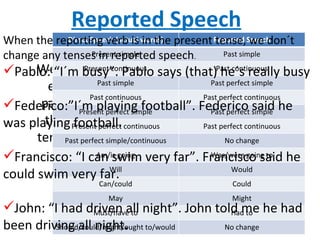
Reported Speech We use  reported speech  to tell somebody else what a person said earlier. After a past tense reporting verb (e.g. said, told) the original verbs usually shift back one tense into the past, and the pronouns and possesive adjectives change. When the reporting verb is in the present tense, we don´t change any tenses in reported speech . Pablo: “I´m busy”. Pablo says (that) he´s really busy Federico:”I´m playing football”. Federico said he was playing football. Francisco: “I can swim very far”. Francisco said he could swim very far. John: “I had driven all night”. John told me he had been driving all night . Direct Speech (actual words) Reported Speech Present simple Past simple Present continuous Past continuous Past simple Past perfect simple Past continuous Past perfect continuous Present perfect simple Past perfect simple Present perfect continuous Past perfect continuous Past perfect simple/continuous No change Am/is going Was/were going to Will Would Can/could Could May Might Must/have to Had to Should/could/might/ought to/would No change
Expressions of  time  and  place These words/phrases often change in reported speech: Examples John: “Yesterday I had a lot of fun”. John told me (that) he had had a lot of fun the day before. Guido: “I will see KungFu Panda tomorrow”. Guido said he would see KungFu Panda the following day. Joaquín: “I must finish my homework tonight”. Joaquin told me he had to finish his homework that night. Direct Speech Retheseported speech Now Then Today, tonight That day, that night Tomorrow The next day/ the following day/the day after Yesterday The day before/the previous day Tonight That night Next week/month/year The following week/month/year Last week/month/year The previous week/month/year A month/ a week ago The previous month/week Here There This/that the these Those
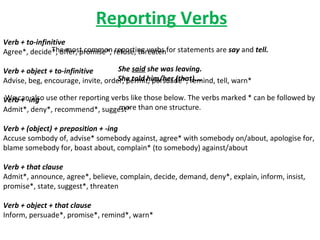
Reporting Verbs The most common reporting verbs for statements are  say  and  tell. She  said  she was leaving. She told him/her (that)…. We can also use other reporting verbs like those below. The verbs marked * can be followed by more than one structure. Verb + to-infinitive Agree*, decide*, offer, promise*, refuse, threaten Verb + object + to-infinitive Advise, beg, encourage, invite, order, permit, persuade*, remind, tell, warn* Verb + -ing Admit*, deny*, recommend*, suggest* Verb + (object) + preposition + -ing Accuse sombody of, advise* somebody against, agree* with somebody on/about, apologise for, blame somebody for, boast about, complain* (to somebody) against/about Verb + that clause Admit*, announce, agree*, believe, complain, decide, demand, deny*, explain, inform, insist, promise*, state, suggest*, threaten Verb + object + that clause Inform, persuade*, promise*, remind*, warn*
Powerpoint made by  Federico Sarquis . For more information and stuff visit: WWW.BLOGSPOT.COM

ppt Reported Speech

  • 1.
    Reported Speech Weuse reported speech to tell somebody else what a person said earlier. After a past tense reporting verb (e.g. said, told) the original verbs usually shift back one tense into the past, and the pronouns and possesive adjectives change. When the reporting verb is in the present tense, we don´t change any tenses in reported speech . Pablo: “I´m busy”. Pablo says (that) he´s really busy Federico:”I´m playing football”. Federico said he was playing football. Francisco: “I can swim very far”. Francisco said he could swim very far. John: “I had driven all night”. John told me he had been driving all night . Direct Speech (actual words) Reported Speech Present simple Past simple Present continuous Past continuous Past simple Past perfect simple Past continuous Past perfect continuous Present perfect simple Past perfect simple Present perfect continuous Past perfect continuous Past perfect simple/continuous No change Am/is going Was/were going to Will Would Can/could Could May Might Must/have to Had to Should/could/might/ought to/would No change
  • 2.
    Expressions of time and place These words/phrases often change in reported speech: Examples John: “Yesterday I had a lot of fun”. John told me (that) he had had a lot of fun the day before. Guido: “I will see KungFu Panda tomorrow”. Guido said he would see KungFu Panda the following day. Joaquín: “I must finish my homework tonight”. Joaquin told me he had to finish his homework that night. Direct Speech Retheseported speech Now Then Today, tonight That day, that night Tomorrow The next day/ the following day/the day after Yesterday The day before/the previous day Tonight That night Next week/month/year The following week/month/year Last week/month/year The previous week/month/year A month/ a week ago The previous month/week Here There This/that the these Those
  • 3.
    Reporting Verbs Themost common reporting verbs for statements are say and tell. She said she was leaving. She told him/her (that)…. We can also use other reporting verbs like those below. The verbs marked * can be followed by more than one structure. Verb + to-infinitive Agree*, decide*, offer, promise*, refuse, threaten Verb + object + to-infinitive Advise, beg, encourage, invite, order, permit, persuade*, remind, tell, warn* Verb + -ing Admit*, deny*, recommend*, suggest* Verb + (object) + preposition + -ing Accuse sombody of, advise* somebody against, agree* with somebody on/about, apologise for, blame somebody for, boast about, complain* (to somebody) against/about Verb + that clause Admit*, announce, agree*, believe, complain, decide, demand, deny*, explain, inform, insist, promise*, state, suggest*, threaten Verb + object + that clause Inform, persuade*, promise*, remind*, warn*
  • 4.
    Powerpoint made by Federico Sarquis . For more information and stuff visit: WWW.BLOGSPOT.COM