Faheem Guirgis MD, FACEP
Assistant Professor of Emergency Medicine
Division of Research
Department of Emergency Medicine
UF Health Jacksonville
8 Tips for Treating Sepsis
Financial Disclosures
 K23 from NIGMS
 NIH Loan Repayment Program
Objectives
 Learn rapid stepwise assessment of possible
sepsis patients
 Learn how to evaluate patients for organ
dysfunction
 Review evidence-based early sepsis management
 Discuss common pitfalls and how to avoid them
 Review and discuss recent literature and
implications for sepsis management
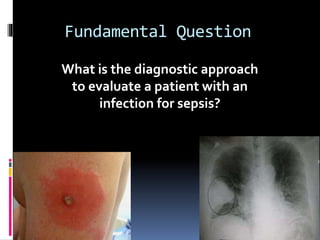
Fundamental Question
What is the diagnostic approach
to evaluate a patient with an
infection for sepsis?
Stepwise Assessment for sepsis
in patients with infection
Assess and Address:
 1. Critical instability
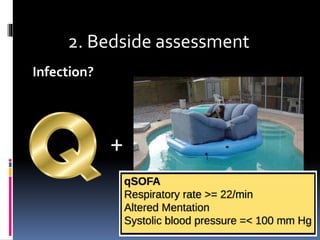
 2. Clinical signs of organ dysfunction (qSOFA)
 3. Subtle signs of organ dysfunction
1. Critical Instability
 Always start with ABCs
 Immediate interventions
 Hypoxia, respiratory distress, hypotension,
hypoperfusion, hypothermia/hyperthermia, or
hypoglycemia
+
2. Bedside assessment
Infection?
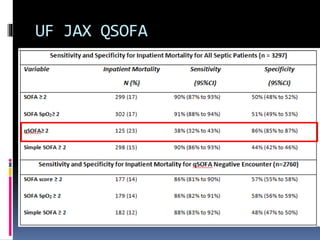
UF JAX QSOFA
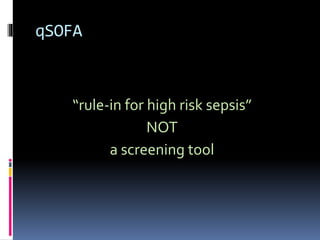
qSOFA
“rule-in for high risk sepsis”
NOT
a screening tool
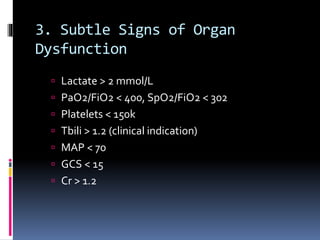
3. Subtle Signs of Organ
Dysfunction
 Lactate > 2 mmol/L
 PaO2/FiO2 < 400, SpO2/FiO2 < 302
 Platelets < 150k
 Tbili > 1.2 (clinical indication)
 MAP < 70
 GCS < 15
 Cr > 1.2
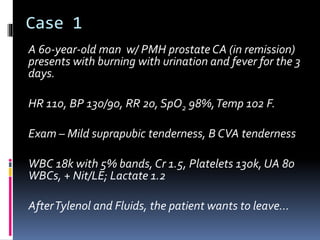
Case 1
A 60-year-old man w/ PMH prostate CA (in remission)
presents with burning with urination and fever for the 3
days.
HR 110, BP 130/90, RR 20, SpO2 98%,Temp 102 F.
Exam – Mild suprapubic tenderness, B CVA tenderness
WBC 18k with 5% bands, Cr 1.5, Platelets 130k, UA 80
WBCs, + Nit/LE; Lactate 1.2
AfterTylenol and Fluids, the patient wants to leave…
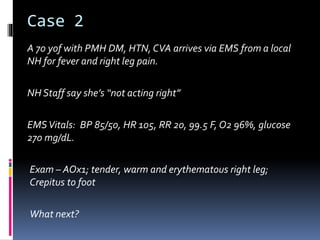
Case 2
A 70 yof with PMH DM, HTN, CVA arrives via EMS from a local
NH for fever and right leg pain.
NH Staff say she’s “not acting right”
EMSVitals: BP 85/50, HR 105, RR 20, 99.5 F, O2 96%, glucose
270 mg/dL.
Exam – AOx1; tender, warm and erythematous right leg;
Crepitus to foot
What next?
Ready for the 8 tips?
Stay Tuned…
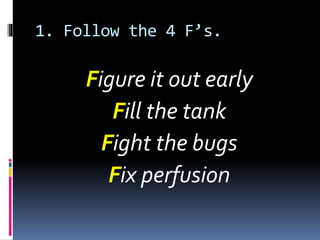
1. Follow the 4 F’s.
Figure it out early
Fill the tank
Fight the bugs
Fix perfusion
2. Empiric Fluids Plus Ultrasound
(fill the tank)
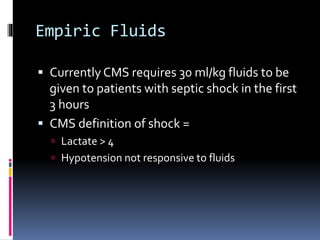
Empiric Fluids
 Currently CMS requires 30 ml/kg fluids to be
given to patients with septic shock in the first
3 hours
 CMS definition of shock =
 Lactate > 4
 Hypotension not responsive to fluids
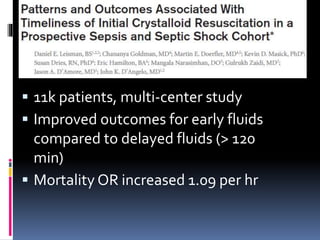
 11k patients, multi-center study
 Improved outcomes for early fluids
compared to delayed fluids (> 120
min)
 Mortality OR increased 1.09 per hr
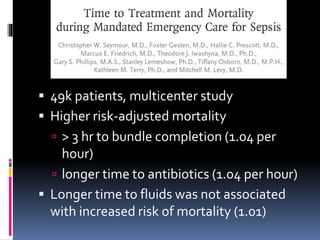
 49k patients, multicenter study
 Higher risk-adjusted mortality
 > 3 hr to bundle completion (1.04 per
hour)
 longer time to antibiotics (1.04 per hour)
 Longer time to fluids was not associated
with increased risk of mortality (1.01)
Beyond Empiric Fluids - US
Learn from the experts
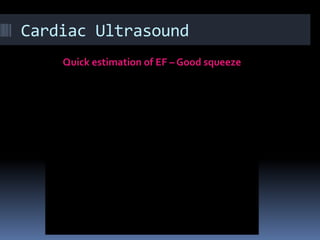
Cardiac Ultrasound
Quick estimation of EF – Good squeeze
Bad Squeeze
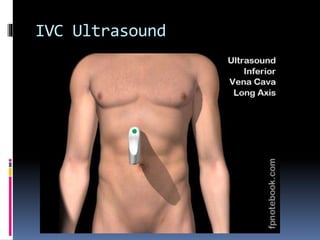
IVC Ultrasound
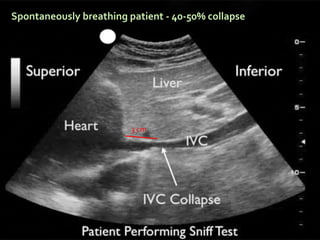
3 cm
Spontaneously breathing patient - 40-50% collapse
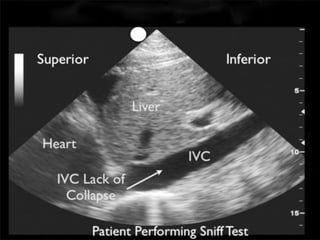
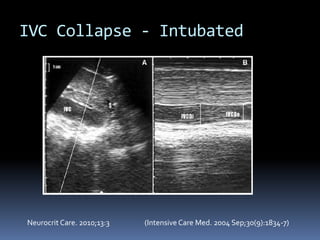
IVC Collapse - Intubated
Neurocrit Care. 2010;13:3 (Intensive Care Med. 2004 Sep;30(9):1834-7)
3. Antibiotics
TIMING IS EVERYTHING
Use a full loading dose of
early, broad-spectrum
antibiotics
Antibiotics
Antibiotics in the 1st hour (all sepsis)
Studies
49k - 1.04 per hour mortality (Seymour, et al)
35k - increased odds of death (1.09) (Liu et al)
Kumar study – 8% mortality increase/hr
Post-shock = OR 2.4 mortality (Puskarich et al)
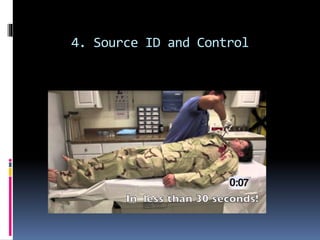
4. Source ID and Control
“Sepsis is a compulsive search
for a source of infection”
1. Treat the patient like a trauma – fully expose
2. The less the patient can tell you the more
compulsive the search
Source Severity should be
proportional to severity of
illness
 Don’t blame the UA!
 Source control ASAP
 Remove infected lines
 IR/Surgery
5. Know your vasoactive meds
2016 Guidelines
 Norepinephrine 1st agent
 Vaso or Epi as 2nd agent
 Dopamine – increased risk of
mortality in septic shock and
cardiogenic shock
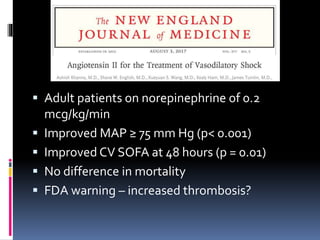
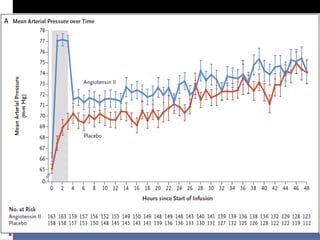
 Adult patients on norepinephrine of 0.2
mcg/kg/min
 Improved MAP ≥ 75 mm Hg (p< 0.001)
 Improved CV SOFA at 48 hours (p = 0.01)
 No difference in mortality
 FDA warning – increased thrombosis?
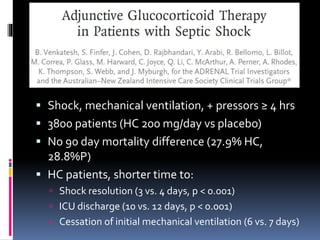
 Shock, mechanical ventilation, + pressors ≥ 4 hrs
 3800 patients (HC 200 mg/day vs placebo)
 No 90 day mortality difference (27.9% HC,
28.8%P)
 HC patients, shorter time to:
 Shock resolution (3 vs. 4 days, p < 0.001)
 ICU discharge (10 vs. 12 days, p < 0.001)
 Cessation of initial mechanical ventilation (6 vs. 7 days)
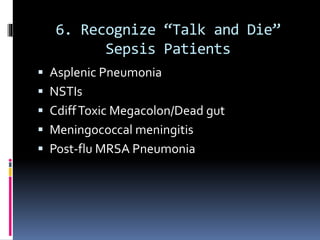
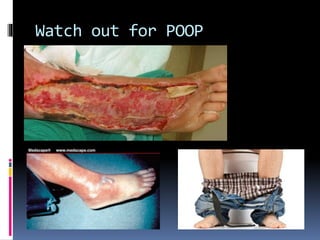
6. Recognize “Talk and Die”
Sepsis Patients
 Asplenic Pneumonia
 NSTIs
 CdiffToxic Megacolon/Dead gut
 Meningococcal meningitis
 Post-flu MRSA Pneumonia
Watch out for POOP
7. Understand lactate-guided
resuscitation
Strength: High lactate is associated with poor
outcomes.
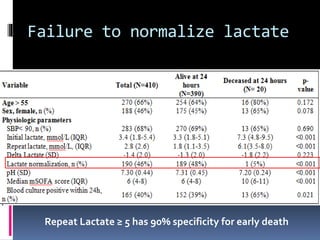
Failure to normalize lactate
Repeat Lactate ≥ 5 has 90% specificity for early death
Lactate Limitations
 Lactate can come from many different sources
 Anaerobic metabolism
 Reduced clearance (liver/kidney)
 B1 adrenergic stimulation (Na+/K+ ATPase)
 Altered mitochondrial function or “cytopathic
hypoxia”
 Lactate can be normal in septic shock
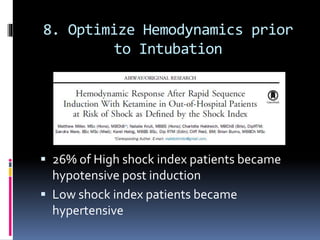
 26% of High shock index patients became
hypotensive post induction
 Low shock index patients became
hypertensive
8. Optimize Hemodynamics prior
to Intubation
 Fluid load
 Push-dose vasopressors or norepinephrine drip
initiated prior to intubation
 Half dose induction meds for RSI, Max dose
paralytics
Intubation for Shock
Back to our Cases
Case 1 - Stepwise Assessment
60 yom with Fever, Back pain, + UA
 1. Critical Instability? No
 2. Bedside assessment?
 qSOFA negative
 3. Subtle organ dysfunction?
 Yes
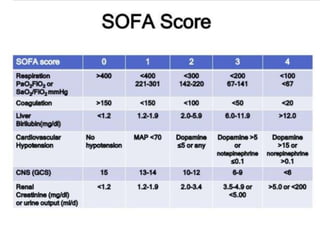
 Cr of 1.5 mg/dL
 Platelet count of 130 x 103/mm3
Case 1 – 60 yom w/ UTI
 SOFA of 2
 Treated with sepsis bundle
 After his vital signs remained stable, the
patient was admitted to a monitored hospital
bed and was discharged to continue oral
antibiotics 2 days later.
Case 2 – Stepwise Assessment
70 yof with AMS and leg pain
 1. Critical Instability?
 Yes - Address hypotension with Fluid bolus
 2. Bedside assessment?
 qSOFA positive (hypotension + AMS)
Management
 Resus bay – Sepsis bundle, large bore IVs, 30
ml/kg fluid bolus
 Required norepinephrine (initiated at 10
mcg/min) to maintain a MAP > 65 mm Hg
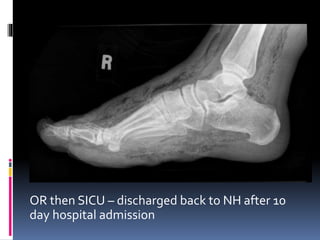
 XRAY?
OR then SICU – discharged back to NH after 10
day hospital admission
The End!
 Thank you!
 Email with questions:
Faheem.Guirgis@jax.ufl.edu

Guirgis-em trauma sepsis

  • 1.
    Faheem Guirgis MD,FACEP Assistant Professor of Emergency Medicine Division of Research Department of Emergency Medicine UF Health Jacksonville 8 Tips for Treating Sepsis
  • 2.
    Financial Disclosures  K23from NIGMS  NIH Loan Repayment Program
  • 3.
    Objectives  Learn rapidstepwise assessment of possible sepsis patients  Learn how to evaluate patients for organ dysfunction  Review evidence-based early sepsis management  Discuss common pitfalls and how to avoid them  Review and discuss recent literature and implications for sepsis management
  • 4.
    Fundamental Question What isthe diagnostic approach to evaluate a patient with an infection for sepsis?
  • 5.
    Stepwise Assessment forsepsis in patients with infection Assess and Address:  1. Critical instability  2. Clinical signs of organ dysfunction (qSOFA)  3. Subtle signs of organ dysfunction
  • 6.
    1. Critical Instability Always start with ABCs  Immediate interventions  Hypoxia, respiratory distress, hypotension, hypoperfusion, hypothermia/hyperthermia, or hypoglycemia
  • 7.
  • 8.
  • 9.
    qSOFA “rule-in for highrisk sepsis” NOT a screening tool
  • 10.
    3. Subtle Signsof Organ Dysfunction  Lactate > 2 mmol/L  PaO2/FiO2 < 400, SpO2/FiO2 < 302  Platelets < 150k  Tbili > 1.2 (clinical indication)  MAP < 70  GCS < 15  Cr > 1.2
  • 12.
    Case 1 A 60-year-oldman w/ PMH prostate CA (in remission) presents with burning with urination and fever for the 3 days. HR 110, BP 130/90, RR 20, SpO2 98%,Temp 102 F. Exam – Mild suprapubic tenderness, B CVA tenderness WBC 18k with 5% bands, Cr 1.5, Platelets 130k, UA 80 WBCs, + Nit/LE; Lactate 1.2 AfterTylenol and Fluids, the patient wants to leave…
  • 13.
    Case 2 A 70yof with PMH DM, HTN, CVA arrives via EMS from a local NH for fever and right leg pain. NH Staff say she’s “not acting right” EMSVitals: BP 85/50, HR 105, RR 20, 99.5 F, O2 96%, glucose 270 mg/dL. Exam – AOx1; tender, warm and erythematous right leg; Crepitus to foot What next?
  • 14.
    Ready for the8 tips? Stay Tuned…
  • 15.
    1. Follow the4 F’s. Figure it out early Fill the tank Fight the bugs Fix perfusion
  • 16.
    2. Empiric FluidsPlus Ultrasound (fill the tank)
  • 17.
    Empiric Fluids  CurrentlyCMS requires 30 ml/kg fluids to be given to patients with septic shock in the first 3 hours  CMS definition of shock =  Lactate > 4  Hypotension not responsive to fluids
  • 18.
     11k patients,multi-center study  Improved outcomes for early fluids compared to delayed fluids (> 120 min)  Mortality OR increased 1.09 per hr
  • 19.
     49k patients,multicenter study  Higher risk-adjusted mortality  > 3 hr to bundle completion (1.04 per hour)  longer time to antibiotics (1.04 per hour)  Longer time to fluids was not associated with increased risk of mortality (1.01)
  • 20.
    Beyond Empiric Fluids- US Learn from the experts
  • 21.
  • 22.
  • 23.
  • 24.
    3 cm Spontaneously breathingpatient - 40-50% collapse
  • 26.
    IVC Collapse -Intubated Neurocrit Care. 2010;13:3 (Intensive Care Med. 2004 Sep;30(9):1834-7)
  • 27.
  • 28.
    Use a fullloading dose of early, broad-spectrum antibiotics
  • 29.
    Antibiotics Antibiotics in the1st hour (all sepsis) Studies 49k - 1.04 per hour mortality (Seymour, et al) 35k - increased odds of death (1.09) (Liu et al) Kumar study – 8% mortality increase/hr Post-shock = OR 2.4 mortality (Puskarich et al)
  • 30.
    4. Source IDand Control
  • 31.
    “Sepsis is acompulsive search for a source of infection” 1. Treat the patient like a trauma – fully expose 2. The less the patient can tell you the more compulsive the search
  • 32.
    Source Severity shouldbe proportional to severity of illness  Don’t blame the UA!  Source control ASAP  Remove infected lines  IR/Surgery
  • 33.
    5. Know yourvasoactive meds 2016 Guidelines  Norepinephrine 1st agent  Vaso or Epi as 2nd agent  Dopamine – increased risk of mortality in septic shock and cardiogenic shock
  • 34.
     Adult patientson norepinephrine of 0.2 mcg/kg/min  Improved MAP ≥ 75 mm Hg (p< 0.001)  Improved CV SOFA at 48 hours (p = 0.01)  No difference in mortality  FDA warning – increased thrombosis?
  • 36.
     Shock, mechanicalventilation, + pressors ≥ 4 hrs  3800 patients (HC 200 mg/day vs placebo)  No 90 day mortality difference (27.9% HC, 28.8%P)  HC patients, shorter time to:  Shock resolution (3 vs. 4 days, p < 0.001)  ICU discharge (10 vs. 12 days, p < 0.001)  Cessation of initial mechanical ventilation (6 vs. 7 days)
  • 37.
    6. Recognize “Talkand Die” Sepsis Patients  Asplenic Pneumonia  NSTIs  CdiffToxic Megacolon/Dead gut  Meningococcal meningitis  Post-flu MRSA Pneumonia
  • 38.
  • 39.
    7. Understand lactate-guided resuscitation Strength:High lactate is associated with poor outcomes.
  • 40.
    Failure to normalizelactate Repeat Lactate ≥ 5 has 90% specificity for early death
  • 41.
    Lactate Limitations  Lactatecan come from many different sources  Anaerobic metabolism  Reduced clearance (liver/kidney)  B1 adrenergic stimulation (Na+/K+ ATPase)  Altered mitochondrial function or “cytopathic hypoxia”  Lactate can be normal in septic shock
  • 42.
     26% ofHigh shock index patients became hypotensive post induction  Low shock index patients became hypertensive 8. Optimize Hemodynamics prior to Intubation
  • 43.
     Fluid load Push-dose vasopressors or norepinephrine drip initiated prior to intubation  Half dose induction meds for RSI, Max dose paralytics Intubation for Shock
  • 44.
  • 45.
    Case 1 -Stepwise Assessment 60 yom with Fever, Back pain, + UA  1. Critical Instability? No  2. Bedside assessment?  qSOFA negative  3. Subtle organ dysfunction?  Yes  Cr of 1.5 mg/dL  Platelet count of 130 x 103/mm3
  • 46.
    Case 1 –60 yom w/ UTI  SOFA of 2  Treated with sepsis bundle  After his vital signs remained stable, the patient was admitted to a monitored hospital bed and was discharged to continue oral antibiotics 2 days later.
  • 47.
    Case 2 –Stepwise Assessment 70 yof with AMS and leg pain  1. Critical Instability?  Yes - Address hypotension with Fluid bolus  2. Bedside assessment?  qSOFA positive (hypotension + AMS)
  • 48.
    Management  Resus bay– Sepsis bundle, large bore IVs, 30 ml/kg fluid bolus  Required norepinephrine (initiated at 10 mcg/min) to maintain a MAP > 65 mm Hg  XRAY?
  • 49.
    OR then SICU– discharged back to NH after 10 day hospital admission
  • 50.
    The End!  Thankyou!  Email with questions: Faheem.Guirgis@jax.ufl.edu

Editor's Notes

  • #5 Discuss this idea? Sick/Not sick What makes sepsis so difficult to diagnose? lack of a gold standard diagnostic test Progression of symptoms and change in clinical condition (slow vs rapid) Indolent organ dysfunction difficult to recognize
  • #6 This will work in every possible case if you adhere to it. Clinical signs = bedside
  • #8 Immediately observable signs of organ dysfunction Are there signs that this patient is having an abnormal, systemic response to infection, ie organ dysfunction. Dangerous as a screening tool - Rule in for high risk sepsis 38% sensitive, 85% specific for death Use it – but understand the limitations Positive = move to resus bay, jump on this patient Neg = further evaluate organ dysfunction This patient is QSOFA negative – what does that mean?
  • #9 Jama EVEN RECENTLY published a paper by Raith et all that showed an AUROC Of 0.60 for qSOFA, 0.589 for SIRS, and 0.75 for SOFA – they are essentially admitting that qSOFA is insensitive
  • #10 Dangerous as a screening tool - Rule in for high risk sepsis Use it – but understand the limitations Positive = move to resus bay, jump on this patient Neg = keep looking
  • #12 Robust scoring system – very well –studied Look for new changes in SOFA components Accurate prognosis for death associated with need for intensive care Associated with long-term organ dysfunction and poor outcomes as well as sepsis recidivism NOT USER FRIENDLY – EPIC AUTO CALCULATOR?
  • #14  Patient is alert but not oriented. During transfer from the EMS stretcher to her bed, the patient screams in pain as her right leg bumps the bed rail.
  • #16  a. Figure it out early      qSOFA - rule in for high risk sepsis      Simple SOFA - components, Platelets, Cr, GCS, MAP pressor use, O2 requirement (indicator of increased disease severity)      Biomarkers - Lactate, procalcitonin, cholesterol b. Fill tank - fluid tolerance, fluids till IVC full then look for B-lines      US-based decision making - 2 H's and 2T's in trauma - hypoxia, hemorrhage, tension pneumo, tamponade      Similar in a non-trauma shock patient - differential not quite as narrow but Not enough fluids, or too much? US guided - Heart, IVC, lung Why do we give fluids? To improve cardiac output; bicycle analogy reference article by JL Vincent Reference this article http://journal.publications.chestnet.org/article.aspx?articleid=2589098&utm_source=newsletter_340&utm_medium=email&utm_campaign=critical-care-reviews-newsletter-274 c. Fight bugs d. Fix perfusion
  • #19 Lower hospital mortality, mechanical ventilation, ICU admission, length of stay, ICU days Mean fluid volumes in the < 30 minute and 31 – 120 minute groups were 29 ml/kg and 27 ml/kg, respectively
  • #20 Obese patients - A study of 4157 patients, of whom 31.3% (1293) were obese (body mass index > 30) Fluid dosing based on adjusted BW (ideal BW + 40% of actual - ideal BW) vs. actual body weight in obese patients was associated with improved mortality. (Taylor SP et al. J Crit Care. 2018;43:7-12) CHF/ESRD – In the Leisman et al study, these pts were treated with lower fluid volumes (15 ml/kg) and experienced delays to fluid administration This was not associated with an increased mortality In general, rec. for an initial dose of 30 ml/kg intravenous fluids for CMS septic shock patients
  • #21 What does Anne Landers say? “SEEK PROFESSIONAL HELP”
  • #27 The effect of intubation on pulmonary pressures negatively affects hemodynamics; you essentially reverse what the patient was doing prior to intubation On MV, PPV causes an increase in intrathoracic pressure during inspiration which causes IVC diameter to increase relative to expiration where the IVC collapses High TV (8-10 mL/kg), Rate 12, I:E 1:2, PEEP 0 (Dmax - Dmin)/Dmin Size variation 15-18% = fluid responsive PPV 93%, NPV 92%
  • #30 Changed from 3 hrs for sepsis, 1 hr for shock in 2012 guidelines Liu VX et al. Am J Respir Crit Care Med. 2017;196(7):856-863.)
  • #31 Recount the Nec Fasc case I had in room 28 when I was a Pre-attending
  • #33 Case I had where patient had perf’d viscus and I thought it was UTI
  • #34 Dobutamine is not a pressor! It’s an inotrope! But Epi is prob a better choice Arterial line as soon as possible Remember – Epi can be bad for splanchnic circulation and increases lactate and may preclude lactate normalization as a resuscitation endpoint (stimulates skeletal muscle B2 receptors) Vaso at higher doses cardiac, digital, and splanchnic ischemia
  • #37 What about steroids for septic shock?
  • #38 Nec Fasc patient I had at Jacobi Asplenic pneumonia patient went into DIC and died later that night in < 12 hours Patient with sepsis from ischemic bowel died within 6 hours
  • #39 Warning Signs: WBC >= 30k High lactate Hyponatremia AKI
  • #40  Strength - lactate is probably the most reliable, clinically useful biomarker we have for sepsis High lactate is associated with poor outcomes Failure to normalize lactate (when elevated) is a stronger predictor of poor outcome than lactate clearance (Adnan's study)
  • #41 Failure to clear lactate -
  • #43 Mostly trauma patients Mean Ketamine dose in HSI group was 1.2 mg/kg (median 1.7) vs 1.4 mg/kg in the LSI group
  • #44 Talk about what happens to hemodynamics s/p intubation
  • #49 Piperacillin/tazobactam 4.5 g IV was given in the first hour of arrival to the ED (Plus Clindamycin and Vancomycin)