














@SepsisUK
Sepsis. Process & scale
Dr Ron Daniels FFICM FRCA FRCPEd
CEO, UK Sepsis Trust
CEO, Global Sepsis Alliance
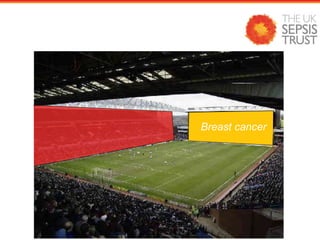
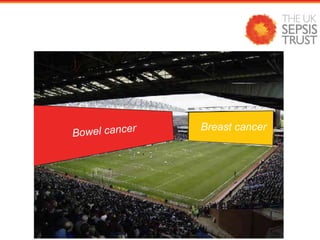
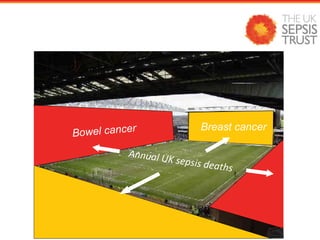
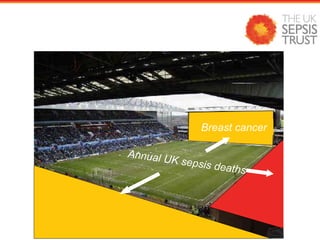
Breast cancer
Breast cancer
Breast cancer
Breast cancer
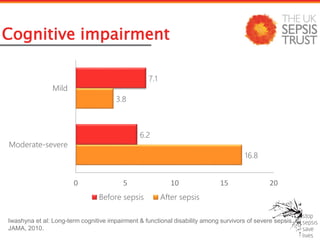
Iwashyna et al: Long-term cognitive impairment & functional disability among survivors of severe sepsis.
JAMA, 2010.
16.8
3.8
6.2
7.1
0 5 10 15 20
Moderate-severe
Mild
Before sepsis After sepsis
Cognitive impairment
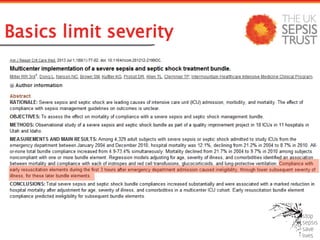
Basics limit severity
Recognition 2014-16
@SepsisUK
Burns
Burns
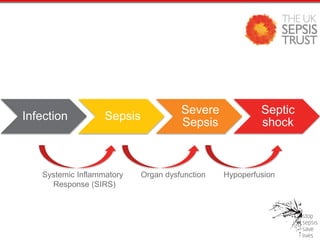
Infection Sepsis
Severe
Sepsis
Septic
shock
Systemic Inflammatory Organ dysfunction Hypoperfusion
Response (SIRS)
Burns
Burns
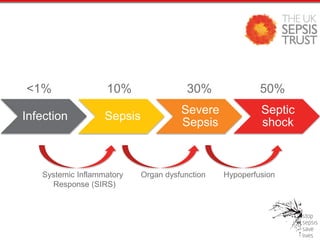
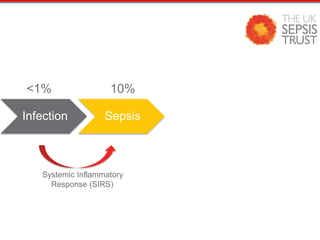
Infection Sepsis
Severe
Sepsis
Septic
shock
Systemic Inflammatory Organ dysfunction Hypoperfusion
Response (SIRS)
<1% 10% 30% 50%
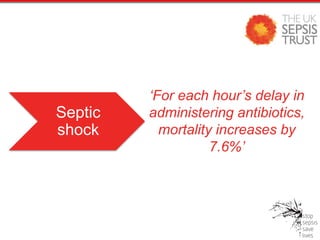
Funk and Kumar
Critical Care Clinics 2011 (in press)
‘For each hour’s delay in
administering antibiotics,
mortality increases by
7.6%’
Septic
shock
Burns
Burns
Infection Sepsis
Severe
Sepsis
Septic
shock
Burns
Burns
Infection Sepsis
Severe
Sepsis
Septic
shock
Systemic Inflammatory
Response (SIRS)
<1% 10% 35%
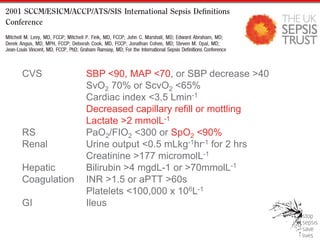
CVS SBP <90, MAP <70, or SBP decrease >40
SvO2 70% or ScvO2 <65%
Cardiac index <3.5 Lmin-1
Decreased capillary refill or mottling
Lactate >2 mmolL-1
RS PaO2/FIO2 <300 or SpO2 <90%
Renal Urine output <0.5 mLkg-1hr-1 for 2 hrs
Creatinine >177 micromolL-1
Hepatic Bilirubin >4 mgdL-1 or >70mmolL-1
Coagulation INR >1.5 or aPTT >60s
Platelets <100,000 x 106L-1
GI Ileus
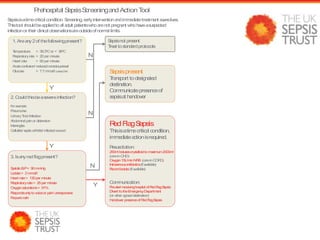
Prehospital SepsisScreeningandActionTool
1. Areany2of thefollowingpresent?
Temperature > 38.30Cor < 360C
Respiratoryrate > 20per minute
Heart rate > 90per minute
Acuteconfusion/ reducedconsciouslevel
Glucose > 7.7mmol/l (unlessDM)
3. Isanyredflagpresent?
SystolicB.P< 90mmHg
Lactate> 2mmol/l
Heart rate> 130per minute
Respiratoryrate> 25per minute
Oxygensaturations< 91%
Respondsonlytovoiceor pain/ unresponsive
Purpuricrash
Sepsisnot present
Treat tostandardprotocols
RedFlagSepsis
Thisisatimecritical condition,
immediateactionisrequired.
Resuscitation:
250ml bolusescrystalloidtomaximum2000ml
(careinCHD)
Oxygen15L/minNRB (careinCOPD)
Intravenousantibiotics(ifavailable)
Recordlactate(ifavailable)
Communication:
Pre-alert receivinghospital ofRedFlagSepsis
Divert totheEmergencyDepartment
(or other agreeddestination)
Handover presenceofRedFlagSepsis
Y
Y
Y
Sepsispresent
Transport todesignated
destination.
Communicatepresenceof
sepsisat handover
N
N
N
Sepsisisatimecritical condition. Screening, earlyinterventionandimmediatetreatment saveslives.
Thistool shouldbeappliedtoall adult patientswhoarenot pregnant whohaveasuspected
infectionor their clinical observationsareoutsideofnormal limits
2. Couldthisbeasevereinfection?
For example:
Pneumonia
UrinaryTract Infection
Abdominal painor distension
Meningitis
Cellulitis/ septicarthritis/ infectedwound
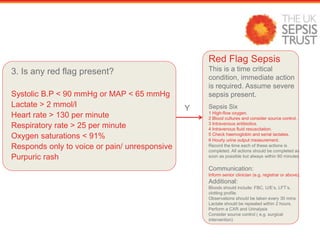
3. Is any red flag present?
Systolic B.P < 90 mmHg or MAP < 65 mmHg
Lactate > 2 mmol/l
Heart rate > 130 per minute
Respiratory rate > 25 per minute
Oxygen saturations < 91%
Responds only to voice or pain/ unresponsive
Purpuric rash
Red Flag Sepsis
This is a time critical
condition, immediate action
is required. Assume severe
sepsis present.
Sepsis Six
1 High-flow oxygen.
2 Blood cultures and consider source control.
3 Intravenous antibiotics.
4 Intravenous fluid resuscitation.
5 Check haemoglobin and serial lactates.
6 Hourly urine output measurement.
Record the time each of these actions is
completed. All actions should be completed as
soon as possible but always within 60 minutes.
Communication:
Inform senior clinician (e.g. registrar or above).
Additional:
Bloods should include: FBC, U/E’s, LFT’s,
clotting profile.
Observations should be taken every 30 mins
Lactate should be repeated within 2 hours.
Perform a CXR and Urinalysis
Consider source control ( e.g. surgical
intervention)
Y
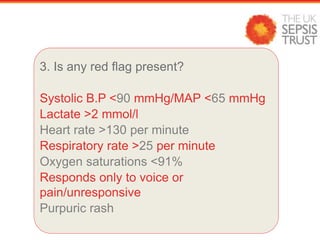
3. Is any red flag present?
Systolic B.P <90 mmHg/MAP <65 mmHg
Lactate >2 mmol/l
Heart rate >130 per minute
Respiratory rate >25 per minute
Oxygen saturations <91%
Responds only to voice or
pain/unresponsive
Purpuric rash
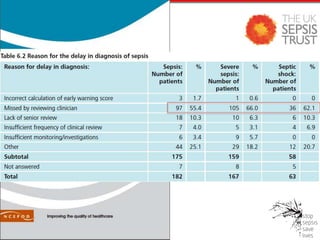
NCEPOD 2015
@SepsisUK
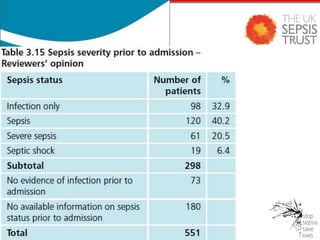
At least
53% of
patients
had sepsis
prior to
arrival in
hospital
Fixing the system.
@SepsisUK
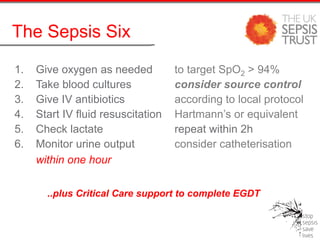
The Sepsis Six
1. Give oxygen as needed to target SpO2 > 94%
2. Take blood cultures consider source control
3. Give IV antibiotics according to local protocol
4. Start IV fluid resuscitation Hartmann’s or equivalent
5. Check lactate repeat within 2h
6. Monitor urine output consider catheterisation
within one hour
..plus Critical Care support to complete EGDT
Breast cancer
Mortality
Breast cancer
ron@sepsistrust.org
@SepsisUK
www.sepsistrust.org
www.world-sepsis-day.org

Sepsis - Process and Scale - Daniels

  • 1.
    @SepsisUK Sepsis. Process &scale Dr Ron Daniels FFICM FRCA FRCPEd CEO, UK Sepsis Trust CEO, Global Sepsis Alliance
  • 5.
  • 6.
  • 7.
  • 8.
  • 11.
    Iwashyna et al:Long-term cognitive impairment & functional disability among survivors of severe sepsis. JAMA, 2010. 16.8 3.8 6.2 7.1 0 5 10 15 20 Moderate-severe Mild Before sepsis After sepsis Cognitive impairment
  • 12.
  • 13.
  • 14.
  • 15.
    Burns Burns Infection Sepsis Severe Sepsis Septic shock Systemic InflammatoryOrgan dysfunction Hypoperfusion Response (SIRS) <1% 10% 30% 50%
  • 16.
    Funk and Kumar CriticalCare Clinics 2011 (in press) ‘For each hour’s delay in administering antibiotics, mortality increases by 7.6%’ Septic shock
  • 17.
  • 18.
  • 21.
    CVS SBP <90,MAP <70, or SBP decrease >40 SvO2 70% or ScvO2 <65% Cardiac index <3.5 Lmin-1 Decreased capillary refill or mottling Lactate >2 mmolL-1 RS PaO2/FIO2 <300 or SpO2 <90% Renal Urine output <0.5 mLkg-1hr-1 for 2 hrs Creatinine >177 micromolL-1 Hepatic Bilirubin >4 mgdL-1 or >70mmolL-1 Coagulation INR >1.5 or aPTT >60s Platelets <100,000 x 106L-1 GI Ileus
  • 22.
    Prehospital SepsisScreeningandActionTool 1. Areany2ofthefollowingpresent? Temperature > 38.30Cor < 360C Respiratoryrate > 20per minute Heart rate > 90per minute Acuteconfusion/ reducedconsciouslevel Glucose > 7.7mmol/l (unlessDM) 3. Isanyredflagpresent? SystolicB.P< 90mmHg Lactate> 2mmol/l Heart rate> 130per minute Respiratoryrate> 25per minute Oxygensaturations< 91% Respondsonlytovoiceor pain/ unresponsive Purpuricrash Sepsisnot present Treat tostandardprotocols RedFlagSepsis Thisisatimecritical condition, immediateactionisrequired. Resuscitation: 250ml bolusescrystalloidtomaximum2000ml (careinCHD) Oxygen15L/minNRB (careinCOPD) Intravenousantibiotics(ifavailable) Recordlactate(ifavailable) Communication: Pre-alert receivinghospital ofRedFlagSepsis Divert totheEmergencyDepartment (or other agreeddestination) Handover presenceofRedFlagSepsis Y Y Y Sepsispresent Transport todesignated destination. Communicatepresenceof sepsisat handover N N N Sepsisisatimecritical condition. Screening, earlyinterventionandimmediatetreatment saveslives. Thistool shouldbeappliedtoall adult patientswhoarenot pregnant whohaveasuspected infectionor their clinical observationsareoutsideofnormal limits 2. Couldthisbeasevereinfection? For example: Pneumonia UrinaryTract Infection Abdominal painor distension Meningitis Cellulitis/ septicarthritis/ infectedwound
  • 23.
    3. Is anyred flag present? Systolic B.P < 90 mmHg or MAP < 65 mmHg Lactate > 2 mmol/l Heart rate > 130 per minute Respiratory rate > 25 per minute Oxygen saturations < 91% Responds only to voice or pain/ unresponsive Purpuric rash Red Flag Sepsis This is a time critical condition, immediate action is required. Assume severe sepsis present. Sepsis Six 1 High-flow oxygen. 2 Blood cultures and consider source control. 3 Intravenous antibiotics. 4 Intravenous fluid resuscitation. 5 Check haemoglobin and serial lactates. 6 Hourly urine output measurement. Record the time each of these actions is completed. All actions should be completed as soon as possible but always within 60 minutes. Communication: Inform senior clinician (e.g. registrar or above). Additional: Bloods should include: FBC, U/E’s, LFT’s, clotting profile. Observations should be taken every 30 mins Lactate should be repeated within 2 hours. Perform a CXR and Urinalysis Consider source control ( e.g. surgical intervention) Y
  • 24.
    3. Is anyred flag present? Systolic B.P <90 mmHg/MAP <65 mmHg Lactate >2 mmol/l Heart rate >130 per minute Respiratory rate >25 per minute Oxygen saturations <91% Responds only to voice or pain/unresponsive Purpuric rash
  • 25.
  • 28.
    At least 53% of patients hadsepsis prior to arrival in hospital
  • 33.
  • 34.
    The Sepsis Six 1.Give oxygen as needed to target SpO2 > 94% 2. Take blood cultures consider source control 3. Give IV antibiotics according to local protocol 4. Start IV fluid resuscitation Hartmann’s or equivalent 5. Check lactate repeat within 2h 6. Monitor urine output consider catheterisation within one hour ..plus Critical Care support to complete EGDT
  • 42.
  • 43.
  • 44.
  • 45.

Editor's Notes

  • #17 New Insights into Infection Issues in the Canadian ICU Setting - Satellite Symposium Thursday, March 15th, 2007