Nothing to disclose
Outline
 Acknowledgements
 Objectives
 Patient scenario
 Development of prediction rules
 UF- Jax algorithm
Acknowledgements
Lori Gurien, MD
Phyllis Hendry, MD, FAAP, FACEP
Anne Dziwulski, BSN, RN, CSTR
Shameka King, BSN, RN, CCRN
David Meysenburg, BSN, RN, TCRN
Julia Paul, MSN, ARNP
David Skarupa, MD, FACS
Lisa Teel, MSN, RN, CPEN
Todd Wylie, MD, MPH
Brian Yorkgitis, DO
Objectives
 Discuss prediction rules that identify children at
low-risk for intraabdominal injuries
 Review UF-Jax algorithm for pediatric blunt
abdominal trauma
Scenario
You are on trauma call
EMS: “a high speed crash on the
interstate 95 and you will be
receiving 2 patients.”
You: “OK. Proceed.”
Scenario
EMS: “You will receive 1 adult
and 1 child. There is severe
damage to the vehicle and it
was a prolonged extrication to
get both of the victims out of
the car.”
Scenario: Adult Patient 1
 47 yo restrained driver who is reported to be
intoxicated.
 Vitals: GCS 14; BP 116/76; P 106 RR 20
 Exam:
 Abrasion on the left chest from the shoulder to the
RUQ of the abdomen.
 Abdomen is soft but distended.
 Left femur is deformed and normal distal pulses in
the foot.
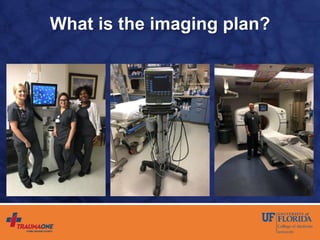
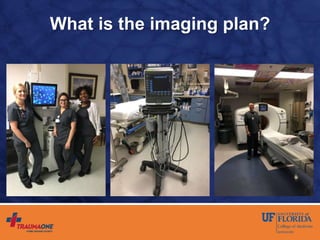
What is the imaging plan?
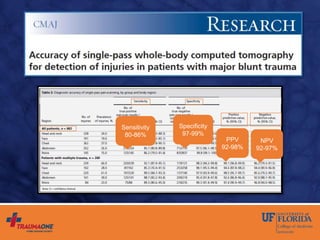
Sensitivity
80-86%
Specificity
97-99%
PPV
92-98%
NPV
92-97%
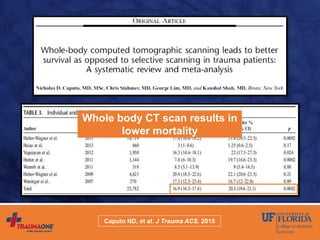
Whole body CT scan results in
lower mortality
Caputo ND, et al. J Trauma ACS. 2015
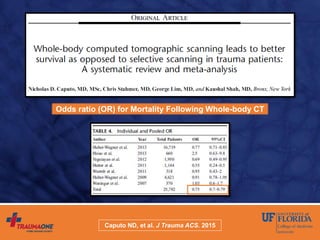
Odds ratio (OR) for Mortality Following Whole-body CT
Caputo ND, et al. J Trauma ACS. 2015
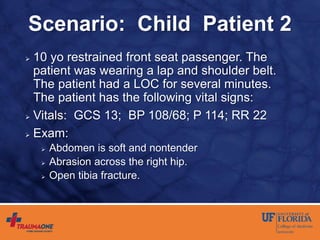
Scenario: Child Patient 2
 10 yo restrained front seat passenger. The
patient was wearing a lap and shoulder belt.
The patient had a LOC for several minutes.
The patient has the following vital signs:
 Vitals: GCS 13; BP 108/68; P 114; RR 22
 Exam:
 Abdomen is soft and nontender
 Abrasion across the right hip.
 Open tibia fracture.
What is the imaging plan?
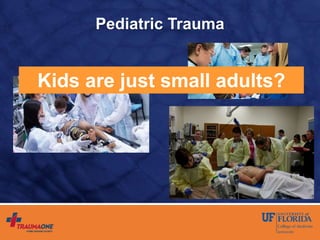
Pediatric Trauma
Kids are just small adults?
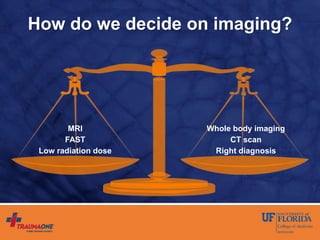
How do we decide on imaging?
Right diagnosisLow radiation dose
CT scanFAST
Whole body imagingMRI
Should we care about radiation?
The “C” word
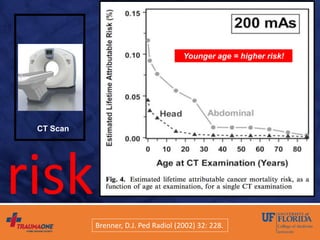
Brenner, D.J. Ped Radiol (2002) 32: 228.
CT Scan
risk
Younger age = higher risk!
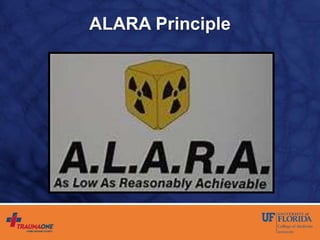
ALARA Principle
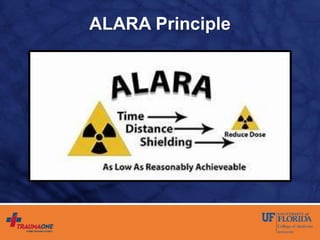
ALARA Principle
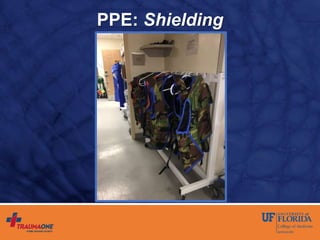
PPE: Shielding
Can we really skip CT scan???
CT scan ABD/PELVIS
PECARN
 Pediatric Emergency Care Applied Research
Network
 Created a clinical prediction rule to identify
children at very low risk for intraabdominal
injury requiring intervention
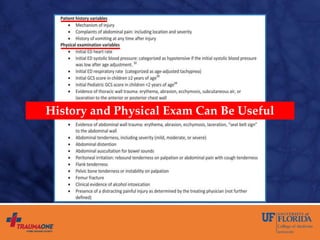
 Based on history and physical exam only
 Prospective, Observational Cohort blunt torso trauma at PECARN
centers
 Enrollment: May 2007 – January 2010
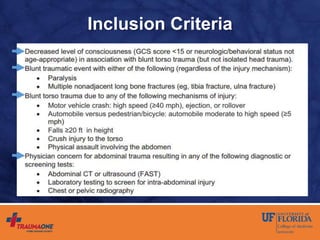
 Exclusion Criteria:
 Injury >24 hours prior to presentation
 Pregnancy
 Transfer from outside hospital
 Penetrating trauma
 Preexisting neurologic condition impeding reliable exam
Inclusion Criteria
History and Physical Exam Can Be Useful
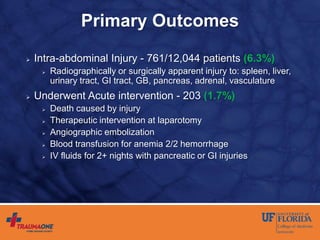
Primary Outcomes
 Intra-abdominal Injury - 761/12,044 patients (6.3%)
 Radiographically or surgically apparent injury to: spleen, liver,
urinary tract, GI tract, GB, pancreas, adrenal, vasculature
 Underwent Acute intervention - 203 (1.7%)
 Death caused by injury
 Therapeutic intervention at laparotomy
 Angiographic embolization
 Blood transfusion for anemia 2/2 hemorrhage
 IV fluids for 2+ nights with pancreatic or GI injuries
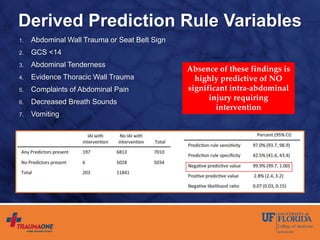
Derived Prediction Rule Variables
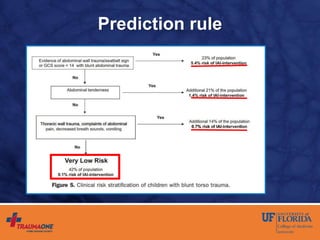
1. Abdominal Wall Trauma or Seat Belt Sign
2. GCS <14
3. Abdominal Tenderness
4. Evidence Thoracic Wall Trauma
5. Complaints of Abdominal Pain
6. Decreased Breath Sounds
7. Vomiting
Absence of these findings is
highly predictive of NO
significant intra-abdominal
injury requiring
intervention
Prediction rule
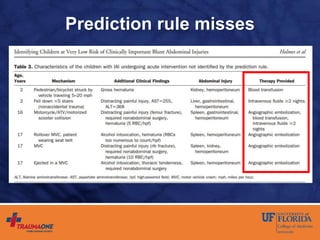
Prediction rule misses
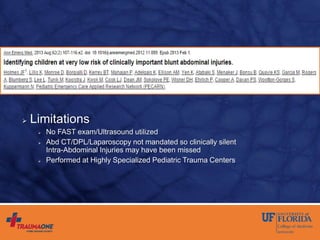
 Limitations
 No FAST exam/Ultrasound utilized
 Abd CT/DPL/Laparoscopy not mandated so clinically silent
Intra-Abdominal Injuries may have been missed
 Performed at Highly Specialized Pediatric Trauma Centers
Any adjuncts that can help?
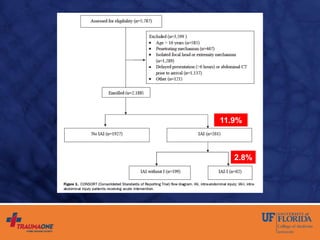
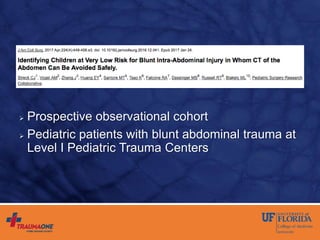
 Prospective observational cohort
 Pediatric patients with blunt abdominal trauma at
Level I Pediatric Trauma Centers
11.9%
2.8%
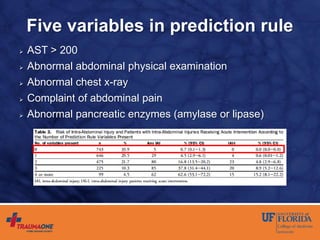
Five variables in prediction rule
 AST > 200
 Abnormal abdominal physical examination
 Abnormal chest x-ray
 Complaint of abdominal pain
 Abnormal pancreatic enzymes (amylase or lipase)
Prediction rule
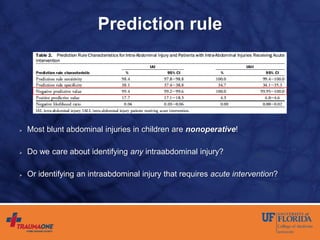
 Most blunt abdominal injuries in children are nonoperative!
 Do we care about identifying any intraabdominal injury?
 Or identifying an intraabdominal injury that requires acute intervention?
Prediction rule
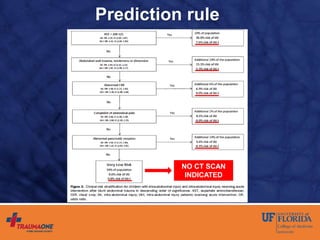
NO CT SCAN
INDICATED
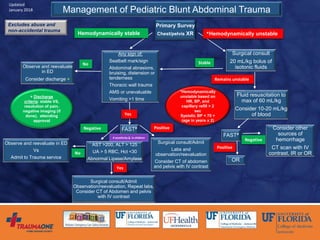
Management of Pediatric Blunt Abdominal Trauma
Primary Survey
Chest/pelvis XR
Observe and reevaluate
in ED
Consider discharge +
FAST#
Observe and reevaluate in ED
Vs
Admit to Trauma service
AST >200, ALT > 125
UA > 5 RBC, Hct <30
Abnormal Lipase/Amylase
Any sign of:
Seatbelt mark/sign
Abdominal abrasions,
bruising, distension or
tenderness
Thoracic wall trauma
AMS or unevaluable
Vomiting >1 time
Surgical consult
20 mL/kg bolus of
isotonic fluids
Surgical consult/Admit
Labs and
observation/reevaluation
Consider CT of abdomen
and pelvis with IV contrast
Surgical consult/Admit
Observation/reevaluation, Repeat labs,
Consider CT of Abdomen and pelvis
with IV contrast
Fluid resuscitation to
max of 60 mL/kg
Consider 10-20 mL/kg
of blood
FAST#
OR
Consider other
sources of
hemorrhage
CT scan with IV
contrast, IR or OR
+ Discharge
criteria: stable VS,
resolution of pain,
negative imaging (if
done), attending
approval
*Hemodynamically
unstable based on
HR, BP, and
capillary refill > 2
sec
Systolic BP < 70 +
(age in years x 2)
Hemodynamically stable *Hemodynamically unstable
StableNo
No
Remains unstable
Positive
Positive
Yes
Yes
Negative
Negative
Excludes abuse and
non-accidental trauma
# sensitivity↓ in children
Updated
January 2018
Conclusions
 Kids are not little adults
 Radiation risk is real
 CT can be useful:
 Abnormal exam
 Abnormal labs
 Physical exam & observation can be
appropriate

Kerwin-peds abd trauma

  • 2.
  • 3.
    Outline  Acknowledgements  Objectives Patient scenario  Development of prediction rules  UF- Jax algorithm
  • 4.
    Acknowledgements Lori Gurien, MD PhyllisHendry, MD, FAAP, FACEP Anne Dziwulski, BSN, RN, CSTR Shameka King, BSN, RN, CCRN David Meysenburg, BSN, RN, TCRN Julia Paul, MSN, ARNP David Skarupa, MD, FACS Lisa Teel, MSN, RN, CPEN Todd Wylie, MD, MPH Brian Yorkgitis, DO
  • 5.
    Objectives  Discuss predictionrules that identify children at low-risk for intraabdominal injuries  Review UF-Jax algorithm for pediatric blunt abdominal trauma
  • 6.
    Scenario You are ontrauma call EMS: “a high speed crash on the interstate 95 and you will be receiving 2 patients.” You: “OK. Proceed.”
  • 7.
    Scenario EMS: “You willreceive 1 adult and 1 child. There is severe damage to the vehicle and it was a prolonged extrication to get both of the victims out of the car.”
  • 8.
    Scenario: Adult Patient1  47 yo restrained driver who is reported to be intoxicated.  Vitals: GCS 14; BP 116/76; P 106 RR 20  Exam:  Abrasion on the left chest from the shoulder to the RUQ of the abdomen.  Abdomen is soft but distended.  Left femur is deformed and normal distal pulses in the foot.
  • 9.
    What is theimaging plan?
  • 10.
  • 11.
    Whole body CTscan results in lower mortality Caputo ND, et al. J Trauma ACS. 2015
  • 12.
    Odds ratio (OR)for Mortality Following Whole-body CT Caputo ND, et al. J Trauma ACS. 2015
  • 13.
    Scenario: Child Patient2  10 yo restrained front seat passenger. The patient was wearing a lap and shoulder belt. The patient had a LOC for several minutes. The patient has the following vital signs:  Vitals: GCS 13; BP 108/68; P 114; RR 22  Exam:  Abdomen is soft and nontender  Abrasion across the right hip.  Open tibia fracture.
  • 14.
    What is theimaging plan?
  • 15.
    Pediatric Trauma Kids arejust small adults?
  • 17.
    How do wedecide on imaging? Right diagnosisLow radiation dose CT scanFAST Whole body imagingMRI
  • 18.
    Should we careabout radiation?
  • 19.
  • 20.
    Brenner, D.J. PedRadiol (2002) 32: 228. CT Scan risk Younger age = higher risk!
  • 21.
  • 22.
  • 23.
  • 24.
    Can we reallyskip CT scan???
  • 25.
  • 26.
    PECARN  Pediatric EmergencyCare Applied Research Network  Created a clinical prediction rule to identify children at very low risk for intraabdominal injury requiring intervention  Based on history and physical exam only
  • 27.
     Prospective, ObservationalCohort blunt torso trauma at PECARN centers  Enrollment: May 2007 – January 2010  Exclusion Criteria:  Injury >24 hours prior to presentation  Pregnancy  Transfer from outside hospital  Penetrating trauma  Preexisting neurologic condition impeding reliable exam
  • 28.
  • 29.
    History and PhysicalExam Can Be Useful
  • 30.
    Primary Outcomes  Intra-abdominalInjury - 761/12,044 patients (6.3%)  Radiographically or surgically apparent injury to: spleen, liver, urinary tract, GI tract, GB, pancreas, adrenal, vasculature  Underwent Acute intervention - 203 (1.7%)  Death caused by injury  Therapeutic intervention at laparotomy  Angiographic embolization  Blood transfusion for anemia 2/2 hemorrhage  IV fluids for 2+ nights with pancreatic or GI injuries
  • 31.
    Derived Prediction RuleVariables 1. Abdominal Wall Trauma or Seat Belt Sign 2. GCS <14 3. Abdominal Tenderness 4. Evidence Thoracic Wall Trauma 5. Complaints of Abdominal Pain 6. Decreased Breath Sounds 7. Vomiting Absence of these findings is highly predictive of NO significant intra-abdominal injury requiring intervention
  • 32.
  • 33.
  • 34.
     Limitations  NoFAST exam/Ultrasound utilized  Abd CT/DPL/Laparoscopy not mandated so clinically silent Intra-Abdominal Injuries may have been missed  Performed at Highly Specialized Pediatric Trauma Centers
  • 35.
  • 36.
     Prospective observationalcohort  Pediatric patients with blunt abdominal trauma at Level I Pediatric Trauma Centers
  • 37.
  • 38.
    Five variables inprediction rule  AST > 200  Abnormal abdominal physical examination  Abnormal chest x-ray  Complaint of abdominal pain  Abnormal pancreatic enzymes (amylase or lipase)
  • 39.
    Prediction rule  Mostblunt abdominal injuries in children are nonoperative!  Do we care about identifying any intraabdominal injury?  Or identifying an intraabdominal injury that requires acute intervention?
  • 40.
    Prediction rule NO CTSCAN INDICATED
  • 41.
    Management of PediatricBlunt Abdominal Trauma Primary Survey Chest/pelvis XR Observe and reevaluate in ED Consider discharge + FAST# Observe and reevaluate in ED Vs Admit to Trauma service AST >200, ALT > 125 UA > 5 RBC, Hct <30 Abnormal Lipase/Amylase Any sign of: Seatbelt mark/sign Abdominal abrasions, bruising, distension or tenderness Thoracic wall trauma AMS or unevaluable Vomiting >1 time Surgical consult 20 mL/kg bolus of isotonic fluids Surgical consult/Admit Labs and observation/reevaluation Consider CT of abdomen and pelvis with IV contrast Surgical consult/Admit Observation/reevaluation, Repeat labs, Consider CT of Abdomen and pelvis with IV contrast Fluid resuscitation to max of 60 mL/kg Consider 10-20 mL/kg of blood FAST# OR Consider other sources of hemorrhage CT scan with IV contrast, IR or OR + Discharge criteria: stable VS, resolution of pain, negative imaging (if done), attending approval *Hemodynamically unstable based on HR, BP, and capillary refill > 2 sec Systolic BP < 70 + (age in years x 2) Hemodynamically stable *Hemodynamically unstable StableNo No Remains unstable Positive Positive Yes Yes Negative Negative Excludes abuse and non-accidental trauma # sensitivity↓ in children Updated January 2018
  • 42.
    Conclusions  Kids arenot little adults  Radiation risk is real  CT can be useful:  Abnormal exam  Abnormal labs  Physical exam & observation can be appropriate

Editor's Notes

  • #19 Pediatric Trauma – leading cause of death in children greater than 1 year of age More than 90% of these injuries are from blunt mechanism Abdominal CT provides valuable information for both diagnosis and management of intraabdominal injury following blunt abdominal injury Use of abdominal CT in children has increased significantly over time
  • #20 CT scans have risks in pediatric patients, specifically radiation-induced malignancy in children Higher risk in children than in adults due to growing tissues and organs and longer life expectancy Estimated risk of fatal cancer from radiation: 1/1000 pediatric CT scans 1/500 lifetime risk for abdominal CT in 1 year old
  • #22 This is the radiation safety principle
  • #23 3 ways to achieve ALARA Decrease time Increase distance Shielding
  • #25 How can we identify children at very low risk for intraabdominal injury so we can adopt selective imaging strategies that avoid abdominal CT scans in low-risk patients? Well – others are already looking into this question
  • #30 Previous literature or biologic/physiologic plausibility as identifying risks
  • #31 568/761 (75%) had intraperitoneal fluid – FAST would have potentially caught these patients
  • #36 PECARN does not take FAST exam, plain films, or lab values into account with its prediction rule Can be useful at trauma centers with easy access to these resources