Sepsis Care in 2015
Salim R. Rezaie, MD
UTHSCSA, San Antonio, TX
Twitter: @srrezaie
Email: srrezaie@gmail.com
No
Financial
Disclosures

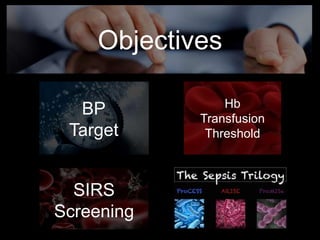
Objectives
BP
Target
Hb
Transfusion
Threshold
SIRS
Screening
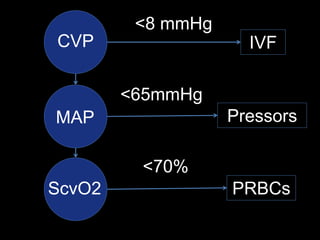
CVP
MAP
ScvO2
<8 mmHg
<65mmHg
<70%
IVF
Pressors
PRBCs
Surviving Sepsis Campaign
MAP โ‰ฅ65 mmHg
Level 1C Rec
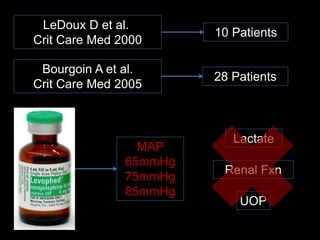
LeDoux D et al.
Crit Care Med 2000
Bourgoin A et al.
Crit Care Med 2005
10 Patients
28 Patients
MAP
65mmHg
75mmHg
85mmHg
Lactate
Renal Fxn
UOP
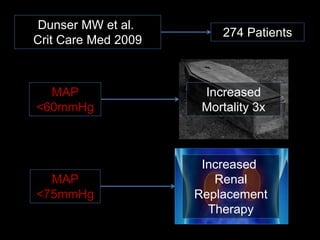
Dunser MW et al.
Crit Care Med 2009
274 Patients
MAP
<75mmHg
Increased
Renal
Replacement
Therapy
MAP
<60mmHg
Increased
Mortality 3x
Does a Higher MAP Decrease
Renal Failure in Sepsis?
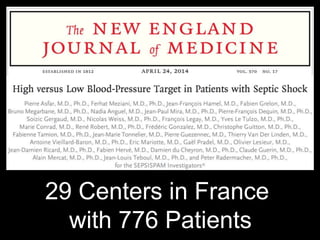
29 Centers in France
with 776 Patients
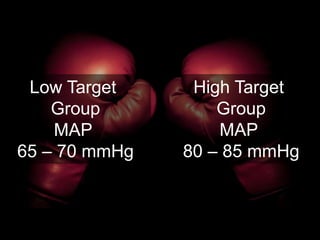
Low Target
Group
MAP
65 โ€“ 70 mmHg
High Target
Group
MAP
80 โ€“ 85 mmHg
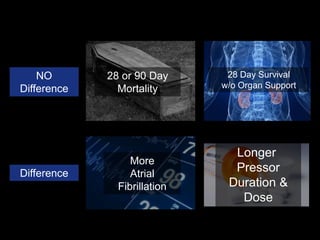
Difference
NO
Difference
28 or 90 Day
Mortality
28 Day Survival
w/o Organ Support
More
Atrial
Fibrillation
Longer
Pressor
Duration &
Dose
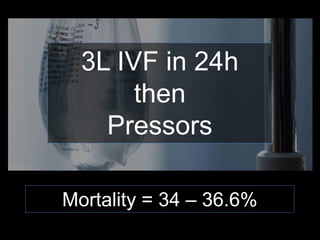
3L IVF in 24h
then
Pressors
Mortality = 34 โ€“ 36.6%
Donโ€™t Chase
MAP โ‰ฅ65mmHg
Bottom Line
Give Fluids
Early
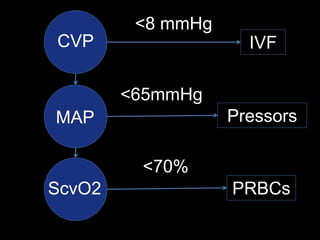
CVP
MAP
ScvO2
<8 mmHg
<65mmHg
<70%
IVF
Pressors
PRBCs
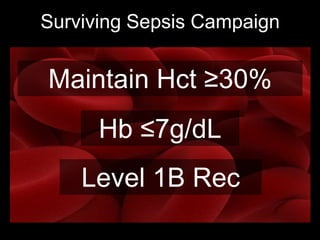
Surviving Sepsis Campaign
Maintain Hct โ‰ฅ30%
Hb โ‰ค7g/dL
Level 1B Rec
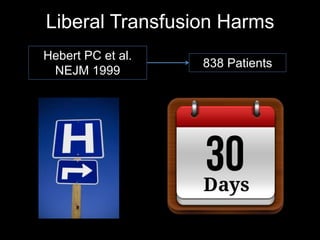
Liberal Transfusion Harms
Hebert PC et al.
NEJM 1999
838 Patients
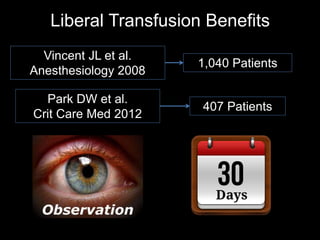
Liberal Transfusion Benefits
Vincent JL et al.
Anesthesiology 2008
1,040 Patients
Park DW et al.
Crit Care Med 2012
407 Patients
Does a Liberal Transfusion Strategy
Improve Mortality in Sepsis?
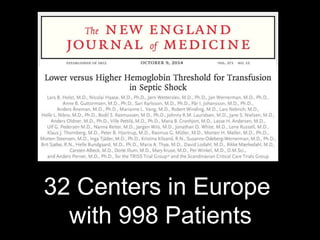
32 Centers in Europe
with 998 Patients
Transfusion
Requirements
In
Septic Shock
(TRISS)
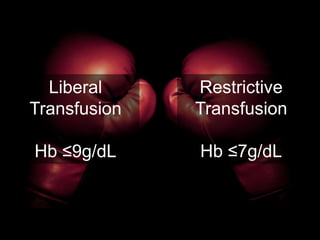
Liberal
Transfusion
Hb โ‰ค9g/dL
Restrictive
Transfusion
Hb โ‰ค7g/dL
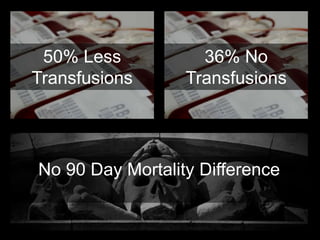
50% Less
Transfusions
36% No
Transfusions
No 90 Day Mortality Difference
Acute
Myocardial
Infarction
Excluded
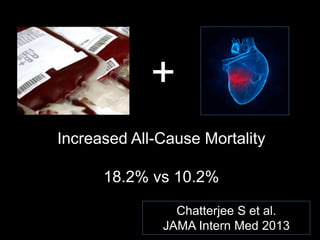
Chatterjee S et al.
JAMA Intern Med 2013
+
Increased All-Cause Mortality
18.2% vs 10.2%
Bottom Line
Use A
Restrictive
Transfusion
Strategy
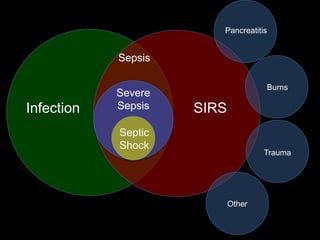
Infection SIRS
Sepsis
Severe
Sepsis
Septic
Shock
Pancreatitis
Burns
Trauma
Other
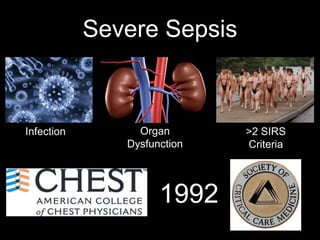
Severe Sepsis
Infection Organ
Dysfunction
>2 SIRS
Criteria
1992
How Good is SIRS at Screening for
Severe Sepsis?
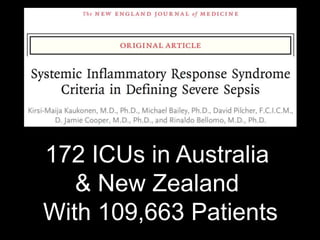
172 ICUs in Australia
& New Zealand
With 109,663 Patients
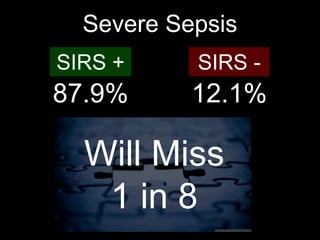
SIRS + SIRS -
87.9% 12.1%
Will Miss
1 in 8
Severe Sepsis
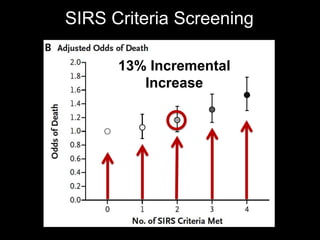
SIRS Criteria Screening
13% Incremental
Increase
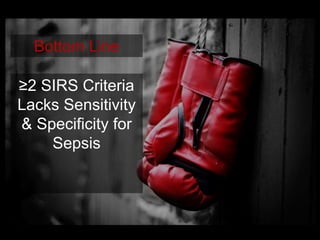
Bottom Line
โ‰ฅ2 SIRS Criteria
Lacks Sensitivity
& Specificity for
Sepsis
ProCESS
ARISE
ProMISe
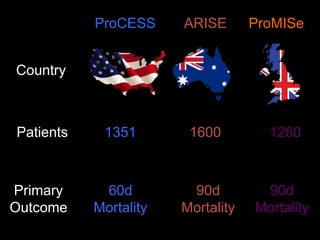
ProCESS ARISE ProMISe
Country
Patients
Primary
Outcome
1351 12601600
60d
Mortality
90d
Mortality
90d
Mortality
Before Randomizationโ€ฆ
A B C
Then Followed for 1st 6 Hours
The ProCESS Trial
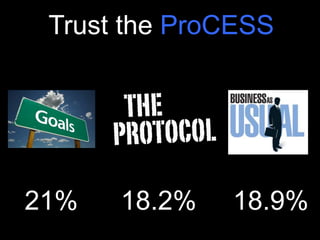
Trust the ProCESS
21% 18.2% 18.9%
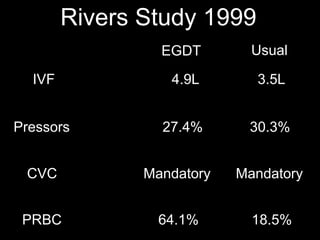
EGDT Usual
IVF
Pressors
CVC
PRBC
4.9L 3.5L
27.4% 30.3%
Mandatory Mandatory
64.1% 18.5%
Rivers Study 1999
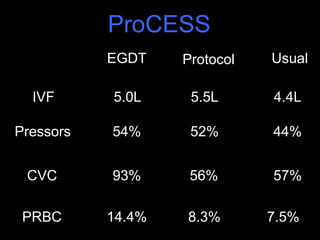
ProCESS
EGDT Protocol Usual
IVF
Pressors
CVC
PRBC
5.0L 5.5L 4.4L
54% 52% 44%
93% 56% 57%
14.4% 8.3% 7.5%
Flexibility in Management
Feasibility in the Community
Mostly
University EDs
The ARISE Trial
18.6% 18.8%
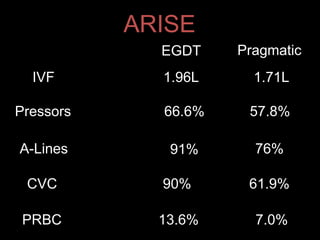
ARISE
EGDT Pragmatic
IVF
Pressors
CVC
PRBC
1.96L 1.71L
66.6% 57.8%
90% 61.9%
13.6% 7.0%
ARISE
A-Lines 91% 76%
Community/Rural
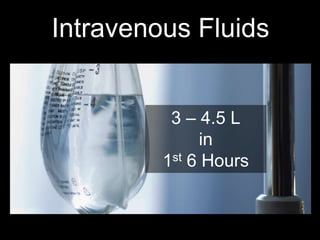
Intravenous Fluids
3 โ€“ 4.5 L
in
1st 6 Hours
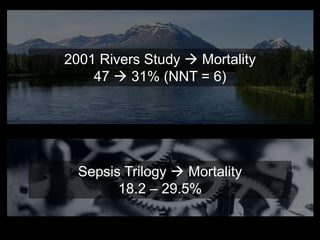
2001 Rivers Study ๏ƒ  Mortality
47 ๏ƒ  31% (NNT = 6)
Sepsis Trilogy ๏ƒ  Mortality
18.2 โ€“ 29.5%
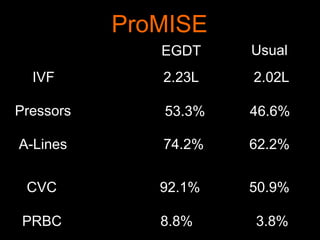
The ProMISe Trial
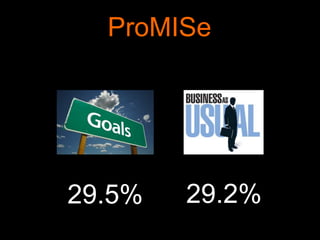
29.5% 29.2%
ProMISe
EGDT Usual
IVF
Pressors
CVC
PRBC
2.23L 2.02L
53.3% 46.6%
92.1% 50.9%
8.8% 3.8%
ProMISE
A-Lines 74.2% 62.2%
Nail in the Coffin for EGDT?
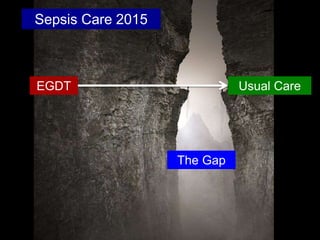
>10 Years
Laterโ€ฆ
EGDT Usual Care
The Gap
Sepsis Care 2015
CVP
ScvO2
Surviving Sepsis Campaign
Updates 6 Hour Bundle
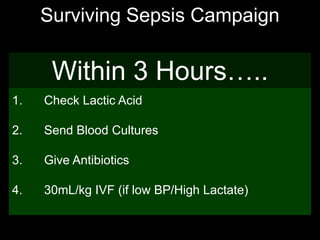
Surviving Sepsis Campaign
1. Check Lactic Acid
2. Send Blood Cultures
3. Give Antibiotics
4. 30mL/kg IVF (if low BP/High Lactate)
Within 3 Hoursโ€ฆ..
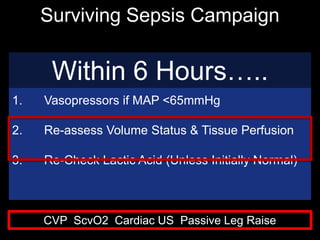
Surviving Sepsis Campaign
1. Vasopressors if MAP <65mmHg
2. Re-assess Volume Status & Tissue Perfusion
3. Re-Check Lactic Acid (Unless Initially Normal)
Within 6 Hoursโ€ฆ..
CVP ScvO2 Cardiac US Passive Leg Raise
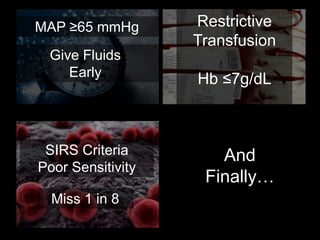
MAP โ‰ฅ65 mmHg
Give Fluids
Early
Restrictive
Transfusion
Hb โ‰ค7g/dL
SIRS Criteria
Poor Sensitivity
And
Finallyโ€ฆ
Miss 1 in 8
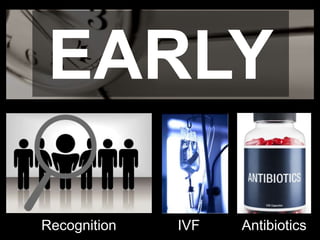
EARLY
Recognition IVF Antibiotics

Sepsis Care in 2015

Editor's Notes

  • #5ย  BP Threshold in Sepsis โ€“ MAP 65 vs 85mmHg Hb Transfusion Targets โ€“ 7 vs 9 g/dL SIRS for Screening of Sepsis Sepsis Trilogy (ProCESS, ARISE, & PROMISE)
  • #6ย The Rivers Protocol: If CVP < 8 mmHg then IVF until CVP >8 mmHg If MAP <65 mmHg then start pressors until MAP โ‰ฅ 65 mmHg (i.e. worried about too much IVF) If ScvO2 <70% then start PRBC transfusion until HCT โ‰ฅ 30%
  • #7ย Surviving Sepsis Campaign Recommends a MAP โ‰ฅ 65 mmHg in patients with septic shock Grade 1c Recommendation = Strong Recommendation, but founded on weak evidence Higher MAP may be beneficial
  • #8ย Ledoux D et al: 10 patients with septic shock ๏ƒ  Increased pressors to MAP of 65, 75, and 85 mmHg ๏ƒ  Increasing the MAP from 65 mm Hg to 85 mm Hg with norepinephrine increased CO, but no diff in lactate or UOP Bourgoin A et al: 28 patients with septic shock ๏ƒ  Increased pressors to MAP of 65 to 85 mmHg ๏ƒ  Increased CO, but no difference renal function or UOP Increasing MAP had no effect on Lactate Clearance, Renal Fxn, or UOP
  • #9ย Dunser et al ๏ƒ  Retrospective cohort study 274 septic patients ๏ƒ  One or more episodes of MAP <60 mmHg = increased risk of death by 2.96 One or more episodes of MAP < 75mmHg = increased need for renal replacement therapy
  • #11ย SEPSISPAM Trial was published along side ProCESS trial April 2014 Multicenter, open label trial of 776 patients with septic shock from 29 hospitals in France Septic Shock = Sepsis with Refractory Hypotension after 30cc/kg bolus of IVF Primary Outcome: 28 day mortality Also looked to see if higher MAP beneficial in patients with chronic HTN
  • #13ย No Difference in: High MAP vs Low MAP 28 Day Mortality: 36.6% vs 34.0% (p=0.57) 90 Day Mortality: 43.8% vs 42.3% (p=0.74) Survival w/o Need for Organ Support: 60.6% vs 62.1% (p = 0.66) ๏ƒ  Subgroup Analysis did show that patients with chronic HTN did have more doubling of Cr & Renal Replacement therapy in 1st week of care, but no difference at 28 days Difference in: High MAP vs Low MAP Rate of Afib: 6.7% vs 2.8% (p=0.02) Vasopressor Duration and Dose: Higher in High MAP Group (Levophed 0.40 ug/kg/min vs 0.35 ug/kg/min) and(4.7 days vs 3.7 days)
  • #14ย Patients enrolled in SEPSISPAM Trial and ProCESS Trial fairly similar with similar pre-enrollment fluid administration and patients in ProCESS a bit sicker (i.e. Lower MAP, Higher Initial Lactate Levels) In the SEPSISPAM Trial patients were resuscitated with 3L IVF in the 1st 24 hours then started on pressors ๏ƒ  28 Day Mortality 34.0 & 36.6% In the ProCESS Trial patients were resuscitated with 5L IVF in the 1st 6 hours ๏ƒ  Only half received pressors ๏ƒ  60 Day Mortality 21.0%, 18.2%, and 18.9% Not definitive, but does tell me, we shouldnโ€™t fear giving fluids early to patients in septic shock, we should push the fluids and not worry about the MAP as much
  • #15ย Chasing CVPs and MAPs makes physicians feel better, but early IVF improves patient mortality
  • #16ย The Rivers Protocol: If CVP < 8 mmHg then IVF until CVP >8 mmHg If MAP <65 mmHg then start pressors until MAP โ‰ฅ 65 mmHg (i.e. worried about too much IVF) If ScvO2 <70% then start PRBC transfusion until HCT โ‰ฅ 30%
  • #17ย Surviving Sepsis Campaign: Transfuse to maintain Hct 30% in presence of hypoperfusion in 1st six hours, thenโ€ฆ. Transfusion threshold is Hb โ‰ค7g/dL with goal of maintaining Hb between 7 โ€“ 9g/dL Level 1B Rec ๏ƒ  Strong Recommendation with moderate evidence to support
  • #18ย Hebert PC et al. NEJM 1999: Restrictive vs Liberal Transfusion strategy in critically ill ๏ƒ  Mortality rate during hospitalization was lower in restrictive group 22.3% vs liberal group 28.1% (p = 0.05), but 30 day mortality had no difference 18.7% vs 23.3% (p = 0.11)
  • #19ย Vincent JL et al. Anesthesiology 2008: multicenter, observational study (198 European ICUs) ๏ƒ  Higher 30 day survival rate in the transfusion group Park DW et al Crit Care Med 2012: multicenter, observational study (22 ICUs in Korea) ๏ƒ  transfused patients had a lower mortality atโ€ฆ. 7 Days (9.2 vs 27.0%) 28 Days (24.3% vs 38.8%) In-Hospital (31.6% vs 41.8%)
  • #22ย Transfusion Requirements In Septic Shock (TRISS): Multicenter, parallel group trial of patients in the ICU with septic shock and Hb โ‰ค9g/dL ๏ƒ  32 ICUs in denmark, sweden, norway, and finland (998 patients) ๏ƒ  compared liberal transfusion strategy (Hb โ‰ค9g/dL) vs Restrictive strategy (Hb โ‰ค7g/dL)
  • #24ย Restrictive vs Liberal Transfusion Strategy: 90D Mortality: 43% vs 45% (p = 0.44) 1545U vs 3088 Units PRBCs Transfused 36.1% vs 1.2% Did not require Transfusion 50% less transfusions, 1/3 didnโ€™t require transfusions ๏ƒ  No diff in 90D mortality
  • #25ย Patients with Acute Myocardial Infarction Excluded from Study
  • #26ย Chatterjee S et al. JAMA Intern Med 2013 ๏ƒ  Meta-Analysis of Blood transfusion strategy in patients with myocardial infarction Transfusion vs No Transfusion in AMI Increased all-cause mortality with transfusion 18.2% vs 10.2%
  • #28ย SIRS Temp > 100.4 or < 95.0 RR > 20 or PaCO2 < 32mmHg HR > 90/min WBC >12k or <4k or Band > 10% Sepsis = SIRS + Infection Severe Sepsis = Sepsis + Organ Dysfuncion Septic Shock = Severe Sepsis + Persistent Hypotension after 30cc/kg IVF Resuscitation Infection isnโ€™t the only thing that can cause SIRS (poor specificity, but maybe also poor sensitivity)
  • #29ย Severe Sepsis = Infection + Organ Dysfunction + 2 or more SIRS criteria This definition was created as a consensus statement from ACCP & SCCM in 1992 (Over 20 years ago)
  • #31ย Retrospective Analysis of 109,663 patients in the 1st 24 hours in the ICU
  • #32ย Positive Infection with Organ Dysfunction, then looked to see who had SIRS criteria Majority of Severe Sepsis patients had 2 or more SIRS Criteria But using 2 or more SIRS Criteria alone will miss 1 in 8 patients with Severe Sepsis
  • #33ย APACHE III ๏ƒ  Severity of Illness (Pts SIRS+ were sicker) ๏ƒ  (24 vs 11) More Renal Failure in SIRS+ Severe Sepsis (18.9% vs 11.7%) Higher Mortality in SIRS+ Severe Sepsis (24.5% vs 16.1%)
  • #34ย SIRS + Severe Sepsis: Mortality 36.1% ๏ƒ  18.3% SIRS โ€“ Severe Sepsis: Mortality 27.7 ๏ƒ  8.5% SIRS+ with higher mortality rates, but the two had the exact same rate of decline in Mortality
  • #35ย Each Additional SIRS Criteria Increased Mortality by 13% in a linear fashion without a transitional increase when 2 criteria were metโ€ฆ.there is nothing magical about two SIRS Criteria
  • #37ย The Big 3 Sepsis Studies: 1. ProCESS May 2014 2. ARISE October 2014 3. ProMISeโ€ฆMarch 2015
  • #39ย In order to be randomized in the studiesโ€ฆ.3 things had to happenโ€ฆ Septic shock recognized IVF 1 - 2 L before randomization Abx
  • #41ย 3 arms in the ProCESS Trial ๏ƒ  No statistical difference in 60 day mortality Protocol Arm: Like EGDT, but A-lines not mandatory, and type of fluid and vasopressor not specified
  • #42ย Single Center Study - More IVF & PRBC transfusions in 1st 6hrs in EGDT
  • #43ย IVF in 1st 6 hours similar to Rivers Study Our usual care is a blend of EGDT: Pressors, CVC PRBC: Fewer most likely due to fewer ScvO2 readings
  • #44ย Take Home Message: No clear superior method in management of septic shock patients, but did make it clear no one resuscitative pathway is bad or better. This gives flexibility in the management.
  • #45ย Most of the centers in the ProCESS trial were large tertiary centersโ€ฆ.maybe usual care not as feasible in smaller centers?
  • #47ย 2 arms in the ARISE Trial ๏ƒ  No statistical difference in 90 day mortality EGDT Pragmatic Care: Whatever physicians thought best; Not checking Scv02
  • #48ย 2.5L of IVF before randomization Similar IVF in 1st 6 hours But again a blend of EGDT in care: Pressors, A-Lines, CVC
  • #49ย This trial took place in a significant proportion of non-tertiary metropolitan and rural EDs, which allows for more generalizability of results, unlike ProCESS which took place in mostly University, Tertiary Care Hospitals
  • #50ย In an empiric fluid strategy patients should get 3 โ€“ 4.5 L IVF in 1st 6 hours based off ProCESS and ARISE
  • #51ย We have lower mortality rates now compared to the 2001 Rivers et al study nowโ€ฆ.why?
  • #53ย 2 arms in the ProMISe Trial ๏ƒ  No statistical difference in 90 day mortality
  • #54ย This study was set in a real-world context with 29%ย of recruiting hospitals beingย teaching facilities. 1L in 60 minutes of IVF prior to randomization Looking at the results, a significant portion of โ€œusualโ€ care patients still get arterial catheters (62.2%), CVCs (50.9%), and vasopressors (46.6%).
  • #55ย Is this the end of EGDT?!?
  • #56ย First of all we should give credit to Emanual Riversโ€ฆ.He has forever changed who we managed patients with sepsisโ€ฆ..but even after >10years since his landmark trialโ€ฆ.none of these other trials proved superiority
  • #57ย The 2001 Rivers et al study has changed how we manage sepsis (i.e. We are more aggressive in identifying these patients, and our โ€œusual careโ€ has changed to early identification, early IVFs and early antibiotics), which may explain why we have lower mortality rates now compared to the 2001 Rivers et al study
  • #58ย What this tells me is that our โ€œusualโ€ care has components of the EGDT algorithm engrained in it. ย Sick patients need fluids, antibiotics, and supportive therapies (i.e. Early critical care and resuscitation), but they donโ€™t need CVP and SCVO2 monitoring to dictate their care .
  • #59ย Sick patients need fluids, antibiotics, and supportive therapies (i.e. Early critical care and resuscitation), but they donโ€™t need CVP and SCVO2 monitoring to dictate their care
  • #60ย SSC 6 Hour Bundle Updated April 2015
  • #61ย SSC 6 Hour Bundle Updated April 2015 Repeat focused exam (after initial fluid resuscitation) by licensed independent practitioner including vital signs, cardiopulmonary, capillary refill, pulse, and skin findings. OR TWO OF THE FOLLOWING: โ€ข Measure CVP โ€ข Measure ScvO2 โ€ข Bedside cardiovascular ultrasound โ€ข Dynamic assessment of fluid responsiveness with passive leg raise or fluid challenge Of note, the 6-hour bundle has been updated; the 3-hour SSC bundle is not affected.
  • #62ย SSC 6 Hour Bundle Updated April 2015 Repeat focused exam (after initial fluid resuscitation) by licensed independent practitioner including vital signs, cardiopulmonary, capillary refill, pulse, and skin findings. OR TWO OF THE FOLLOWING: โ€ข Measure CVP โ€ข Measure ScvO2 โ€ข Bedside cardiovascular ultrasound โ€ข Dynamic assessment of fluid responsiveness with passive leg raise or fluid challenge Of note, the 6-hour bundle has been updated; the 3-hour SSC bundle is not affected.
  • #63ย Questions
  • #65ย Simply put, in septic shock, we need to be AGGRESSIVEย in our care EARLY. ย If patients are identified EARLY, given IVF EARLY, and antibiotics EARLY, again the key being EARLY,ย then the pathway used afterwards (i.e EGDT, Protocolized, or "usual care") is less important in management and resuscitation.