Arturo J. Bencosme, PhD
ajbencosme@comcast.net
Having an understanding of the nature of organizational change,
a map of the change process to be going through,
a narrative about the journey ahead,
and the will to encourage the followers to become fellow travelers
along the journey
will all support the organizational change guide.
Resources for Guiding Organizational Change
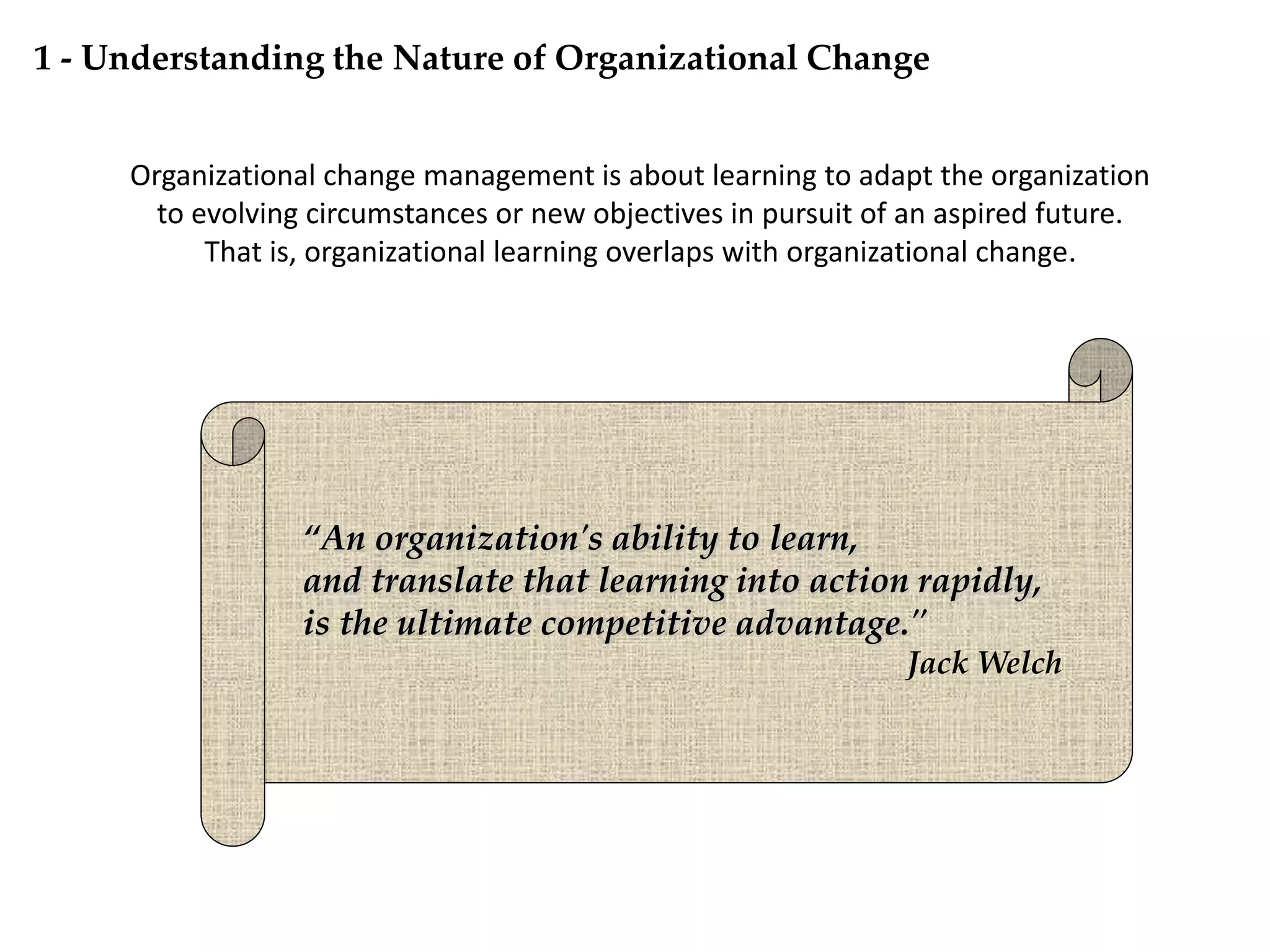
Organizational change management is about learning to adapt the organization
to evolving circumstances or new objectives in pursuit of an aspired future.
That is, organizational learning overlaps with organizational change.
“An organization's ability to learn,
and translate that learning into action rapidly,
is the ultimate competitive advantage."
Jack Welch
1 - Understanding the Nature of Organizational Change
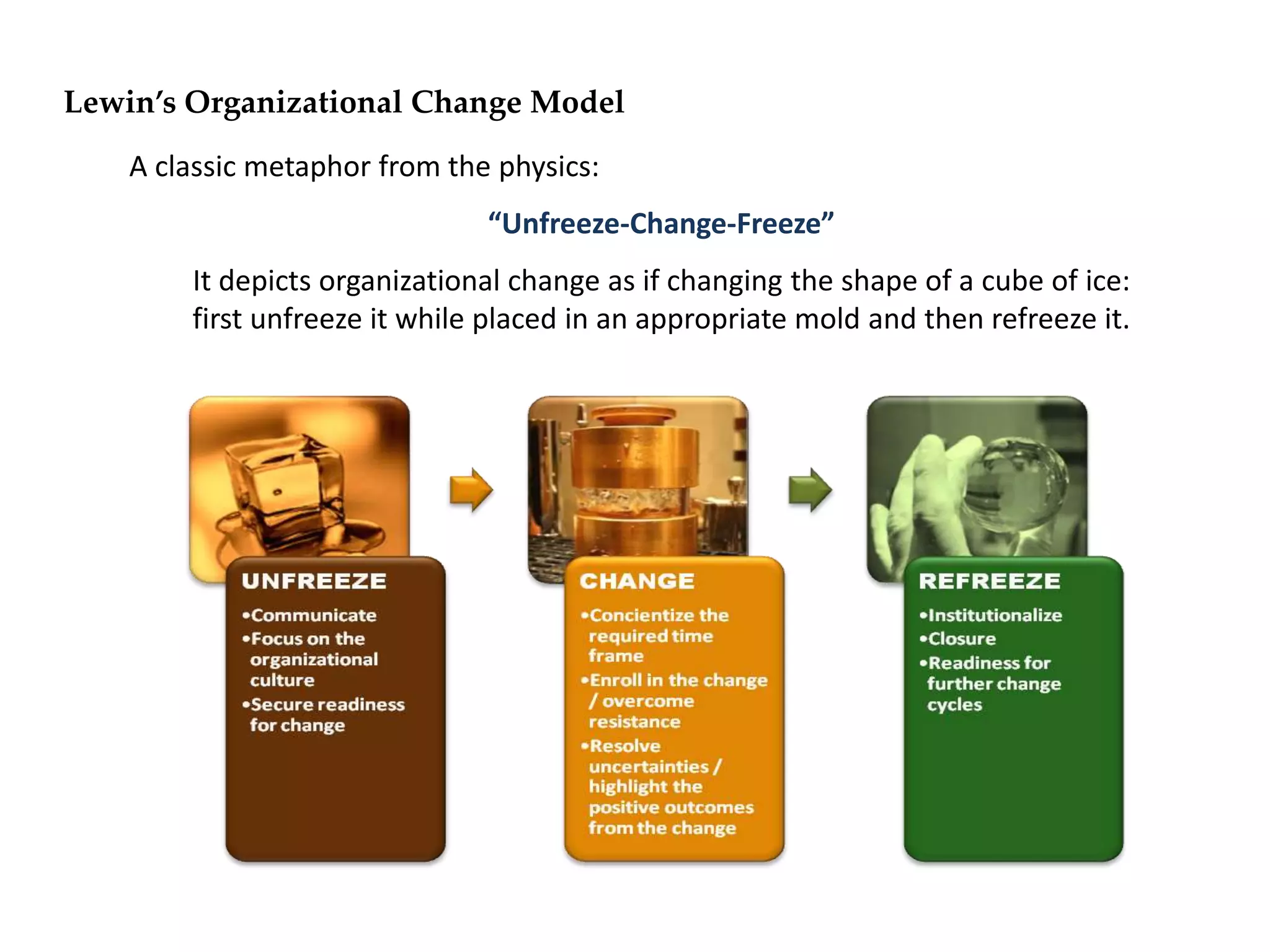
A classic metaphor from the physics:
“Unfreeze-Change-Freeze”
It depicts organizational change as if changing the shape of a cube of ice:
first unfreeze it while placed in an appropriate mold and then refreeze it.
Lewin’s Organizational Change Model
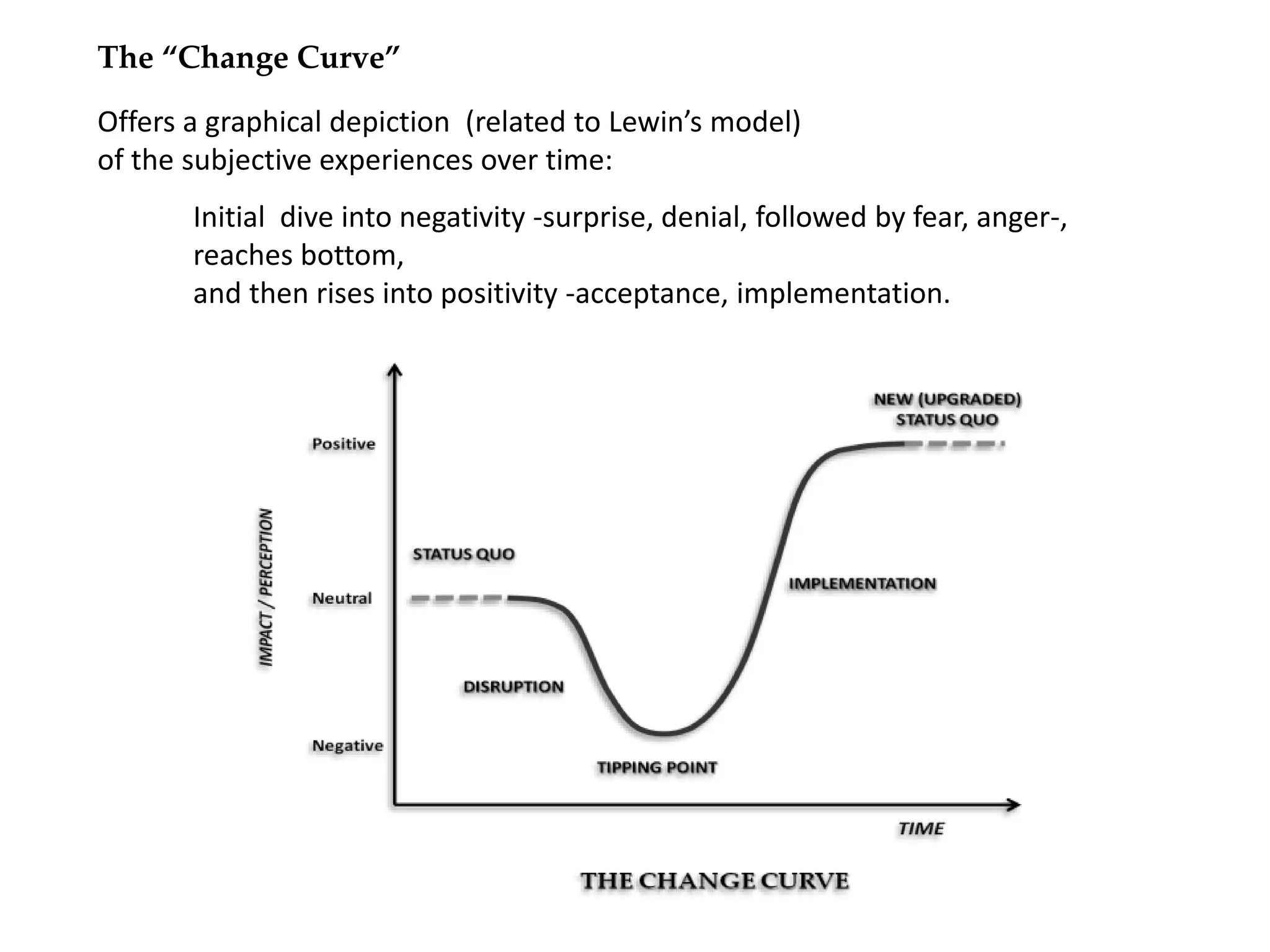
Offers a graphical depiction (related to Lewin’s model)
of the subjective experiences over time:
Initial dive into negativity -surprise, denial, followed by fear, anger-,
reaches bottom,
and then rises into positivity -acceptance, implementation.
The “Change Curve”
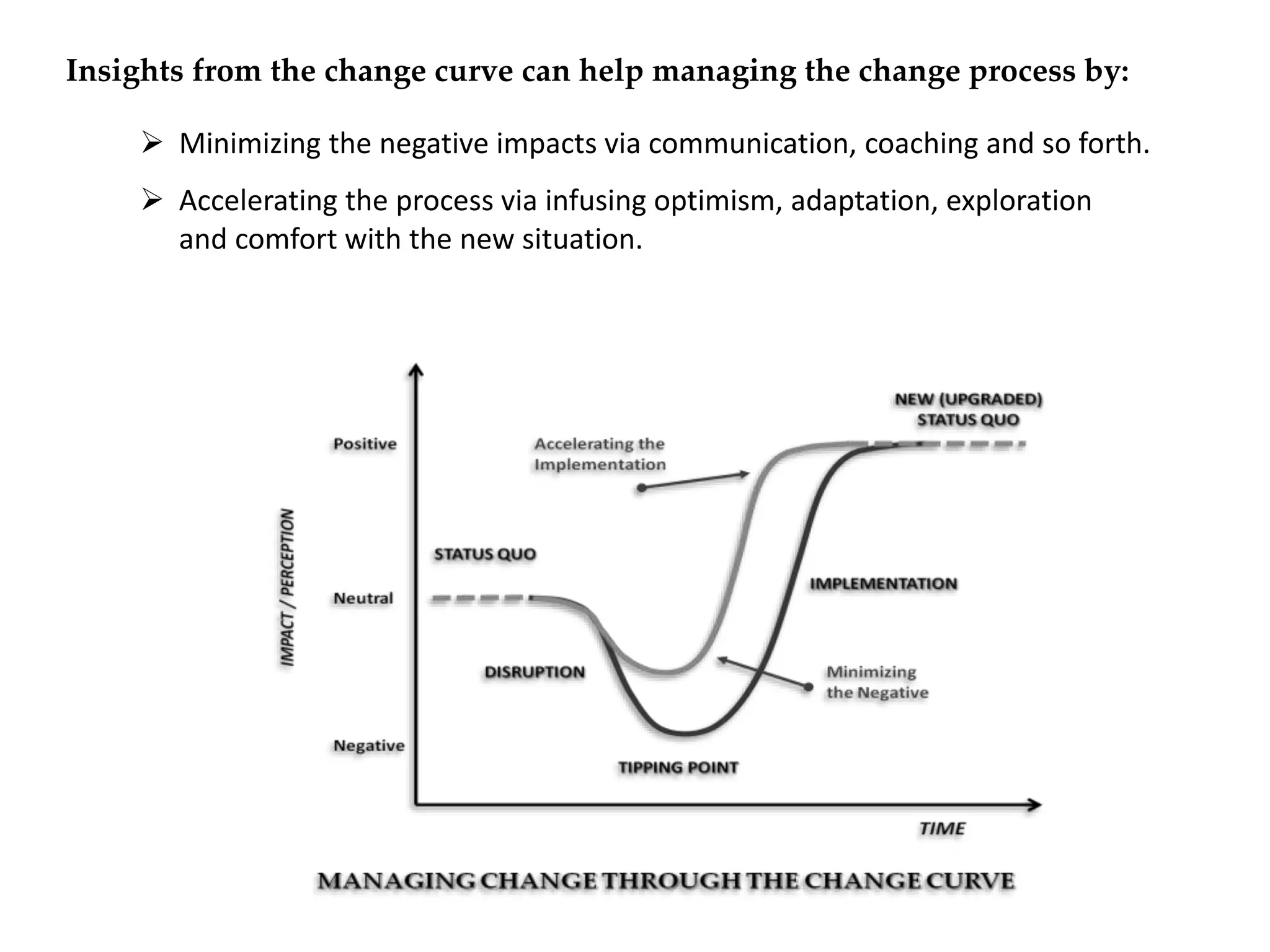
 Minimizing the negative impacts via communication, coaching and so forth.
 Accelerating the process via infusing optimism, adaptation, exploration
and comfort with the new situation.
Insights from the change curve can help managing the change process by:
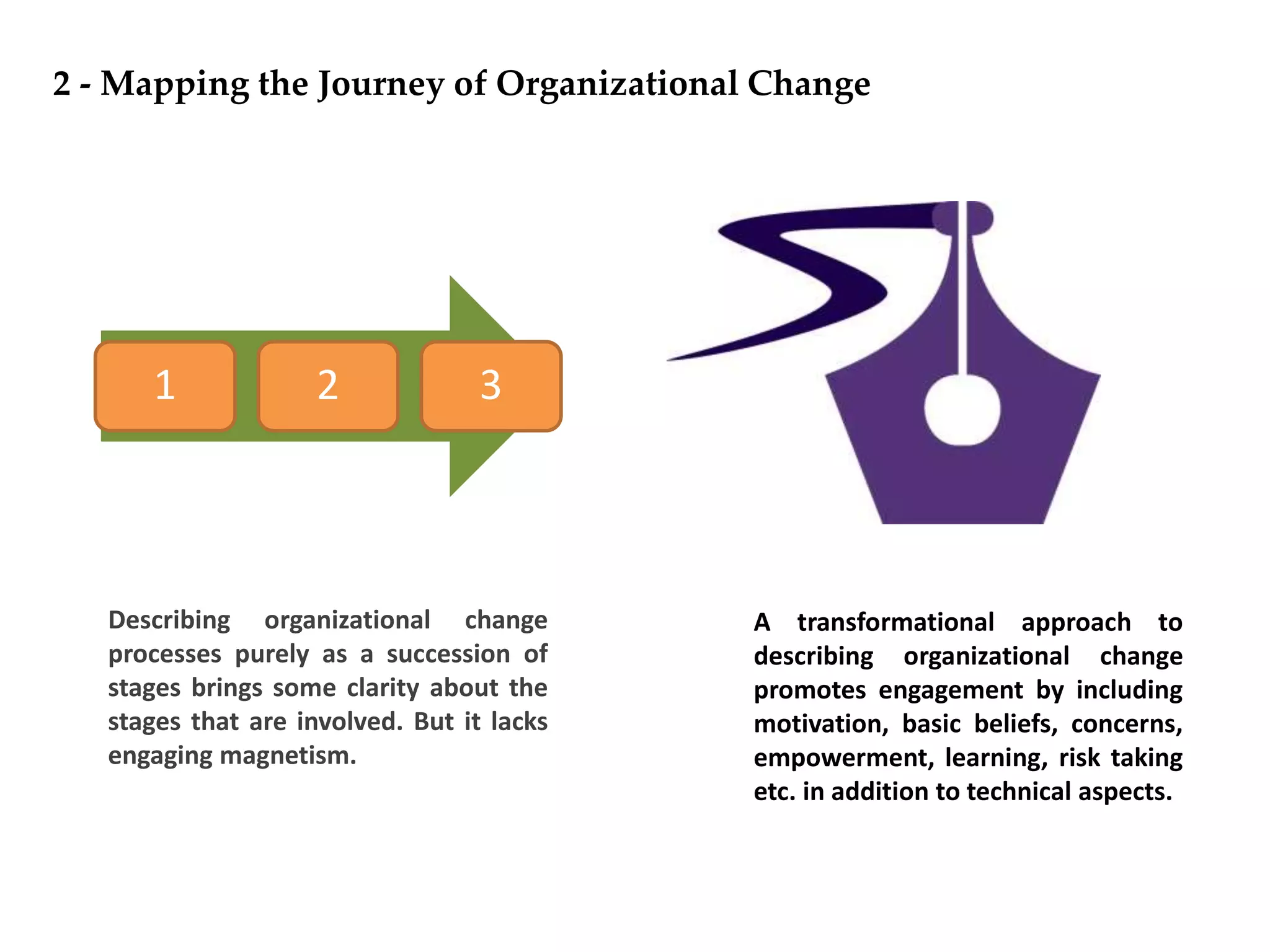
1 2 3
A transformational approach to
describing organizational change
promotes engagement by including
motivation, basic beliefs, concerns,
empowerment, learning, risk taking
etc. in addition to technical aspects.
Describing organizational change
processes purely as a succession of
stages brings some clarity about the
stages that are involved. But it lacks
engaging magnetism.
2 - Mapping the Journey of Organizational Change
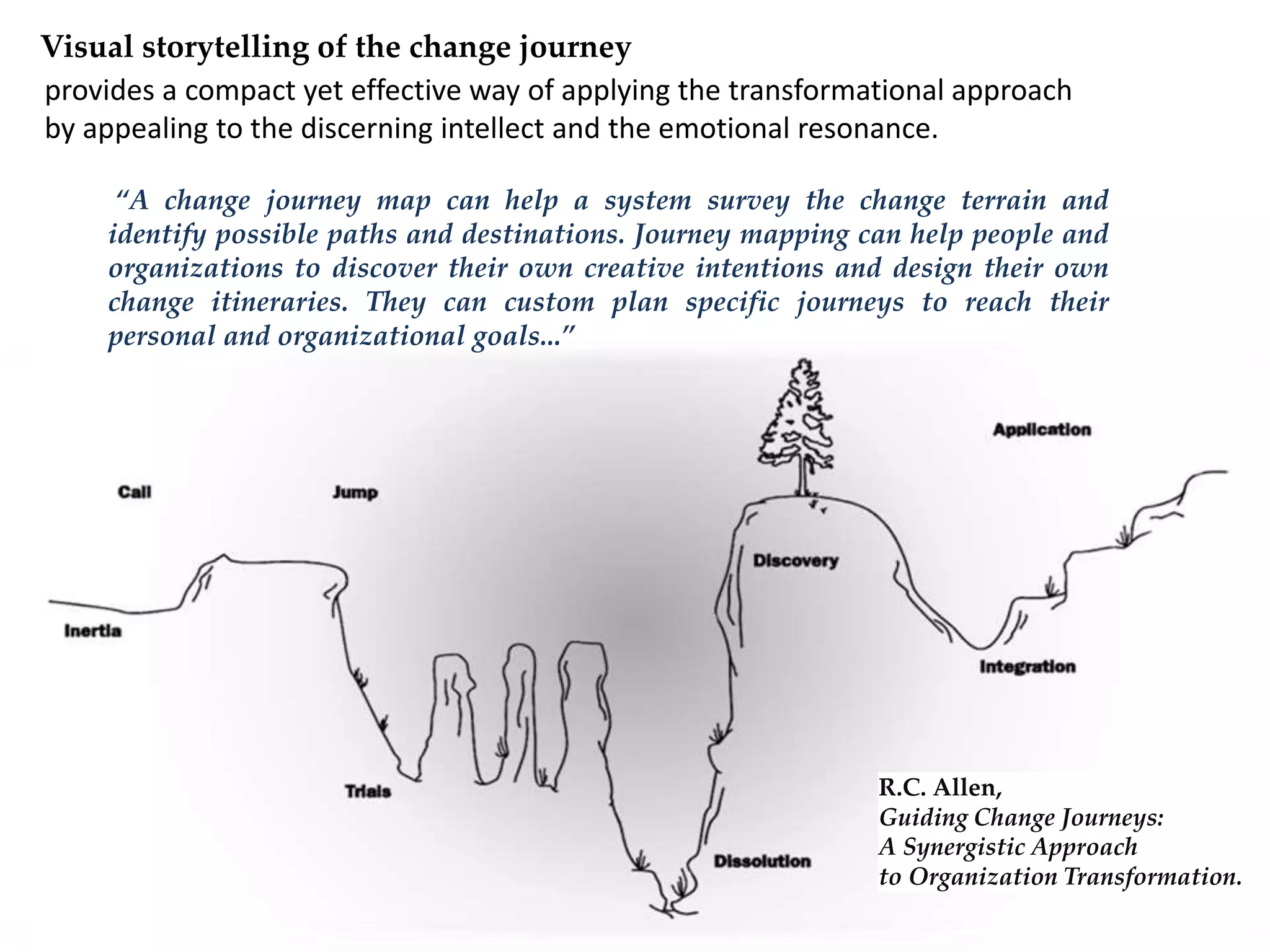
R.C. Allen,
Guiding Change Journeys:
A Synergistic Approach
to Organization Transformation.
Visual storytelling of the change journey
“A change journey map can help a system survey the change terrain and
identify possible paths and destinations. Journey mapping can help people and
organizations to discover their own creative intentions and design their own
change itineraries. They can custom plan specific journeys to reach their
personal and organizational goals...”
provides a compact yet effective way of applying the transformational approach
by appealing to the discerning intellect and the emotional resonance.
Levin and Allen warn about the negative emotional energies along the change process.
A more attractive approach will call on the positive emotional energies required
for a successful organizational change process,
such as overcoming a cliff in a mountain climbing trekking journey.
Focusing on the Positive Energies in Organizational Change
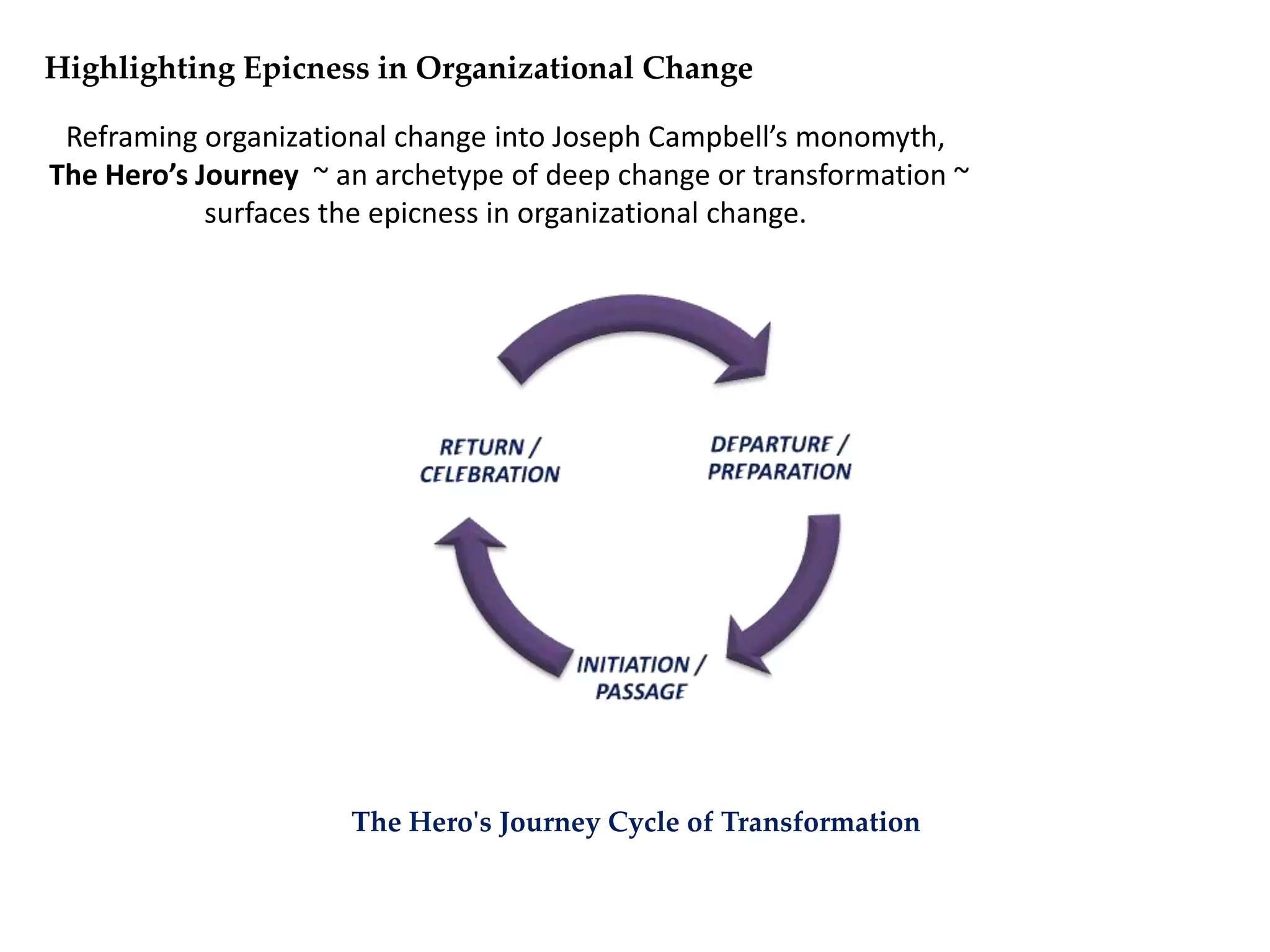
Reframing organizational change into Joseph Campbell’s monomyth,
The Hero’s Journey ~ an archetype of deep change or transformation ~
surfaces the epicness in organizational change.
The Hero's Journey Cycle of Transformation
Highlighting Epicness in Organizational Change
This sets the foundation for constructing deeply engaging journey maps.
Campbell suggested that this pattern might comprise up to 19 stages.
A simplified eight stage version is adopted here.
The Hero’s Journey pattern allows for a collective dimension,
a shared epic intent for the process of organizational change.
A Hero’s Journey depiction of organizational change is comprehensive
It encompasses objective elements (re-engineered workflows, new products or services)
AND subjective experiences and cultural shifts (such as overcoming fears and concerns)
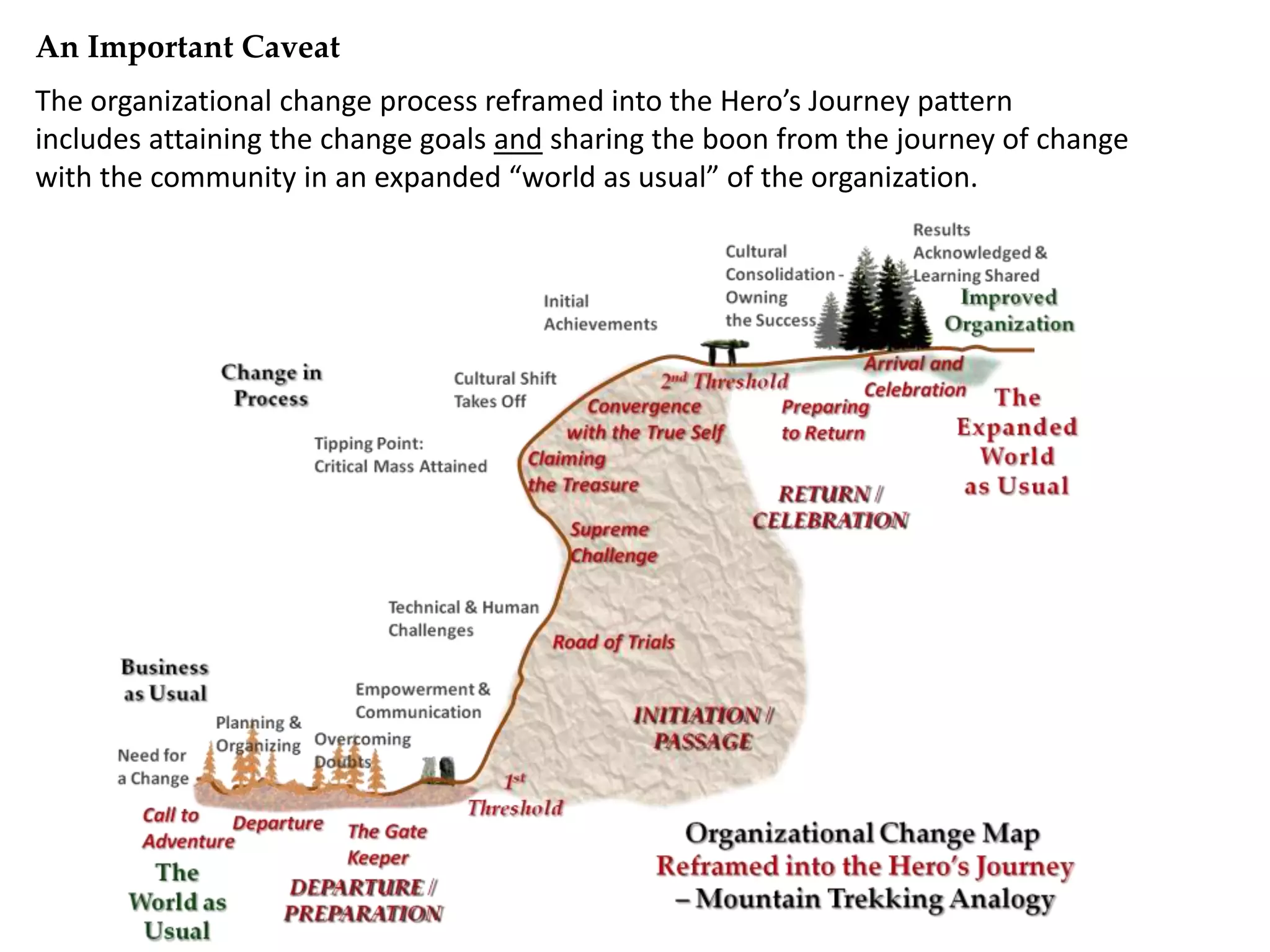
The organizational change process reframed into the Hero’s Journey pattern
includes attaining the change goals and sharing the boon from the journey of change
with the community in an expanded “world as usual” of the organization.
An Important Caveat
The sigmoid “S” learning curve captures the essence
in the mountain trekking analogy’s
positive focus for organizational change.
The “Learning to Change” Curve
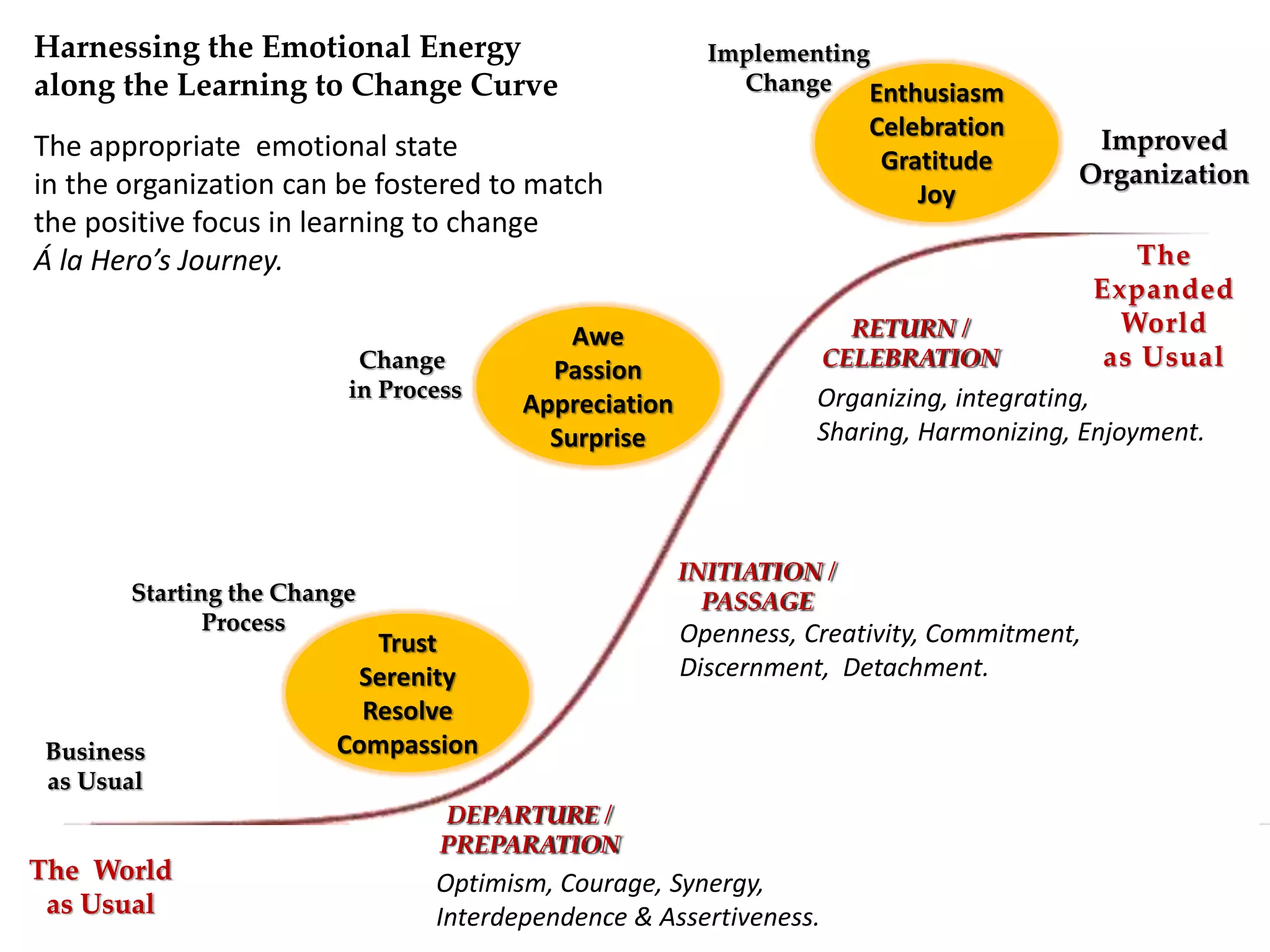
Harnessing the Emotional Energy
along the Learning to Change Curve
The appropriate emotional state
in the organization can be fostered to match
the positive focus in learning to change
Á la Hero’s Journey.
Improved
Organization
Change
in Process
Business
as Usual
INITIATION /
PASSAGE
RETURN /
CELEBRATION
The
Expanded
World
as Usual
DEPARTURE /
PREPARATION
The World
as Usual
Trust
Serenity
Resolve
Compassion
Awe
Passion
Appreciation
Surprise
Enthusiasm
Celebration
Gratitude
Joy
Optimism, Courage, Synergy,
Interdependence & Assertiveness.
Openness, Creativity, Commitment,
Discernment, Detachment.
Organizing, integrating,
Sharing, Harmonizing, Enjoyment.
Starting the Change
Process
Implementing
Change
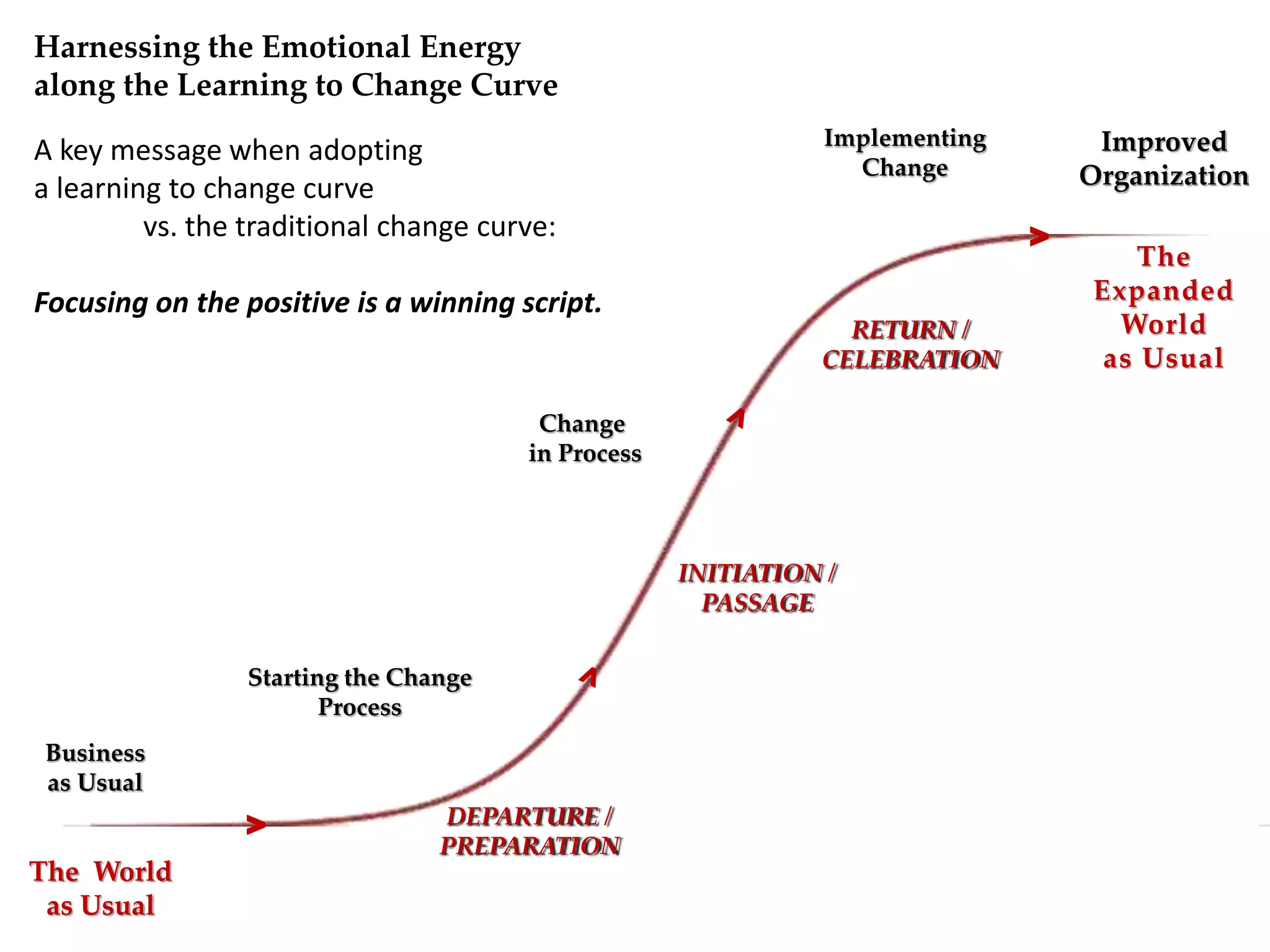
Harnessing the Emotional Energy
along the Learning to Change Curve
A key message when adopting
a learning to change curve
vs. the traditional change curve:
Focusing on the positive is a winning script.
Improved
Organization
Change
in Process
Business
as Usual
INITIATION /
PASSAGE
RETURN /
CELEBRATION
The
Expanded
World
as Usual
DEPARTURE /
PREPARATION
The World
as Usual
Starting the Change
Process
Implementing
Change
>
>
3 - Narratives about Organizational Change Journey Ahead
“ The Epic Story
about Our Future"
“Leading from the results” … change in itself hardly sells to the organization.
By contrast, a dream (e.g., an aspiration to attain a desired end result) impels people.
While planning a change process is mostly an intellectual construct,
a dream has an appeal and enchantment of its own.
That is easy to convoke through symbols and images in visual stories
For describing the process and the end result of the change process.
Organizational Storytelling
- Especially when the narrative is future focused
is a powerful means for developing and leading organizations.
The change process reframed into the Hero’s Journey pattern
is the foundation for composing a compelling story
that will be embodied throughout the organization
to promote the meeting of the minds and the hearts of all.
What are the challenges ahead?
And, which could kill the process but if overcome, will be the tipping point?
How to prepare for transforming obstacles into possibilities?
Who / what will be the aides and who / what the opponents to the success?
What betterment for society and the world at large
would this organizational change process bring?
Future focused, epic organizational change stories will
address important questions
In the direction of appropriately facing obstacles & challenges,
bringing a sense of oneness with the organization’s core ideas and the path ahead
aiming to contribute to the larger-than-the-organization purpose.
The end result is deep motivation to be a part of bringing that purpose to life.
An epic story about the change ahead
will reinforce the organizational culture
A Generic script for an Epic Change Narrative
World
As Usual
Call to
Adventure Departure
Gate
Keeper
First
Threshold
Road of
Trials
Abyss /
Supreme
Challenge
Claiming
The
Treasure
Convergence
with
the True Self
Second
Threshold
Preparing
to Return
Arrival &
Celebration
The Expanded
World As
Usual
can be derived directly from the change process map
reframed into the Hero’s Journey
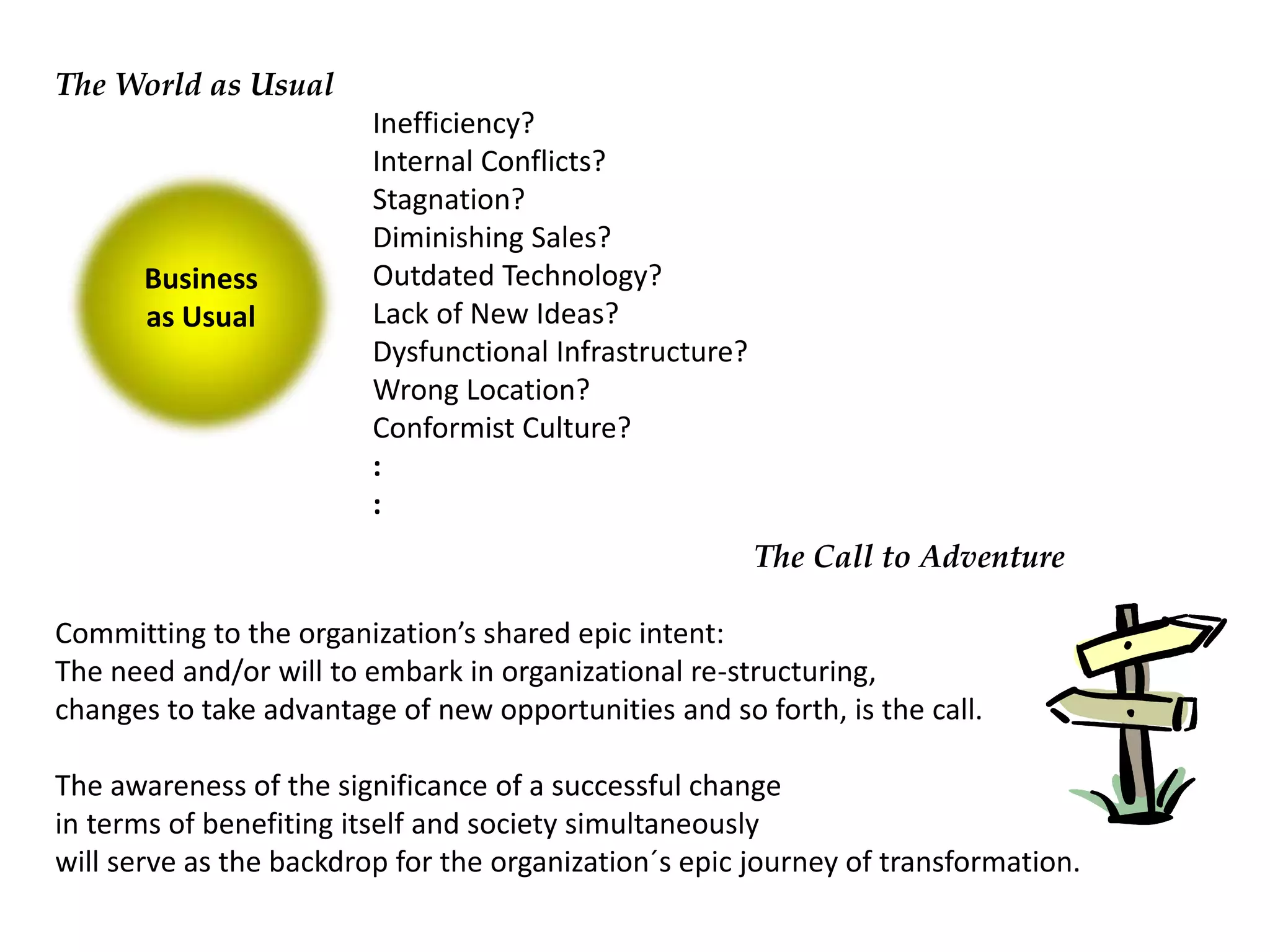
The World as Usual
Inefficiency?
Internal Conflicts?
Stagnation?
Diminishing Sales?
Outdated Technology?
Lack of New Ideas?
Dysfunctional Infrastructure?
Wrong Location?
Conformist Culture?
:
:
Business
as Usual
The Call to Adventure
Committing to the organization’s shared epic intent:
The need and/or will to embark in organizational re-structuring,
changes to take advantage of new opportunities and so forth, is the call.
The awareness of the significance of a successful change
in terms of benefiting itself and society simultaneously
will serve as the backdrop for the organization´s epic journey of transformation.
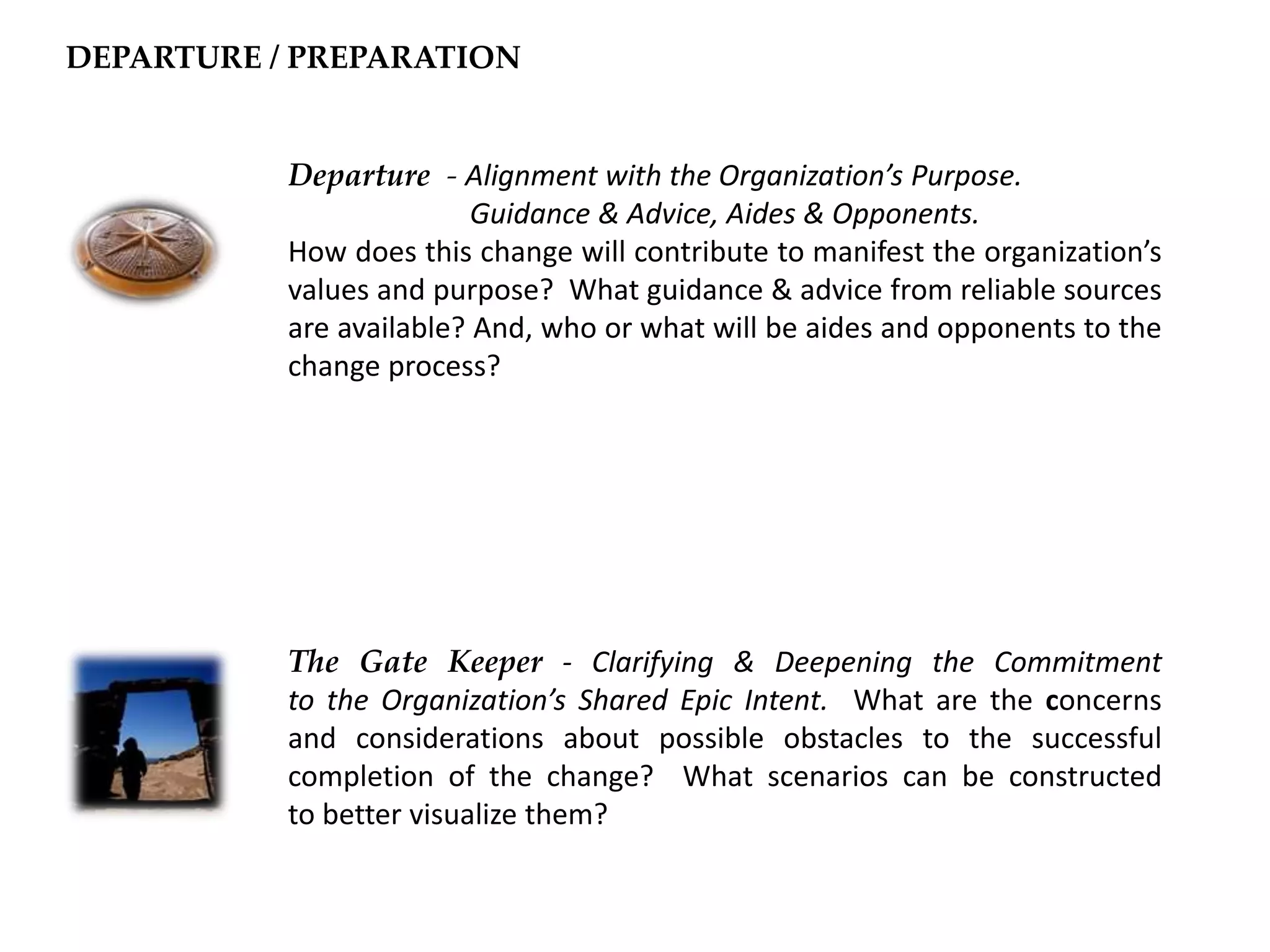
Departure - Alignment with the Organization’s Purpose.
Guidance & Advice, Aides & Opponents.
How does this change will contribute to manifest the organization’s
values and purpose? What guidance & advice from reliable sources
are available? And, who or what will be aides and opponents to the
change process?
The Gate Keeper - Clarifying & Deepening the Commitment
to the Organization’s Shared Epic Intent. What are the concerns
and considerations about possible obstacles to the successful
completion of the change? What scenarios can be constructed
to better visualize them?
DEPARTURE / PREPARATION
Endurance Trials - Transforming Adversity into Opportunities - Utilizing
Everything for Collective Learning. How to best utilize resources such as
learning from past experiences, consultants, creativity and so forth?
Abyss / Supreme Challenge - Overcoming the Greatest Barriers.
What can kill the process? How to re-enforce the mindset already used
to overcome enduring trials? The greatest fear might not be about the
organization’s inadequacy to succeed but the realization that it its unbeatable.
Claiming the Treasure: - Fulfillment of the Change Goals.
How to acknowledge success and still keep on the journey toward sharing
the learning and benefiting society?
Convergence with the Organization’s True Self: - Internal Alignment –
Strengthening the Corporate Culture. How to gain a deeper awareness that it
is not just that they did it, but it is who they are.
INITIATION / PASSAGE
Preparing to Return - Owning the Treasure & Bringing it into Society.
How to deepen the learning from the change journey? How to improve
on future change processes? Should the assumptions made be re-
examined? How does the change that was attained align with the
organization´s identity.
Arrival & Celebration - Freedom from fear: Letting the Passion for the
Highest Contribution for a Better World Lead the Organization’s
Evolution. How to reciprocate to society in a way that is consistent with
the organization’s purpose?
RETURN / CELEBRATION
How will the organization’s “world as usual” or “business as
usual” become expanded because of the change implemented,
the learning, and so forth?
What would it mean for the organization to master two worlds:
the ordinary one –thriving in its day-to-day
and the extraordinary one –knowing that it is capable of
pursuing deep change?
The Organization’s “New World as Usual”
IV - The Ideal Guide: An Epic Servant Leader
Encouraging and fostering a shared embodiment of the organization’s heroic path
will bring an extraordinary connection among the members of the organization
all of whom, in turn, are living their own personal journey. Thus,
supporting each member of the organization and enrolling them
Into the organization’s journey are paramount.
The ideal organizational change guide
would thus be an Epic Servant Leader
–assisting the members of the organization
in contributing to a better world
in a “hero’s journey” way.
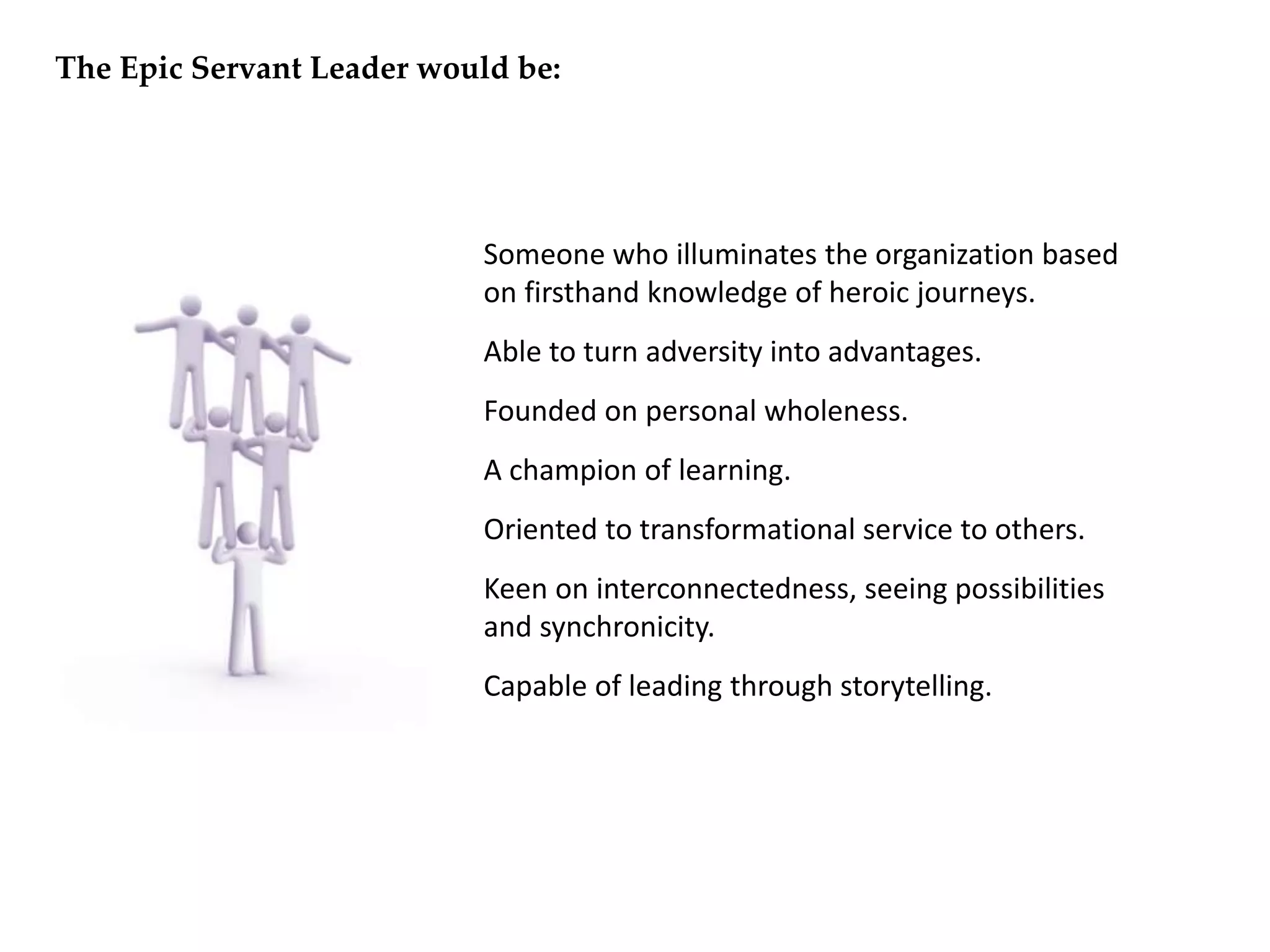
• Someone who illuminates the organization based
on firsthand knowledge of heroic journeys.
• Able to turn adversity into advantages.
• Founded on personal wholeness.
• A champion of learning.
• Oriented to transformational service to others.
• Keen on interconnectedness, seeing possibilities
and synchronicity.
• Capable of leading through storytelling.
The Epic Servant Leader would be:
Driven to illuminate the organization
based on firsthand knowledge of heroic journeys.
This would allow the guide to share that knowledge with others and likely inspire them
to follow their own journey. Most importantly, it will support the guide to empower
others through mentorship.
Able to turn adversity into advantages
Displaying resilience that was acquired possibly through having gone successfully past
trials and challenges along his / her hero’s journey.
This allows the guide to respond to obstacles in a way that results in positive outcomes.
The Ideal Guide:
Founded on personal wholeness
Leading from a place of authenticity not of authority or other circumstances.
This would be a guide who embodies the hero in his or her own life and portrays
his or her own integrity regardless of the role being played personally,
professionally and so forth: being loyal to his or her values, sense of purpose and
aspirations.
A champion of learning - Exert the Role of a Chief Learning Officer
A guide that strives for learning both intellectually and intuitively
throughout the entire organization and models learning.
Oriented to transformational service to others– especially to the followers.
This guide will strive to maintain a dynamic balance
between impelling the organization’s journey
and serving the self-realization of those who are the followers.
Keen on interconnectedness, seeing possibilities and synchronicity
This guide would co-create new realities by means of developing an awareness of the
interconnections within the system in which the organization operates and aiming to the
possibilities that such an awareness brings: new interconnections establish new realities.
Committing to work under this paradigm will open the door to synchronicity.
Capable of leading through storytelling
A guide that exerts his or her leadership by means of engaging the followers
in the construction of a shared organizational myth or legend
as a collective learning process
that includes every person’s individual myth
intertwined with that of the organization
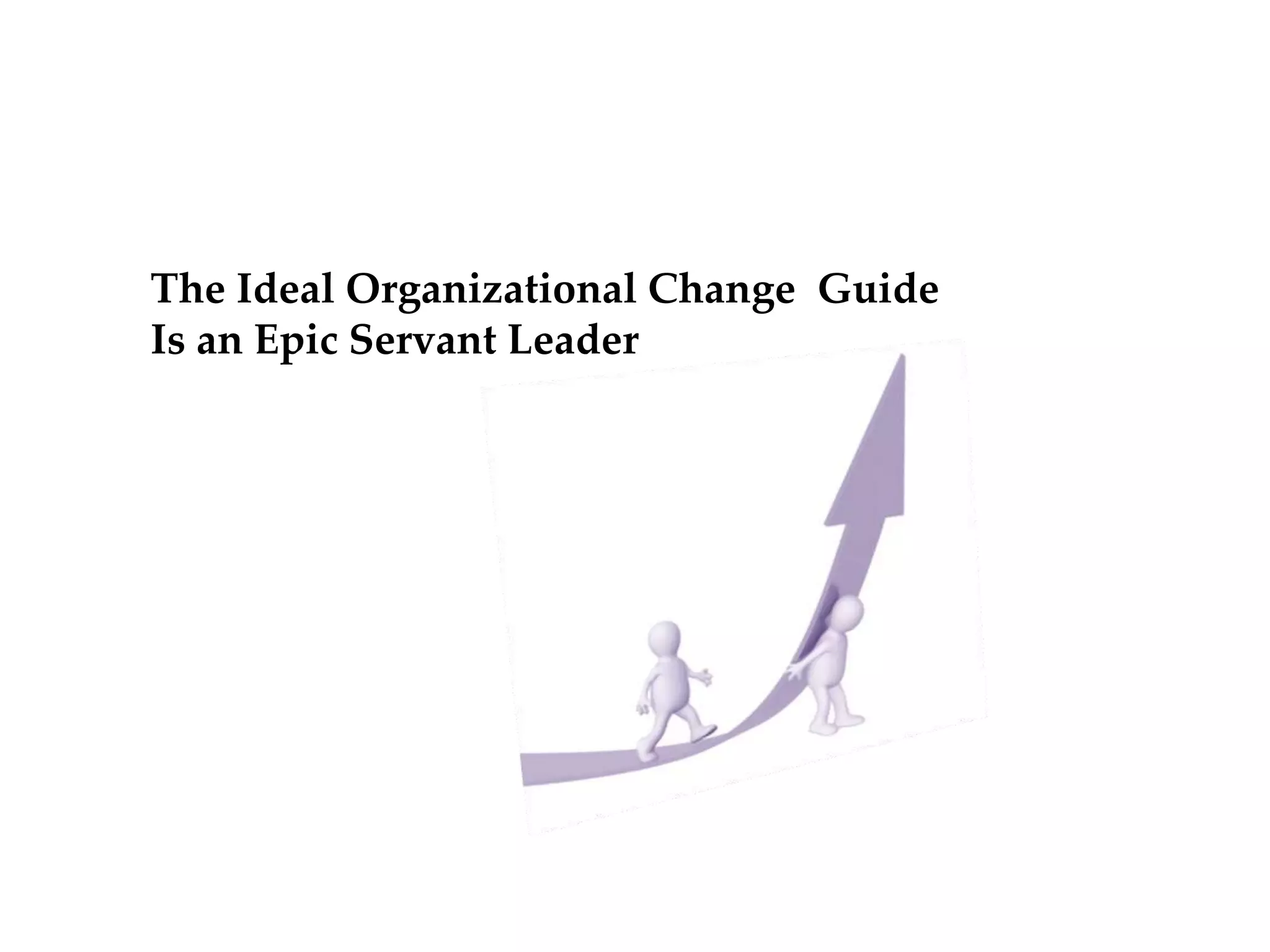
The Ideal Organizational Change Guide
Is an Epic Servant Leader
Reframing and guiding organizational change into a hero’s journey
allows for deriving meaning from past experiences,
engaging positively in the change process and planning for and manifesting
a transcendental purpose along the future.
Just as individuals can take the path of being of service to others following the hero’s
journey in their lives, so can any organization elect to take the same path.
Once the members of an organization make this choice,
they will have crossed an important ontological threshold:
they have left behind being just an organization
to become a fellowship of travelers in the field of meaning and transcendence.
Epic Reading
Allen, R. (2002). Guiding Change Journeys: A Synergistic Approach to Organization Transformation.
John Willey & Sons.
Campbell, J. (1973). The Hero with a Thousand Faces.
Princeton – Bollingen.
Jarnagin, C., & Slocum Jr., J. (2007). Creating Corporate Cultures Through Mythopoetic Leadership.
Organizational Dynamics , 36 (3).
Ledet, W. (2002). Making the Move Toward a Learning Organization: A Classic Journey of Change.
Ledet Enterprises, Inc.
Lewin, K. (2016). Frontiers of Group Dynamics: Concept, method and reality
in social science, social equilibria, and social change. Human Relations , 5-41.
Lotze, E. (2004). Work Culture Transformation - Straw to Gold - The Modern Hero's Journey.
K• G• Saur München.
Vogler, C. (2007). The Writer’s Journey: Mythic Structure for Writers (3 ed.).
Michael Wiese Prod.
Wahlstrom, T. (1999). Psychological Applications in Management: The Hero's Journey.
Dissertation.Com.
Holder, R.J. & McKinney, R. (1999), Corporate Change and the Hero’s Quest.
Human Energy Design Systems and Richard — Southern Illinois University, Edwardsville.

Guiding the Organizational Change Journey

  • 1.
    Arturo J. Bencosme,PhD ajbencosme@comcast.net
  • 2.
    Having an understandingof the nature of organizational change, a map of the change process to be going through, a narrative about the journey ahead, and the will to encourage the followers to become fellow travelers along the journey will all support the organizational change guide. Resources for Guiding Organizational Change
  • 3.
    Organizational change managementis about learning to adapt the organization to evolving circumstances or new objectives in pursuit of an aspired future. That is, organizational learning overlaps with organizational change. “An organization's ability to learn, and translate that learning into action rapidly, is the ultimate competitive advantage." Jack Welch 1 - Understanding the Nature of Organizational Change
  • 4.
    A classic metaphorfrom the physics: “Unfreeze-Change-Freeze” It depicts organizational change as if changing the shape of a cube of ice: first unfreeze it while placed in an appropriate mold and then refreeze it. Lewin’s Organizational Change Model
  • 5.
    Offers a graphicaldepiction (related to Lewin’s model) of the subjective experiences over time: Initial dive into negativity -surprise, denial, followed by fear, anger-, reaches bottom, and then rises into positivity -acceptance, implementation. The “Change Curve”
  • 6.
     Minimizing thenegative impacts via communication, coaching and so forth.  Accelerating the process via infusing optimism, adaptation, exploration and comfort with the new situation. Insights from the change curve can help managing the change process by:
  • 7.
    1 2 3 Atransformational approach to describing organizational change promotes engagement by including motivation, basic beliefs, concerns, empowerment, learning, risk taking etc. in addition to technical aspects. Describing organizational change processes purely as a succession of stages brings some clarity about the stages that are involved. But it lacks engaging magnetism. 2 - Mapping the Journey of Organizational Change
  • 8.
    R.C. Allen, Guiding ChangeJourneys: A Synergistic Approach to Organization Transformation. Visual storytelling of the change journey “A change journey map can help a system survey the change terrain and identify possible paths and destinations. Journey mapping can help people and organizations to discover their own creative intentions and design their own change itineraries. They can custom plan specific journeys to reach their personal and organizational goals...” provides a compact yet effective way of applying the transformational approach by appealing to the discerning intellect and the emotional resonance.
  • 9.
    Levin and Allenwarn about the negative emotional energies along the change process. A more attractive approach will call on the positive emotional energies required for a successful organizational change process, such as overcoming a cliff in a mountain climbing trekking journey. Focusing on the Positive Energies in Organizational Change
  • 10.
    Reframing organizational changeinto Joseph Campbell’s monomyth, The Hero’s Journey ~ an archetype of deep change or transformation ~ surfaces the epicness in organizational change. The Hero's Journey Cycle of Transformation Highlighting Epicness in Organizational Change
  • 11.
    This sets thefoundation for constructing deeply engaging journey maps. Campbell suggested that this pattern might comprise up to 19 stages. A simplified eight stage version is adopted here. The Hero’s Journey pattern allows for a collective dimension, a shared epic intent for the process of organizational change.
  • 12.
    A Hero’s Journeydepiction of organizational change is comprehensive It encompasses objective elements (re-engineered workflows, new products or services) AND subjective experiences and cultural shifts (such as overcoming fears and concerns)
  • 13.
    The organizational changeprocess reframed into the Hero’s Journey pattern includes attaining the change goals and sharing the boon from the journey of change with the community in an expanded “world as usual” of the organization. An Important Caveat
  • 14.
    The sigmoid “S”learning curve captures the essence in the mountain trekking analogy’s positive focus for organizational change. The “Learning to Change” Curve
  • 15.
    Harnessing the EmotionalEnergy along the Learning to Change Curve The appropriate emotional state in the organization can be fostered to match the positive focus in learning to change Á la Hero’s Journey. Improved Organization Change in Process Business as Usual INITIATION / PASSAGE RETURN / CELEBRATION The Expanded World as Usual DEPARTURE / PREPARATION The World as Usual Trust Serenity Resolve Compassion Awe Passion Appreciation Surprise Enthusiasm Celebration Gratitude Joy Optimism, Courage, Synergy, Interdependence & Assertiveness. Openness, Creativity, Commitment, Discernment, Detachment. Organizing, integrating, Sharing, Harmonizing, Enjoyment. Starting the Change Process Implementing Change
  • 16.
    Harnessing the EmotionalEnergy along the Learning to Change Curve A key message when adopting a learning to change curve vs. the traditional change curve: Focusing on the positive is a winning script. Improved Organization Change in Process Business as Usual INITIATION / PASSAGE RETURN / CELEBRATION The Expanded World as Usual DEPARTURE / PREPARATION The World as Usual Starting the Change Process Implementing Change > >
  • 17.
    3 - Narrativesabout Organizational Change Journey Ahead “ The Epic Story about Our Future" “Leading from the results” … change in itself hardly sells to the organization. By contrast, a dream (e.g., an aspiration to attain a desired end result) impels people. While planning a change process is mostly an intellectual construct, a dream has an appeal and enchantment of its own. That is easy to convoke through symbols and images in visual stories For describing the process and the end result of the change process.
  • 18.
    Organizational Storytelling - Especiallywhen the narrative is future focused is a powerful means for developing and leading organizations. The change process reframed into the Hero’s Journey pattern is the foundation for composing a compelling story that will be embodied throughout the organization to promote the meeting of the minds and the hearts of all.
  • 19.
    What are thechallenges ahead? And, which could kill the process but if overcome, will be the tipping point? How to prepare for transforming obstacles into possibilities? Who / what will be the aides and who / what the opponents to the success? What betterment for society and the world at large would this organizational change process bring? Future focused, epic organizational change stories will address important questions
  • 20.
    In the directionof appropriately facing obstacles & challenges, bringing a sense of oneness with the organization’s core ideas and the path ahead aiming to contribute to the larger-than-the-organization purpose. The end result is deep motivation to be a part of bringing that purpose to life. An epic story about the change ahead will reinforce the organizational culture
  • 21.
    A Generic scriptfor an Epic Change Narrative World As Usual Call to Adventure Departure Gate Keeper First Threshold Road of Trials Abyss / Supreme Challenge Claiming The Treasure Convergence with the True Self Second Threshold Preparing to Return Arrival & Celebration The Expanded World As Usual can be derived directly from the change process map reframed into the Hero’s Journey
  • 22.
    The World asUsual Inefficiency? Internal Conflicts? Stagnation? Diminishing Sales? Outdated Technology? Lack of New Ideas? Dysfunctional Infrastructure? Wrong Location? Conformist Culture? : : Business as Usual The Call to Adventure Committing to the organization’s shared epic intent: The need and/or will to embark in organizational re-structuring, changes to take advantage of new opportunities and so forth, is the call. The awareness of the significance of a successful change in terms of benefiting itself and society simultaneously will serve as the backdrop for the organization´s epic journey of transformation.
  • 23.
    Departure - Alignmentwith the Organization’s Purpose. Guidance & Advice, Aides & Opponents. How does this change will contribute to manifest the organization’s values and purpose? What guidance & advice from reliable sources are available? And, who or what will be aides and opponents to the change process? The Gate Keeper - Clarifying & Deepening the Commitment to the Organization’s Shared Epic Intent. What are the concerns and considerations about possible obstacles to the successful completion of the change? What scenarios can be constructed to better visualize them? DEPARTURE / PREPARATION
  • 24.
    Endurance Trials -Transforming Adversity into Opportunities - Utilizing Everything for Collective Learning. How to best utilize resources such as learning from past experiences, consultants, creativity and so forth? Abyss / Supreme Challenge - Overcoming the Greatest Barriers. What can kill the process? How to re-enforce the mindset already used to overcome enduring trials? The greatest fear might not be about the organization’s inadequacy to succeed but the realization that it its unbeatable. Claiming the Treasure: - Fulfillment of the Change Goals. How to acknowledge success and still keep on the journey toward sharing the learning and benefiting society? Convergence with the Organization’s True Self: - Internal Alignment – Strengthening the Corporate Culture. How to gain a deeper awareness that it is not just that they did it, but it is who they are. INITIATION / PASSAGE
  • 25.
    Preparing to Return- Owning the Treasure & Bringing it into Society. How to deepen the learning from the change journey? How to improve on future change processes? Should the assumptions made be re- examined? How does the change that was attained align with the organization´s identity. Arrival & Celebration - Freedom from fear: Letting the Passion for the Highest Contribution for a Better World Lead the Organization’s Evolution. How to reciprocate to society in a way that is consistent with the organization’s purpose? RETURN / CELEBRATION
  • 26.
    How will theorganization’s “world as usual” or “business as usual” become expanded because of the change implemented, the learning, and so forth? What would it mean for the organization to master two worlds: the ordinary one –thriving in its day-to-day and the extraordinary one –knowing that it is capable of pursuing deep change? The Organization’s “New World as Usual”
  • 27.
    IV - TheIdeal Guide: An Epic Servant Leader Encouraging and fostering a shared embodiment of the organization’s heroic path will bring an extraordinary connection among the members of the organization all of whom, in turn, are living their own personal journey. Thus, supporting each member of the organization and enrolling them Into the organization’s journey are paramount. The ideal organizational change guide would thus be an Epic Servant Leader –assisting the members of the organization in contributing to a better world in a “hero’s journey” way.
  • 28.
    • Someone whoilluminates the organization based on firsthand knowledge of heroic journeys. • Able to turn adversity into advantages. • Founded on personal wholeness. • A champion of learning. • Oriented to transformational service to others. • Keen on interconnectedness, seeing possibilities and synchronicity. • Capable of leading through storytelling. The Epic Servant Leader would be:
  • 29.
    Driven to illuminatethe organization based on firsthand knowledge of heroic journeys. This would allow the guide to share that knowledge with others and likely inspire them to follow their own journey. Most importantly, it will support the guide to empower others through mentorship.
  • 30.
    Able to turnadversity into advantages Displaying resilience that was acquired possibly through having gone successfully past trials and challenges along his / her hero’s journey. This allows the guide to respond to obstacles in a way that results in positive outcomes.
  • 31.
    The Ideal Guide: Foundedon personal wholeness Leading from a place of authenticity not of authority or other circumstances. This would be a guide who embodies the hero in his or her own life and portrays his or her own integrity regardless of the role being played personally, professionally and so forth: being loyal to his or her values, sense of purpose and aspirations.
  • 32.
    A champion oflearning - Exert the Role of a Chief Learning Officer A guide that strives for learning both intellectually and intuitively throughout the entire organization and models learning.
  • 33.
    Oriented to transformationalservice to others– especially to the followers. This guide will strive to maintain a dynamic balance between impelling the organization’s journey and serving the self-realization of those who are the followers.
  • 34.
    Keen on interconnectedness,seeing possibilities and synchronicity This guide would co-create new realities by means of developing an awareness of the interconnections within the system in which the organization operates and aiming to the possibilities that such an awareness brings: new interconnections establish new realities. Committing to work under this paradigm will open the door to synchronicity.
  • 35.
    Capable of leadingthrough storytelling A guide that exerts his or her leadership by means of engaging the followers in the construction of a shared organizational myth or legend as a collective learning process that includes every person’s individual myth intertwined with that of the organization
  • 36.
    The Ideal OrganizationalChange Guide Is an Epic Servant Leader
  • 37.
    Reframing and guidingorganizational change into a hero’s journey allows for deriving meaning from past experiences, engaging positively in the change process and planning for and manifesting a transcendental purpose along the future. Just as individuals can take the path of being of service to others following the hero’s journey in their lives, so can any organization elect to take the same path. Once the members of an organization make this choice, they will have crossed an important ontological threshold: they have left behind being just an organization to become a fellowship of travelers in the field of meaning and transcendence.
  • 38.
    Epic Reading Allen, R.(2002). Guiding Change Journeys: A Synergistic Approach to Organization Transformation. John Willey & Sons. Campbell, J. (1973). The Hero with a Thousand Faces. Princeton – Bollingen. Jarnagin, C., & Slocum Jr., J. (2007). Creating Corporate Cultures Through Mythopoetic Leadership. Organizational Dynamics , 36 (3). Ledet, W. (2002). Making the Move Toward a Learning Organization: A Classic Journey of Change. Ledet Enterprises, Inc. Lewin, K. (2016). Frontiers of Group Dynamics: Concept, method and reality in social science, social equilibria, and social change. Human Relations , 5-41. Lotze, E. (2004). Work Culture Transformation - Straw to Gold - The Modern Hero's Journey. K• G• Saur München. Vogler, C. (2007). The Writer’s Journey: Mythic Structure for Writers (3 ed.). Michael Wiese Prod. Wahlstrom, T. (1999). Psychological Applications in Management: The Hero's Journey. Dissertation.Com. Holder, R.J. & McKinney, R. (1999), Corporate Change and the Hero’s Quest. Human Energy Design Systems and Richard — Southern Illinois University, Edwardsville.