Guidelines on why Business Prioritize CAPA Process
The Corrective and Preventive Action (CAPA) process is essential for organizational growth and
sustainability. Ignoring it can lead to recurring issues, regulatory penalties, and reputational
damage. CAPA helps organizations systematically identify, investigate, and resolve quality
issues.
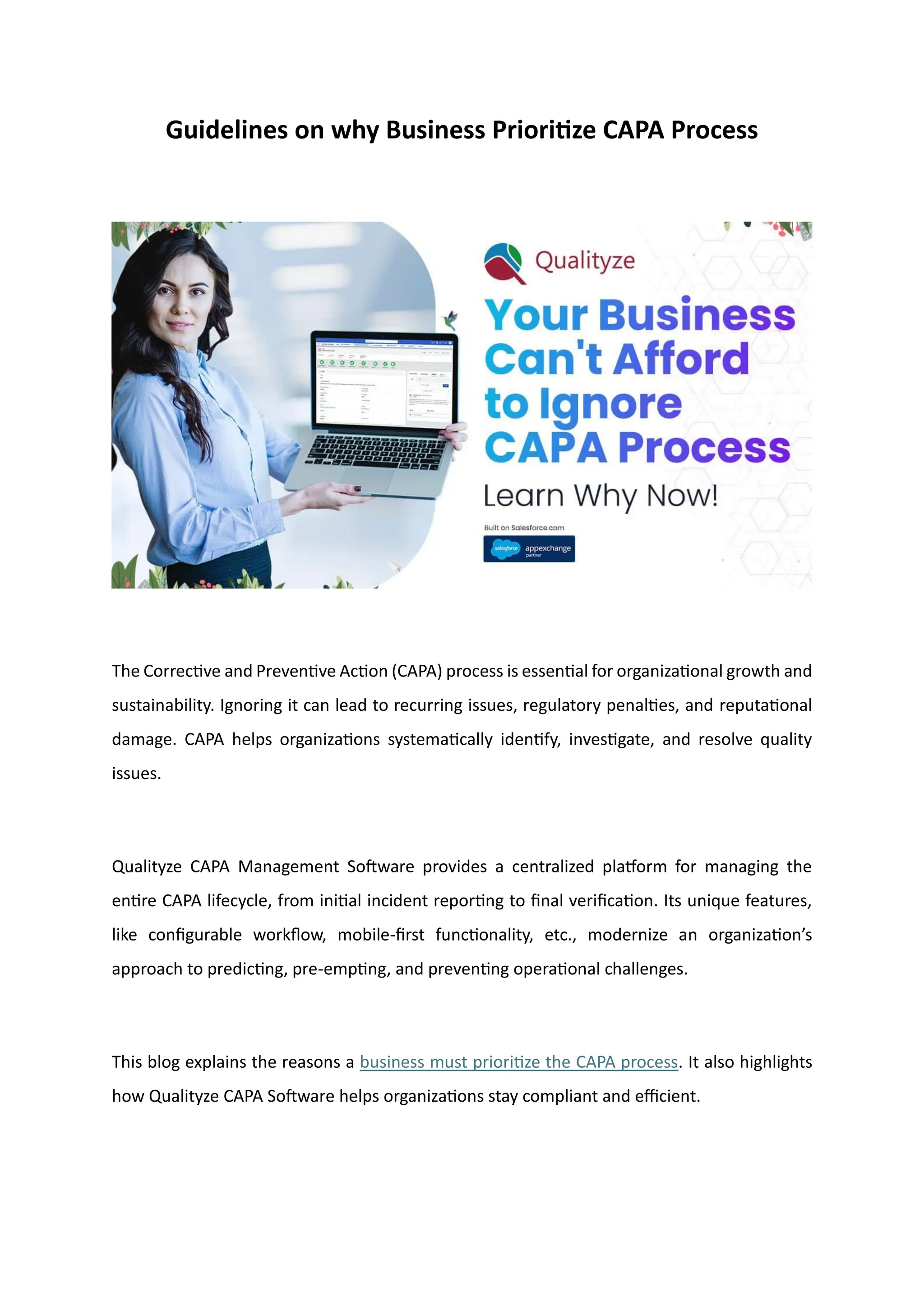
Qualityze CAPA Management Software provides a centralized platform for managing the
entire CAPA lifecycle, from initial incident reporting to final verification. Its unique features,
like configurable workflow, mobile-first functionality, etc., modernize an organization’s
approach to predicting, pre-empting, and preventing operational challenges.
This blog explains the reasons a business must prioritize the CAPA process. It also highlights
how Qualityze CAPA Software helps organizations stay compliant and efficient.
What Is the CAPA Process?
The CAPA process identifies and eliminates non-conformances. It also prevents their
recurrence by addressing root causes. Organizations use CAPA to comply with regulations like
FDA 21 CFR Part 820 and ISO 9001.
A typical CAPA process involves these steps:
1. Identifying issues.
2. Conducting root cause analysis.
3. Implementing corrective actions.
4. Verifying effectiveness.
5. Preventing recurrence.
This structured approach minimizes risks and ensures continuous improvement.
Why is CAPA Important for Your Business?
A well-defined CAPA process offers numerous benefits:
1. Improved Product Quality: By proactively addressing quality issues, you can enhance
product reliability and reduce defects.
2. Increased Customer Satisfaction: High-quality products lead to happier customers and
stronger customer loyalty.
3. Reduced Costs: Preventing problems is more cost-effective than dealing with their
consequences, such as recalls or customer complaints.
4. Regulatory Compliance: Many industries have stringent regulations regarding quality
management. A robust CAPA system helps ensure compliance.
5. Improved Operational Efficiency: Streamlining the CAPA process can save valuable
time and resources for critical tasks.
Consequences of Ignoring CAPA
1. Regulatory Non-Compliance: Regulatory bodies mandate CAPA implementation to ensure
product and service quality. Failing to comply may result in fines, recalls, or production
shutdowns.
2. Increased Operational Costs: Unaddressed issues escalate over time. Recalls, rework and
legal penalties increase costs significantly.
3. Damage to Reputation: Recurring quality issues affect customer trust. Negative feedback
spreads quickly, impacting market position.
4. Decline in Employee Morale: Unresolved issues create frustration. Employees lose
confidence in management’s ability to maintain quality standards.
Ignoring CAPA affects both short-term operations and long-term sustainability.
Why Does Your Business Need CAPA Management Software?
1. Streamlined Workflows: CAPA management software automates manual tasks. It ensures
consistent execution of the CAPA process across all departments.
2. Data Accuracy: Automated data capture reduces errors. Centralized systems store data
securely, ensuring easy access for analysis.
3. Collaboration: Software enables real-time collaboration. Teams work together effectively,
even across locations.
4. Compliance: CAPA software simplifies documentation. It provides audit trails to
demonstrate compliance during inspections.
5. Performance Tracking: Advanced analytics track KPIs like resolution time and recurrence
rates. These insights help improve processes continuously.
Why Choose Qualityze CAPA Management Software?
Qualityze EQMS Software of CAPA Management System stands out for its advanced features
and user-centric design. Built on the Salesforce platform, it ensures scalability and security. It
also integrates seamlessly with other systems, fostering a unified approach.
Unique Features
• AI-Powered Insights: Qualityze uses artificial intelligence to predict trends and identify
recurring issues.
• Risk Assessment: Enables users to assess the risk associated with each quality issue
and prioritize corrective and preventive actions accordingly.
• Document Management: Provides a secure and centralized repository for storing and
managing all CAPA-related documents.
• Customizable Workflows: Organizations can tailor workflows to their specific needs,
ensuring process alignment.
• Reporting and Analytics: Generate customizable reports and dashboards for tracking
key metrics, identifying trends, and demonstrating compliance.
• Mobile Access: The software allows teams to manage CAPA actions on the go,
improving productivity.
• Global Compliance: Qualityze supports multiple regulatory frameworks, making it
ideal for global organizations.
How to Ensure CAPA Success
1. Promote a Positive CAPA Culture: Management should emphasize CAPA’s role in
organizational success. Employees must view CAPA as an improvement tool, not a punitive
measure.
2. Standardize Processes: procedures eliminate confusion. Assign responsibilities and define
timelines to ensure accountability.
3. Invest in Technology: CAPA management software reduces manual effort. Automation
ensures accuracy and speeds up issue resolution.
4. Focus on Root Causes: Effective CAPA addresses underlying problems. Techniques like the
"5 Whys" or Pareto Analysis help identify root causes.
5. Monitor and Refine: Use performance metrics to assess CAPA effectiveness. Regular
reviews help identify improvement opportunities.
Common CAPA Challenges and Solutions
1. Lack of Employee Engagement: The solution to overcome the lack of employee
engagement is to train them on the importance of CAPA. Involve them in process
improvement initiatives.
2. Inconsistent Documentation: Use CAPA software for centralized and standardized
documentation. CAPA modernizes your documentation process, reducing errors associated
with manual documentation.
3. Poor Root Cause Analysis: Root cause analysis is indispensable to the success of any
business. It helps in identifying the challenges and issues, saving your company the cost of
rework and recall. Poor root cause analysis can be overcome by providing tools and training
to your employees for effective root cause identification.
Measuring CAPA Effectiveness
Track these metrics to evaluate CAPA performance:
• Resolution Time: Shorter times indicate efficiency.
• Recurrence Rate: A low rate shows effective root cause analysis.
• Audit Findings: Fewer findings reflect better compliance.
• Employee Participation: High engagement indicates a positive CAPA culture.
Regular assessments ensure continuous improvement and sustained success.
Conclusion
The CAPA process is essential for quality, compliance, and operational efficiency. Ignoring it
exposes businesses to risks and inefficiencies. Qualityze CAPA Management Software
transforms CAPA into a streamlined and proactive process. Its unique features and benefits
set it apart, making it an invaluable tool for modern organizations. Watch this video to get
complete information on Quality CAPA software –
Guidelines on why Business Prioritize CAPA Process.pdf

Guidelines on why Business Prioritize CAPA Process.pdf

  • 1.
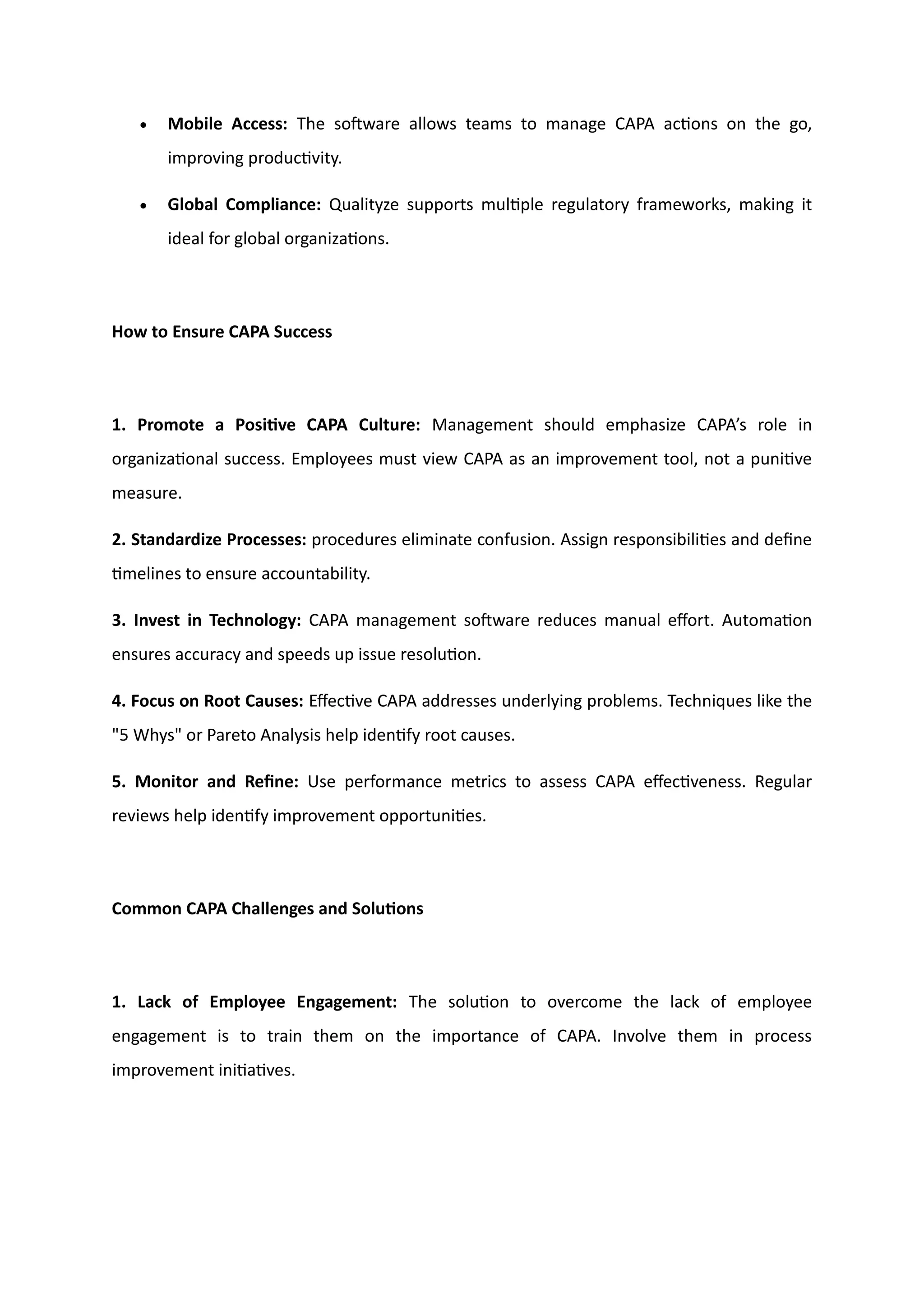
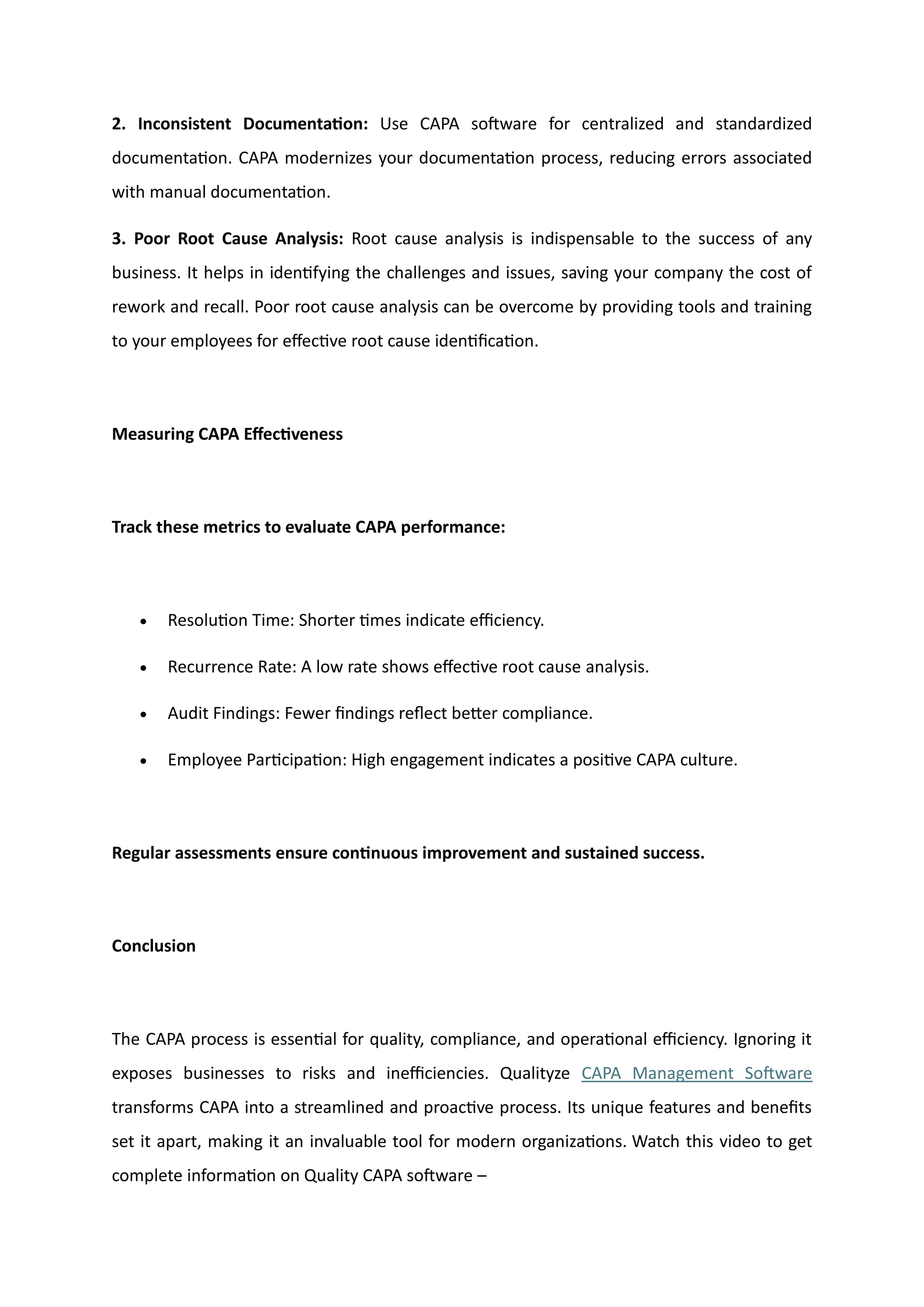
    Guidelines on whyBusiness Prioritize CAPA Process The Corrective and Preventive Action (CAPA) process is essential for organizational growth and sustainability. Ignoring it can lead to recurring issues, regulatory penalties, and reputational damage. CAPA helps organizations systematically identify, investigate, and resolve quality issues. Qualityze CAPA Management Software provides a centralized platform for managing the entire CAPA lifecycle, from initial incident reporting to final verification. Its unique features, like configurable workflow, mobile-first functionality, etc., modernize an organization’s approach to predicting, pre-empting, and preventing operational challenges. This blog explains the reasons a business must prioritize the CAPA process. It also highlights how Qualityze CAPA Software helps organizations stay compliant and efficient.
  • 2.
    What Is theCAPA Process? The CAPA process identifies and eliminates non-conformances. It also prevents their recurrence by addressing root causes. Organizations use CAPA to comply with regulations like FDA 21 CFR Part 820 and ISO 9001. A typical CAPA process involves these steps: 1. Identifying issues. 2. Conducting root cause analysis. 3. Implementing corrective actions. 4. Verifying effectiveness. 5. Preventing recurrence. This structured approach minimizes risks and ensures continuous improvement. Why is CAPA Important for Your Business? A well-defined CAPA process offers numerous benefits: 1. Improved Product Quality: By proactively addressing quality issues, you can enhance product reliability and reduce defects. 2. Increased Customer Satisfaction: High-quality products lead to happier customers and stronger customer loyalty.
  • 3.
    3. Reduced Costs:Preventing problems is more cost-effective than dealing with their consequences, such as recalls or customer complaints. 4. Regulatory Compliance: Many industries have stringent regulations regarding quality management. A robust CAPA system helps ensure compliance. 5. Improved Operational Efficiency: Streamlining the CAPA process can save valuable time and resources for critical tasks. Consequences of Ignoring CAPA 1. Regulatory Non-Compliance: Regulatory bodies mandate CAPA implementation to ensure product and service quality. Failing to comply may result in fines, recalls, or production shutdowns. 2. Increased Operational Costs: Unaddressed issues escalate over time. Recalls, rework and legal penalties increase costs significantly. 3. Damage to Reputation: Recurring quality issues affect customer trust. Negative feedback spreads quickly, impacting market position. 4. Decline in Employee Morale: Unresolved issues create frustration. Employees lose confidence in management’s ability to maintain quality standards. Ignoring CAPA affects both short-term operations and long-term sustainability. Why Does Your Business Need CAPA Management Software? 1. Streamlined Workflows: CAPA management software automates manual tasks. It ensures consistent execution of the CAPA process across all departments. 2. Data Accuracy: Automated data capture reduces errors. Centralized systems store data securely, ensuring easy access for analysis.
  • 4.
    3. Collaboration: Softwareenables real-time collaboration. Teams work together effectively, even across locations. 4. Compliance: CAPA software simplifies documentation. It provides audit trails to demonstrate compliance during inspections. 5. Performance Tracking: Advanced analytics track KPIs like resolution time and recurrence rates. These insights help improve processes continuously. Why Choose Qualityze CAPA Management Software? Qualityze EQMS Software of CAPA Management System stands out for its advanced features and user-centric design. Built on the Salesforce platform, it ensures scalability and security. It also integrates seamlessly with other systems, fostering a unified approach. Unique Features • AI-Powered Insights: Qualityze uses artificial intelligence to predict trends and identify recurring issues. • Risk Assessment: Enables users to assess the risk associated with each quality issue and prioritize corrective and preventive actions accordingly. • Document Management: Provides a secure and centralized repository for storing and managing all CAPA-related documents. • Customizable Workflows: Organizations can tailor workflows to their specific needs, ensuring process alignment. • Reporting and Analytics: Generate customizable reports and dashboards for tracking key metrics, identifying trends, and demonstrating compliance.
  • 5.
    • Mobile Access:The software allows teams to manage CAPA actions on the go, improving productivity. • Global Compliance: Qualityze supports multiple regulatory frameworks, making it ideal for global organizations. How to Ensure CAPA Success 1. Promote a Positive CAPA Culture: Management should emphasize CAPA’s role in organizational success. Employees must view CAPA as an improvement tool, not a punitive measure. 2. Standardize Processes: procedures eliminate confusion. Assign responsibilities and define timelines to ensure accountability. 3. Invest in Technology: CAPA management software reduces manual effort. Automation ensures accuracy and speeds up issue resolution. 4. Focus on Root Causes: Effective CAPA addresses underlying problems. Techniques like the "5 Whys" or Pareto Analysis help identify root causes. 5. Monitor and Refine: Use performance metrics to assess CAPA effectiveness. Regular reviews help identify improvement opportunities. Common CAPA Challenges and Solutions 1. Lack of Employee Engagement: The solution to overcome the lack of employee engagement is to train them on the importance of CAPA. Involve them in process improvement initiatives.
  • 6.
    2. Inconsistent Documentation:Use CAPA software for centralized and standardized documentation. CAPA modernizes your documentation process, reducing errors associated with manual documentation. 3. Poor Root Cause Analysis: Root cause analysis is indispensable to the success of any business. It helps in identifying the challenges and issues, saving your company the cost of rework and recall. Poor root cause analysis can be overcome by providing tools and training to your employees for effective root cause identification. Measuring CAPA Effectiveness Track these metrics to evaluate CAPA performance: • Resolution Time: Shorter times indicate efficiency. • Recurrence Rate: A low rate shows effective root cause analysis. • Audit Findings: Fewer findings reflect better compliance. • Employee Participation: High engagement indicates a positive CAPA culture. Regular assessments ensure continuous improvement and sustained success. Conclusion The CAPA process is essential for quality, compliance, and operational efficiency. Ignoring it exposes businesses to risks and inefficiencies. Qualityze CAPA Management Software transforms CAPA into a streamlined and proactive process. Its unique features and benefits set it apart, making it an invaluable tool for modern organizations. Watch this video to get complete information on Quality CAPA software –