Guidelines for
Managing
Projects 1
By: Nkemdilim Ene
Date: October 28, 2016
- PRINCE2
OBJECTIVES
ď‚–
ď‚– To learn standardized PRINCE2 Project Management
Terminology
ď‚–
ď‚– To understand the main themes and principles of
managing projects using the PRINCE2 model
ď‚–
ď‚– To correlate the themes and principles of PRINCE2
management to the various responsibilities, roles and
activities currently undertaken by Preston
ď‚–
ď‚– To identify gaps in our current project activities when
compared to the PRINCE2 model
OUTLINE
ď‚–
ď‚–
ď‚–
ď‚– Introduction
ď‚– Definition of Terms
§ Project Management Concepts
ď‚– Review of the Project Management Processes
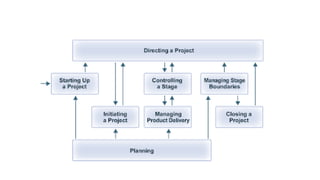
§ Starting up a Project
§ Initiating a Project
§ Directing a Project
§ Controlling a Stage
§ Closing a Project
ď‚–
ď‚–
Introduction
Providing a context
INTRODUCTIO
N
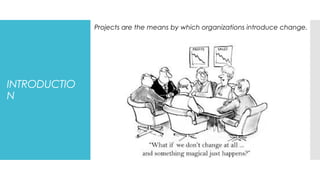
Projects are the means by which organizations introduce change.
INTRODUCTIO
N
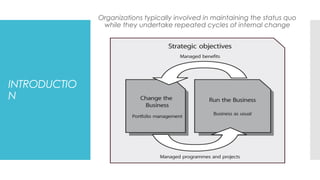
Organizations typically involved in maintaining the status quo
while they undertake repeated cycles of internal change
INTRODUCTION
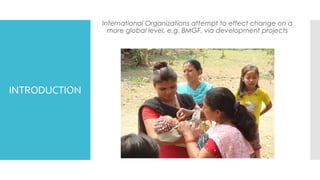
International Organizations attempt to effect change on a
more global level, e.g. BMGF, via development projects
Definition of Terms
Terminology, Themes& Concepts
DEFINITIONS
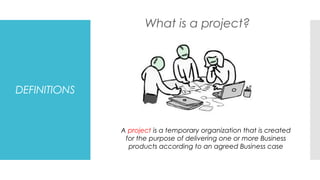
What is a project?
A project is a temporary organization that is created
for the purpose of delivering one or more Business
products according to an agreed Business case
DEFINITIONS
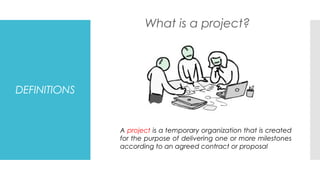
What is a project?
A project is a temporary organization that is created
for the purpose of delivering one or more milestones
according to an agreed contract or proposal
DEFINITIONS
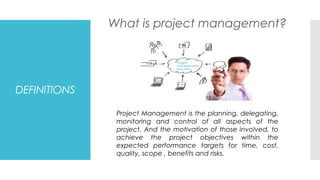
What is project management?
Project Management is the planning, delegating,
monitoring and control of all aspects of the
project. And the motivation of those involved, to
achieve the project objectives within the
expected performance targets for time, cost,
quality, scope , benefits and risks.
DEFINITIONS
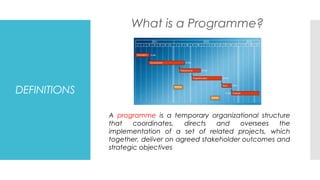
What is a Programme?
A programme is a temporary organizational structure
that coordinates, directs and oversees the
implementation of a set of related projects, which
together, deliver on agreed stakeholder outcomes and
strategic objectives
DEFINITIONS
Why is this change needed now?
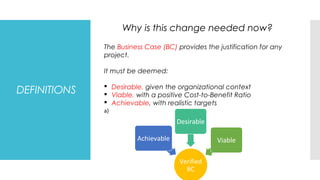
The Business Case (BC) provides the justification for any
project.
It must be deemed:
§ Desirable, given the organizational context
§ Viable, with a positive Cost-to-Benefit Ratio
§ Achievable, with realistic targets
a)
Verified
BC
Achievable
Desirable
Viable
DEFINITIONS
Why is this change needed now?
PRINCE 2 THEMES/DOMAINS
The Business Case (BC) is subject to verification at multiple
stages during the life of the project. At each of these stages
3 business options are considered regarding the project
investment:
§ Do nothing
§ Do the minimum
§ Do something
“Do nothing” should always be the starting option – and
forms the basis for quantifying the benefit to be achieved if
we “do the minimum” or “do something”
DEFINITIONS
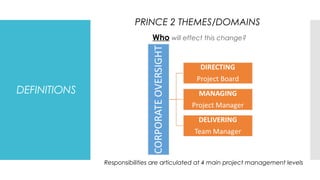
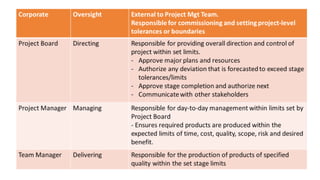
Who will effect this change?
PRINCE 2 THEMES/DOMAINS
The temporary organization that will effect the desired
change consists of individuals with defined roles and
responsibilities for better accountability for outputs and
outcomes.
This unit could be internal or external to the organization
DEFINITIONS
Who will effect this change?
PRINCE 2 THEMES/DOMAINS
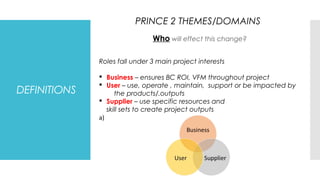
Roles fall under 3 main project interests
§ Business – ensures BC ROI, VFM throughout project
§ User – use, operate , maintain, support or be impacted by
the products/.outputs
§ Supplier – use specific resources and
skill sets to create project outputs
a)
DEFINITIONS
Who will effect this change?
PRINCE 2 THEMES/DOMAINS
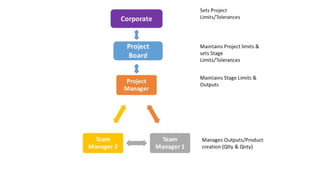
Responsibilities are articulated at 4 main project management levels
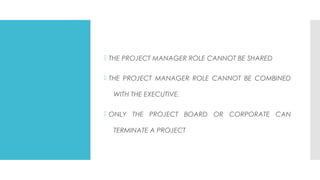
ď‚– THE PROJECT MANAGER ROLE CANNOT BE SHARED
ď‚– THE PROJECT MANAGER ROLE CANNOT BE COMBINED
WITH THE EXECUTIVE.
ď‚– ONLY THE PROJECT BOARD OR CORPORATE CAN
TERMINATE A PROJECT
DEFINITIONS
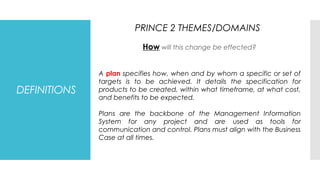
How will this change be effected?
PRINCE 2 THEMES/DOMAINS
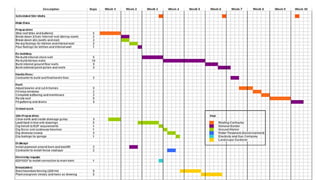
A plan specifies how, when and by whom a specific or set of
targets is to be achieved. It details the specification for
products to be created, within what timeframe, at what cost,
and benefits to be expected.
Plans are the backbone of the Management Information
System for any project and are used as tools for
communication and control. Plans must align with the Business
Case at all times.
DEFINITIONS
How will this change be effected?
PRINCE 2 THEMES/DOMAINS
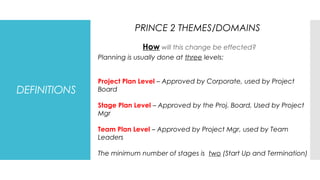
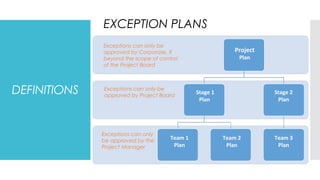
Planning is usually done at three levels:
Project Plan Level – Approved by Corporate, used by Project
Board
Stage Plan Level – Approved by the Proj. Board, Used by Project
Mgr
Team Plan Level – Approved by Project Mgr, used by Team
Leaders
The minimum number of stages is two (Start Up and Termination)
DEFINITIONS
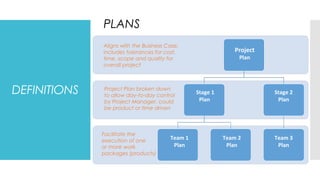
Project
Plan
Stage 1
Plan
Stage 2
Plan
Team 1
Plan
Team 2
Plan
Team 3
Plan
Aligns with the Business Case,
includes tolerances for cost,
time, scope and quality for
overall project
Project Plan broken down
to allow day-to-day control
by Project Manager, could
be product or time driven
Facilitate the
execution of one
or more work
packages (products)
PLANS
DEFINITIONS
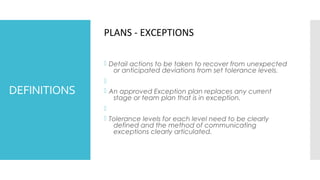
ď‚– Detail actions to be taken to recover from unexpected
or anticipated deviations from set tolerance levels.
ď‚–
ď‚– An approved Exception plan replaces any current
stage or team plan that is in exception.
ď‚–
ď‚– Tolerance levels for each level need to be clearly
defined and the method of communicating
exceptions clearly articulated.
PLANS - EXCEPTIONS
DEFINITIONS
Project
Plan
Stage 1
Plan
Stage 2
Plan
Team 1
Plan
Team 2
Plan
Team 3
Plan
Exceptions can only be
approved by Corporate, if
beyond the scope of control
of the Project Board
Exceptions can only be
approved by Project Board
Exceptions can only
be approved by the
Project Manager
EXCEPTION PLANS
Review of Project
Management
Processes
PROCESSES
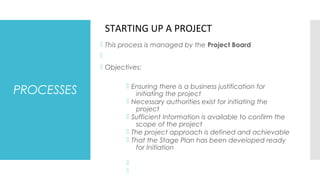
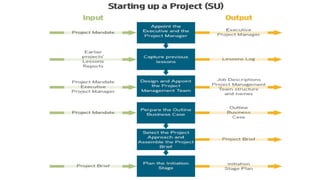
ď‚– This process is managed by the Project Board
ď‚–
ď‚– Objectives:
ď‚– Ensuring there is a business justification for
initiating the project
ď‚– Necessary authorities exist for initiating the
project
ď‚– Sufficient Information is available to confirm the
scope of the project
ď‚– The project approach is defined and achievable
ď‚– That the Stage Plan has been developed ready
for Initiation
ď‚–
ď‚–
STARTING UP A PROJECT
PROCESSES
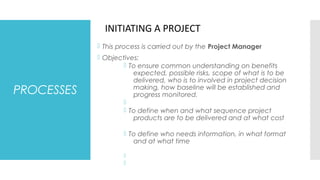
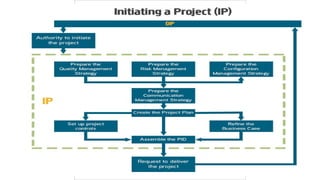
ď‚– This process is carried out by the Project Manager
ď‚– Objectives:
ď‚– To ensure common understanding on benefits
expected, possible risks, scope of what is to be
delivered, who is to involved in project decision
making, how baseline will be established and
progress monitored.
ď‚–
ď‚– To define when and what sequence project
products are to be delivered and at what cost
ď‚– To define who needs information, in what format
and at what time
ď‚–
ď‚–
INITIATING A PROJECT
PROCESSES
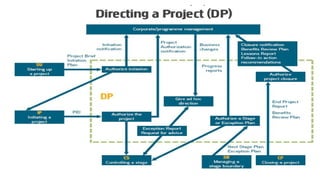
ď‚– This process is carried out by the Project Board.
ď‚– Starts on completion of the Starting up a Project process
and is triggered by the request to initiate a project
ď‚– Objectives:
ď‚– To ensure there is authority to initiate project
 To ensure there is authority to deliver the project’s
products
ď‚– To manage direction and control throughout the
life of the project
ď‚– To interface with Corporate and other
stakeholders
ď‚– To ensure there is authority to close the project
ď‚–
ď‚–
DIRECTING A PROJECT
PROCESSES
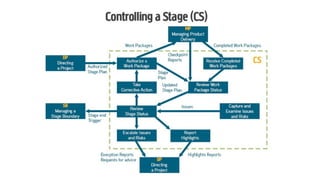
ď‚– This process is carried out by the Project Manager.
ď‚– This involves assigning and monitoring work as well as
proactively handling issues that arise within each stage.
ď‚– Objectives:
ď‚– To deliver agreed stage products within set time
frame, cost limits and in line with quality
standards
 To avoid “scope creep” and loss of focus
ď‚– To keep risks and issues under control
ď‚– To ensure team is focused on delivery within the
tolerances laid don for each stage.
ď‚– To manage transition to next stage by obtaining
authorization from Project Board
CONTROLLING A STAGE
PROCESSES
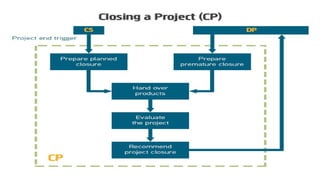
ď‚– This process is carried out by the Project Board.
This process provides a fixed point for accepting project
products and confirming that project targets have been
achieved.
ď‚–
Objectives:
ď‚– To verify user acceptance of products created
ď‚– To review performance of the project against
baseline
ď‚– To assess benefits that have already been
realized and update forecast for remaining
benefits
ď‚– To make provision for resolution of all open risks
and issues
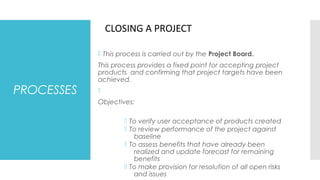
CLOSING A PROJECT
PRESTON
GAPS ď‚– Identify 3 gaps in our current project management
processes when compared to the PRINCE2 model.
ď‚–
ď‚–
TAKE HOME ASSIGNMENT
Guidelines for Managing Projects

Guidelines for Managing Projects

  • 1.
    Guidelines for Managing Projects 1 By:Nkemdilim Ene Date: October 28, 2016 - PRINCE2
  • 2.
    OBJECTIVES ď‚– ď‚– To learnstandardized PRINCE2 Project Management Terminology ď‚– ď‚– To understand the main themes and principles of managing projects using the PRINCE2 model ď‚– ď‚– To correlate the themes and principles of PRINCE2 management to the various responsibilities, roles and activities currently undertaken by Preston ď‚– ď‚– To identify gaps in our current project activities when compared to the PRINCE2 model
  • 3.
    OUTLINE     Introduction  Definitionof Terms § Project Management Concepts  Review of the Project Management Processes § Starting up a Project § Initiating a Project § Directing a Project § Controlling a Stage § Closing a Project  
  • 4.
  • 5.
    INTRODUCTIO N Projects are themeans by which organizations introduce change.
  • 6.
    INTRODUCTIO N Organizations typically involvedin maintaining the status quo while they undertake repeated cycles of internal change
  • 7.
    INTRODUCTION International Organizations attemptto effect change on a more global level, e.g. BMGF, via development projects
  • 8.
  • 9.
    DEFINITIONS What is aproject? A project is a temporary organization that is created for the purpose of delivering one or more Business products according to an agreed Business case
  • 10.
    DEFINITIONS What is aproject? A project is a temporary organization that is created for the purpose of delivering one or more milestones according to an agreed contract or proposal
  • 11.
    DEFINITIONS What is projectmanagement? Project Management is the planning, delegating, monitoring and control of all aspects of the project. And the motivation of those involved, to achieve the project objectives within the expected performance targets for time, cost, quality, scope , benefits and risks.
  • 12.
    DEFINITIONS What is aProgramme? A programme is a temporary organizational structure that coordinates, directs and oversees the implementation of a set of related projects, which together, deliver on agreed stakeholder outcomes and strategic objectives
  • 13.
    DEFINITIONS Why is thischange needed now? The Business Case (BC) provides the justification for any project. It must be deemed: § Desirable, given the organizational context § Viable, with a positive Cost-to-Benefit Ratio § Achievable, with realistic targets a) Verified BC Achievable Desirable Viable
  • 14.
    DEFINITIONS Why is thischange needed now? PRINCE 2 THEMES/DOMAINS The Business Case (BC) is subject to verification at multiple stages during the life of the project. At each of these stages 3 business options are considered regarding the project investment: § Do nothing § Do the minimum § Do something “Do nothing” should always be the starting option – and forms the basis for quantifying the benefit to be achieved if we “do the minimum” or “do something”
  • 15.
    DEFINITIONS Who will effectthis change? PRINCE 2 THEMES/DOMAINS The temporary organization that will effect the desired change consists of individuals with defined roles and responsibilities for better accountability for outputs and outcomes. This unit could be internal or external to the organization
  • 16.
    DEFINITIONS Who will effectthis change? PRINCE 2 THEMES/DOMAINS Roles fall under 3 main project interests § Business – ensures BC ROI, VFM throughout project § User – use, operate , maintain, support or be impacted by the products/.outputs § Supplier – use specific resources and skill sets to create project outputs a)
  • 17.
    DEFINITIONS Who will effectthis change? PRINCE 2 THEMES/DOMAINS Responsibilities are articulated at 4 main project management levels
  • 20.
    ď‚– THE PROJECTMANAGER ROLE CANNOT BE SHARED ď‚– THE PROJECT MANAGER ROLE CANNOT BE COMBINED WITH THE EXECUTIVE. ď‚– ONLY THE PROJECT BOARD OR CORPORATE CAN TERMINATE A PROJECT
  • 21.
    DEFINITIONS How will thischange be effected? PRINCE 2 THEMES/DOMAINS A plan specifies how, when and by whom a specific or set of targets is to be achieved. It details the specification for products to be created, within what timeframe, at what cost, and benefits to be expected. Plans are the backbone of the Management Information System for any project and are used as tools for communication and control. Plans must align with the Business Case at all times.
  • 23.
    DEFINITIONS How will thischange be effected? PRINCE 2 THEMES/DOMAINS Planning is usually done at three levels: Project Plan Level – Approved by Corporate, used by Project Board Stage Plan Level – Approved by the Proj. Board, Used by Project Mgr Team Plan Level – Approved by Project Mgr, used by Team Leaders The minimum number of stages is two (Start Up and Termination)
  • 24.
    DEFINITIONS Project Plan Stage 1 Plan Stage 2 Plan Team1 Plan Team 2 Plan Team 3 Plan Aligns with the Business Case, includes tolerances for cost, time, scope and quality for overall project Project Plan broken down to allow day-to-day control by Project Manager, could be product or time driven Facilitate the execution of one or more work packages (products) PLANS
  • 25.
    DEFINITIONS ď‚– Detail actionsto be taken to recover from unexpected or anticipated deviations from set tolerance levels. ď‚– ď‚– An approved Exception plan replaces any current stage or team plan that is in exception. ď‚– ď‚– Tolerance levels for each level need to be clearly defined and the method of communicating exceptions clearly articulated. PLANS - EXCEPTIONS
  • 26.
    DEFINITIONS Project Plan Stage 1 Plan Stage 2 Plan Team1 Plan Team 2 Plan Team 3 Plan Exceptions can only be approved by Corporate, if beyond the scope of control of the Project Board Exceptions can only be approved by Project Board Exceptions can only be approved by the Project Manager EXCEPTION PLANS
  • 27.
  • 29.
    PROCESSES ď‚– This processis managed by the Project Board ď‚– ď‚– Objectives: ď‚– Ensuring there is a business justification for initiating the project ď‚– Necessary authorities exist for initiating the project ď‚– Sufficient Information is available to confirm the scope of the project ď‚– The project approach is defined and achievable ď‚– That the Stage Plan has been developed ready for Initiation ď‚– ď‚– STARTING UP A PROJECT
  • 31.
    PROCESSES ď‚– This processis carried out by the Project Manager ď‚– Objectives: ď‚– To ensure common understanding on benefits expected, possible risks, scope of what is to be delivered, who is to involved in project decision making, how baseline will be established and progress monitored. ď‚– ď‚– To define when and what sequence project products are to be delivered and at what cost ď‚– To define who needs information, in what format and at what time ď‚– ď‚– INITIATING A PROJECT
  • 33.
    PROCESSES  This processis carried out by the Project Board.  Starts on completion of the Starting up a Project process and is triggered by the request to initiate a project  Objectives:  To ensure there is authority to initiate project  To ensure there is authority to deliver the project’s products  To manage direction and control throughout the life of the project  To interface with Corporate and other stakeholders  To ensure there is authority to close the project   DIRECTING A PROJECT
  • 35.
    PROCESSES  This processis carried out by the Project Manager.  This involves assigning and monitoring work as well as proactively handling issues that arise within each stage.  Objectives:  To deliver agreed stage products within set time frame, cost limits and in line with quality standards  To avoid “scope creep” and loss of focus  To keep risks and issues under control  To ensure team is focused on delivery within the tolerances laid don for each stage.  To manage transition to next stage by obtaining authorization from Project Board CONTROLLING A STAGE
  • 37.
    PROCESSES ď‚– This processis carried out by the Project Board. This process provides a fixed point for accepting project products and confirming that project targets have been achieved. ď‚– Objectives: ď‚– To verify user acceptance of products created ď‚– To review performance of the project against baseline ď‚– To assess benefits that have already been realized and update forecast for remaining benefits ď‚– To make provision for resolution of all open risks and issues CLOSING A PROJECT
  • 39.
    PRESTON GAPS ď‚– Identify3 gaps in our current project management processes when compared to the PRINCE2 model. ď‚– ď‚– TAKE HOME ASSIGNMENT