
3
Is the planning, delegating, monitoring and control of all aspects of the
project.
Aim, to achieve the project objectives within the expected
performance targets for:
 Time
 Cost
 Quality
 Scope
 Benefits and
 Risk
4
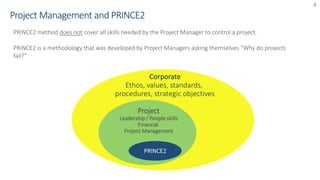
PRINCE2 method does not cover all skills needed by the Project Manager to control a project.
PRINCE2 is a methodology that was developed by Project Managers asking themselves “Why do projects
fail?”
Project
Leadership / People skills
Financial
Project Management
5
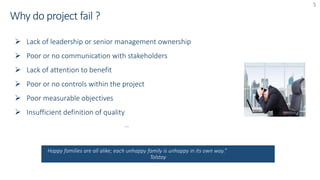
“Happy families are all alike; each unhappy family is unhappy in its own way.”
6
Standing for PRojects IN Controlled Environments, PRINCE2 is the world’s most adopted
project management framework, with over one million practitioners.
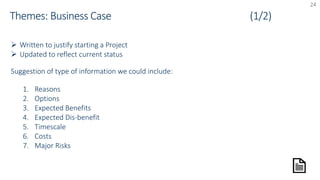
It provides invaluable guidance that gives individuals and organizations alike the essentials of
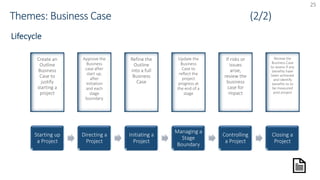
running a project.
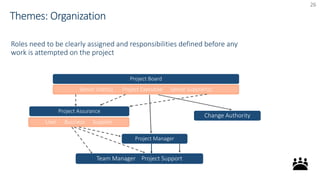
Best of all, PRINCE2 is easy to learn and flexible enough to adapt to all types of project.
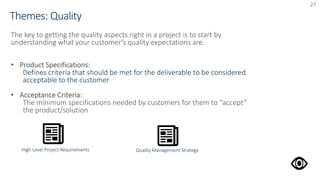
AXELOS is a joint venture set up in 2014 by
the Government of the United Kingdom and Capita, to
develop, manage and operate qualifications in best
practice, in methodologies formerly owned by the Office of
Government Commerce
7
• The PRINCE2 Definition of a project:
A temporary organization that is created for the purpose of delivering one or more business
products according to an agreed Business Case
• Key benefits of PRINCE2:
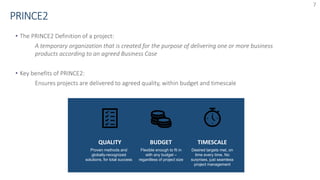
Ensures projects are delivered to agreed quality, within budget and timescale
BUDGET
Desired targets met, on
time every time. No
surprises, just seamless
project management
TIMESCALEQUALITY
Proven methods and
globally-recognized
solutions, for total success
Flexible enough to fit in
with any budget –
regardless of project size
8
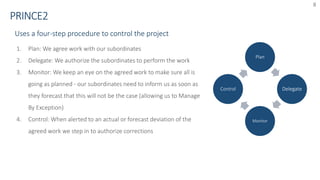
1. Plan: We agree work with our subordinates
2. Delegate: We authorize the subordinates to perform the work
3. Monitor: We keep an eye on the agreed work to make sure all is
going as planned - our subordinates need to inform us as soon as
they forecast that this will not be the case (allowing us to Manage
By Exception)
4. Control: When alerted to an actual or forecast deviation of the
agreed work we step in to authorize corrections
Plan
Delegate
Monitor
Control
9
10
Each and every project you work on has a lot riding on it. Deadlines have to be met,
solutions have to be found. That’s where PRINCE2 comes in.
In the fast-moving world of 21st century business, Governments and Business both
benefit from the true global best practice standards delivered through PRINCE2.
So here’s the question: can you afford not to benefit from all that PRINCE2 offers you?
11
Benefits:
 Product focused
 Process based
 Recognized best practice
 Tailorable, scalable and flexible
 Widely used in public and private sector
 There is not license fee
12
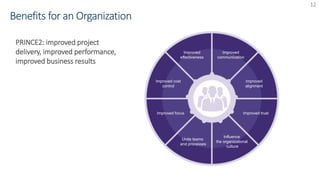
PRINCE2: improved project
delivery, improved performance,
improved business results
Improved
communication
Improved
effectiveness
Improved cost
control
Improved focus
Unite teams
and processes
Influence
the organizational
culture
Improved trust
Improved
alignment
13
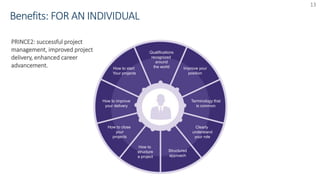
Qualifications
recognized
around
the worldHow to start
Your projects
How to improve
your delivery
How to close
your
projects
How to
structure
a project
Structured
approach
Clearly
understand
your role
Terminology that
is common
Improve your
position
PRINCE2: successful project
management, improved project
delivery, enhanced career
advancement.
15
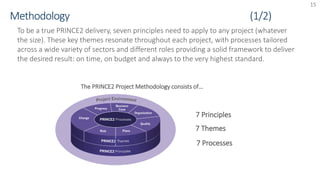
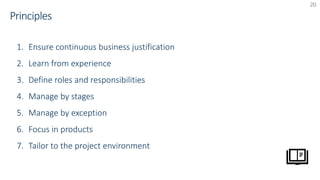
7 Themes
7 Principles
7 Processes
The PRINCE2 Project Methodology consists of…
To be a true PRINCE2 delivery, seven principles need to apply to any project (whatever
the size). These key themes resonate throughout each project, with processes tailored
across a wide variety of sectors and different roles providing a solid framework to deliver
the desired result: on time, on budget and always to the very highest standard.
16
17
18
19
20
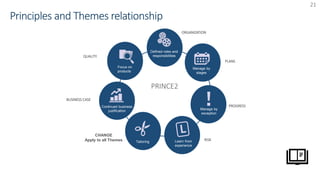
21
PRINCE2
Focus on
products
Manage by
stages
Manage by
exception
Learn from
experience
Tailoring
Continued business
justification
Defined roles and
responsibilities
BUSINESS CASE
RISK
ORGANIZATION
PLANS
PROGRESS
QUALITY
CHANGE
Apply to all Themes
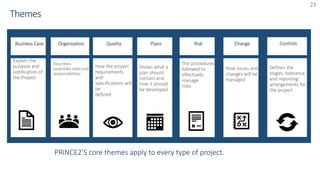
23
Business Case
Explain the
purpose and
justification of
the Project
Organization
Describes
essentials roles and
responsibilities
Quality
How the project
requirements
and
specifications will
be
defined
Plans
Shows what a
plan should
contain and
how it should
be developed
Risk
The procedures
followed to
effectively
manage
risks
Change
How issues and
changes will be
managed
Controls
Defines the
stages, tolerance,
and reporting
arrangements for
the project
24
25
Starting up
a Project
Directing a
Project
Initiating a
Project
Managing a
Stage
Boundary
Controlling
a Project
Closing a
Project
Create an
Outline
Business
Case to
justify
starting a
project
Approve the
Business
case after
start up,
after
initiation
and each
stage
boundary
Refine the
Outline
into a full
Business
Case
Update the
Business
Case to
reflect the
project
progress at
the end of a
stage
If risks or
issues
arise,
review the
business
case for
impact
Review the
Business Case
to assess if any
benefits have
been achieved
and identify
benefits to to
be measured
post project
26
27
The key to getting the quality aspects right in a project is to start by
understanding what your customer's quality expectations are.
28
29
30
31
32
Despite the best planning, our customers sometimes want to add in something
extra or change something.
33
34
36
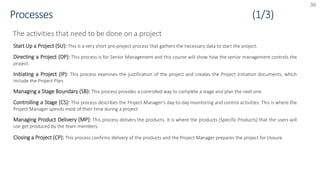
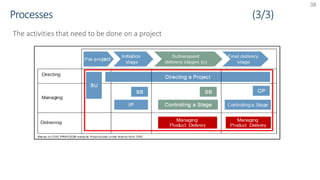
Start Up a Project (SU): This is a very short pre-project process that gathers the necessary data to start the project.
Directing a Project (DP): This process is for Senior Management and this course will show how the senior management controls the
project.
Initiating a Project (IP): This process examines the justification of the project and creates the Project Initiation documents, which
include the Project Plan.
Managing a Stage Boundary (SB): This process provides a controlled way to complete a stage and plan the next one.
Controlling a Stage (CS): This process describes the Project Manager’s day-to-day monitoring and control activities. This is where the
Project Manager spends most of their time during a project.
Managing Product Delivery (MP): This process delivers the products. It is where the products (Specific Products) that the users will
use get produced by the team members.
Closing a Project (CP): This process confirms delivery of the products and the Project Manager prepares the project for closure.
37
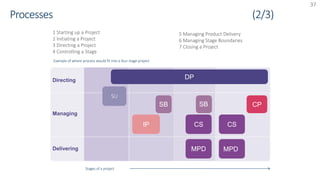
SU
DP
IP CS
SB
MPD MPD
CP
1 Starting up a Project
2 Initiating a Project
3 Directing a Project
4 Controlling a Stage
5 Managing Product Delivery
6 Managing Stage Boundaries
7 Closing a Project
Directing
Managing
Delivering
CS
SB
Stages of a project
Example of where process would fit into a four stage project
38
PRINCE2 Basic Concepts

PRINCE2 Basic Concepts

  • 3.
    3 Is the planning,delegating, monitoring and control of all aspects of the project. Aim, to achieve the project objectives within the expected performance targets for:  Time  Cost  Quality  Scope  Benefits and  Risk
  • 4.
    4 PRINCE2 method doesnot cover all skills needed by the Project Manager to control a project. PRINCE2 is a methodology that was developed by Project Managers asking themselves “Why do projects fail?” Project Leadership / People skills Financial Project Management
  • 5.
    5 “Happy families areall alike; each unhappy family is unhappy in its own way.”
  • 6.
    6 Standing for PRojectsIN Controlled Environments, PRINCE2 is the world’s most adopted project management framework, with over one million practitioners. It provides invaluable guidance that gives individuals and organizations alike the essentials of running a project. Best of all, PRINCE2 is easy to learn and flexible enough to adapt to all types of project. AXELOS is a joint venture set up in 2014 by the Government of the United Kingdom and Capita, to develop, manage and operate qualifications in best practice, in methodologies formerly owned by the Office of Government Commerce
  • 7.
    7 • The PRINCE2Definition of a project: A temporary organization that is created for the purpose of delivering one or more business products according to an agreed Business Case • Key benefits of PRINCE2: Ensures projects are delivered to agreed quality, within budget and timescale BUDGET Desired targets met, on time every time. No surprises, just seamless project management TIMESCALEQUALITY Proven methods and globally-recognized solutions, for total success Flexible enough to fit in with any budget – regardless of project size
  • 8.
    8 1. Plan: Weagree work with our subordinates 2. Delegate: We authorize the subordinates to perform the work 3. Monitor: We keep an eye on the agreed work to make sure all is going as planned - our subordinates need to inform us as soon as they forecast that this will not be the case (allowing us to Manage By Exception) 4. Control: When alerted to an actual or forecast deviation of the agreed work we step in to authorize corrections Plan Delegate Monitor Control
  • 9.
  • 10.
    10 Each and everyproject you work on has a lot riding on it. Deadlines have to be met, solutions have to be found. That’s where PRINCE2 comes in. In the fast-moving world of 21st century business, Governments and Business both benefit from the true global best practice standards delivered through PRINCE2. So here’s the question: can you afford not to benefit from all that PRINCE2 offers you?
  • 11.
    11 Benefits:  Product focused Process based  Recognized best practice  Tailorable, scalable and flexible  Widely used in public and private sector  There is not license fee
  • 12.
    12 PRINCE2: improved project delivery,improved performance, improved business results Improved communication Improved effectiveness Improved cost control Improved focus Unite teams and processes Influence the organizational culture Improved trust Improved alignment
  • 13.
    13 Qualifications recognized around the worldHow tostart Your projects How to improve your delivery How to close your projects How to structure a project Structured approach Clearly understand your role Terminology that is common Improve your position PRINCE2: successful project management, improved project delivery, enhanced career advancement.
  • 15.
    15 7 Themes 7 Principles 7Processes The PRINCE2 Project Methodology consists of… To be a true PRINCE2 delivery, seven principles need to apply to any project (whatever the size). These key themes resonate throughout each project, with processes tailored across a wide variety of sectors and different roles providing a solid framework to deliver the desired result: on time, on budget and always to the very highest standard.
  • 16.
  • 17.
  • 18.
  • 19.
  • 20.
  • 21.
    21 PRINCE2 Focus on products Manage by stages Manageby exception Learn from experience Tailoring Continued business justification Defined roles and responsibilities BUSINESS CASE RISK ORGANIZATION PLANS PROGRESS QUALITY CHANGE Apply to all Themes
  • 23.
    23 Business Case Explain the purposeand justification of the Project Organization Describes essentials roles and responsibilities Quality How the project requirements and specifications will be defined Plans Shows what a plan should contain and how it should be developed Risk The procedures followed to effectively manage risks Change How issues and changes will be managed Controls Defines the stages, tolerance, and reporting arrangements for the project
  • 24.
  • 25.
    25 Starting up a Project Directinga Project Initiating a Project Managing a Stage Boundary Controlling a Project Closing a Project Create an Outline Business Case to justify starting a project Approve the Business case after start up, after initiation and each stage boundary Refine the Outline into a full Business Case Update the Business Case to reflect the project progress at the end of a stage If risks or issues arise, review the business case for impact Review the Business Case to assess if any benefits have been achieved and identify benefits to to be measured post project
  • 26.
  • 27.
    27 The key togetting the quality aspects right in a project is to start by understanding what your customer's quality expectations are.
  • 28.
  • 29.
  • 30.
  • 31.
  • 32.
    32 Despite the bestplanning, our customers sometimes want to add in something extra or change something.
  • 33.
  • 34.
  • 36.
    36 Start Up aProject (SU): This is a very short pre-project process that gathers the necessary data to start the project. Directing a Project (DP): This process is for Senior Management and this course will show how the senior management controls the project. Initiating a Project (IP): This process examines the justification of the project and creates the Project Initiation documents, which include the Project Plan. Managing a Stage Boundary (SB): This process provides a controlled way to complete a stage and plan the next one. Controlling a Stage (CS): This process describes the Project Manager’s day-to-day monitoring and control activities. This is where the Project Manager spends most of their time during a project. Managing Product Delivery (MP): This process delivers the products. It is where the products (Specific Products) that the users will use get produced by the team members. Closing a Project (CP): This process confirms delivery of the products and the Project Manager prepares the project for closure.
  • 37.
    37 SU DP IP CS SB MPD MPD CP 1Starting up a Project 2 Initiating a Project 3 Directing a Project 4 Controlling a Stage 5 Managing Product Delivery 6 Managing Stage Boundaries 7 Closing a Project Directing Managing Delivering CS SB Stages of a project Example of where process would fit into a four stage project
  • 38.