Conflict with or Complement to PMBOK
Russ Meermans, PMP, PRINCE2 Practitioner
January 27, 2014
© 2014
Russ Meermans © 2014 1
Agenda
• What is PMBOK Guide / What is PRINCE2 ®
• Characteristics of PRINCE2 ®
• Quick Comparison, PMBOK® – PRINCE2 ®
Russ Meermans © 2014 2
What is PMBOK® Guide ?
 PMBOK® Guide identifies that subset of the project management
body of knowledge generally recognized as good practices
 PMBOK® Guide provides and promotes a common vocabulary
within the project management profession for discussing, writing,
and applying project management concepts
 PMBOK® Guide establishes guidelines for project management
processes, tools, and techniques
Russ Meermans © 2014 3
What Is PRINCE2® ?
 Projects in a Controlled Environment (PRINCE)
 PRINCE2® is a book that describes a method for approaching
managing and closing down a project of any type or size
 PRINCE2® tells what should be done and why it should be done
but does not say how it should be done
 PRINCE2® is not prescriptive, rather it is descriptive
 PRINCE2® is a structured management method
®U.K.’s Office of Government Commerce (OGC)
Russ Meermans © 2014 4
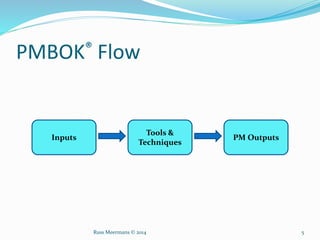
PMBOK® Flow
Inputs
Tools &
Techniques
PM Outputs
Russ Meermans © 2014 5
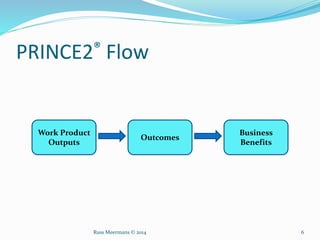
PRINCE2® Flow
Work Product
Outputs
Outcomes
Business
Benefits
Russ Meermans © 2014 6
Five Main Aspects to PRINCE2®
 In order to successfully complete any significant job of
work there are five main aspects that need to be
considered, namely:
• The method to be used, in other words how will you approach
the job
• How will the work be organized
• What are the main factors that need to be taken into account
• Who will have responsibility for what
• And how will progress be monitored and communicated
Russ Meermans © 2014 7
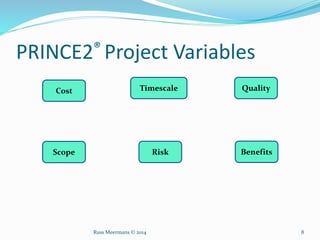
PRINCE2® Project Variables
Cost Timescale Quality
Scope Risk Benefits
Russ Meermans © 2014 8
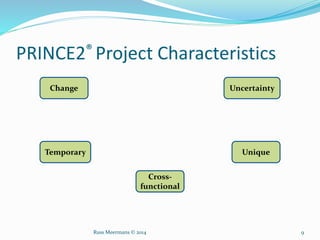
PRINCE2® Project Characteristics
Change
Temporary
Cross-
functional
Unique
Uncertainty
Russ Meermans © 2014 9
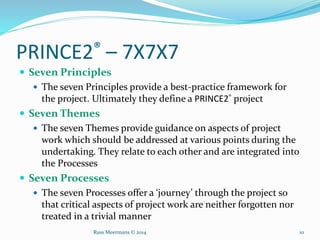
PRINCE2® – 7X7X7
 Seven Principles
 The seven Principles provide a best-practice framework for
the project. Ultimately they define a PRINCE2® project
 Seven Themes
 The seven Themes provide guidance on aspects of project
work which should be addressed at various points during the
undertaking. They relate to each other and are integrated into
the Processes
 Seven Processes
 The seven Processes offer a ‘journey’ through the project so
that critical aspects of project work are neither forgotten nor
treated in a trivial manner
Russ Meermans © 2014 10
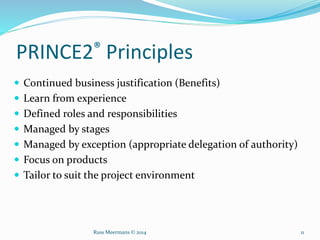
PRINCE2® Principles
 Continued business justification (Benefits)
 Learn from experience
 Defined roles and responsibilities
 Managed by stages
 Managed by exception (appropriate delegation of authority)
 Focus on products
 Tailor to suit the project environment
Russ Meermans © 2014 11
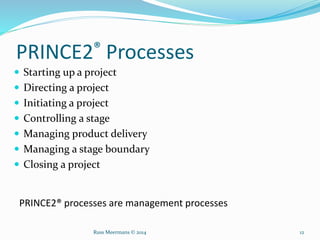
PRINCE2® Processes
 Starting up a project
 Directing a project
 Initiating a project
 Controlling a stage
 Managing product delivery
 Managing a stage boundary
 Closing a project
PRINCE2® processes are management processes
Russ Meermans © 2014 12
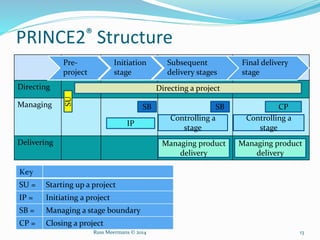
PRINCE2® Structure
Directing
Managing
Delivering
Pre-
project
Initiation
stage
Subsequent
delivery stages
Final delivery
stage
Key
SU = Starting up a project
IP = Initiating a project
SB = Managing a stage boundary
CP = Closing a project
SU
Directing a project
SB
SB
Controlling a
stage
Controlling a
stage
IP
CP
Managing product
delivery
Managing product
delivery
Russ Meermans © 2014 13
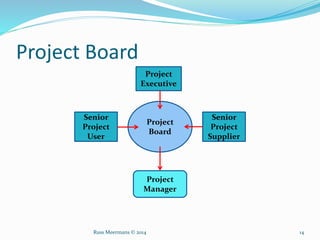
Project Board
Project
Board
Senior
Project
User
Senior
Project
Supplier
Project
Executive
Project
Manager
Russ Meermans © 2014 14
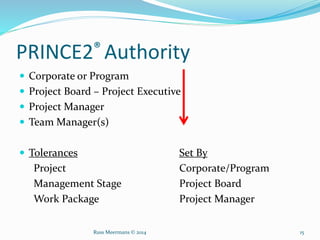
PRINCE2® Authority
 Corporate or Program
 Project Board – Project Executive
 Project Manager
 Team Manager(s)
 Tolerances Set By
Project Corporate/Program
Management Stage Project Board
Work Package Project Manager
Russ Meermans © 2014 15
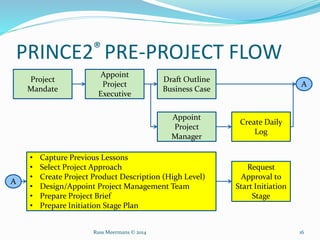
PRINCE2® PRE-PROJECT FLOW
Appoint
Project
Executive
Draft Outline
Business Case
Appoint
Project
Manager
Project
Mandate
• Capture Previous Lessons
• Select Project Approach
• Create Project Product Description (High Level)
• Design/Appoint Project Management Team
• Prepare Project Brief
• Prepare Initiation Stage Plan
Create Daily
Log
Request
Approval to
Start Initiation
Stage
A
A
Russ Meermans © 2014 16
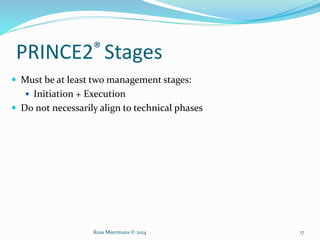
PRINCE2® Stages
 Must be at least two management stages:
 Initiation + Execution
 Do not necessarily align to technical phases
Russ Meermans © 2014 17
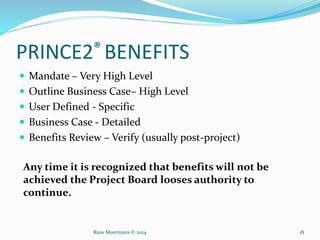
PRINCE2® BENEFITS
 Mandate – Very High Level
 Outline Business Case– High Level
 User Defined - Specific
 Business Case - Detailed
 Benefits Review – Verify (usually post-project)
Any time it is recognized that benefits will not be
achieved the Project Board looses authority to
continue.
Russ Meermans © 2014 18
PRINCE2® Themes
 Business Case
 Organization
 Quality
 Plan
 Risk
 Change
 Progress
Russ Meermans © 2014 19
PRINCE2® Themes
 Business Case
 Organization
 Quality
 Plan
 Risk
 Change
 Progress
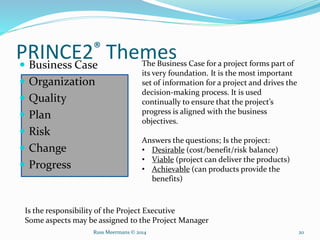
The Business Case for a project forms part of
its very foundation. It is the most important
set of information for a project and drives the
decision-making process. It is used
continually to ensure that the project’s
progress is aligned with the business
objectives.
Answers the questions; Is the project:
• Desirable (cost/benefit/risk balance)
• Viable (project can deliver the products)
• Achievable (can products provide the
benefits)
Is the responsibility of the Project Executive
Some aspects may be assigned to the Project Manager
Russ Meermans © 2014 20
PRINCE2® Themes
 Business Case
 Organization
 Quality
 Plan
 Risk
 Change
 Progress
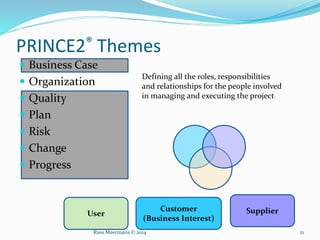
Defining all the roles, responsibilities
and relationships for the people involved
in managing and executing the project.
User
Customer
(Business Interest)
Supplier
Russ Meermans © 2014 21
PRINCE2® Themes
 Business Case
 Organization
 Quality
 Plan
 Risk
 Change
 Progress
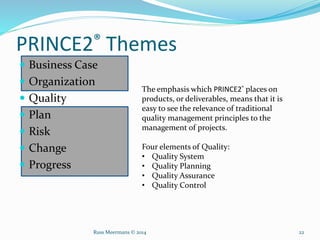
The emphasis which PRINCE2® places on
products, or deliverables, means that it is
easy to see the relevance of traditional
quality management principles to the
management of projects.
Four elements of Quality:
• Quality System
• Quality Planning
• Quality Assurance
• Quality Control
Russ Meermans © 2014 22
PRINCE2® Themes
Quality
 Responsibility of the Project Board
 Three views: Executive – User – Supplier
 Project Manager has NO Quality Execution Responsibilities
 (except for the Quality Plan)
Russ Meermans © 2014 23
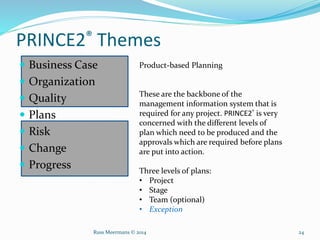
PRINCE2® Themes
 Business Case
 Organization
 Quality
 Plans
 Risk
 Change
 Progress
Product-based Planning
These are the backbone of the
management information system that is
required for any project. PRINCE2® is very
concerned with the different levels of
plan which need to be produced and the
approvals which are required before plans
are put into action.
Three levels of plans:
• Project
• Stage
• Team (optional)
• Exception
Russ Meermans © 2014 24
PRINCE2® Themes
 Business Case
 Organization
 Quality
 Plan
 Risk
 Change
 Progress
Since risk is such a fundamental
consideration within the Business Case,
PRINCE2® identifies Risk as a Theme in its
own right to assess and take relevant
action in respect of uncertainties.
Russ Meermans © 2014 25
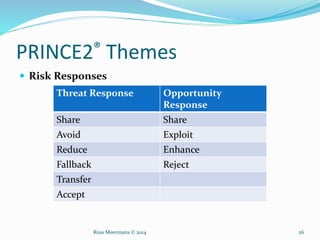
PRINCE2® Themes
 Risk Responses
Threat Response Opportunity
Response
Share Share
Avoid Exploit
Reduce Enhance
Fallback Reject
Transfer
Accept
Russ Meermans © 2014 26
PRINCE2® Themes
 Business Case
 Organization
 Quality
 Plan
 Risk
 Change
 Progress
Change in projects is inevitable so
PRINCE2® defines procedures for
managing changes as they occur or
become necessary. This can be a
particularly crucial element in a project
since the rest of the project or other
projects or perhaps a program can be
affected by changes made within a
project. This Theme also provides for
Configuration Management which may
be thought of as asset control.
A common approach to Issue
and Change Control
• Request for change
• Off-specification (non-conformance)
• Problem/concern (issue)
Russ Meermans © 2014 27
PRINCE2® Themes
 Business Case
 Organization
 Quality
 Plan
 Risk
 Change
 Progress
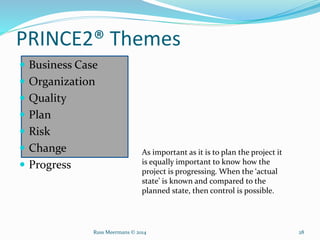
As important as it is to plan the project it
is equally important to know how the
project is progressing. When the ‘actual
state’ is known and compared to the
planned state, then control is possible.
Russ Meermans © 2014 28
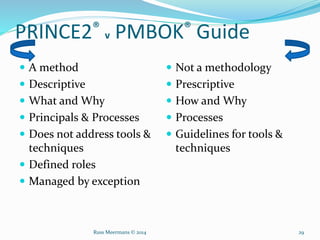
PRINCE2® v PMBOK® Guide
 A method
 Descriptive
 What and Why
 Principals & Processes
 Does not address tools &
techniques
 Defined roles
 Managed by exception
 Not a methodology
 Prescriptive
 How and Why
 Processes
 Guidelines for tools &
techniques
Russ Meermans © 2014 29
PRINCE2® v PMBOK® Guide
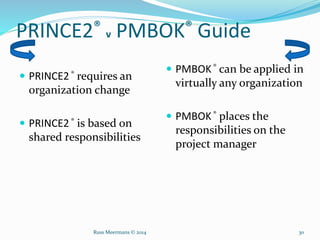
 PRINCE2 ® requires an
organization change
 PRINCE2 ® is based on
shared responsibilities
 PMBOK ® can be applied in
virtually any organization
 PMBOK ® places the
responsibilities on the
project manager
Russ Meermans © 2014 30
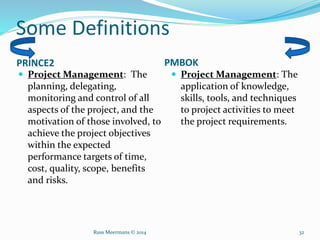
Some Definitions
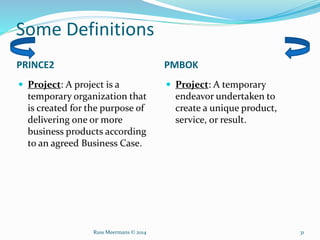
PRINCE2 PMBOK
 Project: A project is a
temporary organization that
is created for the purpose of
delivering one or more
business products according
to an agreed Business Case.
 Project: A temporary
endeavor undertaken to
create a unique product,
service, or result.
Russ Meermans © 2014 31
Some Definitions
PRINCE2 PMBOK
 Project Management: The
planning, delegating,
monitoring and control of all
aspects of the project, and the
motivation of those involved, to
achieve the project objectives
within the expected
performance targets of time,
cost, quality, scope, benefits
and risks.
 Project Management: The
application of knowledge,
skills, tools, and techniques
to project activities to meet
the project requirements.
Russ Meermans © 2014 32
Conflict or Complementary
 Bottom Line –
PRINCE2 and PMBOK Edition 5 are Complementary
Russ Meermans © 2014 33

presentacion Prince 2.pptx

  • 1.
    Conflict with orComplement to PMBOK Russ Meermans, PMP, PRINCE2 Practitioner January 27, 2014 © 2014 Russ Meermans © 2014 1
  • 2.
    Agenda • What isPMBOK Guide / What is PRINCE2 ® • Characteristics of PRINCE2 ® • Quick Comparison, PMBOK® – PRINCE2 ® Russ Meermans © 2014 2
  • 3.
    What is PMBOK®Guide ?  PMBOK® Guide identifies that subset of the project management body of knowledge generally recognized as good practices  PMBOK® Guide provides and promotes a common vocabulary within the project management profession for discussing, writing, and applying project management concepts  PMBOK® Guide establishes guidelines for project management processes, tools, and techniques Russ Meermans © 2014 3
  • 4.
    What Is PRINCE2®?  Projects in a Controlled Environment (PRINCE)  PRINCE2® is a book that describes a method for approaching managing and closing down a project of any type or size  PRINCE2® tells what should be done and why it should be done but does not say how it should be done  PRINCE2® is not prescriptive, rather it is descriptive  PRINCE2® is a structured management method ®U.K.’s Office of Government Commerce (OGC) Russ Meermans © 2014 4
  • 5.
    PMBOK® Flow Inputs Tools & Techniques PMOutputs Russ Meermans © 2014 5
  • 6.
  • 7.
    Five Main Aspectsto PRINCE2®  In order to successfully complete any significant job of work there are five main aspects that need to be considered, namely: • The method to be used, in other words how will you approach the job • How will the work be organized • What are the main factors that need to be taken into account • Who will have responsibility for what • And how will progress be monitored and communicated Russ Meermans © 2014 7
  • 8.
    PRINCE2® Project Variables CostTimescale Quality Scope Risk Benefits Russ Meermans © 2014 8
  • 9.
  • 10.
    PRINCE2® – 7X7X7 Seven Principles  The seven Principles provide a best-practice framework for the project. Ultimately they define a PRINCE2® project  Seven Themes  The seven Themes provide guidance on aspects of project work which should be addressed at various points during the undertaking. They relate to each other and are integrated into the Processes  Seven Processes  The seven Processes offer a ‘journey’ through the project so that critical aspects of project work are neither forgotten nor treated in a trivial manner Russ Meermans © 2014 10
  • 11.
    PRINCE2® Principles  Continuedbusiness justification (Benefits)  Learn from experience  Defined roles and responsibilities  Managed by stages  Managed by exception (appropriate delegation of authority)  Focus on products  Tailor to suit the project environment Russ Meermans © 2014 11
  • 12.
    PRINCE2® Processes  Startingup a project  Directing a project  Initiating a project  Controlling a stage  Managing product delivery  Managing a stage boundary  Closing a project PRINCE2® processes are management processes Russ Meermans © 2014 12
  • 13.
    PRINCE2® Structure Directing Managing Delivering Pre- project Initiation stage Subsequent delivery stages Finaldelivery stage Key SU = Starting up a project IP = Initiating a project SB = Managing a stage boundary CP = Closing a project SU Directing a project SB SB Controlling a stage Controlling a stage IP CP Managing product delivery Managing product delivery Russ Meermans © 2014 13
  • 14.
  • 15.
    PRINCE2® Authority  Corporateor Program  Project Board – Project Executive  Project Manager  Team Manager(s)  Tolerances Set By Project Corporate/Program Management Stage Project Board Work Package Project Manager Russ Meermans © 2014 15
  • 16.
    PRINCE2® PRE-PROJECT FLOW Appoint Project Executive DraftOutline Business Case Appoint Project Manager Project Mandate • Capture Previous Lessons • Select Project Approach • Create Project Product Description (High Level) • Design/Appoint Project Management Team • Prepare Project Brief • Prepare Initiation Stage Plan Create Daily Log Request Approval to Start Initiation Stage A A Russ Meermans © 2014 16
  • 17.
    PRINCE2® Stages  Mustbe at least two management stages:  Initiation + Execution  Do not necessarily align to technical phases Russ Meermans © 2014 17
  • 18.
    PRINCE2® BENEFITS  Mandate– Very High Level  Outline Business Case– High Level  User Defined - Specific  Business Case - Detailed  Benefits Review – Verify (usually post-project) Any time it is recognized that benefits will not be achieved the Project Board looses authority to continue. Russ Meermans © 2014 18
  • 19.
    PRINCE2® Themes  BusinessCase  Organization  Quality  Plan  Risk  Change  Progress Russ Meermans © 2014 19
  • 20.
    PRINCE2® Themes  BusinessCase  Organization  Quality  Plan  Risk  Change  Progress The Business Case for a project forms part of its very foundation. It is the most important set of information for a project and drives the decision-making process. It is used continually to ensure that the project’s progress is aligned with the business objectives. Answers the questions; Is the project: • Desirable (cost/benefit/risk balance) • Viable (project can deliver the products) • Achievable (can products provide the benefits) Is the responsibility of the Project Executive Some aspects may be assigned to the Project Manager Russ Meermans © 2014 20
  • 21.
    PRINCE2® Themes  BusinessCase  Organization  Quality  Plan  Risk  Change  Progress Defining all the roles, responsibilities and relationships for the people involved in managing and executing the project. User Customer (Business Interest) Supplier Russ Meermans © 2014 21
  • 22.
    PRINCE2® Themes  BusinessCase  Organization  Quality  Plan  Risk  Change  Progress The emphasis which PRINCE2® places on products, or deliverables, means that it is easy to see the relevance of traditional quality management principles to the management of projects. Four elements of Quality: • Quality System • Quality Planning • Quality Assurance • Quality Control Russ Meermans © 2014 22
  • 23.
    PRINCE2® Themes Quality  Responsibilityof the Project Board  Three views: Executive – User – Supplier  Project Manager has NO Quality Execution Responsibilities  (except for the Quality Plan) Russ Meermans © 2014 23
  • 24.
    PRINCE2® Themes  BusinessCase  Organization  Quality  Plans  Risk  Change  Progress Product-based Planning These are the backbone of the management information system that is required for any project. PRINCE2® is very concerned with the different levels of plan which need to be produced and the approvals which are required before plans are put into action. Three levels of plans: • Project • Stage • Team (optional) • Exception Russ Meermans © 2014 24
  • 25.
    PRINCE2® Themes  BusinessCase  Organization  Quality  Plan  Risk  Change  Progress Since risk is such a fundamental consideration within the Business Case, PRINCE2® identifies Risk as a Theme in its own right to assess and take relevant action in respect of uncertainties. Russ Meermans © 2014 25
  • 26.
    PRINCE2® Themes  RiskResponses Threat Response Opportunity Response Share Share Avoid Exploit Reduce Enhance Fallback Reject Transfer Accept Russ Meermans © 2014 26
  • 27.
    PRINCE2® Themes  BusinessCase  Organization  Quality  Plan  Risk  Change  Progress Change in projects is inevitable so PRINCE2® defines procedures for managing changes as they occur or become necessary. This can be a particularly crucial element in a project since the rest of the project or other projects or perhaps a program can be affected by changes made within a project. This Theme also provides for Configuration Management which may be thought of as asset control. A common approach to Issue and Change Control • Request for change • Off-specification (non-conformance) • Problem/concern (issue) Russ Meermans © 2014 27
  • 28.
    PRINCE2® Themes  BusinessCase  Organization  Quality  Plan  Risk  Change  Progress As important as it is to plan the project it is equally important to know how the project is progressing. When the ‘actual state’ is known and compared to the planned state, then control is possible. Russ Meermans © 2014 28
  • 29.
    PRINCE2® v PMBOK®Guide  A method  Descriptive  What and Why  Principals & Processes  Does not address tools & techniques  Defined roles  Managed by exception  Not a methodology  Prescriptive  How and Why  Processes  Guidelines for tools & techniques Russ Meermans © 2014 29
  • 30.
    PRINCE2® v PMBOK®Guide  PRINCE2 ® requires an organization change  PRINCE2 ® is based on shared responsibilities  PMBOK ® can be applied in virtually any organization  PMBOK ® places the responsibilities on the project manager Russ Meermans © 2014 30
  • 31.
    Some Definitions PRINCE2 PMBOK Project: A project is a temporary organization that is created for the purpose of delivering one or more business products according to an agreed Business Case.  Project: A temporary endeavor undertaken to create a unique product, service, or result. Russ Meermans © 2014 31
  • 32.
    Some Definitions PRINCE2 PMBOK Project Management: The planning, delegating, monitoring and control of all aspects of the project, and the motivation of those involved, to achieve the project objectives within the expected performance targets of time, cost, quality, scope, benefits and risks.  Project Management: The application of knowledge, skills, tools, and techniques to project activities to meet the project requirements. Russ Meermans © 2014 32
  • 33.
    Conflict or Complementary Bottom Line – PRINCE2 and PMBOK Edition 5 are Complementary Russ Meermans © 2014 33