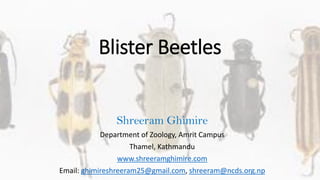
Blister Beetles
Shreeram Ghimire
Department of Zoology, Amrit Campus
Thamel, Kathmandu
www.shreeramghimire.com
Email: ghimireshreeram25@gmail.com, shreeram@ncds.org.np
Introduction
• Blister beetles are important member of order Coleoptera and specifically
are termed as family Meloidae. These beetles are stated as blister due to
secretion of a chemically blistering agent ‘Cantharidin’. That secretion is
defensive in nature.
• It is estimated that blister beetles have more than 2500 species in
approximately 120 genera.
• These beetles are phytophagous. They feed on plant leaves and flowers of
alfalfa, soya bean, other beans, potatoes and other horticultural plants.
• These animals are mostly diurnal but very few are nocturnal too.
• Adults live in organized groups and are colorful.
• All blister beetle larvae are specialized predators. Larvae of most of the
species enter the nests of wild bees and feed on immature bees and
reserved provisions. Sometimes, larvae also consume eggs of grasshoppers
General Anatomy
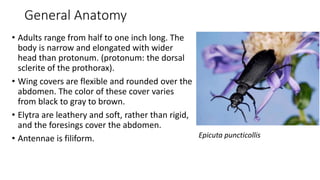
• Adults range from half to one inch long. The
body is narrow and elongated with wider
head than protonum. (protonum: the dorsal
sclerite of the prothorax).
• Wing covers are flexible and rounded over the
abdomen. The color of these cover varies
from black to gray to brown.
• Elytra are leathery and soft, rather than rigid,
and the foresings cover the abdomen.
• Antennae is filiform. Epicuta puncticollis
Blister Beetles as Pest
• Blister beetles are recorded as pest to various crops like alfalfa,
potatoes, beans, sugar beets and other leafy plants. These beetles
damage leaves and flowers.
• Blister beetles also affect livestock digestive system when they are
ingested. These beetles are regarded as toxic even potentially lethal
due to production of cantharidin by the insects. Various scholars
mentioned the impacts on horse, sheep and cattle. Animals may be
poisoned by eating crushed beetles in cured hay. Cantharidin affects
digestive and urinary tract.
• Chemistry of Cantharidin: from chemical safety point of view, it is
acute toxic and irritant. It is a monoterpenoid with an epoxy-bridged
cyclic dicarboxylic anhydride structure. It is declared as poison in large
doses.
Biology
• Female beetles lay clusters of eggs in the soil in late summer. The
small, active larvae that hatch from these eggs crawl over the soil
surface entering cracks in search for grasshopper eggs deposited in
the soil.
• After finding grasshopper eggs or bee egg, blister beetle larvae
becomes immobile and spends the rest of their developmental time
as legless grubs.
• The unique feature of this beetle is triungulin larva. The first instar
larva develops to legless grub and is parasitic in nature.
• The larvae pupate and emerges as adults.
• The species become active during summer season.
Ecology
• Larva of this beetle feeds on eggs of grasshopper and bees. Blister
beetles larva are thus parasitoid in nature. So, it is recorded that
higher the number of grasshopper in particular habitat means higher
the chance of bristle beetles to flourish. So, these beetles help to
control the grasshopper, useful for some crops in some instance.
• Cantharidin is used in both defense as well as mean of chemical
communication among blister beetles.
• Blister beetles are phytophagous and are pest to wide range of crop
species like tomato, onion, tobacco, citrus, spinach and other crops.
• Blister beetles develop Mullerian mimicry with other coleopteran
families creating better natural fitness due to advanced aposematism.
Nepal
• Based on search in google scholar and other online platforms, no
specific research related to blister beetles have been recorded yet in
the case of Nepal.
• Few Indian scholars have tried to coin the terminology due to pest
significance rather than on ecological significance.
• Nepal, due to its wide range of ecosystem, may harbor good diversity
of these beetles.
• Based on my baseline survey, I have collected 4 species: Mylabris
pustulata, Mylabris guerini, Epicuta puncticollis and Mylabris
variabilis.
• There is a ongoing survey of Blister beetles in Kathmandu valley and
surrounding districts led by presenter of these slides. The finding will
be shared soon.
Scientific Leader of Blister Beetle Research
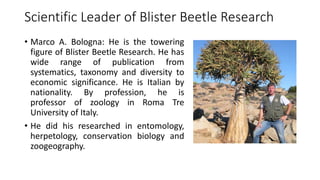
• Marco A. Bologna: He is the towering
figure of Blister Beetle Research. He has
wide range of publication from
systematics, taxonomy and diversity to
economic significance. He is Italian by
nationality. By profession, he is
professor of zoology in Roma Tre
University of Italy.
• He did his researched in entomology,
herpetology, conservation biology and
zoogeography.
References
• Carrel, J. E., McCairel, M. H., Slagle, A. J., Doom, J. P., Brill, J., and
McCormick, J. P. 1993. Cantharidin production in a blister
beetle. Experientia, 49(2): 171-174.
• Bologna, M. A., and Pinto, J. D. 2001. Phylogenetic studies of
Meloidae (Coleoptera), with emphasis on the evolution of
phoresy. Systematic Entomology, 26(1): 33-72.
• Ghoneim,K. 2013. Agronomic and biodiversity impacts of the blister
beetles (Coleoptera: Meloidae) in the world: A review. Int. J. Agri. Sci.
Res., 2:21-36
• Nikbakhtzadeh, M. R., and Tirgari, S. 2002. Blister beetles (Coleoptera:
Meloidae) in Nahavand county (Hamedan province, Iran) and their
ecological relationship to other coleopteran families. Iranian Journal
of Public Health, 55-62.

Blister beetles

  • 1.
    Blister Beetles Shreeram Ghimire Departmentof Zoology, Amrit Campus Thamel, Kathmandu www.shreeramghimire.com Email: ghimireshreeram25@gmail.com, shreeram@ncds.org.np
  • 2.
    Introduction • Blister beetlesare important member of order Coleoptera and specifically are termed as family Meloidae. These beetles are stated as blister due to secretion of a chemically blistering agent ‘Cantharidin’. That secretion is defensive in nature. • It is estimated that blister beetles have more than 2500 species in approximately 120 genera. • These beetles are phytophagous. They feed on plant leaves and flowers of alfalfa, soya bean, other beans, potatoes and other horticultural plants. • These animals are mostly diurnal but very few are nocturnal too. • Adults live in organized groups and are colorful. • All blister beetle larvae are specialized predators. Larvae of most of the species enter the nests of wild bees and feed on immature bees and reserved provisions. Sometimes, larvae also consume eggs of grasshoppers
  • 3.
    General Anatomy • Adultsrange from half to one inch long. The body is narrow and elongated with wider head than protonum. (protonum: the dorsal sclerite of the prothorax). • Wing covers are flexible and rounded over the abdomen. The color of these cover varies from black to gray to brown. • Elytra are leathery and soft, rather than rigid, and the foresings cover the abdomen. • Antennae is filiform. Epicuta puncticollis
  • 4.
    Blister Beetles asPest • Blister beetles are recorded as pest to various crops like alfalfa, potatoes, beans, sugar beets and other leafy plants. These beetles damage leaves and flowers. • Blister beetles also affect livestock digestive system when they are ingested. These beetles are regarded as toxic even potentially lethal due to production of cantharidin by the insects. Various scholars mentioned the impacts on horse, sheep and cattle. Animals may be poisoned by eating crushed beetles in cured hay. Cantharidin affects digestive and urinary tract. • Chemistry of Cantharidin: from chemical safety point of view, it is acute toxic and irritant. It is a monoterpenoid with an epoxy-bridged cyclic dicarboxylic anhydride structure. It is declared as poison in large doses.
  • 5.
    Biology • Female beetleslay clusters of eggs in the soil in late summer. The small, active larvae that hatch from these eggs crawl over the soil surface entering cracks in search for grasshopper eggs deposited in the soil. • After finding grasshopper eggs or bee egg, blister beetle larvae becomes immobile and spends the rest of their developmental time as legless grubs. • The unique feature of this beetle is triungulin larva. The first instar larva develops to legless grub and is parasitic in nature. • The larvae pupate and emerges as adults. • The species become active during summer season.
  • 6.
    Ecology • Larva ofthis beetle feeds on eggs of grasshopper and bees. Blister beetles larva are thus parasitoid in nature. So, it is recorded that higher the number of grasshopper in particular habitat means higher the chance of bristle beetles to flourish. So, these beetles help to control the grasshopper, useful for some crops in some instance. • Cantharidin is used in both defense as well as mean of chemical communication among blister beetles. • Blister beetles are phytophagous and are pest to wide range of crop species like tomato, onion, tobacco, citrus, spinach and other crops. • Blister beetles develop Mullerian mimicry with other coleopteran families creating better natural fitness due to advanced aposematism.
  • 7.
    Nepal • Based onsearch in google scholar and other online platforms, no specific research related to blister beetles have been recorded yet in the case of Nepal. • Few Indian scholars have tried to coin the terminology due to pest significance rather than on ecological significance. • Nepal, due to its wide range of ecosystem, may harbor good diversity of these beetles. • Based on my baseline survey, I have collected 4 species: Mylabris pustulata, Mylabris guerini, Epicuta puncticollis and Mylabris variabilis. • There is a ongoing survey of Blister beetles in Kathmandu valley and surrounding districts led by presenter of these slides. The finding will be shared soon.
  • 8.
    Scientific Leader ofBlister Beetle Research • Marco A. Bologna: He is the towering figure of Blister Beetle Research. He has wide range of publication from systematics, taxonomy and diversity to economic significance. He is Italian by nationality. By profession, he is professor of zoology in Roma Tre University of Italy. • He did his researched in entomology, herpetology, conservation biology and zoogeography.
  • 9.
    References • Carrel, J.E., McCairel, M. H., Slagle, A. J., Doom, J. P., Brill, J., and McCormick, J. P. 1993. Cantharidin production in a blister beetle. Experientia, 49(2): 171-174. • Bologna, M. A., and Pinto, J. D. 2001. Phylogenetic studies of Meloidae (Coleoptera), with emphasis on the evolution of phoresy. Systematic Entomology, 26(1): 33-72. • Ghoneim,K. 2013. Agronomic and biodiversity impacts of the blister beetles (Coleoptera: Meloidae) in the world: A review. Int. J. Agri. Sci. Res., 2:21-36 • Nikbakhtzadeh, M. R., and Tirgari, S. 2002. Blister beetles (Coleoptera: Meloidae) in Nahavand county (Hamedan province, Iran) and their ecological relationship to other coleopteran families. Iranian Journal of Public Health, 55-62.