
Step-by-Step Guide for NGOs on
“How to write Proposals”
A proposal is an essential marketing document that helps cultivate an initial
professional relationship between an NGO and a donor agency over a project to be
implemented.
The proposal outlines the plan of the implementing organization about the project,
giving extensive information about the intention, for implementing it, the ways to
manage it and the results to be delivered from it.
Difference between a Proposal and a Concept Note
A proposal is an essential marketing document that helps cultivate an initial
professional relationship between an NGO and a donor agency over a project to
be implemented.
The proposal outlines the plan of the implementing organization about the
project, giving extensive information about the intention, for implementing it, the
ways to manage it and the results to be delivered from it.
Proposals have recently
become more sophisticated.
This reflects the increased
competitiveness and larger
resources existing in the
NGO sector. The trend of
inviting proposals for
contracting development
programs began with the
allotment of substantial
resources for development
that triggered off the
mushrooming of NGOs
around the world.
Enormous opportunities existing in the
sector have led to the trend of making
proposal writing a profession. Proposal
writing poses many challenges, especially
for small and unskilled NGOs. Here, we
discuss some basic and necessary
information required for developing a
Proposal.
Proposals are important:
• Because without a
proposal, there is no
understanding of
whatever
• A donor believes more
in a written document
• Helps planning activities
and making budgets
• Reflects the
competitiveness of
several NGOs seeking
limited resources
Problems in Writing Proposals
Before we start learning about proposal
writing, it will serve our purpose if we
outline the exact difficulties we face
working on the proposal. The following are
the common problems we face while
trying to write a proposal
There are as many proposal formats as
there are a number of donors and each
donor as a different format. Although the
basic information requested by various
donors is generally the same, yet we often
encounter snags that make the entire
process confusing.
Fear of Proposal Rejections?
No matter how much of an expert we are
in writing proposals, the underlying fear
of proposal rejection hovers over us while
writing it.
Planning problems?
Although a good idea exists,
yet when we try to plan it
out extensively, we face
many unexpected challenges.
Tight deadlines?
This is perhaps the most
universal problem for all
proposal writers. For some
reason or the other, we are
expected to complete
working proposals under
very tight deadlines.
Solicited and Unsolicited Proposal?
Solicited and unsolicited proposals are quite confusing. Many NGOs
work hard and submit proposals to donors, but soon they get a letter
saying that they had never asked them to send.
Before we start writing a
proposal, it is important for
us to do some research. No
matter how small or big
the project is some kind of
references to existing
literature or data should be
made.
Before Writing a
Proposal
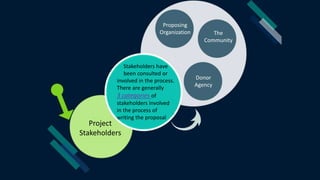
Project
Stakeholders
Stakeholders have
been consulted or
involved in the process.
There are generally
3 categories of
stakeholders involved
in the process of
writing the proposal
Proposing
Organization
Donor
Agency
The
Community
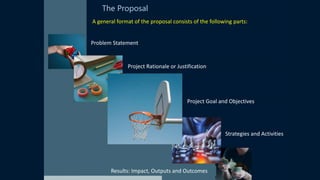
The Proposal
A general format of the proposal consists of the following parts:
Problem Statement
Project Rationale or Justification
Project Goal and Objectives
Strategies and Activities
Results: Impact, Outputs and Outcomes
To Read full Steps, please visit the following link:
https://www2.fundsforngos.org/?p=27172

Guide for NGOs on “How to write Proposals”

  • 1.
    Step-by-Step Guide forNGOs on “How to write Proposals”
  • 2.
    A proposal isan essential marketing document that helps cultivate an initial professional relationship between an NGO and a donor agency over a project to be implemented. The proposal outlines the plan of the implementing organization about the project, giving extensive information about the intention, for implementing it, the ways to manage it and the results to be delivered from it. Difference between a Proposal and a Concept Note A proposal is an essential marketing document that helps cultivate an initial professional relationship between an NGO and a donor agency over a project to be implemented. The proposal outlines the plan of the implementing organization about the project, giving extensive information about the intention, for implementing it, the ways to manage it and the results to be delivered from it.
  • 3.
    Proposals have recently becomemore sophisticated. This reflects the increased competitiveness and larger resources existing in the NGO sector. The trend of inviting proposals for contracting development programs began with the allotment of substantial resources for development that triggered off the mushrooming of NGOs around the world. Enormous opportunities existing in the sector have led to the trend of making proposal writing a profession. Proposal writing poses many challenges, especially for small and unskilled NGOs. Here, we discuss some basic and necessary information required for developing a Proposal.
  • 4.
    Proposals are important: •Because without a proposal, there is no understanding of whatever • A donor believes more in a written document • Helps planning activities and making budgets • Reflects the competitiveness of several NGOs seeking limited resources Problems in Writing Proposals Before we start learning about proposal writing, it will serve our purpose if we outline the exact difficulties we face working on the proposal. The following are the common problems we face while trying to write a proposal
  • 5.
    There are asmany proposal formats as there are a number of donors and each donor as a different format. Although the basic information requested by various donors is generally the same, yet we often encounter snags that make the entire process confusing. Fear of Proposal Rejections? No matter how much of an expert we are in writing proposals, the underlying fear of proposal rejection hovers over us while writing it. Planning problems? Although a good idea exists, yet when we try to plan it out extensively, we face many unexpected challenges. Tight deadlines? This is perhaps the most universal problem for all proposal writers. For some reason or the other, we are expected to complete working proposals under very tight deadlines.
  • 6.
    Solicited and UnsolicitedProposal? Solicited and unsolicited proposals are quite confusing. Many NGOs work hard and submit proposals to donors, but soon they get a letter saying that they had never asked them to send. Before we start writing a proposal, it is important for us to do some research. No matter how small or big the project is some kind of references to existing literature or data should be made. Before Writing a Proposal
  • 7.
    Project Stakeholders Stakeholders have been consultedor involved in the process. There are generally 3 categories of stakeholders involved in the process of writing the proposal Proposing Organization Donor Agency The Community
  • 8.
    The Proposal A generalformat of the proposal consists of the following parts: Problem Statement Project Rationale or Justification Project Goal and Objectives Strategies and Activities Results: Impact, Outputs and Outcomes
  • 9.
    To Read fullSteps, please visit the following link: https://www2.fundsforngos.org/?p=27172