Guest Lecture by 
MA Laura Vanessa Muñoz 
Communications and Project Manager 
Mexico City and London
I. PR in different parts of the world: USA, UK 
and Mexico 
II. Stakeholder mapping 
III. PR Best practices before contacting 
journalists 
IV. Pitching 
V. Following up
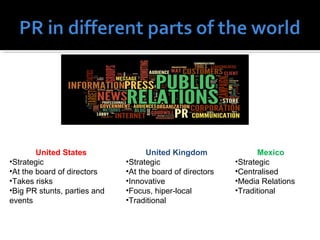
United States 
•Strategic 
•At the board of directors 
•Takes risks 
•Big PR stunts, parties and 
events 
United Kingdom 
•Strategic 
•At the board of directors 
•Innovative 
•Focus, hiper-local 
•Traditional 
Mexico 
•Strategic 
•Centralised 
•Media Relations 
•Traditional
 It should be one of the first stages of strategic 
management, the communication with 
stakeholders helps to develop the stable, long-term 
relationships that an organisation needs to 
build support and to manage conflict when issues 
and problems arise. 
 The goal of the analysis is to measure which 
stakeholder or group of stakeholders has the 
greatest potential to affect the company and 
therefore decide which stakeholders will need 
particular attention.
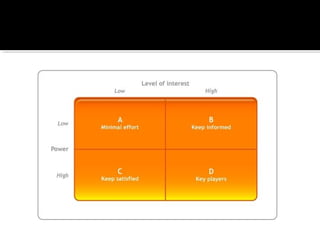
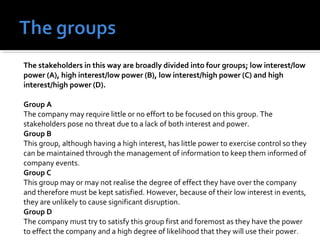
The stakeholders in this way are broadly divided into four groups; low interest/low 
power (A), high interest/low power (B), low interest/high power (C) and high 
interest/high power (D). 
Group A 
The company may require little or no effort to be focused on this group. The 
stakeholders pose no threat due to a lack of both interest and power. 
Group B 
This group, although having a high interest, has little power to exercise control so they 
can be maintained through the management of information to keep them informed of 
company events. 
Group C 
This group may or may not realise the degree of effect they have over the company 
and therefore must be kept satisfied. However, because of their low interest in events, 
they are unlikely to cause significant disruption. 
Group D 
The company must try to satisfy this group first and foremost as they have the power 
to effect the company and a high degree of likelihood that they will use their power.
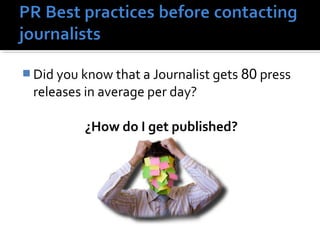
Did you know that a Journalist gets 80 press 
releases in average per day? 
¿How do I get published?
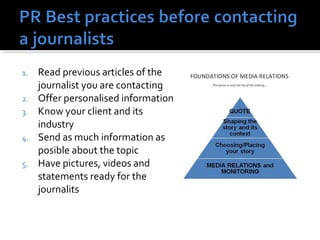
1. Read previous articles of the 
journalist you are contacting 
2. Offer personalised information 
3. Know your client and its 
industry 
4. Send as much information as 
posible about the topic 
5. Have pictures, videos and 
statements ready for the 
journalits
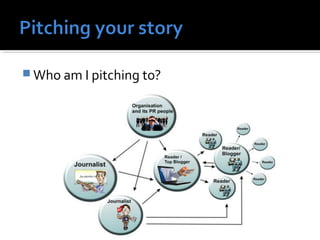
Who am I pitching to?
“Pitching” the story 
A news reporter gets at least 20 calls a day 
from people trying to get him interested 
How do you make your story stand out? 
Get Ready
You only have30 seconds to: 
 Introduce yourself 
 Give him/her information 
 Know if he/she is interested
Prepare your “pitch” (write notes to help you) 
 Let him/her know who you are and why you are 
calling 
 Ask him if he/she is busy or you can call him back 
 Demonstrate that you know his/her style and 
that you read his/her work 
 Explain the central idea in no more than 4 
sentences 
 Explain why the readers would be interested 
 Ask him if he/she is interested in the info
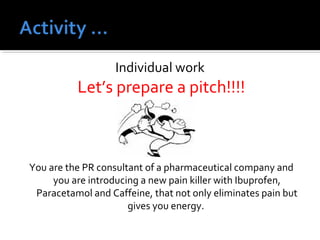
Individual work 
Let’s prepare a pitch!!!! 
You are the PR consultant of a pharmaceutical company and 
you are introducing a new pain killer with Ibuprofen, 
Paracetamol and Caffeine, that not only eliminates pain but 
gives you energy.
Follow up the call and send him/her more 
information… 
Be helpful for the reporter and provide: 
 Pictures 
 Statistics 
 Contact information 
 A deeper interview with your client
MA Laura Vanessa Muñoz 
Twitter @_LauraVanessa 
Community @ProMediosMX 
www.lauravanessamunoz.com 
www.profesionalesenmedios.com

Public Relations: Stakeholders Mapping and Pitching

  • 1.
    Guest Lecture by MA Laura Vanessa Muñoz Communications and Project Manager Mexico City and London
  • 2.
    I. PR indifferent parts of the world: USA, UK and Mexico II. Stakeholder mapping III. PR Best practices before contacting journalists IV. Pitching V. Following up
  • 3.
    United States •Strategic •At the board of directors •Takes risks •Big PR stunts, parties and events United Kingdom •Strategic •At the board of directors •Innovative •Focus, hiper-local •Traditional Mexico •Strategic •Centralised •Media Relations •Traditional
  • 4.
     It shouldbe one of the first stages of strategic management, the communication with stakeholders helps to develop the stable, long-term relationships that an organisation needs to build support and to manage conflict when issues and problems arise.  The goal of the analysis is to measure which stakeholder or group of stakeholders has the greatest potential to affect the company and therefore decide which stakeholders will need particular attention.
  • 6.
    The stakeholders inthis way are broadly divided into four groups; low interest/low power (A), high interest/low power (B), low interest/high power (C) and high interest/high power (D). Group A The company may require little or no effort to be focused on this group. The stakeholders pose no threat due to a lack of both interest and power. Group B This group, although having a high interest, has little power to exercise control so they can be maintained through the management of information to keep them informed of company events. Group C This group may or may not realise the degree of effect they have over the company and therefore must be kept satisfied. However, because of their low interest in events, they are unlikely to cause significant disruption. Group D The company must try to satisfy this group first and foremost as they have the power to effect the company and a high degree of likelihood that they will use their power.
  • 7.
    Did you knowthat a Journalist gets 80 press releases in average per day? ¿How do I get published?
  • 8.
    1. Read previousarticles of the journalist you are contacting 2. Offer personalised information 3. Know your client and its industry 4. Send as much information as posible about the topic 5. Have pictures, videos and statements ready for the journalits
  • 9.
    Who am Ipitching to?
  • 10.
    “Pitching” the story A news reporter gets at least 20 calls a day from people trying to get him interested How do you make your story stand out? Get Ready
  • 11.
    You only have30seconds to:  Introduce yourself  Give him/her information  Know if he/she is interested
  • 12.
    Prepare your “pitch”(write notes to help you)  Let him/her know who you are and why you are calling  Ask him if he/she is busy or you can call him back  Demonstrate that you know his/her style and that you read his/her work  Explain the central idea in no more than 4 sentences  Explain why the readers would be interested  Ask him if he/she is interested in the info
  • 13.
    Individual work Let’sprepare a pitch!!!! You are the PR consultant of a pharmaceutical company and you are introducing a new pain killer with Ibuprofen, Paracetamol and Caffeine, that not only eliminates pain but gives you energy.
  • 14.
    Follow up thecall and send him/her more information… Be helpful for the reporter and provide:  Pictures  Statistics  Contact information  A deeper interview with your client
  • 16.
    MA Laura VanessaMuñoz Twitter @_LauraVanessa Community @ProMediosMX www.lauravanessamunoz.com www.profesionalesenmedios.com