Graduate School
    Abroad
      by
Overview
•   Graduate programs abroad
•   Schools With International Focus in the US
•   Funding
•   Career planning
Welcome and Introductions
• Diana Yefanova
  • Ph.D
    candidate, Comparative
    and International
    Development Education
    (CIDE), Department of
    Educational Policy and
    Administration, U of MN


• Joy Hemmesch
  • Study Abroad Advisor with
    CSBSJU
Why Graduate School Abroad?
Graduate School Timeline
• Junior Year
   • Get to know your faculty; think about what you
     want from graduate study - it is more intense and
     focused than undergraduate study. It's not too
     soon to research programs through use of the
     Internet and/or contact the graduate school for
     application materials and catalogs. Some
     students may also want to take the required
     graduate exams.
   • http://www.csbsju.edu/career/students/postgrad/gr
     adsch/default.htm
Graduate School Timeline
• Senior Year
  • Following are activities that will need to be completed; the
    timing is dependent on the application deadlines of the
    individual school you are applying to.
  • Request school catalogs along with applications for
    admission and financial aid.
  • Register for necessary admission exams.
  • Ask faculty/employers to write letters of recommendation;
    allow plenty of time in advance of the deadline (include a
    self-addressed, stamped envelope).
  • Arrange for official transcripts to be mailed.
  • Complete and mail applications.
  • Verify the receipt of all admission materials (application,
    transcript, exam score, letters of recommendation, etc.).
  • Visit the schools.
  • Evaluate admission offers
Schools With International Focus in
the US: Why Attend?
A. You love certain area or
   country/language studies and
   want to continue learning more
   about it without leaving the US
B. You need an advanced degree to
   work in the international career
   that interests you
C. Your parents/teachers expect
   you to go
D. All your friends you studied
   abroad with are going
E. All of the above
Choices, choices…
Big Names
•   George Washington University Elliot School
•   Columbia University SIPA
•   Monterey Institute of Int’l Studies
•   Thunderbird School of Int’l Management
•   Columbia University
Unusual Options
•   Joint/double degrees (e.g.Yale International
    Relations Joint Degree in International affairs
    and Forestry (MA))
•   Service-learning combined with academics
    (International Partnership for Service-Learning
    and Leadership)                                       Bottom line: be
                                                       flexible, don’t rush:
                                                      Good Fit Comes First!
Sample Majors/Fields
international industrial technology
     international development
global trade and finance
    international public policy
    administration/affairs
 global health homeland security
humanitarian assistance
    comparative international education
management
…
a) What’s YOUR dream international
    field?
b) What would allow you to apply your
    study abroad experience and
    acquired skills ?
c) MA or Ph.D.?
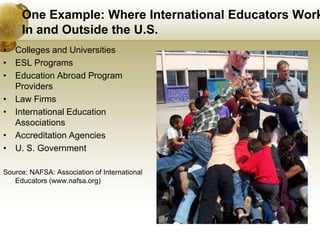
One Example: Where International Educators Work
     In and Outside the U.S.
• Colleges and Universities
• ESL Programs
• Education Abroad Program
  Providers
• Law Firms
• International Education
  Associations
• Accreditation Agencies
• U. S. Government

Source: NAFSA: Association of International
   Educators (www.nafsa.org)
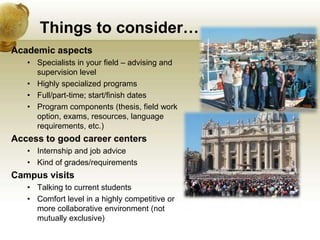
Things to consider…
Academic aspects
   • Specialists in your field – advising and
     supervision level
   • Highly specialized programs
   • Full/part-time; start/finish dates
   • Program components (thesis, field work
     option, exams, resources, language
     requirements, etc.)
Access to good career centers
   • Internship and job advice
   • Kind of grades/requirements
Campus visits
   • Talking to current students
   • Comfort level in a highly competitive or
     more collaborative environment (not
     mutually exclusive)
Common Obstacles
• Academic fit: difficulty with
    • Establishing meaningful contact
      with prospective adviser or
      program contacts
    • Finding students to talk to re: their
      experiences
    • Misinformation on what is (not)
      good for your future career
• Lifestyle fit
   •   Family
   •   Job-study balance
   •   Spiritual/mental health
• Financials
   •   Total costs
   •   Scholarship conditions
   •   Taxable financial aid
   •   Apply for multiple sources

Choosing Graduate School Abroad

  • 1.
  • 2.
    Overview • Graduate programs abroad • Schools With International Focus in the US • Funding • Career planning
  • 3.
    Welcome and Introductions •Diana Yefanova • Ph.D candidate, Comparative and International Development Education (CIDE), Department of Educational Policy and Administration, U of MN • Joy Hemmesch • Study Abroad Advisor with CSBSJU
  • 4.
  • 5.
    Graduate School Timeline •Junior Year • Get to know your faculty; think about what you want from graduate study - it is more intense and focused than undergraduate study. It's not too soon to research programs through use of the Internet and/or contact the graduate school for application materials and catalogs. Some students may also want to take the required graduate exams. • http://www.csbsju.edu/career/students/postgrad/gr adsch/default.htm
  • 6.
    Graduate School Timeline •Senior Year • Following are activities that will need to be completed; the timing is dependent on the application deadlines of the individual school you are applying to. • Request school catalogs along with applications for admission and financial aid. • Register for necessary admission exams. • Ask faculty/employers to write letters of recommendation; allow plenty of time in advance of the deadline (include a self-addressed, stamped envelope). • Arrange for official transcripts to be mailed. • Complete and mail applications. • Verify the receipt of all admission materials (application, transcript, exam score, letters of recommendation, etc.). • Visit the schools. • Evaluate admission offers
  • 7.
    Schools With InternationalFocus in the US: Why Attend? A. You love certain area or country/language studies and want to continue learning more about it without leaving the US B. You need an advanced degree to work in the international career that interests you C. Your parents/teachers expect you to go D. All your friends you studied abroad with are going E. All of the above
  • 8.
    Choices, choices… Big Names • George Washington University Elliot School • Columbia University SIPA • Monterey Institute of Int’l Studies • Thunderbird School of Int’l Management • Columbia University Unusual Options • Joint/double degrees (e.g.Yale International Relations Joint Degree in International affairs and Forestry (MA)) • Service-learning combined with academics (International Partnership for Service-Learning and Leadership) Bottom line: be flexible, don’t rush: Good Fit Comes First!
  • 9.
    Sample Majors/Fields international industrialtechnology international development global trade and finance international public policy administration/affairs global health homeland security humanitarian assistance comparative international education management … a) What’s YOUR dream international field? b) What would allow you to apply your study abroad experience and acquired skills ? c) MA or Ph.D.?
  • 10.
    One Example: WhereInternational Educators Work In and Outside the U.S. • Colleges and Universities • ESL Programs • Education Abroad Program Providers • Law Firms • International Education Associations • Accreditation Agencies • U. S. Government Source: NAFSA: Association of International Educators (www.nafsa.org)
  • 11.
    Things to consider… Academicaspects • Specialists in your field – advising and supervision level • Highly specialized programs • Full/part-time; start/finish dates • Program components (thesis, field work option, exams, resources, language requirements, etc.) Access to good career centers • Internship and job advice • Kind of grades/requirements Campus visits • Talking to current students • Comfort level in a highly competitive or more collaborative environment (not mutually exclusive)
  • 12.
    Common Obstacles • Academicfit: difficulty with • Establishing meaningful contact with prospective adviser or program contacts • Finding students to talk to re: their experiences • Misinformation on what is (not) good for your future career • Lifestyle fit • Family • Job-study balance • Spiritual/mental health • Financials • Total costs • Scholarship conditions • Taxable financial aid • Apply for multiple sources

Editor's Notes

  • #4 Peggy will do the introductions and “survey of the audience”
  • #5 Joe will lead this section
  • #8 Community ServiceYou’ve discussed this with your counselor/adviser/SA adviser/multiple advisers, not to mention countless friends and relatives. You’ve decide NOT to leave the US right now…Here are might be some of the reasons why, - not a complete list, of course.Give careful thought to what your reasons are. Are you being honest with yourself? How committed are you? Do you really need a graduate degree to do what you want to do? It is an important decision.
  • #9 The school's reputation, size, location, cost, availability of financial aid,how competitive it is.FP Magazine and U.S. News and World Report if you are going by pure rank. An unbiased ranking of Graduate Schools for International Relations/Affairs seems to not existAnother important point is summer internships in the field, I can tell you that network and name do matter, sadly: tog et foot in the door BUT I'd go with whatever program meets your expectations and allows you to focus most closely on your chosen subject of interest, no matter the ranking
  • #10 Plenty of options! Reflect on your options and articulate the skills you’ve developed and move forward, even if this means changing directionDo you want to work towards a Master's degree or a Ph.D.?Do you have the prerequisites for the programs that interest you or time to get them before you apply?
  • #11 One of the fields is International Education…similarly, many other specializations will allow you to apply the skills and knowledge in multiple areasThe key is to gain an idea of where program alumni are working and how they got thereMany jobs in our field require Master’s degrees, while many directorships require PhDs. While some jobs are available at the bachelor’s level, these are increasingly few, and higher degrees may open doors to positions and expertise levels not attainable with only a bachelor’s.People who work in International Education often have...Been inspired by a work, study or travel abroad experience.An interest in different cultures. The belief that intercultural communication and understanding can foster peace and social equality.A desire to work in an ever-changing environment that may require travel, adaptability and life-long learning.In general a BA or BS is required for most international education positions while a Master's degree is often preferred. Education degrees are popular however, it is not unusual to find people who majored in liberal arts, political science, public affairs, psychology or a foreign language. Several graduate schools offer programs in International Education, Intercultural Relations, Higher Education Administration or Student Affairs.For OSU website http://oregonstate.edu/international/studyabroad/students/return/careers/int-ed
  • #12 Positive realism: I am not going to lead you down a rosy path implying that international jobs are plentiful and easy to find.  You cannot assume that IBM will open their doors to you because you studied in France last year. On the other hand, the number of Midwesterners (or not :) working in international positions attests to the possibilities for interesting international employment.  Both short-term and long-term opportunities are available, so if you’re ready for a challenge and you have a lot of perseverance and determination, the world is yours!First things first (assume already did that):Study abroad! More than once, in different countries, if possible.Learn a second (or third) language.Work as an international ambassador, work study student or intern in your school's study abroad or international programs office.A BIG plus and strong recommendation:Get your master's degree (optimally in international studies/relations or student/personnel administration, but those two little letters after your name are really all that counts). If possible, integrate an internship with the international programs office into your master's program.
  • #13 Problem ---possible solutionsEmergency financing: plan ahead; don’t’ rely on family & friends only