Finding the Right
 College for You
Some Deciding Factors...
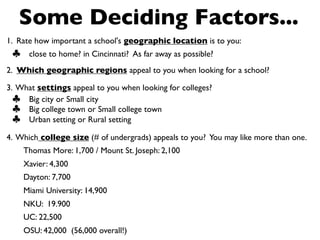
1. Rate how important a school's geographic location is to you:
 ♣!    close to home? in Cincinnati? As far away as possible?
2. Which geographic regions appeal to you when looking for a school?

3. What settings appeal to you when looking for colleges?
  ♣! Big city or Small city
  ♣! Big college town or Small college town
  ♣! Urban setting or Rural setting

4. Which college size (# of undergrads) appeals to you? You may like more than one.
      Thomas More: 1,700 / Mount St. Joseph: 2,100
      Xavier: 4,300
      Dayton: 7,700
      Miami University: 14,900
      NKU: 19.900
      UC: 22,500
      OSU: 42,000 (56,000 overall!)
Some Deciding Factors...
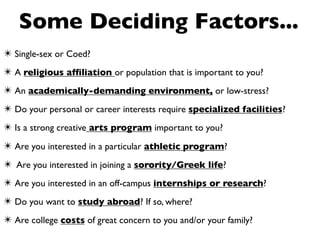
✴ Single-sex or Coed?
✴ A religious affiliation or population that is important to you?
✴ An academically-demanding environment, or low-stress?
✴ Do your personal or career interests require specialized facilities?
✴ Is a strong creative arts program important to you?
✴ Are you interested in a particular athletic program?
✴ Are you interested in joining a sorority/Greek life?
✴ Are you interested in an off-campus internships or research?
✴ Do you want to study abroad? If so, where?
✴ Are college costs of great concern to you and/or your family?
How to Evaluate Colleges
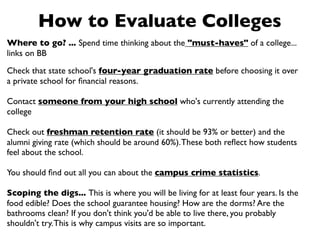
Where to go? ... Spend time thinking about the "must-haves" of a college...
links on BB

Check that state school's four-year graduation rate before choosing it over
a private school for financial reasons.

Contact someone from your high school who's currently attending the
college

Check out freshman retention rate (it should be 93% or better) and the
alumni giving rate (which should be around 60%). These both reflect how students
feel about the school.

You should find out all you can about the campus crime statistics.

Scoping the digs... This is where you will be living for at least four years. Is the
food edible? Does the school guarantee housing? How are the dorms? Are the
bathrooms clean? If you don't think you'd be able to live there, you probably
shouldn't try. This is why campus visits are so important.
Campus Visits
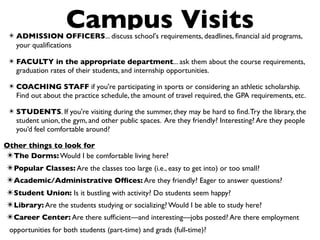
 ✴ ADMISSION OFFICERS... discuss school's requirements, deadlines, financial aid programs,
   your qualifications

 ✴ FACULTY in the appropriate department... ask them about the course requirements,
   graduation rates of their students, and internship opportunities.

 ✴ COACHING STAFF if you're participating in sports or considering an athletic scholarship.
   Find out about the practice schedule, the amount of travel required, the GPA requirements, etc.

 ✴ STUDENTS. If you're visiting during the summer, they may be hard to find. Try the library, the
   student union, the gym, and other public spaces. Are they friendly? Interesting? Are they people
   you’d feel comfortable around?

Other things to look for
✴The Dorms: Would I be comfortable living here?
✴Popular Classes: Are the classes too large (i.e., easy to get into) or too small?
✴Academic/Administrative Offices: Are they friendly? Eager to answer questions?
✴Student Union: Is it bustling with activity? Do students seem happy?
✴Library: Are the students studying or socializing? Would I be able to study here?
✴Career Center: Are there sufficient—and interesting—jobs posted? Are there employment
 opportunities for both students (part-time) and grads (full-time)?
Costs to Consider...
•   DIRECT COSTS
    • tuition
    • fees (labs, supplies, activities, etc )
    • books and supplies


•   INDIRECT COSTS
    • dorm/rooming/apartment
    • board / meal plan
    • daily transportation
    • travel expenses
    • personal expenses (laundry, fun!)
    • medical, dental, emergency monies
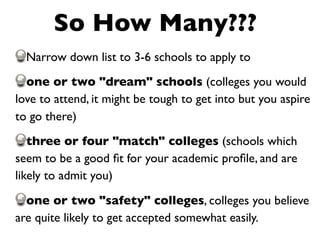
So How Many???
  Narrow down list to 3-6 schools to apply to
  one or two "dream" schools (colleges you would
love to attend, it might be tough to get into but you aspire
to go there)
   three or four "match" colleges (schools which
seem to be a good fit for your academic profile, and are
likely to admit you)

  one or two "safety" colleges, colleges you believe
are quite likely to get accepted somewhat easily.
Admissions:
What Really Counts?
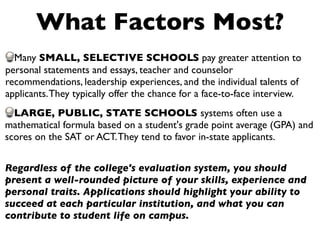
What Factors Most?
  Many SMALL, SELECTIVE SCHOOLS pay greater attention to
personal statements and essays, teacher and counselor
recommendations, leadership experiences, and the individual talents of
applicants. They typically offer the chance for a face-to-face interview.
  LARGE, PUBLIC, STATE SCHOOLS systems often use a
mathematical formula based on a student's grade point average (GPA) and
scores on the SAT or ACT. They tend to favor in-state applicants.


Regardless of the college's evaluation system, you should
present a well-rounded picture of your skills, experience and
personal traits. Applications should highlight your ability to
succeed at each particular institution, and what you can
contribute to student life on campus.
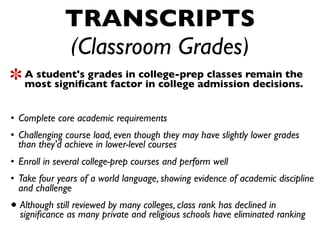
TRANSCRIPTS
               (Classroom Grades)
    A student's grades in college-prep classes remain the
    most significant factor in college admission decisions.
Highly selective colleges look for students who:
 • Complete core academic requirements
 • Challenging course load, even though they may have slightly lower grades
   than they'd achieve in lower-level courses
 • Enroll in several college-prep courses and perform well
 • Take four years of a world language, showing evidence of academic discipline
   and challenge
 • Although stillasreviewedprivate andcolleges, class rankhave eliminated ranking
   significance many
                            by many
                                       religious schools
                                                           has declined in
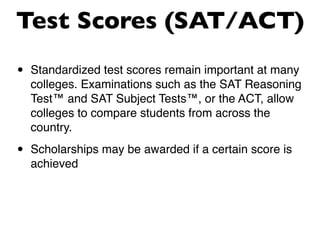
Test Scores (SAT/ACT)
•   Standardized test scores remain important at many
    colleges. Examinations such as the SAT Reasoning
    Test™ and SAT Subject Tests™, or the ACT, allow
    colleges to compare students from across the
    country.

•   Scholarships may be awarded if a certain score is
    achieved
Personal Statement/
       Essay
•   Personal statements and essays are both a
    measure of writing ability and a window into
    each student's background. Admissions
    officers want to hear an original voice in the
    student's own words. For a successful essay,
    get to the point quickly and personalize your
    writing through specific examples.
Activity List / Resume
      (Extra-Curriculars)
Evidence of extracurricular activities is important to the
admissions process, and depth of involvement is more
impressive than breadth. Students can achieve this if they...

   • Focus on a limited number of interests

   • Document long-term involvement with organizations

   • Highlight activities related to a major or career goal

   • Show leadership skills and ability
Recommendation Letters
At selective colleges, strong school support in the form of
recommendations from counselors and faculty members
have become more important than ever. These
recommendations should be highly specific, describing
not just each student's love of learning, but the ways in
which the students have demonstrated that they can
  • Add to the classroom experience
  • Challenge themselves
  • Attempt original projects
Additional
            Factors???
Many schools set aside spaces for students who may
not meet traditional criteria but will add to the class
diversity. Geographic location, racial or ethnic
background, extenuating or unusual life circumstances,
and experience living or studying overseas may all be
influential.
Evidence also suggests that in some cases seeking early
decision may also increase the chances of admission.
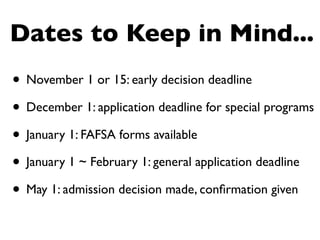
Dates to Keep in Mind...
• November 1 or 15: early decision deadline
• December 1: application deadline for special programs
• January 1: FAFSA forms available
• January 1 ~ February 1: general application deadline
• May 1: admission decision made, confirmation given
WHAT’S DUE FOR CLASS?

• Throughout the quarter... ACTIVITY LIST
• Throughout the quarter... COLLEGE ESSAY
• DEADLINE: FRIDAY NOVEMBER 2 ONE
  FULLY-COMPLETED AND SUBMITTED
                                     nd...


  APPLICATION TO A COLLEGE APPROPRIATE
  TO YOUR SKILLS
 • In order to receiveof yourIapplicationthe
   CONFIRMATION
                      credit, must see

    submissions (either email or webpage)

2 finding the right college

  • 1.
    Finding the Right College for You
  • 2.
    Some Deciding Factors... 1.Rate how important a school's geographic location is to you: ♣! close to home? in Cincinnati? As far away as possible? 2. Which geographic regions appeal to you when looking for a school? 3. What settings appeal to you when looking for colleges? ♣! Big city or Small city ♣! Big college town or Small college town ♣! Urban setting or Rural setting 4. Which college size (# of undergrads) appeals to you? You may like more than one. Thomas More: 1,700 / Mount St. Joseph: 2,100 Xavier: 4,300 Dayton: 7,700 Miami University: 14,900 NKU: 19.900 UC: 22,500 OSU: 42,000 (56,000 overall!)
  • 3.
    Some Deciding Factors... ✴Single-sex or Coed? ✴ A religious affiliation or population that is important to you? ✴ An academically-demanding environment, or low-stress? ✴ Do your personal or career interests require specialized facilities? ✴ Is a strong creative arts program important to you? ✴ Are you interested in a particular athletic program? ✴ Are you interested in joining a sorority/Greek life? ✴ Are you interested in an off-campus internships or research? ✴ Do you want to study abroad? If so, where? ✴ Are college costs of great concern to you and/or your family?
  • 4.
    How to EvaluateColleges Where to go? ... Spend time thinking about the "must-haves" of a college... links on BB Check that state school's four-year graduation rate before choosing it over a private school for financial reasons. Contact someone from your high school who's currently attending the college Check out freshman retention rate (it should be 93% or better) and the alumni giving rate (which should be around 60%). These both reflect how students feel about the school. You should find out all you can about the campus crime statistics. Scoping the digs... This is where you will be living for at least four years. Is the food edible? Does the school guarantee housing? How are the dorms? Are the bathrooms clean? If you don't think you'd be able to live there, you probably shouldn't try. This is why campus visits are so important.
  • 5.
    Campus Visits ✴ADMISSION OFFICERS... discuss school's requirements, deadlines, financial aid programs, your qualifications ✴ FACULTY in the appropriate department... ask them about the course requirements, graduation rates of their students, and internship opportunities. ✴ COACHING STAFF if you're participating in sports or considering an athletic scholarship. Find out about the practice schedule, the amount of travel required, the GPA requirements, etc. ✴ STUDENTS. If you're visiting during the summer, they may be hard to find. Try the library, the student union, the gym, and other public spaces. Are they friendly? Interesting? Are they people you’d feel comfortable around? Other things to look for ✴The Dorms: Would I be comfortable living here? ✴Popular Classes: Are the classes too large (i.e., easy to get into) or too small? ✴Academic/Administrative Offices: Are they friendly? Eager to answer questions? ✴Student Union: Is it bustling with activity? Do students seem happy? ✴Library: Are the students studying or socializing? Would I be able to study here? ✴Career Center: Are there sufficient—and interesting—jobs posted? Are there employment opportunities for both students (part-time) and grads (full-time)?
  • 6.
    Costs to Consider... • DIRECT COSTS • tuition • fees (labs, supplies, activities, etc ) • books and supplies • INDIRECT COSTS • dorm/rooming/apartment • board / meal plan • daily transportation • travel expenses • personal expenses (laundry, fun!) • medical, dental, emergency monies
  • 7.
    So How Many??? Narrow down list to 3-6 schools to apply to one or two "dream" schools (colleges you would love to attend, it might be tough to get into but you aspire to go there) three or four "match" colleges (schools which seem to be a good fit for your academic profile, and are likely to admit you) one or two "safety" colleges, colleges you believe are quite likely to get accepted somewhat easily.
  • 8.
  • 9.
    What Factors Most? Many SMALL, SELECTIVE SCHOOLS pay greater attention to personal statements and essays, teacher and counselor recommendations, leadership experiences, and the individual talents of applicants. They typically offer the chance for a face-to-face interview. LARGE, PUBLIC, STATE SCHOOLS systems often use a mathematical formula based on a student's grade point average (GPA) and scores on the SAT or ACT. They tend to favor in-state applicants. Regardless of the college's evaluation system, you should present a well-rounded picture of your skills, experience and personal traits. Applications should highlight your ability to succeed at each particular institution, and what you can contribute to student life on campus.
  • 10.
    TRANSCRIPTS (Classroom Grades) A student's grades in college-prep classes remain the most significant factor in college admission decisions. Highly selective colleges look for students who: • Complete core academic requirements • Challenging course load, even though they may have slightly lower grades than they'd achieve in lower-level courses • Enroll in several college-prep courses and perform well • Take four years of a world language, showing evidence of academic discipline and challenge • Although stillasreviewedprivate andcolleges, class rankhave eliminated ranking significance many by many religious schools has declined in
  • 11.
    Test Scores (SAT/ACT) • Standardized test scores remain important at many colleges. Examinations such as the SAT Reasoning Test™ and SAT Subject Tests™, or the ACT, allow colleges to compare students from across the country. • Scholarships may be awarded if a certain score is achieved
  • 12.
    Personal Statement/ Essay • Personal statements and essays are both a measure of writing ability and a window into each student's background. Admissions officers want to hear an original voice in the student's own words. For a successful essay, get to the point quickly and personalize your writing through specific examples.
  • 13.
    Activity List /Resume (Extra-Curriculars) Evidence of extracurricular activities is important to the admissions process, and depth of involvement is more impressive than breadth. Students can achieve this if they... • Focus on a limited number of interests • Document long-term involvement with organizations • Highlight activities related to a major or career goal • Show leadership skills and ability
  • 14.
    Recommendation Letters At selectivecolleges, strong school support in the form of recommendations from counselors and faculty members have become more important than ever. These recommendations should be highly specific, describing not just each student's love of learning, but the ways in which the students have demonstrated that they can • Add to the classroom experience • Challenge themselves • Attempt original projects
  • 15.
    Additional Factors??? Many schools set aside spaces for students who may not meet traditional criteria but will add to the class diversity. Geographic location, racial or ethnic background, extenuating or unusual life circumstances, and experience living or studying overseas may all be influential. Evidence also suggests that in some cases seeking early decision may also increase the chances of admission.
  • 16.
    Dates to Keepin Mind... • November 1 or 15: early decision deadline • December 1: application deadline for special programs • January 1: FAFSA forms available • January 1 ~ February 1: general application deadline • May 1: admission decision made, confirmation given
  • 17.
    WHAT’S DUE FORCLASS? • Throughout the quarter... ACTIVITY LIST • Throughout the quarter... COLLEGE ESSAY • DEADLINE: FRIDAY NOVEMBER 2 ONE FULLY-COMPLETED AND SUBMITTED nd... APPLICATION TO A COLLEGE APPROPRIATE TO YOUR SKILLS • In order to receiveof yourIapplicationthe CONFIRMATION credit, must see submissions (either email or webpage)