Research paper on
“Goods and Service Tax is Essential for Sustainable Development in Indian
Economy”
Abstracts:-
We begin by elaborating on the important concept of – cascading effect of taxes. It is also, logically,
referred to as “taxes on taxes”. It is simple to illustrate – say A sells goods to B after charging sales tax,
and then B re-sells those goods to C after charging sales tax. While B was computing his sales tax
liability, he also included the sales tax paid on previous purchase,which is how it becomes a tax on tax.
This was the case with the sales tax few years ago. At that time, a VAT system was introduced whereby
every next stage dealer used to get credit of the tax paid at earlier stage against his tax liability. This
reduced an overall liability of many traders and also helped to reduce inflationary impact this had on the
prices.
Similar concept came in the duty on manufacture – The Central Excise Duty – much before it came for
sales tax. The CENVAT credit scheme (earlier known as MODVAT) was also a welcome move by trade
and industry where credit of excise duty paid at the input stages was allowed to be set-off against the
liability of excise on removal of goods. With effect from 2004, this system was extended to Service Tax
also. Moreover, cross utilization of credit between excise duty and service tax was also permitted. To a
huge extent, the problem of cascading effect of taxes is resolved by these measures.
However,there are still problems with the system that have not been solved till date. We shall talk about
these problems now. The credit of Input VAT is available against Output VAT. In the same manner, the
credit of input excise/service tax is available for set-off against output liability of excise/service tax.
However,the credit of VAT is not available against excise and vice versa. We all know that VAT is
computed on a value which includes excise duty. In the same manner, CENVAT credit is allowed only
for the Excise duty paid on inputs, and not on the VAT paid on the input raw material. This shows that
there is a tax on tax!
Excise duty and service tax are levied by the Central Government, while the VAT is levied by the State
Government, which is one of the reasons why such a cross-utilization of credits was not allowed.
However,this does not constitute a valid reason that justifies the cascading effect of taxes. For the people,
it makes no difference if a tax is levied by the Centre or the State – a tax is a tax, and there is a tax on tax.
The GST is introduced to combat this problem, among many others.
Key words:-
 GST:Goods and service tax “it would be a comprehensive indirect tax on manufacture,
sale and consumption of goods and services throughout India, to replace taxes levied by
the Central and State governments.”
 VAT: value added tax “indirect tax on the domestic consumption of goods and services”
charged by state government
 EXCISE DUTY: “is an inland tax on the sale, or production for sale, of specific goods or
a tax on a goods produce for sale, or sold, within a country or licenses for specific
Activity”
 CENVAT : “ Central value added tax ”
 MODVAT :”Modified value added tax”
INTRODUTION OF TOPIC:
The GST or the Goods and Service Tax is a long pending indirect tax reform which India has been
waiting for, and which is hoped to iron out the wrinkles in the existing tax system. This comprehensive
tax policy is expected to be one of the most important reforms in contributing to the India growth story.
GST is expected to be a critical reform in spurring growth in the economy. When introduced, GST will
not only make the tax system simpler, but will also help in increased compliance, boost tax revenues,
reduce the tax outflow in the hands of the consumers and make exports competitive. It is hoped that the
new Government will set forth a roadmap of the GST implementation in the upcoming Budget.
To begin with, the GST is a value added tax to be levied on both goods and services (except for a list of
exempted goods and services), at both the centre and state level (Central GST and State GST
respectively). This is a single tax which will be levied on the product or service which is sold. In other
words, multiple taxes like CENVAT,central sales tax, state sales tax, octroi, etc will not exist and will be
replaced by GST. This comprehensive tax covers all stages from manufacture to sale. The tax will be
levied only on the value added at each stage of the life cycle.
The GST, as mentioned above is an indirect tax and will be borne by the customer. There will be a
standard rate of GST across various goods and services, which could broadly be in line with international
rates. World over, GST has been implemented in over 150 countries.
The Constitution (One Hundred and Twenty-second Amendment) Bill, 2014 was introduced in the Lok
Sabha by Finance Minister Arum Jaitley on 19 December 2014. The Bill was passed by the House on 6
May 2015,[8] receiving 352 votes for and 37 against. All 37 no votes came from members of the
AIADMK. The Indian National Congress party opposed the Bill and boycotted the vote, its members
leaving the House before voting began. Although the BJD and the CPI(M) had previously opposed the
Bill, they cast votes in favor
OBJECTIVE OF STUDY:-
 To study scope of GST
 To understand the concept of goods and service tax
 To know the benefits of goods and service tax to economy, business, industry and consumer
 To examine the features of goods and service tax
 To understand Key Issues and Analysis of GST
 To collect information of current tax system and analysis of tax by GST
 To study challenges before GST in India.
Literature review:
Dr. R. Vasanthagopal, (2011) Studied “GST in India: A Big Leap in the Indirect Taxation System”, and
found that the positive impacts are dependent on a neutral and rational design of the GST, balancing the
conflicting interests of various stakeholders, full political commitment for a fundamental tax reform with
a constitutional amendment, the method. Different news articles, Books and Web were used which were
enumerated and recorded.
Switchover to a ’flawless’ GST would be a big leaf ion the indirect taxatio0n system and also give a new
impetus to India’s economic change. It is also noted that, buoyed by the success of GST, more than 140
countries have introduced GST in some form to other and is fast becoming the preferred form of indirect
tax in the Asia Pacific region.
The Honorable Minister of Finance, Corporate Affairs & Information and Broadcasting, Government of
India further mentioned that the implementation of the GST will be pegged as one of the biggest game
changing reforms of the Indian government. It will help India become an economically integrated
economy, will help reduce business costs and facilitate seamless movements of goods and services
eliminating local charges. It would reduce tax cascading eliminating tax on tax and hence help reach a
situation where revenue would be benefited and GDP would improve.
Researchmethodology
The research paper is an attempt of exploratory research,based on the secondary data sourced from
journals, Internet, articles, previous research paper. Looking into requirements of the objectives of the
study the research design employed for the study is of descriptive type. Keeping in view of the set
objectives, this research design was adopted to have greater accuracy and in depth analysis of the research
study. Available secondary data was extensively used for the study. The investigator procures the required
data through secondary survey
Data analysis and data interpretation
 Scope of GST
 GST is applicable on the supply of goods or services.
 Alcoholic liquor for human consumption is exempt from GST.
 Initially, GST will not apply to: (a) petroleum crude, (b) high speed diesel, (c) motor spirit
(petrol), (d) natural gas,and (e) aviation turbine fuel.
 The GST Council will decide when GST will be levied on them.
 Tobacco and tobacco products will be subject to GST. The centre may also impose excise duty
on tobacco.
BENEFITS OF GST
 For business and industry
 Easy compliance
 Removal of cascading
 Improved competitiveness
 For Central and State Governments
 Simple and easy to administer
 Better controls on leakage
 Consolidation of tax base
 Higher revenue efficiency
 For the consumer
 Single and Transparent tax proportionate to the value of goods and services
 Reduction of prices
(Source: Seventy Third Report Of Standing Committee on Finance (2012-2013), The Constitution (One
Hundred Fifteenth Amendment) Bill, 2011, pp. 11 available at
http://www.prsindia.org/uploads/media/Cons titution%20115/GST%20SC%20Report.pdf)
Key Issues and Analysis:
 An ideal GST regime intends to create a harmonized system of taxation by subsuming all
indirect taxes under one tax. It seeks to address challenges with the current indirect tax
regime by broadening the tax base, eliminating cascading of taxes, increasing
compliance, and reducing economic distortions caused by inter-state variations in taxes.
 The provisions of this Bill do not fully conform to an ideal GST regime. Deferring the
levy of GST on five petroleum products could lead to cascading of taxes.
 The Bill permits the centre to levy and collect GST in the course of inter- state trade and
commerce. Instead, some experts have recommended a modified bank model for inter-
state transactions to ease tax compliance and administrative burden.
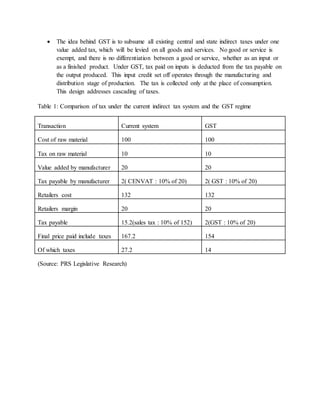
 The idea behind GST is to subsume all existing central and state indirect taxes under one
value added tax, which will be levied on all goods and services. No good or service is
exempt, and there is no differentiation between a good or service, whether as an input or
as a finished product. Under GST, tax paid on inputs is deducted from the tax payable on
the output produced. This input credit set off operates through the manufacturing and
distribution stage of production. The tax is collected only at the place of consumption.
This design addresses cascading of taxes.
Table 1: Comparison of tax under the current indirect tax system and the GST regime
Transaction Current system GST
Cost of raw material 100 100
Tax on raw material 10 10
Value added by manufacturer 20 20
Tax payable by manufacturer 2( CENVAT : 10% of 20) 2( GST : 10% of 20)
Retailers cost 132 132
Retailers margin 20 20
Tax payable 15.2(sales tax : 10% of 152) 2(GST : 10% of 20)
Final price paid include taxes 167.2 154
Of which taxes 27.2 14
(Source: PRS Legislative Research)
GST IN INDIA AS COMPARE TO OTHER COUNTRIS
Country Tax applicable Coverage Standard Rate
New Zealand GST levied on most
goods and services.
Includes most
important goods and
certain important
services. Goods
include all type of
personal and real
property excluding
Money.
15%
Singapore GST is broad based
consumption tax
levied on the imports
of goods and services.
Levied on nearly all
imports and supplies,
and exports are zero-
rated.
7%
Canada GST applies to the
supply of most goods
and services in
Canada a harmonized
sales tax applies in
some provenance.
Applies goods that
include real property
and intangible
personal property.
15%
Australia GST applies to most
goods. Services and
other items.
Applies to goods and
services that are both
said or consumed in
the country.
10%
European Union Value-added tax on
goods and services.
The export goods and
services abroad are
normally not subject
to VAT.
15%
India GST levied on most
goods and services.
Applies to supply of
goods and services
GST levied on
imports. And exports
are zero-rated,
inclusion of petroleum
and petroleum
products, however, to
be decided by the
GST councils
recommendations.
To be determined by
law made by
parliament, on the
recommendations of
the GST.
(Source: PRS Legislative Research)
Challenges before Goods and Service Tax in India
1) Legacy issues which will use resources.
2) Non harmonization of tax rates.
3) Lack of automation.
4) Lack of procedural manuals.
5) Lack of skilled officials.
6) Double registration – handling old registration.
7) Poor quality of tax return.
8) No tax system for 100% scrutiny of tax returns and tax audit.
9) Lack of cross verification with other tax administration.
10) Lack of mechanism to control evasion.
11) Impact on prices.
Finding:
 The entire Indian market will be a unified market which may translate into
lower business costs. It can facilitate seamless movement of goods across
states and reduce the transaction costs of businesses
 It is good for export oriented businesses. Because it is not applied for
goods/services which are exported out of India.
 In the long run, the lower tax burden could translate into lower prices on
goods for consumers.
 The Suppliers, manufacturers, wholesalers and retailers are able to recover
GST incurred on input costs as tax credits. This reduces the cost of doing
business, thus enabling fairer prices for consumers.
 GST will ensure the uniformity of taxes across the states, regardless of place
of manufacture or distribution
 It will mitigate cascading and double taxation and enable better compliance
through the lowering of overall tax burden on goods and services
 Suggestion
 Governments have to organize a committee to evaluate the impact of
implementation of GST.
 Joint operation between consumer association and non-governmental
organization to ensure worldwide pricing monitoring.
 Enlist the cooperation of big retailer like hypermarket for benchmark the price
of goods.
 GST also apply in IT system like the
Tax Information Network, where the
TDS of the VAT credit is recorded in a central database.
 GST will be charged more on luxurious productand apply tax credit system
for life base product.
 Conclusion
GST is a single national uniform tax levied across India on all goods and services.
In GST, all Indirect taxes such as excise duty, octroi, central sales tax (CST)and
value- added tax (VAT) etc. will be subsumed under a single regime. Introduction
of The Goods and Services Tax (GST)will be a significant step towards a
comprehensive indirect tax reform in the country. It is expected to bring about
efficiency and transparency in the indirect tax mechanism in India. Further it will
also encourage an unbiased tax structure that is neutral to business processes and
geographical locations. Given the enormity of the implication of GST, it requires a
consensus among all political parties and states. However the implementation of
GST has been delayed several times on account of lack of consensus among the
States and Centre on aspects relating to limiting fiscal autonomy of the States.
History has proved that many countries have benefited from moving to a GST
regime. In India, Implementation of GST would also greatly help in removing
economic distortions caused by present complex tax structure and will help in
development of a common national market
Bibliography
1. Empowered Committee of Finance Ministers (2009). First Discussion Paper on Goods
and Services Tax in India, The Empowered Committee of State Finance Ministers, New
Delhi
2. Goods and Services Tax (GST) - A step forward (2013) available at
http://articles.economictimes.indiatimes.c om/2013-08-
3. www.gjms.co.in
4. GSTanoverview.com
5. www.GSTindia.com
6. WIKIPEDIA
7. QUORA
8. EmpoweredCommittee of Finance Ministers(2009).FirstDiscussionPaperonGoodsand
ServicesTax inIndia,The EmpoweredCommittee of State Finance Ministers,New Delhi
9. Goodsand ServicesTax (GST) - A stepforward(2013) available at
http://articles.economictimes.indiatimes.com/2013-08- 13/news/41374977_1_services-tax-
state- GST-goods-and-services
10. http://www.cbgaindia.org/files/primers_manuals/Primer%20on%20Goods%20an
d%20Services%20Tax.pdf
11. SAURABH GUPTA,MADHUR GUPTA, How „Impossible‟ GSThas become „Inevitable‟forIndia?
NIVESHAK,Volume 7Issue 1, January2014, pp.26-28
12. Mr. PranabMukherjee,Finance Ministerof India,Speechatthe UnionBudget2010-11,
February26, 2010, available at http://www.thehindu.com/business/Econo
my/article113901.ece
13. http://www.kotaksecurities.com/budget2013-14/union-budget-2013-14/Indian- budget-
news/5-Points-to-know-about- GST.html#sthash.BfPSt6Re.dpbs
14. What isGST (Goodsand Servicestax)?(2013) available at
http://www.moneycontrol.com/smemento r/mentorade/budget-2013/what-is-GST- goods-and-
services-tax-827592.html
15. Dr. R. Vasanthagopal (2011),“GST inIndia:A BigLeap inthe IndirectTaxationSystem”,
International Journal of Trade,EconomicsandFinance,Vol.2,No.2, April 2011
16. SeventyThird ReportOf StandingCommittee onFinance (2012-2013), available at
http://www.prsindia.org/uploads/media/Constitution%20115/GST%20SC%20Report.pdf
17. CA RajkumarS Adukia,A Study onProposedGoodsand ServicesTax [GST] FrameworkInIndia,
available athttp://taxclubindia.com/simple/rajkumar.pdf

Gst research paper

  • 1.
    Research paper on “Goodsand Service Tax is Essential for Sustainable Development in Indian Economy” Abstracts:- We begin by elaborating on the important concept of – cascading effect of taxes. It is also, logically, referred to as “taxes on taxes”. It is simple to illustrate – say A sells goods to B after charging sales tax, and then B re-sells those goods to C after charging sales tax. While B was computing his sales tax liability, he also included the sales tax paid on previous purchase,which is how it becomes a tax on tax. This was the case with the sales tax few years ago. At that time, a VAT system was introduced whereby every next stage dealer used to get credit of the tax paid at earlier stage against his tax liability. This reduced an overall liability of many traders and also helped to reduce inflationary impact this had on the prices. Similar concept came in the duty on manufacture – The Central Excise Duty – much before it came for sales tax. The CENVAT credit scheme (earlier known as MODVAT) was also a welcome move by trade and industry where credit of excise duty paid at the input stages was allowed to be set-off against the liability of excise on removal of goods. With effect from 2004, this system was extended to Service Tax also. Moreover, cross utilization of credit between excise duty and service tax was also permitted. To a huge extent, the problem of cascading effect of taxes is resolved by these measures. However,there are still problems with the system that have not been solved till date. We shall talk about these problems now. The credit of Input VAT is available against Output VAT. In the same manner, the credit of input excise/service tax is available for set-off against output liability of excise/service tax. However,the credit of VAT is not available against excise and vice versa. We all know that VAT is computed on a value which includes excise duty. In the same manner, CENVAT credit is allowed only for the Excise duty paid on inputs, and not on the VAT paid on the input raw material. This shows that there is a tax on tax! Excise duty and service tax are levied by the Central Government, while the VAT is levied by the State Government, which is one of the reasons why such a cross-utilization of credits was not allowed. However,this does not constitute a valid reason that justifies the cascading effect of taxes. For the people, it makes no difference if a tax is levied by the Centre or the State – a tax is a tax, and there is a tax on tax. The GST is introduced to combat this problem, among many others.
  • 2.
    Key words:-  GST:Goodsand service tax “it would be a comprehensive indirect tax on manufacture, sale and consumption of goods and services throughout India, to replace taxes levied by the Central and State governments.”  VAT: value added tax “indirect tax on the domestic consumption of goods and services” charged by state government  EXCISE DUTY: “is an inland tax on the sale, or production for sale, of specific goods or a tax on a goods produce for sale, or sold, within a country or licenses for specific Activity”  CENVAT : “ Central value added tax ”  MODVAT :”Modified value added tax”
  • 3.
    INTRODUTION OF TOPIC: TheGST or the Goods and Service Tax is a long pending indirect tax reform which India has been waiting for, and which is hoped to iron out the wrinkles in the existing tax system. This comprehensive tax policy is expected to be one of the most important reforms in contributing to the India growth story. GST is expected to be a critical reform in spurring growth in the economy. When introduced, GST will not only make the tax system simpler, but will also help in increased compliance, boost tax revenues, reduce the tax outflow in the hands of the consumers and make exports competitive. It is hoped that the new Government will set forth a roadmap of the GST implementation in the upcoming Budget. To begin with, the GST is a value added tax to be levied on both goods and services (except for a list of exempted goods and services), at both the centre and state level (Central GST and State GST respectively). This is a single tax which will be levied on the product or service which is sold. In other words, multiple taxes like CENVAT,central sales tax, state sales tax, octroi, etc will not exist and will be replaced by GST. This comprehensive tax covers all stages from manufacture to sale. The tax will be levied only on the value added at each stage of the life cycle. The GST, as mentioned above is an indirect tax and will be borne by the customer. There will be a standard rate of GST across various goods and services, which could broadly be in line with international rates. World over, GST has been implemented in over 150 countries. The Constitution (One Hundred and Twenty-second Amendment) Bill, 2014 was introduced in the Lok Sabha by Finance Minister Arum Jaitley on 19 December 2014. The Bill was passed by the House on 6 May 2015,[8] receiving 352 votes for and 37 against. All 37 no votes came from members of the AIADMK. The Indian National Congress party opposed the Bill and boycotted the vote, its members leaving the House before voting began. Although the BJD and the CPI(M) had previously opposed the Bill, they cast votes in favor OBJECTIVE OF STUDY:-  To study scope of GST  To understand the concept of goods and service tax  To know the benefits of goods and service tax to economy, business, industry and consumer  To examine the features of goods and service tax  To understand Key Issues and Analysis of GST  To collect information of current tax system and analysis of tax by GST  To study challenges before GST in India.
  • 4.
    Literature review: Dr. R.Vasanthagopal, (2011) Studied “GST in India: A Big Leap in the Indirect Taxation System”, and found that the positive impacts are dependent on a neutral and rational design of the GST, balancing the conflicting interests of various stakeholders, full political commitment for a fundamental tax reform with a constitutional amendment, the method. Different news articles, Books and Web were used which were enumerated and recorded. Switchover to a ’flawless’ GST would be a big leaf ion the indirect taxatio0n system and also give a new impetus to India’s economic change. It is also noted that, buoyed by the success of GST, more than 140 countries have introduced GST in some form to other and is fast becoming the preferred form of indirect tax in the Asia Pacific region. The Honorable Minister of Finance, Corporate Affairs & Information and Broadcasting, Government of India further mentioned that the implementation of the GST will be pegged as one of the biggest game changing reforms of the Indian government. It will help India become an economically integrated economy, will help reduce business costs and facilitate seamless movements of goods and services eliminating local charges. It would reduce tax cascading eliminating tax on tax and hence help reach a situation where revenue would be benefited and GDP would improve. Researchmethodology The research paper is an attempt of exploratory research,based on the secondary data sourced from journals, Internet, articles, previous research paper. Looking into requirements of the objectives of the study the research design employed for the study is of descriptive type. Keeping in view of the set objectives, this research design was adopted to have greater accuracy and in depth analysis of the research study. Available secondary data was extensively used for the study. The investigator procures the required data through secondary survey
  • 5.
    Data analysis anddata interpretation  Scope of GST  GST is applicable on the supply of goods or services.  Alcoholic liquor for human consumption is exempt from GST.  Initially, GST will not apply to: (a) petroleum crude, (b) high speed diesel, (c) motor spirit (petrol), (d) natural gas,and (e) aviation turbine fuel.  The GST Council will decide when GST will be levied on them.  Tobacco and tobacco products will be subject to GST. The centre may also impose excise duty on tobacco. BENEFITS OF GST  For business and industry  Easy compliance  Removal of cascading  Improved competitiveness  For Central and State Governments  Simple and easy to administer  Better controls on leakage  Consolidation of tax base  Higher revenue efficiency  For the consumer  Single and Transparent tax proportionate to the value of goods and services  Reduction of prices (Source: Seventy Third Report Of Standing Committee on Finance (2012-2013), The Constitution (One Hundred Fifteenth Amendment) Bill, 2011, pp. 11 available at http://www.prsindia.org/uploads/media/Cons titution%20115/GST%20SC%20Report.pdf)
  • 6.
    Key Issues andAnalysis:  An ideal GST regime intends to create a harmonized system of taxation by subsuming all indirect taxes under one tax. It seeks to address challenges with the current indirect tax regime by broadening the tax base, eliminating cascading of taxes, increasing compliance, and reducing economic distortions caused by inter-state variations in taxes.  The provisions of this Bill do not fully conform to an ideal GST regime. Deferring the levy of GST on five petroleum products could lead to cascading of taxes.  The Bill permits the centre to levy and collect GST in the course of inter- state trade and commerce. Instead, some experts have recommended a modified bank model for inter- state transactions to ease tax compliance and administrative burden.
  • 7.
     The ideabehind GST is to subsume all existing central and state indirect taxes under one value added tax, which will be levied on all goods and services. No good or service is exempt, and there is no differentiation between a good or service, whether as an input or as a finished product. Under GST, tax paid on inputs is deducted from the tax payable on the output produced. This input credit set off operates through the manufacturing and distribution stage of production. The tax is collected only at the place of consumption. This design addresses cascading of taxes. Table 1: Comparison of tax under the current indirect tax system and the GST regime Transaction Current system GST Cost of raw material 100 100 Tax on raw material 10 10 Value added by manufacturer 20 20 Tax payable by manufacturer 2( CENVAT : 10% of 20) 2( GST : 10% of 20) Retailers cost 132 132 Retailers margin 20 20 Tax payable 15.2(sales tax : 10% of 152) 2(GST : 10% of 20) Final price paid include taxes 167.2 154 Of which taxes 27.2 14 (Source: PRS Legislative Research)
  • 8.
    GST IN INDIAAS COMPARE TO OTHER COUNTRIS Country Tax applicable Coverage Standard Rate New Zealand GST levied on most goods and services. Includes most important goods and certain important services. Goods include all type of personal and real property excluding Money. 15% Singapore GST is broad based consumption tax levied on the imports of goods and services. Levied on nearly all imports and supplies, and exports are zero- rated. 7% Canada GST applies to the supply of most goods and services in Canada a harmonized sales tax applies in some provenance. Applies goods that include real property and intangible personal property. 15% Australia GST applies to most goods. Services and other items. Applies to goods and services that are both said or consumed in the country. 10% European Union Value-added tax on goods and services. The export goods and services abroad are normally not subject to VAT. 15% India GST levied on most goods and services. Applies to supply of goods and services GST levied on imports. And exports are zero-rated, inclusion of petroleum and petroleum products, however, to be decided by the GST councils recommendations. To be determined by law made by parliament, on the recommendations of the GST. (Source: PRS Legislative Research)
  • 9.
    Challenges before Goodsand Service Tax in India 1) Legacy issues which will use resources. 2) Non harmonization of tax rates. 3) Lack of automation. 4) Lack of procedural manuals. 5) Lack of skilled officials. 6) Double registration – handling old registration. 7) Poor quality of tax return. 8) No tax system for 100% scrutiny of tax returns and tax audit. 9) Lack of cross verification with other tax administration. 10) Lack of mechanism to control evasion. 11) Impact on prices. Finding:  The entire Indian market will be a unified market which may translate into lower business costs. It can facilitate seamless movement of goods across states and reduce the transaction costs of businesses  It is good for export oriented businesses. Because it is not applied for goods/services which are exported out of India.
  • 10.
     In thelong run, the lower tax burden could translate into lower prices on goods for consumers.  The Suppliers, manufacturers, wholesalers and retailers are able to recover GST incurred on input costs as tax credits. This reduces the cost of doing business, thus enabling fairer prices for consumers.  GST will ensure the uniformity of taxes across the states, regardless of place of manufacture or distribution  It will mitigate cascading and double taxation and enable better compliance through the lowering of overall tax burden on goods and services  Suggestion  Governments have to organize a committee to evaluate the impact of implementation of GST.  Joint operation between consumer association and non-governmental organization to ensure worldwide pricing monitoring.  Enlist the cooperation of big retailer like hypermarket for benchmark the price of goods.  GST also apply in IT system like the Tax Information Network, where the TDS of the VAT credit is recorded in a central database.  GST will be charged more on luxurious productand apply tax credit system for life base product.
  • 11.
     Conclusion GST isa single national uniform tax levied across India on all goods and services. In GST, all Indirect taxes such as excise duty, octroi, central sales tax (CST)and value- added tax (VAT) etc. will be subsumed under a single regime. Introduction of The Goods and Services Tax (GST)will be a significant step towards a comprehensive indirect tax reform in the country. It is expected to bring about efficiency and transparency in the indirect tax mechanism in India. Further it will also encourage an unbiased tax structure that is neutral to business processes and geographical locations. Given the enormity of the implication of GST, it requires a consensus among all political parties and states. However the implementation of GST has been delayed several times on account of lack of consensus among the States and Centre on aspects relating to limiting fiscal autonomy of the States. History has proved that many countries have benefited from moving to a GST regime. In India, Implementation of GST would also greatly help in removing economic distortions caused by present complex tax structure and will help in development of a common national market Bibliography 1. Empowered Committee of Finance Ministers (2009). First Discussion Paper on Goods and Services Tax in India, The Empowered Committee of State Finance Ministers, New Delhi
  • 12.
    2. Goods andServices Tax (GST) - A step forward (2013) available at http://articles.economictimes.indiatimes.c om/2013-08- 3. www.gjms.co.in 4. GSTanoverview.com 5. www.GSTindia.com 6. WIKIPEDIA 7. QUORA 8. EmpoweredCommittee of Finance Ministers(2009).FirstDiscussionPaperonGoodsand ServicesTax inIndia,The EmpoweredCommittee of State Finance Ministers,New Delhi 9. Goodsand ServicesTax (GST) - A stepforward(2013) available at http://articles.economictimes.indiatimes.com/2013-08- 13/news/41374977_1_services-tax- state- GST-goods-and-services 10. http://www.cbgaindia.org/files/primers_manuals/Primer%20on%20Goods%20an d%20Services%20Tax.pdf 11. SAURABH GUPTA,MADHUR GUPTA, How „Impossible‟ GSThas become „Inevitable‟forIndia? NIVESHAK,Volume 7Issue 1, January2014, pp.26-28 12. Mr. PranabMukherjee,Finance Ministerof India,Speechatthe UnionBudget2010-11, February26, 2010, available at http://www.thehindu.com/business/Econo my/article113901.ece 13. http://www.kotaksecurities.com/budget2013-14/union-budget-2013-14/Indian- budget- news/5-Points-to-know-about- GST.html#sthash.BfPSt6Re.dpbs 14. What isGST (Goodsand Servicestax)?(2013) available at http://www.moneycontrol.com/smemento r/mentorade/budget-2013/what-is-GST- goods-and- services-tax-827592.html 15. Dr. R. Vasanthagopal (2011),“GST inIndia:A BigLeap inthe IndirectTaxationSystem”, International Journal of Trade,EconomicsandFinance,Vol.2,No.2, April 2011 16. SeventyThird ReportOf StandingCommittee onFinance (2012-2013), available at http://www.prsindia.org/uploads/media/Constitution%20115/GST%20SC%20Report.pdf 17. CA RajkumarS Adukia,A Study onProposedGoodsand ServicesTax [GST] FrameworkInIndia, available athttp://taxclubindia.com/simple/rajkumar.pdf