Collaborating to enhance opportunities for 
teaching and learning, and for the well-being of 
staff and students at the University of Otago 
Introducing Books on Prescription
Introductions 
Katie Jahnke | Health Promoter & Projects Coordinator 
Southern PHO | Katie.Jahnke@southernpho.health.nz 
Jodie Black | Registered Psychologist 
Student Health, University of Otago | jodie.black@otago.ac.nz 
Sarah Gallagher | Subject Librarian 
Health Sciences Library, University of Otago | sarah.gallagher@otago.ac.nz 
Richard German | Divisional Librarian 
Health Sciences Library, University of Otago | richard.german@otago.ac.nz
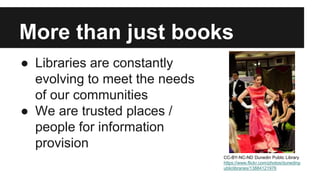
Overview 
Katie - History of BOP and Southern PHO involvement 
Richard - How libraries are changing internationally 
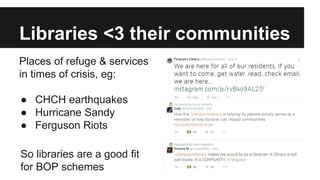
Sarah - Why and how the Medical Library became involved 
Jodie - The role of the programme at Student Health
What is BOP? 
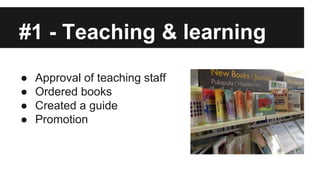
A community health initiative whereby GPs, mental 
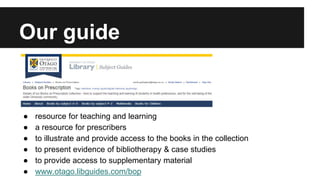
health professionals and other health professionals 
can offer their patients recommended self-help books 
for mild to moderate mental health problems.
History 
• Developed in Wales in 2002 by psychologist Dr Neil 
Frude 
• In 2005 the scheme was rolled out across Wales then 
throughout the UK following extensive evaluation 
• Implemented in Central Otago in 2011 and 
progressively rolled out in Otago and Southland
Why start a BOP scheme? 
• 46.6% of the population will meet the criteria for a mental disorder 
during their lives 
• 39.5% have already had experience of mental disorder 
• 20.7% of the population will have experienced a mental health 
disorder within the past 12 months 
• There is significant unmet need for people with mental disorders. 
Over a 12 month period only 39% of people with a mental 
disorder had visited health services
Evidence 
• Clinical evidence shows that books can be as effective as other forms 
of therapy and with the advantage of having no potential side effects 
associated with drugs, and often achieve good results more quickly. 
• Bibliotherapy is one of the key self-help strategies recommended in the 
treatment of depression and anxiety. 
• Research suggests that patients benefit from knowing more about their 
problems, and learning psychological tactics to deal with them.
Southern PHO 
• 285,852 enrolled patients in 89 practices 
• 40% enrolled pop. live outside the main cities 
important to have a rural focus 
• Reduced access to mental health services in 
rural areas
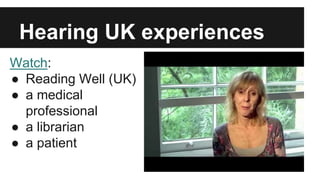
Hearing UK experiences 
Watch: 
● Reading Well (UK) 
● a medical 
professional 
● a librarian 
● a patient
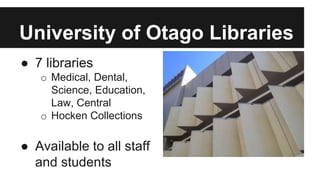
University of Otago Libraries 
● 7 libraries 
o Medical, Dental, 
Science, Education, 
Law, Central 
o Hocken Collections 
● Available to all staff 
and students
What libraries are about 
Ranganathan’s five laws of library science: 
1. Books are for use 
2. Every reader his/her book 
3. Every book its reader 
4. Save the time of the reader 
5. The library is a growing organism
Future libraries 
Extensions of Ranganathan’s ‘laws’ (Crawford and 
Gorman, 1995): 
1. Libraries serve humanity 
2. Respect all forms by which knowledge is communicated 
3. Use technology intelligently to enhance service 
4. Protect free access to knowledge 
5. Honor the past and create the future
More than just books 
● Libraries are constantly 
evolving to meet the needs 
of our communities 
● We are trusted places / 
people for information 
provision 
CC-BY-NC-ND Dunedin Public Library 
https://www.flickr.com/photos/dunedinp 
ubliclibraries/13884121976
NZ Public Libraries in 2013 
Source: Libraries in Aotearoa 2014, p7
Libraries & health information 
“Libraries can build on the fact that 
many people visit libraries for health 
information before or instead of 
engaging with health professionals” 
- Ingham 2014
Libraries <3 their communities 
Places of refuge & services 
in times of crisis, eg: 
● CHCH earthquakes 
● Hurricane Sandy 
● Ferguson Riots 
So libraries are a good fit 
for BOP schemes
BOP in universities 
Otago is one of a few university libraries in the 
world that have adopted Books on Prescription 
• University College Dublin 
• Brunel University London 
• Loughborough University
Why is Otago involved? 
Dual reasons for our involvement: 
● Opportunity to support teaching and learning in the 
Dunedin School of Medicine 
● Opportunity to contribute a resource to improve staff 
and student well-being at the University of Otago
#1 - Teaching & learning 
● Approval of teaching staff 
● Ordered books 
● Created a guide 
● Promotion
Our guide 
● resource for teaching and learning 
● a resource for prescribers 
● to illustrate and provide access to the books in the collection 
● to present evidence of bibliotherapy & case studies 
● to provide access to supplementary material 
● www.otago.libguides.com/bop
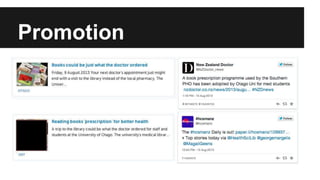
Promotion
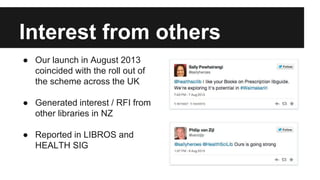
Interest from others 
● Our launch in August 2013 
coincided with the roll out of 
the scheme across the UK 
● Generated interest / RFI from 
other libraries in NZ 
● Reported in LIBROS and 
HEALTH SIG
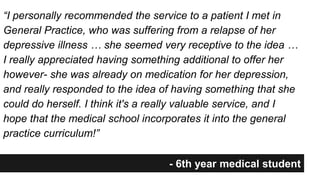
“I personally recommended the service to a patient I met in 
General Practice, who was suffering from a relapse of her 
depressive illness … she seemed very receptive to the idea … 
I really appreciated having something additional to offer her 
however- she was already on medication for her depression, 
and really responded to the idea of having something that she 
could do herself. I think it's a really valuable service, and I 
hope that the medical school incorporates it into the general 
practice curriculum!” 
- 6th year medical student
#2 - Well-being 
Support the well-being of 
staff and students 
● Student Health 
● Disability Information & 
Support 
● Employee Assistance 
Programme (EAP) 
CC http://pixabay.com/en/reading-manual-docs-help-book-man- 
99244/
Student Health Services 
● Largest “enrolled” population in the Southern District 
● About 50 staff including: nurses, general practitioners, 
counsellors, dietitians, psychiatrist and administrative 
staff 
● Majority of students access Student Health during term 
and return to their family GP over breaks 
● 28% of Otago students record their “home area” as the 
Southern District
Counselling Services 
● Unique to have counselling services on site 
● Same day appointments with self referral for brief 
assessment, advice, counselling and/or further referrals 
● Referrals have doubled over the last 5 years 
● Peak demand periods towards the end of each 
semester
Benefits for Student Health 
● Part of a stepped care approach to mental health 
● Options for those on a waitlist or returning home over 
breaks 
● Provide options directly accessible by students 
● Utilizing library infrastructure
Promoting BOP in SHS 
● Information session provided to SHS staff 
● Books rotate through staff room 
● SHS staff have added to scheme - including sexual 
health 
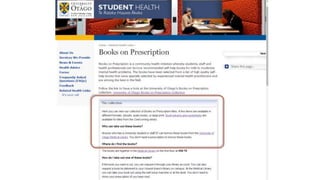
● Link to BOP on SHS website 
● Bookmarks promoting BOP are available from all 
clinical rooms
Challenges to consider 
● Staff familiarisation with the scheme and books 
● Client attitudes towards electronic and bibliotherapy self 
help are more positive than the clinicians 
● Some staff already use electronic resources, including 
websites and apps
Goals 
● Further promotion to staff and students as a well-being 
aid 
● Further promotion to teaching staff (Medicine) 
● Further promotion to health workers on campus
Evaluation 
The Southern PHO are undertaking an extensive 
evaluation in the region, including: 
• Surveying prescribers and librarians 
• Collating issuing data and user feedback 
• Interviews and focus groups with prescribers and 
consumers
Continuous improvement 
Our collaborative practice includes a cycle of review to 
ensure we continue to improve this programme. 
Four step quality cycle 
• plan > act > review > improve 
Source: http://www.uow.edu.au/quality/quality/index
Indicators of success 
● Website / online guide hits 
● Books issued and holds placed 
● Extra copies requested 
● Student and staff feedback 
● Prescriptions filled 
● Evidence of incorporation into learning programs 
● Cross promotion through other well-being projects
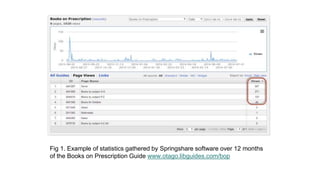
Fig 1. Example of statistics gathered by Springshare software over 12 months 
of the Books on Prescription Guide www.otago.libguides.com/bop
“I personally find the books on prescription program to be a 
very valuable resource. Dunedin has limited access to 
counselling and mental health services, and many of the 
services which are available have significant wait times for 
patients who are not acutely unwell. This can have a 
significant impact on the mental health of patients who are 
unable to afford to pay out of pocket for these services.” 
- 6th year medical student
Next steps 
● Develop opportunities to incorporate into Residential 
Assistant, peer support and future staff training 
● Otago University Student Association (OUSA) Mental 
Health Awareness Week 
● Review the outcomes and adopt any recommendations 
from the PHO evaluation
Summary 
● Working in collaboration across departments has made 
this project possible 
● A structure of continuous quality improvement will allow 
to project to continue to grow and meet the needs of 
staff and students
References 
Ingham A. Can your public library improve your health and well-being? An investigation of East Sussex Library and 
Information Service. Health Information & Libraries Journal. 2014;31(2):156-60. 
LIANZA. Libraries in Aotearoa 2014 http://www.lianza.org.nz/resources/lianza-publications/libraries-aotearoa/libraries-aotearoa- 
2014 [Accessed 19.08.2014] 
NHS Choices. Reading Well Books on Prescription. https://www.youtube.com/watch?v=1H8OpYP0zPg [Accessed 
19.08.2014] 
New Media Consortium. NMC Horizon Report: 2014 Library Edition http://cdn.nmc.org/media/2014-nmc-horizon-report-library- 
EN.pdf [Accessed 19.08.2014] 
Pratt RJ. The introduction of a healthy reading scheme for people with mental health problems: usage and experiences 
of health professionals and library staff. Mental Health in Family Medicine. 2008;5(4):219-28.
Thank you 
www.booksonprescription.co.nz 
www.otago.libguides.com/bop

Collaborating to enhance opportunities for teaching and learning, and for the wellbeing of staff and students at the University of Otago

  • 1.
    Collaborating to enhanceopportunities for teaching and learning, and for the well-being of staff and students at the University of Otago Introducing Books on Prescription
  • 2.
    Introductions Katie Jahnke| Health Promoter & Projects Coordinator Southern PHO | Katie.Jahnke@southernpho.health.nz Jodie Black | Registered Psychologist Student Health, University of Otago | jodie.black@otago.ac.nz Sarah Gallagher | Subject Librarian Health Sciences Library, University of Otago | sarah.gallagher@otago.ac.nz Richard German | Divisional Librarian Health Sciences Library, University of Otago | richard.german@otago.ac.nz
  • 3.
    Overview Katie -History of BOP and Southern PHO involvement Richard - How libraries are changing internationally Sarah - Why and how the Medical Library became involved Jodie - The role of the programme at Student Health
  • 4.
    What is BOP? A community health initiative whereby GPs, mental health professionals and other health professionals can offer their patients recommended self-help books for mild to moderate mental health problems.
  • 5.
    History • Developedin Wales in 2002 by psychologist Dr Neil Frude • In 2005 the scheme was rolled out across Wales then throughout the UK following extensive evaluation • Implemented in Central Otago in 2011 and progressively rolled out in Otago and Southland
  • 6.
    Why start aBOP scheme? • 46.6% of the population will meet the criteria for a mental disorder during their lives • 39.5% have already had experience of mental disorder • 20.7% of the population will have experienced a mental health disorder within the past 12 months • There is significant unmet need for people with mental disorders. Over a 12 month period only 39% of people with a mental disorder had visited health services
  • 7.
    Evidence • Clinicalevidence shows that books can be as effective as other forms of therapy and with the advantage of having no potential side effects associated with drugs, and often achieve good results more quickly. • Bibliotherapy is one of the key self-help strategies recommended in the treatment of depression and anxiety. • Research suggests that patients benefit from knowing more about their problems, and learning psychological tactics to deal with them.
  • 8.
    Southern PHO •285,852 enrolled patients in 89 practices • 40% enrolled pop. live outside the main cities important to have a rural focus • Reduced access to mental health services in rural areas
  • 9.
    Hearing UK experiences Watch: ● Reading Well (UK) ● a medical professional ● a librarian ● a patient
  • 10.
    University of OtagoLibraries ● 7 libraries o Medical, Dental, Science, Education, Law, Central o Hocken Collections ● Available to all staff and students
  • 11.
    What libraries areabout Ranganathan’s five laws of library science: 1. Books are for use 2. Every reader his/her book 3. Every book its reader 4. Save the time of the reader 5. The library is a growing organism
  • 12.
    Future libraries Extensionsof Ranganathan’s ‘laws’ (Crawford and Gorman, 1995): 1. Libraries serve humanity 2. Respect all forms by which knowledge is communicated 3. Use technology intelligently to enhance service 4. Protect free access to knowledge 5. Honor the past and create the future
  • 13.
    More than justbooks ● Libraries are constantly evolving to meet the needs of our communities ● We are trusted places / people for information provision CC-BY-NC-ND Dunedin Public Library https://www.flickr.com/photos/dunedinp ubliclibraries/13884121976
  • 14.
    NZ Public Librariesin 2013 Source: Libraries in Aotearoa 2014, p7
  • 15.
    Libraries & healthinformation “Libraries can build on the fact that many people visit libraries for health information before or instead of engaging with health professionals” - Ingham 2014
  • 16.
    Libraries <3 theircommunities Places of refuge & services in times of crisis, eg: ● CHCH earthquakes ● Hurricane Sandy ● Ferguson Riots So libraries are a good fit for BOP schemes
  • 17.
    BOP in universities Otago is one of a few university libraries in the world that have adopted Books on Prescription • University College Dublin • Brunel University London • Loughborough University
  • 18.
    Why is Otagoinvolved? Dual reasons for our involvement: ● Opportunity to support teaching and learning in the Dunedin School of Medicine ● Opportunity to contribute a resource to improve staff and student well-being at the University of Otago
  • 19.
    #1 - Teaching& learning ● Approval of teaching staff ● Ordered books ● Created a guide ● Promotion
  • 20.
    Our guide ●resource for teaching and learning ● a resource for prescribers ● to illustrate and provide access to the books in the collection ● to present evidence of bibliotherapy & case studies ● to provide access to supplementary material ● www.otago.libguides.com/bop
  • 21.
  • 22.
    Interest from others ● Our launch in August 2013 coincided with the roll out of the scheme across the UK ● Generated interest / RFI from other libraries in NZ ● Reported in LIBROS and HEALTH SIG
  • 23.
    “I personally recommendedthe service to a patient I met in General Practice, who was suffering from a relapse of her depressive illness … she seemed very receptive to the idea … I really appreciated having something additional to offer her however- she was already on medication for her depression, and really responded to the idea of having something that she could do herself. I think it's a really valuable service, and I hope that the medical school incorporates it into the general practice curriculum!” - 6th year medical student
  • 24.
    #2 - Well-being Support the well-being of staff and students ● Student Health ● Disability Information & Support ● Employee Assistance Programme (EAP) CC http://pixabay.com/en/reading-manual-docs-help-book-man- 99244/
  • 25.
    Student Health Services ● Largest “enrolled” population in the Southern District ● About 50 staff including: nurses, general practitioners, counsellors, dietitians, psychiatrist and administrative staff ● Majority of students access Student Health during term and return to their family GP over breaks ● 28% of Otago students record their “home area” as the Southern District
  • 26.
    Counselling Services ●Unique to have counselling services on site ● Same day appointments with self referral for brief assessment, advice, counselling and/or further referrals ● Referrals have doubled over the last 5 years ● Peak demand periods towards the end of each semester
  • 27.
    Benefits for StudentHealth ● Part of a stepped care approach to mental health ● Options for those on a waitlist or returning home over breaks ● Provide options directly accessible by students ● Utilizing library infrastructure
  • 28.
    Promoting BOP inSHS ● Information session provided to SHS staff ● Books rotate through staff room ● SHS staff have added to scheme - including sexual health ● Link to BOP on SHS website ● Bookmarks promoting BOP are available from all clinical rooms
  • 30.
    Challenges to consider ● Staff familiarisation with the scheme and books ● Client attitudes towards electronic and bibliotherapy self help are more positive than the clinicians ● Some staff already use electronic resources, including websites and apps
  • 31.
    Goals ● Furtherpromotion to staff and students as a well-being aid ● Further promotion to teaching staff (Medicine) ● Further promotion to health workers on campus
  • 32.
    Evaluation The SouthernPHO are undertaking an extensive evaluation in the region, including: • Surveying prescribers and librarians • Collating issuing data and user feedback • Interviews and focus groups with prescribers and consumers
  • 33.
    Continuous improvement Ourcollaborative practice includes a cycle of review to ensure we continue to improve this programme. Four step quality cycle • plan > act > review > improve Source: http://www.uow.edu.au/quality/quality/index
  • 34.
    Indicators of success ● Website / online guide hits ● Books issued and holds placed ● Extra copies requested ● Student and staff feedback ● Prescriptions filled ● Evidence of incorporation into learning programs ● Cross promotion through other well-being projects
  • 35.
    Fig 1. Exampleof statistics gathered by Springshare software over 12 months of the Books on Prescription Guide www.otago.libguides.com/bop
  • 36.
    “I personally findthe books on prescription program to be a very valuable resource. Dunedin has limited access to counselling and mental health services, and many of the services which are available have significant wait times for patients who are not acutely unwell. This can have a significant impact on the mental health of patients who are unable to afford to pay out of pocket for these services.” - 6th year medical student
  • 37.
    Next steps ●Develop opportunities to incorporate into Residential Assistant, peer support and future staff training ● Otago University Student Association (OUSA) Mental Health Awareness Week ● Review the outcomes and adopt any recommendations from the PHO evaluation
  • 38.
    Summary ● Workingin collaboration across departments has made this project possible ● A structure of continuous quality improvement will allow to project to continue to grow and meet the needs of staff and students
  • 39.
    References Ingham A.Can your public library improve your health and well-being? An investigation of East Sussex Library and Information Service. Health Information & Libraries Journal. 2014;31(2):156-60. LIANZA. Libraries in Aotearoa 2014 http://www.lianza.org.nz/resources/lianza-publications/libraries-aotearoa/libraries-aotearoa- 2014 [Accessed 19.08.2014] NHS Choices. Reading Well Books on Prescription. https://www.youtube.com/watch?v=1H8OpYP0zPg [Accessed 19.08.2014] New Media Consortium. NMC Horizon Report: 2014 Library Edition http://cdn.nmc.org/media/2014-nmc-horizon-report-library- EN.pdf [Accessed 19.08.2014] Pratt RJ. The introduction of a healthy reading scheme for people with mental health problems: usage and experiences of health professionals and library staff. Mental Health in Family Medicine. 2008;5(4):219-28.
  • 40.
    Thank you www.booksonprescription.co.nz www.otago.libguides.com/bop

Editor's Notes

  • #25 Image source: CC http://pixabay.com/en/reading-manual-docs-help-book-man-99244/ Once we’d decided that this was a teaching and learning tool we suddenly realised actually, this has a fantastic alternate purpose, which was for these books to also be available for all students and staff of the university to use in support of their own well-being, or to be able to support friends and family who may have mild to moderate mental health issues. With a population of over 20,000 at our University, there’s a fair chance that the scheme may be of use. We’re continuing to work to promoting the collection and the service.
  • #26 Student Health is one of the largest primary health centres in the Southern District, both in the population eligible at access services and in terms of staff numbers. Student health is unique in that it does not require student to “enroll” so as student return to their homes over breaks they are able to remain registered with their family GP. 28% of students identify their home as being in the Southern District so should also be registered with a Southern Primary Health Organization Primary Care Provider.
  • #27 Student Health Services are the only practice in the Southern District to have full time onsite counselling support. To access other primary care mental health support in the Southern District people need to see their GP and obtain a referral for services which may then lead to a 5-6 week wait. At Student Health we have endeavoured to make our services timely and accessible to students and offer a number of same day appointments where student can self refer for brief assessment and advice. A number of students do not require further counselling from our service and for those that do there may be a 2-3 week wait for an appointment time that fits in with their academic timetable. We have seen the demand for this service grow considerably with the requests for service doubling over a five year period. Because we are often a first point of contact for students in distress means that we respond to a range of psychosocial needs across the spectrum of mild, moderate and severe, however the most common presenting concerns relate to symptoms of anxiety and depression As with all services offered within the Student Health Centre we see a peak demand period toward the end of each semester and traditionally more so in semester 2. This can prove to be a challenge to meet student needs in a timely fashion around final assignments/ exams and returning home for the summer
  • #28 As mentioned by Katie, Books on Prescription is a recognised component of a stepped care approach to mental health, this is a shift away from a “one size fits all” approach to mental health and seeks to offer a range of treatment options based on need and severity of symptoms. It also can be paired with counselling or pharmacological treatments, provides options for those waiting for ongoing counselling services or are returning home over breaks - being able to continue to borrow from the University library or link in to regional schemes. Partnering with the medical library has also meant that the books are directly accessible to students at a time most appropriate for them. They can access information through the Student Health website without making an appointment. In the era of google students have often completed some internet research to gain more information before attending counselling so this is a way to point in the direction of reliable information. The use of books is not new to Student health, however managing a book collection with in a health setting has had its challenges and utilizing the library infrastructure has improved the quality, range and accessibility to these resources, student might be prescribed one book, but have the ability to review the collection to see if others are of interest.
  • #30 We have really endeavoured to make it as easily as possible to remember, recommend and find information about the program for both health professionals and students with links to the collection directly from the Student Health page