Division Meeting
Dr. Beck, Dr. Caldwell, and Dr. Mann
April 5, 2019
Dr. Dennis Pruitt
Vice President of Student Affairs & Academic Support
Give 4 Garnet
April 10
Give 4 Garnet 2019
April 10, 5:59 a.m. - midnight
• Student Affairs Goal: 1,000 donors
• Supports Gamecock Guarantee
• Dr. Pruitt Challenge
– $1 for every donor
• Greene Street Celebration
– 10 a.m. – 2 p.m.
Participate
• Volunteer
• Visit Greene Street
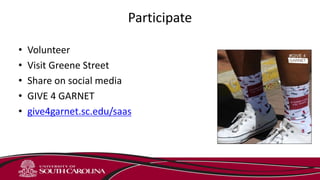
• Share on social media
• GIVE 4 GARNET
• give4garnet.sc.edu/saas
10 Years of Gamecock Guarantee
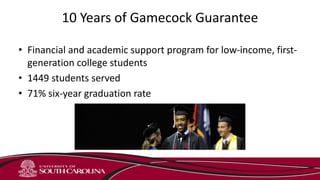
• Financial and academic support program for low-income, first-
generation college students
• 1449 students served
• 71% six-year graduation rate
Questions
Sara Shealy
shealyse@mailbox.sc.edu
803-576-6168
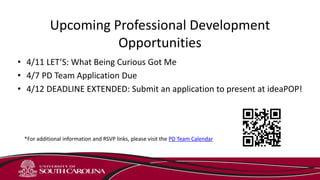
Upcoming Professional Development
Opportunities
• 4/11 LET’S: What Being Curious Got Me
• 4/7 PD Team Application Due
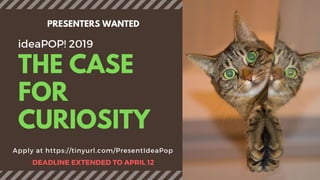
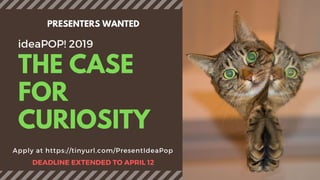
• 4/12 DEADLINE EXTENDED: Submit an application to present at ideaPOP!
*For additional information and RSVP links, please visit the PD Team Calendar
Nominate a GEM Today
Gamecocks who Excel at Magnificent Service
Nominate a colleague in your department or across the Division
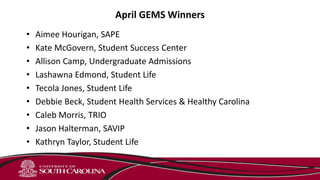
April GEMS Winners
• Aimee Hourigan, SAPE
• Kate McGovern, Student Success Center
• Allison Camp, Undergraduate Admissions
• Lashawna Edmond, Student Life
• Tecola Jones, Student Life
• Debbie Beck, Student Health Services & Healthy Carolina
• Caleb Morris, TRIO
• Jason Halterman, SAVIP
• Kathryn Taylor, Student Life
Nominators have a chance to win, too!
When you nominate a colleague you will be entered in the monthly drawings and
you have an opportunity to win a $25 gift card.
April Nominator Winner
• Maria Sturmer, Career Center
Mental Health Services
& Suicide Risk Reduction
University of South Carolina
Presentation Objectives
• Examine suicide and mental health statistics and trends
• Provide overview of the Suicide Prevention Task Force Report
– Mental health services on campus
– Current mental health and suicide prevention efforts
– Next steps and opportunities
– Overview of recommendations
• Describe emerging initiatives
– SAMHSA Garrett Lee Smith suicide prevention grant
– SHS service and prevention enhancements
– Campus enhancements
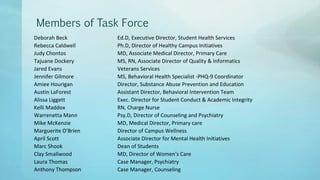
Members of Task Force
Deborah Beck Ed.D, Executive Director, Student Health Services
Rebecca Caldwell Ph.D, Director of Healthy Campus Initiatives
Judy Chontos MD, Associate Medical Director, Primary Care
Tajuane Dockery MS, RN, Associate Director of Quality & Informatics
Jared Evans Veterans Services
Jennifer Gilmore MS, Behavioral Health Specialist -PHQ-9 Coordinator
Amiee Hourigan Director, Substance Abuse Prevention and Education
Austin LaForest Assistant Director, Behavioral Intervention Team
Alissa Liggett Exec. Director for Student Conduct & Academic Integrity
Kelli Maddox RN, Charge Nurse
Warrenetta Mann Psy.D, Director of Counseling and Psychiatry
Mike McKenzie MD, Medical Director, Primary care
Marguerite O'Brien Director of Campus Wellness
April Scott Associate Director for Mental Health Initiatives
Marc Shook Dean of Students
Clay Smallwood MD, Director of Women's Care
Laura Thomas Case Manager, Psychiatry
Anthony Thompson Case Manager, Counseling
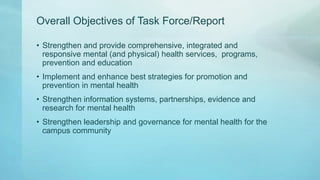
Overall Objectives of Task Force/Report
• Strengthen and provide comprehensive, integrated and
responsive mental (and physical) health services, programs,
prevention and education
• Implement and enhance best strategies for promotion and
prevention in mental health
• Strengthen information systems, partnerships, evidence and
research for mental health
• Strengthen leadership and governance for mental health for the
campus community
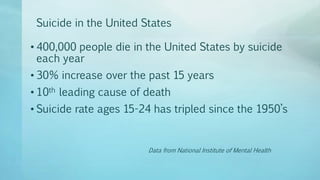
Suicide in the United States
• 400,000 people die in the United States by suicide
each year
• 30% increase over the past 15 years
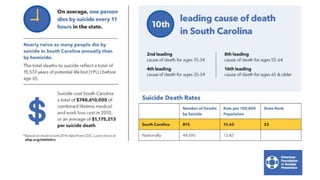
• 10th leading cause of death
• Suicide rate ages 15-24 has tripled since the 1950’s
Data from National Institute of Mental Health
Suicide in the United States
• Untreated depression is the # 1 cause of death
– Untreated mental illness (including depression, bipolar disorder,
schizophrenia, and others) is the cause for the vast majority of
suicides.
• Twice as many men (ages 20-24) complete suicide
compared to women
• Males tend to use more lethal means (70% firearms)
• 83% of people who die by suicide were seen by a health
care provider within 1 year of their death (29% in an
outpatient setting).
Data from CDC, National Institute of Mental Health, American Foundation
for Suicide Prevention & American Association of Suicidology
College Students and Suicide Prevalence
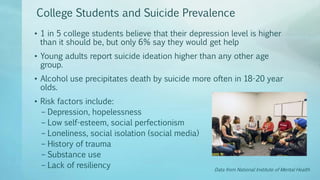
• 1 in 5 college students believe that their depression level is higher
than it should be, but only 6% say they would get help
• Young adults report suicide ideation higher than any other age
group.
• Alcohol use precipitates death by suicide more often in 18-20 year
olds.
• Risk factors include:
– Depression, hopelessness
– Low self-esteem, social perfectionism
– Loneliness, social isolation (social media)
– History of trauma
– Substance use
– Lack of resiliency Data from National Institute of Mental Health
University of South Carolina Data
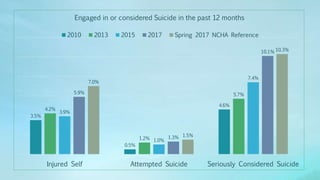
• Within a 12-month period (NCHA 2017):
– 10% of students seriously considered suicide at some point
– 6% of students intentionally caused harm to themselves
– 1.3% attempted suicide
• 73% of students indicated a current need for mental health services
(nationally 70%), (Healthy Minds, 2016)
• 52% of students perceive that “most people feel that mental health
treatment is a sign of personal failure”, and individually, 12% personally
believe it to be a personal failure (Healthy Minds, 2016)
• 71% consumed alcohol in the prior 30 days and 37% binge-drink at
least once within two weeks, (nationally 68% and 32%)
3.5%
0.5%
4.6%
4.2%
1.2%
5.7%
3.9%
1.0%
7.4%
5.9%
1.3%
10.1%
7.0%
1.5%
10.3%
Injured Self Attempted Suicide Seriously Considered Suicide
Engaged in or considered Suicide in the past 12 months
2010 2013 2015 2017 Spring 2017 NCHA Reference
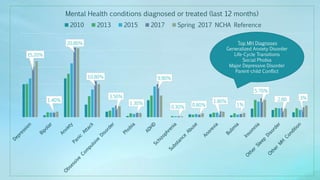
15.20%
1.40%
20.80%
10.80%
3.50%
1.30%
9.90%
0.30% 0.80%
1.80%
1%
5.70%
2.80 3%
Mental Health conditions diagnosed or treated (last 12 months)
2010 2013 2015 2017 Spring 2017 NCHA Reference
Top MH Diagnoses
Generalized Anxiety Disorder
Life-Cycle Transitions
Social Phobia
Major Depressive Disorder
Parent-child Conflict
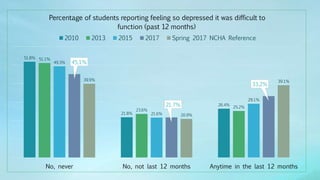
51.8%
21.8%
26.4%
51.1%
23.6%
25.2%
49.3%
21.6%
29.1%
45.1%
21.7%
33.2%
39.9%
20.9%
39.1%
No, never No, not last 12 months Anytime in the last 12 months
Percentage of students reporting feeling so depressed it was difficult to
function (past 12 months)
2010 2013 2015 2017 Spring 2017 NCHA Reference
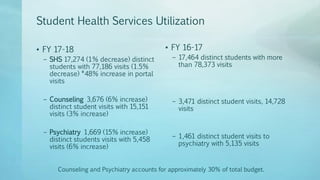
Student Health Services Utilization
• FY 17-18
– SHS 17,274 (1% decrease) distinct
students with 77,186 visits (1.5%
decrease) *48% increase in portal
visits
– Counseling 3,676 (6% increase)
distinct student visits with 15,151
visits (3% increase)
– Psychiatry 1,669 (15% increase)
distinct students visits with 5,458
visits (6% increase)
• FY 16-17
– 17,464 distinct students with more
than 78,373 visits
– 3,471 distinct student visits, 14,728
visits
– 1,461 distinct student visits to
psychiatry with 5,135 visits
Counseling and Psychiatry accounts for approximately 30% of total budget.
What Have We Done to Reduce Suicide Risk & Enhance
Our Mental Health Services
• Created a sustainable & integrated model of care
• Counseling and Psychiatry Services
– Highly qualified staff
– After-hours emergency response
• Incorporated National Prevention Strategies & Healthy Campus Objectives
• Mental Health Initiatives
– Prevention/Education
– Gatekeeper Training
– Community-Based Outreach
– Mental Health Matters Campaign
– Reduce stigma
• Campus and Community Partnerships
• JED Campus Model
– Mental Health Council
• Hired a 4-legged FTE-Indy
Student (Patient) Centered Medical Home
• Model integrates behavioral health, prevention and wellness into a
holistic model.
– Improve patient experience
– Improve health outcomes
– Reduce the cost of care
• Clinicians are key in identifying mental health needs as early as
possible and make appropriate referrals.
• This model has assisted us in identifying those at risk for depression
and other mental health concerns early and allowing us to provide
early intervention.
• The PCMH model of care aligns with the National Prevention Strategies
– model has been intentionally integrated to meet these standards and strategies
How Did We Assess Our Services & Suicide Prevention
Strategies
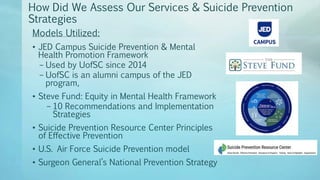
Models Utilized:
• JED Campus Suicide Prevention & Mental
Health Promotion Framework
– Used by UofSC since 2014
– UofSC is an alumni campus of the JED
program,
• Steve Fund: Equity in Mental Health Framework
– 10 Recommendations and Implementation
Strategies
• Suicide Prevention Resource Center Principles
of Effective Prevention
• U.S. Air Force Suicide Prevention model
• Surgeon General’s National Prevention Strategy
How Did We Assess Our Services & Suicide Prevention
Strategies
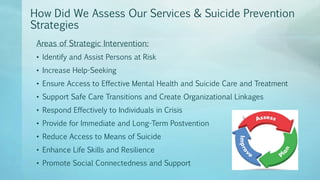
Areas of Strategic Intervention:
• Identify and Assist Persons at Risk
• Increase Help-Seeking
• Ensure Access to Effective Mental Health and Suicide Care and Treatment
• Support Safe Care Transitions and Create Organizational Linkages
• Respond Effectively to Individuals in Crisis
• Provide for Immediate and Long-Term Postvention
• Reduce Access to Means of Suicide
• Enhance Life Skills and Resilience
• Promote Social Connectedness and Support
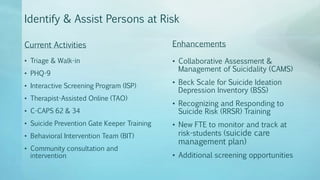
Identify & Assist Persons at Risk
Current Activities
• Triage & Walk-in
• PHQ-9
• Interactive Screening Program (ISP)
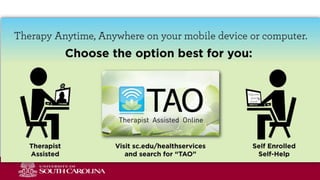
• Therapist-Assisted Online (TAO)
• C-CAPS 62 & 34
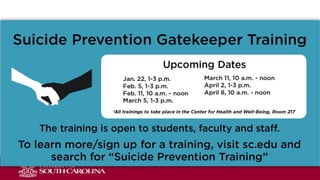
• Suicide Prevention Gate Keeper Training
• Behavioral Intervention Team (BIT)
• Community consultation and
intervention
Enhancements
• Collaborative Assessment &
Management of Suicidality (CAMS)
• Beck Scale for Suicide Ideation
Depression Inventory (BSS)
• Recognizing and Responding to
Suicide Risk (RRSR) Training
• New FTE to monitor and track at
risk-students (suicide care
management plan)
• Additional screening opportunities
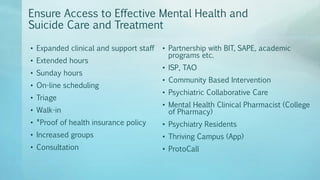
Ensure Access to Effective Mental Health and
Suicide Care and Treatment
• Expanded clinical and support staff
• Extended hours
• Sunday hours
• On-line scheduling
• Triage
• Walk-in
• *Proof of health insurance policy
• Increased groups
• Consultation
• Partnership with BIT, SAPE, academic
programs etc.
• ISP, TAO
• Community Based Intervention
• Psychiatric Collaborative Care
• Mental Health Clinical Pharmacist (College
of Pharmacy)
• Psychiatry Residents
• Thriving Campus (App)
• ProtoCall
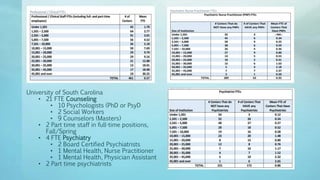
University of South Carolina
• 21 FTE Counseling
• 10 Psychologists (PhD or PsyD
• 2 Social Workers
• 9 Counselors (Masters)
• 2 Part time staff in full-time positions,
Fall/Spring
• 4 FTE Psychiatry
• 2 Board Certified Psychiatrists
• 1 Mental Health, Nurse Practitioner
• 1 Mental Health, Physician Assistant
• 2 Part time psychiatrists
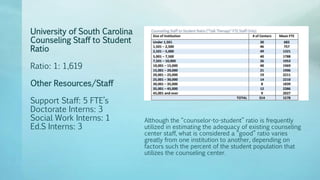
Although the “counselor-to-student” ratio is frequently
utilized in estimating the adequacy of existing counseling
center staff, what is considered a “good” ratio varies
greatly from one institution to another, depending on
factors such the percent of the student population that
utilizes the counseling center.
University of South Carolina
Counseling Staff to Student
Ratio
Ratio: 1: 1,619
Other Resources/Staff
Support Staff: 5 FTE’s
Doctorate Interns: 3
Social Work Interns: 1
Ed.S Interns: 3
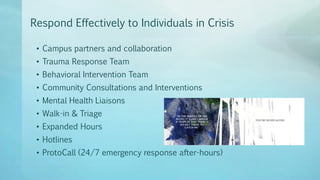
Respond Effectively to Individuals in Crisis
• Campus partners and collaboration
• Trauma Response Team
• Behavioral Intervention Team
• Community Consultations and Interventions
• Mental Health Liaisons
• Walk-in & Triage
• Expanded Hours
• Hotlines
• ProtoCall (24/7 emergency response after-hours)
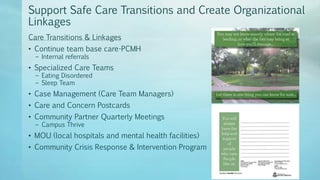
Support Safe Care Transitions and Create Organizational
Linkages
Care Transitions & Linkages
• Continue team base care-PCMH
– Internal referrals
• Specialized Care Teams
– Eating Disordered
– Sleep Team
• Case Management (Care Team Managers)
• Care and Concern Postcards
• Community Partner Quarterly Meetings
– Campus Thrive
• MOU (local hospitals and mental health facilities)
• Community Crisis Response & Intervention Program
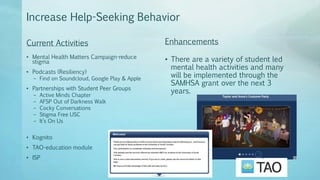
Increase Help-Seeking Behavior
Current Activities
• Mental Health Matters Campaign-reduce
stigma
• Podcasts (Resiliency)
– Find on Soundcloud, Google Play & Apple
• Partnerships with Student Peer Groups
– Active Minds Chapter
– AFSP Out of Darkness Walk
– Cocky Conversations
– Stigma Free USC
– It’s On Us
• Kognito
• TAO-education module
• ISP
Enhancements
• There are a variety of student led
mental health activities and many
will be implemented through the
SAMHSA grant over the next 3
years.
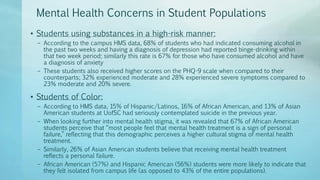
Mental Health Concerns in Student Populations
• Students using substances in a high-risk manner:
– According to the campus HMS data, 68% of students who had indicated consuming alcohol in
the past two weeks and having a diagnosis of depression had reported binge-drinking within
that two week period; similarly this rate is 67% for those who have consumed alcohol and have
a diagnosis of anxiety
– These students also received higher scores on the PHQ-9 scale when compared to their
counterparts; 32% experienced moderate and 28% experienced severe symptoms compared to
23% moderate and 20% severe.
• Students of Color:
– According to HMS data, 15% of Hispanic/Latinos, 16% of African American, and 13% of Asian
American students at UofSC had seriously contemplated suicide in the previous year.
– When looking further into mental health stigma, it was revealed that 67% of African American
students perceive that “most people feel that mental health treatment is a sign of personal
failure,” reflecting that this demographic perceives a higher cultural stigma of mental health
treatment.
– Similarly, 26% of Asian American students believe that receiving mental health treatment
reflects a personal failure.
– African American (57%) and Hispanic American (56%) students were more likely to indicate that
they felt isolated from campus life (as opposed to 43% of the entire populations).
Mental Health Concerns in Student Populations
• Student of Limited Resources (Low-SES, Pell Grant Eligible)
– HMS data indicated that 23% of students who had gone hungry due to not having enough
money for food had considered suicide in the past year.
– Along with an elevated rate of suicidal ideation when compared to the student population, a
larger percentage within this group of students (82%) also report currently needing assistance
with emotional or mental health problems more than the aggregate student population (73%).
• LGBTQ Students
– 20% of students who do not identify as heterosexual considered suicide in the past 12 months;
this rate is 21% for transgender students (NCHA).
– Students who did not identify as heterosexual lagged in all measures of campus belonging; only
59% see themselves as part of the campus community, as opposed to 83% of the total
population.
• Military and Veteran Students
– Of those military affiliated students who consume alcohol, 86% of female armed service
students reported binge drinking in the prior two weeks; 80% of male armed service students
reported binge drinking behavior (HMS).
– 11% of military affiliated students had seriously considered attempting suicide in the past year.
Together We Can: SAMHSA Garrett Lee Smith suicide
prevention & mental health promotion grant
• Audience-specific and culturally-informed education & prevention
programs, outreach marketing, and trainings will be enhanced
and/or implemented to five target populations determined to be
at increased risk of suicidal ideation and/or decreased help
seeking behavior.
– students of color, (to include International students)
– students veterans,
– LGBTQ students,
– students with low-SES/low financial resources,
– students who engage in high-risk behavior
• Programs will aim to increase sense of campus belonging, reduce
isolation, and increase resiliency among these populations.
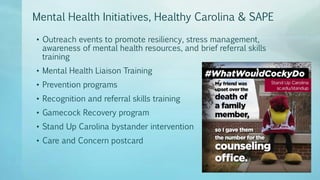
Mental Health Initiatives, Healthy Carolina & SAPE
• Outreach events to promote resiliency, stress management,
awareness of mental health resources, and brief referral skills
training
• Mental Health Liaison Training
• Prevention programs
• Recognition and referral skills training
• Gamecock Recovery program
• Stand Up Carolina bystander intervention
• Care and Concern postcard
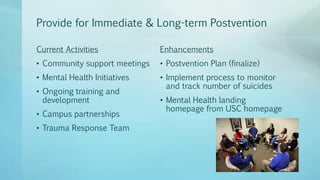
Provide for Immediate & Long-term Postvention
Current Activities
• Community support meetings
• Mental Health Initiatives
• Ongoing training and
development
• Campus partnerships
• Trauma Response Team
Enhancements
• Postvention Plan (finalize)
• Implement process to monitor
and track number of suicides
• Mental Health landing
homepage from USC homepage
Reduce Access to Means of Suicide
Current Activities
• MedReturn Program - National Association of Drug Diversion
Investigators (NADDI)
• Environmental Scan (annual)
• Means Restrictions
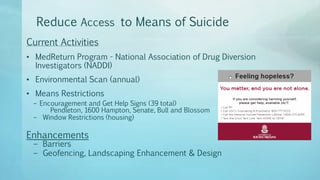
– Encouragement and Get Help Signs (39 total)
Pendleton, 1600 Hampton, Senate, Bull and Blossom
– Window Restrictions (housing)
Enhancements
– Barriers
– Geofencing, Landscaping Enhancement & Design
Enhance Life Skills and Resilience
Current Activities
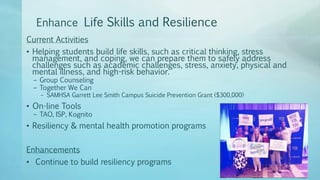
• Helping students build life skills, such as critical thinking, stress
management, and coping, we can prepare them to safely address
challenges such as academic challenges, stress, anxiety, physical and
mental illness, and high-risk behavior.
– Group Counseling
– Together We Can
– SAMHSA Garrett Lee Smith Campus Suicide Prevention Grant ($300,000)
• On-line Tools
– TAO, ISP, Kognito
• Resiliency & mental health promotion programs
Enhancements
• Continue to build resiliency programs
Promote Social Connectedness & Support
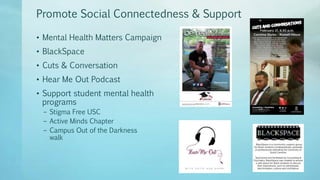
• Mental Health Matters Campaign
• BlackSpace
• Cuts & Conversation
• Hear Me Out Podcast
• Support student mental health
programs
– Stigma Free USC
– Active Minds Chapter
– Campus Out of the Darkness
walk
Awards/Recognitions
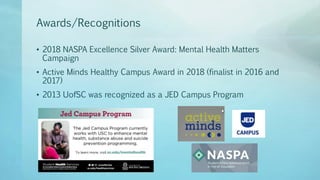
• 2018 NASPA Excellence Silver Award: Mental Health Matters
Campaign
• Active Minds Healthy Campus Award in 2018 (finalist in 2016 and
2017)
• 2013 UofSC was recognized as a JED Campus Program
Next Steps & Opportunities
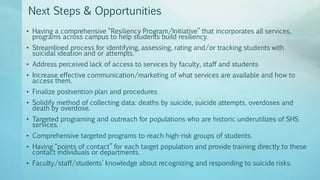
• Having a comprehensive “Resiliency Program/Initiative” that incorporates all services,
programs across campus to help students build resiliency.
• Streamlined process for identifying, assessing, rating and/or tracking students with
suicidal ideation and or attempts.
• Address perceived lack of access to services by faculty, staff and students
• Increase effective communication/marketing of what services are available and how to
access them.
• Finalize postvention plan and procedures
• Solidify method of collecting data: deaths by suicide, suicide attempts, overdoses and
death by overdose.
• Targeted programing and outreach for populations who are historic underutilizes of SHS
services.
• Comprehensive targeted programs to reach high-risk groups of students.
• Having “points of contact” for each target population and provide training directly to these
contact individuals or departments.
• Faculty/staff/students’ knowledge about recognizing and responding to suicide risks.
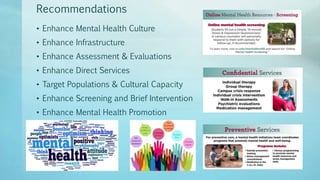
Recommendations
• Enhance Mental Health Culture
• Enhance Infrastructure
• Enhance Assessment & Evaluations
• Enhance Direct Services
• Target Populations & Cultural Capacity
• Enhance Screening and Brief Intervention
• Enhance Mental Health Promotion
Resources
• Counseling Center: 803-777-5223
– 24/7 after hours crisis (ProtoCall)
• Psychiatry: 803-777-1833
• Student Health Services: 803-777-3174
• National Suicide Hotline: 800-273-8255 (TALK)
• The Trevor Lifeline (LGBTQ): 866-488-7386
• Crisis Text Line: Text Home to 741741
• Columbia Area Mental Health: 803-898-8888
• USC Police Department: 803-777-4215
• https://www.cdc.gov/mentalhealth/index.htm
• https://www.surgeongeneral.gov/priorities/prevention/strategy/mental-and-emotional-well-being.html
• https://www.acha.org/HealthyCampus/Objectives/Student_Objectives
• https://www.crisistextline.org
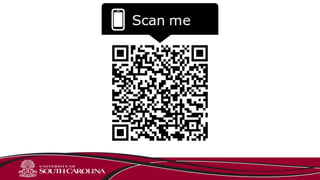
Tell us what you think!
• Get out your phone, laptop, tablet, etc.
• Go to srs.campuslabs.com
• Type in code 23324
Nominate a GEM Today!
Gamecocks who Excel at Magnificent Service
Nominate a colleague in your department or across the Division
PD Team
April Opportunities
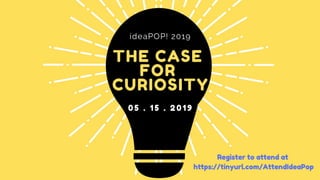
• 4/11 at 9am – L.E.T.S. Series: What Being Curious Got Me, with Dr. Pruitt
• 4/18 at 8:30 a.m. – What’s Dennis Reading? Breakfast
*For additional information and RSVP links, please visit the PD Team Calendar
Join the PD Team!
Application Due April 7th
PD Team Application
MAY 15, 2019
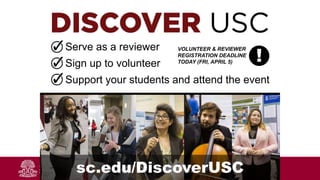
Serve as a reviewer
Support your students and attend the event
Sign up to volunteer
sc.edu/DiscoverUSC
VOLUNTEER & REVIEWER
REGISTRATION DEADLINE
TODAY (FRI, APRIL 5) !
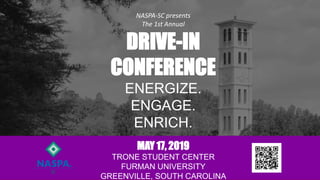
MAY 17, 2019
TRONE STUDENT CENTER
FURMAN UNIVERSITY
GREENVILLE, SOUTH CAROLINA
NASPA-SC presents
The 1st Annual
DRIVE-IN
CONFERENCE
ENERGIZE.
ENGAGE.
ENRICH.
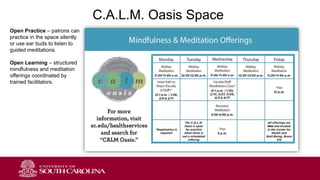
C.A.L.M. Oasis Space
Open Practice – patrons can
practice in the space silently
or use ear buds to listen to
guided meditations.
Open Learning – structured
mindfulness and meditation
offerings coordinated by
trained facilitators.
April 2019 Division Meeting

April 2019 Division Meeting

  • 1.
    Division Meeting Dr. Beck,Dr. Caldwell, and Dr. Mann April 5, 2019
  • 2.
    Dr. Dennis Pruitt VicePresident of Student Affairs & Academic Support
  • 3.
  • 4.
    Give 4 Garnet2019 April 10, 5:59 a.m. - midnight • Student Affairs Goal: 1,000 donors • Supports Gamecock Guarantee • Dr. Pruitt Challenge – $1 for every donor • Greene Street Celebration – 10 a.m. – 2 p.m.
  • 5.
    Participate • Volunteer • VisitGreene Street • Share on social media • GIVE 4 GARNET • give4garnet.sc.edu/saas
  • 6.
    10 Years ofGamecock Guarantee • Financial and academic support program for low-income, first- generation college students • 1449 students served • 71% six-year graduation rate
  • 7.
  • 8.
    Upcoming Professional Development Opportunities •4/11 LET’S: What Being Curious Got Me • 4/7 PD Team Application Due • 4/12 DEADLINE EXTENDED: Submit an application to present at ideaPOP! *For additional information and RSVP links, please visit the PD Team Calendar
  • 10.
    Nominate a GEMToday Gamecocks who Excel at Magnificent Service Nominate a colleague in your department or across the Division
  • 11.
    April GEMS Winners •Aimee Hourigan, SAPE • Kate McGovern, Student Success Center • Allison Camp, Undergraduate Admissions • Lashawna Edmond, Student Life • Tecola Jones, Student Life • Debbie Beck, Student Health Services & Healthy Carolina • Caleb Morris, TRIO • Jason Halterman, SAVIP • Kathryn Taylor, Student Life
  • 12.
    Nominators have achance to win, too! When you nominate a colleague you will be entered in the monthly drawings and you have an opportunity to win a $25 gift card.
  • 13.
    April Nominator Winner •Maria Sturmer, Career Center
  • 15.
    Mental Health Services &Suicide Risk Reduction University of South Carolina
  • 16.
    Presentation Objectives • Examinesuicide and mental health statistics and trends • Provide overview of the Suicide Prevention Task Force Report – Mental health services on campus – Current mental health and suicide prevention efforts – Next steps and opportunities – Overview of recommendations • Describe emerging initiatives – SAMHSA Garrett Lee Smith suicide prevention grant – SHS service and prevention enhancements – Campus enhancements
  • 17.
    Members of TaskForce Deborah Beck Ed.D, Executive Director, Student Health Services Rebecca Caldwell Ph.D, Director of Healthy Campus Initiatives Judy Chontos MD, Associate Medical Director, Primary Care Tajuane Dockery MS, RN, Associate Director of Quality & Informatics Jared Evans Veterans Services Jennifer Gilmore MS, Behavioral Health Specialist -PHQ-9 Coordinator Amiee Hourigan Director, Substance Abuse Prevention and Education Austin LaForest Assistant Director, Behavioral Intervention Team Alissa Liggett Exec. Director for Student Conduct & Academic Integrity Kelli Maddox RN, Charge Nurse Warrenetta Mann Psy.D, Director of Counseling and Psychiatry Mike McKenzie MD, Medical Director, Primary care Marguerite O'Brien Director of Campus Wellness April Scott Associate Director for Mental Health Initiatives Marc Shook Dean of Students Clay Smallwood MD, Director of Women's Care Laura Thomas Case Manager, Psychiatry Anthony Thompson Case Manager, Counseling
  • 18.
    Overall Objectives ofTask Force/Report • Strengthen and provide comprehensive, integrated and responsive mental (and physical) health services, programs, prevention and education • Implement and enhance best strategies for promotion and prevention in mental health • Strengthen information systems, partnerships, evidence and research for mental health • Strengthen leadership and governance for mental health for the campus community
  • 19.
    Suicide in theUnited States • 400,000 people die in the United States by suicide each year • 30% increase over the past 15 years • 10th leading cause of death • Suicide rate ages 15-24 has tripled since the 1950’s Data from National Institute of Mental Health
  • 20.
    Suicide in theUnited States • Untreated depression is the # 1 cause of death – Untreated mental illness (including depression, bipolar disorder, schizophrenia, and others) is the cause for the vast majority of suicides. • Twice as many men (ages 20-24) complete suicide compared to women • Males tend to use more lethal means (70% firearms) • 83% of people who die by suicide were seen by a health care provider within 1 year of their death (29% in an outpatient setting). Data from CDC, National Institute of Mental Health, American Foundation for Suicide Prevention & American Association of Suicidology
  • 22.
    College Students andSuicide Prevalence • 1 in 5 college students believe that their depression level is higher than it should be, but only 6% say they would get help • Young adults report suicide ideation higher than any other age group. • Alcohol use precipitates death by suicide more often in 18-20 year olds. • Risk factors include: – Depression, hopelessness – Low self-esteem, social perfectionism – Loneliness, social isolation (social media) – History of trauma – Substance use – Lack of resiliency Data from National Institute of Mental Health
  • 23.
    University of SouthCarolina Data • Within a 12-month period (NCHA 2017): – 10% of students seriously considered suicide at some point – 6% of students intentionally caused harm to themselves – 1.3% attempted suicide • 73% of students indicated a current need for mental health services (nationally 70%), (Healthy Minds, 2016) • 52% of students perceive that “most people feel that mental health treatment is a sign of personal failure”, and individually, 12% personally believe it to be a personal failure (Healthy Minds, 2016) • 71% consumed alcohol in the prior 30 days and 37% binge-drink at least once within two weeks, (nationally 68% and 32%)
  • 24.
    3.5% 0.5% 4.6% 4.2% 1.2% 5.7% 3.9% 1.0% 7.4% 5.9% 1.3% 10.1% 7.0% 1.5% 10.3% Injured Self AttemptedSuicide Seriously Considered Suicide Engaged in or considered Suicide in the past 12 months 2010 2013 2015 2017 Spring 2017 NCHA Reference
  • 25.
    15.20% 1.40% 20.80% 10.80% 3.50% 1.30% 9.90% 0.30% 0.80% 1.80% 1% 5.70% 2.80 3% MentalHealth conditions diagnosed or treated (last 12 months) 2010 2013 2015 2017 Spring 2017 NCHA Reference Top MH Diagnoses Generalized Anxiety Disorder Life-Cycle Transitions Social Phobia Major Depressive Disorder Parent-child Conflict
  • 26.
    51.8% 21.8% 26.4% 51.1% 23.6% 25.2% 49.3% 21.6% 29.1% 45.1% 21.7% 33.2% 39.9% 20.9% 39.1% No, never No,not last 12 months Anytime in the last 12 months Percentage of students reporting feeling so depressed it was difficult to function (past 12 months) 2010 2013 2015 2017 Spring 2017 NCHA Reference
  • 27.
    Student Health ServicesUtilization • FY 17-18 – SHS 17,274 (1% decrease) distinct students with 77,186 visits (1.5% decrease) *48% increase in portal visits – Counseling 3,676 (6% increase) distinct student visits with 15,151 visits (3% increase) – Psychiatry 1,669 (15% increase) distinct students visits with 5,458 visits (6% increase) • FY 16-17 – 17,464 distinct students with more than 78,373 visits – 3,471 distinct student visits, 14,728 visits – 1,461 distinct student visits to psychiatry with 5,135 visits Counseling and Psychiatry accounts for approximately 30% of total budget.
  • 28.
    What Have WeDone to Reduce Suicide Risk & Enhance Our Mental Health Services • Created a sustainable & integrated model of care • Counseling and Psychiatry Services – Highly qualified staff – After-hours emergency response • Incorporated National Prevention Strategies & Healthy Campus Objectives • Mental Health Initiatives – Prevention/Education – Gatekeeper Training – Community-Based Outreach – Mental Health Matters Campaign – Reduce stigma • Campus and Community Partnerships • JED Campus Model – Mental Health Council • Hired a 4-legged FTE-Indy
  • 29.
    Student (Patient) CenteredMedical Home • Model integrates behavioral health, prevention and wellness into a holistic model. – Improve patient experience – Improve health outcomes – Reduce the cost of care • Clinicians are key in identifying mental health needs as early as possible and make appropriate referrals. • This model has assisted us in identifying those at risk for depression and other mental health concerns early and allowing us to provide early intervention. • The PCMH model of care aligns with the National Prevention Strategies – model has been intentionally integrated to meet these standards and strategies
  • 30.
    How Did WeAssess Our Services & Suicide Prevention Strategies Models Utilized: • JED Campus Suicide Prevention & Mental Health Promotion Framework – Used by UofSC since 2014 – UofSC is an alumni campus of the JED program, • Steve Fund: Equity in Mental Health Framework – 10 Recommendations and Implementation Strategies • Suicide Prevention Resource Center Principles of Effective Prevention • U.S. Air Force Suicide Prevention model • Surgeon General’s National Prevention Strategy
  • 31.
    How Did WeAssess Our Services & Suicide Prevention Strategies Areas of Strategic Intervention: • Identify and Assist Persons at Risk • Increase Help-Seeking • Ensure Access to Effective Mental Health and Suicide Care and Treatment • Support Safe Care Transitions and Create Organizational Linkages • Respond Effectively to Individuals in Crisis • Provide for Immediate and Long-Term Postvention • Reduce Access to Means of Suicide • Enhance Life Skills and Resilience • Promote Social Connectedness and Support
  • 32.
    Identify & AssistPersons at Risk Current Activities • Triage & Walk-in • PHQ-9 • Interactive Screening Program (ISP) • Therapist-Assisted Online (TAO) • C-CAPS 62 & 34 • Suicide Prevention Gate Keeper Training • Behavioral Intervention Team (BIT) • Community consultation and intervention Enhancements • Collaborative Assessment & Management of Suicidality (CAMS) • Beck Scale for Suicide Ideation Depression Inventory (BSS) • Recognizing and Responding to Suicide Risk (RRSR) Training • New FTE to monitor and track at risk-students (suicide care management plan) • Additional screening opportunities
  • 33.
    Ensure Access toEffective Mental Health and Suicide Care and Treatment • Expanded clinical and support staff • Extended hours • Sunday hours • On-line scheduling • Triage • Walk-in • *Proof of health insurance policy • Increased groups • Consultation • Partnership with BIT, SAPE, academic programs etc. • ISP, TAO • Community Based Intervention • Psychiatric Collaborative Care • Mental Health Clinical Pharmacist (College of Pharmacy) • Psychiatry Residents • Thriving Campus (App) • ProtoCall
  • 34.
    University of SouthCarolina • 21 FTE Counseling • 10 Psychologists (PhD or PsyD • 2 Social Workers • 9 Counselors (Masters) • 2 Part time staff in full-time positions, Fall/Spring • 4 FTE Psychiatry • 2 Board Certified Psychiatrists • 1 Mental Health, Nurse Practitioner • 1 Mental Health, Physician Assistant • 2 Part time psychiatrists
  • 35.
    Although the “counselor-to-student”ratio is frequently utilized in estimating the adequacy of existing counseling center staff, what is considered a “good” ratio varies greatly from one institution to another, depending on factors such the percent of the student population that utilizes the counseling center. University of South Carolina Counseling Staff to Student Ratio Ratio: 1: 1,619 Other Resources/Staff Support Staff: 5 FTE’s Doctorate Interns: 3 Social Work Interns: 1 Ed.S Interns: 3
  • 36.
    Respond Effectively toIndividuals in Crisis • Campus partners and collaboration • Trauma Response Team • Behavioral Intervention Team • Community Consultations and Interventions • Mental Health Liaisons • Walk-in & Triage • Expanded Hours • Hotlines • ProtoCall (24/7 emergency response after-hours)
  • 37.
    Support Safe CareTransitions and Create Organizational Linkages Care Transitions & Linkages • Continue team base care-PCMH – Internal referrals • Specialized Care Teams – Eating Disordered – Sleep Team • Case Management (Care Team Managers) • Care and Concern Postcards • Community Partner Quarterly Meetings – Campus Thrive • MOU (local hospitals and mental health facilities) • Community Crisis Response & Intervention Program
  • 38.
    Increase Help-Seeking Behavior CurrentActivities • Mental Health Matters Campaign-reduce stigma • Podcasts (Resiliency) – Find on Soundcloud, Google Play & Apple • Partnerships with Student Peer Groups – Active Minds Chapter – AFSP Out of Darkness Walk – Cocky Conversations – Stigma Free USC – It’s On Us • Kognito • TAO-education module • ISP Enhancements • There are a variety of student led mental health activities and many will be implemented through the SAMHSA grant over the next 3 years.
  • 39.
    Mental Health Concernsin Student Populations • Students using substances in a high-risk manner: – According to the campus HMS data, 68% of students who had indicated consuming alcohol in the past two weeks and having a diagnosis of depression had reported binge-drinking within that two week period; similarly this rate is 67% for those who have consumed alcohol and have a diagnosis of anxiety – These students also received higher scores on the PHQ-9 scale when compared to their counterparts; 32% experienced moderate and 28% experienced severe symptoms compared to 23% moderate and 20% severe. • Students of Color: – According to HMS data, 15% of Hispanic/Latinos, 16% of African American, and 13% of Asian American students at UofSC had seriously contemplated suicide in the previous year. – When looking further into mental health stigma, it was revealed that 67% of African American students perceive that “most people feel that mental health treatment is a sign of personal failure,” reflecting that this demographic perceives a higher cultural stigma of mental health treatment. – Similarly, 26% of Asian American students believe that receiving mental health treatment reflects a personal failure. – African American (57%) and Hispanic American (56%) students were more likely to indicate that they felt isolated from campus life (as opposed to 43% of the entire populations).
  • 40.
    Mental Health Concernsin Student Populations • Student of Limited Resources (Low-SES, Pell Grant Eligible) – HMS data indicated that 23% of students who had gone hungry due to not having enough money for food had considered suicide in the past year. – Along with an elevated rate of suicidal ideation when compared to the student population, a larger percentage within this group of students (82%) also report currently needing assistance with emotional or mental health problems more than the aggregate student population (73%). • LGBTQ Students – 20% of students who do not identify as heterosexual considered suicide in the past 12 months; this rate is 21% for transgender students (NCHA). – Students who did not identify as heterosexual lagged in all measures of campus belonging; only 59% see themselves as part of the campus community, as opposed to 83% of the total population. • Military and Veteran Students – Of those military affiliated students who consume alcohol, 86% of female armed service students reported binge drinking in the prior two weeks; 80% of male armed service students reported binge drinking behavior (HMS). – 11% of military affiliated students had seriously considered attempting suicide in the past year.
  • 41.
    Together We Can:SAMHSA Garrett Lee Smith suicide prevention & mental health promotion grant • Audience-specific and culturally-informed education & prevention programs, outreach marketing, and trainings will be enhanced and/or implemented to five target populations determined to be at increased risk of suicidal ideation and/or decreased help seeking behavior. – students of color, (to include International students) – students veterans, – LGBTQ students, – students with low-SES/low financial resources, – students who engage in high-risk behavior • Programs will aim to increase sense of campus belonging, reduce isolation, and increase resiliency among these populations.
  • 42.
    Mental Health Initiatives,Healthy Carolina & SAPE • Outreach events to promote resiliency, stress management, awareness of mental health resources, and brief referral skills training • Mental Health Liaison Training • Prevention programs • Recognition and referral skills training • Gamecock Recovery program • Stand Up Carolina bystander intervention • Care and Concern postcard
  • 43.
    Provide for Immediate& Long-term Postvention Current Activities • Community support meetings • Mental Health Initiatives • Ongoing training and development • Campus partnerships • Trauma Response Team Enhancements • Postvention Plan (finalize) • Implement process to monitor and track number of suicides • Mental Health landing homepage from USC homepage
  • 44.
    Reduce Access toMeans of Suicide Current Activities • MedReturn Program - National Association of Drug Diversion Investigators (NADDI) • Environmental Scan (annual) • Means Restrictions – Encouragement and Get Help Signs (39 total) Pendleton, 1600 Hampton, Senate, Bull and Blossom – Window Restrictions (housing) Enhancements – Barriers – Geofencing, Landscaping Enhancement & Design
  • 45.
    Enhance Life Skillsand Resilience Current Activities • Helping students build life skills, such as critical thinking, stress management, and coping, we can prepare them to safely address challenges such as academic challenges, stress, anxiety, physical and mental illness, and high-risk behavior. – Group Counseling – Together We Can – SAMHSA Garrett Lee Smith Campus Suicide Prevention Grant ($300,000) • On-line Tools – TAO, ISP, Kognito • Resiliency & mental health promotion programs Enhancements • Continue to build resiliency programs
  • 46.
    Promote Social Connectedness& Support • Mental Health Matters Campaign • BlackSpace • Cuts & Conversation • Hear Me Out Podcast • Support student mental health programs – Stigma Free USC – Active Minds Chapter – Campus Out of the Darkness walk
  • 47.
    Awards/Recognitions • 2018 NASPAExcellence Silver Award: Mental Health Matters Campaign • Active Minds Healthy Campus Award in 2018 (finalist in 2016 and 2017) • 2013 UofSC was recognized as a JED Campus Program
  • 48.
    Next Steps &Opportunities • Having a comprehensive “Resiliency Program/Initiative” that incorporates all services, programs across campus to help students build resiliency. • Streamlined process for identifying, assessing, rating and/or tracking students with suicidal ideation and or attempts. • Address perceived lack of access to services by faculty, staff and students • Increase effective communication/marketing of what services are available and how to access them. • Finalize postvention plan and procedures • Solidify method of collecting data: deaths by suicide, suicide attempts, overdoses and death by overdose. • Targeted programing and outreach for populations who are historic underutilizes of SHS services. • Comprehensive targeted programs to reach high-risk groups of students. • Having “points of contact” for each target population and provide training directly to these contact individuals or departments. • Faculty/staff/students’ knowledge about recognizing and responding to suicide risks.
  • 49.
    Recommendations • Enhance MentalHealth Culture • Enhance Infrastructure • Enhance Assessment & Evaluations • Enhance Direct Services • Target Populations & Cultural Capacity • Enhance Screening and Brief Intervention • Enhance Mental Health Promotion
  • 50.
    Resources • Counseling Center:803-777-5223 – 24/7 after hours crisis (ProtoCall) • Psychiatry: 803-777-1833 • Student Health Services: 803-777-3174 • National Suicide Hotline: 800-273-8255 (TALK) • The Trevor Lifeline (LGBTQ): 866-488-7386 • Crisis Text Line: Text Home to 741741 • Columbia Area Mental Health: 803-898-8888 • USC Police Department: 803-777-4215 • https://www.cdc.gov/mentalhealth/index.htm • https://www.surgeongeneral.gov/priorities/prevention/strategy/mental-and-emotional-well-being.html • https://www.acha.org/HealthyCampus/Objectives/Student_Objectives • https://www.crisistextline.org
  • 51.
    Tell us whatyou think! • Get out your phone, laptop, tablet, etc. • Go to srs.campuslabs.com • Type in code 23324
  • 52.
    Nominate a GEMToday! Gamecocks who Excel at Magnificent Service Nominate a colleague in your department or across the Division
  • 53.
    PD Team April Opportunities •4/11 at 9am – L.E.T.S. Series: What Being Curious Got Me, with Dr. Pruitt • 4/18 at 8:30 a.m. – What’s Dennis Reading? Breakfast *For additional information and RSVP links, please visit the PD Team Calendar
  • 54.
    Join the PDTeam! Application Due April 7th PD Team Application
  • 55.
  • 58.
    Serve as areviewer Support your students and attend the event Sign up to volunteer sc.edu/DiscoverUSC VOLUNTEER & REVIEWER REGISTRATION DEADLINE TODAY (FRI, APRIL 5) !
  • 59.
    MAY 17, 2019 TRONESTUDENT CENTER FURMAN UNIVERSITY GREENVILLE, SOUTH CAROLINA NASPA-SC presents The 1st Annual DRIVE-IN CONFERENCE ENERGIZE. ENGAGE. ENRICH.
  • 64.
    C.A.L.M. Oasis Space OpenPractice – patrons can practice in the space silently or use ear buds to listen to guided meditations. Open Learning – structured mindfulness and meditation offerings coordinated by trained facilitators.

Editor's Notes