Jun. 25, 2014
Auto-ID Labs, KAIST
Dept. of Computer Science, KAIST
GS1 EPCglobal framework and
Oliot Project overview
Seonghoon Kim
shkim08@kaist.ac.kr, http://oliot.org, http://autoidlab.kaist.ac.kr, http://resl.kaist.ac.kr http://autoidlabs.org http://gs1.org
© Auto-ID Lab Korea / KAIST
Slide 2
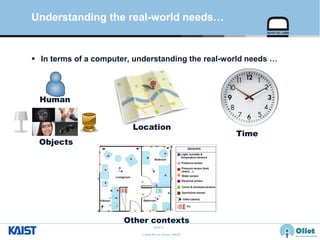
Understanding the real-world needs…
 In terms of a computer, understanding the real-world needs …
Location
Time
Other contexts
Human
Objects
© Auto-ID Lab Korea / KAIST
Slide 3
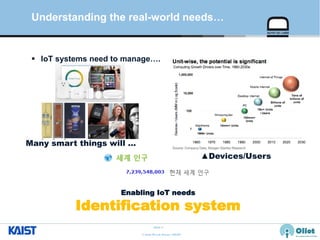
Understanding the real-world needs…
 IoT systems need to manage….
▲Devices/Users
Enabling IoT needs
Identification system
Many smart things will …
© Auto-ID Lab Korea / KAIST
Slide 4
Contents
 GS1/EPCglobal standard
– Introduction
– Global Product Classification (GPC)
– Application Identifier (AI)
– GS1 Keys
– Electronic Product Code (EPC)
– GS1/EPCglobal Architecture
 Oliot (Open Language for Internet of Things)
– Overview
– Smart Things’ Control & Data Acquisition
– Oliot middleware for sensors, and actuators
– Oliot Datastore
– Discovery & ONS
– Current status
 Conclusion
© Auto-ID Lab Korea / KAIST
Slide 5
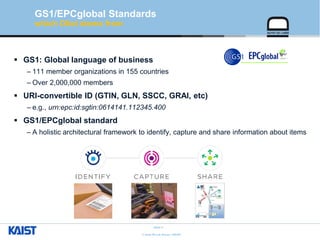
 GS1: Global language of business
– 111 member organizations in 155 countries
– Over 2,000,000 members
 URI-convertible ID (GTIN, GLN, SSCC, GRAI, etc)
– e.g., urn:epc:id:sgtin:0614141.112345.400
 GS1/EPCglobal standard
– A holistic architectural framework to identify, capture and share information about items
GS1/EPCglobal Standards
which Oliot stems from
© Auto-ID Lab Korea / KAIST
Slide 6
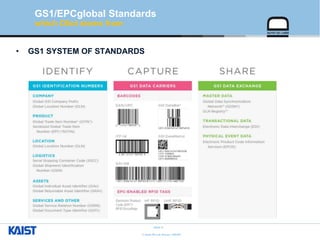
• GS1 SYSTEM OF STANDARDS
GS1/EPCglobal Standards
which Oliot stems from
© Auto-ID Lab Korea / KAIST
Slide 7
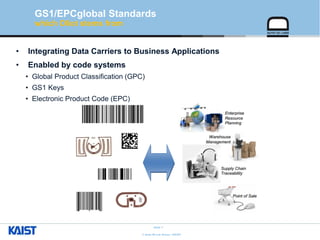
• Integrating Data Carriers to Business Applications
• Enabled by code systems
• Global Product Classification (GPC)
• GS1 Keys
• Electronic Product Code (EPC)
GS1/EPCglobal Standards
which Oliot stems from
© Auto-ID Lab Korea / KAIST
Slide 8
GS1/EPCglobal Standards
Global Product Classification (GPC)
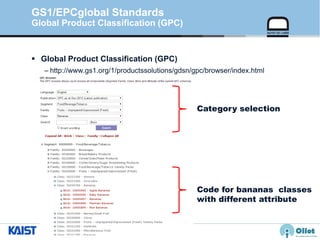
 Global Product Classification (GPC)
– http://www.gs1.org/1/productssolutions/gdsn/gpc/browser/index.html
Category selection
Code for bananas classes
with different attribute
© Auto-ID Lab Korea / KAIST
Slide 9
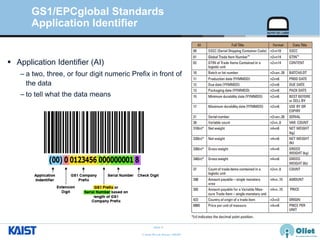
 Application Identifier (AI)
– a two, three, or four digit numeric Prefix in front of
the data
– to tell what the data means
GS1/EPCglobal Standards
Application Identifier
© Auto-ID Lab Korea / KAIST
Slide 10
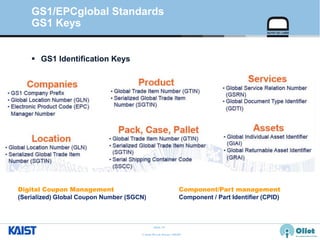
 GS1 Identification Keys
GS1/EPCglobal Standards
GS1 Keys
Digital Coupon Management
(Serialized) Global Coupon Number (SGCN)
Component/Part management
Component / Part Identifier (CPID)
© Auto-ID Lab Korea / KAIST
Slide 11
 GLN, GTIN, and SSCC
GS1/EPCglobal Standards
GS1 Keys
© Auto-ID Lab Korea / KAIST
Slide 12
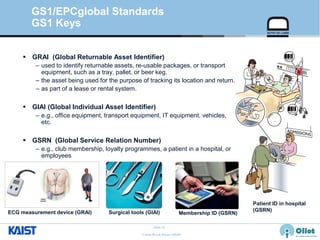
 GRAI (Global Returnable Asset Identifier)
– used to identify returnable assets, re-usable packages, or transport
equipment, such as a tray, pallet, or beer keg.
– the asset being used for the purpose of tracking its location and return.
– as part of a lease or rental system.
 GIAI (Global Individual Asset Identifier)
– e.g., office equipment, transport equipment, IT equipment, vehicles,
etc.
 GSRN (Global Service Relation Number)
– e.g., club membership, loyalty programmes, a patient in a hospital, or
employees
GS1/EPCglobal Standards
GS1 Keys
ECG measurement device (GRAI)
Surgical equipment (GIAI)
Membership ID (GSRN)
Patient ID in hospital
(GSRN)Surgical tools (GIAI)
© Auto-ID Lab Korea / KAIST
Slide 13
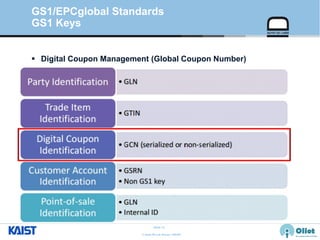
 Digital Coupon Management (Global Coupon Number)
GS1/EPCglobal Standards
GS1 Keys
© Auto-ID Lab Korea / KAIST
Slide 14
 The Component / Part Identifier (CPID)
– enables companies to identify components and parts, typically where an
Original Equipment Manufacturer (OEM) defines the specifications of a
component or part that is part of its final product
GS1/EPCglobal Standards
GS1 Keys
© Auto-ID Lab Korea / KAIST
Slide 15
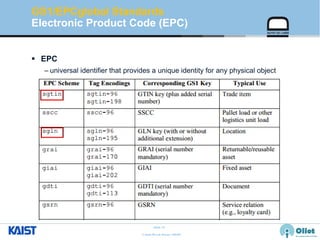
 EPC
– universal identifier that provides a unique identity for any physical object
GS1/EPCglobal Standards
Electronic Product Code (EPC)
© Auto-ID Lab Korea / KAIST
Slide 16
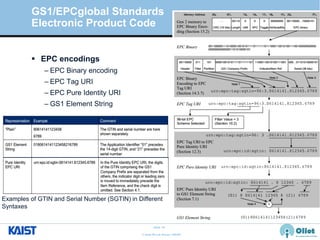
 EPC encodings
– EPC Binary encoding
– EPC Tag URI
– EPC Pure Identity URI
– GS1 Element String
GS1/EPCglobal Standards
Electronic Product Code
Examples of GTIN and Serial Number (SGTIN) in Different
Syntaxes
© Auto-ID Lab Korea / KAIST
Slide 17
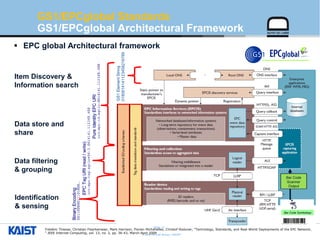
 EPC global Architectural framework
GS1/EPCglobal Standards
GS1/EPCglobal Architectural Framework
Identification
& sensing
Data filtering
& grouping
Data store and
share
Item Discovery &
Information search
Frédéric Thiesse, Christian Floerkemeier, Mark Harrison, Florian Michahelles, Christof Roduner, "Technology, Standards, and Real-World Deployments of the EPC Network,
" IEEE Internet Computing, vol. 13, no. 2, pp. 36-43, March-April 2009
Bar Code
Scanner
Output
GS1ElementString
0180614141123458216789
© Auto-ID Lab Korea / KAIST
Slide 18
GS1/EPCglobal Standards
GS1/EPCglobal Architectural Framework
with Supply Chain Example
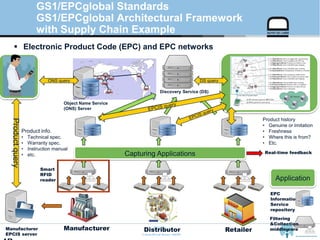
 Electronic Product Code (EPC) and EPC networks
Applications
Manufacturer Distributor Retailer
Product info.
• Technical spec.
• Warranty spec.
• Instruction manual
• etc.
Product history
• Genuine or Imitation
• Freshness
• Where this is from?
• Etc.
Manufacturer
EPCIS server
Productquery
Korea
JapanChina
Taiwan
Australia
USA
Brazil
Switzerland
England
Object Name Service
(ONS) Server
ONS query
EPC
Information
Service
repository
Filtering
&Collection
middleware
Capturing Applications
DS query
Application
Real-time feedback
Smart
RFID
reader
Discovery Service (DS)
© Auto-ID Lab Korea / KAIST
Slide 19
Open Language for the Internet of Things
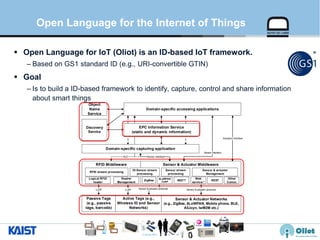
 Open Language for IoT (Oliot) is an ID-based IoT framework.
– Based on GS1 standard ID (e.g., URI-convertible GTIN)
 Goal
– Is to build a ID-based framework to identify, capture, control and share information
about smart things
Passive Tags
(e.g., passive
tags, barcode)
Sensor & Actuator Networks
(e.g., ZigBee, 6LoWPAN, Mobile phone, BLE,
AllJoyn, lwM2M etc.)
Active Tags (e.g.,
Wireless ID and Sensor
Networks)
RFID Middleware
LLRP LLRP Sensor & actuator protocols Sensor & actuator protocols
Domain-specific capturing application
Domain-specific accessing applications
Sensor Interface
Sensor interface
EPC Information Service
(static and dynamic information)
ALE
Actuation Interface
Sensor & Actuator Middleware
Object
Name
Service
Discovery
Service
ZigBee
6LoWPAN/
CoAP
MQTT
Web
service-*
REST
Other
Comm.
RFID stream processing
Logical RFID
reader
Reader
Management
Sensor stream
processing
Sensor & actuator
Management
ID-Sensor stream
processing
© Auto-ID Lab Korea / KAIST
Slide 20
Oliot Scope
Smart Things’ Control & Data Acquisition
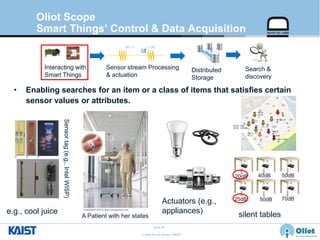
• Enabling searches for an item or a class of items that satisfies certain
sensor values or attributes.
Sensortag(e.g.,IntelWISP)
e.g., cool juice
A Patient with her states
20dB 50dB40dB
70dB50dB25dB
silent tables
4인 3T,
소근소
근
Full, 시끄러
움
Full, 조
용,
몬순 커피
2인
2T
테이블 4, 조
용
휴
업
2인
4T
4인
2T
4인
2T
8인 2T, 조용
4인 3T, 시끄러움
∆t
Sensor stream Processing
& actuation
Distributed
Storage
Interacting with
Smart Things
Search &
discovery
Actuators (e.g.,
appliances)
© Auto-ID Lab Korea / KAIST
Slide 21
Passive Tags
(e.g., passive
tags)
Sensor & Actuator Networks
(e.g., ZigBee, 6LoWPAN, Mobile phone, etc.)
Active Tags (e.g.,
Wireless ID and Sensor
Networks)
RFID Middleware
LLRP LLRP Sensor & actuator protocols Sensor & actuator protocols
Object orchestration and organization management
Domain-specific applications
Sensor Interface
Sensor interface
Smart Things Information Service
(static and dynamic information)
ALE
Actuation Interface
Sensor & Actuator Middleware
ONS
Discovery
Service
ZigBee
6LoWPAN/
CoAP
MQTT
Web
service-*
REST
Other
Comm.
RFID stream processing
Logical RFID
reader
Reader
Management
Sensor stream processing
Sensor & actuator
Management
Oliot Scope
Smart Things’ Control & Data Acquisition
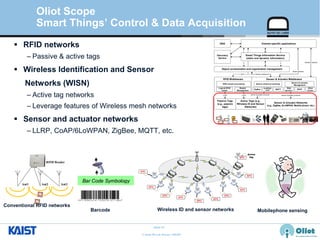
 RFID networks
– Passive & active tags
 Wireless Identification and Sensor
Networks (WISN)
– Active tag networks
– Leverage features of Wireless mesh networks
 Sensor and actuator networks
– LLRP, CoAP/6LoWPAN, ZigBee, MQTT, etc.
RFID Reader
Ant1 Ant2 Ant3
Conventional RFID networks
Wireless ID and sensor networks
EPC
EPC
EPC
EPC
EPC
EPC EPC
EPC
EPC
Active
tagEPC
Mobilephone sensingBarcode
© Auto-ID Lab Korea / KAIST
Slide 22
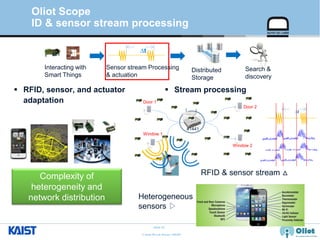
 Stream processing
Oliot Scope
ID & sensor stream processing
 RFID, sensor, and actuator
adaptation
Complexity of
heterogeneity and
network distribution
∆t
#1441
Door 1
Window 1
Door 2
Window 2
RFID & sensor stream △
Heterogeneous
sensors ▷
∆t
Sensor stream Processing
& actuation
Distributed
Storage
Interacting with
Smart Things
Search &
discovery
© Auto-ID Lab Korea / KAIST
Slide 23
Oliot Scope
ID & sensor stream processing
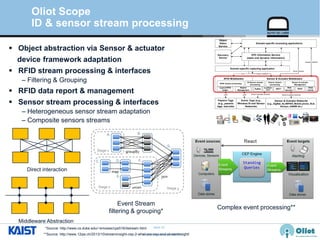
 Object abstraction via Sensor & actuator
device framework adaptation
 RFID stream processing & interfaces
– Filtering & Grouping
 RFID data report & management
 Sensor stream processing & interfaces
– Heterogeneous sensor stream adaptation
– Composite sensors streams
*Source: http://www.cs.duke.edu/~kmoses/cps516/dstream.html
Event Stream
filtering & grouping*
Direct interaction
Middleware Abstraction
Passive Tags
(e.g., passive
tags, barcode)
Sensor & Actuator Networks
(e.g., ZigBee, 6LoWPAN, Mobile phone, BLE,
AllJoyn, lwM2M etc.)
Active Tags (e.g.,
Wireless ID and Sensor
Networks)
RFID Middleware
LLRP LLRP Sensor & actuator protocols Sensor & actuator protocols
Domain-specific capturing application
Domain-specific accessing applications
Sensor Interface
Sensor interface
EPC Information Service
(static and dynamic information)
ALE
Actuation Interface
Sensor & Actuator Middleware
Object
Name
Service
Discovery
Service
ZigBee
6LoWPAN/
CoAP
MQTT
Web
service-*
REST
Other
Comm.
RFID stream processing
Logical RFID
reader
Reader
Management
Sensor stream
processing
Sensor & actuator
Management
ID-Sensor stream
processing
Complex event processing**
**Source: http://www.12qw.ch/2013/10/streaminsight-cep-2-what-are-cep-and-streaminsight/
© Auto-ID Lab Korea / KAIST
Slide 24
Oliot Scope
Smart Thing Information Services
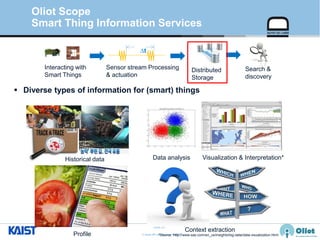
 Diverse types of information for (smart) things
*Source: http://www.sas.com/en_us/insights/big-data/data-visualization.html
Data analysis
Context extraction
Visualization & Interpretation*
Profile
Historical data
∆t
Sensor stream Processing
& actuation
Distributed
Storage
Interacting with
Smart Things
Search &
discovery
© Auto-ID Lab Korea / KAIST
Slide 25
Passive Tags
(e.g., passive
tags, barcode)
Sensor & Actuator Networks
(e.g., ZigBee, 6LoWPAN, Mobile phone, BLE,
AllJoyn, lwM2M etc.)
Active Tags (e.g.,
Wireless ID and Sensor
Networks)
RFID Middleware
LLRP LLRP Sensor & actuator protocols Sensor & actuator protocols
Domain-specific capturing application
Domain-specific accessing applications
Sensor Interface
Sensor interface
EPC Information Service
(static and dynamic information)
ALE
Actuation Interface
Sensor & Actuator Middleware
Object
Name
Service
Discovery
Service
ZigBee
6LoWPAN/
CoAP
MQTT
Web
service-*
REST
Other
Comm.
RFID stream processing
Logical RFID
reader
Reader
Management
Sensor stream
processing
Sensor & actuator
Management
ID-Sensor stream
processing
Oliot Scope
Smart Thing Information Services
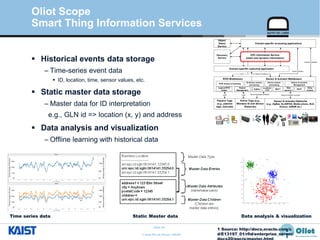
 Historical events data storage
– Time-series event data
 ID, location, time, sensor values, etc.
 Static master data storage
– Master data for ID interpretation
e.g., GLN id => location (x, y) and address
 Data analysis and visualization
– Offline learning with historical data
1 Source: http://docs.oracle.com/c
d/E13197_01/rfid/enterprise_server/
Time series data Data analysis & visualizationStatic Master data
© Auto-ID Lab Korea / KAIST
Slide 26
Oliot Scope
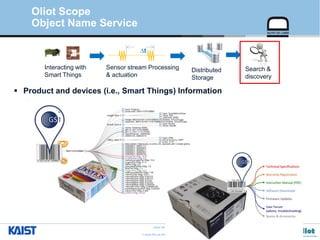
Object Name Service
 Product and devices (i.e., Smart Things) Information
∆t
Sensor stream Processing
& actuation
Distributed
Storage
Interacting with
Smart Things
Search &
discovery
© Auto-ID Lab Korea / KAIST
Slide 27
Passive Tags
(e.g., passive
tags, barcode)
Sensor & Actuator Networks
(e.g., ZigBee, 6LoWPAN, Mobile phone, BLE,
AllJoyn, lwM2M etc.)
Active Tags (e.g.,
Wireless ID and Sensor
Networks)
RFID Middleware
LLRP LLRP Sensor & actuator protocols Sensor & actuator protocols
Domain-specific capturing application
Domain-specific accessing applications
Sensor Interface
Sensor interface
EPC Information Service
(static and dynamic information)
ALE
Actuation Interface
Sensor & Actuator Middleware
Object
Name
Service
Discovery
Service
ZigBee
6LoWPAN/
CoAP
MQTT
Web
service-*
REST
Other
Comm.
RFID stream processing
Logical RFID
reader
Reader
Management
Sensor stream
processing
Sensor & actuator
Management
ID-Sensor stream
processing
Oliot Scope
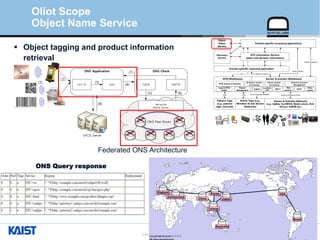
Object Name Service
ONS Application
GS1 ID AUS
ONS Client
FQDN NAPTR
Recursive
Name Server
EPCIS Server
ONS Peer Roots
(1)
(2)
(3)
(4)
(5) (6)
(7)
(8)
Federated ONS Architecture
 Object tagging and product information
retrieval
Korea
JapanChina
Taiwan
Australia
USA
Brazil
Switzerland
England
ONS Query response
© Auto-ID Lab Korea / KAIST
Slide 28
Oliot Scope
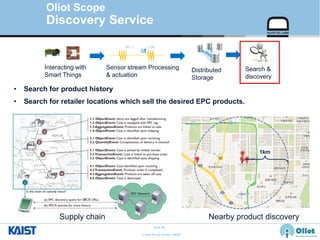
Discovery Service
• Search for product history
• Search for retailer locations which sell the desired EPC products.
Supply chain
1km
Nearby product discovery
∆t
Sensor stream Processing
& actuation
Distributed
Storage
Interacting with
Smart Things
Search &
discovery
© Auto-ID Lab Korea / KAIST
Slide 29
Passive Tags
(e.g., passive
tags, barcode)
Sensor & Actuator Networks
(e.g., ZigBee, 6LoWPAN, Mobile phone, BLE,
AllJoyn, lwM2M etc.)
Active Tags (e.g.,
Wireless ID and Sensor
Networks)
RFID Middleware
LLRP LLRP Sensor & actuator protocols Sensor & actuator protocols
Domain-specific capturing application
Domain-specific accessing applications
Sensor Interface
Sensor interface
EPC Information Service
(static and dynamic information)
ALE
Actuation Interface
Sensor & Actuator Middleware
Object
Name
Service
Discovery
Service
ZigBee
6LoWPAN/
CoAP
MQTT
Web
service-*
REST
Other
Comm.
RFID stream processing
Logical RFID
reader
Reader
Management
Sensor stream
processing
Sensor & actuator
Management
ID-Sensor stream
processing
Oliot Scope
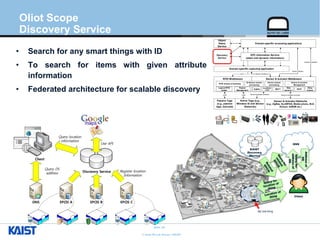
Discovery Service
• Search for any smart things with ID
• To search for items with given attribute
information
• Federated architecture for scalable discovery
Discovery Service
ONS
Client
EPCIS A EPCIS B EPCIS C
Query DS
address
Use API
Query location
information
Register location
Information
KAIST
Discovery
Service
ONS
Client
Queryfor
addressof
DS
Addressof
DS
My lost thing
© Auto-ID Lab Korea / KAIST
Slide 30
Passive Tags
(e.g., passive
tags, barcode)
Sensor & Actuator Networks
(e.g., ZigBee, 6LoWPAN, Mobile phone, BLE,
AllJoyn, lwM2M etc.)
Active Tags (e.g.,
Wireless ID and Sensor
Networks)
RFID Middleware
LLRP LLRP Sensor & actuator protocols Sensor & actuator protocols
Domain-specific capturing application
Domain-specific accessing applications
Sensor Interface
Sensor interface
EPC Information Service
(static and dynamic information)
ALE
Actuation Interface
Sensor & Actuator Middleware
Object
Name
Service
Discovery
Service
ZigBee
6LoWPAN/
CoAP
MQTT
Web
service-*
REST
Other
Comm.
RFID stream processing
Logical RFID
reader
Reader
Management
Sensor stream
processing
Sensor & actuator
Management
ID-Sensor stream
processing
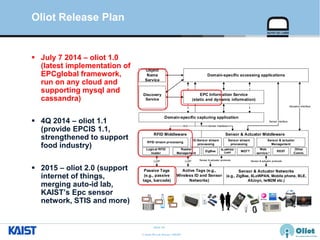
 July 7 2014 – oliot 1.0
(latest implementation of
EPCglobal framework,
run on any cloud and
supporting mysql and
cassandra)
 4Q 2014 – oliot 1.1
(provide EPCIS 1.1,
strengthened to support
food industry)
 2015 – oliot 2.0 (support
internet of things,
merging auto-id lab,
KAIST’s Epc sensor
network, STIS and more)
Oliot Release Plan
© Auto-ID Lab Korea / KAIST
Slide 31
Conclusion
ID is the most important feature to distinguish smart things (product, computing
devices, etc.).
Oliot is the EPCglobal-based ID-centric IoT Platform.
We are looking for collaborators:
- developing open sources together such as GS1 source, GS1 digital
- companies who do business with our oliot
- architecting IoT world including food SCM and safety systems, health
care/medicare, retail systems

GS1 EPCglobal framework and Oliot Project Overview

  • 1.
    Jun. 25, 2014 Auto-IDLabs, KAIST Dept. of Computer Science, KAIST GS1 EPCglobal framework and Oliot Project overview Seonghoon Kim shkim08@kaist.ac.kr, http://oliot.org, http://autoidlab.kaist.ac.kr, http://resl.kaist.ac.kr http://autoidlabs.org http://gs1.org
  • 2.
    © Auto-ID LabKorea / KAIST Slide 2 Understanding the real-world needs…  In terms of a computer, understanding the real-world needs … Location Time Other contexts Human Objects
  • 3.
    © Auto-ID LabKorea / KAIST Slide 3 Understanding the real-world needs…  IoT systems need to manage…. ▲Devices/Users Enabling IoT needs Identification system Many smart things will …
  • 4.
    © Auto-ID LabKorea / KAIST Slide 4 Contents  GS1/EPCglobal standard – Introduction – Global Product Classification (GPC) – Application Identifier (AI) – GS1 Keys – Electronic Product Code (EPC) – GS1/EPCglobal Architecture  Oliot (Open Language for Internet of Things) – Overview – Smart Things’ Control & Data Acquisition – Oliot middleware for sensors, and actuators – Oliot Datastore – Discovery & ONS – Current status  Conclusion
  • 5.
    © Auto-ID LabKorea / KAIST Slide 5  GS1: Global language of business – 111 member organizations in 155 countries – Over 2,000,000 members  URI-convertible ID (GTIN, GLN, SSCC, GRAI, etc) – e.g., urn:epc:id:sgtin:0614141.112345.400  GS1/EPCglobal standard – A holistic architectural framework to identify, capture and share information about items GS1/EPCglobal Standards which Oliot stems from
  • 6.
    © Auto-ID LabKorea / KAIST Slide 6 • GS1 SYSTEM OF STANDARDS GS1/EPCglobal Standards which Oliot stems from
  • 7.
    © Auto-ID LabKorea / KAIST Slide 7 • Integrating Data Carriers to Business Applications • Enabled by code systems • Global Product Classification (GPC) • GS1 Keys • Electronic Product Code (EPC) GS1/EPCglobal Standards which Oliot stems from
  • 8.
    © Auto-ID LabKorea / KAIST Slide 8 GS1/EPCglobal Standards Global Product Classification (GPC)  Global Product Classification (GPC) – http://www.gs1.org/1/productssolutions/gdsn/gpc/browser/index.html Category selection Code for bananas classes with different attribute
  • 9.
    © Auto-ID LabKorea / KAIST Slide 9  Application Identifier (AI) – a two, three, or four digit numeric Prefix in front of the data – to tell what the data means GS1/EPCglobal Standards Application Identifier
  • 10.
    © Auto-ID LabKorea / KAIST Slide 10  GS1 Identification Keys GS1/EPCglobal Standards GS1 Keys Digital Coupon Management (Serialized) Global Coupon Number (SGCN) Component/Part management Component / Part Identifier (CPID)
  • 11.
    © Auto-ID LabKorea / KAIST Slide 11  GLN, GTIN, and SSCC GS1/EPCglobal Standards GS1 Keys
  • 12.
    © Auto-ID LabKorea / KAIST Slide 12  GRAI (Global Returnable Asset Identifier) – used to identify returnable assets, re-usable packages, or transport equipment, such as a tray, pallet, or beer keg. – the asset being used for the purpose of tracking its location and return. – as part of a lease or rental system.  GIAI (Global Individual Asset Identifier) – e.g., office equipment, transport equipment, IT equipment, vehicles, etc.  GSRN (Global Service Relation Number) – e.g., club membership, loyalty programmes, a patient in a hospital, or employees GS1/EPCglobal Standards GS1 Keys ECG measurement device (GRAI) Surgical equipment (GIAI) Membership ID (GSRN) Patient ID in hospital (GSRN)Surgical tools (GIAI)
  • 13.
    © Auto-ID LabKorea / KAIST Slide 13  Digital Coupon Management (Global Coupon Number) GS1/EPCglobal Standards GS1 Keys
  • 14.
    © Auto-ID LabKorea / KAIST Slide 14  The Component / Part Identifier (CPID) – enables companies to identify components and parts, typically where an Original Equipment Manufacturer (OEM) defines the specifications of a component or part that is part of its final product GS1/EPCglobal Standards GS1 Keys
  • 15.
    © Auto-ID LabKorea / KAIST Slide 15  EPC – universal identifier that provides a unique identity for any physical object GS1/EPCglobal Standards Electronic Product Code (EPC)
  • 16.
    © Auto-ID LabKorea / KAIST Slide 16  EPC encodings – EPC Binary encoding – EPC Tag URI – EPC Pure Identity URI – GS1 Element String GS1/EPCglobal Standards Electronic Product Code Examples of GTIN and Serial Number (SGTIN) in Different Syntaxes
  • 17.
    © Auto-ID LabKorea / KAIST Slide 17  EPC global Architectural framework GS1/EPCglobal Standards GS1/EPCglobal Architectural Framework Identification & sensing Data filtering & grouping Data store and share Item Discovery & Information search Frédéric Thiesse, Christian Floerkemeier, Mark Harrison, Florian Michahelles, Christof Roduner, "Technology, Standards, and Real-World Deployments of the EPC Network, " IEEE Internet Computing, vol. 13, no. 2, pp. 36-43, March-April 2009 Bar Code Scanner Output GS1ElementString 0180614141123458216789
  • 18.
    © Auto-ID LabKorea / KAIST Slide 18 GS1/EPCglobal Standards GS1/EPCglobal Architectural Framework with Supply Chain Example  Electronic Product Code (EPC) and EPC networks Applications Manufacturer Distributor Retailer Product info. • Technical spec. • Warranty spec. • Instruction manual • etc. Product history • Genuine or Imitation • Freshness • Where this is from? • Etc. Manufacturer EPCIS server Productquery Korea JapanChina Taiwan Australia USA Brazil Switzerland England Object Name Service (ONS) Server ONS query EPC Information Service repository Filtering &Collection middleware Capturing Applications DS query Application Real-time feedback Smart RFID reader Discovery Service (DS)
  • 19.
    © Auto-ID LabKorea / KAIST Slide 19 Open Language for the Internet of Things  Open Language for IoT (Oliot) is an ID-based IoT framework. – Based on GS1 standard ID (e.g., URI-convertible GTIN)  Goal – Is to build a ID-based framework to identify, capture, control and share information about smart things Passive Tags (e.g., passive tags, barcode) Sensor & Actuator Networks (e.g., ZigBee, 6LoWPAN, Mobile phone, BLE, AllJoyn, lwM2M etc.) Active Tags (e.g., Wireless ID and Sensor Networks) RFID Middleware LLRP LLRP Sensor & actuator protocols Sensor & actuator protocols Domain-specific capturing application Domain-specific accessing applications Sensor Interface Sensor interface EPC Information Service (static and dynamic information) ALE Actuation Interface Sensor & Actuator Middleware Object Name Service Discovery Service ZigBee 6LoWPAN/ CoAP MQTT Web service-* REST Other Comm. RFID stream processing Logical RFID reader Reader Management Sensor stream processing Sensor & actuator Management ID-Sensor stream processing
  • 20.
    © Auto-ID LabKorea / KAIST Slide 20 Oliot Scope Smart Things’ Control & Data Acquisition • Enabling searches for an item or a class of items that satisfies certain sensor values or attributes. Sensortag(e.g.,IntelWISP) e.g., cool juice A Patient with her states 20dB 50dB40dB 70dB50dB25dB silent tables 4인 3T, 소근소 근 Full, 시끄러 움 Full, 조 용, 몬순 커피 2인 2T 테이블 4, 조 용 휴 업 2인 4T 4인 2T 4인 2T 8인 2T, 조용 4인 3T, 시끄러움 ∆t Sensor stream Processing & actuation Distributed Storage Interacting with Smart Things Search & discovery Actuators (e.g., appliances)
  • 21.
    © Auto-ID LabKorea / KAIST Slide 21 Passive Tags (e.g., passive tags) Sensor & Actuator Networks (e.g., ZigBee, 6LoWPAN, Mobile phone, etc.) Active Tags (e.g., Wireless ID and Sensor Networks) RFID Middleware LLRP LLRP Sensor & actuator protocols Sensor & actuator protocols Object orchestration and organization management Domain-specific applications Sensor Interface Sensor interface Smart Things Information Service (static and dynamic information) ALE Actuation Interface Sensor & Actuator Middleware ONS Discovery Service ZigBee 6LoWPAN/ CoAP MQTT Web service-* REST Other Comm. RFID stream processing Logical RFID reader Reader Management Sensor stream processing Sensor & actuator Management Oliot Scope Smart Things’ Control & Data Acquisition  RFID networks – Passive & active tags  Wireless Identification and Sensor Networks (WISN) – Active tag networks – Leverage features of Wireless mesh networks  Sensor and actuator networks – LLRP, CoAP/6LoWPAN, ZigBee, MQTT, etc. RFID Reader Ant1 Ant2 Ant3 Conventional RFID networks Wireless ID and sensor networks EPC EPC EPC EPC EPC EPC EPC EPC EPC Active tagEPC Mobilephone sensingBarcode
  • 22.
    © Auto-ID LabKorea / KAIST Slide 22  Stream processing Oliot Scope ID & sensor stream processing  RFID, sensor, and actuator adaptation Complexity of heterogeneity and network distribution ∆t #1441 Door 1 Window 1 Door 2 Window 2 RFID & sensor stream △ Heterogeneous sensors ▷ ∆t Sensor stream Processing & actuation Distributed Storage Interacting with Smart Things Search & discovery
  • 23.
    © Auto-ID LabKorea / KAIST Slide 23 Oliot Scope ID & sensor stream processing  Object abstraction via Sensor & actuator device framework adaptation  RFID stream processing & interfaces – Filtering & Grouping  RFID data report & management  Sensor stream processing & interfaces – Heterogeneous sensor stream adaptation – Composite sensors streams *Source: http://www.cs.duke.edu/~kmoses/cps516/dstream.html Event Stream filtering & grouping* Direct interaction Middleware Abstraction Passive Tags (e.g., passive tags, barcode) Sensor & Actuator Networks (e.g., ZigBee, 6LoWPAN, Mobile phone, BLE, AllJoyn, lwM2M etc.) Active Tags (e.g., Wireless ID and Sensor Networks) RFID Middleware LLRP LLRP Sensor & actuator protocols Sensor & actuator protocols Domain-specific capturing application Domain-specific accessing applications Sensor Interface Sensor interface EPC Information Service (static and dynamic information) ALE Actuation Interface Sensor & Actuator Middleware Object Name Service Discovery Service ZigBee 6LoWPAN/ CoAP MQTT Web service-* REST Other Comm. RFID stream processing Logical RFID reader Reader Management Sensor stream processing Sensor & actuator Management ID-Sensor stream processing Complex event processing** **Source: http://www.12qw.ch/2013/10/streaminsight-cep-2-what-are-cep-and-streaminsight/
  • 24.
    © Auto-ID LabKorea / KAIST Slide 24 Oliot Scope Smart Thing Information Services  Diverse types of information for (smart) things *Source: http://www.sas.com/en_us/insights/big-data/data-visualization.html Data analysis Context extraction Visualization & Interpretation* Profile Historical data ∆t Sensor stream Processing & actuation Distributed Storage Interacting with Smart Things Search & discovery
  • 25.
    © Auto-ID LabKorea / KAIST Slide 25 Passive Tags (e.g., passive tags, barcode) Sensor & Actuator Networks (e.g., ZigBee, 6LoWPAN, Mobile phone, BLE, AllJoyn, lwM2M etc.) Active Tags (e.g., Wireless ID and Sensor Networks) RFID Middleware LLRP LLRP Sensor & actuator protocols Sensor & actuator protocols Domain-specific capturing application Domain-specific accessing applications Sensor Interface Sensor interface EPC Information Service (static and dynamic information) ALE Actuation Interface Sensor & Actuator Middleware Object Name Service Discovery Service ZigBee 6LoWPAN/ CoAP MQTT Web service-* REST Other Comm. RFID stream processing Logical RFID reader Reader Management Sensor stream processing Sensor & actuator Management ID-Sensor stream processing Oliot Scope Smart Thing Information Services  Historical events data storage – Time-series event data  ID, location, time, sensor values, etc.  Static master data storage – Master data for ID interpretation e.g., GLN id => location (x, y) and address  Data analysis and visualization – Offline learning with historical data 1 Source: http://docs.oracle.com/c d/E13197_01/rfid/enterprise_server/ Time series data Data analysis & visualizationStatic Master data
  • 26.
    © Auto-ID LabKorea / KAIST Slide 26 Oliot Scope Object Name Service  Product and devices (i.e., Smart Things) Information ∆t Sensor stream Processing & actuation Distributed Storage Interacting with Smart Things Search & discovery
  • 27.
    © Auto-ID LabKorea / KAIST Slide 27 Passive Tags (e.g., passive tags, barcode) Sensor & Actuator Networks (e.g., ZigBee, 6LoWPAN, Mobile phone, BLE, AllJoyn, lwM2M etc.) Active Tags (e.g., Wireless ID and Sensor Networks) RFID Middleware LLRP LLRP Sensor & actuator protocols Sensor & actuator protocols Domain-specific capturing application Domain-specific accessing applications Sensor Interface Sensor interface EPC Information Service (static and dynamic information) ALE Actuation Interface Sensor & Actuator Middleware Object Name Service Discovery Service ZigBee 6LoWPAN/ CoAP MQTT Web service-* REST Other Comm. RFID stream processing Logical RFID reader Reader Management Sensor stream processing Sensor & actuator Management ID-Sensor stream processing Oliot Scope Object Name Service ONS Application GS1 ID AUS ONS Client FQDN NAPTR Recursive Name Server EPCIS Server ONS Peer Roots (1) (2) (3) (4) (5) (6) (7) (8) Federated ONS Architecture  Object tagging and product information retrieval Korea JapanChina Taiwan Australia USA Brazil Switzerland England ONS Query response
  • 28.
    © Auto-ID LabKorea / KAIST Slide 28 Oliot Scope Discovery Service • Search for product history • Search for retailer locations which sell the desired EPC products. Supply chain 1km Nearby product discovery ∆t Sensor stream Processing & actuation Distributed Storage Interacting with Smart Things Search & discovery
  • 29.
    © Auto-ID LabKorea / KAIST Slide 29 Passive Tags (e.g., passive tags, barcode) Sensor & Actuator Networks (e.g., ZigBee, 6LoWPAN, Mobile phone, BLE, AllJoyn, lwM2M etc.) Active Tags (e.g., Wireless ID and Sensor Networks) RFID Middleware LLRP LLRP Sensor & actuator protocols Sensor & actuator protocols Domain-specific capturing application Domain-specific accessing applications Sensor Interface Sensor interface EPC Information Service (static and dynamic information) ALE Actuation Interface Sensor & Actuator Middleware Object Name Service Discovery Service ZigBee 6LoWPAN/ CoAP MQTT Web service-* REST Other Comm. RFID stream processing Logical RFID reader Reader Management Sensor stream processing Sensor & actuator Management ID-Sensor stream processing Oliot Scope Discovery Service • Search for any smart things with ID • To search for items with given attribute information • Federated architecture for scalable discovery Discovery Service ONS Client EPCIS A EPCIS B EPCIS C Query DS address Use API Query location information Register location Information KAIST Discovery Service ONS Client Queryfor addressof DS Addressof DS My lost thing
  • 30.
    © Auto-ID LabKorea / KAIST Slide 30 Passive Tags (e.g., passive tags, barcode) Sensor & Actuator Networks (e.g., ZigBee, 6LoWPAN, Mobile phone, BLE, AllJoyn, lwM2M etc.) Active Tags (e.g., Wireless ID and Sensor Networks) RFID Middleware LLRP LLRP Sensor & actuator protocols Sensor & actuator protocols Domain-specific capturing application Domain-specific accessing applications Sensor Interface Sensor interface EPC Information Service (static and dynamic information) ALE Actuation Interface Sensor & Actuator Middleware Object Name Service Discovery Service ZigBee 6LoWPAN/ CoAP MQTT Web service-* REST Other Comm. RFID stream processing Logical RFID reader Reader Management Sensor stream processing Sensor & actuator Management ID-Sensor stream processing  July 7 2014 – oliot 1.0 (latest implementation of EPCglobal framework, run on any cloud and supporting mysql and cassandra)  4Q 2014 – oliot 1.1 (provide EPCIS 1.1, strengthened to support food industry)  2015 – oliot 2.0 (support internet of things, merging auto-id lab, KAIST’s Epc sensor network, STIS and more) Oliot Release Plan
  • 31.
    © Auto-ID LabKorea / KAIST Slide 31 Conclusion ID is the most important feature to distinguish smart things (product, computing devices, etc.). Oliot is the EPCglobal-based ID-centric IoT Platform. We are looking for collaborators: - developing open sources together such as GS1 source, GS1 digital - companies who do business with our oliot - architecting IoT world including food SCM and safety systems, health care/medicare, retail systems