Lecture 3:
       Program Analysis
         Steven Skiena

Department of Computer Science
 State University of New York
 Stony Brook, NY 11794–4400

http://www.cs.sunysb.edu/∼skiena
Problem of the Day
Find two functions f (n) and g(n) that satisfy the following
relationship. If no such f and g exist, write ”None”.
1. f (n) = o(g(n)) and f (n) = Θ(g(n))
2. f (n) = Θ(g(n)) and f (n) = o(g(n))
3. f (n) = Θ(g(n)) and f (n) = O(g(n))
4. f (n) = Ω(g(n)) and f (n) = O(g(n))
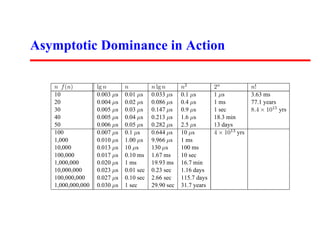
Asymptotic Dominance in Action

   n f (n)         lg n       n          n lg n      n2           2n             n!
   10              0.003 µs   0.01 µs    0.033 µs    0.1 µs       1 µs           3.63 ms
   20              0.004 µs   0.02 µs    0.086 µs    0.4 µs       1 ms           77.1 years
   30              0.005 µs   0.03 µs    0.147 µs    0.9 µs       1 sec          8.4 × 10¹⁵ yrs
   40              0.005 µs   0.04 µs    0.213 µs    1.6 µs       18.3 min
   50              0.006 µs   0.05 µs    0.282 µs    2.5 µs       13 days
   100             0.007 µs   0.1 µs     0.644 µs    10 µs        4 × 10¹³ yrs
   1,000           0.010 µs   1.00 µs    9.966 µs    1 ms
   10,000          0.013 µs   10 µs      130 µs      100 ms
   100,000         0.017 µs   0.10 ms    1.67 ms     10 sec
   1,000,000       0.020 µs   1 ms       19.93 ms    16.7 min
   10,000,000      0.023 µs   0.01 sec   0.23 sec    1.16 days
   100,000,000     0.027 µs   0.10 sec   2.66 sec    115.7 days
   1,000,000,000   0.030 µs   1 sec      29.90 sec   31.7 years
Implications of Dominance

 • Exponential algorithms get hopeless fast.
 • Quadratic algorithms get hopeless at or before 1,000,000.
 • O(n log n) is possible to about one billion.
 • O(log n) never sweats.
Testing Dominance
f (n) dominates g(n) if lim n→∞ g(n)/f (n) = 0, which is the
same as saying g(n) = o(f (n)).
Note the little-oh – it means “grows strictly slower than”.
Implications of Dominance

 • na dominates nb if a > b since
                    lim nb /na = nb−a → 0
                   n→∞

 • na + o(na) doesn’t dominate na since
                   lim na/(na + o(na)) → 1
                  n→∞
Dominance Rankings
You must come to accept the dominance ranking of the basic
functions:
     n!   2n    n3    n2    n log n   n    log n   1
Advanced Dominance Rankings
Additional functions arise in more sophisticated analysis than
we will do in this course:

          n      3     2     1+                    √
   n!     c      n    n      n      n log n    n     n
log 2 n    log n   log n/ log log n  log log n   α(n)     1
Reasoning About Efficiency
Grossly reasoning about the running time of an algorithm is
usually easy given a precise-enough written description of the
algorithm.
When you really understand an algorithm, this analysis can
be done in your head. However, recognize there is always
implicitly a written algorithm/program we are reasoning
about.
Selection Sort

selection sort(int s[], int n)
       {
            int i,j;
            int min;

             for (i=0; i<n; i++) {
                    min=i;
                    for (j=i+1; j<n; j++)
                           if (s[j] < s[min]) min=j;
                    swap(&s[i],&s[min]);
             }
}
Worst Case Analysis
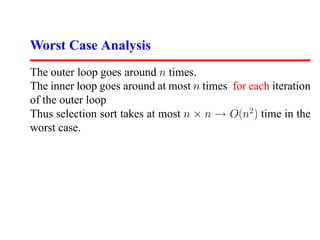
The outer loop goes around n times.
The inner loop goes around at most n times for each iteration
of the outer loop
Thus selection sort takes at most n × n → O(n2 ) time in the
worst case.
More Careful Analysis
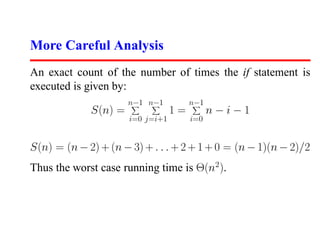
An exact count of the number of times the if statement is
executed is given by:
                      n−1 n−1          n−1
             S(n) =               1=         n−i−1
                      i=0 j=i+1        i=0


S(n) = (n − 2) + (n − 3) + . . . + 2 + 1 + 0 = (n − 1)(n − 2)/2
Thus the worst case running time is Θ(n2 ).
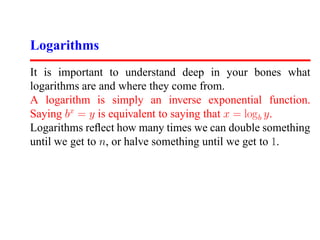
Logarithms
It is important to understand deep in your bones what
logarithms are and where they come from.
A logarithm is simply an inverse exponential function.
Saying bx = y is equivalent to saying that x = log b y.
Logarithms reflect how many times we can double something
until we get to n, or halve something until we get to 1.
Binary Search
In binary search we throw away half the possible number of
keys after each comparison. Thus twenty comparisons suffice
to find any name in the million-name Manhattan phone book!
How many time can we halve n before getting to 1?
Answer: lg n .
Logarithms and Trees
How tall a binary tree do we need until we have n leaves?
The number of potential leaves doubles with each level.
How many times can we double 1 until we get to n?
Answer: lg n .
Logarithms and Bits
How many bits do you need to represent the numbers from 0
to 2i − 1?
Each bit you add doubles the possible number of bit patterns,
so the number of bits equals lg(2i ) = i.
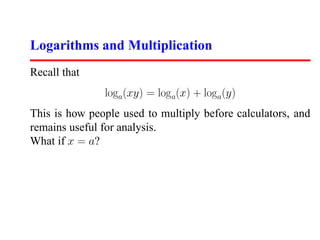
Logarithms and Multiplication
Recall that
               loga(xy) = log a(x) + loga(y)
This is how people used to multiply before calculators, and
remains useful for analysis.
What if x = a?
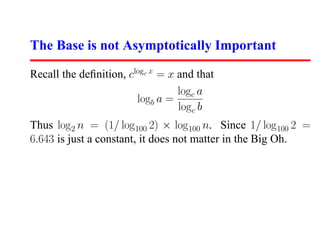
The Base is not Asymptotically Important

Recall the definition, clogc x = x and that
                                  logc a
                        logb a =
                                  log c b
Thus log 2 n = (1/ log 100 2) × log 100 n. Since 1/ log 100 2 =
6.643 is just a constant, it does not matter in the Big Oh.
Federal Sentencing Guidelines
2F1.1. Fraud and Deceit; Forgery; Offenses Involving Altered or Counterfeit Instruments other than Counterfeit Bearer Obligations of the United States.
(a) Base offense Level: 6
(b) Specific offense Characteristics


(1) If the loss exceeded $2,000, increase the offense level as follows:

                                                        Loss(Apply the Greatest)     Increase in Level
                                                        (A) $2,000 or less                 no increase
                                                        (B) More than $2,000                     add 1
                                                        (C) More than $5,000                     add 2
                                                        (D) More than $10,000                    add 3
                                                        (E) More than $20,000                    add 4
                                                        (F) More than $40,000                    add 5
                                                        (G) More than $70,000                    add 6
                                                        (H) More than $120,000                   add 7
                                                        (I) More than $200,000                   add 8
                                                        (J) More than $350,000                   add 9
                                                        (K) More than $500,000                  add 10
                                                        (L) More than $800,000                  add 11
                                                        (M) More than $1,500,000                add 12
                                                        (N) More than $2,500,000                add 13
                                                        (O) More than $5,000,000                add 14
                                                        (P) More than $10,000,000               add 15
                                                        (Q) More than $20,000,000               add 16
                                                        (R) More than $40,000,000               add 17
                                                        (Q) More than $80,000,000               add 18
Make the Crime Worth the Time
The increase in punishment level grows logarithmically in the
amount of money stolen.
Thus it pays to commit one big crime rather than many small
crimes totalling the same amount.

Skiena algorithm 2007 lecture03 modeling logarithms

  • 1.
    Lecture 3: Program Analysis Steven Skiena Department of Computer Science State University of New York Stony Brook, NY 11794–4400 http://www.cs.sunysb.edu/∼skiena
  • 2.
    Problem of theDay Find two functions f (n) and g(n) that satisfy the following relationship. If no such f and g exist, write ”None”. 1. f (n) = o(g(n)) and f (n) = Θ(g(n)) 2. f (n) = Θ(g(n)) and f (n) = o(g(n)) 3. f (n) = Θ(g(n)) and f (n) = O(g(n)) 4. f (n) = Ω(g(n)) and f (n) = O(g(n))
  • 3.
    Asymptotic Dominance inAction n f (n) lg n n n lg n n2 2n n! 10 0.003 µs 0.01 µs 0.033 µs 0.1 µs 1 µs 3.63 ms 20 0.004 µs 0.02 µs 0.086 µs 0.4 µs 1 ms 77.1 years 30 0.005 µs 0.03 µs 0.147 µs 0.9 µs 1 sec 8.4 × 10¹⁵ yrs 40 0.005 µs 0.04 µs 0.213 µs 1.6 µs 18.3 min 50 0.006 µs 0.05 µs 0.282 µs 2.5 µs 13 days 100 0.007 µs 0.1 µs 0.644 µs 10 µs 4 × 10¹³ yrs 1,000 0.010 µs 1.00 µs 9.966 µs 1 ms 10,000 0.013 µs 10 µs 130 µs 100 ms 100,000 0.017 µs 0.10 ms 1.67 ms 10 sec 1,000,000 0.020 µs 1 ms 19.93 ms 16.7 min 10,000,000 0.023 µs 0.01 sec 0.23 sec 1.16 days 100,000,000 0.027 µs 0.10 sec 2.66 sec 115.7 days 1,000,000,000 0.030 µs 1 sec 29.90 sec 31.7 years
  • 4.
    Implications of Dominance • Exponential algorithms get hopeless fast. • Quadratic algorithms get hopeless at or before 1,000,000. • O(n log n) is possible to about one billion. • O(log n) never sweats.
  • 5.
    Testing Dominance f (n)dominates g(n) if lim n→∞ g(n)/f (n) = 0, which is the same as saying g(n) = o(f (n)). Note the little-oh – it means “grows strictly slower than”.
  • 6.
    Implications of Dominance • na dominates nb if a > b since lim nb /na = nb−a → 0 n→∞ • na + o(na) doesn’t dominate na since lim na/(na + o(na)) → 1 n→∞
  • 7.
    Dominance Rankings You mustcome to accept the dominance ranking of the basic functions: n! 2n n3 n2 n log n n log n 1
  • 8.
    Advanced Dominance Rankings Additionalfunctions arise in more sophisticated analysis than we will do in this course: n 3 2 1+ √ n! c n n n n log n n n log 2 n log n log n/ log log n log log n α(n) 1
  • 9.
    Reasoning About Efficiency Grosslyreasoning about the running time of an algorithm is usually easy given a precise-enough written description of the algorithm. When you really understand an algorithm, this analysis can be done in your head. However, recognize there is always implicitly a written algorithm/program we are reasoning about.
  • 10.
    Selection Sort selection sort(ints[], int n) { int i,j; int min; for (i=0; i<n; i++) { min=i; for (j=i+1; j<n; j++) if (s[j] < s[min]) min=j; swap(&s[i],&s[min]); } }
  • 11.
    Worst Case Analysis Theouter loop goes around n times. The inner loop goes around at most n times for each iteration of the outer loop Thus selection sort takes at most n × n → O(n2 ) time in the worst case.
  • 12.
    More Careful Analysis Anexact count of the number of times the if statement is executed is given by: n−1 n−1 n−1 S(n) = 1= n−i−1 i=0 j=i+1 i=0 S(n) = (n − 2) + (n − 3) + . . . + 2 + 1 + 0 = (n − 1)(n − 2)/2 Thus the worst case running time is Θ(n2 ).
  • 13.
    Logarithms It is importantto understand deep in your bones what logarithms are and where they come from. A logarithm is simply an inverse exponential function. Saying bx = y is equivalent to saying that x = log b y. Logarithms reflect how many times we can double something until we get to n, or halve something until we get to 1.
  • 14.
    Binary Search In binarysearch we throw away half the possible number of keys after each comparison. Thus twenty comparisons suffice to find any name in the million-name Manhattan phone book! How many time can we halve n before getting to 1? Answer: lg n .
  • 15.
    Logarithms and Trees Howtall a binary tree do we need until we have n leaves? The number of potential leaves doubles with each level. How many times can we double 1 until we get to n? Answer: lg n .
  • 16.
    Logarithms and Bits Howmany bits do you need to represent the numbers from 0 to 2i − 1? Each bit you add doubles the possible number of bit patterns, so the number of bits equals lg(2i ) = i.
  • 17.
    Logarithms and Multiplication Recallthat loga(xy) = log a(x) + loga(y) This is how people used to multiply before calculators, and remains useful for analysis. What if x = a?
  • 18.
    The Base isnot Asymptotically Important Recall the definition, clogc x = x and that logc a logb a = log c b Thus log 2 n = (1/ log 100 2) × log 100 n. Since 1/ log 100 2 = 6.643 is just a constant, it does not matter in the Big Oh.
  • 19.
    Federal Sentencing Guidelines 2F1.1.Fraud and Deceit; Forgery; Offenses Involving Altered or Counterfeit Instruments other than Counterfeit Bearer Obligations of the United States. (a) Base offense Level: 6 (b) Specific offense Characteristics (1) If the loss exceeded $2,000, increase the offense level as follows: Loss(Apply the Greatest) Increase in Level (A) $2,000 or less no increase (B) More than $2,000 add 1 (C) More than $5,000 add 2 (D) More than $10,000 add 3 (E) More than $20,000 add 4 (F) More than $40,000 add 5 (G) More than $70,000 add 6 (H) More than $120,000 add 7 (I) More than $200,000 add 8 (J) More than $350,000 add 9 (K) More than $500,000 add 10 (L) More than $800,000 add 11 (M) More than $1,500,000 add 12 (N) More than $2,500,000 add 13 (O) More than $5,000,000 add 14 (P) More than $10,000,000 add 15 (Q) More than $20,000,000 add 16 (R) More than $40,000,000 add 17 (Q) More than $80,000,000 add 18
  • 20.
    Make the CrimeWorth the Time The increase in punishment level grows logarithmically in the amount of money stolen. Thus it pays to commit one big crime rather than many small crimes totalling the same amount.