Growth Hacking
Marketing Management
Prepared By
Manu Melwin Joy
Assistant Professor
SCMS School of Technology and Management
Kerala, India.
Phone – 9744551114
Mail – manu_melwinjoy@yahoo.com
Kindly restrict the use of slides for personal purpose.
Please seek permission to reproduce the same in public forms and presentations.
Growth Hacking
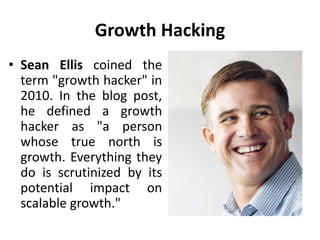
• Sean Ellis coined the
term "growth hacker" in
2010. In the blog post,
he defined a growth
hacker as "a person
whose true north is
growth. Everything they
do is scrutinized by its
potential impact on
scalable growth."
Growth Hacking
• Growth hacking is a
process of rapid
experimentation across
marketing channels and
product development to
identify the most
effective, efficient ways
to grow a business.
Growth Hacking
• Growth hacking refers
to a set of both
conventional and
unconventional
marketing experiments
that lead to growth of a
business.
Growth Hacking
• Growth hackers are
marketers, engineers
and product managers
that specifically focus
on building and
engaging the user base
of a business.
Growth Hacking
• Growth hackers often
focus on low-cost
alternatives to traditional
marketing, e.g. using
social media, viral
marketing or targeted
advertising instead of
buying advertising
through more traditional
media such as radio,
newspaper, and
television.
Growth Hacking
• Growth hacking is
particularly prevalent
with startups, when the
goal is rapid growth at an
early-stage launch phase.
Growth hacking may
focus on lowering cost
per customer acquisition,
but growth hacking is a
focus on long-term
sustainability.
Growth Hacking
• Growth hacking is about
optimization as well as
lead generation. Imagine
your business is a bucket
and your leads are water.
You don't want to pour
water into a leaky bucket;
it's a waste of money.
That's why a true growth
hacker would care about
customer retention.
Growth Hacking
• Those who specialize in
growth hacking use
various types of
marketing and product
iterations—rapidly testing
persuasive copy, email
marketing, SEO and viral
strategies, among others,
with a purpose to
increase the conversion
rate and achieve rapid
growth of the user base.
Growth Hacking
• It can also involve on-line
community management
and social media
outreach or highly
personalized outreach to
news outlets to improve
performance metrics such
as driving customer
acquisition and selling
products.
Growth Hacking
• Some consider growth
hacking a part of the
online marketing
ecosystem, as in many
cases growth hackers are
using techniques such as
search engine
optimization, website
analytics, content
marketing and A/B
testing.
Growth Hacking
• An early example of
"growth hacking" was
Hotmail's inclusion of "PS
I Love You" with a link for
others to get the free
online mail service.
Another example was the
offer of more storage by
Dropbox to users who
referred their friends.
Growth Hacking
• Online worldwide independent
lodging company, Airbnb, is an
example of growth hacking by
coupling technology and
ingenuity. Airbnb realized they
could essentially hack the
Craiglist.org scale and tap both
into their user base as well as
their website by adding
automated listing generators
from Airbnb with the feature
called "Post to Craigslist". The
company's growth was a
combination of clever thinking
and technical know-how.
Growth hacking - Manu Melwin Joy

Growth hacking - Manu Melwin Joy

  • 1.
  • 2.
    Prepared By Manu MelwinJoy Assistant Professor SCMS School of Technology and Management Kerala, India. Phone – 9744551114 Mail – manu_melwinjoy@yahoo.com Kindly restrict the use of slides for personal purpose. Please seek permission to reproduce the same in public forms and presentations.
  • 3.
    Growth Hacking • SeanEllis coined the term "growth hacker" in 2010. In the blog post, he defined a growth hacker as "a person whose true north is growth. Everything they do is scrutinized by its potential impact on scalable growth."
  • 4.
    Growth Hacking • Growthhacking is a process of rapid experimentation across marketing channels and product development to identify the most effective, efficient ways to grow a business.
  • 5.
    Growth Hacking • Growthhacking refers to a set of both conventional and unconventional marketing experiments that lead to growth of a business.
  • 6.
    Growth Hacking • Growthhackers are marketers, engineers and product managers that specifically focus on building and engaging the user base of a business.
  • 7.
    Growth Hacking • Growthhackers often focus on low-cost alternatives to traditional marketing, e.g. using social media, viral marketing or targeted advertising instead of buying advertising through more traditional media such as radio, newspaper, and television.
  • 8.
    Growth Hacking • Growthhacking is particularly prevalent with startups, when the goal is rapid growth at an early-stage launch phase. Growth hacking may focus on lowering cost per customer acquisition, but growth hacking is a focus on long-term sustainability.
  • 9.
    Growth Hacking • Growthhacking is about optimization as well as lead generation. Imagine your business is a bucket and your leads are water. You don't want to pour water into a leaky bucket; it's a waste of money. That's why a true growth hacker would care about customer retention.
  • 10.
    Growth Hacking • Thosewho specialize in growth hacking use various types of marketing and product iterations—rapidly testing persuasive copy, email marketing, SEO and viral strategies, among others, with a purpose to increase the conversion rate and achieve rapid growth of the user base.
  • 11.
    Growth Hacking • Itcan also involve on-line community management and social media outreach or highly personalized outreach to news outlets to improve performance metrics such as driving customer acquisition and selling products.
  • 12.
    Growth Hacking • Someconsider growth hacking a part of the online marketing ecosystem, as in many cases growth hackers are using techniques such as search engine optimization, website analytics, content marketing and A/B testing.
  • 13.
    Growth Hacking • Anearly example of "growth hacking" was Hotmail's inclusion of "PS I Love You" with a link for others to get the free online mail service. Another example was the offer of more storage by Dropbox to users who referred their friends.
  • 14.
    Growth Hacking • Onlineworldwide independent lodging company, Airbnb, is an example of growth hacking by coupling technology and ingenuity. Airbnb realized they could essentially hack the Craiglist.org scale and tap both into their user base as well as their website by adding automated listing generators from Airbnb with the feature called "Post to Craigslist". The company's growth was a combination of clever thinking and technical know-how.