The document discusses how the internet and social media may be both connecting people and isolating them. It provides a brief history of the internet and its growth. While younger generations have integrated new technologies, older generations tend to be less connected. Social media has become an important part of identity for teens and is available through mobile devices. However, constant connectivity through technology can also lead to isolation and reduced attention spans. The effects of internet and social media use are complex with arguments on both sides.

![Growth
The first networked ‘sharing’ was in 1962, but it wasn’t until July of
1972 that the modern internet was formed [1].
Source: Promotional Still
on Docurama](https://image.slidesharecdn.com/flipbook-161023190602/75/Is-the-Internet-Isolating-or-Connecting-us-3-2048.jpg)

![The internet now becomes a new mode of communication,
effecting both professional and social aspects of life.
A survey in 2014 said that “87% of
American adults use the internet, up
from 14% in 1995” [2].
Source: Thomas P. Röthlisberger, Flickr
Communication](https://image.slidesharecdn.com/flipbook-161023190602/75/Is-the-Internet-Isolating-or-Connecting-us-5-2048.jpg)
![While youths are adapting to the changing world, older generations are
falling behind.
• Only 45% over the age of 65 use
computers [4].
• Older generations tend not to use the
computer due to lack of interest [4].
Source: Martin Andersson, Flickr](https://image.slidesharecdn.com/flipbook-161023190602/75/Is-the-Internet-Isolating-or-Connecting-us-6-2048.jpg)



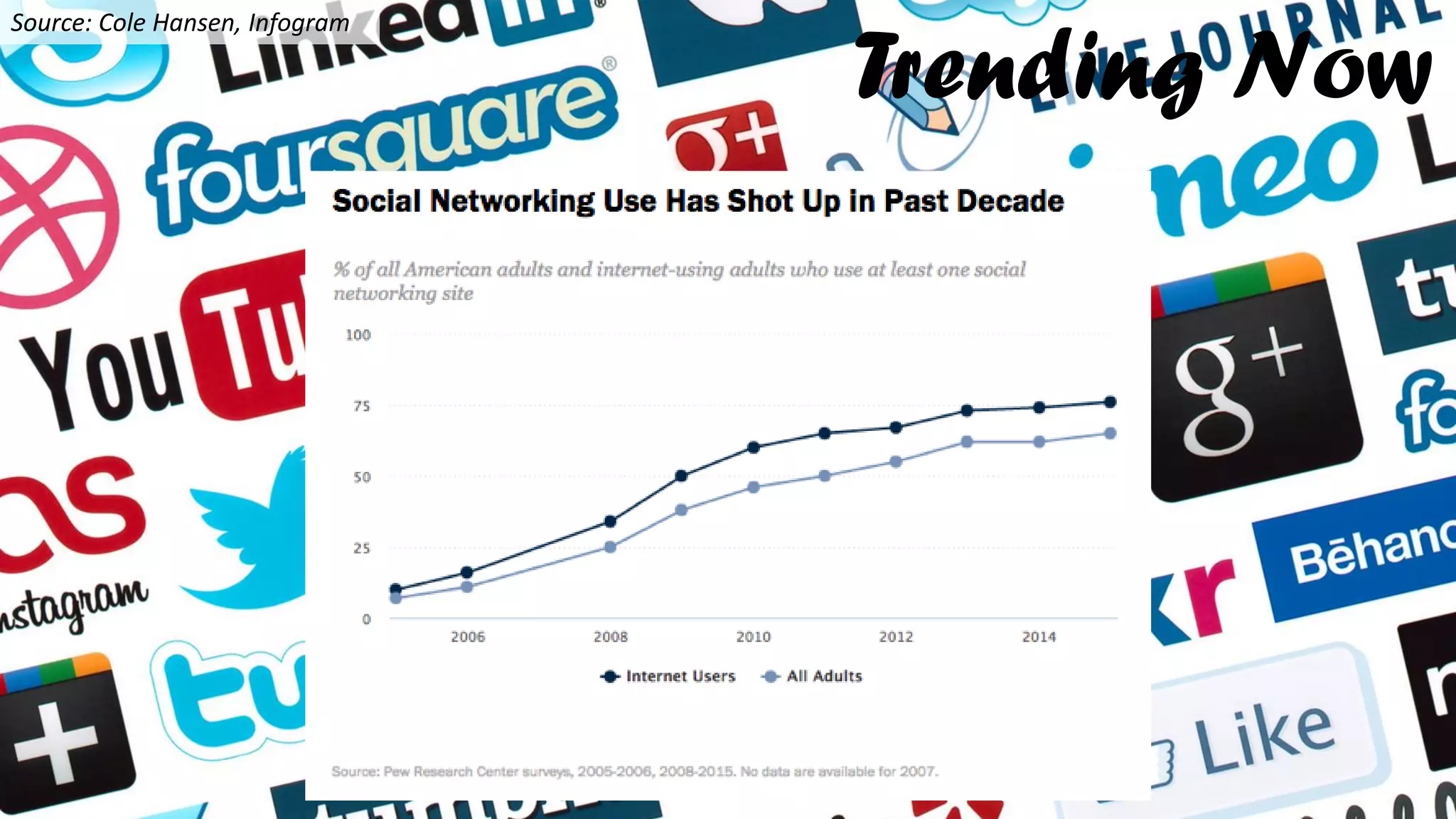
![In Real Life
Social media has become part of the adolescent identity
• “71% of teens use more than one social network site” [5].
• “92% of teens report going online daily” [5], aged 13-17.
• Global estimate of around 2.8 billion accounts [6].
• Facebook is more widely used than any other social media app in
kids aged 13-17 [5].
Source: Maggie Zhouhui Cai, http://zhuohuicai.com](https://image.slidesharecdn.com/flipbook-161023190602/75/Is-the-Internet-Isolating-or-Connecting-us-12-2048.jpg)
![Is it helping us?
Studies show that elderly over the age of 65 use
social media benefit from reduction in
cognitive decline [3], but what about teens?
Source: Challot, Flickr](https://image.slidesharecdn.com/flipbook-161023190602/75/Is-the-Internet-Isolating-or-Connecting-us-13-2048.jpg)
![What is it Doing for Teens?
• Social media is used as a conversation starter, as a way to share interests.
• It can become an isolation factor for some people, if you aren’t
connected society thinks you’re missing out.
• “Compared to 1985, there has been small-to-modest change, rather
than a large drop in the number of people who report that they have no
one with whom they can discuss important matters” [10].
• Contrary to common belief, social media isn’t taking as much of a toll of
teens as we might think.
Source: María Jesús, Flickr](https://image.slidesharecdn.com/flipbook-161023190602/75/Is-the-Internet-Isolating-or-Connecting-us-14-2048.jpg)


![Always Online
• There is a global estimate of 1.69 billion accounts linked to
smartphones [6].
• Of adults aged 18-34, 84%have smartphones [9].
• Of adults aged 18-24, 77% agree that when there is nothing that
occupies their attention, they’ll check their phones [9].
Source: Miltos A, Flickr](https://image.slidesharecdn.com/flipbook-161023190602/75/Is-the-Internet-Isolating-or-Connecting-us-18-2048.jpg)

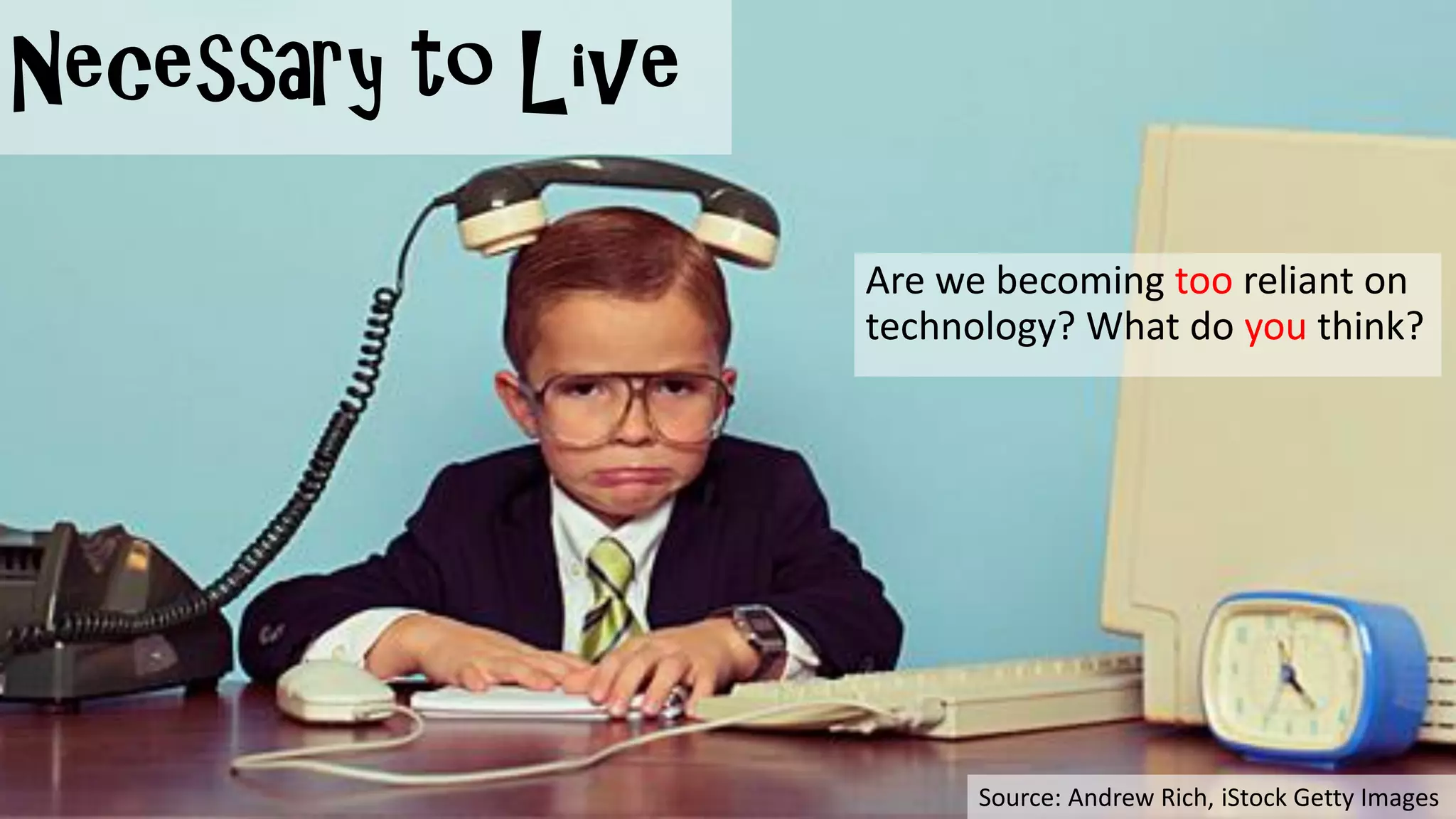

![• "Overall, Americans reported no more
loneliness in the 2000s than they did
in the 1970s“ [7].
• Children adapt very quickly to
technology, they are able to
understand complex idea about how
communication works around the
world at a young age [8].
• Older generations who use the
internet are less likely to suffer from
cognitive degradation [3].
• Easier for elderly to connect to
younger generations.
• Emergency situations are able to
connect and react more quickly.
• Less interactive local communities [10].
• Research showing that more tech savvy
individuals having lower attention spans,
making it more difficult to focus on one
thing [9].
• Degradation of language, prominence of
‘slang.’
• Privacy leaks, companies taking your
searches and selling the data.
• Another form of addiction, people stuck
inside.
Source: onlinepianist.com](https://image.slidesharecdn.com/flipbook-161023190602/75/Is-the-Internet-Isolating-or-Connecting-us-22-2048.jpg)

![Works Cited
[1]
Leiner, Barry M., et al. “Brief History of the Internet.” Internet Society. 2016,
www.internetsociety.org/internet/what-internet/history-internet/brief-history-internet.
[2]
“Internet Use Over Time.” Key Indicators, Pew Research Center, 2015,
www.pewinternet.org/data-trend/internet-use/internet-use-over-time/. Accessed 18 October
2016.
[3]
Klein, Lauren. “Does Technology Cut Us Off from Other People?” Greater Good The Science of a
Meaning Life, 12 Mar. 2014,
greatergood.berkeley.edu/article/item/does_technology_cut_us_off_from_other_people.
Accessed 21 October 2014.
[4]
Kim, Kyungo, et al. “Understanding Older Individuals’ Emotional Responses to New Technology
Associated with Healthy Lifestyle Choice.” Journal of Physical Education & Sport, vol. 14, no.
2, 25 June 2014, pp. 138-147, dx.doi.org/10.7752/jpes.2014.02022. Accessed 19 October 2016.
[5]
“Teens, Social Media & Technology Overview 2015: Smartphones Facilitate Shifts in Communication
Landscape for Teens.” Pew Research Center, 9 April 2015,
www.pewinternet.org/2015/04/09/teens-social-media-technology-2015/](https://image.slidesharecdn.com/flipbook-161023190602/75/Is-the-Internet-Isolating-or-Connecting-us-24-2048.jpg)
![[6]
We are Social, Singapore. “Digital, Social & Mobile in 2015.” SlideShare, 20 Jan. 2015,
www.slideshare.net/wearesocialsg/digital-social-mobile-in-2015. Accessed 20 October, 2016.
[7]
Masnick, Mike. “Yeah, It Turns Out That Technology Doesn't Make Us Lonely.” Techdirt. 9 May 2012,
www.techdirt.com/articles/20120504/02032818774/yeah-it-turns-out-that-technology-doesnt-make-us
lonely.shtml.
[8]
Marsh, Jackie, et al. “Young Children’s Initiation into Family Literacy Practices in the Digital Age.” Journal of Early Childhood
Research, 2015, pp. 1-14. dx.doi.org/10.1177/1476718X15582095. Accessed 19 Oct. 2016.
[9]
Krashinsky, Susan. “Four Ways Canadian are Consuming Media Differently.” The Globe and Mail, 4 Dec. 2014,. Accessed 17
Oct. 2016. www.theglobeandmail.com/report-on-business/industry-news/marketing/four-ways-canadians-are-
consuming-media-differently/article21949630/
[10]
Hampton, Keith, et al. “Social Isolation and New Technology.” Pew Research Center, 4 Nov. 2014,
www.pewinternet.org/2009/11/04/social-isolation-and-new-technology/. Accessed 18 October 2016.](https://image.slidesharecdn.com/flipbook-161023190602/75/Is-the-Internet-Isolating-or-Connecting-us-25-2048.jpg)


![[DSC Europe 25] Uros Pesic - The Reality of AI in Marketing.pdf](https://cdn.slidesharecdn.com/ss_thumbnails/rtkodnmtycovsllvzsyn-9-251215095918-b0c6bfe3-thumbnail.jpg?width=640&height=640&fit=bounds)


![[DSC Europe 25] Jon Dajci - Bridging TradFi and DeFi: Building the Future of ...](https://cdn.slidesharecdn.com/ss_thumbnails/fqmhfvlbqhkihjvqvhmu-7-251211083849-6af7e325-thumbnail.jpg?width=640&height=640&fit=bounds)


![[DSC Europe 25] Miodrag Pesovic & Vladislav Radonjic - Federated Data Archite...](https://cdn.slidesharecdn.com/ss_thumbnails/gsbe3y5it5uhndi4e08e-1-251212103249-f1008e0c-thumbnail.jpg?width=640&height=640&fit=bounds)
![[DSC Europe 25] Debmalya Biswas - Agentification: the art of transforming man...](https://cdn.slidesharecdn.com/ss_thumbnails/r5azlggvtqiaiiusrqdr-4-251212103249-5a12c89b-thumbnail.jpg?width=640&height=640&fit=bounds)
![[DSC Europe 25] Dusan Nesic - Securing Tomorrow’s Infrastructure: Why Cyber-P...](https://cdn.slidesharecdn.com/ss_thumbnails/qikbszfftyowjm2q6duw-1-251211083848-8f2ead6b-thumbnail.jpg?width=640&height=640&fit=bounds)
![[DSC Europe 25] Hans Kleinsman - The Compliance Gearbox: How Tax Tech Mediate...](https://cdn.slidesharecdn.com/ss_thumbnails/dxdytie1toel0hr90bjs-2-251212103250-174fdbe7-thumbnail.jpg?width=640&height=640&fit=bounds)

![[DSC Europe 25] Marko Krstic - Understanding the AI Threat Landscape - Risks,...](https://cdn.slidesharecdn.com/ss_thumbnails/tiyim1ins5jvbrvzpzla-2-251209104645-c69d3553-thumbnail.jpg?width=640&height=640&fit=bounds)
![[DSC Europe 25] Vladimir Jelic - The AI-Driven Security Shift From Reactive D...](https://cdn.slidesharecdn.com/ss_thumbnails/6g5gj25mtjwayniqem1t-6-251209104645-7a5a5fc6-thumbnail.jpg?width=640&height=640&fit=bounds)

![[DSC Europe 25] Ivan Peric - Intelligence Swarm Logic and Techno-Functional M...](https://cdn.slidesharecdn.com/ss_thumbnails/7my7c97fsduiccadgavw-2-251212103249-5a03f7c6-thumbnail.jpg?width=640&height=640&fit=bounds)
