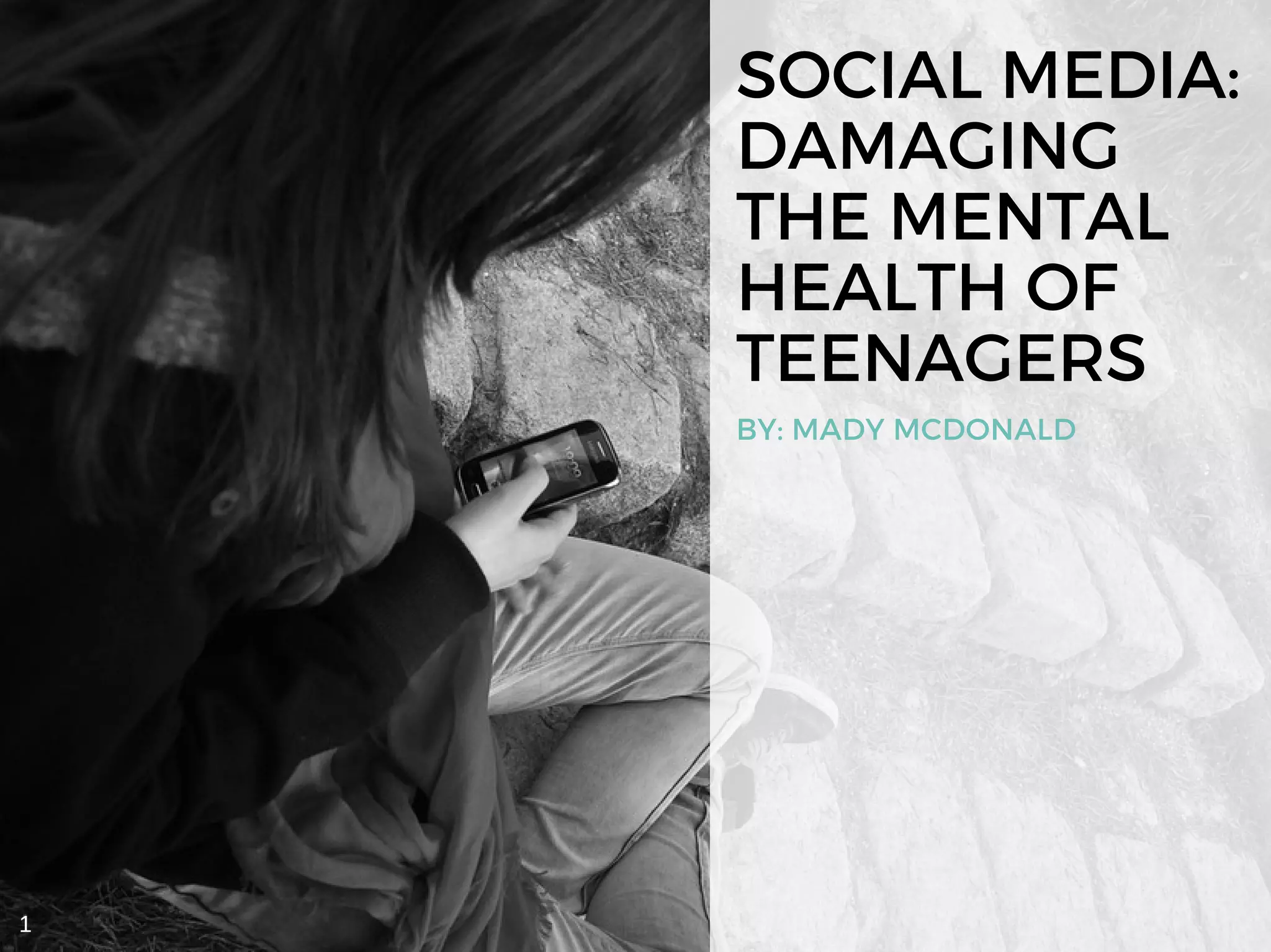
SOCIAL MEDIA:
DAMAGING
THE MENTAL
HEALTH OF
TEENAGERS
BY: MADY MCDONALD
1
Social media permits users to connect to one
another ­ to participate in a social network that
includes friends, other connections, invites,
updates, events, etc.
2
(2)
1 0 U S E S &
G R A T I F I C A T I O N S F O R
U S I N G S O C I A L M E D I A
1
3
SOCIAL INTERACTION
2 INFORMATION
SEEKING
PASS TIME
ENTERTAINMENT
COMMUNICATORY
UTILITY
8
CONVENIENCE UTILITY
9
EXPRESSION OF
OPINION3
4
5
6
7
8
9
10RELAXATION
INFORMATION SHARING
SURVEILLANCE/KNOWLEDGE
ABOUT OTHERS
(13)
- IGOR PANTIC, ( 7)
HOWEVER. . .
"Several studies have indicated that
the prolonged use of social
networking sites, such as Facebook,
may be related to signs and
symptoms of depression. In addition,
some authors have indicated that
certain social networking site
activities might be associated with
low self-esteem, especially in
children and adolescents"
70%
SOCIAL MEDIA
of teenagers
ages 12 to 17
use
(6)
3
T E E N S W H O A R E O N S O C I A L
M E D I A F O R M O R E T H A N T W O
H O U R S A D A Y R E P O R T P O O R
S E L F - R A T E D M E N T A L
H E A L T H , P S Y C H O L O G I C A L
D I S T R E S S , S U I C I D A L
I D E A T I O N O R U N M E T N E E D
F O R M E N T A L H E A L T H
S U P P O R T
E L I Z A B E T H P A Y N E ( 1 2 )
No Use/Not Daily <= 1 Hour 2-4 Hours 5+ Hours
11% 10% 20% 28%
Percentage of Ontario Students in Grades 7-12 Rating
Their Mental Health as "Poor" According to Daily Use of
Social Media (9)
4
MEDIA
MULTITASKING
Media multitasking involves
using one form of media in
conjunction with another.
Young individuals incorporate
media surfing into everyday
daily activities and they do so
while using multiple devices
at once.
5
(11)
" P E O P L E W H O J U G G L E
M U L T I P L E M E D I A D E V I C E S
H A V E A L O W E R D E N S I T Y O F
G R A Y M A T T E R I N T H E
A N T E R I O R C I N G U L A T E
C O R T E X , A R E G I O N O F T H E
B R A I N I N V O L V E D I N
C O G N I T I V E A N D E M O T I O N A L
P R O C E S S I N G ”
SUMATHI REDDY, ( 11)
MEDIA USE AT NIGHT
Teenagers spoke about the pressure they felt to make themselves available 24/7,
and the resulting anxiety if they did not respond immediately to texts or posts. Teens
are so emotionally invested in social media that a fifth of secondary school pupils will
wake up at night to log on, just to make sure they don't miss out. (10)
DAMAGING SLEEP AND INCREASING RISK OF ANXIETY & DEPRESSION
6
"THE GROWTH IN TIME SPENT ON THE
INTERNET IS DRIVEN BY THE GROWING
NUMBER OF CONNECTED DEVICES WE
HAVE WITH US ALL THE TIME"
SUSAN KRASHINSKY, (4)
7
WHY IS HEAVY USE OF
SOCIAL MEDIA
ASSOCIATED WITH
WORSE MENTAL HEALTH?
3 FACTORS AT PLAY
HEAVY USAGE MAY INFLUENCE IMPORTANT
ASPECTS OF PHYSICAL HEALTH, WHICH IN
TURN AFFECTS MENTAL HEALTH. HEAVY USERS
OF SOCIAL MEDIA OFTEN REMAIN SLUMPED IN
A CHAIR, SHUT UP IN THEIR ROOM, GLUED TO
THEIR SCREEN. THIS SOMETIMES MEANS THAT
THEY ARE SKIPPING MEALS OR STAYING
SEDENTARY FOR EXCESSIVE PERIODS OF TIME.
THIS IS WORRYING GIVEN THAT REGULAR
EXERCISE AND A HEALTY DIET ARE BOTH
LINKED TO GOOD MENTAL HEALTH (5)
01
RESEARCH SHOWS THAT " PASSIVE- USE" OF
SOCIAL MEDIA MAY BE BAD FOR MENTAL
HEALTH. PASSIVE USE REFERS TO QUIETLY
OBSERVING OTHER PEOPLE' S SOCIAL MEDIA
PROFILES AND PICTURES. STUDIES SHOW
THAT THIS LEADS TO ENVY AND
RESENTMENT, WHICH CAN LOWER SELF-
ESTEEM AND WELL BEING. ( 5)
02
03 "Active use" of social media had been
linked to poor mental health. Active use
refers to the practice of regularly
posting pictures, videos, status updates,
comments or posts. In doing so, many
young people engage in strenuous
impression management, filtering reality
with the purpose of seeking the
approval and admiration of others. This
can be very damaging to a young
persons self-esteem if posts and photos
receive few likes or comments. The
whole process may lead young people
to question their value over others,
resulting in unhealthy self-scrutiny of
body image, physical appearance and
general lifestyle. This leads to self-
doubt and self-loathing. (5)
SHOULD PARENTS
JUST THROW AWAY
THEIR TEENS'
CELLPHONES AND
LOCK UP THEIR
LAPTOPS?
8
(12)
"WE'RE
COMMUNICATING,
BUT WE'RE NOT
COMMUNICATING
DEEPLY. THAT'S
THE DISCONNECT"
9
Catherine Steiner­Adair, Harvard Medical School clinical psychologist, (8)
T H O U G H T H E R E I S N O O N E S I Z E F I T S A L L A P P R O A C H ,
H E R E A R E 5 R E S E A R C H - B A S E D T I P S
THE COMBINATION OF TECHNOLOGICAL ADVANCEMENTS AND NORMAL
ADOLESCENT DEVELOPMENT CREATES A HUGE CHALLENGE FOR TODAY'S
PARENTS
SUPPORT TEENS' SOCIAL
LIVES ONLINE AND OFF
BALANCE BREADTH AND FOCUS IN
INTELLECTUAL DEVELOPMENT
FOSTER EMOTIONAL AND
ATTENTIONAL SELF­AWARENESS
PRIORITIZE OFFLINE
CONNECTIONS
WATCH FOR TROUBLE
AND INTERVENE
Catherine Steiner-Adair, Harvard Medical School clinical psychologist. (#)
(3)
"INACTION ON THESE ISSUES IS
HARMING THE PHYSICAL AND
EMOTIONAL WELLBEING OF
YOUNG PEOPLE IN THIS
COUNTRY,
SO...
WHAT ARE WE WAITING FOR?"
10
(1)
WORKS CITED
(1)  “Teaching Kids to Be Smart about Social Media.” Aug. 2014, http://kidshealth.org/en/parents/social­media­
smarts.html
(2) “Facebook and Mental Health: Is Social Media Hurting or Helping?” Mental Health, Dual­Diagnosis, & Behavioral
Addictions, 14 Jan. 2016
(3) “Five Tips for Helping Teens Manage Technology.” Greater Good: The Science of a Meaningful Life, 25 June 2014
(4) “Four Ways Canadians Are Consuming Media Differently.” The Globe and Mail, 4 Dec. 2014
(5) “Here’s Why Social Media Harms Your Teens Mental Health.” Huffington post, 14 Sept. 2016
(6) Jazlyn. “10 Ways Social Media Affects Mental Health.” Top 10 Facts, Degreed Blog, 29 Apr. 2015,
http://blog.degreed.com/10­ways­social­media­affects­our­mental­health/
(7) Pantic, Igor. “Online Social Networking and Mental Health.” Cyberpsychology, Behaviour, and Social Networking,
vol. 17, no. 10, Oct. 2014, pp. 652­657
(8) “Portrait of an e­Family: How They’re Making Their Hyper­Digital Lives Work.” The Globe and Mail, 22 Aug. 2013
(9) “Social Media and Student Mental Health: What’s the Connection?” Centre for Addiction and Mental Health, Aug.
2015
(10) “Social Media is Harming the Mental Health of Teenagers. The State Has to Act.” The Guardian, 16 Sept. 2015
(11) “Teen Researchers Defend Media Multitasking; Doing Homework with Music, Texts, Tweets Works Better For
Some.” Wall Street Journal, 3 Oct. 2014
(12) “Teens’ Poor Mental Health Linked to Social Media Use.” The Ottawa Citizen, 8 Aug. 2015
(13)  Whiting, Anita, and David Williams. “Why People Use Social Media: A Uses and Gratifications Approach.”
Qualitative Market Research: An International Journal, vol. 16, no. 4, 30 Aug. 2013, pp. 362­269
IMAGES
All graphics are from the Canva template. The photos are from royalty free websites
and are listed in the order they appear in the presentation
1 ­ https://pixabay.com/en/girl­mobile­smartphone­society­701247/
2 ­ https://pixabay.com/en/macbook­laptop­computer­technology­925595/
3 ­ https://pixabay.com/en/smartphone­iphone­cellphone­hand­1399669/
4 ­ https://pixabay.com/en/children­walking­road­distant­1149671/
5 ­ https://www.pexels.com/search/phone%20laptop/
6 ­ https://www.pexels.com/photo/laptop­computer­turned­on­while­in­dark­area­30814/
7 ­ https://pixabay.com/en/macbook­macbook­air­computer­1001303/ 
8 ­ https://www.pexels.com/photo/person­smartphone­office­table­3368/
9 ­ https://www.pexels.com/photo/macbook­pro­beside­black­framed­eyeglasses­on­
brown­wooden­surface­187107/
10 ­ https://www.pexels.com/photo/man­holds­digital­tablet­in­his­hands­6363/ 

Social Media: Damaging the Mental Health of Teenagers