 Technology & Children
By Adelina Rashiti
“Digital Natives”
Technology has
become an
inseparable part of
our kids daily life.
The average age for
a child to have their
first smartphone is
now 10.3 years.
Two to four years old
watch an average of 2.5-3
hours of tv.
Generation Einstein’ is growing up
in and being shaped by
24/7commercialized information
society’(Boschma & Groen, 2007).
Children have access to internet almost
from birth now.
Children have access to internet
almost from birth now.
According to comScore,
Canadians among the biggest
online addicts, spending more
time on the internet than
anyone else in the world.
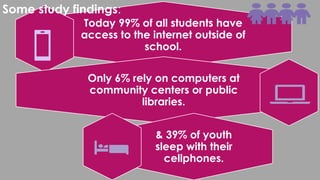
Today 99% of all students have
access to the internet outside of
school.
Only 6% rely on computers at
community centers or public
libraries.
& 39% of youth
sleep with their
cellphones.
Some study findings:
Media researchers more concerned about
children using smartphones, iPads etc. than
parents (Funk, Brouer, Curtiss, and McBroom
2009).
Parents expect their children
to use technology at school
and believe that they would
be at disadvantage if they do
not attain these skills.
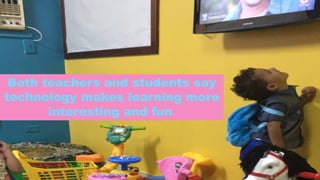
Both teachers and students say
technology makes learning more
interesting and fun.
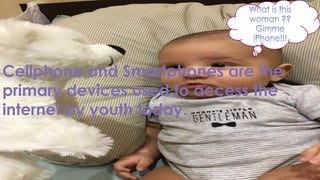
Cellphone and Smartphones are the
primary devices used to access the
internet by youth today.
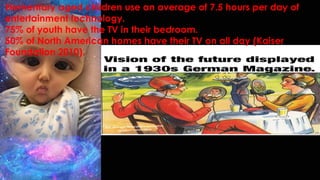
Elementary aged children use an average of 7.5 hours per day of
entertainment technology.
75% of youth have the TV in their bedroom.
50% of North American homes have their TV on all day (Kaiser
Foundation 2010).
Most parents are happy to be able to “spy” on their
children via technology.
When asked about advantages and disadvantages of a
class website, many were pleased with the ability to
access homework assignments.
Yappy
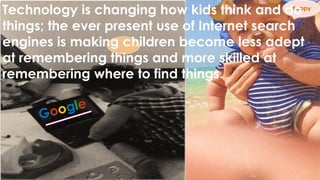
Technology is changing how kids think and do
things; the ever present use of Internet search
engines is making children become less adept
at remembering things and more skilled at
remembering where to find things.
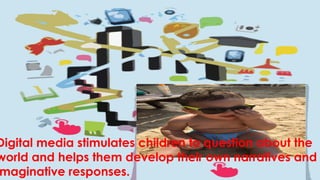
Digital media stimulates children to question about the
world and helps them develop their own narratives and
maginative responses.
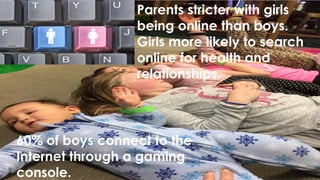
Parents stricter with girls
being online than boys.
Girls more likely to search
online for health and
relationships.
.
60% of boys connect to the
Internet through a gaming
console.
Studies over the past decade have come
to conclusion that many adolescents
today are having difficulty identifying
emotions in people, causing difficulty to
feel empathy toward others who may be
feeling pain, sorrow, anger and other
emotions.
“Technology is a useful
servant but a dangerous
master.” – Christian Louis Lange
References:
1. AT&T inc.; parents can rule, kids can be cruel, new mobile phone study reveals. (2012).Technology & Business
Journal, , 166. Retrieved from https://search-proquest-
com.proxy.queensu.ca/docview/1021362258?accountid=6180
2. Loney, Heather. "Canada’S Youth Are Highly Connected, Girls Face Different Rules Online: Study". Global News.
N.p., 2014. Web. 30 May 2017. Retrieved from
http://globalnews.ca/news/1098160/canadas-youth-are-highly-connected-girls-face-different-rules-online-study/
3. Conrad, Brent. “Media Statistics - Children’s Use of TV, Internet, and Video Games.” Internet, Video Game, and
Television Stats for Children. Clinical Psychologists for TechAddictions. Web. Retrieved from
http://www.techaddiction.ca/media-statistics.html
10. Taylor, Jim. “ How Technology Is Changing The Way Children Think and Focus.” Are you Children Prepared to
think and focus success in 21 century lifer. Psychology Today. N.p., 2012. Web. 30 May 2017. Retrieved from
https://www.psychologytoday.com/blog/the-power-prime/201212/how-technology-is-changing-the-way-
children-think-and-focus.
4. Dell’Antonia, Kj. "Don't Post About Me On Social Media, Children Say". Well. N.p., 2016. Web. 2 June 2017. Retrived
from https://well.blogs.nytimes.com/2016/03/08/dont-post-about-me-on-social-media-children-say/
5. . Moms Worry About Impact of Technology on Their Kids. (2015, June 1). PR Newswire. Retrieved
from http://go.galegroup.com.proxy.queensu.ca/ps/i.do?p=AONE&sw=w&u=queensulaw&v=2.1&it=r&id=GALE%7C
A415976631&asid=
6. The Impact Of Technology On The Developing Child". HuffPost. N.p., 2013. Web. Retrieved
from http://m.huffpost.com/us/entry/3343245
7. Toddlers And Touchscreens: A Science In Development". Association for Psychological Science. N.p.,
2015. Web. 30 May 2017. Retrieved
fromhttps://www.psychologicalscience.org/publications/observer/obsonline/toddlers-and-touchscreens-a-
science-in-development.html
8. Technology Lets Parents Track Kids' Every Move. (2006, August 29). Morning Edition. Retrieved
from http://go.galegroup.com.proxy.queensu.ca/ps/i.do?p=AONE&sw=w&u=queensulaw&v=2.1&it=r&id=GA
LE%7CA155576765&sid=summon&asid=cfa0dfe5b2db098507117a48535ca8d7
9. Paul, P. (2013, May 5). Cyberparenting and the Risk of T.M.I. New York Times, p. 8(L). Retrieved
from http://go.galegroup.com.proxy.queensu.ca/ps/i.do?p=AONE&sw=w&u=queensulaw&v=2.1&it=r&id=GA
LE%7CA328694536&asid=ed444bf722dd554a00a728a96a4737f2
10. "Statistics On Children’S Use Of TV, Internet, & Video Games - Techaddiction".Techaddiction.ca. Web. 30
May 2017. Retrieved from http://m.huffpost.com/ca/entry/6958156
Pictures:
All pictures used are personal, except slide # 13, 15, 16.
13. Instagram@likecureslike can also be found on google images
14.Google images/ionela_novak twitter.
15. google images

Flipbook

  • 1.
     Technology &Children By Adelina Rashiti “Digital Natives”
  • 2.
    Technology has become an inseparablepart of our kids daily life.
  • 3.
    The average agefor a child to have their first smartphone is now 10.3 years.
  • 4.
    Two to fouryears old watch an average of 2.5-3 hours of tv.
  • 5.
    Generation Einstein’ isgrowing up in and being shaped by 24/7commercialized information society’(Boschma & Groen, 2007).
  • 6.
    Children have accessto internet almost from birth now. Children have access to internet almost from birth now.
  • 7.
    According to comScore, Canadiansamong the biggest online addicts, spending more time on the internet than anyone else in the world.
  • 8.
    Today 99% ofall students have access to the internet outside of school. Only 6% rely on computers at community centers or public libraries. & 39% of youth sleep with their cellphones. Some study findings:
  • 9.
    Media researchers moreconcerned about children using smartphones, iPads etc. than parents (Funk, Brouer, Curtiss, and McBroom 2009).
  • 10.
    Parents expect theirchildren to use technology at school and believe that they would be at disadvantage if they do not attain these skills.
  • 11.
    Both teachers andstudents say technology makes learning more interesting and fun.
  • 12.
    Cellphone and Smartphonesare the primary devices used to access the internet by youth today.
  • 13.
    Elementary aged childrenuse an average of 7.5 hours per day of entertainment technology. 75% of youth have the TV in their bedroom. 50% of North American homes have their TV on all day (Kaiser Foundation 2010).
  • 14.
    Most parents arehappy to be able to “spy” on their children via technology. When asked about advantages and disadvantages of a class website, many were pleased with the ability to access homework assignments.
  • 15.
    Yappy Technology is changinghow kids think and do things; the ever present use of Internet search engines is making children become less adept at remembering things and more skilled at remembering where to find things.
  • 16.
    Digital media stimulateschildren to question about the world and helps them develop their own narratives and maginative responses.
  • 17.
    Parents stricter withgirls being online than boys. Girls more likely to search online for health and relationships. . 60% of boys connect to the Internet through a gaming console.
  • 18.
    Studies over thepast decade have come to conclusion that many adolescents today are having difficulty identifying emotions in people, causing difficulty to feel empathy toward others who may be feeling pain, sorrow, anger and other emotions.
  • 19.
    “Technology is auseful servant but a dangerous master.” – Christian Louis Lange
  • 20.
    References: 1. AT&T inc.;parents can rule, kids can be cruel, new mobile phone study reveals. (2012).Technology & Business Journal, , 166. Retrieved from https://search-proquest- com.proxy.queensu.ca/docview/1021362258?accountid=6180 2. Loney, Heather. "Canada’S Youth Are Highly Connected, Girls Face Different Rules Online: Study". Global News. N.p., 2014. Web. 30 May 2017. Retrieved from http://globalnews.ca/news/1098160/canadas-youth-are-highly-connected-girls-face-different-rules-online-study/ 3. Conrad, Brent. “Media Statistics - Children’s Use of TV, Internet, and Video Games.” Internet, Video Game, and Television Stats for Children. Clinical Psychologists for TechAddictions. Web. Retrieved from http://www.techaddiction.ca/media-statistics.html 10. Taylor, Jim. “ How Technology Is Changing The Way Children Think and Focus.” Are you Children Prepared to think and focus success in 21 century lifer. Psychology Today. N.p., 2012. Web. 30 May 2017. Retrieved from https://www.psychologytoday.com/blog/the-power-prime/201212/how-technology-is-changing-the-way- children-think-and-focus. 4. Dell’Antonia, Kj. "Don't Post About Me On Social Media, Children Say". Well. N.p., 2016. Web. 2 June 2017. Retrived from https://well.blogs.nytimes.com/2016/03/08/dont-post-about-me-on-social-media-children-say/ 5. . Moms Worry About Impact of Technology on Their Kids. (2015, June 1). PR Newswire. Retrieved from http://go.galegroup.com.proxy.queensu.ca/ps/i.do?p=AONE&sw=w&u=queensulaw&v=2.1&it=r&id=GALE%7C A415976631&asid= 6. The Impact Of Technology On The Developing Child". HuffPost. N.p., 2013. Web. Retrieved from http://m.huffpost.com/us/entry/3343245
  • 21.
    7. Toddlers AndTouchscreens: A Science In Development". Association for Psychological Science. N.p., 2015. Web. 30 May 2017. Retrieved fromhttps://www.psychologicalscience.org/publications/observer/obsonline/toddlers-and-touchscreens-a- science-in-development.html 8. Technology Lets Parents Track Kids' Every Move. (2006, August 29). Morning Edition. Retrieved from http://go.galegroup.com.proxy.queensu.ca/ps/i.do?p=AONE&sw=w&u=queensulaw&v=2.1&it=r&id=GA LE%7CA155576765&sid=summon&asid=cfa0dfe5b2db098507117a48535ca8d7 9. Paul, P. (2013, May 5). Cyberparenting and the Risk of T.M.I. New York Times, p. 8(L). Retrieved from http://go.galegroup.com.proxy.queensu.ca/ps/i.do?p=AONE&sw=w&u=queensulaw&v=2.1&it=r&id=GA LE%7CA328694536&asid=ed444bf722dd554a00a728a96a4737f2 10. "Statistics On Children’S Use Of TV, Internet, & Video Games - Techaddiction".Techaddiction.ca. Web. 30 May 2017. Retrieved from http://m.huffpost.com/ca/entry/6958156 Pictures: All pictures used are personal, except slide # 13, 15, 16. 13. Instagram@likecureslike can also be found on google images 14.Google images/ionela_novak twitter. 15. google images