



Groups, Phyla
, Classes
1  Kingdom
 2 Groups
 10 Phyla
 290,000+ Species
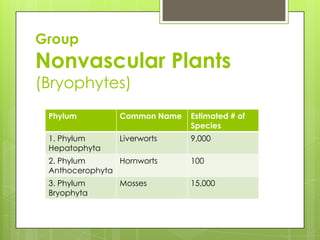
Group
Nonvascular Plants
(Bryophytes)
 Phylum         Common Name   Estimated # of
                              Species
 1. Phylum      Liverworts    9,000
 Hepatophyta
 2. Phylum      Hornworts     100
 Anthocerophyta
 3. Phylum      Mosses        15,000
 Bryophyta
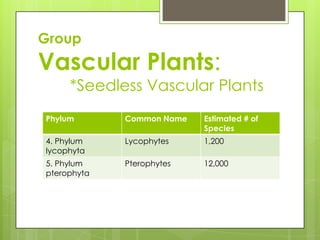
Group
Vascular Plants:
     *Seedless Vascular Plants
Phylum       Common Name   Estimated # of
                           Species
4. Phylum    Lycophytes    1,200
lycophyta
5. Phylum    Pterophytes   12,000
pterophyta
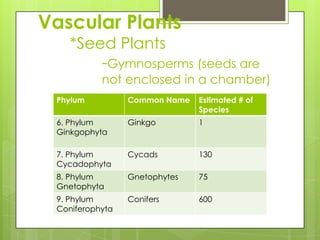
Vascular Plants
    *Seed Plants
        -Gymnosperms (seeds are
           not enclosed in a chamber)
 Phylum          Common Name   Estimated # of
                               Species
 6. Phylum       Ginkgo        1
 Ginkgophyta

 7. Phylum       Cycads        130
 Cycadophyta
 8. Phylum       Gnetophytes   75
 Gnetophyta
 9. Phylum       Conifers      600
 Coniferophyta
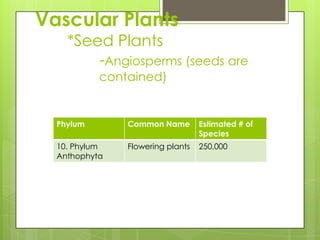
Vascular Plants
    *Seed Plants
        -Angiosperms (seeds are
           contained)


  Phylum       Common Name        Estimated # of
                                  Species
  10. Phylum   Flowering plants   250,000
  Anthophyta
Group: Novascular Plants
No  water-conducting cells
 (xylem).
1. Phylum Hepatophyta
 Some    liverworts have flattened
  gametophytes while others have
  stemlike gametophytes.
 The gametophytes themselves are
  liver-shaped.
2. Phylum Anthocerophyta
 The  sporophytes have a long, tapered
  shape.
 A hornwort sporophyte lacks seta and
  consists only of sporangium.
 Hornworts are often among the first to
  colonize open area with moist soils.
 They share a symbiotic relationship with
  nitrogen-fixing cyanobacteria.
3. Phylum Bryophyta
 Bryophyta   are nonvascular embryophytes
  that have no water-conducting tissues.
 Known as mosses, these organisms range
  in height from less than 1 mm to up to 2 m.
 Persistent unbranched sporophytes
 No vascular system
Vascular Plants
Xylem tissue, true roots, stems &
 leaves.
4. Phylum Lycophyta
 Many    lycophytes grow on other plants as
  epiphytes (plants that use other plants as
  a substrate but are not parasites).
 Other species grow on forest floors.
 Others live below ground, gaining
  nutrients from fungi.
 It includes sporophytes, club mosses, spike
  mosses, and quillworts.
5. Phylum Pterophyta
 Thisphylum includes ferns, horsetails, and
  whisk ferns and relatives.
 Ferns radiated from their Devonian origins
  and grew next to tree lycophytes and
  horsetails.
 They are most diverse in the tropics, but
  there are some species that have
  adapted to arid climates.
6. Phylum Ginkgophyta
 There   is only one surviving species of
  this phylum, the Ginkgo biloba.
 This phylum, and species, has
  deciduous fanlike leaves that turn
  gold in the Fall.
 It tolerates air pollution well.
7. Phylum Cycadophyta
 The second largest group of
  gymnosperms, they have large
  cones and palmlike leaves.
 Cycads thrived during the Mesozoic
  era, known as the age of cycads
  and the age of dinosaurs.
8. Phylum Gnetophyta
 Have woody vascular system
 Consists of three genera: Gnetum,
  Ephedra, and Welwitschia.
 These have been grouped together
  based on molecular data.
9. Phylum Coniferophyta
 Thisphylum is by far the largest of the
  gymnosperms.
 Many are large trees.
 Most conifers are evergreens, remaining
  green all year round.
 When spring comes around, conifers
  already have fully developed leaves.
9. Phylum Anthophyta
Thisencompasses all
 angiosperms (flowering plants).
The flower itself is a
 development used for sexual
 reproduction.
Use fruit to encompass seeds.

Groups, phyla, classes

  • 1.
  • 2.
    1 Kingdom 2 Groups  10 Phyla  290,000+ Species
  • 3.
    Group Nonvascular Plants (Bryophytes) Phylum Common Name Estimated # of Species 1. Phylum Liverworts 9,000 Hepatophyta 2. Phylum Hornworts 100 Anthocerophyta 3. Phylum Mosses 15,000 Bryophyta
  • 4.
    Group Vascular Plants: *Seedless Vascular Plants Phylum Common Name Estimated # of Species 4. Phylum Lycophytes 1,200 lycophyta 5. Phylum Pterophytes 12,000 pterophyta
  • 5.
    Vascular Plants *Seed Plants -Gymnosperms (seeds are not enclosed in a chamber) Phylum Common Name Estimated # of Species 6. Phylum Ginkgo 1 Ginkgophyta 7. Phylum Cycads 130 Cycadophyta 8. Phylum Gnetophytes 75 Gnetophyta 9. Phylum Conifers 600 Coniferophyta
  • 6.
    Vascular Plants *Seed Plants -Angiosperms (seeds are contained) Phylum Common Name Estimated # of Species 10. Phylum Flowering plants 250,000 Anthophyta
  • 7.
    Group: Novascular Plants No water-conducting cells (xylem).
  • 8.
    1. Phylum Hepatophyta Some liverworts have flattened gametophytes while others have stemlike gametophytes.  The gametophytes themselves are liver-shaped.
  • 9.
    2. Phylum Anthocerophyta The sporophytes have a long, tapered shape.  A hornwort sporophyte lacks seta and consists only of sporangium.  Hornworts are often among the first to colonize open area with moist soils.  They share a symbiotic relationship with nitrogen-fixing cyanobacteria.
  • 10.
    3. Phylum Bryophyta Bryophyta are nonvascular embryophytes that have no water-conducting tissues.  Known as mosses, these organisms range in height from less than 1 mm to up to 2 m.  Persistent unbranched sporophytes  No vascular system
  • 11.
    Vascular Plants Xylem tissue,true roots, stems & leaves.
  • 12.
    4. Phylum Lycophyta Many lycophytes grow on other plants as epiphytes (plants that use other plants as a substrate but are not parasites).  Other species grow on forest floors.  Others live below ground, gaining nutrients from fungi.  It includes sporophytes, club mosses, spike mosses, and quillworts.
  • 13.
    5. Phylum Pterophyta Thisphylum includes ferns, horsetails, and whisk ferns and relatives.  Ferns radiated from their Devonian origins and grew next to tree lycophytes and horsetails.  They are most diverse in the tropics, but there are some species that have adapted to arid climates.
  • 14.
    6. Phylum Ginkgophyta There is only one surviving species of this phylum, the Ginkgo biloba.  This phylum, and species, has deciduous fanlike leaves that turn gold in the Fall.  It tolerates air pollution well.
  • 15.
    7. Phylum Cycadophyta The second largest group of gymnosperms, they have large cones and palmlike leaves.  Cycads thrived during the Mesozoic era, known as the age of cycads and the age of dinosaurs.
  • 16.
    8. Phylum Gnetophyta Have woody vascular system  Consists of three genera: Gnetum, Ephedra, and Welwitschia.  These have been grouped together based on molecular data.
  • 17.
    9. Phylum Coniferophyta Thisphylum is by far the largest of the gymnosperms.  Many are large trees.  Most conifers are evergreens, remaining green all year round.  When spring comes around, conifers already have fully developed leaves.
  • 18.
    9. Phylum Anthophyta Thisencompassesall angiosperms (flowering plants). The flower itself is a development used for sexual reproduction. Use fruit to encompass seeds.