Botany Primer for GardenersLinda R McMahan, PhDBotanist & Extension HorticulturistOregon State University Extensionlinda.mcmahan@oregonstate.edu
What We Will CoverPlant Diversity Algae, fungi and lichensSpore producing plants – mosses, liverworts, fernsSeed plants – conifers, ginkgo, and flowering plants Plant Structure and GrowthStems and roots Leaf structureFlowers and reproduction
Plant DiversityFrom ancient time when we began studying the world around us, we tried to understand our surroundings by labeling plants and animalsOur current scientific understanding continues to refine relationships, but historically, many organisms have been considered to be plants even if they are not now considered to be soI will use the historic understanding and explain modern differences as we proceed
Plant DiversityThe classification of various kinds of plants is based on reproduction  Spore producing plants appeared on earth before seed producing plantsLater, seed plants became more common—these are also the ones most common in our landscapes and gardens
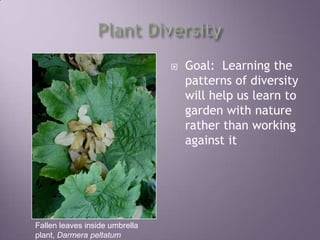
Plant DiversityGoal:  Learning the patterns of diversity will help us learn to garden with nature rather than working against itFallen leaves inside umbrella plant, Darmerapeltatum
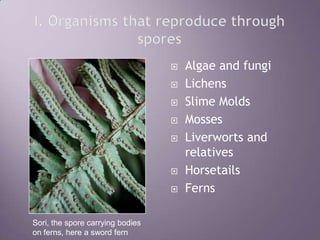
I. Organisms that reproduce through sporesAlgae and fungiLichensSlime Molds MossesLiverworts and relativesHorsetailsFernsSori, the spore carrying bodies on ferns, here a sword fern
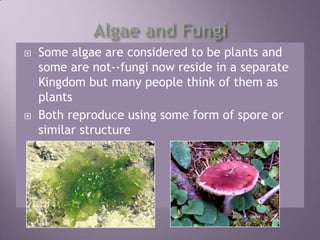
Algae and FungiSome algae are considered to be plants and some are not--fungi now reside in a separate Kingdom but many people think of them as plantsBoth reproduce using some form of spore or similar structure
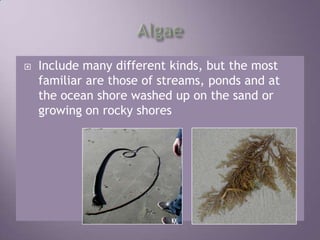
AlgaeInclude many different kinds, but the most familiar are those of streams, ponds and at the ocean shore washed up on the sand or growing on rocky shores
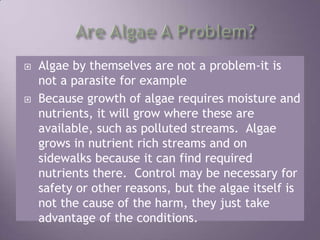
Are Algae A Problem?Algae by themselves are not a problem-it is not a parasite for exampleBecause growth of algae requires moisture and nutrients, it will grow where these are available, such as polluted streams.  Algae grows in nutrient rich streams and on sidewalks because it can find required nutrients there.  Control may be necessary for safety or other reasons, but the algae itself is not the cause of the harm, they just take advantage of the conditions.
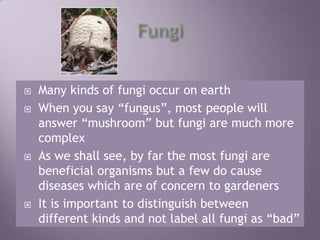
FungiMany kinds of fungi occur on earthWhen you say “fungus”, most people will answer “mushroom” but fungi are much more complexAs we shall see, by far the most fungi are beneficial organisms but a few do cause diseases which are of concern to gardenersIt is important to distinguish between different kinds and not label all fungi as “bad”
FungiSome mushrooms and other fungi are also toxic, but this is rarely a concern. Unless you know they are a problem, please don’t treat mushrooms with fungicides because this will interfere with their positive interactions with plants and the environment.For controlling fungi that cause disease, follow the recommendations of your local or state cooperative extension office.
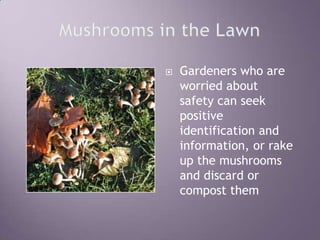
Mushrooms in the LawnGardeners who are worried about safety can seek positive identification and information, or rake up the mushrooms and discard or compost them
Positive Benefits of FungiFungi are one of earth’s major decomposers, helping to return organic matter to enrich our soilsSoil fungi form mutually beneficial relationships with plants called mycorrhizae
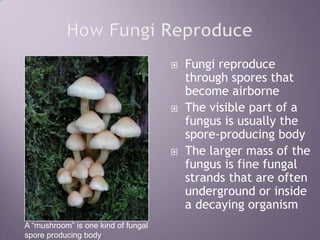
How Fungi ReproduceFungi reproduce through spores that become airborneThe visible part of a fungus is usually the spore-producing bodyThe larger mass of the fungus is fine fungal strands that are often underground or inside a decaying organismA “mushroom” is one kind of fungal spore producing body
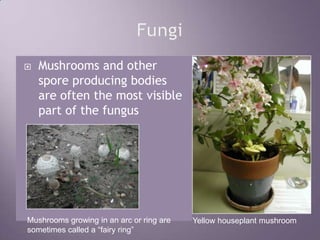
FungiMushrooms and other spore producing bodies are often the most visible part of the fungusMushrooms growing in an arc or ring are sometimes called a “fairy ring”Yellow houseplant mushroom
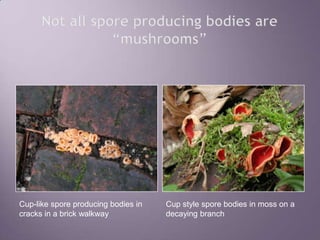
Not all spore producing bodies are “mushrooms”Cup-like spore producing bodies in cracks in a brick walkwayCup style spore bodies in moss on a decaying branch
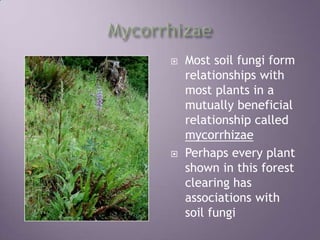
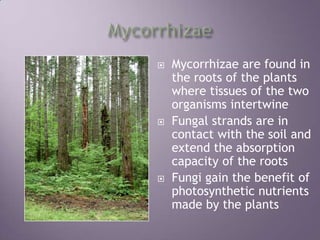
MycorrhizaeMost soil fungi form relationships with most plants in a mutually beneficial relationship called mycorrhizaePerhaps every plant shown in this forest clearing has associations with soil fungi
MycorrhizaeMycorrhizae are found in the roots of the plants where tissues of the two organisms intertwineFungal strands are in contact with the soil and extend the absorption capacity of the rootsFungi gain the benefit of photosynthetic nutrients made by the plants
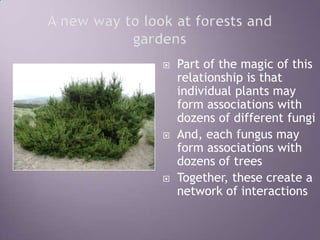
A new way to look at forests and gardensPart of the magic of this relationship is that individual plants may form associations with dozens of different fungiAnd, each fungus may form associations with dozens of trees Together, these create a network of interactions
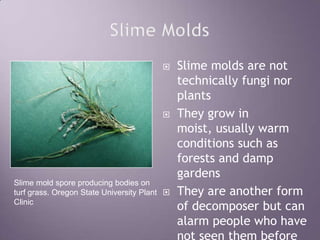
Slime MoldsSlime molds are not technically fungi nor plantsThey grow in moist, usually warm conditions such as forests and damp gardensThey are another form of decomposer but can alarm people who have not seen them beforeSlime mold spore producing bodies on turf grass. Oregon State University Plant Clinic
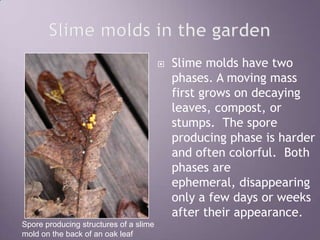
Slime molds in the gardenSlime molds have two phases. A moving mass first grows on decaying leaves, compost, or stumps.  The spore producing phase is harder and often colorful.  Both phases are ephemeral, disappearing only a few days or weeks after their appearance.Spore producing structures of a slime mold on the back of an oak leaf
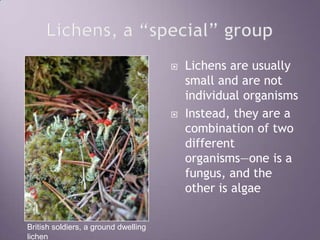
Lichens, a “special” groupLichens are usually small and are not individual organismsInstead, they are a combination of two different organisms—one is a fungus, and the other is algaeBritish soldiers, a ground dwelling lichen
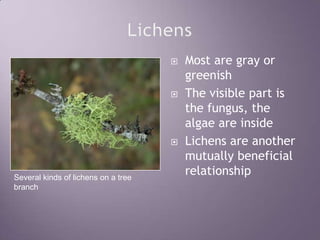
LichensMost are gray or greenishThe visible part is the fungus, the algae are insideLichens are another mutually beneficial relationshipSeveral kinds of lichens on a tree branch
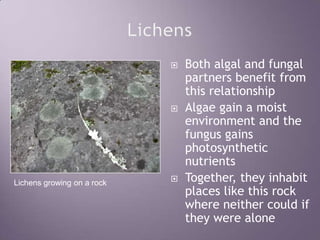
LichensBoth algal and fungal partners benefit from this relationshipAlgae gain a moist environment and the fungus gains photosynthetic nutrientsTogether, they inhabit places like this rock where neither could if they were aloneLichens growing on a rock
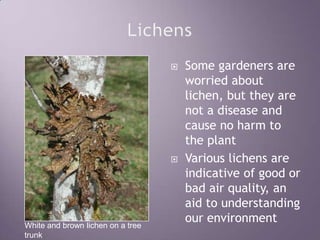
LichensSome gardeners are worried about lichen, but they are not a disease and cause no harm to the plantVarious lichens are indicative of good or bad air quality, an aid to understanding our environmentWhite and brown lichen on a tree trunk
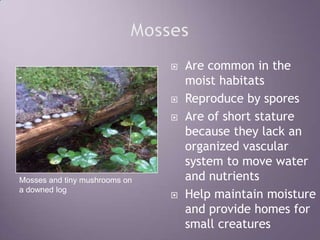
MossesAre common in the moist habitatsReproduce by sporesAre of short stature because they lack an organized vascular system to move water and nutrientsHelp maintain moisture and provide homes for small creaturesMosses and tiny mushrooms on a downed log
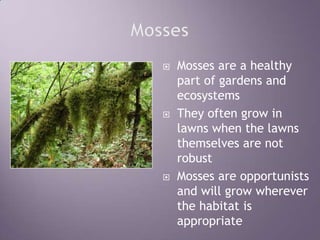
MossesMosses are a healthy part of gardens and ecosystemsThey often grow in lawns when the lawns themselves are not robustMosses are opportunists and will grow wherever the habitat is appropriate
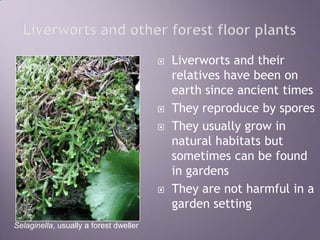
Liverworts and other forest floor plantsLiverworts and their relatives have been on earth since ancient timesThey reproduce by sporesThey usually grow in natural habitats but sometimes can be found in gardensThey are not harmful in a garden settingSelaginella, usually a forest dweller
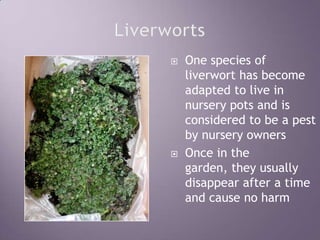
LiverwortsOne species of liverwort has become adapted to live in nursery pots and is considered to be a pest by nursery ownersOnce in the garden, they usually disappear after a time and cause no harm
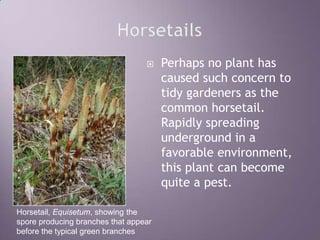
HorsetailsPerhaps no plant has caused such concern to tidy gardeners as the common horsetail.  Rapidly spreading underground in a favorable environment, this plant can become quite a pest.Horsetail, Equisetum, showing the spore producing branches that appear before the typical green branches
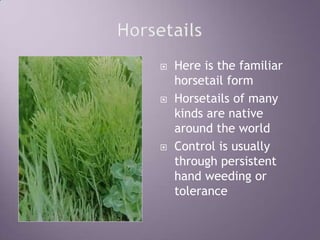
HorsetailsHere is the familiar horsetail formHorsetails of many kinds are native around the worldControl is usually through persistent hand weeding or tolerance
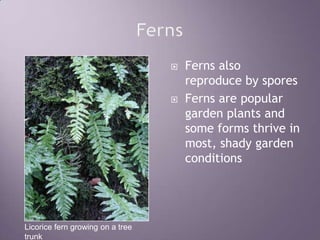
FernsFerns also reproduce by spores Ferns are popular garden plants and some forms thrive in most, shady garden conditionsLicorice fern growing on a tree trunk
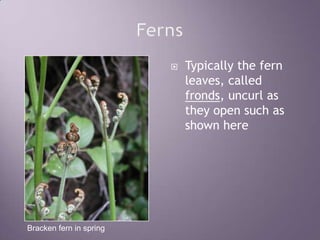
FernsTypically the fern leaves, called fronds, uncurl as they open such as shown hereBracken fern in spring
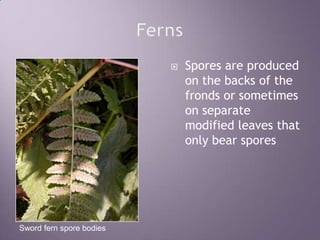
FernsSpores are produced on the backs of the fronds or sometimes on separate modified leaves that only bear sporesSword fern spore bodies
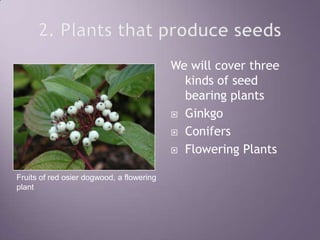
2. Plants that produce seedsWe will cover three kinds of seed bearing plantsGinkgoConifersFlowering PlantsFruits of red osier dogwood, a flowering plant
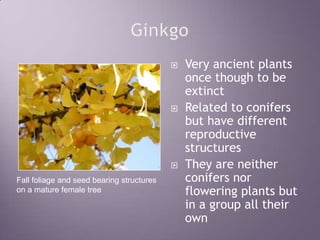
GinkgoVery ancient plants once though to be extinctRelated to conifers but have different reproductive structuresThey are neither conifers nor flowering plants but in a group all their ownFall foliage and seed bearing structures on a mature female tree
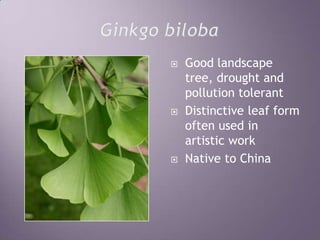
Ginkgo bilobaGood landscape tree, drought and pollution tolerantDistinctive leaf form often used in artistic workNative to China
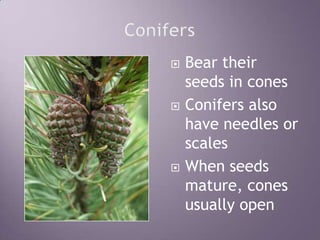
ConifersBear their seeds in conesConifers also have needles or scalesWhen seeds mature, cones usually open
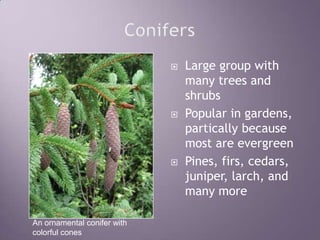
ConifersLarge group with many trees and shrubsPopular in gardens, particallybecause most are evergreenPines, firs, cedars, juniper, larch, and many moreAn ornamental conifer with colorful cones
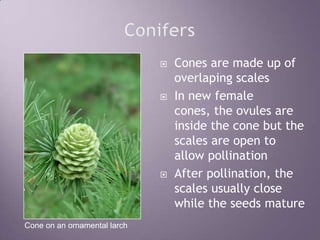
ConifersCones are made up of overlaping scalesIn new female cones, the ovules are inside the cone but the scales are open to allow pollinationAfter pollination, the scales usually close while the seeds matureCone on an ornamental larch
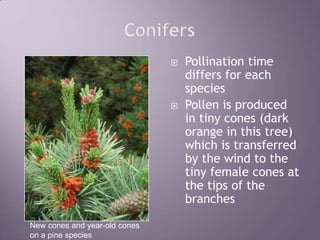
ConifersPollination time differs for each speciesPollen is produced in tiny cones (dark orange in this tree) which is transferred by the wind to the tiny female cones at the tips of the branchesNew cones and year-old cones on a pine species
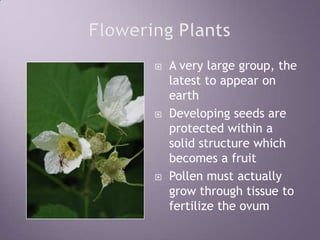
Flowering PlantsA very large group, the latest to appear on earthDeveloping seeds are protected within a solid structure which becomes a fruitPollen must actually grow through tissue to fertilize the ovum
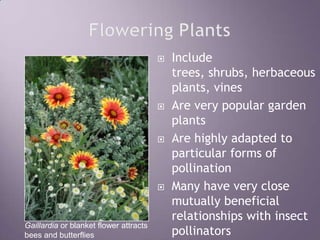
Flowering PlantsInclude trees, shrubs, herbaceous plants, vinesAre very popular garden plantsAre highly adapted to particular forms of pollinationMany have very close mutually beneficial relationships with insect pollinatorsGaillardia or blanket flower attracts bees and butterflies
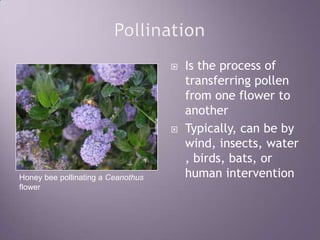
PollinationIs the process of transferring pollen from one flower to anotherTypically, can be by wind, insects, water, birds, bats, or human interventionHoney bee pollinating a Ceanothus flower
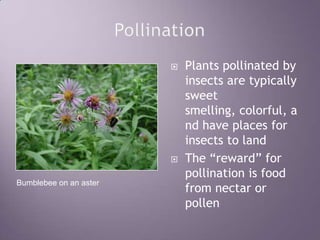
PollinationPlants pollinated by insects are typically sweet smelling, colorful, and have places for insects to landThe “reward” for pollination is food from nectar or pollenBumblebee on an aster
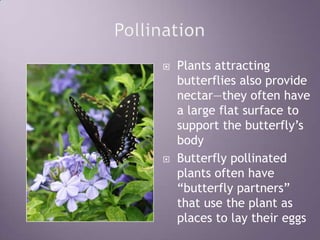
PollinationPlants attracting butterflies also provide nectar—they often have a large flat surface to support the butterfly’s bodyButterfly pollinated plants often have “butterfly partners” that use the plant as places to lay their eggs
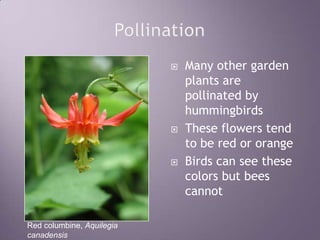
PollinationMany other garden plants are pollinated by hummingbirdsThese flowers tend to be red or orangeBirds can see these colors but bees cannotRed columbine, Aquilegia canadensis
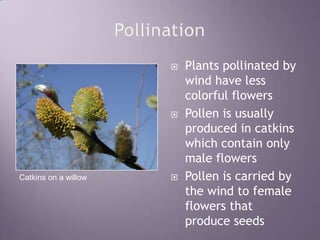
PollinationPlants pollinated by wind have less colorful flowersPollen is usually produced in catkins which contain only male flowersPollen is carried by the wind to female flowers that produce seedsCatkins on a willow
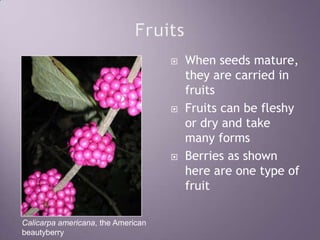
FruitsWhen seeds mature, they are carried in fruitsFruits can be fleshy or dry and take many formsBerries as shown here are one type of fruitCalicarpa americana, the American beautyberry
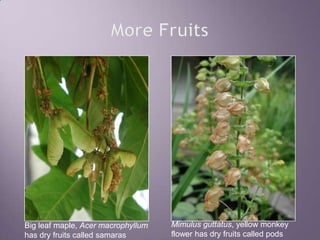
More FruitsMimulus guttatus, yellow monkey flower has dry fruits called podsBig leaf maple, Acer macrophyllum has dry fruits called samaras
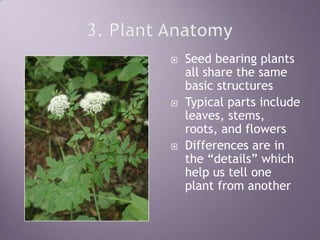
3. Plant AnatomySeed bearing plants all share the same basic structuresTypical parts include leaves, stems, roots, and flowersDifferences are in the “details” which help us tell one plant from another
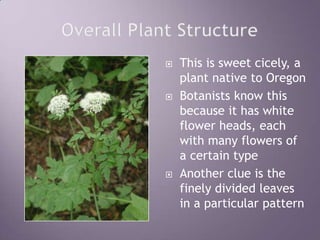
Overall Plant StructureThis is sweet cicely, a plant native to OregonBotanists know this because it has white flower heads, each with many flowers of a certain typeAnother clue is the finely divided leaves in a particular pattern
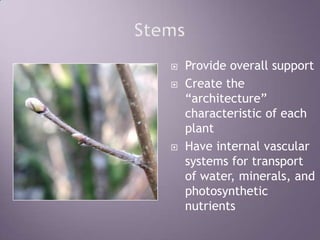
StemsProvide overall supportCreate the “architecture” characteristic of each plantHave internal vascular systems for transport of water, minerals, and photosynthetic nutrients
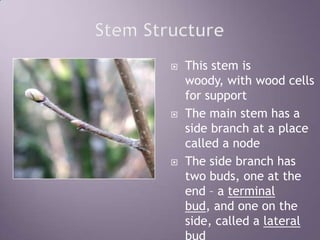
Stem StructureThis stem is woody, with wood cells for supportThe main stem has a side branch at a place called a nodeThe side branch has two buds, one at the end – a terminal bud, and one on the side, called a lateral bud
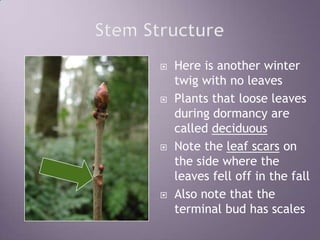
Stem StructureHere is another winter twig with no leavesPlants that loose leaves during dormancy are called deciduousNote the leaf scars on the side where the leaves fell off in the fallAlso note that the terminal bud has scales
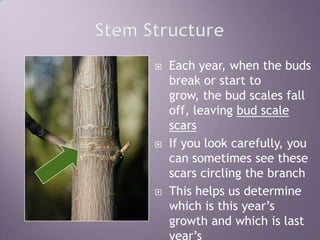
Stem StructureEach year, when the buds break or start to grow, the bud scales fall off, leaving bud scale scarsIf you look carefully, you can sometimes see these scars circling the branchThis helps us determine which is this year’s growth and which is last year’s
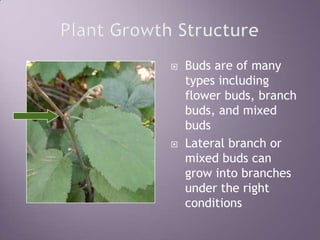
Plant Growth StructureBuds are of many types including flower buds, branch buds, and mixed budsLateral branch or mixed buds can grow into branches under the right conditions
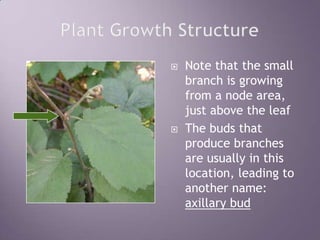
Plant Growth StructureNote that the small branch is growing from a node area, just above the leafThe buds that produce branches are usually in this location, leading to another name: axillarybud
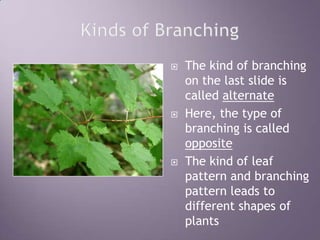
Kinds of BranchingThe kind of branching on the last slide is called alternate Here, the type of branching is called oppositeThe kind of leaf pattern and branching pattern leads to different shapes of plants
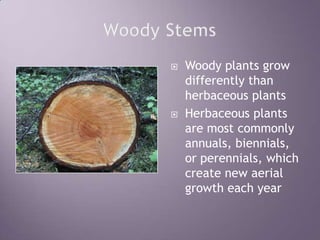
Woody StemsWoody plants grow differently than herbaceous plantsHerbaceous plants are most commonly annuals, biennials, or perennials, which create new aerial growth each year
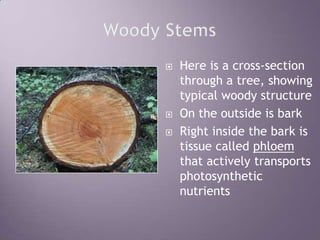
Woody StemsHere is a cross-section through a tree, showing typical woody structureOn the outside is barkRight inside the bark is tissue called phloem that actively transports photosynthetic nutrients
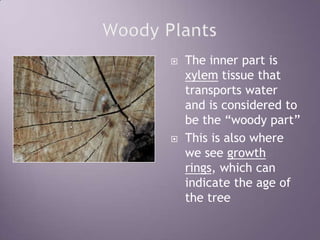
Woody PlantsThe inner part is xylem tissue that transports water and is considered to be the “woody part”This is also where we see growth rings, which can indicate the age of the tree
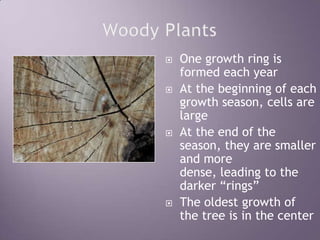
Woody PlantsOne growth ring is formed each yearAt the beginning of each growth season, cells are largeAt the end of the season, they are smaller and more dense, leading to the darker “rings”The oldest growth of the tree is in the center
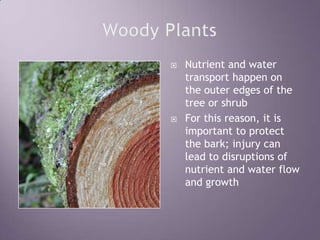
Woody PlantsNutrient and water transport happen on the outer edges of the tree or shrubFor this reason, it is important to protect the bark; injury can lead to disruptions of nutrient and water flow and growth
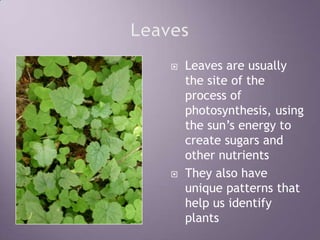
LeavesLeaves are usually the site of the process of photosynthesis, using the sun’s energy to create sugars and other nutrientsThey also have unique patterns that help us identify plants
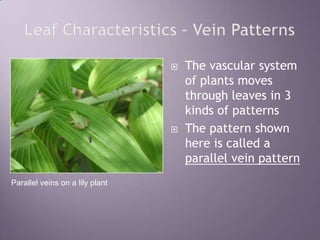
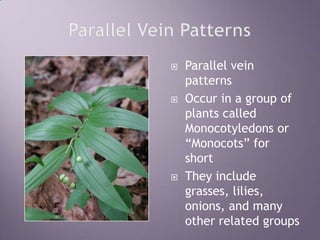
Leaf Characteristics – Vein PatternsThe vascular system of plants moves through leaves in 3 kinds of patternsThe pattern shown here is called a parallel vein patternParallel veins on a lily plant
Parallel Vein PatternsParallel vein patterns Occur in a group of plants called Monocotyledons or “Monocots” for shortThey include grasses, lilies, onions, and many other related groups
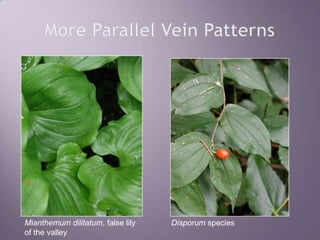
More Parallel Vein PatternsMianthemum dilitatum, false lily of the valleyDisporum species
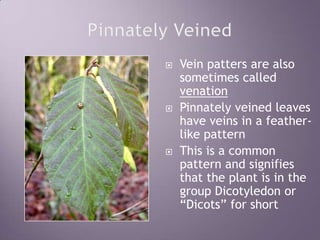
Pinnately VeinedVein patters are also  sometimes called venationPinnatelyveined leaves have veins in a feather-like patternThis is a common pattern and signifies that the plant is in the group Dicotyledon or “Dicots” for short
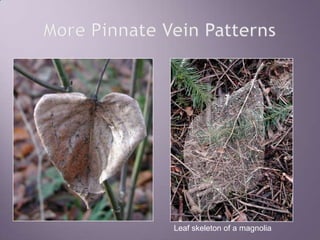
More Pinnate Vein PatternsLeaf skeleton of a magnolia
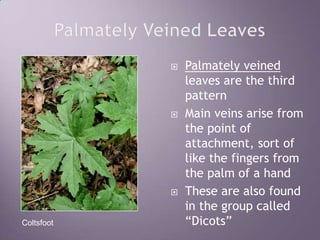
Palmately Veined LeavesPalmately veined leaves are the third patternMain veins arise from the point of attachment, sort of like the fingers from the palm of a handThese are also found in the group called “Dicots”Coltsfoot
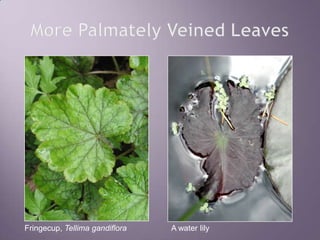
More PalmatelyVeined LeavesFringecup, Tellima gandifloraA water lily
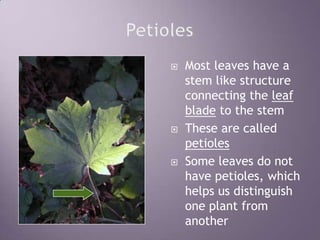
PetiolesMost leaves have a stem like structure connecting the leaf blade to the stemThese are called petiolesSome leaves do not have petioles, which helps us distinguish one plant from another
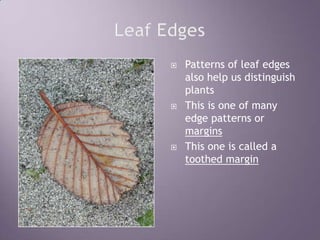
Leaf EdgesPatterns of leaf edges also help us distinguish plantsThis is one of many edge patterns or marginsThis one is called a toothed margin
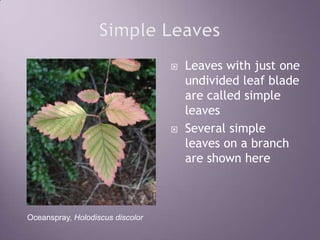
Simple LeavesLeaves with just one undivided leaf blade are called simple leavesSeveral simple leaves on a branch are shown hereOceanspray, Holodiscus discolor
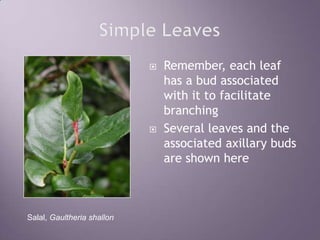
Simple LeavesRemember, each leaf has a bud associated with it to facilitate branchingSeveral leaves and the associated axillary buds are shown hereSalal, Gaultheria shallon
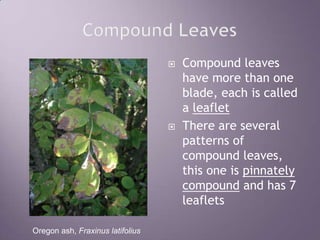
Compound LeavesCompound leaves have more than one blade, each is called a leafletThere are several patterns of compound leaves, this one is pinnately compound and has 7 leafletsOregon ash, Fraxinus latifolius
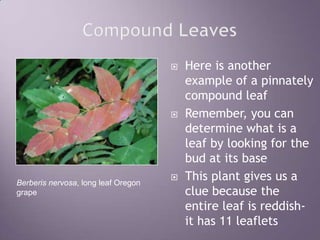
Compound LeavesHere is another example of a pinnately compound leafRemember, you can determine what is a leaf by looking for the bud at its baseThis plant gives us a clue because the entire leaf is reddish- it has 11 leafletsBerberis nervosa, long leaf Oregon grape
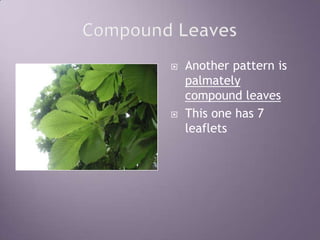
Compound LeavesAnother pattern is palmately compound leavesThis one has 7 leaflets
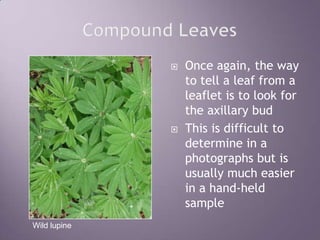
Compound LeavesOnce again, the way to tell a leaf from a leaflet is to look for the axillary budThis is difficult to determine in a photographs but is usually much easier in a hand-held sampleWild lupine
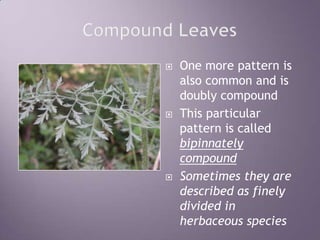
Compound LeavesOne more pattern is also common and is doubly compoundThis particular pattern is called bipinnately compoundSometimes they are described as finely divided in herbaceous species
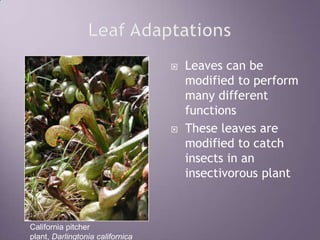
Leaf AdaptationsLeaves can be modified to perform many different functionsThese leaves are modified to catch insects in an insectivorous plantCalifornia pitcher plant, Darlingtoniacalifornica
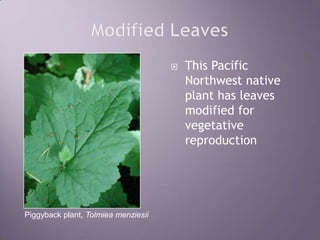
Modified LeavesThis Pacific Northwest native plant has leaves modified for vegetative reproductionPiggyback plant, Tolmiea menziesii
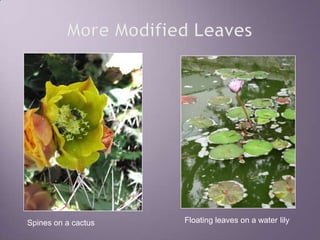
More Modified LeavesFloating leaves on a water lilySpines on a cactus
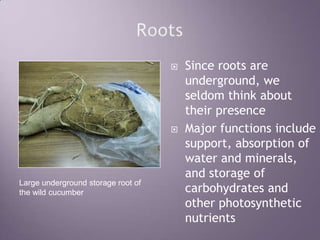
RootsSince roots are underground, we seldom think about their presenceMajor functions include support, absorption of water and minerals, and storage of carbohydrates and other photosynthetic nutrientsLarge underground storage root of the wild cucumber
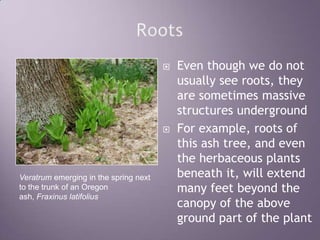
RootsEven though we do not usually see roots, they are sometimes massive structures undergroundFor example, roots of this ash tree, and even the herbaceous plants  beneath it, will extend many feet beyond the canopy of the above ground part of the plantVeratrum emerging in the spring next to the trunk of an Oregon ash, Fraxinus latifolius
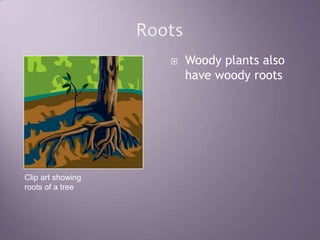
RootsWoody plants also have woody rootsClip art showing roots of a tree
RootsCarrots, like those shown here in a pretend bunny, are tap roots.  Their main structure is a single enlarged root with smaller roots off the surfaceTap roots often serve as storage for carbohydrates and other nutrients
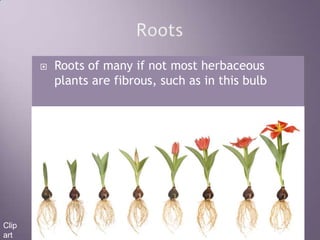
RootsRoots of many if not most herbaceous plants are fibrous, such as in this bulbClip art
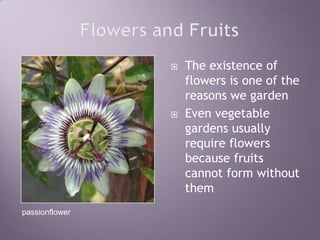
Flowers and FruitsThe existence of flowers is one of the reasons we gardenEven vegetable gardens usually require flowers because fruits cannot form without thempassionflower
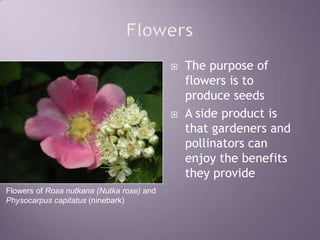
FlowersThe purpose of flowers is to produce seedsA side product is that gardeners and pollinators can enjoy the benefits they provideFlowers of Rosa nutkana (Nutka rose) and Physocarpus capitatus (ninebark)
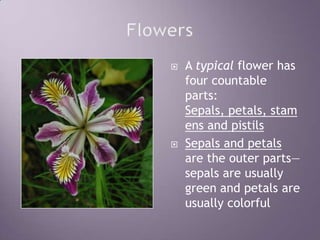
FlowersA typical flower has four countable parts: Sepals, petals, stamens and pistilsSepals and petals are the outer parts—sepals are usually green and petals are usually colorful
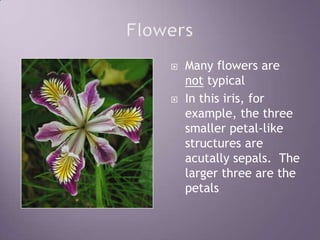
FlowersMany flowers are not typicalIn this iris, for example, the three smaller petal-like structures are acutally sepals.  The larger three are the petals
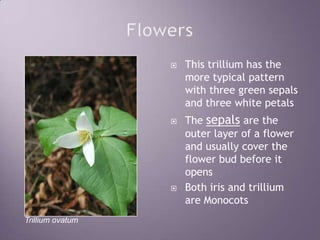
FlowersThis trillium has the more typical pattern with three green sepals and three white petalsThe sepals are the outer layer of a flower and usually cover the flower bud before it opensBoth iris and trillium are MonocotsTrillium ovatum
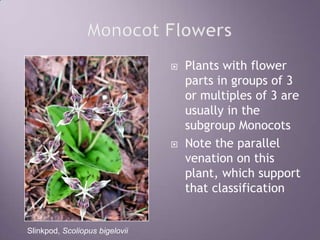
Monocot FlowersPlants with flower parts in groups of 3 or multiples of 3 are usually in the subgroup MonocotsNote the parallel venation on this plant, which support that classificationSlinkpod, Scoliopus bigelovii
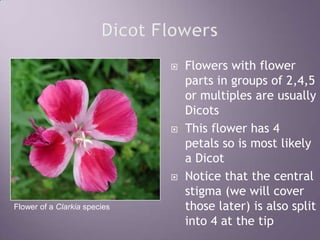
Dicot FlowersFlowers with flower parts in groups of 2,4,5 or multiples are usually DicotsThis flower has 4 petals so is most likely a DicotNotice that the central stigma (we will cover those later) is also split into 4 at the tip Flower of a Clarkia species
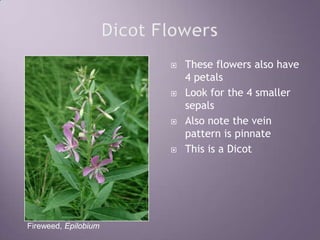
Dicot FlowersThese flowers also have 4 petalsLook for the 4 smaller sepalsAlso note the vein pattern is pinnateThis is a DicotFireweed, Epilobium
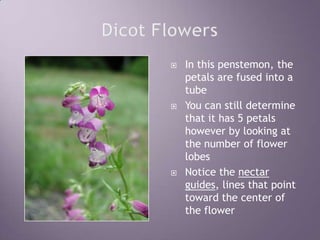
Dicot FlowersIn this penstemon, the petals are fused into a tubeYou can still determine that it has 5 petals however by looking at the number of flower lobesNotice the nectar guides, lines that point toward the center of the flower
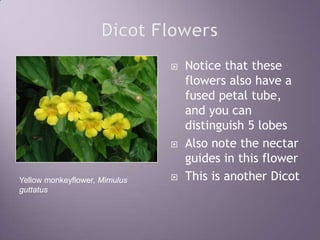
Dicot FlowersNotice that these flowers also have a fused petal tube, and you can distinguish 5 lobesAlso note the nectar guides in this flowerThis is another DicotYellow monkeyflower, Mimulus guttatus
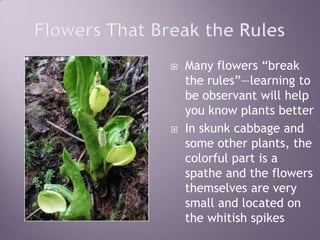
Flowers That Break the RulesMany flowers “break the rules”—learning to be observant will help you know plants betterIn skunk cabbage and some other plants, the colorful part is a spathe and the flowers themselves are very small and located on the whitish spikes
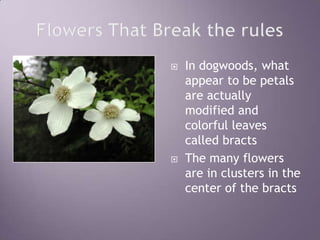
Flowers That Break the rulesIn dogwoods, what appear to be petals are actually modified and colorful leaves called bractsThe many flowers are in clusters in the center of the bracts
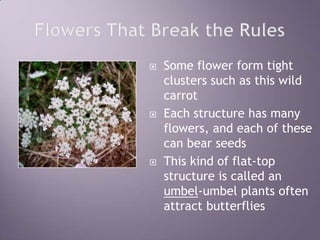
Flowers That Break the RulesSome flower form tight clusters such as this wild carrotEach structure has many flowers, and each of these can bear seedsThis kind of flat-top structure is called an umbel-umbel plants often attract butterflies
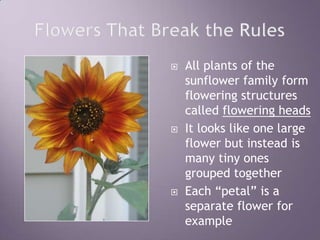
Flowers That Break the RulesAll plants of the sunflower family form flowering structures called flowering headsIt looks like one large flower but instead is many tiny ones grouped togetherEach “petal” is a separate flower for example
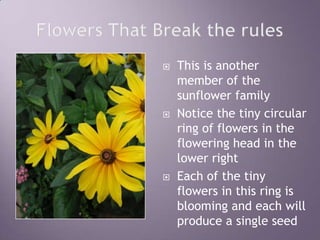
Flowers That Break the rulesThis is another member of the sunflower familyNotice the tiny circular ring of flowers in the flowering head in the lower rightEach of the tiny flowers in this ring is blooming and each will produce a single seed
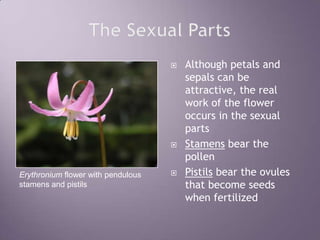
The Sexual PartsAlthough petals and sepals can be attractive, the real work of the flower occurs in the sexual partsStamens bear the pollenPistils bear the ovules that become seeds when fertilizedErythronium flower with pendulous stamens and pistils
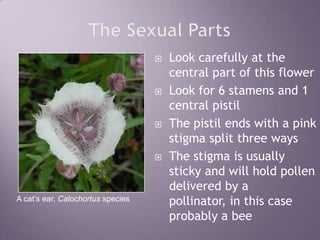
The Sexual PartsLook carefully at the central part of this flowerLook for 6 stamens and 1 central pistilThe pistil ends with a pink stigma split three waysThe stigma is usually sticky and will hold pollen delivered by a pollinator, in this case probably a beeA cat’s ear, Calochortus species
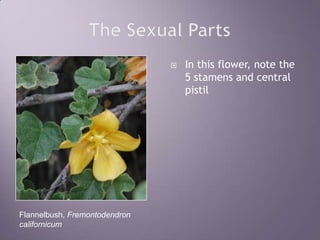
The Sexual PartsIn this flower, note the 5 stamens and central pistilFlannelbush, Fremontodendron californicum
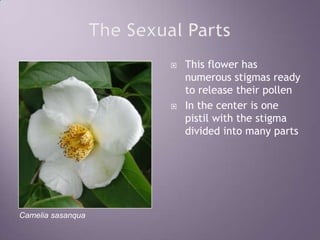
The Sexual PartsThis flower has numerous stigmas ready to release their pollenIn the center is one pistil with the stigma divided into many partsCamelia sasanqua
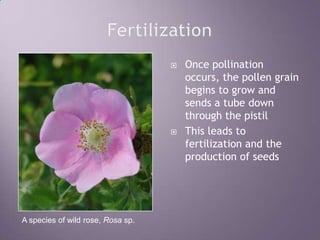
FertilizationOnce pollination occurs, the pollen grain begins to grow and sends a tube down through the pistilThis leads to fertilization and the production of seedsA species of wild rose, Rosa sp.
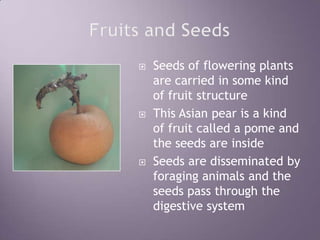
Fruits and SeedsSeeds of flowering plants are carried in some kind of fruit structureThis Asian pear is a kind of fruit called a pome and the seeds are insideSeeds are disseminated by foraging animals and the seeds pass through the digestive system
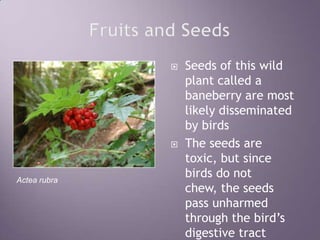
Fruits and SeedsSeeds of this wild plant called a baneberry are most likely disseminated by birdsThe seeds are toxic, but since birds do not chew, the seeds pass unharmed through the bird’s digestive tractActea rubra
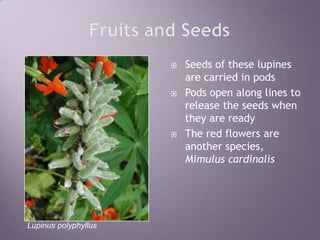
Fruits and SeedsSeeds of these lupines are carried in podsPods open along lines to release the seeds when they are readyThe red flowers are another species, Mimulus cardinalisLupinus polyphyllus
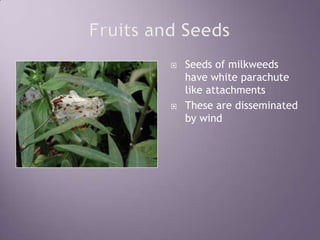
Fruits and SeedsSeeds of milkweeds have white parachute like attachmentsThese are disseminated by wind
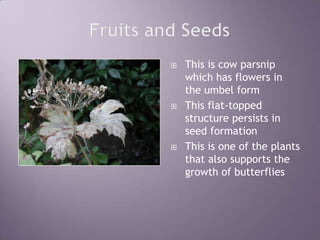
Fruits and SeedsThis is cow parsnip which has flowers in the umbel formThis flat-topped structure persists in seed formationThis is one of the plants that also supports the growth of butterflies
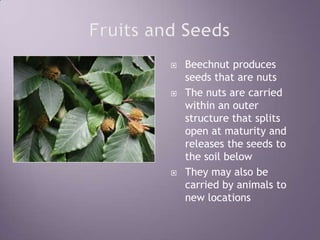
Fruits and SeedsBeechnut produces seeds that are nutsThe nuts are carried within an outer structure that splits open at maturity and releases the seeds to the soil belowThey may also be carried by animals to new locations
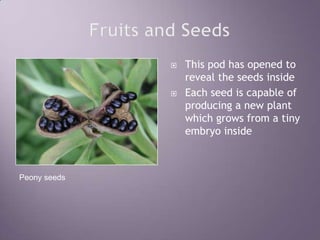
Fruits and SeedsThis pod has opened to reveal the seeds insideEach seed is capable of producing a new plant which grows from a tiny embryo insidePeony seeds
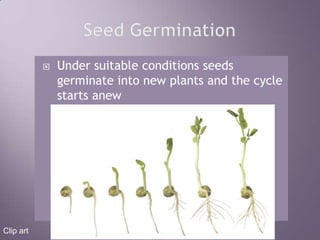
Seed GerminationUnder suitable conditions seeds germinate into new plants and the cycle starts anewClip art
This is the EndThis is the end of our brief beginning tour of botany for gardenersWe have only touched the surface and there is much more to discover and knowI wish you luck on this journeyEchinacea purpurea ‘White Swam’
Botany Primer for GardenersCreated by Linda McMahan, Botanist and Community Horticulture Faculty, Oregon State University Extension Service in 2010All photographs except as noted are those of the author.  This presentation and included materials may be freely used for educational purposes.  For other uses, please contact the author atlinda.mcmahan@oregonstate.edu

Botany Primer For Gardeners

  • 1.
    Botany Primer forGardenersLinda R McMahan, PhDBotanist & Extension HorticulturistOregon State University Extensionlinda.mcmahan@oregonstate.edu
  • 2.
    What We WillCoverPlant Diversity Algae, fungi and lichensSpore producing plants – mosses, liverworts, fernsSeed plants – conifers, ginkgo, and flowering plants Plant Structure and GrowthStems and roots Leaf structureFlowers and reproduction
  • 3.
    Plant DiversityFrom ancienttime when we began studying the world around us, we tried to understand our surroundings by labeling plants and animalsOur current scientific understanding continues to refine relationships, but historically, many organisms have been considered to be plants even if they are not now considered to be soI will use the historic understanding and explain modern differences as we proceed
  • 4.
    Plant DiversityThe classificationof various kinds of plants is based on reproduction Spore producing plants appeared on earth before seed producing plantsLater, seed plants became more common—these are also the ones most common in our landscapes and gardens
  • 5.
    Plant DiversityGoal: Learning the patterns of diversity will help us learn to garden with nature rather than working against itFallen leaves inside umbrella plant, Darmerapeltatum
  • 6.
    I. Organisms thatreproduce through sporesAlgae and fungiLichensSlime Molds MossesLiverworts and relativesHorsetailsFernsSori, the spore carrying bodies on ferns, here a sword fern
  • 7.
    Algae and FungiSomealgae are considered to be plants and some are not--fungi now reside in a separate Kingdom but many people think of them as plantsBoth reproduce using some form of spore or similar structure
  • 8.
    AlgaeInclude many differentkinds, but the most familiar are those of streams, ponds and at the ocean shore washed up on the sand or growing on rocky shores
  • 9.
    Are Algae AProblem?Algae by themselves are not a problem-it is not a parasite for exampleBecause growth of algae requires moisture and nutrients, it will grow where these are available, such as polluted streams. Algae grows in nutrient rich streams and on sidewalks because it can find required nutrients there. Control may be necessary for safety or other reasons, but the algae itself is not the cause of the harm, they just take advantage of the conditions.
  • 10.
    FungiMany kinds offungi occur on earthWhen you say “fungus”, most people will answer “mushroom” but fungi are much more complexAs we shall see, by far the most fungi are beneficial organisms but a few do cause diseases which are of concern to gardenersIt is important to distinguish between different kinds and not label all fungi as “bad”
  • 11.
    FungiSome mushrooms andother fungi are also toxic, but this is rarely a concern. Unless you know they are a problem, please don’t treat mushrooms with fungicides because this will interfere with their positive interactions with plants and the environment.For controlling fungi that cause disease, follow the recommendations of your local or state cooperative extension office.
  • 12.
    Mushrooms in theLawnGardeners who are worried about safety can seek positive identification and information, or rake up the mushrooms and discard or compost them
  • 13.
    Positive Benefits ofFungiFungi are one of earth’s major decomposers, helping to return organic matter to enrich our soilsSoil fungi form mutually beneficial relationships with plants called mycorrhizae
  • 14.
    How Fungi ReproduceFungireproduce through spores that become airborneThe visible part of a fungus is usually the spore-producing bodyThe larger mass of the fungus is fine fungal strands that are often underground or inside a decaying organismA “mushroom” is one kind of fungal spore producing body
  • 15.
    FungiMushrooms and otherspore producing bodies are often the most visible part of the fungusMushrooms growing in an arc or ring are sometimes called a “fairy ring”Yellow houseplant mushroom
  • 16.
    Not all sporeproducing bodies are “mushrooms”Cup-like spore producing bodies in cracks in a brick walkwayCup style spore bodies in moss on a decaying branch
  • 17.
    MycorrhizaeMost soil fungiform relationships with most plants in a mutually beneficial relationship called mycorrhizaePerhaps every plant shown in this forest clearing has associations with soil fungi
  • 18.
    MycorrhizaeMycorrhizae are foundin the roots of the plants where tissues of the two organisms intertwineFungal strands are in contact with the soil and extend the absorption capacity of the rootsFungi gain the benefit of photosynthetic nutrients made by the plants
  • 19.
    A new wayto look at forests and gardensPart of the magic of this relationship is that individual plants may form associations with dozens of different fungiAnd, each fungus may form associations with dozens of trees Together, these create a network of interactions
  • 20.
    Slime MoldsSlime moldsare not technically fungi nor plantsThey grow in moist, usually warm conditions such as forests and damp gardensThey are another form of decomposer but can alarm people who have not seen them beforeSlime mold spore producing bodies on turf grass. Oregon State University Plant Clinic
  • 21.
    Slime molds inthe gardenSlime molds have two phases. A moving mass first grows on decaying leaves, compost, or stumps. The spore producing phase is harder and often colorful. Both phases are ephemeral, disappearing only a few days or weeks after their appearance.Spore producing structures of a slime mold on the back of an oak leaf
  • 22.
    Lichens, a “special”groupLichens are usually small and are not individual organismsInstead, they are a combination of two different organisms—one is a fungus, and the other is algaeBritish soldiers, a ground dwelling lichen
  • 23.
    LichensMost are grayor greenishThe visible part is the fungus, the algae are insideLichens are another mutually beneficial relationshipSeveral kinds of lichens on a tree branch
  • 24.
    LichensBoth algal andfungal partners benefit from this relationshipAlgae gain a moist environment and the fungus gains photosynthetic nutrientsTogether, they inhabit places like this rock where neither could if they were aloneLichens growing on a rock
  • 25.
    LichensSome gardeners areworried about lichen, but they are not a disease and cause no harm to the plantVarious lichens are indicative of good or bad air quality, an aid to understanding our environmentWhite and brown lichen on a tree trunk
  • 26.
    MossesAre common inthe moist habitatsReproduce by sporesAre of short stature because they lack an organized vascular system to move water and nutrientsHelp maintain moisture and provide homes for small creaturesMosses and tiny mushrooms on a downed log
  • 27.
    MossesMosses are ahealthy part of gardens and ecosystemsThey often grow in lawns when the lawns themselves are not robustMosses are opportunists and will grow wherever the habitat is appropriate
  • 28.
    Liverworts and otherforest floor plantsLiverworts and their relatives have been on earth since ancient timesThey reproduce by sporesThey usually grow in natural habitats but sometimes can be found in gardensThey are not harmful in a garden settingSelaginella, usually a forest dweller
  • 29.
    LiverwortsOne species ofliverwort has become adapted to live in nursery pots and is considered to be a pest by nursery ownersOnce in the garden, they usually disappear after a time and cause no harm
  • 30.
    HorsetailsPerhaps no planthas caused such concern to tidy gardeners as the common horsetail. Rapidly spreading underground in a favorable environment, this plant can become quite a pest.Horsetail, Equisetum, showing the spore producing branches that appear before the typical green branches
  • 31.
    HorsetailsHere is thefamiliar horsetail formHorsetails of many kinds are native around the worldControl is usually through persistent hand weeding or tolerance
  • 32.
    FernsFerns also reproduceby spores Ferns are popular garden plants and some forms thrive in most, shady garden conditionsLicorice fern growing on a tree trunk
  • 33.
    FernsTypically the fernleaves, called fronds, uncurl as they open such as shown hereBracken fern in spring
  • 34.
    FernsSpores are producedon the backs of the fronds or sometimes on separate modified leaves that only bear sporesSword fern spore bodies
  • 35.
    2. Plants thatproduce seedsWe will cover three kinds of seed bearing plantsGinkgoConifersFlowering PlantsFruits of red osier dogwood, a flowering plant
  • 36.
    GinkgoVery ancient plantsonce though to be extinctRelated to conifers but have different reproductive structuresThey are neither conifers nor flowering plants but in a group all their ownFall foliage and seed bearing structures on a mature female tree
  • 37.
    Ginkgo bilobaGood landscapetree, drought and pollution tolerantDistinctive leaf form often used in artistic workNative to China
  • 38.
    ConifersBear their seedsin conesConifers also have needles or scalesWhen seeds mature, cones usually open
  • 39.
    ConifersLarge group withmany trees and shrubsPopular in gardens, particallybecause most are evergreenPines, firs, cedars, juniper, larch, and many moreAn ornamental conifer with colorful cones
  • 40.
    ConifersCones are madeup of overlaping scalesIn new female cones, the ovules are inside the cone but the scales are open to allow pollinationAfter pollination, the scales usually close while the seeds matureCone on an ornamental larch
  • 41.
    ConifersPollination time differsfor each speciesPollen is produced in tiny cones (dark orange in this tree) which is transferred by the wind to the tiny female cones at the tips of the branchesNew cones and year-old cones on a pine species
  • 42.
    Flowering PlantsA verylarge group, the latest to appear on earthDeveloping seeds are protected within a solid structure which becomes a fruitPollen must actually grow through tissue to fertilize the ovum
  • 43.
    Flowering PlantsInclude trees,shrubs, herbaceous plants, vinesAre very popular garden plantsAre highly adapted to particular forms of pollinationMany have very close mutually beneficial relationships with insect pollinatorsGaillardia or blanket flower attracts bees and butterflies
  • 44.
    PollinationIs the processof transferring pollen from one flower to anotherTypically, can be by wind, insects, water, birds, bats, or human interventionHoney bee pollinating a Ceanothus flower
  • 45.
    PollinationPlants pollinated byinsects are typically sweet smelling, colorful, and have places for insects to landThe “reward” for pollination is food from nectar or pollenBumblebee on an aster
  • 46.
    PollinationPlants attracting butterfliesalso provide nectar—they often have a large flat surface to support the butterfly’s bodyButterfly pollinated plants often have “butterfly partners” that use the plant as places to lay their eggs
  • 47.
    PollinationMany other gardenplants are pollinated by hummingbirdsThese flowers tend to be red or orangeBirds can see these colors but bees cannotRed columbine, Aquilegia canadensis
  • 48.
    PollinationPlants pollinated bywind have less colorful flowersPollen is usually produced in catkins which contain only male flowersPollen is carried by the wind to female flowers that produce seedsCatkins on a willow
  • 49.
    FruitsWhen seeds mature,they are carried in fruitsFruits can be fleshy or dry and take many formsBerries as shown here are one type of fruitCalicarpa americana, the American beautyberry
  • 50.
    More FruitsMimulus guttatus,yellow monkey flower has dry fruits called podsBig leaf maple, Acer macrophyllum has dry fruits called samaras
  • 51.
    3. Plant AnatomySeedbearing plants all share the same basic structuresTypical parts include leaves, stems, roots, and flowersDifferences are in the “details” which help us tell one plant from another
  • 52.
    Overall Plant StructureThisis sweet cicely, a plant native to OregonBotanists know this because it has white flower heads, each with many flowers of a certain typeAnother clue is the finely divided leaves in a particular pattern
  • 53.
    StemsProvide overall supportCreatethe “architecture” characteristic of each plantHave internal vascular systems for transport of water, minerals, and photosynthetic nutrients
  • 54.
    Stem StructureThis stemis woody, with wood cells for supportThe main stem has a side branch at a place called a nodeThe side branch has two buds, one at the end – a terminal bud, and one on the side, called a lateral bud
  • 55.
    Stem StructureHere isanother winter twig with no leavesPlants that loose leaves during dormancy are called deciduousNote the leaf scars on the side where the leaves fell off in the fallAlso note that the terminal bud has scales
  • 56.
    Stem StructureEach year,when the buds break or start to grow, the bud scales fall off, leaving bud scale scarsIf you look carefully, you can sometimes see these scars circling the branchThis helps us determine which is this year’s growth and which is last year’s
  • 57.
    Plant Growth StructureBudsare of many types including flower buds, branch buds, and mixed budsLateral branch or mixed buds can grow into branches under the right conditions
  • 58.
    Plant Growth StructureNotethat the small branch is growing from a node area, just above the leafThe buds that produce branches are usually in this location, leading to another name: axillarybud
  • 59.
    Kinds of BranchingThekind of branching on the last slide is called alternate Here, the type of branching is called oppositeThe kind of leaf pattern and branching pattern leads to different shapes of plants
  • 60.
    Woody StemsWoody plantsgrow differently than herbaceous plantsHerbaceous plants are most commonly annuals, biennials, or perennials, which create new aerial growth each year
  • 61.
    Woody StemsHere isa cross-section through a tree, showing typical woody structureOn the outside is barkRight inside the bark is tissue called phloem that actively transports photosynthetic nutrients
  • 62.
    Woody PlantsThe innerpart is xylem tissue that transports water and is considered to be the “woody part”This is also where we see growth rings, which can indicate the age of the tree
  • 63.
    Woody PlantsOne growthring is formed each yearAt the beginning of each growth season, cells are largeAt the end of the season, they are smaller and more dense, leading to the darker “rings”The oldest growth of the tree is in the center
  • 64.
    Woody PlantsNutrient andwater transport happen on the outer edges of the tree or shrubFor this reason, it is important to protect the bark; injury can lead to disruptions of nutrient and water flow and growth
  • 65.
    LeavesLeaves are usuallythe site of the process of photosynthesis, using the sun’s energy to create sugars and other nutrientsThey also have unique patterns that help us identify plants
  • 66.
    Leaf Characteristics –Vein PatternsThe vascular system of plants moves through leaves in 3 kinds of patternsThe pattern shown here is called a parallel vein patternParallel veins on a lily plant
  • 67.
    Parallel Vein PatternsParallelvein patterns Occur in a group of plants called Monocotyledons or “Monocots” for shortThey include grasses, lilies, onions, and many other related groups
  • 68.
    More Parallel VeinPatternsMianthemum dilitatum, false lily of the valleyDisporum species
  • 69.
    Pinnately VeinedVein pattersare also sometimes called venationPinnatelyveined leaves have veins in a feather-like patternThis is a common pattern and signifies that the plant is in the group Dicotyledon or “Dicots” for short
  • 70.
    More Pinnate VeinPatternsLeaf skeleton of a magnolia
  • 71.
    Palmately Veined LeavesPalmatelyveined leaves are the third patternMain veins arise from the point of attachment, sort of like the fingers from the palm of a handThese are also found in the group called “Dicots”Coltsfoot
  • 72.
    More PalmatelyVeined LeavesFringecup,Tellima gandifloraA water lily
  • 73.
    PetiolesMost leaves havea stem like structure connecting the leaf blade to the stemThese are called petiolesSome leaves do not have petioles, which helps us distinguish one plant from another
  • 74.
    Leaf EdgesPatterns ofleaf edges also help us distinguish plantsThis is one of many edge patterns or marginsThis one is called a toothed margin
  • 75.
    Simple LeavesLeaves withjust one undivided leaf blade are called simple leavesSeveral simple leaves on a branch are shown hereOceanspray, Holodiscus discolor
  • 76.
    Simple LeavesRemember, eachleaf has a bud associated with it to facilitate branchingSeveral leaves and the associated axillary buds are shown hereSalal, Gaultheria shallon
  • 77.
    Compound LeavesCompound leaveshave more than one blade, each is called a leafletThere are several patterns of compound leaves, this one is pinnately compound and has 7 leafletsOregon ash, Fraxinus latifolius
  • 78.
    Compound LeavesHere isanother example of a pinnately compound leafRemember, you can determine what is a leaf by looking for the bud at its baseThis plant gives us a clue because the entire leaf is reddish- it has 11 leafletsBerberis nervosa, long leaf Oregon grape
  • 79.
    Compound LeavesAnother patternis palmately compound leavesThis one has 7 leaflets
  • 80.
    Compound LeavesOnce again,the way to tell a leaf from a leaflet is to look for the axillary budThis is difficult to determine in a photographs but is usually much easier in a hand-held sampleWild lupine
  • 81.
    Compound LeavesOne morepattern is also common and is doubly compoundThis particular pattern is called bipinnately compoundSometimes they are described as finely divided in herbaceous species
  • 82.
    Leaf AdaptationsLeaves canbe modified to perform many different functionsThese leaves are modified to catch insects in an insectivorous plantCalifornia pitcher plant, Darlingtoniacalifornica
  • 83.
    Modified LeavesThis PacificNorthwest native plant has leaves modified for vegetative reproductionPiggyback plant, Tolmiea menziesii
  • 84.
    More Modified LeavesFloatingleaves on a water lilySpines on a cactus
  • 85.
    RootsSince roots areunderground, we seldom think about their presenceMajor functions include support, absorption of water and minerals, and storage of carbohydrates and other photosynthetic nutrientsLarge underground storage root of the wild cucumber
  • 86.
    RootsEven though wedo not usually see roots, they are sometimes massive structures undergroundFor example, roots of this ash tree, and even the herbaceous plants beneath it, will extend many feet beyond the canopy of the above ground part of the plantVeratrum emerging in the spring next to the trunk of an Oregon ash, Fraxinus latifolius
  • 87.
    RootsWoody plants alsohave woody rootsClip art showing roots of a tree
  • 88.
    RootsCarrots, like thoseshown here in a pretend bunny, are tap roots. Their main structure is a single enlarged root with smaller roots off the surfaceTap roots often serve as storage for carbohydrates and other nutrients
  • 89.
    RootsRoots of manyif not most herbaceous plants are fibrous, such as in this bulbClip art
  • 90.
    Flowers and FruitsTheexistence of flowers is one of the reasons we gardenEven vegetable gardens usually require flowers because fruits cannot form without thempassionflower
  • 91.
    FlowersThe purpose offlowers is to produce seedsA side product is that gardeners and pollinators can enjoy the benefits they provideFlowers of Rosa nutkana (Nutka rose) and Physocarpus capitatus (ninebark)
  • 92.
    FlowersA typical flowerhas four countable parts: Sepals, petals, stamens and pistilsSepals and petals are the outer parts—sepals are usually green and petals are usually colorful
  • 93.
    FlowersMany flowers arenot typicalIn this iris, for example, the three smaller petal-like structures are acutally sepals. The larger three are the petals
  • 94.
    FlowersThis trillium hasthe more typical pattern with three green sepals and three white petalsThe sepals are the outer layer of a flower and usually cover the flower bud before it opensBoth iris and trillium are MonocotsTrillium ovatum
  • 95.
    Monocot FlowersPlants withflower parts in groups of 3 or multiples of 3 are usually in the subgroup MonocotsNote the parallel venation on this plant, which support that classificationSlinkpod, Scoliopus bigelovii
  • 96.
    Dicot FlowersFlowers withflower parts in groups of 2,4,5 or multiples are usually DicotsThis flower has 4 petals so is most likely a DicotNotice that the central stigma (we will cover those later) is also split into 4 at the tip Flower of a Clarkia species
  • 97.
    Dicot FlowersThese flowersalso have 4 petalsLook for the 4 smaller sepalsAlso note the vein pattern is pinnateThis is a DicotFireweed, Epilobium
  • 98.
    Dicot FlowersIn thispenstemon, the petals are fused into a tubeYou can still determine that it has 5 petals however by looking at the number of flower lobesNotice the nectar guides, lines that point toward the center of the flower
  • 99.
    Dicot FlowersNotice thatthese flowers also have a fused petal tube, and you can distinguish 5 lobesAlso note the nectar guides in this flowerThis is another DicotYellow monkeyflower, Mimulus guttatus
  • 100.
    Flowers That Breakthe RulesMany flowers “break the rules”—learning to be observant will help you know plants betterIn skunk cabbage and some other plants, the colorful part is a spathe and the flowers themselves are very small and located on the whitish spikes
  • 101.
    Flowers That Breakthe rulesIn dogwoods, what appear to be petals are actually modified and colorful leaves called bractsThe many flowers are in clusters in the center of the bracts
  • 102.
    Flowers That Breakthe RulesSome flower form tight clusters such as this wild carrotEach structure has many flowers, and each of these can bear seedsThis kind of flat-top structure is called an umbel-umbel plants often attract butterflies
  • 103.
    Flowers That Breakthe RulesAll plants of the sunflower family form flowering structures called flowering headsIt looks like one large flower but instead is many tiny ones grouped togetherEach “petal” is a separate flower for example
  • 104.
    Flowers That Breakthe rulesThis is another member of the sunflower familyNotice the tiny circular ring of flowers in the flowering head in the lower rightEach of the tiny flowers in this ring is blooming and each will produce a single seed
  • 105.
    The Sexual PartsAlthoughpetals and sepals can be attractive, the real work of the flower occurs in the sexual partsStamens bear the pollenPistils bear the ovules that become seeds when fertilizedErythronium flower with pendulous stamens and pistils
  • 106.
    The Sexual PartsLookcarefully at the central part of this flowerLook for 6 stamens and 1 central pistilThe pistil ends with a pink stigma split three waysThe stigma is usually sticky and will hold pollen delivered by a pollinator, in this case probably a beeA cat’s ear, Calochortus species
  • 107.
    The Sexual PartsInthis flower, note the 5 stamens and central pistilFlannelbush, Fremontodendron californicum
  • 108.
    The Sexual PartsThisflower has numerous stigmas ready to release their pollenIn the center is one pistil with the stigma divided into many partsCamelia sasanqua
  • 109.
    FertilizationOnce pollination occurs,the pollen grain begins to grow and sends a tube down through the pistilThis leads to fertilization and the production of seedsA species of wild rose, Rosa sp.
  • 110.
    Fruits and SeedsSeedsof flowering plants are carried in some kind of fruit structureThis Asian pear is a kind of fruit called a pome and the seeds are insideSeeds are disseminated by foraging animals and the seeds pass through the digestive system
  • 111.
    Fruits and SeedsSeedsof this wild plant called a baneberry are most likely disseminated by birdsThe seeds are toxic, but since birds do not chew, the seeds pass unharmed through the bird’s digestive tractActea rubra
  • 112.
    Fruits and SeedsSeedsof these lupines are carried in podsPods open along lines to release the seeds when they are readyThe red flowers are another species, Mimulus cardinalisLupinus polyphyllus
  • 113.
    Fruits and SeedsSeedsof milkweeds have white parachute like attachmentsThese are disseminated by wind
  • 114.
    Fruits and SeedsThisis cow parsnip which has flowers in the umbel formThis flat-topped structure persists in seed formationThis is one of the plants that also supports the growth of butterflies
  • 115.
    Fruits and SeedsBeechnutproduces seeds that are nutsThe nuts are carried within an outer structure that splits open at maturity and releases the seeds to the soil belowThey may also be carried by animals to new locations
  • 116.
    Fruits and SeedsThispod has opened to reveal the seeds insideEach seed is capable of producing a new plant which grows from a tiny embryo insidePeony seeds
  • 117.
    Seed GerminationUnder suitableconditions seeds germinate into new plants and the cycle starts anewClip art
  • 118.
    This is theEndThis is the end of our brief beginning tour of botany for gardenersWe have only touched the surface and there is much more to discover and knowI wish you luck on this journeyEchinacea purpurea ‘White Swam’
  • 119.
    Botany Primer forGardenersCreated by Linda McMahan, Botanist and Community Horticulture Faculty, Oregon State University Extension Service in 2010All photographs except as noted are those of the author. This presentation and included materials may be freely used for educational purposes. For other uses, please contact the author atlinda.mcmahan@oregonstate.edu