Group Theory
M. Gayathri, M.Sc., M.Phil.
Assistant Professor
Department of Mathematics
Sri Sarada Niketan college of Science for Women , Karur-5
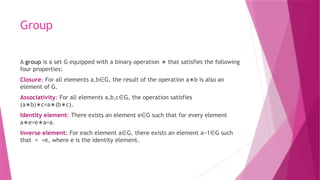
Group
A group is a set G equipped with a binary operation that satisfies the following
∗
four properties:
Closure: For all elements a,b G, the result of the operation a b is also an
∈ ∗
element of G.
Associativity: For all elements a,b,c G, the operation satisfies
∈
(a b) c=a (b c).
∗ ∗ ∗ ∗
Identity element: There exists an element e G such that for every element
∈
a e=e a=a.
∗ ∗
Inverse element: For each element a G, there exists an element a−1 G such
∈ ∈
that = =e, where e is the identity element.
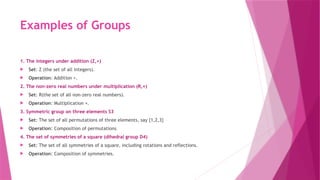
Examples of Groups
1. The integers under addition (Z,+)
 Set: Z (the set of all integers).
 Operation: Addition +.
2. The non-zero real numbers under multiplication (R,×)
 Set: R(the set of all non-zero real numbers).
 Operation: Multiplication ×.
3. Symmetric group on three elements S3​
 Set: The set of all permutations of three elements, say {1,2,3}
 Operation: Composition of permutations
4. The set of symmetries of a square (dihedral group D4​
)
 Set: The set of all symmetries of a square, including rotations and reflections.
 Operation: Composition of symmetries.
Subgroup
 A subgroup is a subset of a group that is itself a group, under the same
operation as the original group. More formally, if G is a group and H is a
subset of G, then H is a subgroup of G if:
 Closure: For all elements h1​
,h2​ H, the result of the operation h1​ h2​is also
∈ ∗
an element of H.
 Identity: The identity element of G, denoted e, is in H.
 Inverses: For every element h H, its inverse is also in H.
∈
If these conditions hold, then H is a subgroup of G, and we write H≤G (i.e., H is a
subgroup of G).
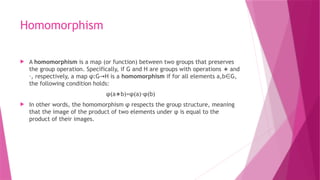
Homomorphism
 A homomorphism is a map (or function) between two groups that preserves
the group operation. Specifically, if G and H are groups with operations and
∗
, respectively, a map φ:G H is a
⋅ → homomorphism if for all elements a,b G,
∈
the following condition holds:
φ(a b)=φ(a) φ(b)
∗ ⋅
 In other words, the homomorphism φ respects the group structure, meaning
that the image of the product of two elements under φ is equal to the
product of their images.
Properties of a Homomorphism
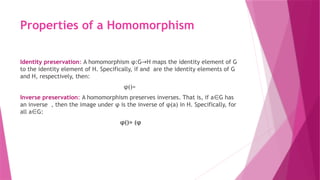
Identity preservation: A homomorphism φ:G H maps the identity element of G
→
to the identity element of H. Specifically, if and are the identity elements of G
and H, respectively, then:
φ()=
Inverse preservation: A homomorphism preserves inverses. That is, if a G has
∈
an inverse , then the image under φ is the inverse of φ(a) in H. Specifically, for
all a G:
∈
φ()= (φ
Kernel and Image of a Homomorphism
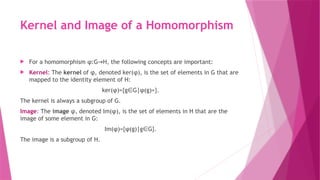
 For a homomorphism φ:G H, the following concepts are important:
→
 Kernel: The kernel of φ, denoted ker(φ), is the set of elements in G that are
mapped to the identity element of H:
ker(φ)={g G
∈ ∣φ(g)=​
}.
The kernel is always a subgroup of G.
Image: The image φ, denoted Im(φ), is the set of elements in H that are the
image of some element in G:
Im(φ)={φ(g) g G}.
∣ ∈
The image is a subgroup of H.
Isomorphism
 A homomorphism φ:G H is called an
→ isomorphism if it is bijective (one-to-
one and onto). If there exists an isomorphism between two groups, then the
groups are said to be isomorphic, meaning they are structurally identical in
terms of group theory, even if they are represented differently.
Cosets
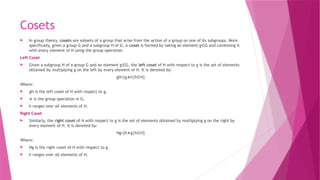
 In group theory, cosets are subsets of a group that arise from the action of a group on one of its subgroups. More
specifically, given a group G and a subgroup H of G, a coset is formed by taking an element g G and combining it
∈
with every element of H using the group operation.
Left Coset
 Given a subgroup H of a group G and an element g G, the
∈ left coset of H with respect to g is the set of elements
obtained by multiplying g on the left by every element of H. It is denoted by:
gH={g h h H}
∗ ∣ ∈
Where:
 gH is the left coset of H with respect to g,
 ∗ is the group operation in G,
 h ranges over all elements of H.
Right Coset
 Similarly, the right coset of H with respect to g is the set of elements obtained by multiplying g on the right by
every element of H. It is denoted by:
Hg={h g h H}
∗ ∣ ∈
Where:
 Hg is the right coset of H with respect to g,
 h ranges over all elements of H.
Normal Subgroup
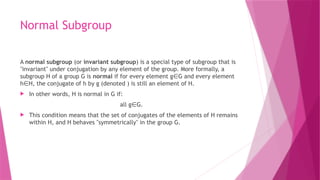
A normal subgroup (or invariant subgroup) is a special type of subgroup that is
"invariant" under conjugation by any element of the group. More formally, a
subgroup H of a group G is normal if for every element g G and every element
∈
h H, the conjugate of h by g (denoted ) is still an element of H.
∈
 In other words, H is normal in G if:
all g G.
∈
 This condition means that the set of conjugates of the elements of H remains
within H, and H behaves "symmetrically" in the group G.

Group Theory - Discrete Mathematics.pptx

  • 1.
    Group Theory M. Gayathri,M.Sc., M.Phil. Assistant Professor Department of Mathematics Sri Sarada Niketan college of Science for Women , Karur-5
  • 2.
    Group A group isa set G equipped with a binary operation that satisfies the following ∗ four properties: Closure: For all elements a,b G, the result of the operation a b is also an ∈ ∗ element of G. Associativity: For all elements a,b,c G, the operation satisfies ∈ (a b) c=a (b c). ∗ ∗ ∗ ∗ Identity element: There exists an element e G such that for every element ∈ a e=e a=a. ∗ ∗ Inverse element: For each element a G, there exists an element a−1 G such ∈ ∈ that = =e, where e is the identity element.
  • 3.
    Examples of Groups 1.The integers under addition (Z,+)  Set: Z (the set of all integers).  Operation: Addition +. 2. The non-zero real numbers under multiplication (R,×)  Set: R(the set of all non-zero real numbers).  Operation: Multiplication ×. 3. Symmetric group on three elements S3​  Set: The set of all permutations of three elements, say {1,2,3}  Operation: Composition of permutations 4. The set of symmetries of a square (dihedral group D4​ )  Set: The set of all symmetries of a square, including rotations and reflections.  Operation: Composition of symmetries.
  • 4.
    Subgroup  A subgroupis a subset of a group that is itself a group, under the same operation as the original group. More formally, if G is a group and H is a subset of G, then H is a subgroup of G if:  Closure: For all elements h1​ ,h2​ H, the result of the operation h1​ h2​is also ∈ ∗ an element of H.  Identity: The identity element of G, denoted e, is in H.  Inverses: For every element h H, its inverse is also in H. ∈ If these conditions hold, then H is a subgroup of G, and we write H≤G (i.e., H is a subgroup of G).
  • 5.
    Homomorphism  A homomorphismis a map (or function) between two groups that preserves the group operation. Specifically, if G and H are groups with operations and ∗ , respectively, a map φ:G H is a ⋅ → homomorphism if for all elements a,b G, ∈ the following condition holds: φ(a b)=φ(a) φ(b) ∗ ⋅  In other words, the homomorphism φ respects the group structure, meaning that the image of the product of two elements under φ is equal to the product of their images.
  • 6.
    Properties of aHomomorphism Identity preservation: A homomorphism φ:G H maps the identity element of G → to the identity element of H. Specifically, if and are the identity elements of G and H, respectively, then: φ()= Inverse preservation: A homomorphism preserves inverses. That is, if a G has ∈ an inverse , then the image under φ is the inverse of φ(a) in H. Specifically, for all a G: ∈ φ()= (φ
  • 7.
    Kernel and Imageof a Homomorphism  For a homomorphism φ:G H, the following concepts are important: →  Kernel: The kernel of φ, denoted ker(φ), is the set of elements in G that are mapped to the identity element of H: ker(φ)={g G ∈ ∣φ(g)=​ }. The kernel is always a subgroup of G. Image: The image φ, denoted Im(φ), is the set of elements in H that are the image of some element in G: Im(φ)={φ(g) g G}. ∣ ∈ The image is a subgroup of H.
  • 8.
    Isomorphism  A homomorphismφ:G H is called an → isomorphism if it is bijective (one-to- one and onto). If there exists an isomorphism between two groups, then the groups are said to be isomorphic, meaning they are structurally identical in terms of group theory, even if they are represented differently.
  • 9.
    Cosets  In grouptheory, cosets are subsets of a group that arise from the action of a group on one of its subgroups. More specifically, given a group G and a subgroup H of G, a coset is formed by taking an element g G and combining it ∈ with every element of H using the group operation. Left Coset  Given a subgroup H of a group G and an element g G, the ∈ left coset of H with respect to g is the set of elements obtained by multiplying g on the left by every element of H. It is denoted by: gH={g h h H} ∗ ∣ ∈ Where:  gH is the left coset of H with respect to g,  ∗ is the group operation in G,  h ranges over all elements of H. Right Coset  Similarly, the right coset of H with respect to g is the set of elements obtained by multiplying g on the right by every element of H. It is denoted by: Hg={h g h H} ∗ ∣ ∈ Where:  Hg is the right coset of H with respect to g,  h ranges over all elements of H.
  • 10.
    Normal Subgroup A normalsubgroup (or invariant subgroup) is a special type of subgroup that is "invariant" under conjugation by any element of the group. More formally, a subgroup H of a group G is normal if for every element g G and every element ∈ h H, the conjugate of h by g (denoted ) is still an element of H. ∈  In other words, H is normal in G if: all g G. ∈  This condition means that the set of conjugates of the elements of H remains within H, and H behaves "symmetrically" in the group G.