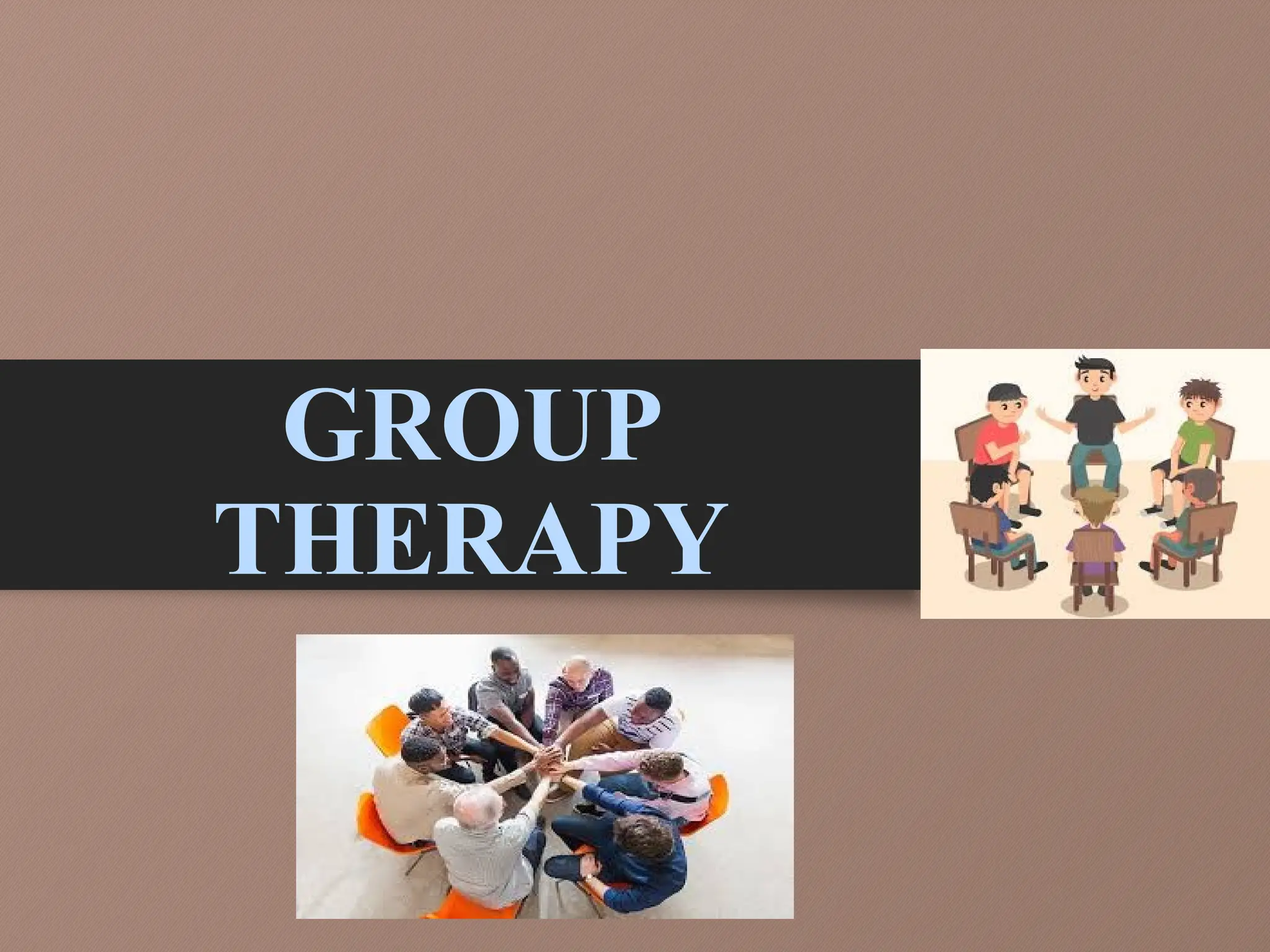
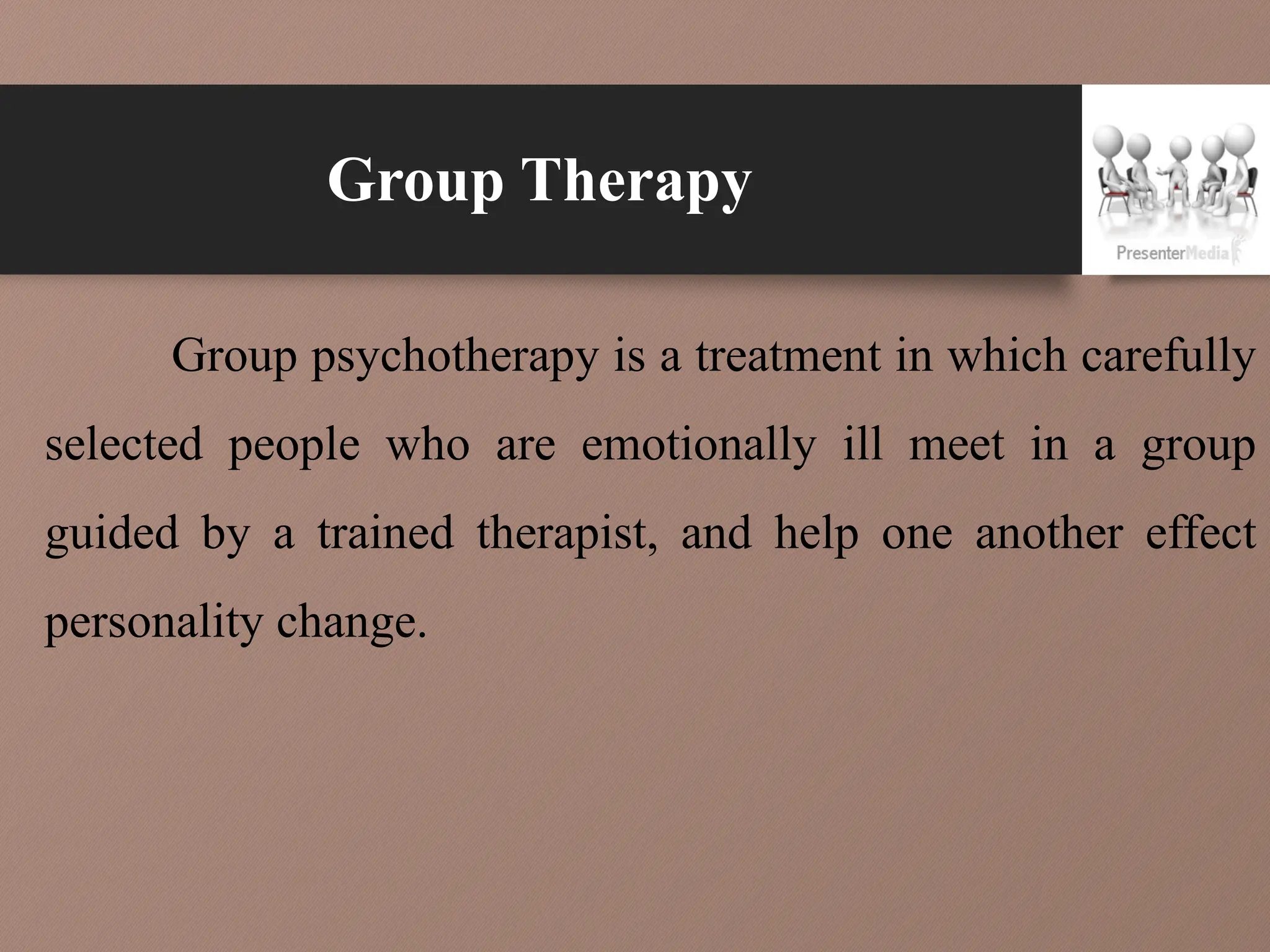
GROUP
THERAPY
Group Therapy
Group psychotherapy is a treatment in which carefully
selected people who are emotionally ill meet in a group
guided by a trained therapist, and help one another effect
personality change.
Selection
Homogeneous groups
Adolescents and patients with personality disorders
Families and couples where the system needs change
Contraindications
Antisocial patients
Actively suicidal or severely depressed patients
Patients who are delusional and who may incorporate the
group into their delusional system
Group Size
• Optimal size for group therapy is 8 to10 members.
Frequency and Length of Sessions
• Most group psychotherapists conduct group sessions once a
week; each session may last for 45 minutes to 1 hour.
Approaches to Group Therapy
The therapist's role is primarily that of a facilitator; he should provide
a safe, comfortable atmosphere for self-disclosure
Focus on the "here and now"
Use any transference situations to develop insight into their problems
Protect members from verbal abuse or from scapegoating
Whenever appropriate, provide positive reinforcement, this gives ego
support and encourages future growth
Cont…,
Protects the self-esteem of the individual and also sets limits on the
behavior
Develop ability to recognize when a group member is" fragile";he should
be approached in a gentle, supportive and non-threatening manner
Use silence effectively to encourage introspection and facilitate insight
Laughter and a moderate amount of joking can act as a safety valve
Role-playing may help a member develop insight
Therapeutic Factors Involved in Group
Therapy
These involve sharing experiences, support to and
from group members, socialization, imitation and
interpersonal learning.
Sharing experience:
This helps the patients to realize that they are not
isolated and that others also have similar experiences and
problems. Hearing from other patients that they have shared
experiences is often more convincing and helpful than
reassurance from the therapist.
Support to and from group members:
Receiving help from other group members can be
supportive to the person helped. The sharing action of being
mutually supporting is an aspect of group cohesiveness that
can provide a sense of belonging for patients who feel
isolated in their everyday lives.
Socialization:
It is acquisition of social skills, for e.g. maintaining
eye contact, within a group through comments that members
provide about one another's deficiencies in social skills.
This process can be helped by trying out new ways of
interacting within the safety of the group.
Imitation:
It is learning from observing and adapting the
behaviors of other group members. If the group is run well,
patients imitate the adaptive behaviors of other group
members.
Interpersonal learning:
It refers to learning about difficulties in relationships
by examining the interaction of individuals with the other
members of the group.
Some Techniques Useful in Group
Therapy
Reflecting or rewarding comments of group members
Asking for group reaction to one member's statement
Asking for individual reaction to one member's statement
Pointing out any shared feelings within the group
Summarizing various points at the end of session
Conclusion
In conclusion, one may say that group therapy plays a
major role in the rehabilitation of the mentally ill individual.
Thus it helps the patient to master communication and
interpersonal skills, problem solving, decision making and
assertiveness skills, thus enabling him tore-enter the society's
mainstream with a greater degree of confidence.
Thank you

Group therapy.pptx Mental Health Nursing

  • 1.
  • 2.
    Group Therapy Group psychotherapyis a treatment in which carefully selected people who are emotionally ill meet in a group guided by a trained therapist, and help one another effect personality change.
  • 3.
    Selection Homogeneous groups Adolescents andpatients with personality disorders Families and couples where the system needs change
  • 4.
    Contraindications Antisocial patients Actively suicidalor severely depressed patients Patients who are delusional and who may incorporate the group into their delusional system
  • 5.
    Group Size • Optimalsize for group therapy is 8 to10 members.
  • 6.
    Frequency and Lengthof Sessions • Most group psychotherapists conduct group sessions once a week; each session may last for 45 minutes to 1 hour.
  • 7.
    Approaches to GroupTherapy The therapist's role is primarily that of a facilitator; he should provide a safe, comfortable atmosphere for self-disclosure Focus on the "here and now" Use any transference situations to develop insight into their problems Protect members from verbal abuse or from scapegoating Whenever appropriate, provide positive reinforcement, this gives ego support and encourages future growth
  • 8.
    Cont…, Protects the self-esteemof the individual and also sets limits on the behavior Develop ability to recognize when a group member is" fragile";he should be approached in a gentle, supportive and non-threatening manner Use silence effectively to encourage introspection and facilitate insight Laughter and a moderate amount of joking can act as a safety valve Role-playing may help a member develop insight
  • 9.
    Therapeutic Factors Involvedin Group Therapy These involve sharing experiences, support to and from group members, socialization, imitation and interpersonal learning.
  • 10.
    Sharing experience: This helpsthe patients to realize that they are not isolated and that others also have similar experiences and problems. Hearing from other patients that they have shared experiences is often more convincing and helpful than reassurance from the therapist.
  • 11.
    Support to andfrom group members: Receiving help from other group members can be supportive to the person helped. The sharing action of being mutually supporting is an aspect of group cohesiveness that can provide a sense of belonging for patients who feel isolated in their everyday lives.
  • 12.
    Socialization: It is acquisitionof social skills, for e.g. maintaining eye contact, within a group through comments that members provide about one another's deficiencies in social skills. This process can be helped by trying out new ways of interacting within the safety of the group.
  • 13.
    Imitation: It is learningfrom observing and adapting the behaviors of other group members. If the group is run well, patients imitate the adaptive behaviors of other group members.
  • 14.
    Interpersonal learning: It refersto learning about difficulties in relationships by examining the interaction of individuals with the other members of the group.
  • 15.
    Some Techniques Usefulin Group Therapy Reflecting or rewarding comments of group members Asking for group reaction to one member's statement Asking for individual reaction to one member's statement Pointing out any shared feelings within the group Summarizing various points at the end of session
  • 16.
    Conclusion In conclusion, onemay say that group therapy plays a major role in the rehabilitation of the mentally ill individual. Thus it helps the patient to master communication and interpersonal skills, problem solving, decision making and assertiveness skills, thus enabling him tore-enter the society's mainstream with a greater degree of confidence.
  • 17.