Definition of Groups
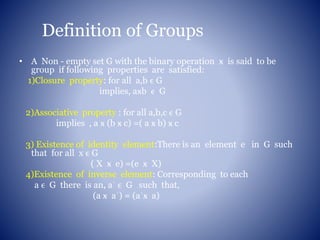
•A Non - empty set G with the binary operation ӿ is said to be
group if following properties are satisfied:
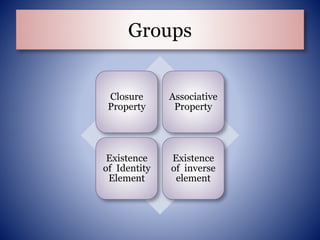
1)Closure property: for all a,b ϵ G
implies, aӿb ϵ G
2)Associative property : for all a,b,c ϵ G
implies , a ӿ (b ӿ c) =( a ӿ b) ӿ c
3) Existence of identity element:There is an element e in G such
that for all x ϵ G
( X ӿ e) =(e ӿ X)
4)Existence of inverse element: Corresponding to each
a ϵ G there is an, aˈ ϵ G such that,
(a ӿ aˈ) = (aˈӿ a)
:
• 1)The setᴢ (set of integers),R(set of real
numbers),Q(set of rational numbers),C (Set
of complex numbers) are all groups under
usual addition +.
• 2)The set of all real valued functions with
domain R under function addition is a
group.
• 3)The set of nxn matrices with real entries
under matrix addition is a group.
6.
Abelian Groups:
• Definition:Agroup is abelian if its binary
operation is commutative. i.e.
for all a,b ϵ G, (a ӿ b) = (b ӿ a)
● Examples:
1)The set ᴢ (set of integers),R(set of real
numbers),Q(set of rational numbers),C (Set of
complex numbers) are all abelian groups under
usual addition.
2)The set of nxn matrices with real entries
under matrix addition is an abelian group.
7.
Elementary Properties ofGroups:
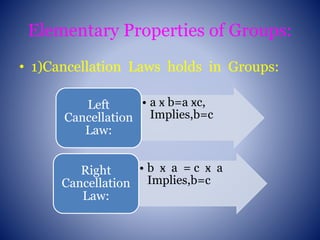
• 1)Cancellation Laws holds in Groups:
• a ӿ b=a ӿc,
Implies,b=c
Left
Cancellation
Law:
• b ӿ a = c ӿ a
Implies,b=c
Right
Cancellation
Law:
8.
2)Uniqueness of IdentityElement:
In a group G ,with binary operation ӿ
there is only one element e ϵ G Such
that,
for all x ϵ G,
e ӿ x = x ӿ e
9.
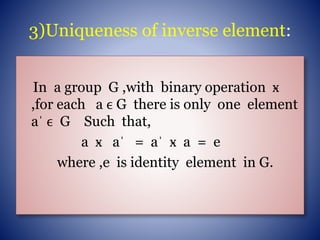
3)Uniqueness of inverseelement:
In a group G ,with binary operation ӿ
,for each a ϵ G there is only one element
aˈ ϵ G Such that,
a ӿ aˈ = aˈ ӿ a = e
where ,e is identity element in G.
10.
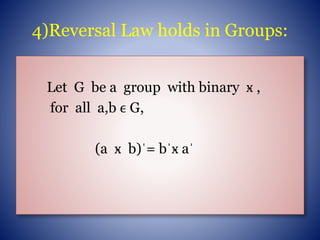
4)Reversal Law holdsin Groups:
Let G be a group with binary ӿ ,
for all a,b ϵ G,
(a ӿ b)ˈ= bˈӿ aˈ