Belbin team roles and Group
dynamics theory.
Students will understand
The various different team roles (Belbin)
Theories in group Dynamics
• Motivational Models
• Behavioural approaches
• Systems Theory
• Cognitive Appraoches
• Biological Models
Raymond Meredith Belbin (born 4 June
1926) is an English researcher and
management consultant best known for his
work on management teams. He is a
visiting professor and Honorary Fellow of
Henley Management College in
Oxfordshire, England.
https://www.youtube.com/watch?v=uL6x99
-VSBA
10 minutes .
Group
dynamics
theory
Motivational
theory
Behavioural
theory
Systems
theory
Cognitive
theory
Biological
theory
Why do people vie for leadership in groups
and others shy away from the group while
others join dozens of groups?
Theorists suggests its to do with group
members motivation.
Three Key theorists specific to group
dynamics motivational theories are:
Abraham Maslow, Kurt lewin and Alvin
Zander
 Kurt Lewin : is a very important theorist in
Group dynamics motivational theory his level
of aspiration theory (LOA) assumes people
enter achievement situations with an ideal
outcome in mind
 Alvin Zander (1971/1996) research found that
groups raised their LOA more after success
than they lowered after failure
 Some groups set themselves up for failure by
setting overly optimistic goals
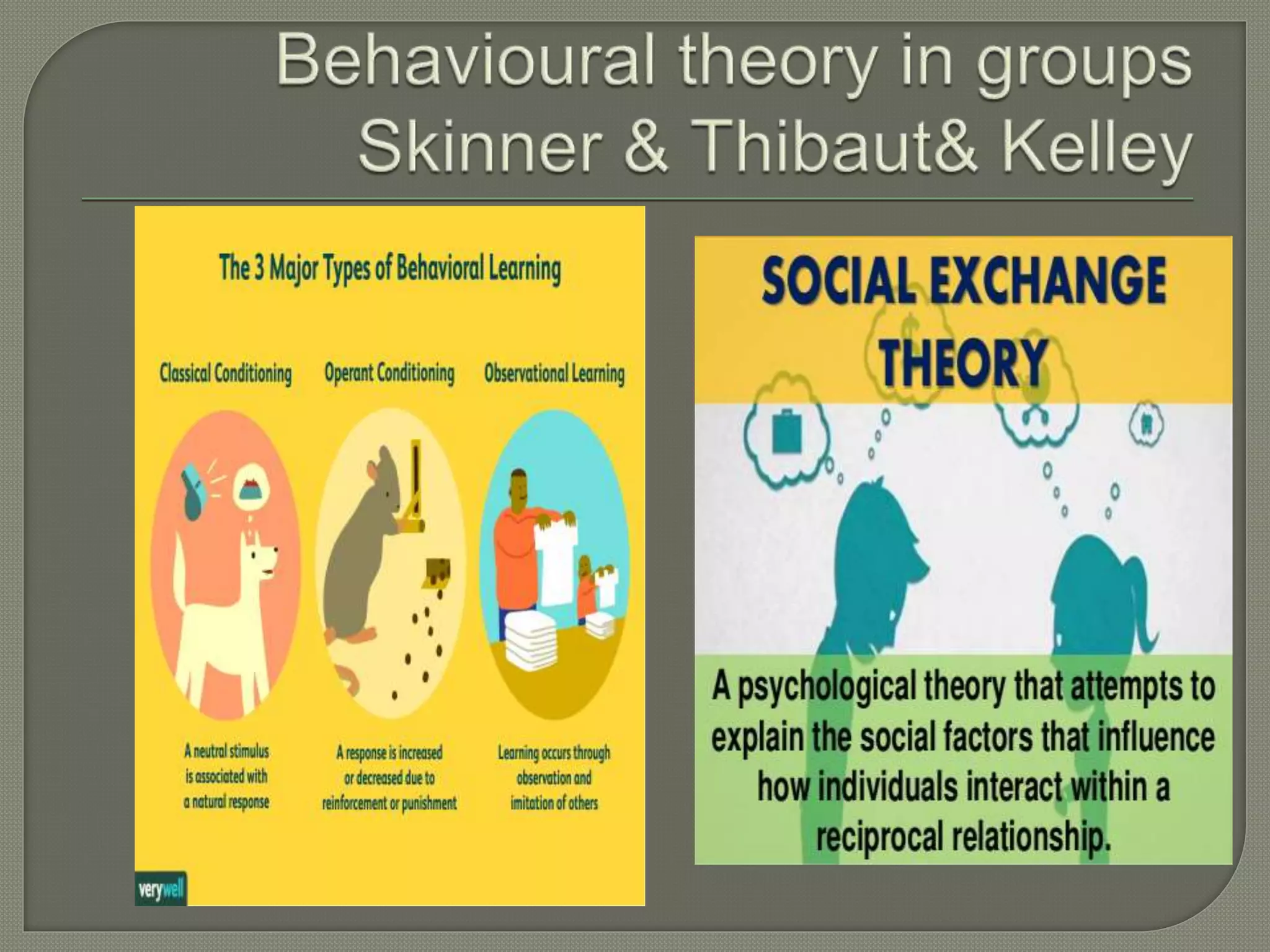
 B.F Skinner believed that psychological processes
such as motives and drives shape peoples
behaviour in groups his theory of the law of effect –
behaviours are followed by positive effects such as
rewards and behaviours that are followed by
negative effects become less common
 John Thibaut and Harold Kelley social exchange
theory extends Skinners theory suggesting that
groups create interdependence among members
so that the actions of each group member
potentially influence the actions and outcomes of
every other group member.
 Systems theory assumes that groups are systems.
Collections of individual units that combine to conform
an integrated complex whole.
 Inputs into the group include any factors that are
present in the situation when the group begins to work
on a task such as characteristic of individual members
(skill experience and training) and group factors( group
structure and cohesiveness)
 These processes combine to transform inputs into
outputs – group performance
 Poor performing groups – may seek new members
 Successful groups – adopt the same procedures to
problem solve. ((Hackman 1987)
 Cognitive processes occur within each individual
in the group
 Cognitive processes suggest that groups are busy
perceiving , judging, reasoning and remembering-
all of these mental activities influence their
understanding of one another , the group and
themselves.
 Expectation states theory: (Joseph Berger) this
explains status differentiation in groups where
group members are allocated status- status is
allocated to group members who have qualities
that members think indicate competence and
potential.
 Biological group theory refers to group members as
living creatures whose responses are shaped by
biological, biochemical and genetic characteristics .
 Simple examples include when conflict arise heart
rates rise and body changes i.e. sweating may occur to
help people cope with the stress. When groups are
trapped in confined spaces – they become physically
uncomfortable which will interfere with their work.
 Biological perspectives also argue that some group
behaviours such as territoriality may be rooted in group
members biological heritage – (tribal connection)
Basic assumptive culture: The tendency for
the group to structure itself,
Behaviour of the group is determined by
conscious or unconscious fears
These basic fears are “fight-flight,”
“dependency,” and “pairing”.
 The group seems to be excessively dependent on
the leader or on the group itself.
 Members may complain of being neglected,
misunderstood, or criticized; they may compete for
attention;
 they may idealize the group and its leaders; or they
may become passively compliant, even sullen, in
response to the leader’s requests.
 The group may not express their needs overtly,
but at an unconscious level they are disappointed
that the leader is not fulfilling all their needs
 The group feels threatened either by an internal source, such
as a clearly dissatisfied group member or an intervention by
the therapist that is rejected.
 An external source may also impact, such as the existence of
other groups that seem superior.
 The group may feel it must have a powerful leader who will
lead them to victory against their enemies, or guide their
retreat to safety. These unrecognized anxieties trigger
considerable conflict within the group, as some members of
the group challenge the leader’s authority, others take sides
as subgroups form to support or rebel against the leader, and
some withdraw.
 A stubbornly quiet, low-energy group may be one that is
resisting the leader, or retreating from the work that must be
done.
The group’s focus shifts from the group-as-
a-whole to one (or more) pairs within the
group.
They may pair up with someone or two
within the group. During this phase the
group members will deviate or deflect
from the discussion.
Anxiety has struck and they may struggle
to create an idea or insight that will resolve
their anxieties.
When a group adopts any one of these
assumptions, it interferes with group
functioning
From the expert himself Don Forsyhth
Your core text Forsynth, D.R. (2006)Group
Dynamics. USA: Thomson Wadsworth p-
54-60)
https://www.youtube.com/watch?v=GbDUxV
cMOx0
8.5 minutes long
https://www.youtube.com/watch?v=hMesD
q_rNOw
https://www.youtube.com/watch?v=7Lunro
ajlLE
 Forsynth, D.R., (2006)Group Dynamics. USA:
Thomson Wadsworth (p-54-60)
 Gençer Hüseyin (2019)Group Dynamics and
Behaviour in Universal Journal of Educational
Research 7(1): 223-229. Available in pdf
https://files.eric.ed.gov/fulltext/EJ1201477.pdf
 Understanding group dynamics and systems
 https://www.sagepub.com/sites/default/files/upm-
binaries/27380_Chapter3.pdf
Kottler, A. J, & Calson, M., E. (2014) (3rd ed.)
Learning Group Leadership An Experiential
Approach. USA: Sage
 Chapter 3:Understanding group dynamics
and systems available
 https://www.sagepub.com/sites/default/files/u
pm-binaries/27380_Chapter3.pdf
 Gençer Hüsey (2019) Group Dynamics and
Behaviour in Universal Journal of Educational
Research 7(1): 223-229.
 Available to access at:
https://files.eric.ed.gov/fulltext/EJ1201477.pdf
 Belbin team roles
 https://www.imperial.ac.uk/media/imperial-
college/administration-and-support-services/staff-
development/public/impex/Belbin-Team-Roles.pdf

Group Dynamics Theories week 14-3-22 (1).pptx

  • 1.
    Belbin team rolesand Group dynamics theory.
  • 2.
    Students will understand Thevarious different team roles (Belbin) Theories in group Dynamics • Motivational Models • Behavioural approaches • Systems Theory • Cognitive Appraoches • Biological Models
  • 3.
    Raymond Meredith Belbin(born 4 June 1926) is an English researcher and management consultant best known for his work on management teams. He is a visiting professor and Honorary Fellow of Henley Management College in Oxfordshire, England.
  • 7.
  • 11.
  • 12.
    Why do peoplevie for leadership in groups and others shy away from the group while others join dozens of groups? Theorists suggests its to do with group members motivation. Three Key theorists specific to group dynamics motivational theories are: Abraham Maslow, Kurt lewin and Alvin Zander
  • 14.
     Kurt Lewin: is a very important theorist in Group dynamics motivational theory his level of aspiration theory (LOA) assumes people enter achievement situations with an ideal outcome in mind  Alvin Zander (1971/1996) research found that groups raised their LOA more after success than they lowered after failure  Some groups set themselves up for failure by setting overly optimistic goals
  • 17.
     B.F Skinnerbelieved that psychological processes such as motives and drives shape peoples behaviour in groups his theory of the law of effect – behaviours are followed by positive effects such as rewards and behaviours that are followed by negative effects become less common  John Thibaut and Harold Kelley social exchange theory extends Skinners theory suggesting that groups create interdependence among members so that the actions of each group member potentially influence the actions and outcomes of every other group member.
  • 19.
     Systems theoryassumes that groups are systems. Collections of individual units that combine to conform an integrated complex whole.  Inputs into the group include any factors that are present in the situation when the group begins to work on a task such as characteristic of individual members (skill experience and training) and group factors( group structure and cohesiveness)  These processes combine to transform inputs into outputs – group performance  Poor performing groups – may seek new members  Successful groups – adopt the same procedures to problem solve. ((Hackman 1987)
  • 21.
     Cognitive processesoccur within each individual in the group  Cognitive processes suggest that groups are busy perceiving , judging, reasoning and remembering- all of these mental activities influence their understanding of one another , the group and themselves.  Expectation states theory: (Joseph Berger) this explains status differentiation in groups where group members are allocated status- status is allocated to group members who have qualities that members think indicate competence and potential.
  • 23.
     Biological grouptheory refers to group members as living creatures whose responses are shaped by biological, biochemical and genetic characteristics .  Simple examples include when conflict arise heart rates rise and body changes i.e. sweating may occur to help people cope with the stress. When groups are trapped in confined spaces – they become physically uncomfortable which will interfere with their work.  Biological perspectives also argue that some group behaviours such as territoriality may be rooted in group members biological heritage – (tribal connection)
  • 28.
    Basic assumptive culture:The tendency for the group to structure itself, Behaviour of the group is determined by conscious or unconscious fears These basic fears are “fight-flight,” “dependency,” and “pairing”.
  • 29.
     The groupseems to be excessively dependent on the leader or on the group itself.  Members may complain of being neglected, misunderstood, or criticized; they may compete for attention;  they may idealize the group and its leaders; or they may become passively compliant, even sullen, in response to the leader’s requests.  The group may not express their needs overtly, but at an unconscious level they are disappointed that the leader is not fulfilling all their needs
  • 30.
     The groupfeels threatened either by an internal source, such as a clearly dissatisfied group member or an intervention by the therapist that is rejected.  An external source may also impact, such as the existence of other groups that seem superior.  The group may feel it must have a powerful leader who will lead them to victory against their enemies, or guide their retreat to safety. These unrecognized anxieties trigger considerable conflict within the group, as some members of the group challenge the leader’s authority, others take sides as subgroups form to support or rebel against the leader, and some withdraw.  A stubbornly quiet, low-energy group may be one that is resisting the leader, or retreating from the work that must be done.
  • 31.
    The group’s focusshifts from the group-as- a-whole to one (or more) pairs within the group. They may pair up with someone or two within the group. During this phase the group members will deviate or deflect from the discussion. Anxiety has struck and they may struggle to create an idea or insight that will resolve their anxieties.
  • 32.
    When a groupadopts any one of these assumptions, it interferes with group functioning
  • 33.
    From the experthimself Don Forsyhth Your core text Forsynth, D.R. (2006)Group Dynamics. USA: Thomson Wadsworth p- 54-60) https://www.youtube.com/watch?v=GbDUxV cMOx0 8.5 minutes long
  • 34.
  • 35.
     Forsynth, D.R.,(2006)Group Dynamics. USA: Thomson Wadsworth (p-54-60)  Gençer Hüseyin (2019)Group Dynamics and Behaviour in Universal Journal of Educational Research 7(1): 223-229. Available in pdf https://files.eric.ed.gov/fulltext/EJ1201477.pdf  Understanding group dynamics and systems  https://www.sagepub.com/sites/default/files/upm- binaries/27380_Chapter3.pdf
  • 36.
    Kottler, A. J,& Calson, M., E. (2014) (3rd ed.) Learning Group Leadership An Experiential Approach. USA: Sage  Chapter 3:Understanding group dynamics and systems available  https://www.sagepub.com/sites/default/files/u pm-binaries/27380_Chapter3.pdf
  • 37.
     Gençer Hüsey(2019) Group Dynamics and Behaviour in Universal Journal of Educational Research 7(1): 223-229.  Available to access at: https://files.eric.ed.gov/fulltext/EJ1201477.pdf  Belbin team roles  https://www.imperial.ac.uk/media/imperial- college/administration-and-support-services/staff- development/public/impex/Belbin-Team-Roles.pdf