“Group Dynamics”
1
COURSE BOOK
“Group Dynamics”
by Donelson R. Forsyth
Fifth edition
2
Group Formation
“Process And Theories Of Group Development And
Socialization”
Group Formation
• Who joins groups? - Individual
• Why are groups formed? - Situation
• How are groups formed? - Process
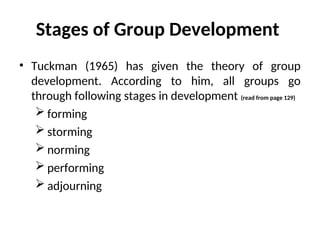
• Tuckman (1965) has given the theory of group
development. According to him, all groups go
through following stages in development (read from page 129)
 forming
 storming
 norming
 performing
 adjourning
Stages of Group Development
Forming
Storming
Norming
Adjourning
Task
Performing
Exchange of background personal
information, uncertainty, tentative communication
Dissatisfaction, disagreement, challenges
to leader and procedures, cliques form
Cohesiveness, agreement on procedures , standards,
and roles, improved communication
Focus on the work of the group, task
completion, decision making, cooperation
Departures, withdrawal,
decreased dependence, regret
Tuckman’s Five-Stage Theory
of Group Development
Performing
Adjourning
Norming
Storming
Forming
Return to
Independence
Dependence/
interdependence
Independence
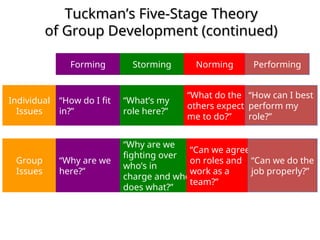
Tuckman’s Five-Stage Theory
of Group Development (continued)
Individual
Issues
Forming Storming Norming Performing
“How do I fit
in?”
“What’s my
role here?”
“What do the
others expect
me to do?”
“How can I best
perform my
role?”
Group
Issues
“Why are we
here?”
“Why are we
fighting over
who’s in
charge and who
does what?”
“Can we agree
on roles and
work as a
team?”
“Can we do the
job properly?”
10
Theories Of Group Development And Socialization
• Researchers have been guided by various
theoretical perspectives of group
development.
• Different researchers have developed
compelling theoretical explanations for group
phenomena.
11
Theories Of Group Development And Socialization
• Motivational and Emotional Perspectives
• Behavioral Perspectives
• Systems Theory Perspectives
• Cognitive Perspectives
• Biological Perspectives
12
Motivational and Emotional Perspectives
• This perspective includes theories that focus on
members’ motivations and emotions and explain
group behavior in terms of members’ wants, needs,
drives, and feelings.
• Motivational approaches offer insight into a wide range
of group phenomena such as “Why do people take more
credit when their group is a successful one, but then
downplay their connection to their group when it
performs poorly?
13
Motivational and Emotional Perspectives
• A motivational explanation of this selectivity might focus on the
role groups play in meeting people’s basic need for
SELF-ESTEEM.
• Most people are motivated to maintain and enhance
their self-esteem, and so they tend to exaggerate the
role they played in their group when things go well and
avoid responsibility for group failure. In consequence,
group members who consider the task to be particularly
important or are more invested in their group are more likely to
deny blame for group failures and take credit for successes,
relative to those who do not think the task, or the group’s
outcomes, have implications for their self-worth.
14
Motivational and Emotional Perspectives
• From emotional perspective, Jennifer George’s (1995)
gave Theory of Group Affective Tone.
• Group Affective Tone is “the collective emotional mood
of a group.”
• George posits that groups, over time, develop a tendency
to display collective mood states.
• George believes that positive group affect will lead to
increases in a number of pro-group actions, including
helping out other members, protecting the group, making
constructive suggestions, and “spreading goodwill” during
interpersonal encounters and vice versa.
15
Behavioral Perspectives
• Many theories about groups are based on the work of
psychologist B. F. Skinner (1953, 1971).
• Skinner’s behaviorism was based on two key assumptions:
– First, Skinner believed that psychological processes, such as motives and
drives, may shape people’s reactions in groups, but such psychological
processes are too difficult to index accurately. He therefore recommended
measuring and analyzing how people actually behave in a specific
context rather than speculating about the psychological or interpersonal
processes that may have instigated their actions.
– Second, Skinner believed that most behavior was consistent with the law
of effect—that is, behaviors that are followed by positive consequences,
such as rewards, will occur more frequently, whereas behaviors that are
followed by negative consequences will become rarer.
16
Behavioral Perspectives
• John Thibaut and Harold Kelley’s (1959) social exchange theory
extended Skinner’s behaviorism to groups. They agreed that
individuals hedonistically strive to maximize their rewards and
minimize their costs. However, when individuals join groups,
they forego exclusive control over their outcomes.
• Groups create interdependence among members, so that the
actions of each member potentially influence the outcomes and
actions of every other member.
17
Systems Theory Perspectives
• A systems theory approach assumes that groups are complex, adaptive, dynamic systems of interacting
individuals.
• The members are the units of the system, who are coupled one to another by relationships. Just as systems
can be deliberately designed to function in a particular way, groups are sometimes created for a purpose,
with procedures and standards that are designed with the overall goal of the system in mind.
• An input–process–output model (I–P–O model) of group performance exemplifies the systems approach.
18
Systems Theory Perspectives
• Input–Process–Output (I–P–O) model: Any one of a number of
general conceptual analyses of groups that assumes group
processes mediate the relationship between individual, group,
and situational input variables and resulting group outcomes.
19
Cognitive Perspectives
• Cognitive processes are the mental processes that allow members to gather information, make sense of it, and
then act on the results of their mental appraisals.
• This perspective suggests that when people join a group for the first time, they immediately begin to form an
impression of the group.
• This perceptual work prompts them to search for information about the other group members and the tasks they
must face.
• Thus, group members are busy perceiving, judging, reasoning, and remembering, and all these mental activities
influence their understanding of one another, the group, and themselves.
20
Cognitive Perspectives
• John Turner’s theory of Self-Categorization theory offers a
cognitive explanation for a range for group processes, including
intergroup perception and stereotyping.
• This theory explains the cognitive mechanisms that work to
align people’s self-conceptions with their conception of the
groups to which they belong.
21
Cognitive Perspectives
• Turner recognizes that much of social perception involves
categorizing people into groups based on age, race, nationality,
and other categories.
• Once classified, individuals’ perceptions of people are influenced
by any stereotypes they may have about the qualities of people
in such groups.
• Turner suggests that people not only categorize others, but they
also recognize their own membership in social categories. This
self categorization process is what turns the individual level
conception of the self into a group-level conception.
22
Biological Perspectives
• This perspective argues that group members are living creatures, whose responses are often shaped by
biological, biochemical, and genetic characteristics.
• When conflict arises in the group, heart rates escalate, and other body changes occur to help members
cope with the stress.
• When groups are trapped in confining, cramped spaces, members often become physiologically aroused,
and this arousal can interfere with their work.
• When people feel that they have been excluded from a group, their neurological reactions betray the
distress they are feeling. Their brains display a pattern of activity that is very similar to the brains of people
who are experiencing physical pain.
23
Biological Perspectives
• Evolutionary psychology offers insight into a range of group processes,
including affiliation, intergroup conflict, and aggression.
• For example, why do so many groups include the role of leader, even
when the group members are fully capable of organizing themselves?
• Evolutionary psychology suggests that leadership, as a process, likely
evolved over time to help relatively small groups of people cope with
extremely difficult, life-threatening circumstances. Facing problems of
survival, group members needed a way to coordinate their activities and
manage the inevitable conflicts that erupt in any group. The person who
stepped forward to help the group with this collective task was the leader,
and over time individuals adapted to accept the influence of another, more
experienced, group member. They also developed the mental apparatus
needed to identify those who were most qualified to lead their groups.
24
Biological Perspectives
• In the modern world, humans often gather in groups that are not
facing danger, yet even in more benign circumstances they often
expect someone to lead them because leadership and
followership are evolved adaptations.
• In consequence, group members’ preferences for leaders are
sometimes influenced by such qualities as strength, sex, and
age, even though these qualities were only relevant in
prehistoric times.
25
NEXT CLASS
•
26

group process.ppt - Group Dynamics - chapter 2

  • 1.
  • 2.
    COURSE BOOK “Group Dynamics” byDonelson R. Forsyth Fifth edition 2
  • 3.
    Group Formation “Process AndTheories Of Group Development And Socialization”
  • 4.
    Group Formation • Whojoins groups? - Individual • Why are groups formed? - Situation • How are groups formed? - Process
  • 5.
    • Tuckman (1965)has given the theory of group development. According to him, all groups go through following stages in development (read from page 129)  forming  storming  norming  performing  adjourning Stages of Group Development
  • 6.
  • 7.
    Exchange of backgroundpersonal information, uncertainty, tentative communication Dissatisfaction, disagreement, challenges to leader and procedures, cliques form Cohesiveness, agreement on procedures , standards, and roles, improved communication Focus on the work of the group, task completion, decision making, cooperation Departures, withdrawal, decreased dependence, regret
  • 8.
    Tuckman’s Five-Stage Theory Tuckman’sFive-Stage Theory of Group Development of Group Development Performing Adjourning Norming Storming Forming Return to Independence Dependence/ interdependence Independence
  • 9.
    Tuckman’s Five-Stage Theory Tuckman’sFive-Stage Theory of Group Development (continued) of Group Development (continued) Individual Issues Forming Storming Norming Performing “How do I fit in?” “What’s my role here?” “What do the others expect me to do?” “How can I best perform my role?” Group Issues “Why are we here?” “Why are we fighting over who’s in charge and who does what?” “Can we agree on roles and work as a team?” “Can we do the job properly?”
  • 10.
  • 11.
    Theories Of GroupDevelopment And Socialization • Researchers have been guided by various theoretical perspectives of group development. • Different researchers have developed compelling theoretical explanations for group phenomena. 11
  • 12.
    Theories Of GroupDevelopment And Socialization • Motivational and Emotional Perspectives • Behavioral Perspectives • Systems Theory Perspectives • Cognitive Perspectives • Biological Perspectives 12
  • 13.
    Motivational and EmotionalPerspectives • This perspective includes theories that focus on members’ motivations and emotions and explain group behavior in terms of members’ wants, needs, drives, and feelings. • Motivational approaches offer insight into a wide range of group phenomena such as “Why do people take more credit when their group is a successful one, but then downplay their connection to their group when it performs poorly? 13
  • 14.
    Motivational and EmotionalPerspectives • A motivational explanation of this selectivity might focus on the role groups play in meeting people’s basic need for SELF-ESTEEM. • Most people are motivated to maintain and enhance their self-esteem, and so they tend to exaggerate the role they played in their group when things go well and avoid responsibility for group failure. In consequence, group members who consider the task to be particularly important or are more invested in their group are more likely to deny blame for group failures and take credit for successes, relative to those who do not think the task, or the group’s outcomes, have implications for their self-worth. 14
  • 15.
    Motivational and EmotionalPerspectives • From emotional perspective, Jennifer George’s (1995) gave Theory of Group Affective Tone. • Group Affective Tone is “the collective emotional mood of a group.” • George posits that groups, over time, develop a tendency to display collective mood states. • George believes that positive group affect will lead to increases in a number of pro-group actions, including helping out other members, protecting the group, making constructive suggestions, and “spreading goodwill” during interpersonal encounters and vice versa. 15
  • 16.
    Behavioral Perspectives • Manytheories about groups are based on the work of psychologist B. F. Skinner (1953, 1971). • Skinner’s behaviorism was based on two key assumptions: – First, Skinner believed that psychological processes, such as motives and drives, may shape people’s reactions in groups, but such psychological processes are too difficult to index accurately. He therefore recommended measuring and analyzing how people actually behave in a specific context rather than speculating about the psychological or interpersonal processes that may have instigated their actions. – Second, Skinner believed that most behavior was consistent with the law of effect—that is, behaviors that are followed by positive consequences, such as rewards, will occur more frequently, whereas behaviors that are followed by negative consequences will become rarer. 16
  • 17.
    Behavioral Perspectives • JohnThibaut and Harold Kelley’s (1959) social exchange theory extended Skinner’s behaviorism to groups. They agreed that individuals hedonistically strive to maximize their rewards and minimize their costs. However, when individuals join groups, they forego exclusive control over their outcomes. • Groups create interdependence among members, so that the actions of each member potentially influence the outcomes and actions of every other member. 17
  • 18.
    Systems Theory Perspectives •A systems theory approach assumes that groups are complex, adaptive, dynamic systems of interacting individuals. • The members are the units of the system, who are coupled one to another by relationships. Just as systems can be deliberately designed to function in a particular way, groups are sometimes created for a purpose, with procedures and standards that are designed with the overall goal of the system in mind. • An input–process–output model (I–P–O model) of group performance exemplifies the systems approach. 18
  • 19.
    Systems Theory Perspectives •Input–Process–Output (I–P–O) model: Any one of a number of general conceptual analyses of groups that assumes group processes mediate the relationship between individual, group, and situational input variables and resulting group outcomes. 19
  • 20.
    Cognitive Perspectives • Cognitiveprocesses are the mental processes that allow members to gather information, make sense of it, and then act on the results of their mental appraisals. • This perspective suggests that when people join a group for the first time, they immediately begin to form an impression of the group. • This perceptual work prompts them to search for information about the other group members and the tasks they must face. • Thus, group members are busy perceiving, judging, reasoning, and remembering, and all these mental activities influence their understanding of one another, the group, and themselves. 20
  • 21.
    Cognitive Perspectives • JohnTurner’s theory of Self-Categorization theory offers a cognitive explanation for a range for group processes, including intergroup perception and stereotyping. • This theory explains the cognitive mechanisms that work to align people’s self-conceptions with their conception of the groups to which they belong. 21
  • 22.
    Cognitive Perspectives • Turnerrecognizes that much of social perception involves categorizing people into groups based on age, race, nationality, and other categories. • Once classified, individuals’ perceptions of people are influenced by any stereotypes they may have about the qualities of people in such groups. • Turner suggests that people not only categorize others, but they also recognize their own membership in social categories. This self categorization process is what turns the individual level conception of the self into a group-level conception. 22
  • 23.
    Biological Perspectives • Thisperspective argues that group members are living creatures, whose responses are often shaped by biological, biochemical, and genetic characteristics. • When conflict arises in the group, heart rates escalate, and other body changes occur to help members cope with the stress. • When groups are trapped in confining, cramped spaces, members often become physiologically aroused, and this arousal can interfere with their work. • When people feel that they have been excluded from a group, their neurological reactions betray the distress they are feeling. Their brains display a pattern of activity that is very similar to the brains of people who are experiencing physical pain. 23
  • 24.
    Biological Perspectives • Evolutionarypsychology offers insight into a range of group processes, including affiliation, intergroup conflict, and aggression. • For example, why do so many groups include the role of leader, even when the group members are fully capable of organizing themselves? • Evolutionary psychology suggests that leadership, as a process, likely evolved over time to help relatively small groups of people cope with extremely difficult, life-threatening circumstances. Facing problems of survival, group members needed a way to coordinate their activities and manage the inevitable conflicts that erupt in any group. The person who stepped forward to help the group with this collective task was the leader, and over time individuals adapted to accept the influence of another, more experienced, group member. They also developed the mental apparatus needed to identify those who were most qualified to lead their groups. 24
  • 25.
    Biological Perspectives • Inthe modern world, humans often gather in groups that are not facing danger, yet even in more benign circumstances they often expect someone to lead them because leadership and followership are evolved adaptations. • In consequence, group members’ preferences for leaders are sometimes influenced by such qualities as strength, sex, and age, even though these qualities were only relevant in prehistoric times. 25
  • 26.

Editor's Notes

  • #2 Add edition and publisher