Pro-productivity institutions:
learning from national experience
Andrea Renda
2016 Conference of the Global Forum on Productivity
Lisbon, 8 July 2016
Introduction
• Promoting productivity: a daunting task
• Resistance from vested interests: losers are often
more powerful than winners
• “Awareness” problem + “image” problem: Difficult
to keep productivity under the spotlight, and hard
to convince stakeholders
• Short-term political cycles v. long-term thinking
• Productivity can clash with other policy objectives
• Different countries have different needs
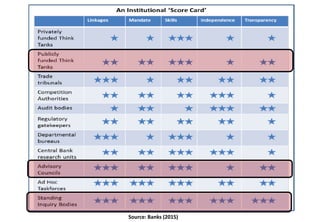
Source: Banks (2015)
Scope of the paper
• Analysis of ten pro-productivity institutions
• Ad hoc productivity commissions established as standing
inquiry bodies (Australia, New Zealand, Mexico, Chile)
• “Temporary” productivity commissions (Denmark, Norway)
• Advisory bodies at the centre of government (France,
Ireland, United States, European Commission)
• Interviews with high-level staff members and with
external stakeholders (total 20 interviews)
• Lesson-drawing
Different timeframes
• Australia (since 1998, but predecessors date back to 1920s)
• New Zealand (since 2012)
• Chile (2015)
• Mexico (2013)
• Norway (2014-2016)
• Denmark (2014-2016, with a predecessor since 2005)
• France (2013, but predecessors date back to the 1940s)
• Ireland (1997)
• European Commission (2014, but experience goes back to 1989)
• United States (1946)
Current state of the work
• Desk research completed
• First four in-depth interviews completed
• Australian Productivity Commission
• New Zealand Productivity Commission
• United States Council of Economic Advisers
• European Political Strategy Centre
• Work will be completed by end August 2016
Very preliminary thoughts (1)
• No one-size-fits all recipe
• Need to adapt institutional and governance
arrangements to national legal and political culture
• Some countries have opted for independent bodies
with bipartisan support; others have bodies that
mostly advice the president (US, France, EU)
• All surveyed institutions care about transparency,
quality, and international cooperation
• And all critically depend on the accuracy and
robustness of the data they produce
Very preliminary thoughts (2)
• Political commitment is key
• In most cases PPIs were created after crises or bad economic
performance, with bipartisan support. The challenge is to
keep momentum over time
• Broad notion of productivity/competitiveness
• Most institutions go beyond the technical economic definition
of productivity, and are oriented towards well-being in the
long term
• Core business is long-term thinking
• Governments increasingly lack time and skills to engage in
prospective thinking
Very preliminary thoughts (3)
• Degree of institutionalization is important for the
effectiveness of these institutions, but it takes time to
consolidate
• Independence is essential, even when institutions are
based at the centre of government
• Independence, transparency and quality are key for
legitimacy. More specifically:
• Input legitimacy is boosted by multi-stakeholder composition
(when located at CoG), coupled with high level skills
• Output legitimacy is promoted by transparency, inclusiveness
and quality of deliverables
Very preliminary thoughts (4)
• Where a culture of evidence-based
policymaking is more developed, these
institutions can engage more effectively with
the executive, and be involved in the regulatory
governance cycle.
• This affects the extent to which independent pro-
productivity institutions can issue concrete policy
recommendations
• Involving pro-productivity institutions is increasingly
important to strengthen the evaluation function in
government, or outside government
Very preliminary thoughts (5)
• Budget has to be sufficient to allow for
• Attracting best talent (mostly, but not only economics)
• Engaging in extensive field work (in case of enquiries)
• Carrying out self-directed research programs
• Managing different enquiries, policy tasks or research
projects at the same time
• An important constraint is the capacity of the
public administration in managing and
operationalizing recommendations:
• Better central and peripheral administrations help the
effectiveness of pro-productivity institutions
Pro-productivity institutions:
learning from national experience
Andrea Renda
2016 Conference of the Global Forum on Productivity
Lisbon, 8 July 2016

Pro-productivity Institutions: Learning From National Experience

  • 1.
    Pro-productivity institutions: learning fromnational experience Andrea Renda 2016 Conference of the Global Forum on Productivity Lisbon, 8 July 2016
  • 2.
    Introduction • Promoting productivity:a daunting task • Resistance from vested interests: losers are often more powerful than winners • “Awareness” problem + “image” problem: Difficult to keep productivity under the spotlight, and hard to convince stakeholders • Short-term political cycles v. long-term thinking • Productivity can clash with other policy objectives • Different countries have different needs
  • 3.
  • 4.
    Scope of thepaper • Analysis of ten pro-productivity institutions • Ad hoc productivity commissions established as standing inquiry bodies (Australia, New Zealand, Mexico, Chile) • “Temporary” productivity commissions (Denmark, Norway) • Advisory bodies at the centre of government (France, Ireland, United States, European Commission) • Interviews with high-level staff members and with external stakeholders (total 20 interviews) • Lesson-drawing
  • 5.
    Different timeframes • Australia(since 1998, but predecessors date back to 1920s) • New Zealand (since 2012) • Chile (2015) • Mexico (2013) • Norway (2014-2016) • Denmark (2014-2016, with a predecessor since 2005) • France (2013, but predecessors date back to the 1940s) • Ireland (1997) • European Commission (2014, but experience goes back to 1989) • United States (1946)
  • 6.
    Current state ofthe work • Desk research completed • First four in-depth interviews completed • Australian Productivity Commission • New Zealand Productivity Commission • United States Council of Economic Advisers • European Political Strategy Centre • Work will be completed by end August 2016
  • 7.
    Very preliminary thoughts(1) • No one-size-fits all recipe • Need to adapt institutional and governance arrangements to national legal and political culture • Some countries have opted for independent bodies with bipartisan support; others have bodies that mostly advice the president (US, France, EU) • All surveyed institutions care about transparency, quality, and international cooperation • And all critically depend on the accuracy and robustness of the data they produce
  • 8.
    Very preliminary thoughts(2) • Political commitment is key • In most cases PPIs were created after crises or bad economic performance, with bipartisan support. The challenge is to keep momentum over time • Broad notion of productivity/competitiveness • Most institutions go beyond the technical economic definition of productivity, and are oriented towards well-being in the long term • Core business is long-term thinking • Governments increasingly lack time and skills to engage in prospective thinking
  • 9.
    Very preliminary thoughts(3) • Degree of institutionalization is important for the effectiveness of these institutions, but it takes time to consolidate • Independence is essential, even when institutions are based at the centre of government • Independence, transparency and quality are key for legitimacy. More specifically: • Input legitimacy is boosted by multi-stakeholder composition (when located at CoG), coupled with high level skills • Output legitimacy is promoted by transparency, inclusiveness and quality of deliverables
  • 10.
    Very preliminary thoughts(4) • Where a culture of evidence-based policymaking is more developed, these institutions can engage more effectively with the executive, and be involved in the regulatory governance cycle. • This affects the extent to which independent pro- productivity institutions can issue concrete policy recommendations • Involving pro-productivity institutions is increasingly important to strengthen the evaluation function in government, or outside government
  • 11.
    Very preliminary thoughts(5) • Budget has to be sufficient to allow for • Attracting best talent (mostly, but not only economics) • Engaging in extensive field work (in case of enquiries) • Carrying out self-directed research programs • Managing different enquiries, policy tasks or research projects at the same time • An important constraint is the capacity of the public administration in managing and operationalizing recommendations: • Better central and peripheral administrations help the effectiveness of pro-productivity institutions
  • 12.
    Pro-productivity institutions: learning fromnational experience Andrea Renda 2016 Conference of the Global Forum on Productivity Lisbon, 8 July 2016