Chapter 10 :
Operations strategy
The process of operations strategy
monitoring and control
Nigel Slack , Michael Lewis . 4th edition
Created by AliArjmand
Tabriz University – May 2017
1
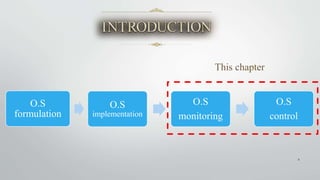
O.S
formulation
O.S
implementation
O.S
monitoring
O.S
control
2
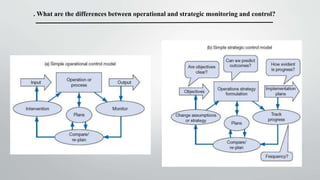
What are the differences between operational and strategic monitoring and control?
How is progress towards strategic objectives tracked?
How can the monitoring and control process attempt to control risk?
How does learning contribute to strategic control?
3
4
. What are the differences between operational and strategic monitoring and control?
5
. What are the differences between operational and strategic monitoring and control?
6
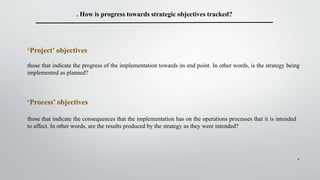
. How is progress towards strategic objectives tracked?
‘Project’ objectives
those that indicate the progress of the implementation towards its end point. In other words, is the strategy being
implemented as planned?
‘Process’ objectives
those that indicate the consequences that the implementation has on the operations processes that it is intended
to affect. In other words, are the results produced by the strategy as they were intended?
7
. How is progress towards strategic objectives tracked?
The red queen effect :
‘Well, in our country’, said Alice, still panting a little, ‘you’d
generally get to somewhere else if you ran very fast for a long
time, as we’ve been doing’. ‘A slow sort of country!’ said the
Queen. ‘Now, here, you see, it takes all the running you can do,
to keep in the same place. If you want to get somewhere else, you
must run at least twice as fast as that!’
8
. How is progress towards strategic objectives tracked?
Example :
9
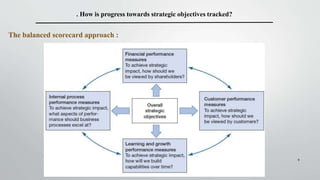
. How is progress towards strategic objectives tracked?
The balanced scorecard approach :
10
. How can the monitoring and control process attempt to control risk?
Here we will look at six aspects of risk that are particularly relevant to operations strategy:
the dynamics of monitoring and control;
the risk of market and operations performance becoming out of balance;
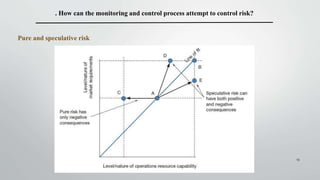
the distinction between pure and speculative risk;
controlling risk through prevention, mitigation and recovery;
Adjustment cost risk;
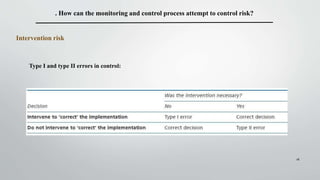
Intervention risk.
11
. How can the monitoring and control process attempt to control risk?
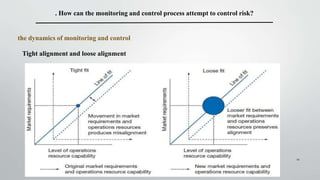
the dynamics of monitoring and control
Tight alignment and loose alignment
12
. How can the monitoring and control process attempt to control risk?
market and operations performance becoming out of balance
‘Operations risk is the potential for unwanted negative consequences from an operationsrelated event.’
13
. How can the monitoring and control process attempt to control risk?
Pure and speculative risk
14
. How can the monitoring and control process attempt to control risk?
Controlling risk
A simple structure for describing generic mechanisms for controlling risk uses three approaches:
Prevention strategies – are where an operation seeks to completely prevent (or reduce the
frequency of) an event occurring.
Mitigating strategies – are where an operation seeks to isolate an event from any possible
negative consequences.
Recovery strategies – are where an operation analyses and accepts the consequences from an
event but undertakes to minimise or alleviate or compensate for them.
15
. How can the monitoring and control process attempt to control risk?
Adjustment cost risk
16
. How can the monitoring and control process attempt to control risk?
Intervention risk
Type I and type II errors in control:
17
. How does learning contribute to strategic control?
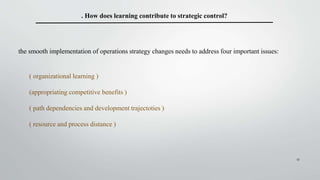
the smooth implementation of operations strategy changes needs to address four important issues:
( organizational learning )
(appropriating competitive benefits )
( path dependencies and development trajectoties )
( resource and process distance )
18
. How does learning contribute to strategic control?
Organisational learning :
Single-loop learning Double-loop learning
19
. How does learning contribute to strategic control?
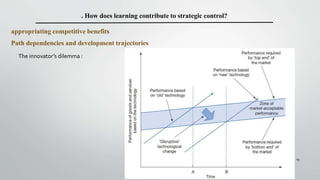
appropriating competitive benefits
Path dependencies and development trajectories
The innovator’s dilemma :
20
. How does learning contribute to strategic control?
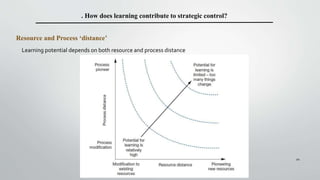
Resource and Process ‘distance’
Learning potential depends on both resource and process distance
21
Thank you all

operations strategy nigel slack,lewis Chapter 10

  • 1.
    Chapter 10 : Operationsstrategy The process of operations strategy monitoring and control Nigel Slack , Michael Lewis . 4th edition Created by AliArjmand Tabriz University – May 2017 1
  • 2.
  • 3.
    What are thedifferences between operational and strategic monitoring and control? How is progress towards strategic objectives tracked? How can the monitoring and control process attempt to control risk? How does learning contribute to strategic control? 3
  • 4.
    4 . What arethe differences between operational and strategic monitoring and control?
  • 5.
    5 . What arethe differences between operational and strategic monitoring and control?
  • 6.
    6 . How isprogress towards strategic objectives tracked? ‘Project’ objectives those that indicate the progress of the implementation towards its end point. In other words, is the strategy being implemented as planned? ‘Process’ objectives those that indicate the consequences that the implementation has on the operations processes that it is intended to affect. In other words, are the results produced by the strategy as they were intended?
  • 7.
    7 . How isprogress towards strategic objectives tracked? The red queen effect : ‘Well, in our country’, said Alice, still panting a little, ‘you’d generally get to somewhere else if you ran very fast for a long time, as we’ve been doing’. ‘A slow sort of country!’ said the Queen. ‘Now, here, you see, it takes all the running you can do, to keep in the same place. If you want to get somewhere else, you must run at least twice as fast as that!’
  • 8.
    8 . How isprogress towards strategic objectives tracked? Example :
  • 9.
    9 . How isprogress towards strategic objectives tracked? The balanced scorecard approach :
  • 10.
    10 . How canthe monitoring and control process attempt to control risk? Here we will look at six aspects of risk that are particularly relevant to operations strategy: the dynamics of monitoring and control; the risk of market and operations performance becoming out of balance; the distinction between pure and speculative risk; controlling risk through prevention, mitigation and recovery; Adjustment cost risk; Intervention risk.
  • 11.
    11 . How canthe monitoring and control process attempt to control risk? the dynamics of monitoring and control Tight alignment and loose alignment
  • 12.
    12 . How canthe monitoring and control process attempt to control risk? market and operations performance becoming out of balance ‘Operations risk is the potential for unwanted negative consequences from an operationsrelated event.’
  • 13.
    13 . How canthe monitoring and control process attempt to control risk? Pure and speculative risk
  • 14.
    14 . How canthe monitoring and control process attempt to control risk? Controlling risk A simple structure for describing generic mechanisms for controlling risk uses three approaches: Prevention strategies – are where an operation seeks to completely prevent (or reduce the frequency of) an event occurring. Mitigating strategies – are where an operation seeks to isolate an event from any possible negative consequences. Recovery strategies – are where an operation analyses and accepts the consequences from an event but undertakes to minimise or alleviate or compensate for them.
  • 15.
    15 . How canthe monitoring and control process attempt to control risk? Adjustment cost risk
  • 16.
    16 . How canthe monitoring and control process attempt to control risk? Intervention risk Type I and type II errors in control:
  • 17.
    17 . How doeslearning contribute to strategic control? the smooth implementation of operations strategy changes needs to address four important issues: ( organizational learning ) (appropriating competitive benefits ) ( path dependencies and development trajectoties ) ( resource and process distance )
  • 18.
    18 . How doeslearning contribute to strategic control? Organisational learning : Single-loop learning Double-loop learning
  • 19.
    19 . How doeslearning contribute to strategic control? appropriating competitive benefits Path dependencies and development trajectories The innovator’s dilemma :
  • 20.
    20 . How doeslearning contribute to strategic control? Resource and Process ‘distance’ Learning potential depends on both resource and process distance
  • 21.