Strategy and
The Internet
CUHK Business School
Greta Zhang
1
2
3
In the Wave
of
Information
Technology
4
A Brief
History of
IT in Biz
5
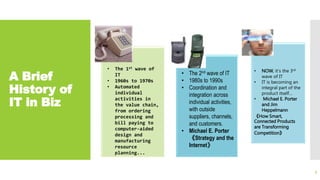
• The 2nd wave of IT
• 1980s to 1990s
• Coordination and
integration across
individual activities,
with outside
suppliers, channels,
and customers.
• Michael E. Porter
《Strategy and the
Internet》
• NOW, it’s the 3rd
wave of IT
• IT is becoming an
integral part of the
product itself…
• Michael E. Porter
and Jim
Heppelmann
《How Smart,
Connected Products
are Transforming
Competition》
• The 1st wave of
IT
• 1960s to 1970s
• Automated
individual
activities in
the value chain,
from ordering
processing and
bill paying to
computer-aided
design and
manufacturing
resource
planning...
Does
strategy
(still)
matter?
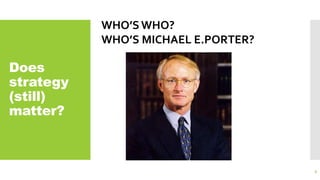
WHO’S WHO?
WHO’S MICHAEL E.PORTER?
6
Does
strategy
(still)
matter?
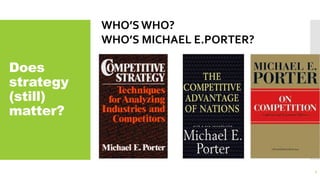
WHO’S WHO?
WHO’S MICHAEL E.PORTER?
 Leading authority on competitive strategy
 His work is recognized in many governments,
corporations and academic circles globally
 BishopWilliam LawrenceUniversity Professor at
Harvard Business School
7
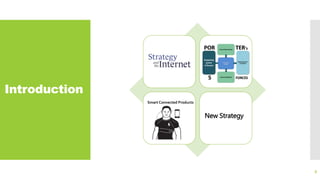
Introduction
8
Smart Connected Products
New Strategy
Part I
9
Does
strategy
(still)
matter?
“Does the Internet render
established rules about
strategy obsolete?”
-Michael E. Porter
10
Does
strategy
(still)
matter?
YES,
STRATEGY
MATTERS.
11
Does
strategy
(still)
matter?
The Idea in Brief
Porter argues (2001):
 Strategy matters.
 The Internet makes strategies
more vital than ever.
BUT Why and How?
12
Does
strategy
(still)
matter?
CONTENTS
► The Basic Concept of Porter’s
Competitive Model
► The Application of the Internet in the
Value Chain
13
Does
strategy
(still)
matter?
OBJECTIVES
► Gain Competitive Advantage
► Understand the Forces that Influence
Competitive Advantage
► Know How to Use Models to Do an Objective
Evaluation
14
Does
strategy
(still)
matter?
QUESTIONS TO GET YOU PONDERING
 Can the Internet or information technology build in
cost and make difficult for a customer to switch
suppliers?
 Can it change the basis for competition within the
industry?
 Can it change the balance of power in the
relationship that a company has with customers or
suppliers?
 Can it provide the basis for new product and services,
new markets or other new business opportunities?
15
16
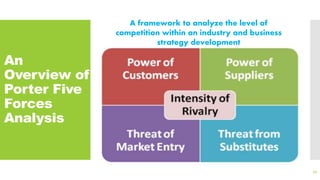
An
Overview of
Porter Five
Forces
Analysis
A framework to analyze the level of
competition within an industry and business
strategy development
17
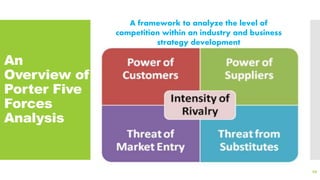
Porter Five
Forces
Analysis
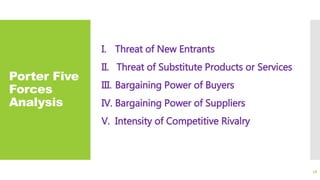
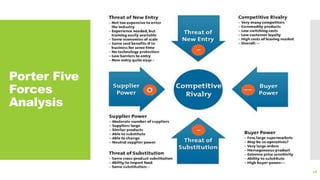
I. Threat of New Entrants
II. Threat of Substitute Products or Services
III. Bargaining Power of Buyers
IV. Bargaining Power of Suppliers
V. Intensity of Competitive Rivalry
18
Porter Five
Forces
Analysis
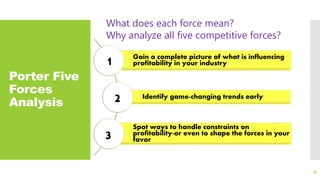
What does each force mean?
Why analyze all five competitive forces?
Gain a complete picture of what is influencing
profitability in your industry
Identify game-changing trends early
Spot ways to handle constraints on
profitability-or even to shape the forces in your
favor
1
2
3
19
Awareness of competitive forces
can help a company stake out a
position in its industry that is
less vulnerable to attack.
-Michael E. Porter
20
Porter Five
Forces
Analysis
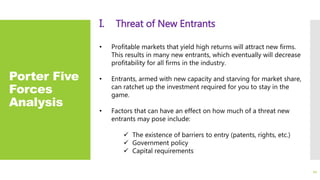
I. Threat of New Entrants
• Profitable markets that yield high returns will attract new firms.
This results in many new entrants, which eventually will decrease
profitability for all firms in the industry.
• Entrants, armed with new capacity and starving for market share,
can ratchet up the investment required for you to stay in the
game.
• Factors that can have an effect on how much of a threat new
entrants may pose include:
 The existence of barriers to entry (patents, rights, etc.)
 Government policy
 Capital requirements
21
Porter Five
Forces
Analysis
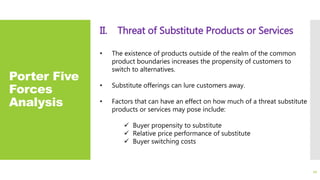
II. Threat of Substitute Products or Services
• The existence of products outside of the realm of the common
product boundaries increases the propensity of customers to
switch to alternatives.
• Substitute offerings can lure customers away.
• Factors that can have an effect on how much of a threat substitute
products or services may pose include:
 Buyer propensity to substitute
 Relative price performance of substitute
 Buyer switching costs
22
Porter Five
Forces
Analysis
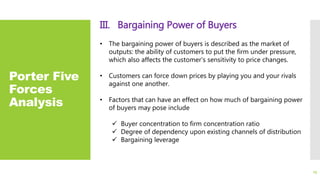
III. Bargaining Power of Buyers
• The bargaining power of buyers is described as the market of
outputs: the ability of customers to put the firm under pressure,
which also affects the customer's sensitivity to price changes.
• Customers can force down prices by playing you and your rivals
against one another.
• Factors that can have an effect on how much of bargaining power
of buyers may pose include
 Buyer concentration to firm concentration ratio
 Degree of dependency upon existing channels of distribution
 Bargaining leverage
23
Porter Five
Forces
Analysis
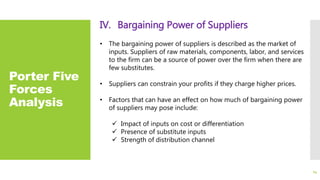
IV. Bargaining Power of Suppliers
• The bargaining power of suppliers is described as the market of
inputs. Suppliers of raw materials, components, labor, and services
to the firm can be a source of power over the firm when there are
few substitutes.
• Suppliers can constrain your profits if they charge higher prices.
• Factors that can have an effect on how much of bargaining power
of suppliers may pose include:
 Impact of inputs on cost or differentiation
 Presence of substitute inputs
 Strength of distribution channel
24
Porter Five
Forces
Analysis
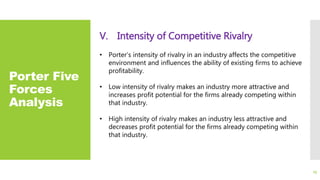
V. Intensity of Competitive Rivalry
• Porter’s intensity of rivalry in an industry affects the competitive
environment and influences the ability of existing firms to achieve
profitability.
• Low intensity of rivalry makes an industry more attractive and
increases profit potential for the firms already competing within
that industry.
• High intensity of rivalry makes an industry less attractive and
decreases profit potential for the firms already competing within
that industry.
25
Porter Five
Forces
Analysis
26
Porter Five
Forces
Analysis
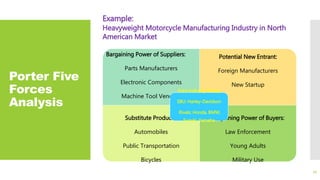
Example:
Heavyweight Motorcycle Manufacturing Industry in North
American Market
Bargaining Power of Suppliers:
Parts Manufacturers
Electronic Components
Machine Tool Vendors
Potential New Entrant:
Foreign Manufacturers
New Startup
Substitute Products:
Automobiles
Public Transportation
Bicycles
Bargaining Power of Buyers:
Law Enforcement
Young Adults
Military Use
Intra-Industry Rivalry
SBU: Harley-Davidson
Rivals: Honda, BMW,
Suzuki, Yamaha
27
Porter Five
Forces
Analysis
Example: Mobile Phone Industry
28
How can the
Internet be
used to
create
economic
value?
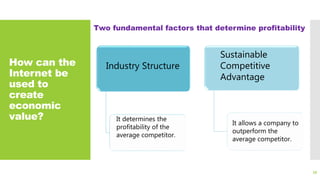
29
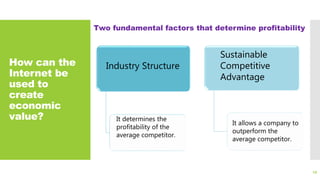
Industry Structure
Sustainable
Competitive
Advantage
It determines the
profitability of the
average competitor.
It allows a company to
outperform the
average competitor.
Two fundamental factors that determine profitability
The Internet
and Industry
Structure
30
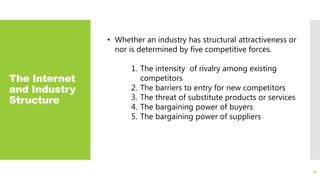
• Whether an industry has structural attractiveness or
nor is determined by five competitive forces.
1. The intensity of rivalry among existing
competitors
2. The barriers to entry for new competitors
3. The threat of substitute products or services
4. The bargaining power of buyers
5. The bargaining power of suppliers
The Internet
and Industry
Structure
31
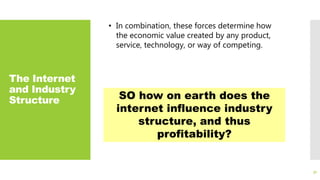
• In combination, these forces determine how
the economic value created by any product,
service, technology, or way of competing.
SO how on earth does the
internet influence industry
structure, and thus
profitability?
How the
Internet
Influences
Industry
Structure
32
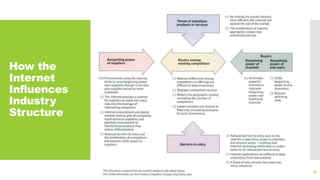
How the
Internet
Influences
Industry
Structure
33
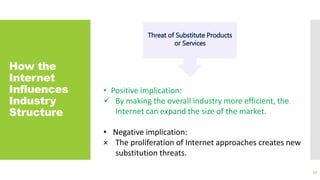
Threat of Substitute Products
or Services
• Positive implication:
 By making the overall industry more efficient, the
Internet can expand the size of the market.
• Negative implication:
× The proliferation of Internet approaches creates new
substitution threats.
How the
Internet
Influences
Industry
Structure
34
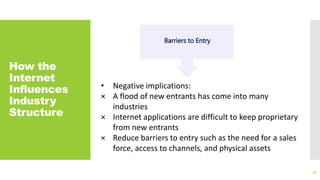
Barriers to Entry
• Negative implications:
× A flood of new entrants has come into many
industries
× Internet applications are difficult to keep proprietary
from new entrants
× Reduce barriers to entry such as the need for a sales
force, access to channels, and physical assets
How the
Internet
Influences
Industry
Structure
35
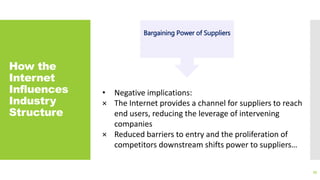
Bargaining Power of Suppliers
• Negative implications:
× The Internet provides a channel for suppliers to reach
end users, reducing the leverage of intervening
companies
× Reduced barriers to entry and the proliferation of
competitors downstream shifts power to suppliers…
How the
Internet
Influences
Industry
Structure
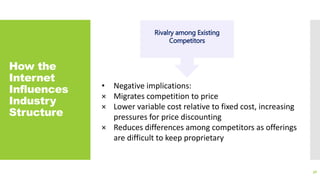
36
Rivalry among Existing
Competitors
• Negative implications:
× Migrates competition to price
× Lower variable cost relative to fixed cost, increasing
pressures for price discounting
× Reduces differences among competitors as offerings
are difficult to keep proprietary
How the
Internet
Influences
Industry
Structure
37
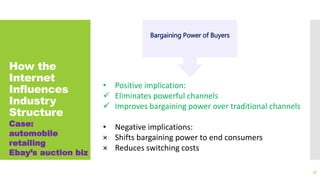
Bargaining Power of Buyers
• Positive implication:
 Eliminates powerful channels
 Improves bargaining power over traditional channels
• Negative implications:
× Shifts bargaining power to end consumers
× Reduces switching costs
Case:
automobile
retailing
Ebay’s auction biz
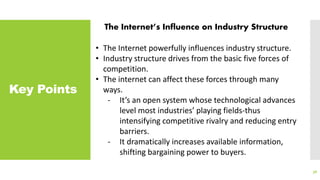
Key Points
38
The Internet’s Influence on Industry Structure
• The Internet powerfully influences industry structure.
• Industry structure drives from the basic five forces of
competition.
• The internet can affect these forces through many
ways.
- It’s an open system whose technological advances
level most industries’ playing fields-thus
intensifying competitive rivalry and reducing entry
barriers.
- It dramatically increases available information,
shifting bargaining power to buyers.
How can the
Internet be
used to
create
economic
value?
39
Industry Structure
Sustainable
Competitive
Advantage
It determines the
profitability of the
average competitor.
It allows a company to
outperform the
average competitor.
Two fundamental factors that determine profitability
The
Internet and
Competitive
Advantage
40
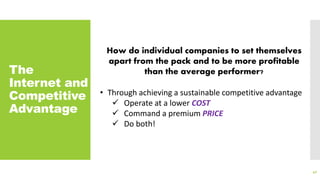
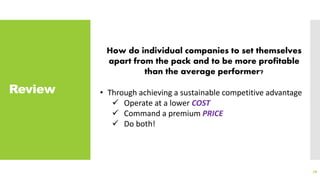
How do individual companies to set themselves
apart from the pack and to be more profitable
than the average performer?
• Through achieving a sustainable competitive advantage
 Operate at a lower COST
 Command a premium PRICE
 Do both!
The
Internet and
Competitive
Advantage
41
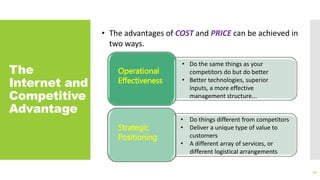
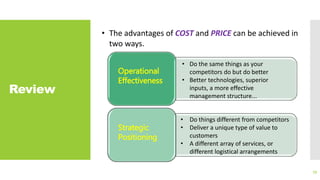
• The advantages of COST and PRICE can be achieved in
two ways.
Operational
Effectiveness
• Do the same things as your
competitors do but do better
• Better technologies, superior
inputs, a more effective
management structure...
Strategic
Positioning
• Do things different from competitors
• Deliver a unique type of value to
customers
• A different array of services, or
different logistical arrangements
The Internet
affects
Operational
Effectiveness
and Strategic
Positioning
in different
ways.
42
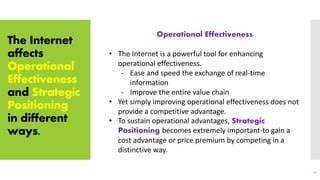
Operational Effectiveness
• The Internet is a powerful tool for enhancing
operational effectiveness.
- Ease and speed the exchange of real-time
information
- Improve the entire value chain
• Yet simply improving operational effectiveness does not
provide a competitive advantage.
• To sustain operational advantages, Strategic
Positioning becomes extremely important-to gain a
cost advantage or price premium by competing in a
distinctive way.
43
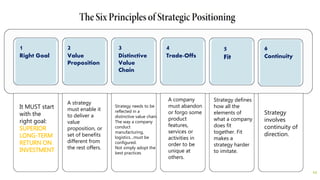
1
Right Goal
2
Value
Proposition
3
Distinctive
Value
Chain
4
Trade-Offs
5
Fit
6
Continuity
It MUST start
with the
right goal:
SUPERIOR
LONG-TERM
RETURN ON
INVESTMENT
A strategy
must enable it
to deliver a
value
proposition, or
set of benefits
different from
the rest offers.
Strategy needs to be
reflected in a
distinctive value chain.
The way a company
conduct
manufacturing,
logistics…must be
configured.
Not simply adopt the
best practices
A company
must abandon
or forgo some
product
features,
services or
activities in
order to be
unique at
others.
Strategy defines
how all the
elements of
what a company
does fit
together. Fit
makes a
strategy harder
to imitate.
Strategy
involves
continuity of
direction.
Key Points
44
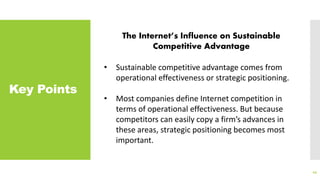
The Internet’s Influence on Sustainable
Competitive Advantage
• Sustainable competitive advantage comes from
operational effectiveness or strategic positioning.
• Most companies define Internet competition in
terms of operational effectiveness. But because
competitors can easily copy a firm’s advances in
these areas, strategic positioning becomes most
important.
The
Internet
and the
Value
Chain
45
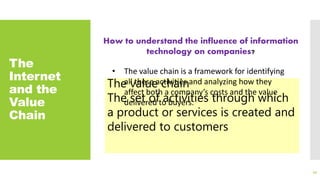
How to understand the influence of information
technology on companies?
The value chain
The set of activities through which
a product or services is created and
delivered to customers
• The value chain is a framework for identifying
all these activities and analyzing how they
affect both a company’s costs and the value
delivered to buyers.
Prominent
Applications
of the
Internet in
the Value
Chain
46
The
Internet
and the
Value
Chain
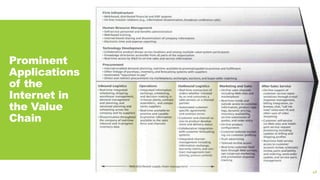
• Because every activity involves the creation,
processing, and communication of information,
information technology has a pervasive influence
on the value chain.
• The special advantage of the Internet is the ability
to link one activity with others and make real-time
data created in one activity widely available, both
within the company and with outside suppliers,
channels, and customers.
47
How to understand the influence of
information technology on companies?
The Internet
as
Complement
?
48
Is the Internet cannibalistic?
Will it replace all conventional ways of doing
business and overturn traditional advantages?
• Some real trade-offs can exist between Internet and
traditional activities.
• But modest in most industries.
Case: Walgreens and W.W.Grainger
The Internet
as
Complement
49
The Internet makes it easier to maintain strategic
positioning.
How?
The Internet
as
Complement
1
50
The Internet
as
Complement
2
51
The Internet
as
Complement
3
52
Conclusion
► Strategies matter and still matter.
►The Internet makes strategies more
vital than ever.
►It’s all about how to use the Internet
and traditional methods to achieve the
greatest strategic advantage.
53
Smart,Connected
Products,Competition
andStrategy
Part II
The Current Wave of Information Technology
54
55
CONTENTS
► What is Smart, Connected Product?
► What is the effect of smart, connected
products on industry structure?
► What are the new strategic choices facing
companies?
What is
Smart,
Connected
Product?
56
57
What is
Smart,
Connected
Product?
58
Smart, Connected Products are
• Not just products that are composed only of
mechanical and electrical parts
• SYSTEMS that combine hardware, sensors,
data storage, microprocessors, software, and
CONNECTIVITY
• More new functionality
• Greater reliability
• Higher product utilization
• Higher capabilities that cut across and
transcend traditional product boundaries
59
What are the core
elements of smart,
connected
products?
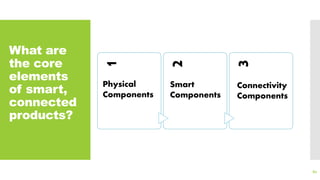
What are
the core
elements
of smart,
connected
products?
60
1
2
3
Smart
Components
Physical
Components
Connectivity
Components
What are
the core
elements
of smart,
connected
products?
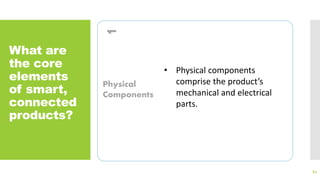
61
1
Physical
Components
• Physical components
comprise the product’s
mechanical and electrical
parts.
What are
the core
elements
of smart,
connected
products?
62
2
Smart
Components
• Smart components comprise
the sensors, microprocessors,
data storage, controls,
software and an embedded
operating system and
enhanced user interface.
What are
the core
elements
of smart,
connected
products?
63
3
Connectivity
Components
• Connectivity components
comprise the ports,
antennae, and protocols
enabling wired or wireless
connections with the
product.
What are
the core
elements
of smart,
connected
products?
64
3
Connectivity
Components
• Connectivity takes three
forms.
 One-to-one
 One-to-many
 Many-to-many
65
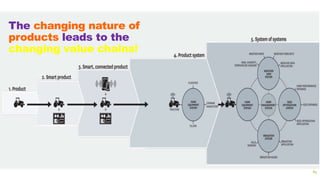
The changing nature of
products leads to the
changing value chains!
The
changing
nature of
products
leads to
the
changing
value
chains.
66
What does it mean?
The NEW types of products
 Alter industry structure and the nature of
competition
 Bring NEW competitive opportunities and
NEW threats
 Reshape industry boundaries
 Create entirely NEW industries
Reshaping
Industry
Structure
67
► How do smart, connected products
reshape structure?
► What’s the effects of smart, connected
products on industry competition and
profitability?
► Use Porter’s Five Force Model to
examine their impact on industry
structure
An
Overview of
Porter Five
Forces
Analysis
A framework to analyze the level of
competition within an industry and business
strategy development
68
Bargaining
Power of
Buyers
69
• The smart, connected products can increase buyer
power by giving buyers a better understanding of
true product performance, allowing them to play
one manufacturer off another.
• Buyers may also find that having access to product
usage data can decrease their reliance on the
manufacturer for advice and support.
• “Product as a service” business models or product-
sharing services can increase buyers’ power by
reducing the cost of switching to a new
manufacturer.
Rivalry
among
Competitors
70
• The expansion of capabilities in smart, connected
products can tempt companies to get into a feature
and function arms race with rivals.
• Rivalry among competitors can increase as smart,
connected products become part of broader
product systems.
Threat of
New
Entrants
71
• High fixed costs of more-complex product design,
embedded technology, and multiple layers of new IT
infrastructure
• Broadening product definitions can raise barriers to
entrants even higher
• Increase buyer loyalty and switching costs, further
raising barriers to entry
Threat of
Substitutes
72
• Create new types of substitution threats, such as
wider product capabilities that subsume
conventional products
• New business models enabled by smart, connected
products can create a substitute for product
ownership, reducing overall demand for a product
• Offer superior performance, customization, and
customer value relative to traditional substitute
products
Bargaining
Power of
Suppliers
73
• Software reduces the need for physical tailoring and
the hence the number of physical component
varieties
• Smart, connected products often introduce new
suppliers that manufacturers have never needed
before: providers of sensors, software, connectivity,
embedded operating systems, and data storage…
• New suppliers of the technology stack for smart,
connected products also gain greater leverage given
their relationships with end users and access to
product usage data.
New
Industry
Boundaries
and
System of
Systems
74
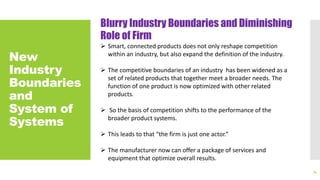
Blurry Industry Boundaries and Diminishing
Role of Firm
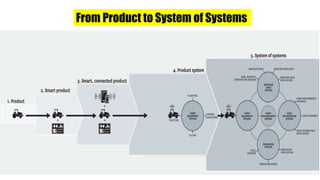
 Smart, connected products does not only reshape competition
within an industry, but also expand the definition of the industry.
 The competitive boundaries of an industry has been widened as a
set of related products that together meet a broader needs. The
function of one product is now optimized with other related
products.
 So the basis of competition shifts to the performance of the
broader product systems.
 This leads to that “the firm is just one actor.”
 The manufacturer now can offer a package of services and
equipment that optimize overall results.
75
New
Industry
Boundaries
and
Systems of
Systems
From Product to System of Systems
How can
companies
achieve
sustainable
competitive
advantage
in a shifting
industry
structure?
76
Do a review!
Review
77
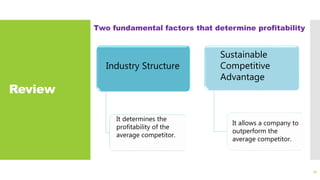
Industry Structure
Sustainable
Competitive
Advantage
It determines the
profitability of the
average competitor.
It allows a company to
outperform the
average competitor.
Two fundamental factors that determine profitability
Review
78
How do individual companies to set themselves
apart from the pack and to be more profitable
than the average performer?
• Through achieving a sustainable competitive advantage
 Operate at a lower COST
 Command a premium PRICE
 Do both!
Review
79
• The advantages of COST and PRICE can be achieved in
two ways.
Operational
Effectiveness
• Do the same things as your
competitors do but do better
• Better technologies, superior
inputs, a more effective
management structure...
Strategic
Positioning
• Do things different from competitors
• Deliver a unique type of value to
customers
• A different array of services, or
different logistical arrangements
How can
companies
achieve
sustainable
competitive
advantage
in a shifting
industry
structure?
80
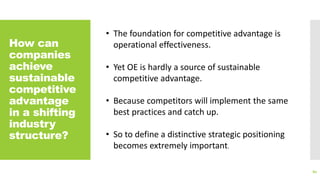
• The foundation for competitive advantage is
operational effectiveness.
• Yet OE is hardly a source of sustainable
competitive advantage.
• Because competitors will implement the same
best practices and catch up.
• So to define a distinctive strategic positioning
becomes extremely important.
So
Strategies
Matter !
81
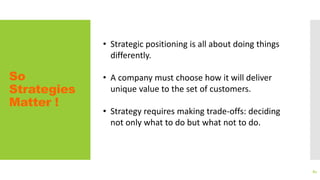
• Strategic positioning is all about doing things
differently.
• A company must choose how it will deliver
unique value to the set of customers.
• Strategy requires making trade-offs: deciding
not only what to do but what not to do.
Implications
for Strategy
82
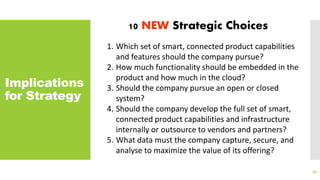
10 NEW Strategic Choices
1. Which set of smart, connected product capabilities
and features should the company pursue?
2. How much functionality should be embedded in the
product and how much in the cloud?
3. Should the company pursue an open or closed
system?
4. Should the company develop the full set of smart,
connected product capabilities and infrastructure
internally or outsource to vendors and partners?
5. What data must the company capture, secure, and
analyse to maximize the value of its offering?
Implications
for Strategy
83
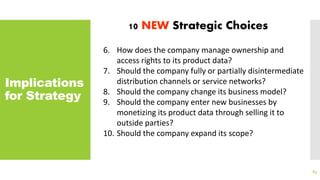
10 NEW Strategic Choices
6. How does the company manage ownership and
access rights to its product data?
7. Should the company fully or partially disintermediate
distribution channels or service networks?
8. Should the company change its business model?
9. Should the company enter new businesses by
monetizing its product data through selling it to
outside parties?
10. Should the company expand its scope?
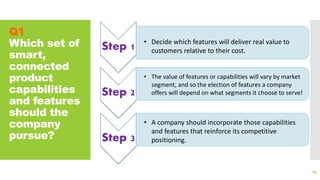
Q1
Which set of
smart,
connected
product
capabilities
and features
should the
company
pursue?
84
Step 1
Step 2
Step 3
• A company should incorporate those capabilities
and features that reinforce its competitive
positioning.
• Decide which features will deliver real value to
customers relative to their cost.
• The value of features or capabilities will vary by market
segment, and so the election of features a company
offers will depend on what segments it choose to serve!
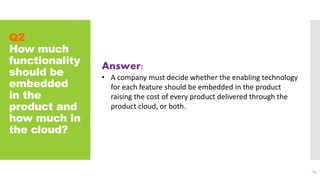
Q2
How much
functionality
should be
embedded
in the
product and
how much in
the cloud?
85
Answer:
• A company must decide whether the enabling technology
for each feature should be embedded in the product
raising the cost of every product delivered through the
product cloud, or both.
Q3
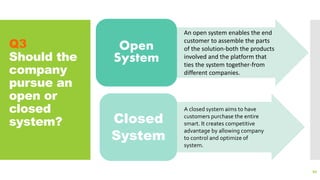
Should the
company
pursue an
open or
closed
system?
86
Open
System
Closed
System
An open system enables the end
customer to assemble the parts
of the solution-both the products
involved and the platform that
ties the system together-from
different companies.
A closed system aims to have
customers purchase the entire
smart. It creates competitive
advantage by allowing company
to control and optimize of
system.
Q4
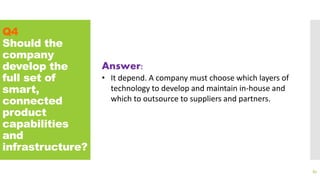
Should the
company
develop the
full set of
smart,
connected
product
capabilities
and
infrastructure?
87
Answer:
• It depend. A company must choose which layers of
technology to develop and maintain in-house and
which to outsource to suppliers and partners.
Q5
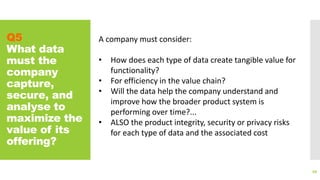
What data
must the
company
capture,
secure, and
analyse to
maximize the
value of its
offering?
88
A company must consider:
• How does each type of data create tangible value for
functionality?
• For efficiency in the value chain?
• Will the data help the company understand and
improve how the broader product system is
performing over time?...
• ALSO the product integrity, security or privacy risks
for each type of data and the associated cost
Q6
How does the
company
manage
ownership
and access
rights to its
product data?
89
The key is who actually owns the data.
Q7
Should the
company fully
or partially
disintermedia
te distribution
channels or
service
networks?
90
By minimizing the role of the middlemen,
companies can potentially capture new
revenue and boost margins. They can also
improve their knowledge of customer needs,
strengthen brand awareness, and boost loyalty
by educating customers more directly about
product value.
Q8
Should the
company
change its
business
model?
91
It depends on
• The costs of servicing the product and other
costs of use
• The risks of downtime and other product
failures and defects not covered by
warranties
Q9
Should the
company
enter new
businesses by
monetizing its
product data
through
selling it to
outside
parties?
92
Only if it may lead to new services or new
business.
Q10
Should the
company
expand its
scope?
93
Companies must identify a clear value
proposition before entering.
Key Points
Smart, connected products enable four new categories of
capabilities that create breakthroughs in differentiation and
operational effectiveness, improve customer experience, and
enable new revenue streams.
To capitalize, manufacturing firms must rethink nearly
everything they do—from how products are designed, and
sourced, to how they are manufactured, sold and serviced,
to putting in place a whole new kind of IT infrastructure.
94
Strategy and
The Internet
CUHK Business School
Greta Zhang
95

Strategy and the Internet

  • 1.
    Strategy and The Internet CUHKBusiness School Greta Zhang 1
  • 2.
  • 3.
  • 4.
  • 5.
    A Brief History of ITin Biz 5 • The 2nd wave of IT • 1980s to 1990s • Coordination and integration across individual activities, with outside suppliers, channels, and customers. • Michael E. Porter 《Strategy and the Internet》 • NOW, it’s the 3rd wave of IT • IT is becoming an integral part of the product itself… • Michael E. Porter and Jim Heppelmann 《How Smart, Connected Products are Transforming Competition》 • The 1st wave of IT • 1960s to 1970s • Automated individual activities in the value chain, from ordering processing and bill paying to computer-aided design and manufacturing resource planning...
  • 6.
  • 7.
    Does strategy (still) matter? WHO’S WHO? WHO’S MICHAELE.PORTER?  Leading authority on competitive strategy  His work is recognized in many governments, corporations and academic circles globally  BishopWilliam LawrenceUniversity Professor at Harvard Business School 7
  • 8.
  • 9.
  • 10.
    Does strategy (still) matter? “Does the Internetrender established rules about strategy obsolete?” -Michael E. Porter 10
  • 11.
  • 12.
    Does strategy (still) matter? The Idea inBrief Porter argues (2001):  Strategy matters.  The Internet makes strategies more vital than ever. BUT Why and How? 12
  • 13.
    Does strategy (still) matter? CONTENTS ► The BasicConcept of Porter’s Competitive Model ► The Application of the Internet in the Value Chain 13
  • 14.
    Does strategy (still) matter? OBJECTIVES ► Gain CompetitiveAdvantage ► Understand the Forces that Influence Competitive Advantage ► Know How to Use Models to Do an Objective Evaluation 14
  • 15.
    Does strategy (still) matter? QUESTIONS TO GETYOU PONDERING  Can the Internet or information technology build in cost and make difficult for a customer to switch suppliers?  Can it change the basis for competition within the industry?  Can it change the balance of power in the relationship that a company has with customers or suppliers?  Can it provide the basis for new product and services, new markets or other new business opportunities? 15
  • 16.
  • 17.
    An Overview of Porter Five Forces Analysis Aframework to analyze the level of competition within an industry and business strategy development 17
  • 18.
    Porter Five Forces Analysis I. Threatof New Entrants II. Threat of Substitute Products or Services III. Bargaining Power of Buyers IV. Bargaining Power of Suppliers V. Intensity of Competitive Rivalry 18
  • 19.
    Porter Five Forces Analysis What doeseach force mean? Why analyze all five competitive forces? Gain a complete picture of what is influencing profitability in your industry Identify game-changing trends early Spot ways to handle constraints on profitability-or even to shape the forces in your favor 1 2 3 19
  • 20.
    Awareness of competitiveforces can help a company stake out a position in its industry that is less vulnerable to attack. -Michael E. Porter 20
  • 21.
    Porter Five Forces Analysis I. Threatof New Entrants • Profitable markets that yield high returns will attract new firms. This results in many new entrants, which eventually will decrease profitability for all firms in the industry. • Entrants, armed with new capacity and starving for market share, can ratchet up the investment required for you to stay in the game. • Factors that can have an effect on how much of a threat new entrants may pose include:  The existence of barriers to entry (patents, rights, etc.)  Government policy  Capital requirements 21
  • 22.
    Porter Five Forces Analysis II. Threatof Substitute Products or Services • The existence of products outside of the realm of the common product boundaries increases the propensity of customers to switch to alternatives. • Substitute offerings can lure customers away. • Factors that can have an effect on how much of a threat substitute products or services may pose include:  Buyer propensity to substitute  Relative price performance of substitute  Buyer switching costs 22
  • 23.
    Porter Five Forces Analysis III. BargainingPower of Buyers • The bargaining power of buyers is described as the market of outputs: the ability of customers to put the firm under pressure, which also affects the customer's sensitivity to price changes. • Customers can force down prices by playing you and your rivals against one another. • Factors that can have an effect on how much of bargaining power of buyers may pose include  Buyer concentration to firm concentration ratio  Degree of dependency upon existing channels of distribution  Bargaining leverage 23
  • 24.
    Porter Five Forces Analysis IV. BargainingPower of Suppliers • The bargaining power of suppliers is described as the market of inputs. Suppliers of raw materials, components, labor, and services to the firm can be a source of power over the firm when there are few substitutes. • Suppliers can constrain your profits if they charge higher prices. • Factors that can have an effect on how much of bargaining power of suppliers may pose include:  Impact of inputs on cost or differentiation  Presence of substitute inputs  Strength of distribution channel 24
  • 25.
    Porter Five Forces Analysis V. Intensityof Competitive Rivalry • Porter’s intensity of rivalry in an industry affects the competitive environment and influences the ability of existing firms to achieve profitability. • Low intensity of rivalry makes an industry more attractive and increases profit potential for the firms already competing within that industry. • High intensity of rivalry makes an industry less attractive and decreases profit potential for the firms already competing within that industry. 25
  • 26.
  • 27.
    Porter Five Forces Analysis Example: Heavyweight MotorcycleManufacturing Industry in North American Market Bargaining Power of Suppliers: Parts Manufacturers Electronic Components Machine Tool Vendors Potential New Entrant: Foreign Manufacturers New Startup Substitute Products: Automobiles Public Transportation Bicycles Bargaining Power of Buyers: Law Enforcement Young Adults Military Use Intra-Industry Rivalry SBU: Harley-Davidson Rivals: Honda, BMW, Suzuki, Yamaha 27
  • 28.
  • 29.
    How can the Internetbe used to create economic value? 29 Industry Structure Sustainable Competitive Advantage It determines the profitability of the average competitor. It allows a company to outperform the average competitor. Two fundamental factors that determine profitability
  • 30.
    The Internet and Industry Structure 30 •Whether an industry has structural attractiveness or nor is determined by five competitive forces. 1. The intensity of rivalry among existing competitors 2. The barriers to entry for new competitors 3. The threat of substitute products or services 4. The bargaining power of buyers 5. The bargaining power of suppliers
  • 31.
    The Internet and Industry Structure 31 •In combination, these forces determine how the economic value created by any product, service, technology, or way of competing. SO how on earth does the internet influence industry structure, and thus profitability?
  • 32.
  • 33.
    How the Internet Influences Industry Structure 33 Threat ofSubstitute Products or Services • Positive implication:  By making the overall industry more efficient, the Internet can expand the size of the market. • Negative implication: × The proliferation of Internet approaches creates new substitution threats.
  • 34.
    How the Internet Influences Industry Structure 34 Barriers toEntry • Negative implications: × A flood of new entrants has come into many industries × Internet applications are difficult to keep proprietary from new entrants × Reduce barriers to entry such as the need for a sales force, access to channels, and physical assets
  • 35.
    How the Internet Influences Industry Structure 35 Bargaining Powerof Suppliers • Negative implications: × The Internet provides a channel for suppliers to reach end users, reducing the leverage of intervening companies × Reduced barriers to entry and the proliferation of competitors downstream shifts power to suppliers…
  • 36.
    How the Internet Influences Industry Structure 36 Rivalry amongExisting Competitors • Negative implications: × Migrates competition to price × Lower variable cost relative to fixed cost, increasing pressures for price discounting × Reduces differences among competitors as offerings are difficult to keep proprietary
  • 37.
    How the Internet Influences Industry Structure 37 Bargaining Powerof Buyers • Positive implication:  Eliminates powerful channels  Improves bargaining power over traditional channels • Negative implications: × Shifts bargaining power to end consumers × Reduces switching costs Case: automobile retailing Ebay’s auction biz
  • 38.
    Key Points 38 The Internet’sInfluence on Industry Structure • The Internet powerfully influences industry structure. • Industry structure drives from the basic five forces of competition. • The internet can affect these forces through many ways. - It’s an open system whose technological advances level most industries’ playing fields-thus intensifying competitive rivalry and reducing entry barriers. - It dramatically increases available information, shifting bargaining power to buyers.
  • 39.
    How can the Internetbe used to create economic value? 39 Industry Structure Sustainable Competitive Advantage It determines the profitability of the average competitor. It allows a company to outperform the average competitor. Two fundamental factors that determine profitability
  • 40.
    The Internet and Competitive Advantage 40 How doindividual companies to set themselves apart from the pack and to be more profitable than the average performer? • Through achieving a sustainable competitive advantage  Operate at a lower COST  Command a premium PRICE  Do both!
  • 41.
    The Internet and Competitive Advantage 41 • Theadvantages of COST and PRICE can be achieved in two ways. Operational Effectiveness • Do the same things as your competitors do but do better • Better technologies, superior inputs, a more effective management structure... Strategic Positioning • Do things different from competitors • Deliver a unique type of value to customers • A different array of services, or different logistical arrangements
  • 42.
    The Internet affects Operational Effectiveness and Strategic Positioning indifferent ways. 42 Operational Effectiveness • The Internet is a powerful tool for enhancing operational effectiveness. - Ease and speed the exchange of real-time information - Improve the entire value chain • Yet simply improving operational effectiveness does not provide a competitive advantage. • To sustain operational advantages, Strategic Positioning becomes extremely important-to gain a cost advantage or price premium by competing in a distinctive way.
  • 43.
    43 1 Right Goal 2 Value Proposition 3 Distinctive Value Chain 4 Trade-Offs 5 Fit 6 Continuity It MUSTstart with the right goal: SUPERIOR LONG-TERM RETURN ON INVESTMENT A strategy must enable it to deliver a value proposition, or set of benefits different from the rest offers. Strategy needs to be reflected in a distinctive value chain. The way a company conduct manufacturing, logistics…must be configured. Not simply adopt the best practices A company must abandon or forgo some product features, services or activities in order to be unique at others. Strategy defines how all the elements of what a company does fit together. Fit makes a strategy harder to imitate. Strategy involves continuity of direction.
  • 44.
    Key Points 44 The Internet’sInfluence on Sustainable Competitive Advantage • Sustainable competitive advantage comes from operational effectiveness or strategic positioning. • Most companies define Internet competition in terms of operational effectiveness. But because competitors can easily copy a firm’s advances in these areas, strategic positioning becomes most important.
  • 45.
    The Internet and the Value Chain 45 How tounderstand the influence of information technology on companies? The value chain The set of activities through which a product or services is created and delivered to customers • The value chain is a framework for identifying all these activities and analyzing how they affect both a company’s costs and the value delivered to buyers.
  • 46.
  • 47.
    The Internet and the Value Chain • Becauseevery activity involves the creation, processing, and communication of information, information technology has a pervasive influence on the value chain. • The special advantage of the Internet is the ability to link one activity with others and make real-time data created in one activity widely available, both within the company and with outside suppliers, channels, and customers. 47 How to understand the influence of information technology on companies?
  • 48.
    The Internet as Complement ? 48 Is theInternet cannibalistic? Will it replace all conventional ways of doing business and overturn traditional advantages? • Some real trade-offs can exist between Internet and traditional activities. • But modest in most industries. Case: Walgreens and W.W.Grainger
  • 49.
    The Internet as Complement 49 The Internetmakes it easier to maintain strategic positioning. How?
  • 50.
  • 51.
  • 52.
  • 53.
    Conclusion ► Strategies matterand still matter. ►The Internet makes strategies more vital than ever. ►It’s all about how to use the Internet and traditional methods to achieve the greatest strategic advantage. 53
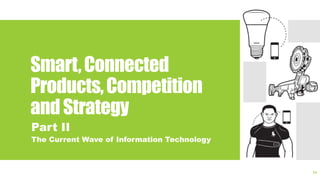
  • 54.
  • 55.
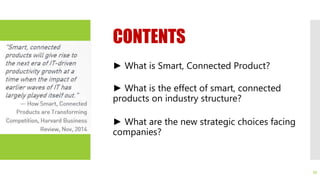
    55 CONTENTS ► What isSmart, Connected Product? ► What is the effect of smart, connected products on industry structure? ► What are the new strategic choices facing companies?
  • 56.
  • 57.
  • 58.
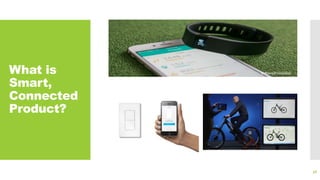
    What is Smart, Connected Product? 58 Smart, ConnectedProducts are • Not just products that are composed only of mechanical and electrical parts • SYSTEMS that combine hardware, sensors, data storage, microprocessors, software, and CONNECTIVITY • More new functionality • Greater reliability • Higher product utilization • Higher capabilities that cut across and transcend traditional product boundaries
  • 59.
    59 What are thecore elements of smart, connected products?
  • 60.
    What are the core elements ofsmart, connected products? 60 1 2 3 Smart Components Physical Components Connectivity Components
  • 61.
    What are the core elements ofsmart, connected products? 61 1 Physical Components • Physical components comprise the product’s mechanical and electrical parts.
  • 62.
    What are the core elements ofsmart, connected products? 62 2 Smart Components • Smart components comprise the sensors, microprocessors, data storage, controls, software and an embedded operating system and enhanced user interface.
  • 63.
    What are the core elements ofsmart, connected products? 63 3 Connectivity Components • Connectivity components comprise the ports, antennae, and protocols enabling wired or wireless connections with the product.
  • 64.
    What are the core elements ofsmart, connected products? 64 3 Connectivity Components • Connectivity takes three forms.  One-to-one  One-to-many  Many-to-many
  • 65.
    65 The changing natureof products leads to the changing value chains!
  • 66.
    The changing nature of products leads to the changing value chains. 66 Whatdoes it mean? The NEW types of products  Alter industry structure and the nature of competition  Bring NEW competitive opportunities and NEW threats  Reshape industry boundaries  Create entirely NEW industries
  • 67.
    Reshaping Industry Structure 67 ► How dosmart, connected products reshape structure? ► What’s the effects of smart, connected products on industry competition and profitability? ► Use Porter’s Five Force Model to examine their impact on industry structure
  • 68.
    An Overview of Porter Five Forces Analysis Aframework to analyze the level of competition within an industry and business strategy development 68
  • 69.
    Bargaining Power of Buyers 69 • Thesmart, connected products can increase buyer power by giving buyers a better understanding of true product performance, allowing them to play one manufacturer off another. • Buyers may also find that having access to product usage data can decrease their reliance on the manufacturer for advice and support. • “Product as a service” business models or product- sharing services can increase buyers’ power by reducing the cost of switching to a new manufacturer.
  • 70.
    Rivalry among Competitors 70 • The expansionof capabilities in smart, connected products can tempt companies to get into a feature and function arms race with rivals. • Rivalry among competitors can increase as smart, connected products become part of broader product systems.
  • 71.
    Threat of New Entrants 71 • Highfixed costs of more-complex product design, embedded technology, and multiple layers of new IT infrastructure • Broadening product definitions can raise barriers to entrants even higher • Increase buyer loyalty and switching costs, further raising barriers to entry
  • 72.
    Threat of Substitutes 72 • Createnew types of substitution threats, such as wider product capabilities that subsume conventional products • New business models enabled by smart, connected products can create a substitute for product ownership, reducing overall demand for a product • Offer superior performance, customization, and customer value relative to traditional substitute products
  • 73.
    Bargaining Power of Suppliers 73 • Softwarereduces the need for physical tailoring and the hence the number of physical component varieties • Smart, connected products often introduce new suppliers that manufacturers have never needed before: providers of sensors, software, connectivity, embedded operating systems, and data storage… • New suppliers of the technology stack for smart, connected products also gain greater leverage given their relationships with end users and access to product usage data.
  • 74.
    New Industry Boundaries and System of Systems 74 Blurry IndustryBoundaries and Diminishing Role of Firm  Smart, connected products does not only reshape competition within an industry, but also expand the definition of the industry.  The competitive boundaries of an industry has been widened as a set of related products that together meet a broader needs. The function of one product is now optimized with other related products.  So the basis of competition shifts to the performance of the broader product systems.  This leads to that “the firm is just one actor.”  The manufacturer now can offer a package of services and equipment that optimize overall results.
  • 75.
  • 76.
    How can companies achieve sustainable competitive advantage in ashifting industry structure? 76 Do a review!
  • 77.
    Review 77 Industry Structure Sustainable Competitive Advantage It determinesthe profitability of the average competitor. It allows a company to outperform the average competitor. Two fundamental factors that determine profitability
  • 78.
    Review 78 How do individualcompanies to set themselves apart from the pack and to be more profitable than the average performer? • Through achieving a sustainable competitive advantage  Operate at a lower COST  Command a premium PRICE  Do both!
  • 79.
    Review 79 • The advantagesof COST and PRICE can be achieved in two ways. Operational Effectiveness • Do the same things as your competitors do but do better • Better technologies, superior inputs, a more effective management structure... Strategic Positioning • Do things different from competitors • Deliver a unique type of value to customers • A different array of services, or different logistical arrangements
  • 80.
    How can companies achieve sustainable competitive advantage in ashifting industry structure? 80 • The foundation for competitive advantage is operational effectiveness. • Yet OE is hardly a source of sustainable competitive advantage. • Because competitors will implement the same best practices and catch up. • So to define a distinctive strategic positioning becomes extremely important.
  • 81.
    So Strategies Matter ! 81 • Strategicpositioning is all about doing things differently. • A company must choose how it will deliver unique value to the set of customers. • Strategy requires making trade-offs: deciding not only what to do but what not to do.
  • 82.
    Implications for Strategy 82 10 NEWStrategic Choices 1. Which set of smart, connected product capabilities and features should the company pursue? 2. How much functionality should be embedded in the product and how much in the cloud? 3. Should the company pursue an open or closed system? 4. Should the company develop the full set of smart, connected product capabilities and infrastructure internally or outsource to vendors and partners? 5. What data must the company capture, secure, and analyse to maximize the value of its offering?
  • 83.
    Implications for Strategy 83 10 NEWStrategic Choices 6. How does the company manage ownership and access rights to its product data? 7. Should the company fully or partially disintermediate distribution channels or service networks? 8. Should the company change its business model? 9. Should the company enter new businesses by monetizing its product data through selling it to outside parties? 10. Should the company expand its scope?
  • 84.
    Q1 Which set of smart, connected product capabilities andfeatures should the company pursue? 84 Step 1 Step 2 Step 3 • A company should incorporate those capabilities and features that reinforce its competitive positioning. • Decide which features will deliver real value to customers relative to their cost. • The value of features or capabilities will vary by market segment, and so the election of features a company offers will depend on what segments it choose to serve!
  • 85.
    Q2 How much functionality should be embedded inthe product and how much in the cloud? 85 Answer: • A company must decide whether the enabling technology for each feature should be embedded in the product raising the cost of every product delivered through the product cloud, or both.
  • 86.
    Q3 Should the company pursue an openor closed system? 86 Open System Closed System An open system enables the end customer to assemble the parts of the solution-both the products involved and the platform that ties the system together-from different companies. A closed system aims to have customers purchase the entire smart. It creates competitive advantage by allowing company to control and optimize of system.
  • 87.
    Q4 Should the company develop the fullset of smart, connected product capabilities and infrastructure? 87 Answer: • It depend. A company must choose which layers of technology to develop and maintain in-house and which to outsource to suppliers and partners.
  • 88.
    Q5 What data must the company capture, secure,and analyse to maximize the value of its offering? 88 A company must consider: • How does each type of data create tangible value for functionality? • For efficiency in the value chain? • Will the data help the company understand and improve how the broader product system is performing over time?... • ALSO the product integrity, security or privacy risks for each type of data and the associated cost
  • 89.
    Q6 How does the company manage ownership andaccess rights to its product data? 89 The key is who actually owns the data.
  • 90.
    Q7 Should the company fully orpartially disintermedia te distribution channels or service networks? 90 By minimizing the role of the middlemen, companies can potentially capture new revenue and boost margins. They can also improve their knowledge of customer needs, strengthen brand awareness, and boost loyalty by educating customers more directly about product value.
  • 91.
    Q8 Should the company change its business model? 91 Itdepends on • The costs of servicing the product and other costs of use • The risks of downtime and other product failures and defects not covered by warranties
  • 92.
    Q9 Should the company enter new businessesby monetizing its product data through selling it to outside parties? 92 Only if it may lead to new services or new business.
  • 93.
    Q10 Should the company expand its scope? 93 Companiesmust identify a clear value proposition before entering.
  • 94.
    Key Points Smart, connectedproducts enable four new categories of capabilities that create breakthroughs in differentiation and operational effectiveness, improve customer experience, and enable new revenue streams. To capitalize, manufacturing firms must rethink nearly everything they do—from how products are designed, and sourced, to how they are manufactured, sold and serviced, to putting in place a whole new kind of IT infrastructure. 94
  • 95.
    Strategy and The Internet CUHKBusiness School Greta Zhang 95