Incredible
Culture
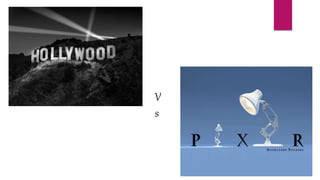
V
s
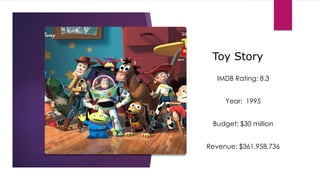
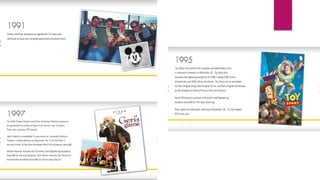
Toy Story
IMDB Rating: 8.3
Year: 1995
Budget: $30 million
Revenue: $361,958,736
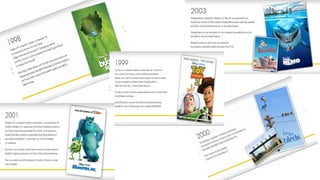
A Bug’s Life
IMDB Rating: 7.2
Year: 1998
Budget: $120 million
Box office: $363,398,565
Toy Story 2
IMDB Rating: 7.9
Year: 1999
Budget: $90 million
Box office : $485,015,17
Monster’s Inc
IMDB Rating: 8
Year: 2001
Budget: $115 million
Box office: $562,816,256
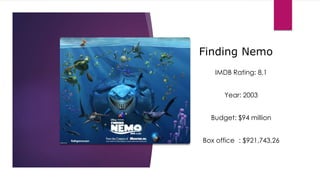
Finding Nemo
IMDB Rating: 8.1
Year: 2003
Budget: $94 million
Box office : $921,743,26
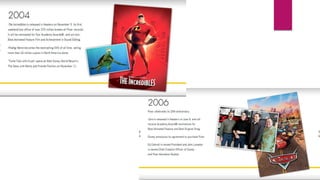
The
Incredibles
IMDB Rating: 8
Year: 2004
Budget: $92 million
Box office: $631,442,092
PIXAR History
Early Years
 A tightly knit group of 40 people.
 Non conventional employees
 Anti-corporate work culture
 This culture created highly productive and a laid back
fun work-place.
 Hire people who are better than already hired.
 No Hero culture
And then begun a new chapter....
The New Chapter
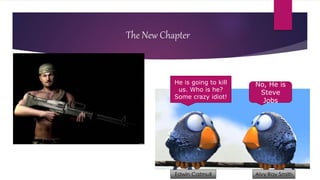
He is going to kill
us. Who is he?
Some crazy idiot!
No, He is
Steve
Jobs
Edwin Catmull Alvy Ray Smith
The New Chapter - 2
 But Pixar continued to run completely by Ed and Alvy
Ray.
 Employees wandered barefoot
 Hardly bathed
 Out of the box thinkers
 Loyal and committed work force
 Strong bonding between employees
 Weird hour work
Pixar’s Workplace Culture
No Employment contracts
 The employees at Pixar had a long-term affiliation
with the company and had stock options as well.
 They contributed across the studio rather than to
just their own projects.
 They learned from one another and strove to
improve with every production.
 Pixar created an incredible workspace, opportunities
to learn and grow and great co-workers.
People-centred Business Model
 Pixar’s business model was people-centred unlike
Hollywood which was idea-centred.
 At Pixar, people were the pivots around which
everything revolved.
 This approach kept the employees interested as well
as motivated.
 The “we are all in this together” workplace and the
hands-off management style provided emotional
support and helped overcome creative setbacks.
Culture of Innovation
 Employees were encouraged to think in terms of steps.
 Each new movie was likened to a stepping stone where one could
learn and try out new things to find out what worked and what did
not.
 Intense self-scrutiny ensured that Pixar benefited from all the
experiences.
 The employees were totally committed to the quality of the
products they were producing.
 Pixar believed in perfecting every detail in every production.
 Before every movie, the crew spent enough time trying to grasp
Hire Better People
 Earlier, Pixar hired people who had reached a
certain skill level, people who could assuredly do
the job.
 Started hiring people who were on the growth-
curve in their careers.
 Also started hiring based on potential rather
than their position with their existing employer.
 Not afraid to hire people whose work culture was
quite different from the one at Pixar.
Preventing Burnout
 Realised that work done by its employees took a lot out of
them and lack of replenishment would lead to burnout
and hamper the quality of work.
 Helped their employees enjoy a long and productive
career.
 They were given periodic breaks to recharge themselves.
 Classes in Yoga, Tai Chi were conducted for the general
well being of the employees.
 Also boasted a full-time dedicated ergonomics expert to
ensure that people had comfortable workplaces
“No Hero” Culture
 The whole team was given preference in spite of many
star performers.
 Recognised moviemaking as a collaborative process.
 When a film does well, everybody got bonus.
 The hallmark of Pixar’s culture was that they recognised
both artistic and technical side as being equally important.
 The decision makers at Pixar felt that when either the
artistic or the technical side dominated, it was unhealthy
and could be counter-productive for the organisation.
The Organisation Structure
 3 parallel groups- technology development, creative
development and production.
 Open communication between these groups and the system
worked very well.
 E.g. a producer of a scene could deal with the animator
without having to go through higher-ups first. Or a
technologist could talk directly to the director if he had an
idea for a new visual effect.
 The system worked so well that U.S. Navy sent some top
organisational experts to Pixar to look for ideas to improve
SHORT FILMS AS A TRAINING GROUND
 Though Pixar had many movies to its credit, it still
made short films.
 According to the company, such films were produced
for training purposes and to try out new technology
without the risk of a major failure.
 If the experiment was a success, it could be used in
the movies, if it failed, the people could be wiser
from that experience.
 The new technologies developed in such short films
were used in movies such as The Bug’s Life and
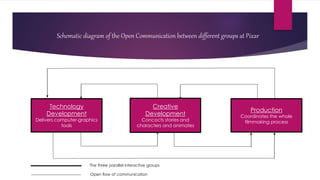
Schematic diagram of the Open Communication between different groups at Pixar
Technology
Development
Delivers computer-graphics
tools
Creative
Development
Concocts stories and
characters and animates
Production
Coordinates the whole
filmmaking process
The three parallel interactive groups
Open flow of communication
Art as a Team Sport
 Succeeded in making art a team sport by collaborative action
where everybody helped and even rescued the other.
 Directors looked over each others work and helped each other
to sharpen the knife without imposing their tone or style.
 All employees encouraged to be a part of the filmmaking
process.
 This unique atmosphere helped retain talent.
 Lowest turnover rate in Hollywood history.
 “An environment that’s really open, a culture that’s wacky.
The Habitat
THE COMPANY RECOGNIZED THAT THE RIGHT OFFICE
ENVIRONMENT COULD HELP NOURISH AND SUSTAIN A
CREATIVE CULTURE.
The Habitat
 The main building resembled an airport hangar.
 Large expanse of green space.
 Visitors were greeted by characters from Pixar
movies.
 The building was decorated with toys.
“Anybody needs to be able to talk to anybody else.
Creativity doesn’t follow titles, it just comes from where
it comes from. You’ll make chance encounters. You
don’t have to arrange to see somebody. You’ll cross
them in the hall, stop and have a discussion, talk about
something you haven’t had the time to talk about, and
that can change the course of things.”
 The center of the main building has the
common area.
 To get to anyplace in the building, you have to
cross this place.
 It serves as the main reception, eating area
and market square.
 It has a main café ,a number of coffee shops
and pool and foosball tables.
 There was a single wash area for all the
 The animation department was highly customized
to reflect the tastes and interests of people
working there.
 They had decorated open fronted mini-cottages.
 For E.g.: one such cottage is in the shape of a
castle because it housed a native of Scotland.
 Employees would move around office on
skateboards and foot-propelled scooters.
The Pixar
university
THE MOST
DISTINCTIVE FEATURE
IN THE PIXAR
CULTURE
 This was a continuing program of lectures,
workshops, courses and events.
 The idea was to help employees express their
creative ideas, collaborate amongst each other
and meet deadlines.
 PU offers a number of courses, including
filmmaking, painting, drawing, sculpting etc.
 Classes were also offered in diverse skills, such
as improvisation, storytelling, karate, juggling
 Everyone, including those who never had anything
related to do with the workshops were made to take
part, including Catmull.
 “So this is Pixar: people taking their lunch hour to
risk looking talentless in front of each another and
the boss.” – Austin Bunn.
 “You get over the embarrassment because you’re
doing it everyday, everybody is doing it. When you
get over the embarrassment, you become more
creative.” – Catmull
 All employees were entitled to spend 4 hours, each
work week, of paid work time taking part in the PU.
 Participation was open to the whole staff, at entry
level and in all functions.
 The classes are considered to be an important part
of the job.
 The idea was to make art a team sport by having
people do it together and fail publicly at it.
 “You have to honour failure, because failure is just
Purpose and Benefits of the PU
 It provided a constant flow of new ideas and
experiences.
 It enriched the individual lives and minds of the
staff, making Pixar a more attractive place to
work.
 The PU also fed creative culture of the
organization.
Purpose and Benefits of the PU
 The PU prompted direct personal contact and
informal communication across the
organization.
 “The skills we develop, are skills we need
everywhere in the organization.”
 E.g.: Teaching drawing to accountants made
them more observant.
Objectives of Pixar University
 To build morale, spirit and communication among
employees.
 It sent out a signal that creativity matters.
 It showed that creativity involved moving beyond
one’s skill set.
 Pixar University also contributes to the HR policy by
promoting Employee Retention.
 In the Words of Nelson, “If you could create good
filmmakers who would work here for 25 years, their
first five years of the film would be really good; their
SOME
CRITICISMS
IN THE CULTURE OF
PIXAR
 Pixar had a strong internal culture.
 Critics felt that any strong internal culture could turn
into a disadvantage- even if it was meant to promote
collaboration and creativity.
 Pixar had retained the same team over the years
 Critics felt that this would lead to stagnation of ideas
blocking innovation.
 In Pixar, the employees worked in closed groups, so
they were not open to criticisms useful in information
technology and creative practices.
 Other Hollywood companies had a constant
OUTLOOK
 The main challenge was integration of the culture of Pixar and
Disney.
 Iger believed that Disney will only benefit by adopting the
egalitarian culture of Pixar.
 A steering committee consisting of Iger, Catmull, Lasseter, Jobs,
Cook and Tom staggs, Disney’s CFO was set up.
 Main function of committee was to maintain and spread the
culture of Pixar within Disney.
 Committee was to meet once in every week
 HR policies of Pixar was kept intact, including the lack of
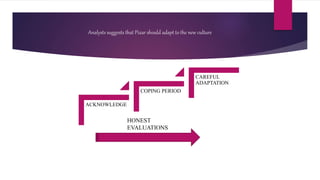
ACKNOWLEDGE
COPING PERIOD
CAREFUL
ADAPTATION
HONEST
EVALUATIONS
Analysts suggests that Pixar should adapt to the new culture
 The challenge is to adapt and sustain its box-office revenue.
 Though the start up cost of the new Pixar will be low but it
would require great effort to make the Pixar people happy and
any attempt to impose the culture of Disney on them would
lead to attrition of ex Pixar employees.
 Many analysts trust Jobs to keep the culture of Pixar intact
otherwise they will be affected by the bureaucracy of Disney.
 Acquiring Pixar was also seen as a major strategic shift at
Disney
 Pixar’s culture was similar to the initial organizational culture at
Disney.
 As quoted by Catmull himself –
 “Pixar's culture of collaboration and innovation has its roots in
Disney animation. our story and production processes are
derivatives of the Walt Disney school of animated film making.
Just like the Disney classics Pixar films are made for family
audiences the world over and most importantly for the child in
everyone.”
 “….. Pixar animators acknowledged that Disney had helped
them to develop their talents through the 7 year old co-
production partnership that ended in 2004.”
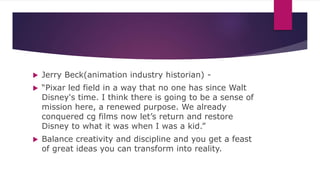
 Jerry Beck(animation industry historian) -
 “Pixar led field in a way that no one has since Walt
Disney's time. I think there is going to be a sense of
mission here, a renewed purpose. We already
conquered cg films now let’s return and restore
Disney to what it was when I was a kid.”
 Balance creativity and discipline and you get a feast
of great ideas you can transform into reality.
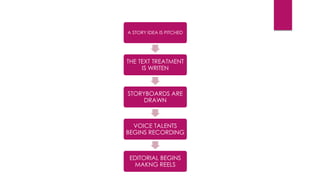
A STORY IDEA IS PITCHED
THE TEXT TREATMENT
IS WRITEN
STORYBOARDS ARE
DRAWN
VOICE TALENTS
BEGINS RECORDING
EDITORIAL BEGINS
MAKNG REELS
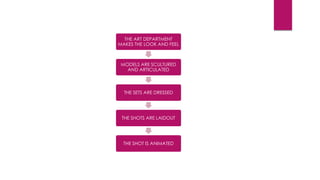
THE ART DEPARTMENT
MAKES THE LOOK AND FEEL
MODELS ARE SCULTURED
AND ARTICULATED
THE SETS ARE DRESSED
THE SHOTS ARE LAIDOUT
THE SHOT IS ANIMATED
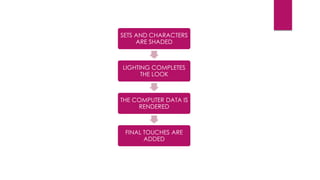
SETS AND CHARACTERS
ARE SHADED
LIGHTING COMPLETES
THE LOOK
THE COMPUTER DATA IS
RENDERED
FINAL TOUCHES ARE
ADDED
Thank you… 

Pixar incredible culture

  • 1.
  • 2.
  • 3.
    Toy Story IMDB Rating:8.3 Year: 1995 Budget: $30 million Revenue: $361,958,736
  • 4.
    A Bug’s Life IMDBRating: 7.2 Year: 1998 Budget: $120 million Box office: $363,398,565
  • 5.
    Toy Story 2 IMDBRating: 7.9 Year: 1999 Budget: $90 million Box office : $485,015,17
  • 6.
    Monster’s Inc IMDB Rating:8 Year: 2001 Budget: $115 million Box office: $562,816,256
  • 7.
    Finding Nemo IMDB Rating:8.1 Year: 2003 Budget: $94 million Box office : $921,743,26
  • 8.
    The Incredibles IMDB Rating: 8 Year:2004 Budget: $92 million Box office: $631,442,092
  • 10.
  • 16.
    Early Years  Atightly knit group of 40 people.  Non conventional employees  Anti-corporate work culture  This culture created highly productive and a laid back fun work-place.  Hire people who are better than already hired.  No Hero culture And then begun a new chapter....
  • 17.
    The New Chapter Heis going to kill us. Who is he? Some crazy idiot! No, He is Steve Jobs Edwin Catmull Alvy Ray Smith
  • 18.
    The New Chapter- 2  But Pixar continued to run completely by Ed and Alvy Ray.  Employees wandered barefoot  Hardly bathed  Out of the box thinkers  Loyal and committed work force  Strong bonding between employees  Weird hour work
  • 19.
  • 20.
    No Employment contracts The employees at Pixar had a long-term affiliation with the company and had stock options as well.  They contributed across the studio rather than to just their own projects.  They learned from one another and strove to improve with every production.  Pixar created an incredible workspace, opportunities to learn and grow and great co-workers.
  • 21.
    People-centred Business Model Pixar’s business model was people-centred unlike Hollywood which was idea-centred.  At Pixar, people were the pivots around which everything revolved.  This approach kept the employees interested as well as motivated.  The “we are all in this together” workplace and the hands-off management style provided emotional support and helped overcome creative setbacks.
  • 22.
    Culture of Innovation Employees were encouraged to think in terms of steps.  Each new movie was likened to a stepping stone where one could learn and try out new things to find out what worked and what did not.  Intense self-scrutiny ensured that Pixar benefited from all the experiences.  The employees were totally committed to the quality of the products they were producing.  Pixar believed in perfecting every detail in every production.  Before every movie, the crew spent enough time trying to grasp
  • 23.
    Hire Better People Earlier, Pixar hired people who had reached a certain skill level, people who could assuredly do the job.  Started hiring people who were on the growth- curve in their careers.  Also started hiring based on potential rather than their position with their existing employer.  Not afraid to hire people whose work culture was quite different from the one at Pixar.
  • 24.
    Preventing Burnout  Realisedthat work done by its employees took a lot out of them and lack of replenishment would lead to burnout and hamper the quality of work.  Helped their employees enjoy a long and productive career.  They were given periodic breaks to recharge themselves.  Classes in Yoga, Tai Chi were conducted for the general well being of the employees.  Also boasted a full-time dedicated ergonomics expert to ensure that people had comfortable workplaces
  • 25.
    “No Hero” Culture The whole team was given preference in spite of many star performers.  Recognised moviemaking as a collaborative process.  When a film does well, everybody got bonus.  The hallmark of Pixar’s culture was that they recognised both artistic and technical side as being equally important.  The decision makers at Pixar felt that when either the artistic or the technical side dominated, it was unhealthy and could be counter-productive for the organisation.
  • 26.
    The Organisation Structure 3 parallel groups- technology development, creative development and production.  Open communication between these groups and the system worked very well.  E.g. a producer of a scene could deal with the animator without having to go through higher-ups first. Or a technologist could talk directly to the director if he had an idea for a new visual effect.  The system worked so well that U.S. Navy sent some top organisational experts to Pixar to look for ideas to improve
  • 27.
    SHORT FILMS ASA TRAINING GROUND  Though Pixar had many movies to its credit, it still made short films.  According to the company, such films were produced for training purposes and to try out new technology without the risk of a major failure.  If the experiment was a success, it could be used in the movies, if it failed, the people could be wiser from that experience.  The new technologies developed in such short films were used in movies such as The Bug’s Life and
  • 28.
    Schematic diagram ofthe Open Communication between different groups at Pixar Technology Development Delivers computer-graphics tools Creative Development Concocts stories and characters and animates Production Coordinates the whole filmmaking process The three parallel interactive groups Open flow of communication
  • 29.
    Art as aTeam Sport  Succeeded in making art a team sport by collaborative action where everybody helped and even rescued the other.  Directors looked over each others work and helped each other to sharpen the knife without imposing their tone or style.  All employees encouraged to be a part of the filmmaking process.  This unique atmosphere helped retain talent.  Lowest turnover rate in Hollywood history.  “An environment that’s really open, a culture that’s wacky.
  • 30.
    The Habitat THE COMPANYRECOGNIZED THAT THE RIGHT OFFICE ENVIRONMENT COULD HELP NOURISH AND SUSTAIN A CREATIVE CULTURE.
  • 31.
    The Habitat  Themain building resembled an airport hangar.  Large expanse of green space.  Visitors were greeted by characters from Pixar movies.  The building was decorated with toys.
  • 32.
    “Anybody needs tobe able to talk to anybody else. Creativity doesn’t follow titles, it just comes from where it comes from. You’ll make chance encounters. You don’t have to arrange to see somebody. You’ll cross them in the hall, stop and have a discussion, talk about something you haven’t had the time to talk about, and that can change the course of things.”
  • 33.
     The centerof the main building has the common area.  To get to anyplace in the building, you have to cross this place.  It serves as the main reception, eating area and market square.  It has a main café ,a number of coffee shops and pool and foosball tables.  There was a single wash area for all the
  • 34.
     The animationdepartment was highly customized to reflect the tastes and interests of people working there.  They had decorated open fronted mini-cottages.  For E.g.: one such cottage is in the shape of a castle because it housed a native of Scotland.  Employees would move around office on skateboards and foot-propelled scooters.
  • 35.
    The Pixar university THE MOST DISTINCTIVEFEATURE IN THE PIXAR CULTURE
  • 36.
     This wasa continuing program of lectures, workshops, courses and events.  The idea was to help employees express their creative ideas, collaborate amongst each other and meet deadlines.  PU offers a number of courses, including filmmaking, painting, drawing, sculpting etc.  Classes were also offered in diverse skills, such as improvisation, storytelling, karate, juggling
  • 37.
     Everyone, includingthose who never had anything related to do with the workshops were made to take part, including Catmull.  “So this is Pixar: people taking their lunch hour to risk looking talentless in front of each another and the boss.” – Austin Bunn.  “You get over the embarrassment because you’re doing it everyday, everybody is doing it. When you get over the embarrassment, you become more creative.” – Catmull
  • 38.
     All employeeswere entitled to spend 4 hours, each work week, of paid work time taking part in the PU.  Participation was open to the whole staff, at entry level and in all functions.  The classes are considered to be an important part of the job.  The idea was to make art a team sport by having people do it together and fail publicly at it.  “You have to honour failure, because failure is just
  • 39.
    Purpose and Benefitsof the PU  It provided a constant flow of new ideas and experiences.  It enriched the individual lives and minds of the staff, making Pixar a more attractive place to work.  The PU also fed creative culture of the organization.
  • 40.
    Purpose and Benefitsof the PU  The PU prompted direct personal contact and informal communication across the organization.  “The skills we develop, are skills we need everywhere in the organization.”  E.g.: Teaching drawing to accountants made them more observant.
  • 41.
    Objectives of PixarUniversity  To build morale, spirit and communication among employees.  It sent out a signal that creativity matters.  It showed that creativity involved moving beyond one’s skill set.  Pixar University also contributes to the HR policy by promoting Employee Retention.  In the Words of Nelson, “If you could create good filmmakers who would work here for 25 years, their first five years of the film would be really good; their
  • 42.
  • 43.
     Pixar hada strong internal culture.  Critics felt that any strong internal culture could turn into a disadvantage- even if it was meant to promote collaboration and creativity.  Pixar had retained the same team over the years  Critics felt that this would lead to stagnation of ideas blocking innovation.  In Pixar, the employees worked in closed groups, so they were not open to criticisms useful in information technology and creative practices.  Other Hollywood companies had a constant
  • 44.
  • 45.
     The mainchallenge was integration of the culture of Pixar and Disney.  Iger believed that Disney will only benefit by adopting the egalitarian culture of Pixar.  A steering committee consisting of Iger, Catmull, Lasseter, Jobs, Cook and Tom staggs, Disney’s CFO was set up.  Main function of committee was to maintain and spread the culture of Pixar within Disney.  Committee was to meet once in every week  HR policies of Pixar was kept intact, including the lack of
  • 46.
  • 47.
     The challengeis to adapt and sustain its box-office revenue.  Though the start up cost of the new Pixar will be low but it would require great effort to make the Pixar people happy and any attempt to impose the culture of Disney on them would lead to attrition of ex Pixar employees.  Many analysts trust Jobs to keep the culture of Pixar intact otherwise they will be affected by the bureaucracy of Disney.  Acquiring Pixar was also seen as a major strategic shift at Disney  Pixar’s culture was similar to the initial organizational culture at Disney.
  • 48.
     As quotedby Catmull himself –  “Pixar's culture of collaboration and innovation has its roots in Disney animation. our story and production processes are derivatives of the Walt Disney school of animated film making. Just like the Disney classics Pixar films are made for family audiences the world over and most importantly for the child in everyone.”  “….. Pixar animators acknowledged that Disney had helped them to develop their talents through the 7 year old co- production partnership that ended in 2004.”
  • 49.
     Jerry Beck(animationindustry historian) -  “Pixar led field in a way that no one has since Walt Disney's time. I think there is going to be a sense of mission here, a renewed purpose. We already conquered cg films now let’s return and restore Disney to what it was when I was a kid.”  Balance creativity and discipline and you get a feast of great ideas you can transform into reality.
  • 50.
    A STORY IDEAIS PITCHED THE TEXT TREATMENT IS WRITEN STORYBOARDS ARE DRAWN VOICE TALENTS BEGINS RECORDING EDITORIAL BEGINS MAKNG REELS
  • 51.
    THE ART DEPARTMENT MAKESTHE LOOK AND FEEL MODELS ARE SCULTURED AND ARTICULATED THE SETS ARE DRESSED THE SHOTS ARE LAIDOUT THE SHOT IS ANIMATED
  • 52.
    SETS AND CHARACTERS ARESHADED LIGHTING COMPLETES THE LOOK THE COMPUTER DATA IS RENDERED FINAL TOUCHES ARE ADDED
  • 53.