Cloud Computing


                Deepak Shukla
          MSc Information Technology
The Hong Kong University of Science & Technology
What is Cloud Computing?
1. Definitions – What’s new?
2. The Entities in Cloud Computing – Who
   makes it happen?
3. The Computational Model – How does it
   work?
4. The Business Model – What’s the Profit?
5. Advantages: Why adopt Cloud Computing?
6. Obstacles: Why not?
Definitions
• Cloud Computing refers to both the applications
  delivered as services over the internet and the
  hardware and software in the Datacenters that
  provide these services.
• A model for enabling convenient, on-demand
  network access to a shared pool of configurable
  computing resources that can be rapidly
  provisioned and released with minimal
  management effort or service provider
  interaction.
Definitions (contd..)
• Cloud Computing is the delivery of
  computational resources from the location
  other than your current one.
• Cloud computing is the delivery of computing
  as a service rather than a product, whereby
  shared resources, software and information
  are provided to computers and other devices
  as a utility (like the electricity grid) over a
  network (typically the Internet). - Wikipedia
What is a Cloud anyways?
• “Cloud” is nothing but the hardware and
  software resources used to provide various
  services to the end users.
• It is the backbone infrastructure that is used
  to provide various on-demand services over
  the Internet.
• The term "cloud" is used as a metaphor for
  the Internet; as an abstraction of the
  underlying infrastructure that it represents.
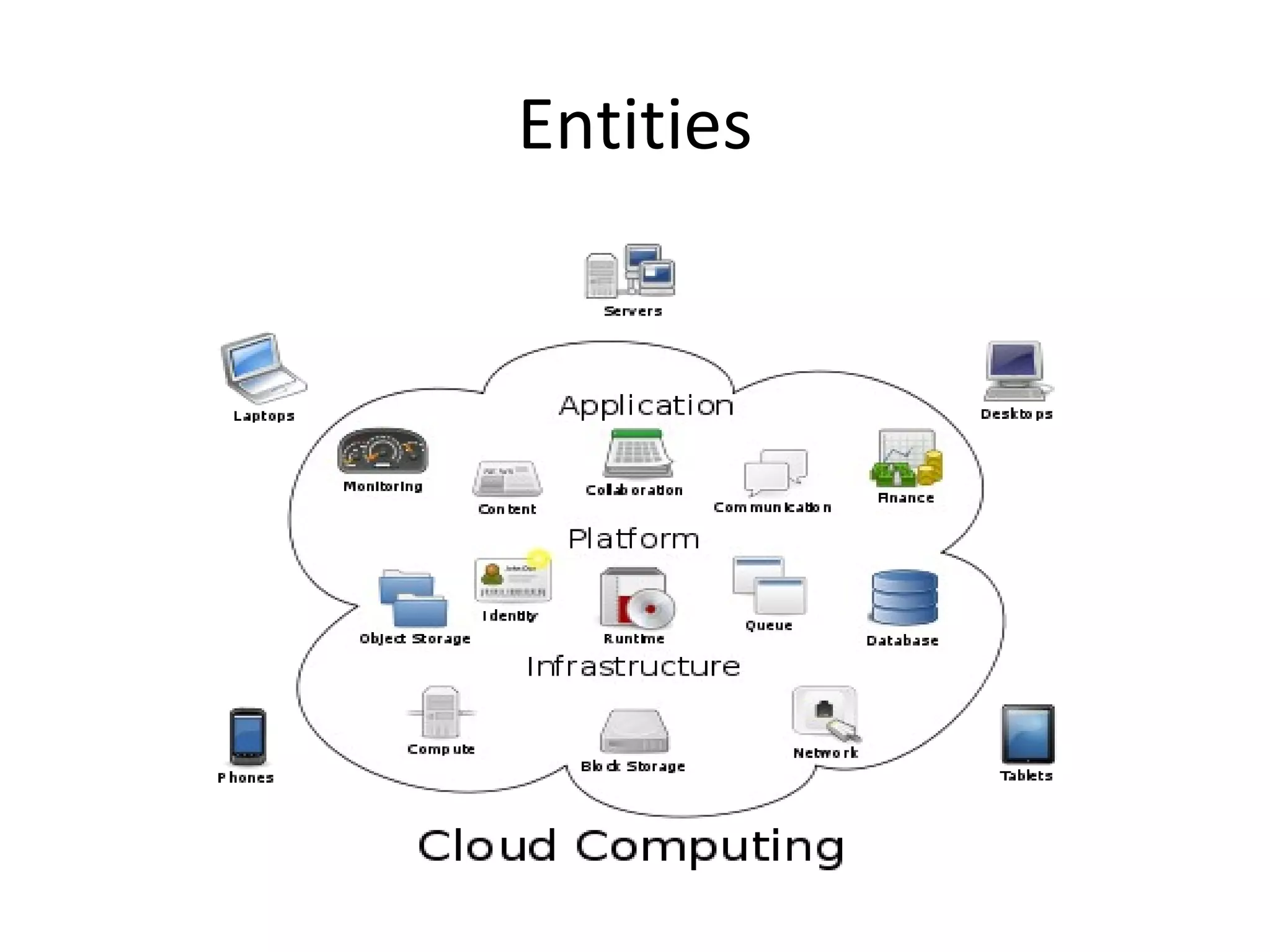
Entities
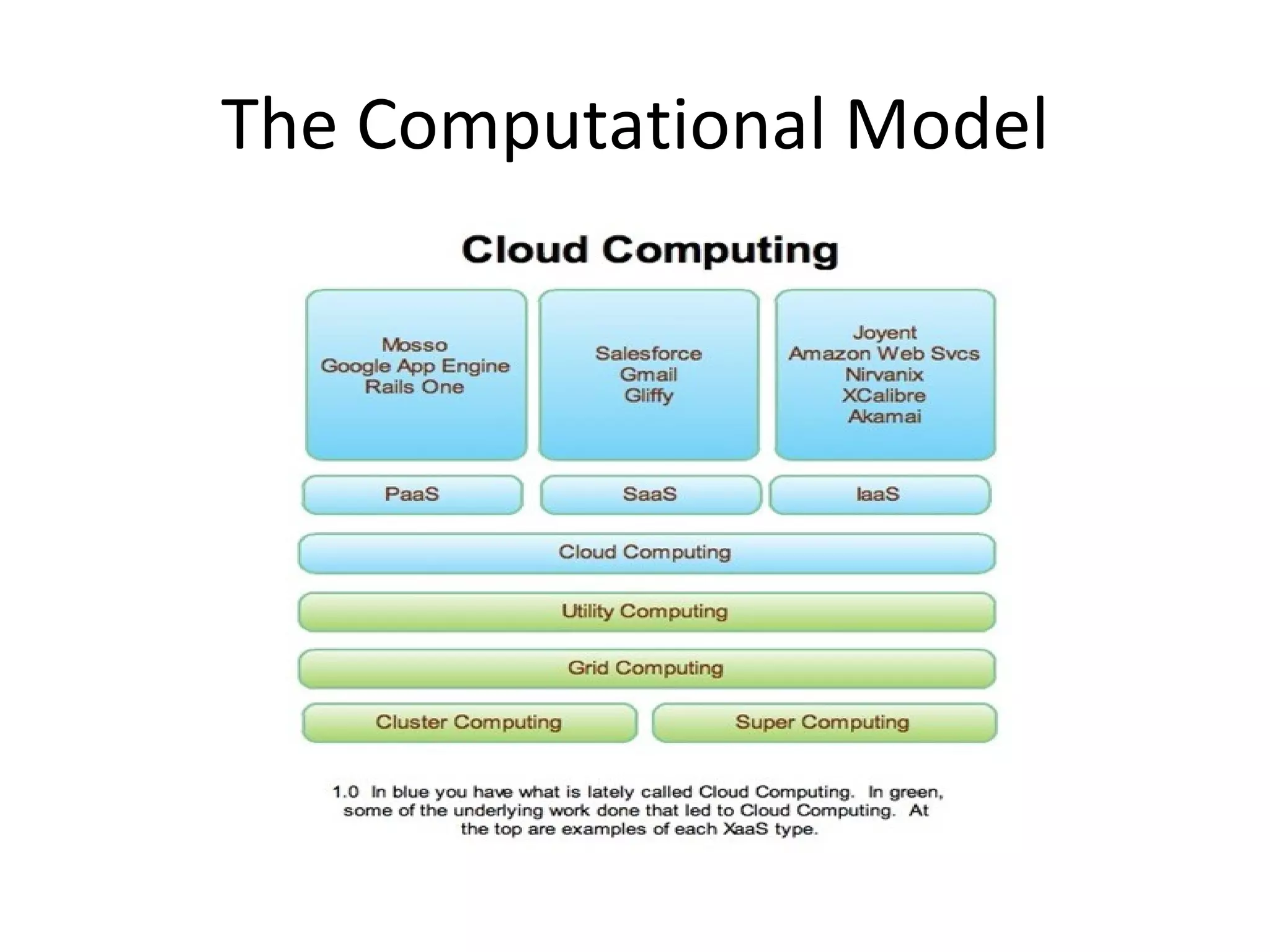
The Computational Model
Cloud Services
• SaaS: Software-as-a-Service is a term used for the
  software applications that are delivered over the
  internet by the Cloud Provider. E.g. Google Docs
• PaaS: Platform-as-a-Service provides an
  underlying platform/OS enabling the user to
  develop and deploy applications that are created
  using the languages and tools supported by the
  Cloud provider. E.g Windows Azure, Force.com
Cloud Services (contd..)
• IaaS: Infrastructure-as-a-Service covers the
  provisioning of all the possible computational
  resources like computational power, storage
  capacity, applications and other fundamental
  computing resources. E.g. Amazon, IBM,
  Microsoft Azure.
The Business Model: What’s the Profit
• In general “huge cost savings”.
• Basically “Pay-as-you-go” service model for all
  types of services provided through the Cloud
  infrastructure.
• No premium licensing charges or maintenance
  charges for the software applications,
  hardware and storage services that are used
  by the Cloud users or consumers.
The Business Model: What’s the Profit
              contd…
• Businesses can focus on their core
  competencies by using IT services as an
  effective tool rather than spending too much
  on it.
• Cloud Computing improves IT efficiency and
  business agility.
• Reduces the need for huge upfront
  investments that characterize enterprise IT
  setups today.
The Business Model: What’s the Profit
              contd…
• Dramatically lowers the cost of entry for
  smaller firms trying to benefit from compute-
  intensive business analytics.
• Almost immediate access to computing
  resources with prior provisioning and on-
  demand leading faster time-to-market in
  many businesses.
• Lowers IT barriers to innovation.
• Most importantly promotes “Green IT”.
Why adopt Cloud Computing?
• Huge cost savings in operation, maintenance
  and IT infrastructure.
• Transfers risk of over-provisioning or under-
  provisioning of IT resources and thus increases
  IT efficiency.
• Focus on core business.
• Very attractive for end users and SME’s due to
  its economics of scale and utilitarian nature.
Obstacles in adopting Cloud
        Computing – Why not?
• Availability of Service over Internet
• Data Lock-in : No standard format yet like
  HTML, XML etc.
• Data Confidentiality and Auditability
• Data Transfer Bottlenecks
• Performance Unpredictability
• Scalable Storage – suitable storage system yet
  to come.
Obstacles in adopting Cloud
          Computing – Why not?
•   Bugs in Large-Scale Distributed Systems
•   Scaling quickly
•   Reputation Fate Sharing
•   Software Licensing
•   Regulation & Standardization Issues.
More about Clouds


              Yang Xing
       MSc Information Technology
The Hong Kong University of Science & Technology
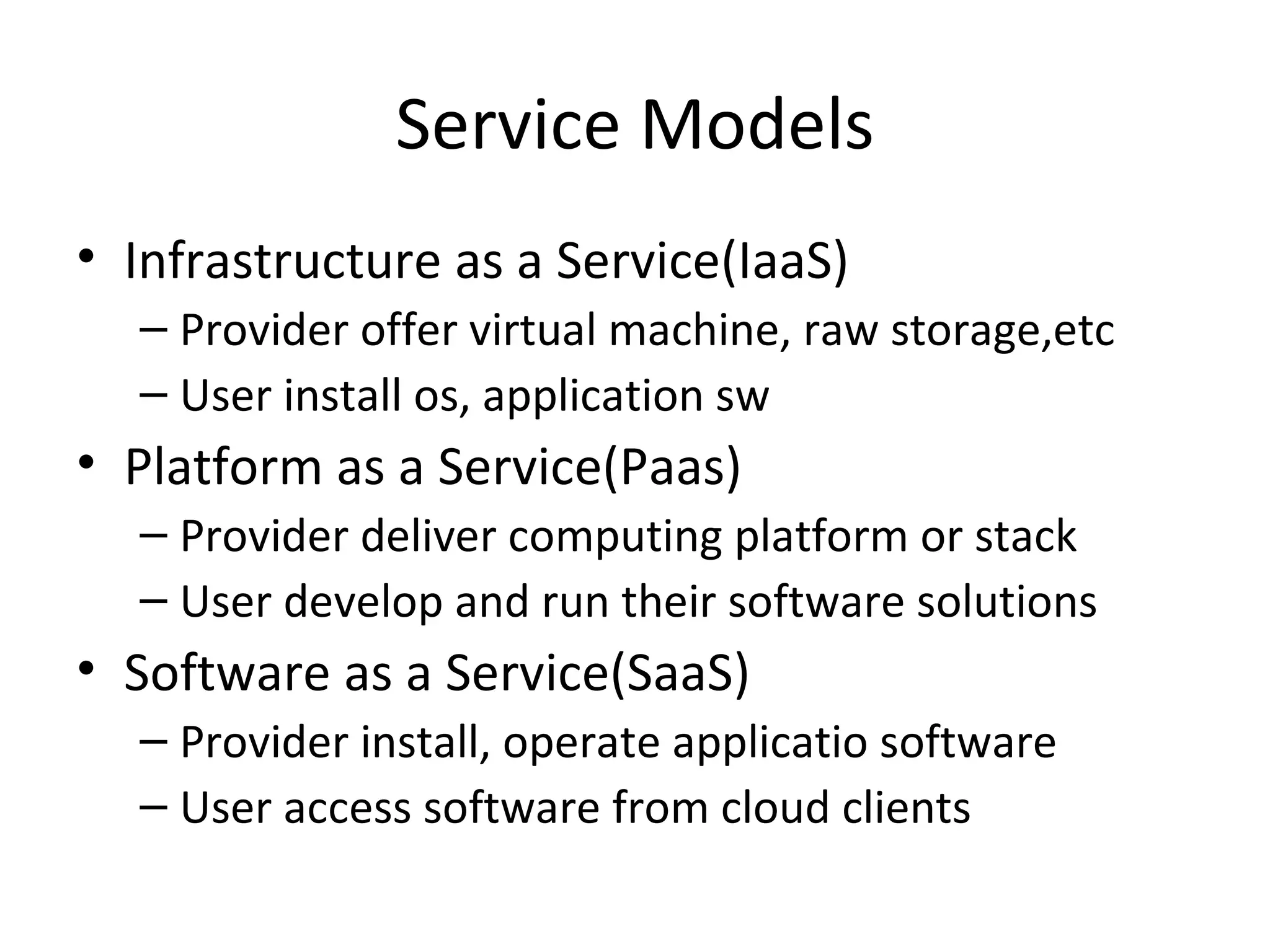
Service Models
• Infrastructure as a Service(IaaS)
  – Provider offer virtual machine, raw storage,etc
  – User install os, application sw
• Platform as a Service(Paas)
  – Provider deliver computing platform or stack
  – User develop and run their software solutions
• Software as a Service(SaaS)
  – Provider install, operate applicatio software
  – User access software from cloud clients
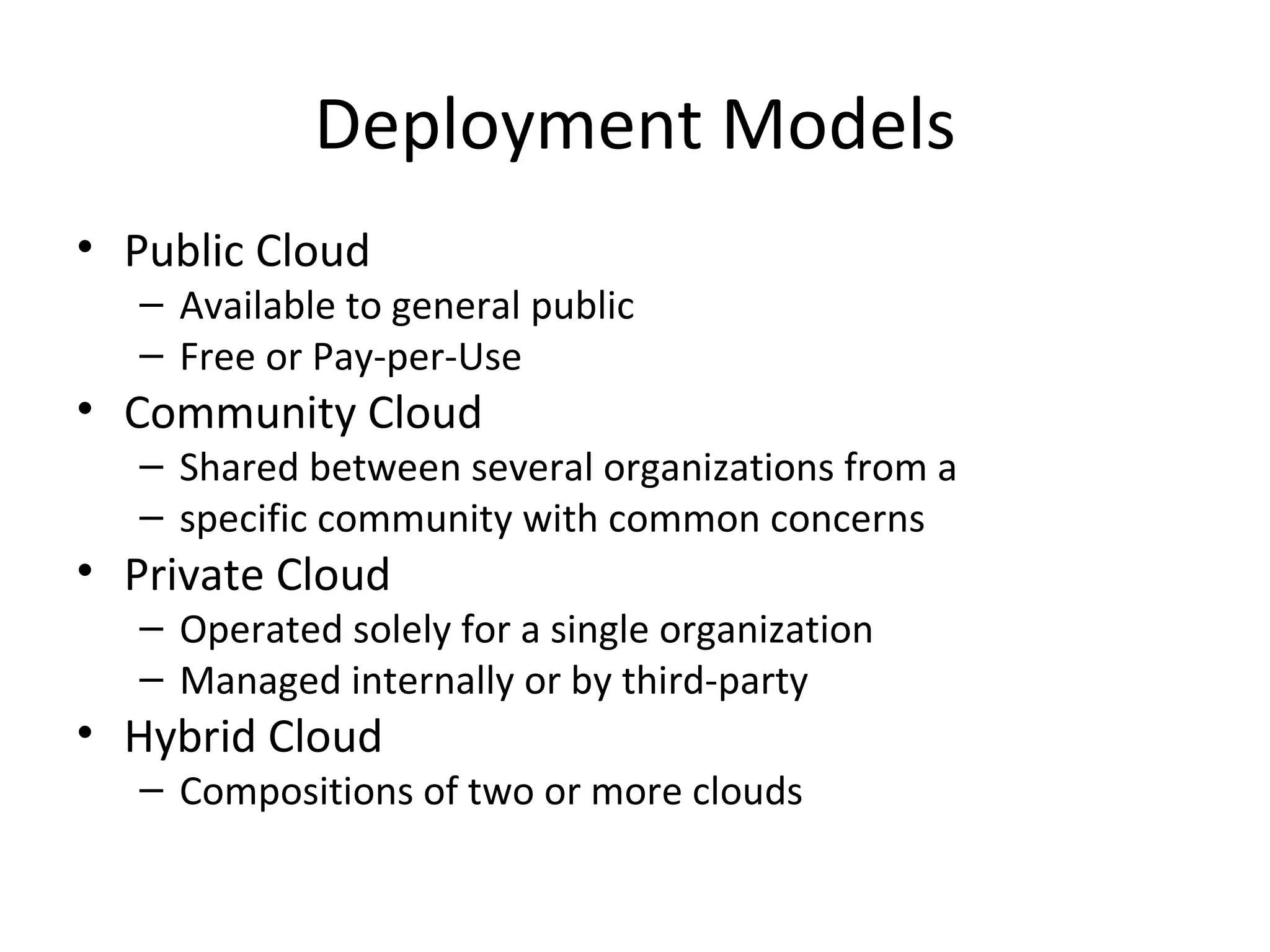
Deployment Models
• Public Cloud
   – Available to general public
   – Free or Pay-per-Use
• Community Cloud
   – Shared between several organizations from a
   – specific community with common concerns
• Private Cloud
   – Operated solely for a single organization
   – Managed internally or by third-party
• Hybrid Cloud
   – Compositions of two or more clouds
Latest Trends in Cloud Market


               Nishita Menon
            MSc Information Technology
   The Hong Kong University of Science & Technology
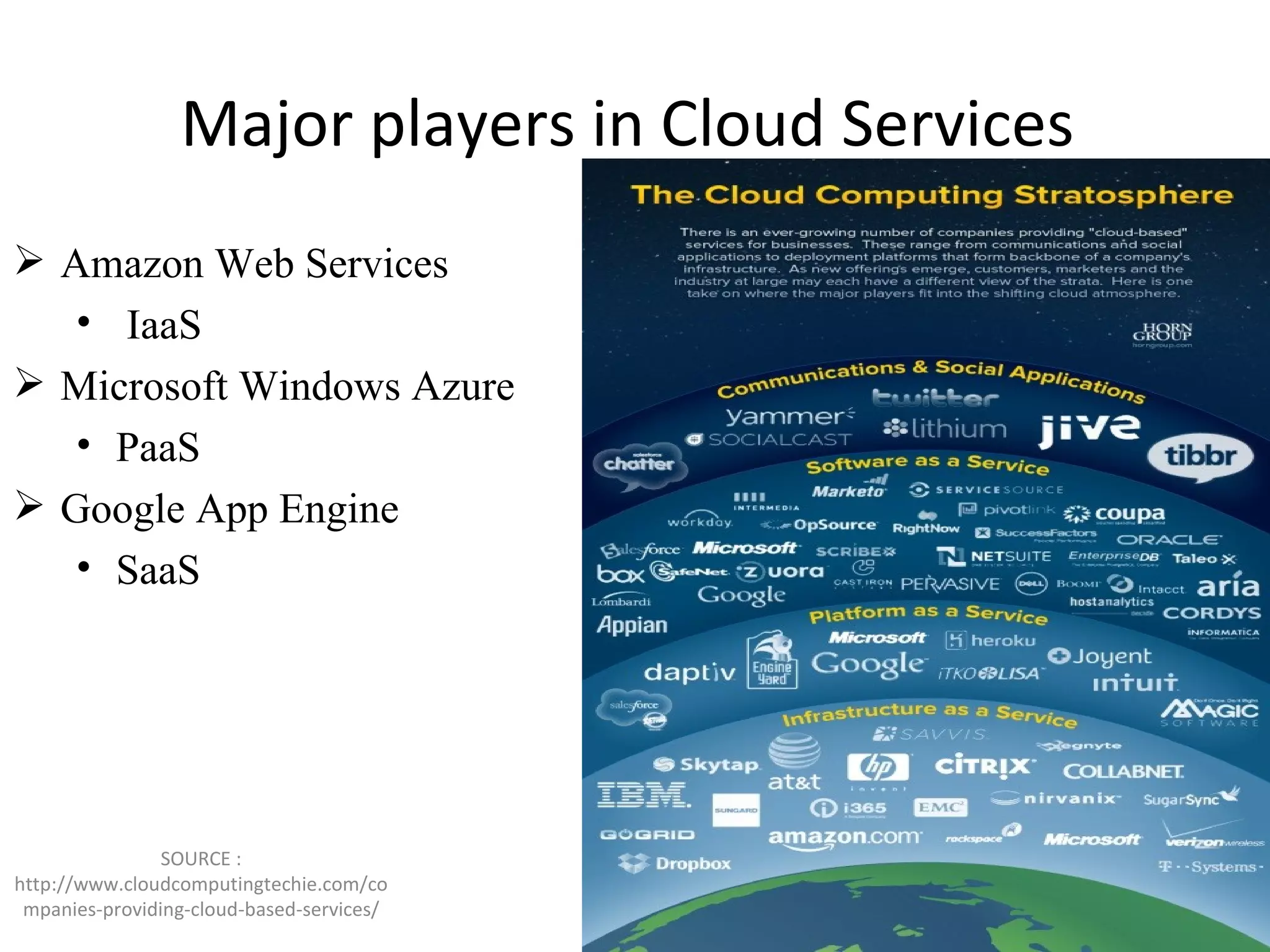
Major players in Cloud Services
 Amazon Web Services
   • IaaS
 Microsoft Windows Azure
   • PaaS
 Google App Engine
   • SaaS


                SOURCE :
http://www.cloudcomputingtechie.com/co
 mpanies-providing-cloud-based-services/
Revenues from Cloud business and the
             growth rate predicted
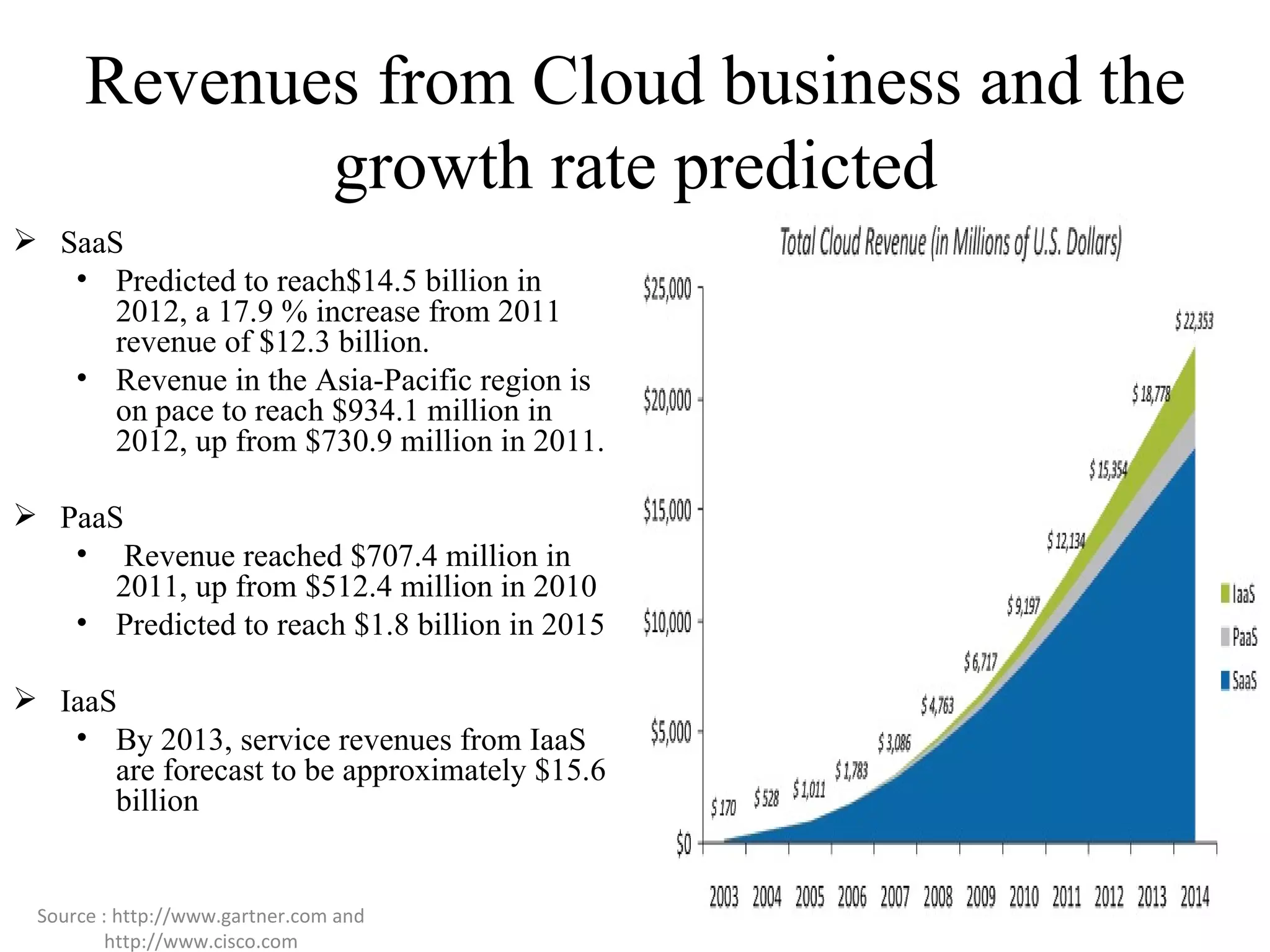
 SaaS
   • Predicted to reach$14.5 billion in
      2012, a 17.9 % increase from 2011
      revenue of $12.3 billion.
   • Revenue in the Asia-Pacific region is
      on pace to reach $934.1 million in
      2012, up from $730.9 million in 2011.

 PaaS
   • Revenue reached $707.4 million in
      2011, up from $512.4 million in 2010
   • Predicted to reach $1.8 billion in 2015

 IaaS
   • By 2013, service revenues from IaaS
      are forecast to be approximately $15.6
      billion


 Source : http://www.gartner.com and
         http://www.cisco.com
Derivative service models that are
emerging as a result of growing Cloud
              adoption
 STaaS (Software Testing as a Service)
    •   provides an accessible,flexible and low-cost test solution – on demand outsourcing
        without the high levels of investment.


     Security as a Service
   •    outsourcing model for security management.


     Daas (Data as a service)
   •    data in this case, can be provided on demand


     Caas (Computing as a service)
   •    on-demand computing platform
Emerging Cloud Services to facilitate
 Cloud Adoption – Cloud Mediators
 Infosys Cloud System Integrator
  • an accountable cloud ecosystem integrator.
  • takes ownership of the complete lifecycle of your
    cloud initiative.
  • hosts, manages and operates business platforms.
  • provides comprehensive services from
     •   strategy,
     •   planning,
     •   cloud set-up to
     •   migration , creation and aggregation of cloud services.
  • addresses all aspects of cloud adoption, reducing total
    cost of ownership.
Group 39 presentation cloud computing

Group 39 presentation cloud computing

  • 1.
    Cloud Computing Deepak Shukla MSc Information Technology The Hong Kong University of Science & Technology
  • 2.
    What is CloudComputing? 1. Definitions – What’s new? 2. The Entities in Cloud Computing – Who makes it happen? 3. The Computational Model – How does it work? 4. The Business Model – What’s the Profit? 5. Advantages: Why adopt Cloud Computing? 6. Obstacles: Why not?
  • 3.
    Definitions • Cloud Computingrefers to both the applications delivered as services over the internet and the hardware and software in the Datacenters that provide these services. • A model for enabling convenient, on-demand network access to a shared pool of configurable computing resources that can be rapidly provisioned and released with minimal management effort or service provider interaction.
  • 4.
    Definitions (contd..) • CloudComputing is the delivery of computational resources from the location other than your current one. • Cloud computing is the delivery of computing as a service rather than a product, whereby shared resources, software and information are provided to computers and other devices as a utility (like the electricity grid) over a network (typically the Internet). - Wikipedia
  • 5.
    What is aCloud anyways? • “Cloud” is nothing but the hardware and software resources used to provide various services to the end users. • It is the backbone infrastructure that is used to provide various on-demand services over the Internet. • The term "cloud" is used as a metaphor for the Internet; as an abstraction of the underlying infrastructure that it represents.
  • 6.
  • 7.
  • 8.
    Cloud Services • SaaS:Software-as-a-Service is a term used for the software applications that are delivered over the internet by the Cloud Provider. E.g. Google Docs • PaaS: Platform-as-a-Service provides an underlying platform/OS enabling the user to develop and deploy applications that are created using the languages and tools supported by the Cloud provider. E.g Windows Azure, Force.com
  • 9.
    Cloud Services (contd..) •IaaS: Infrastructure-as-a-Service covers the provisioning of all the possible computational resources like computational power, storage capacity, applications and other fundamental computing resources. E.g. Amazon, IBM, Microsoft Azure.
  • 10.
    The Business Model:What’s the Profit • In general “huge cost savings”. • Basically “Pay-as-you-go” service model for all types of services provided through the Cloud infrastructure. • No premium licensing charges or maintenance charges for the software applications, hardware and storage services that are used by the Cloud users or consumers.
  • 11.
    The Business Model:What’s the Profit contd… • Businesses can focus on their core competencies by using IT services as an effective tool rather than spending too much on it. • Cloud Computing improves IT efficiency and business agility. • Reduces the need for huge upfront investments that characterize enterprise IT setups today.
  • 12.
    The Business Model:What’s the Profit contd… • Dramatically lowers the cost of entry for smaller firms trying to benefit from compute- intensive business analytics. • Almost immediate access to computing resources with prior provisioning and on- demand leading faster time-to-market in many businesses. • Lowers IT barriers to innovation. • Most importantly promotes “Green IT”.
  • 13.
    Why adopt CloudComputing? • Huge cost savings in operation, maintenance and IT infrastructure. • Transfers risk of over-provisioning or under- provisioning of IT resources and thus increases IT efficiency. • Focus on core business. • Very attractive for end users and SME’s due to its economics of scale and utilitarian nature.
  • 14.
    Obstacles in adoptingCloud Computing – Why not? • Availability of Service over Internet • Data Lock-in : No standard format yet like HTML, XML etc. • Data Confidentiality and Auditability • Data Transfer Bottlenecks • Performance Unpredictability • Scalable Storage – suitable storage system yet to come.
  • 15.
    Obstacles in adoptingCloud Computing – Why not? • Bugs in Large-Scale Distributed Systems • Scaling quickly • Reputation Fate Sharing • Software Licensing • Regulation & Standardization Issues.
  • 16.
    More about Clouds Yang Xing MSc Information Technology The Hong Kong University of Science & Technology
  • 17.
    Service Models • Infrastructureas a Service(IaaS) – Provider offer virtual machine, raw storage,etc – User install os, application sw • Platform as a Service(Paas) – Provider deliver computing platform or stack – User develop and run their software solutions • Software as a Service(SaaS) – Provider install, operate applicatio software – User access software from cloud clients
  • 18.
    Deployment Models • PublicCloud – Available to general public – Free or Pay-per-Use • Community Cloud – Shared between several organizations from a – specific community with common concerns • Private Cloud – Operated solely for a single organization – Managed internally or by third-party • Hybrid Cloud – Compositions of two or more clouds
  • 19.
    Latest Trends inCloud Market Nishita Menon MSc Information Technology The Hong Kong University of Science & Technology
  • 20.
    Major players inCloud Services  Amazon Web Services • IaaS  Microsoft Windows Azure • PaaS  Google App Engine • SaaS SOURCE : http://www.cloudcomputingtechie.com/co mpanies-providing-cloud-based-services/
  • 21.
    Revenues from Cloudbusiness and the growth rate predicted  SaaS • Predicted to reach$14.5 billion in 2012, a 17.9 % increase from 2011 revenue of $12.3 billion. • Revenue in the Asia-Pacific region is on pace to reach $934.1 million in 2012, up from $730.9 million in 2011.  PaaS • Revenue reached $707.4 million in 2011, up from $512.4 million in 2010 • Predicted to reach $1.8 billion in 2015  IaaS • By 2013, service revenues from IaaS are forecast to be approximately $15.6 billion Source : http://www.gartner.com and http://www.cisco.com
  • 22.
    Derivative service modelsthat are emerging as a result of growing Cloud adoption  STaaS (Software Testing as a Service) • provides an accessible,flexible and low-cost test solution – on demand outsourcing without the high levels of investment.  Security as a Service • outsourcing model for security management.  Daas (Data as a service) • data in this case, can be provided on demand  Caas (Computing as a service) • on-demand computing platform
  • 23.
    Emerging Cloud Servicesto facilitate Cloud Adoption – Cloud Mediators  Infosys Cloud System Integrator • an accountable cloud ecosystem integrator. • takes ownership of the complete lifecycle of your cloud initiative. • hosts, manages and operates business platforms. • provides comprehensive services from • strategy, • planning, • cloud set-up to • migration , creation and aggregation of cloud services. • addresses all aspects of cloud adoption, reducing total cost of ownership.